Advances in Steering Mechanisms.
   (First step to steer by wire)

            Presented by
          Arvind J. Bhosale
               SMBS


                                   1
Outline
1 Introduction
2 System Overview
3 Control Strategies
4 Literature Review
5 Applications and Benefits
6 References
7 Questions


                              2
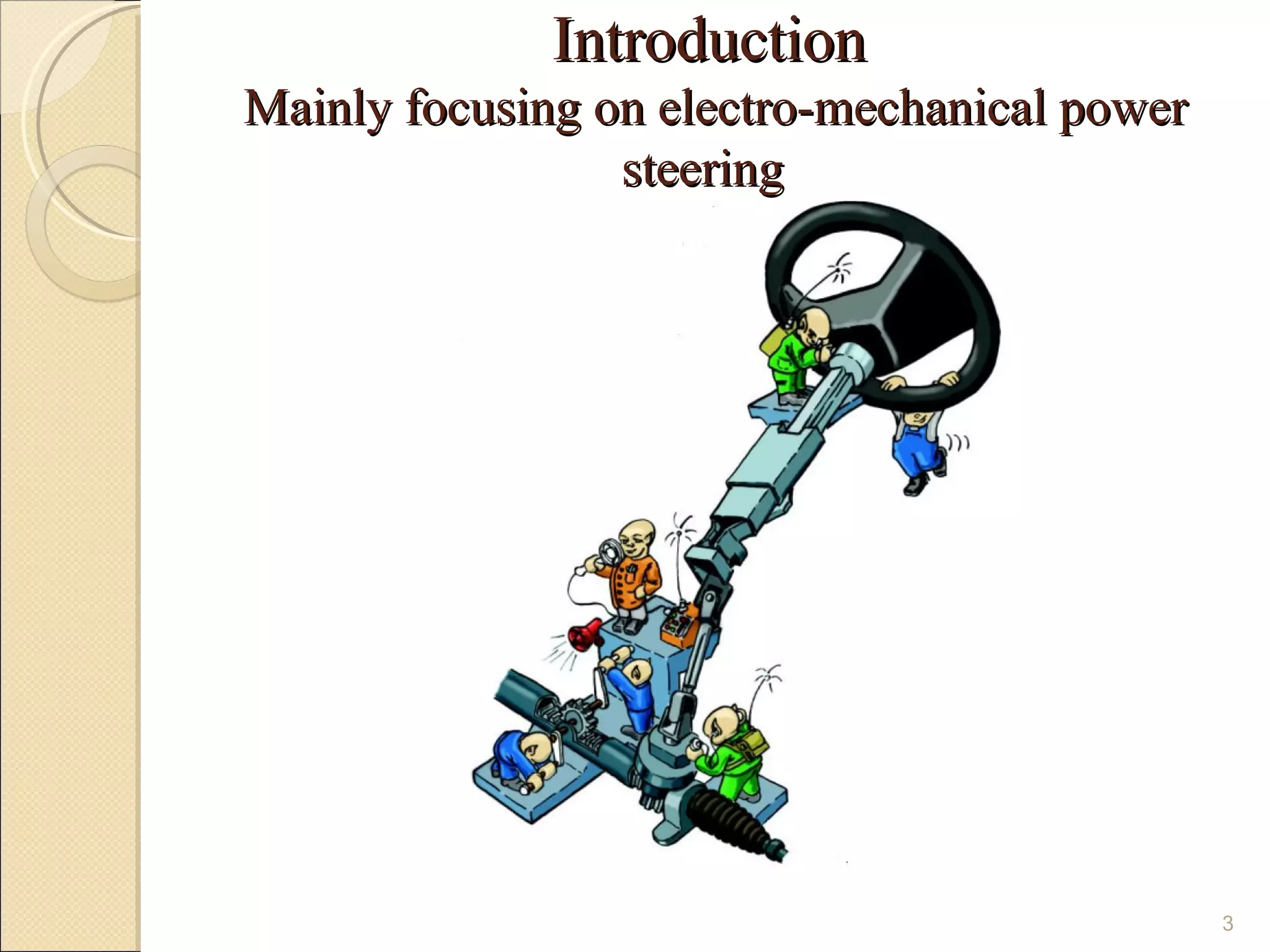
Introduction
Mainly focusing on electro-mechanical power
                 steering


                                              3
Introduction
Requirements
   Should be very accurate and easy to handle
   Effort required to steer should be minimum
   Should provide directional stability
   Easy alteration of driving direction


                                                 4
Introduction
Functions
   To achieve angular motion of the front wheels to
    negotiate a turn
   To provide directional stability
   To provide perfect steering condition
   To facilitate straight ahead recovery after completing a
         turn
   To minimize tire wear


                                                               5
Introduction
Classification
1.3.2 Based on the type of steering linkage or
  mechanism used
 Ackerman steering mechanism
 Davis steering mechanism
1.3.2 Based on the type of Front axle used
   For independent wheel suspension
   For rigid axles suspension
1.3.3 Based on the Steering Gearbox used
 Rack and pinion type
 Recirculating ball type
 Worm and wheel type
 Cam and double roller type
 Worm and nut type

                                                 6
Introduction
1.3.4 Based on the type of power assist used
 Manual steering
 Power assisted steering
    • Hydraulic power steering
    • Electro-hydraulic power steering
    • Electric power steering


                                               7
System Overview
Overview Of Electric Power Steering
   No requirement for hydraulic assistance (Eliminating
    hydraulic oil )
   System provides assistance depending on the driving
    conditions
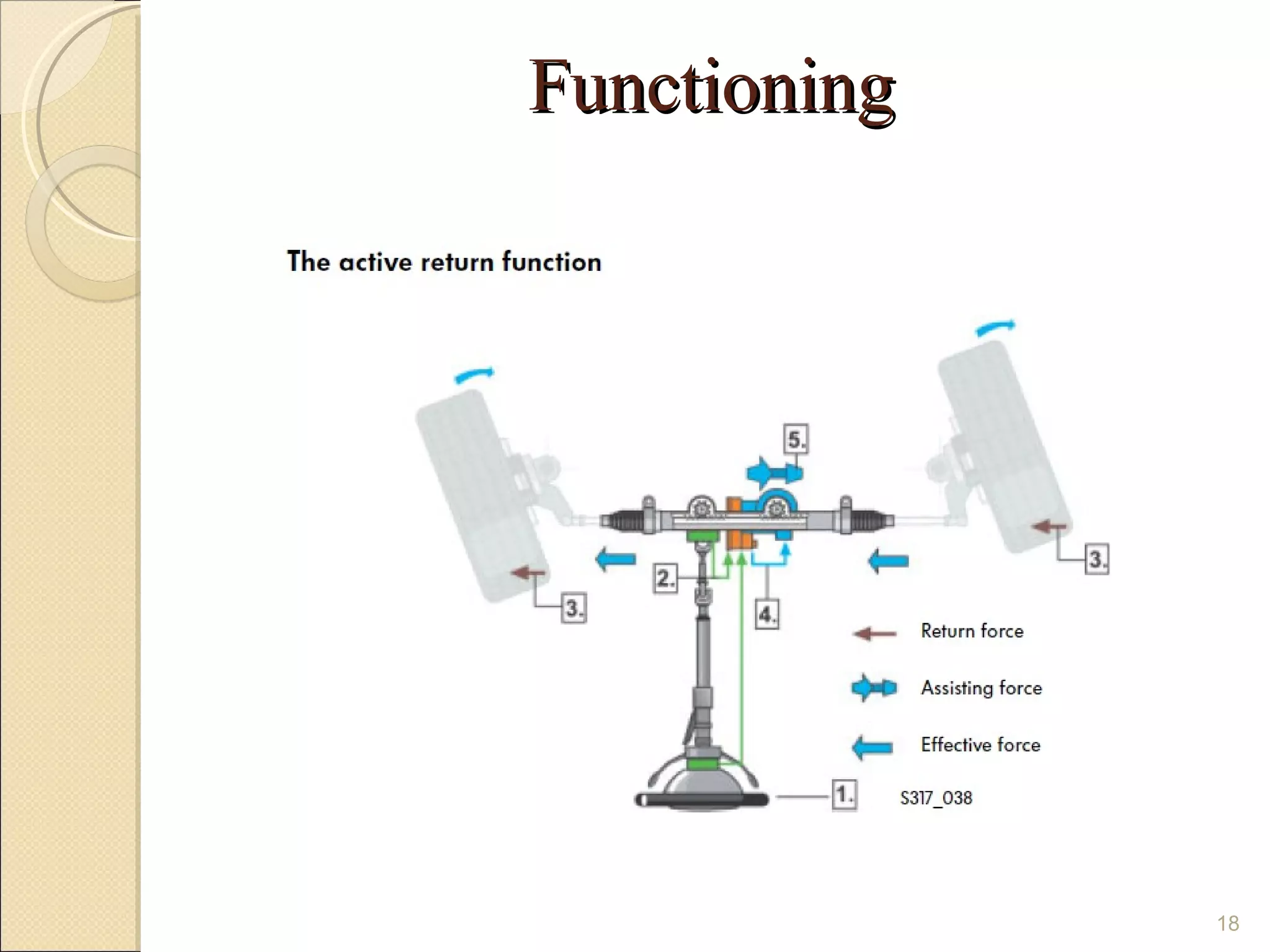
   Supports the “active return” function
   Easier for the driver to steer the vehicle in a straight line
    when the vehicle is being affected constantly by side
    winds or driven up or down hills


                                                                    8
System Overview
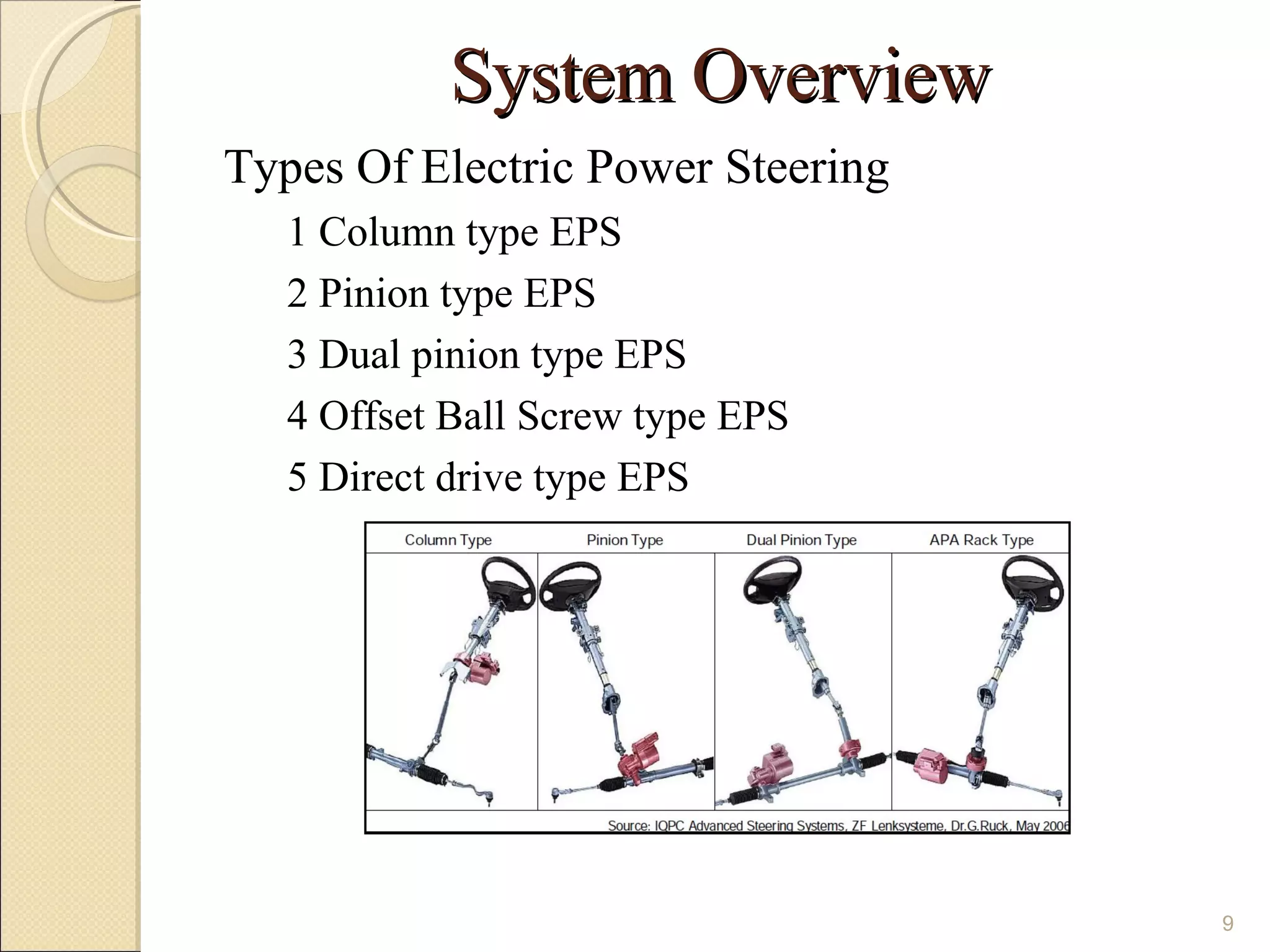
Types Of Electric Power Steering
   1 Column type EPS
   2 Pinion type EPS
   3 Dual pinion type EPS
   4 Offset Ball Screw type EPS
   5 Direct drive type EPS


                                   9
System Overview
              The electro-mechanical power steering
                         with dual pinion

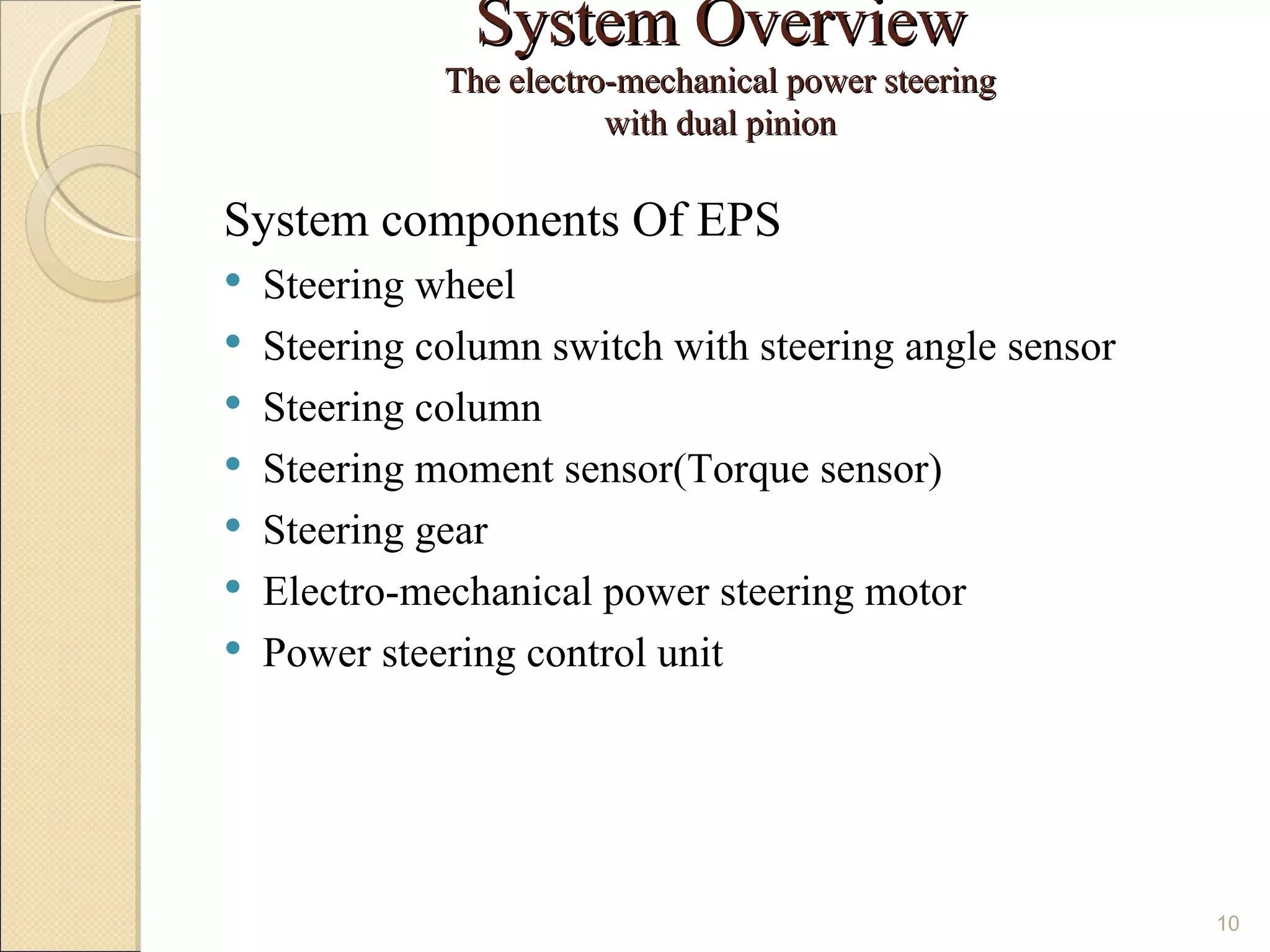
System components Of EPS
   Steering wheel
   Steering column switch with steering angle sensor
   Steering column
   Steering moment sensor(Torque sensor)
   Steering gear
   Electro-mechanical power steering motor
   Power steering control unit


                                                        10
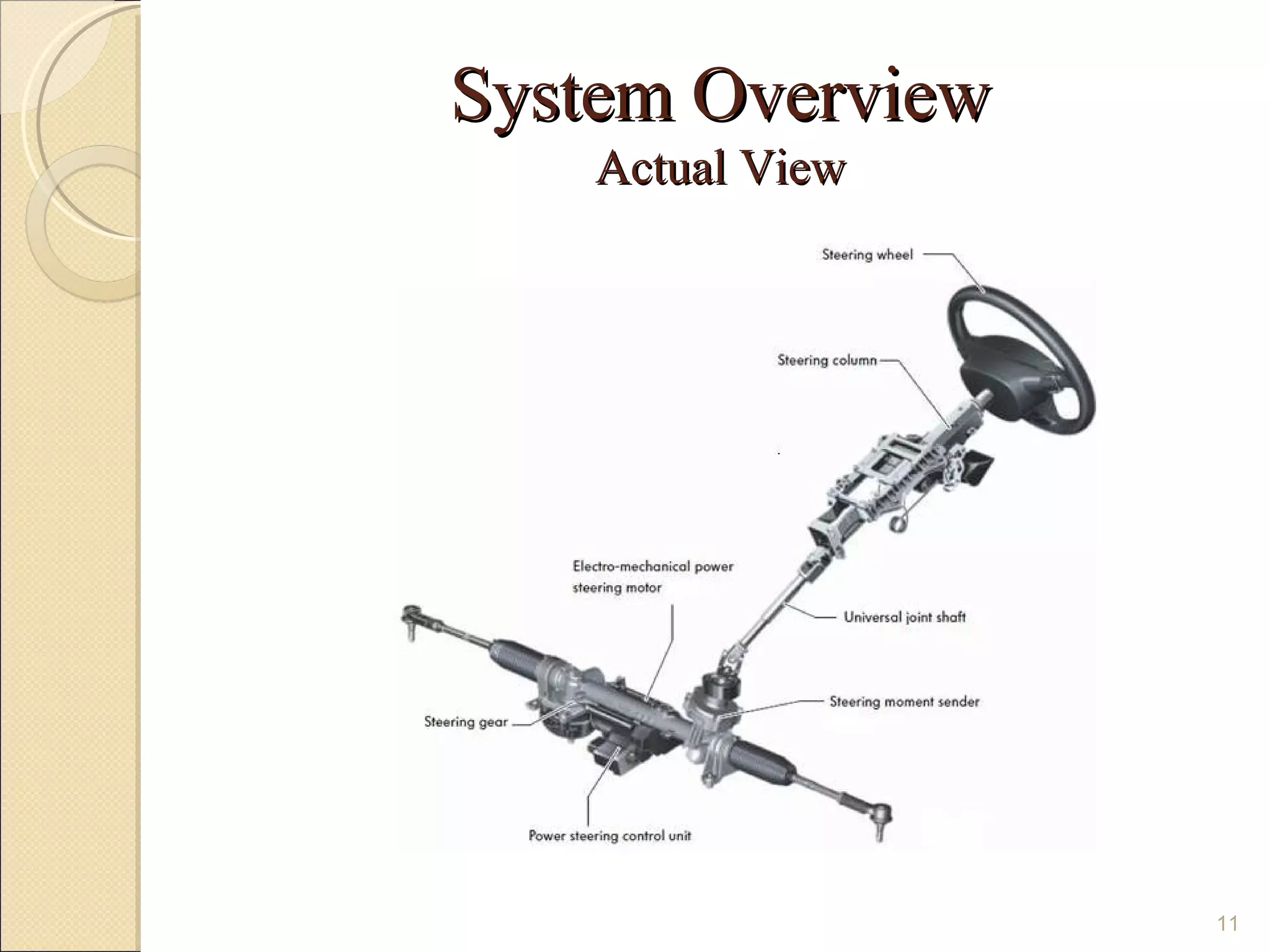
System Overview
    Actual View


                  11
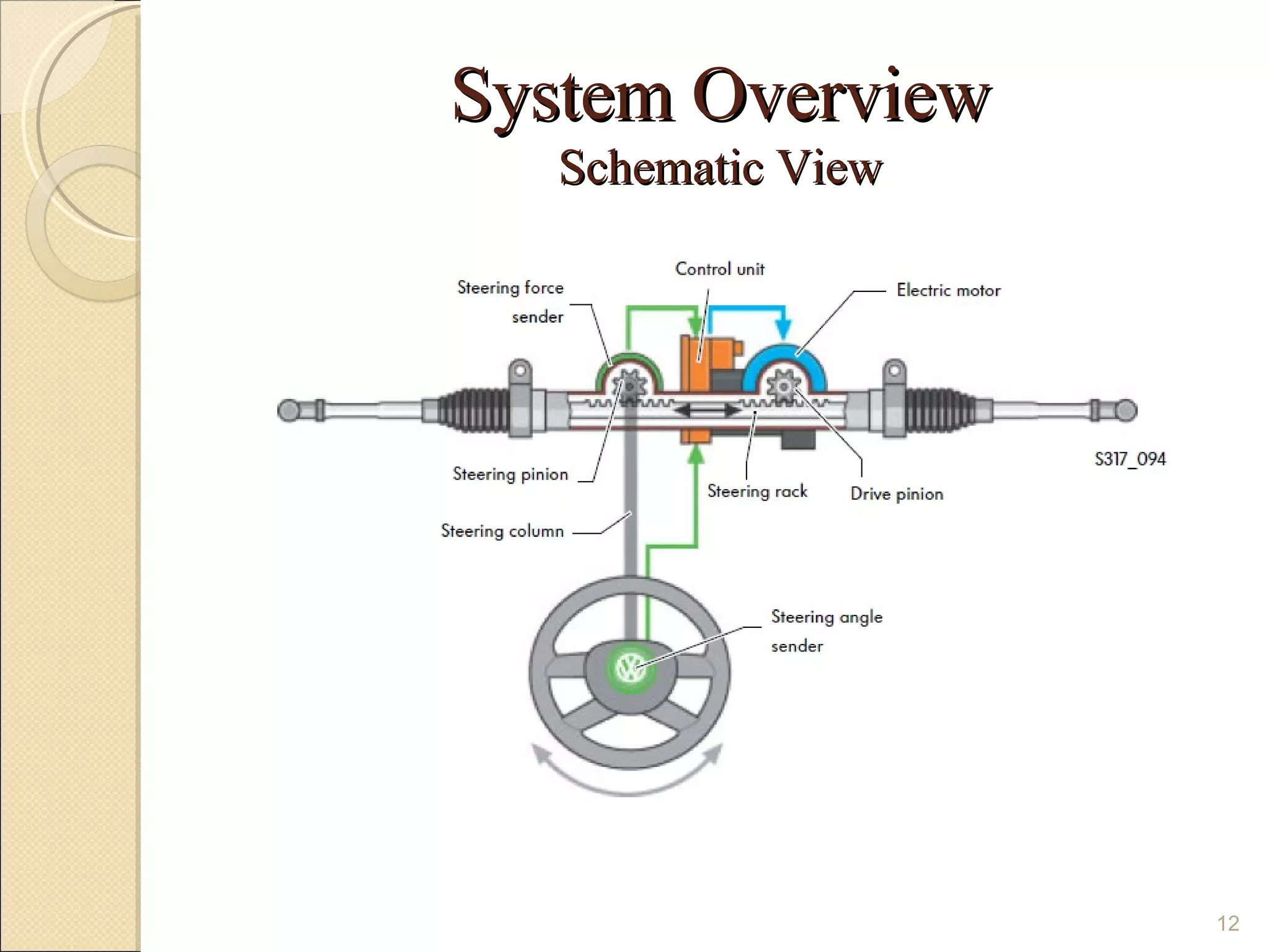
System Overview
  Schematic View


                   12
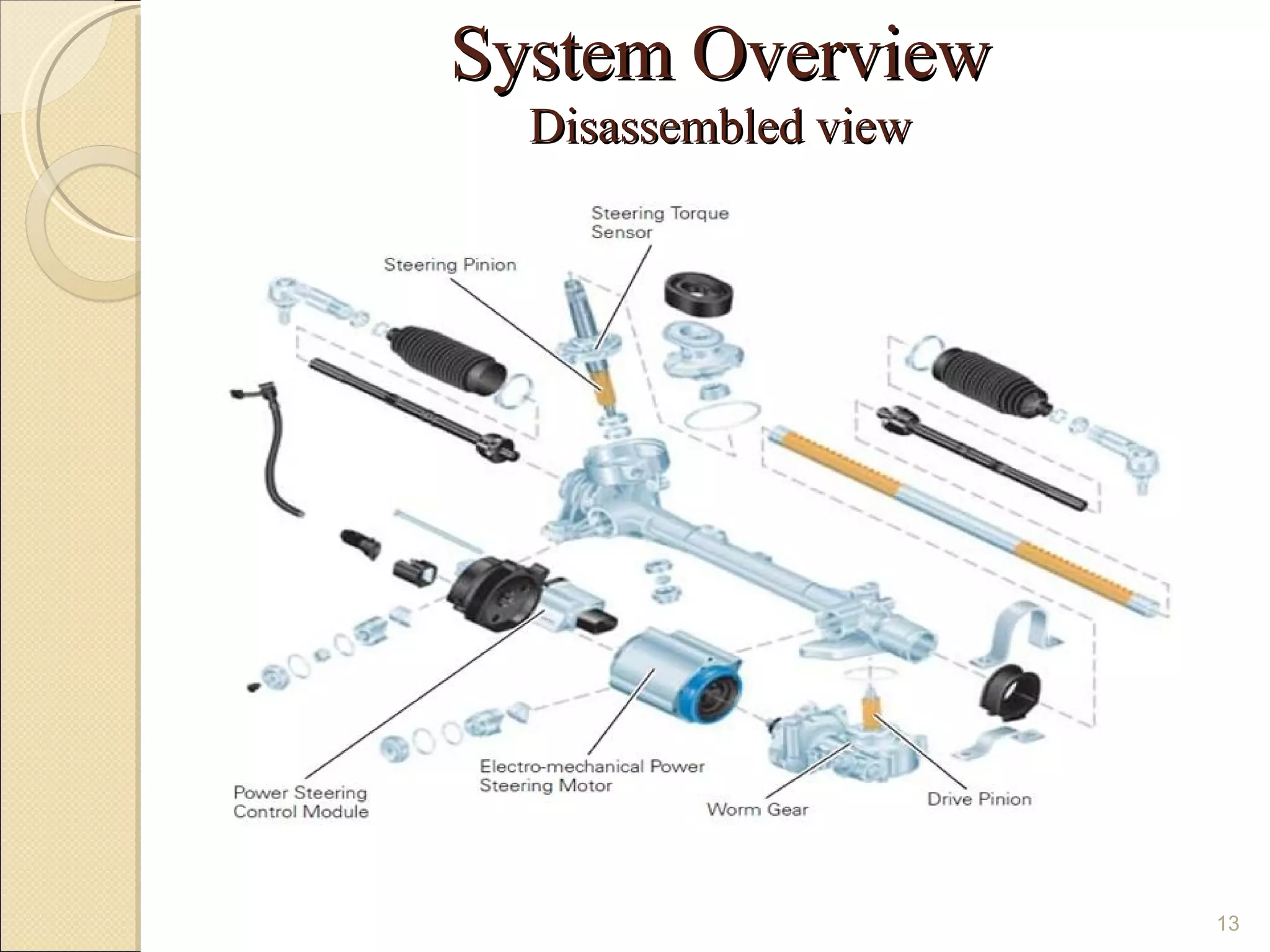
System Overview
  Disassembled view


                      13
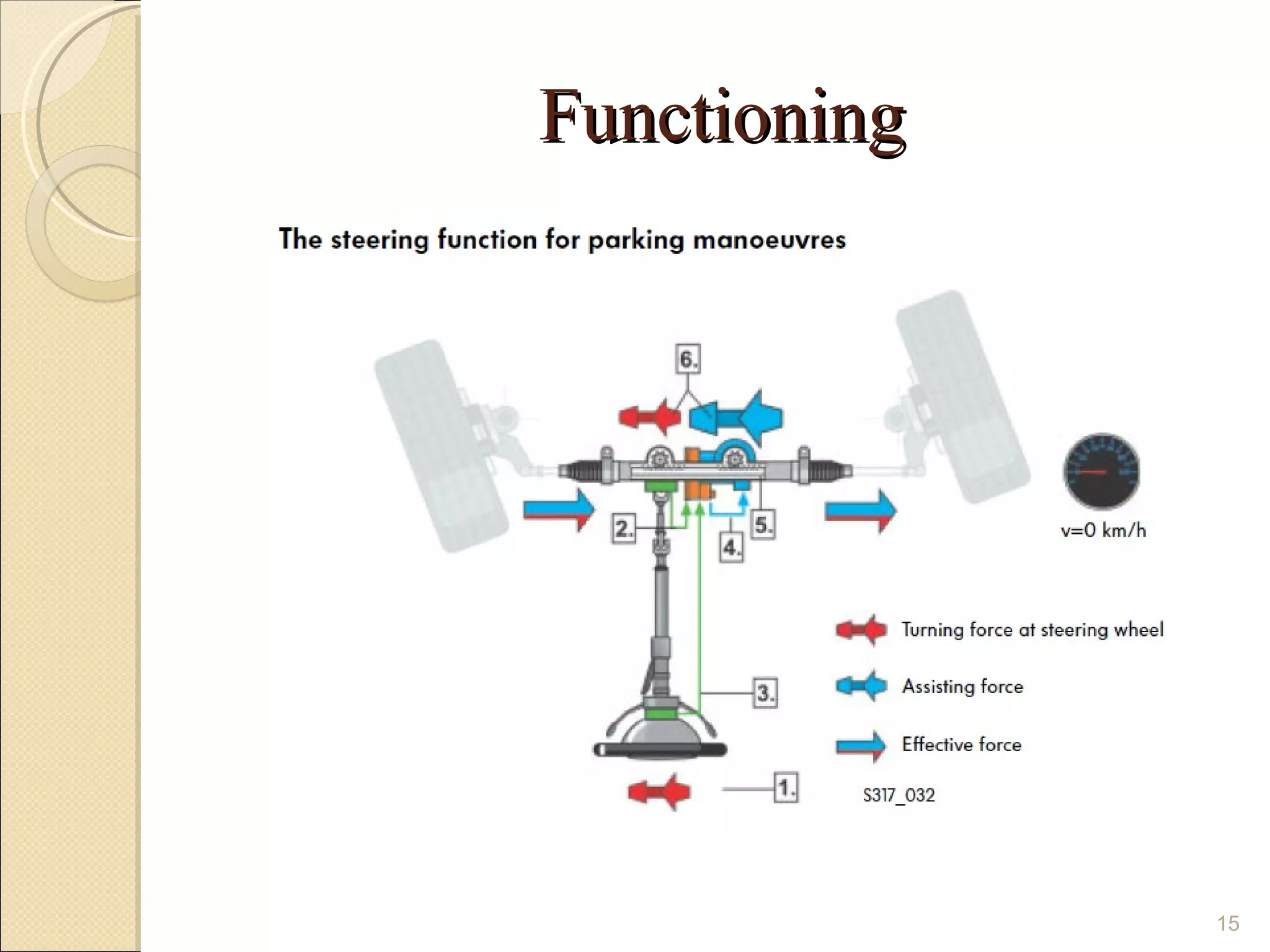
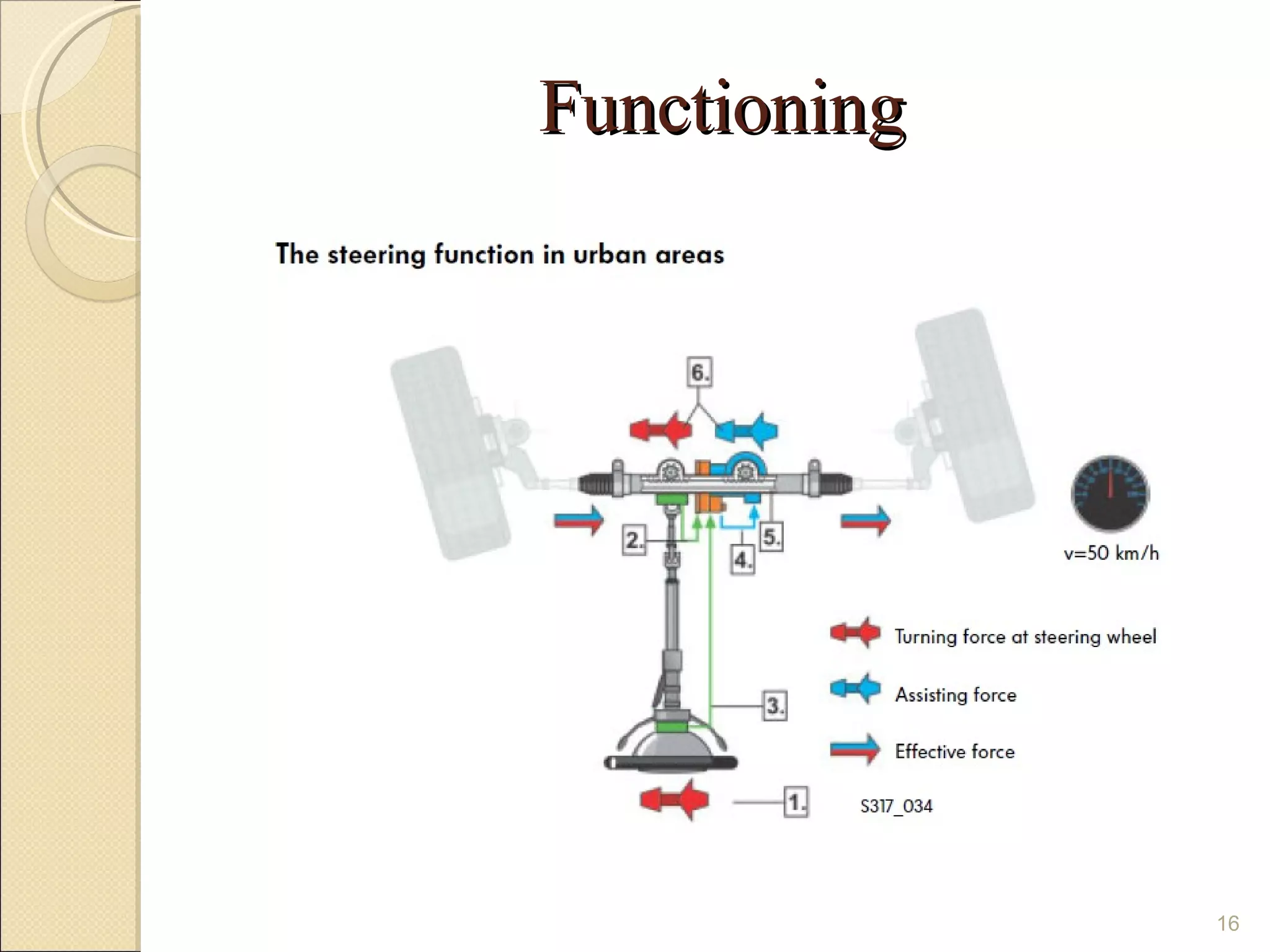
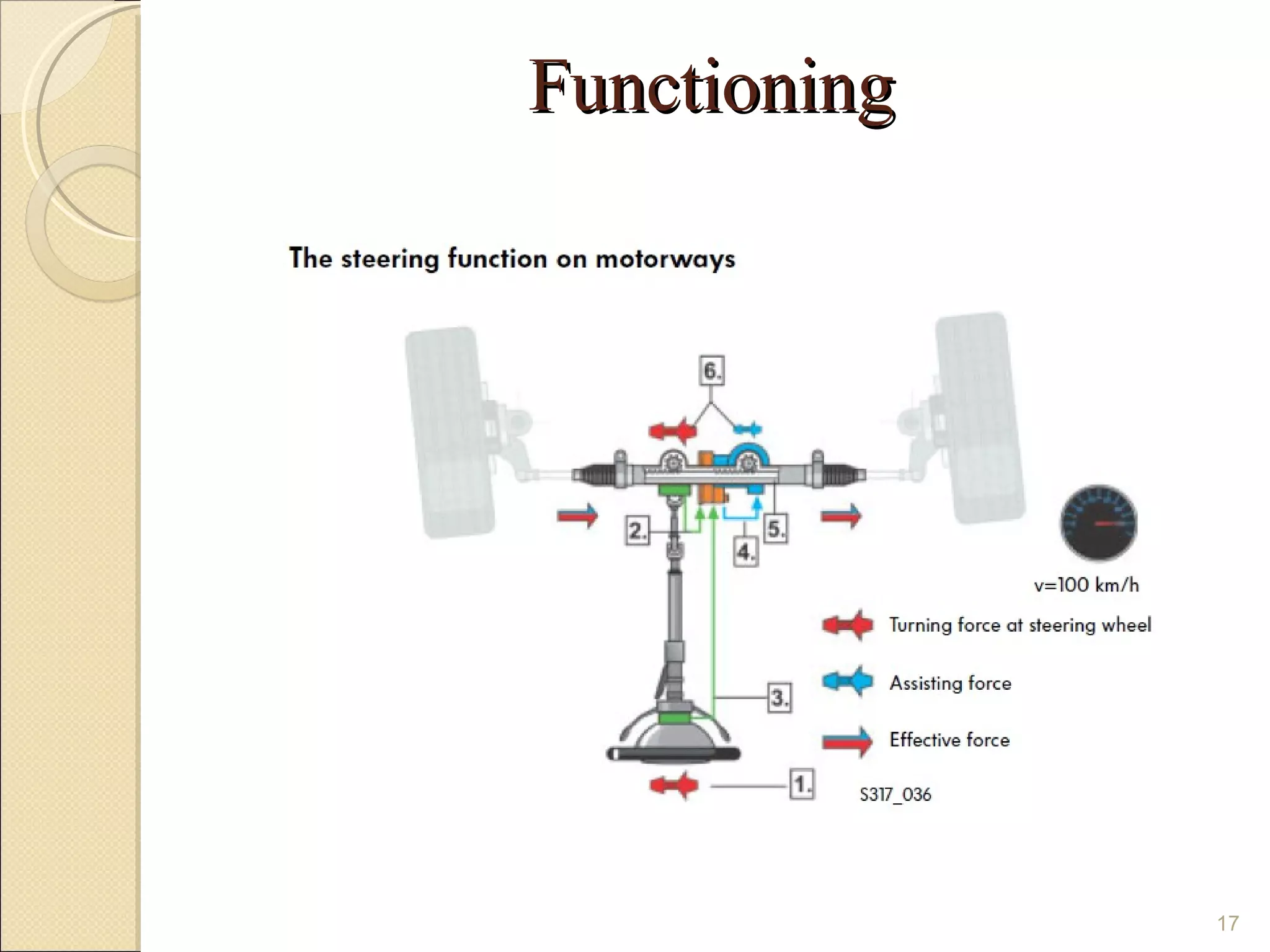
Functioning
There are five general modes of operation of EPS


                                                   14
Functioning


              15
Functioning


              16
Functioning


              17
Functioning


              18
Control Strategies
Control architecture consists of two layers of
 control
 Effort level control (Torque Sensor)
 Assistance level control (Vehicle speed sensor)


                                                    19
Control Strategies
Effort Level Control
  Information like engine speed, and torque required are
 transmitted to control module, which determines the
 optimal degree of assistance the electric motor should
 apply


                                                 (Contd.)
                                                        20
Control Strategies
Effort level control
     During any 120 degree interval of phase current I, the
  instantaneous power (P ) being converted from electrical to
  mechanical is
   P = ωT e = 2EI
       T e = Electromagnetic torque
      E = Induced EMF per phase.
 E = 2NphBgLrω, per phase induced emf
      Nph = Number of winding turns per phase
      Bg = Rotor magnetic field density
      L = Length of the rotor
      r = Internal radius of rotor
                                                      (Contd.)
                                                          21
Control Strategies
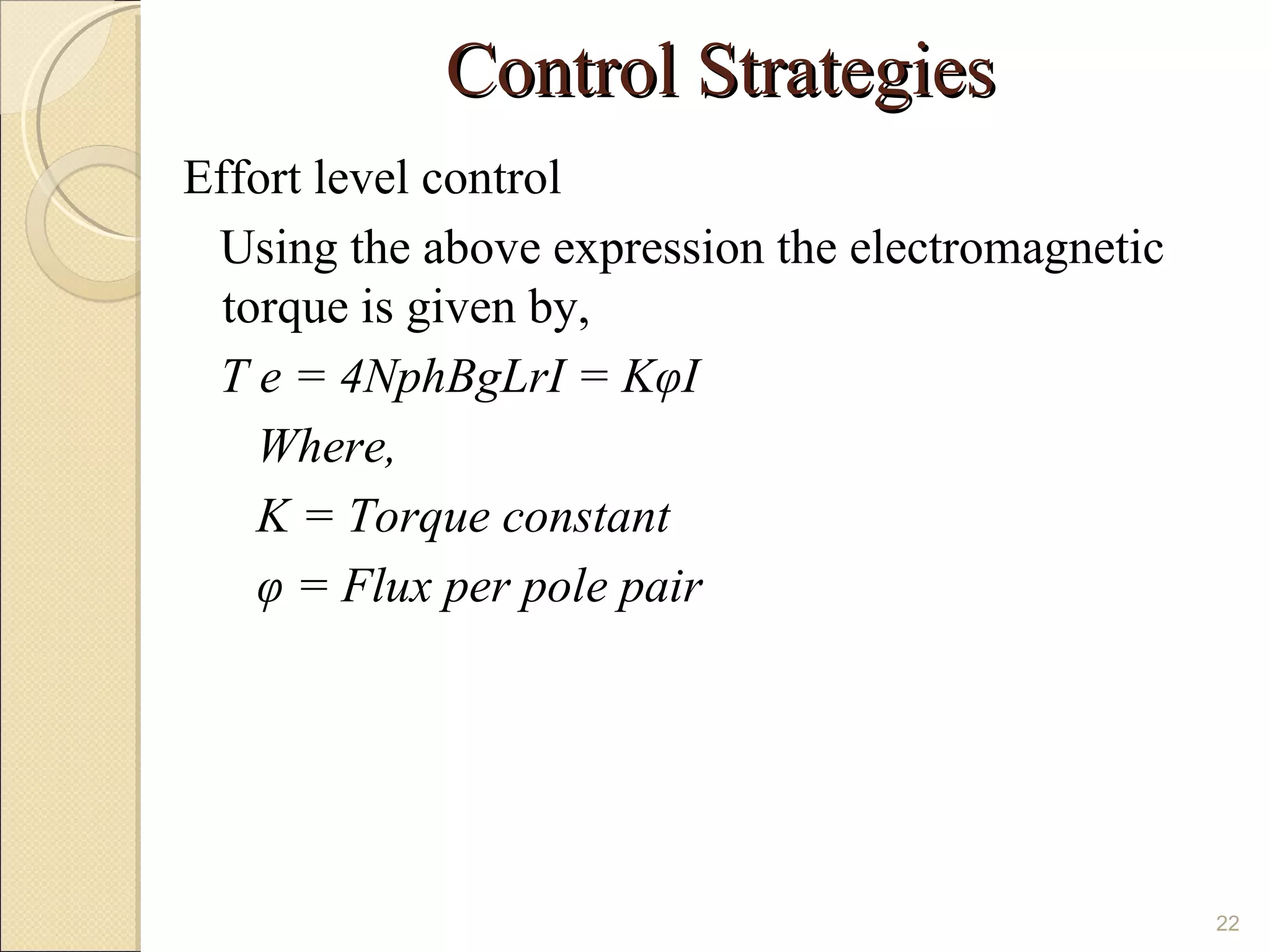
Effort level control
 Using the above expression the electromagnetic
  torque is given by,
 T e = 4NphBgLrI = KφI
    Where,
    K = Torque constant
    φ = Flux per pole pair


                                                  22
Control Strategies
Assistance Level Control
  Figure shows the effort required to be produced by the
 motor for various vehicle speeds


                                                     23
Literature Review
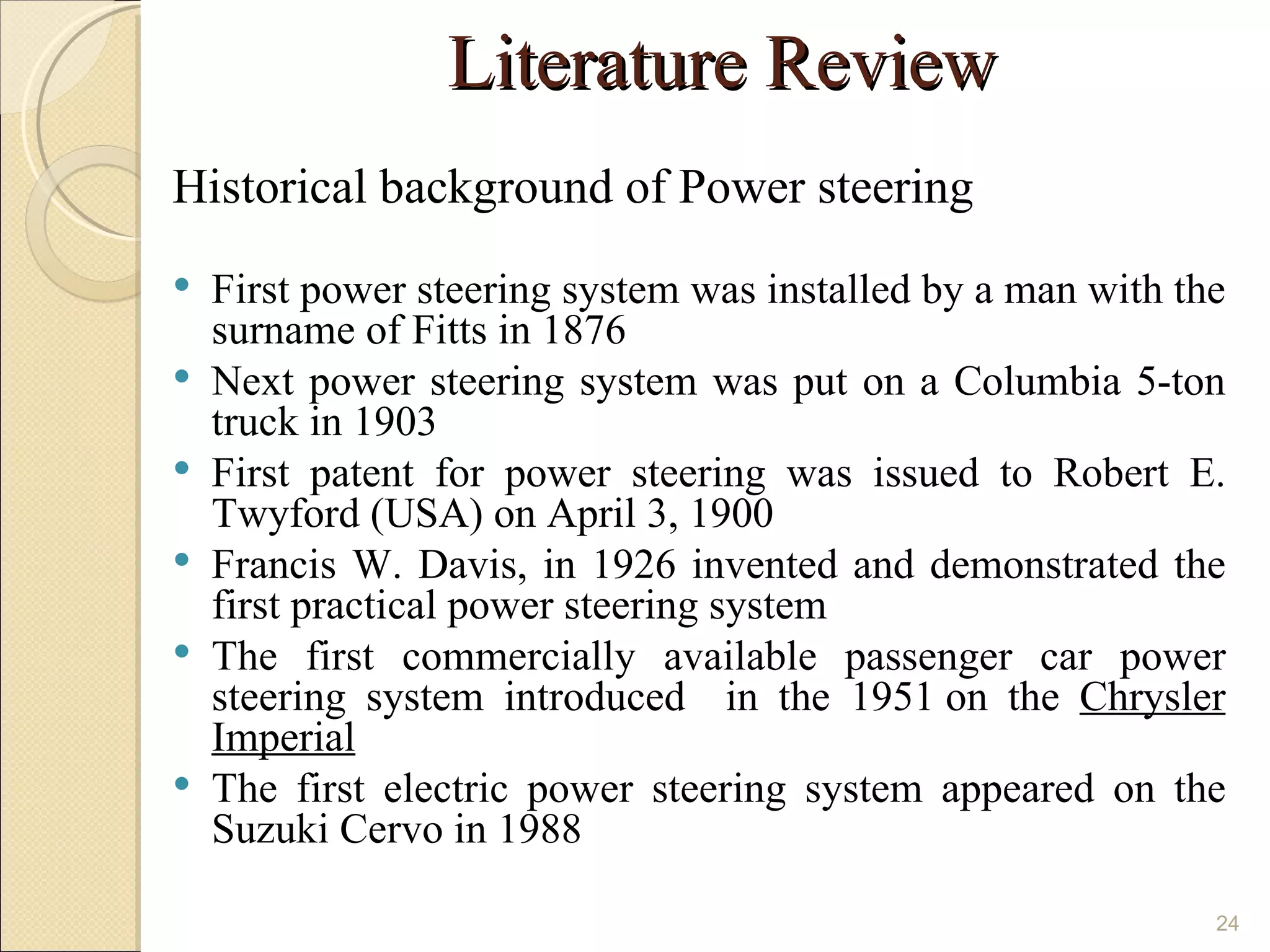
Historical background of Power steering
   First power steering system was installed by a man with the
    surname of Fitts in 1876
   Next power steering system was put on a Columbia 5-ton
    truck in 1903
   First patent for power steering was issued to Robert E.
    Twyford (USA) on April 3, 1900
   Francis W. Davis, in 1926 invented and demonstrated the
    first practical power steering system
   The first commercially available passenger car power
    steering system introduced in the 1951 on the Chrysler
    Imperial
   The first electric power steering system appeared on the
    Suzuki Cervo in 1988

                                                              24
Literature Review
   Control map


                                 25
Literature Review
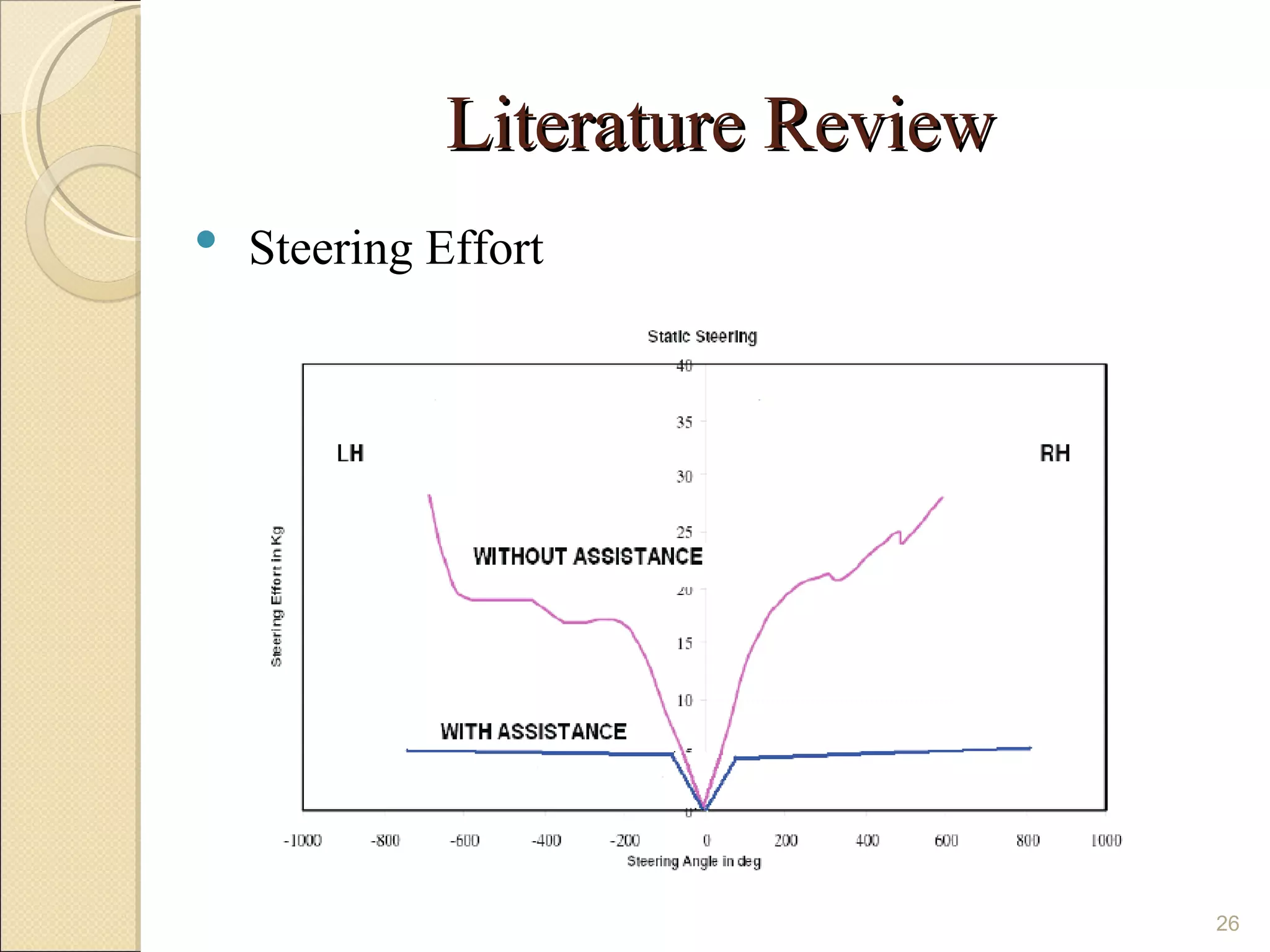
 Steering Effort


                                26
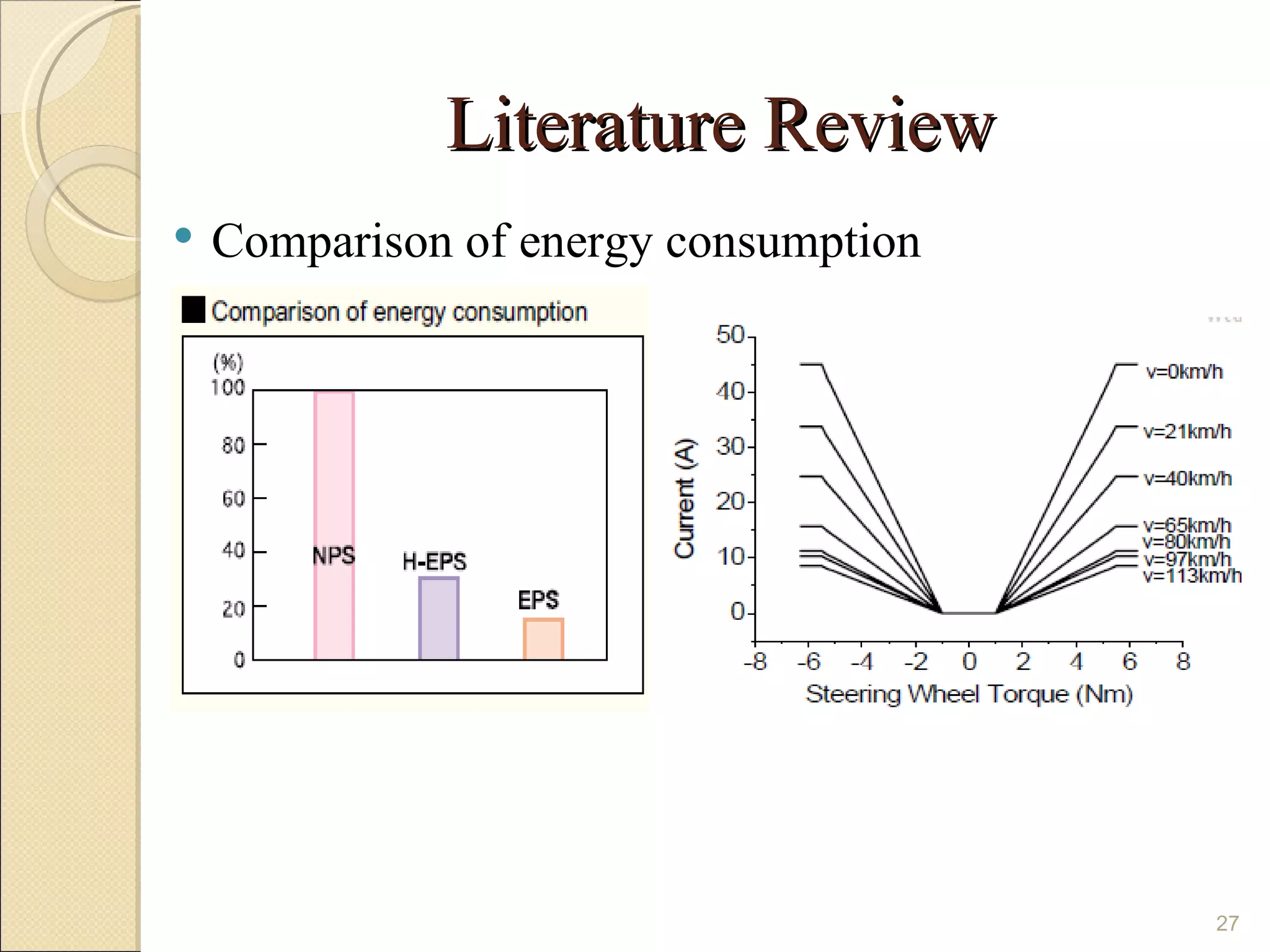
Literature Review
   Comparison of energy consumption


                                       27
Applications


               28
Benefits
   No hydraulic components, for example power steering
    oil pump, hoses, oil tank, filter
   No hydraulic fluid
   Space savings
   Reduction in noise
   Energy savings(fuel saving by 4%)
   No complex hose and wiring system
   Good straight-line stability
   Direct but soft application of the steering input
   No uncomfortable steering reactions over uneven
    driving surfaces


                                                          29
References
Research Papers
1 Srihari Vijayakumar and Ram Chandran., Analysis of an Electric Power Assisted
   Steering System using Bond Graphs, SAE Paper No. 2003-01-0586
2 Shi Guobiao, Lin Yi., et al., Simulation of Straight-Line Type Assist
   Characteristic of Electric Power-Assisted Steering, SAE Paper No.
   2004-01-1107
3 A. Emre Cetin, Banu Sinanoglu., et al., Compliant Control of Electric Power
   Assisted Steering Systems, SAE Paper No. 2005-01-3535
4 R Murugan, S Nandakumar ., et al., DSP-based electric power assisted steering
   using BLDC motor Bharat Electronics Limited, Nandambakkam, Chennai

Books
1 Lamm, Michael "75 years of Chryslers” Popular Mechanics 176 (3): 75, Year
   (March 1999)

Magazines
1 Popular Mechanics, Hearst Magazines
2 Power Steering: The Pioneer Unit, Popular Science


                                                                              30
31
Questions


            32

Electrical power steering

  • 1.
    Advances in SteeringMechanisms. (First step to steer by wire) Presented by Arvind J. Bhosale SMBS 1
  • 2.
    Outline 1 Introduction 2 SystemOverview 3 Control Strategies 4 Literature Review 5 Applications and Benefits 6 References 7 Questions 2
  • 3.
    Introduction Mainly focusing onelectro-mechanical power steering 3
  • 4.
    Introduction Requirements  Should be very accurate and easy to handle  Effort required to steer should be minimum  Should provide directional stability  Easy alteration of driving direction 4
  • 5.
    Introduction Functions  To achieve angular motion of the front wheels to negotiate a turn  To provide directional stability  To provide perfect steering condition  To facilitate straight ahead recovery after completing a turn  To minimize tire wear 5
  • 6.
    Introduction Classification 1.3.2 Based onthe type of steering linkage or mechanism used  Ackerman steering mechanism  Davis steering mechanism 1.3.2 Based on the type of Front axle used  For independent wheel suspension  For rigid axles suspension 1.3.3 Based on the Steering Gearbox used  Rack and pinion type  Recirculating ball type  Worm and wheel type  Cam and double roller type  Worm and nut type 6
  • 7.
    Introduction 1.3.4 Based onthe type of power assist used  Manual steering  Power assisted steering • Hydraulic power steering • Electro-hydraulic power steering • Electric power steering 7
  • 8.
    System Overview Overview OfElectric Power Steering  No requirement for hydraulic assistance (Eliminating hydraulic oil )  System provides assistance depending on the driving conditions  Supports the “active return” function  Easier for the driver to steer the vehicle in a straight line when the vehicle is being affected constantly by side winds or driven up or down hills 8
  • 9.
    System Overview Types OfElectric Power Steering 1 Column type EPS 2 Pinion type EPS 3 Dual pinion type EPS 4 Offset Ball Screw type EPS 5 Direct drive type EPS 9
  • 10.
    System Overview The electro-mechanical power steering with dual pinion System components Of EPS  Steering wheel  Steering column switch with steering angle sensor  Steering column  Steering moment sensor(Torque sensor)  Steering gear  Electro-mechanical power steering motor  Power steering control unit 10
  • 11.
    System Overview Actual View 11
  • 12.
    System Overview Schematic View 12
  • 13.
    System Overview Disassembled view 13
  • 14.
    Functioning There are fivegeneral modes of operation of EPS 14
  • 15.
  • 16.
  • 17.
  • 18.
  • 19.
    Control Strategies Control architectureconsists of two layers of control  Effort level control (Torque Sensor)  Assistance level control (Vehicle speed sensor) 19
  • 20.
    Control Strategies Effort LevelControl Information like engine speed, and torque required are transmitted to control module, which determines the optimal degree of assistance the electric motor should apply (Contd.) 20
  • 21.
    Control Strategies Effort levelcontrol During any 120 degree interval of phase current I, the instantaneous power (P ) being converted from electrical to mechanical is P = ωT e = 2EI T e = Electromagnetic torque E = Induced EMF per phase. E = 2NphBgLrω, per phase induced emf Nph = Number of winding turns per phase Bg = Rotor magnetic field density L = Length of the rotor r = Internal radius of rotor (Contd.) 21
  • 22.
    Control Strategies Effort levelcontrol Using the above expression the electromagnetic torque is given by, T e = 4NphBgLrI = KφI Where, K = Torque constant φ = Flux per pole pair 22
  • 23.
    Control Strategies Assistance LevelControl Figure shows the effort required to be produced by the motor for various vehicle speeds 23
  • 24.
    Literature Review Historical backgroundof Power steering  First power steering system was installed by a man with the surname of Fitts in 1876  Next power steering system was put on a Columbia 5-ton truck in 1903  First patent for power steering was issued to Robert E. Twyford (USA) on April 3, 1900  Francis W. Davis, in 1926 invented and demonstrated the first practical power steering system  The first commercially available passenger car power steering system introduced in the 1951 on the Chrysler Imperial  The first electric power steering system appeared on the Suzuki Cervo in 1988 24
  • 25.
    Literature Review  Control map 25
  • 26.
  • 27.
    Literature Review  Comparison of energy consumption 27
  • 28.
  • 29.
    Benefits  No hydraulic components, for example power steering oil pump, hoses, oil tank, filter  No hydraulic fluid  Space savings  Reduction in noise  Energy savings(fuel saving by 4%)  No complex hose and wiring system  Good straight-line stability  Direct but soft application of the steering input  No uncomfortable steering reactions over uneven driving surfaces 29
  • 30.
    References Research Papers 1 SrihariVijayakumar and Ram Chandran., Analysis of an Electric Power Assisted Steering System using Bond Graphs, SAE Paper No. 2003-01-0586 2 Shi Guobiao, Lin Yi., et al., Simulation of Straight-Line Type Assist Characteristic of Electric Power-Assisted Steering, SAE Paper No. 2004-01-1107 3 A. Emre Cetin, Banu Sinanoglu., et al., Compliant Control of Electric Power Assisted Steering Systems, SAE Paper No. 2005-01-3535 4 R Murugan, S Nandakumar ., et al., DSP-based electric power assisted steering using BLDC motor Bharat Electronics Limited, Nandambakkam, Chennai Books 1 Lamm, Michael "75 years of Chryslers” Popular Mechanics 176 (3): 75, Year (March 1999) Magazines 1 Popular Mechanics, Hearst Magazines 2 Power Steering: The Pioneer Unit, Popular Science 30
  • 31.
  • 32.