4 Wheel Steering System
Introduction to 4 Wheel Steering System
The 4 wheel steering system is a
technology that allows all four wheels of a
vehicle to be steered.
It enhances maneuverability and stability,
especially at high speeds.
This system can be found in various types
of vehicles, including cars, trucks, and even
some motorcycles.
Types of 4 Wheel Steering Systems
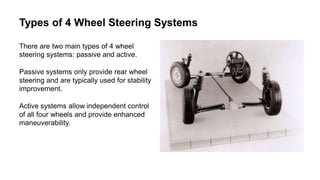
There are two main types of 4 wheel
steering systems: passive and active.
Passive systems only provide rear wheel
steering and are typically used for stability
improvement.
Active systems allow independent control
of all four wheels and provide enhanced
maneuverability.
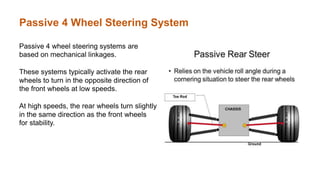
Passive 4 Wheel Steering System
Passive 4 wheel steering systems are
based on mechanical linkages.
These systems typically activate the rear
wheels to turn in the opposite direction of
the front wheels at low speeds.
At high speeds, the rear wheels turn slightly
in the same direction as the front wheels
for stability.
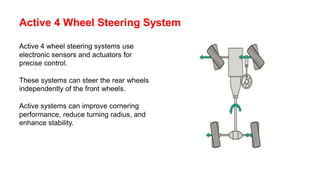
Active 4 Wheel Steering System
Active 4 wheel steering systems use
electronic sensors and actuators for
precise control.
These systems can steer the rear wheels
independently of the front wheels.
Active systems can improve cornering
performance, reduce turning radius, and
enhance stability.
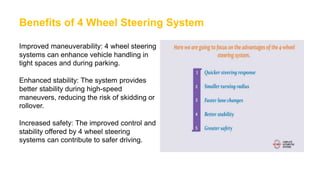
Benefits of 4 Wheel Steering System
Improved maneuverability: 4 wheel steering
systems can enhance vehicle handling in
tight spaces and during parking.
Enhanced stability: The system provides
better stability during high-speed
maneuvers, reducing the risk of skidding or
rollover.
Increased safety: The improved control and
stability offered by 4 wheel steering
systems can contribute to safer driving.
Drawbacks of 4 Wheel Steering System
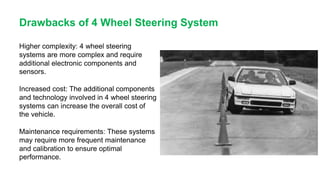
Higher complexity: 4 wheel steering
systems are more complex and require
additional electronic components and
sensors.
Increased cost: The additional components
and technology involved in 4 wheel steering
systems can increase the overall cost of
the vehicle.
Maintenance requirements: These systems
may require more frequent maintenance
and calibration to ensure optimal
performance.
Applications of 4 Wheel Steering System
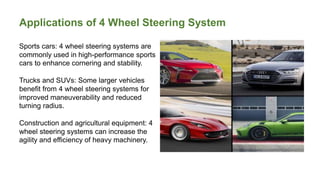
Sports cars: 4 wheel steering systems are
commonly used in high-performance sports
cars to enhance cornering and stability.
Trucks and SUVs: Some larger vehicles
benefit from 4 wheel steering systems for
improved maneuverability and reduced
turning radius.
Construction and agricultural equipment: 4
wheel steering systems can increase the
agility and efficiency of heavy machinery.
Future Developments in 4 Wheel Steering System
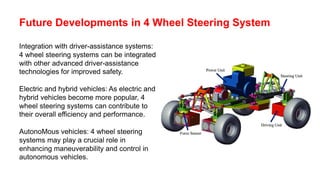
Integration with driver-assistance systems:
4 wheel steering systems can be integrated
with other advanced driver-assistance
technologies for improved safety.
Electric and hybrid vehicles: As electric and
hybrid vehicles become more popular, 4
wheel steering systems can contribute to
their overall efficiency and performance.
AutonoMous vehicles: 4 wheel steering
systems may play a crucial role in
enhancing maneuverability and control in
autonomous vehicles.
Conclusion
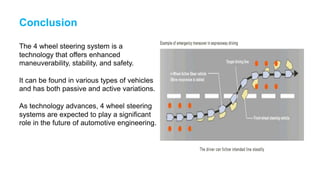
The 4 wheel steering system is a
technology that offers enhanced
maneuverability, stability, and safety.
It can be found in various types of vehicles
and has both passive and active variations.
As technology advances, 4 wheel steering
systems are expected to play a significant
role in the future of automotive engineering.
THANK
YOU

Four wheel steering system ppt for mechanical

  • 1.
  • 2.
    Introduction to 4Wheel Steering System The 4 wheel steering system is a technology that allows all four wheels of a vehicle to be steered. It enhances maneuverability and stability, especially at high speeds. This system can be found in various types of vehicles, including cars, trucks, and even some motorcycles.
  • 3.
    Types of 4Wheel Steering Systems There are two main types of 4 wheel steering systems: passive and active. Passive systems only provide rear wheel steering and are typically used for stability improvement. Active systems allow independent control of all four wheels and provide enhanced maneuverability.
  • 4.
    Passive 4 WheelSteering System Passive 4 wheel steering systems are based on mechanical linkages. These systems typically activate the rear wheels to turn in the opposite direction of the front wheels at low speeds. At high speeds, the rear wheels turn slightly in the same direction as the front wheels for stability.
  • 5.
    Active 4 WheelSteering System Active 4 wheel steering systems use electronic sensors and actuators for precise control. These systems can steer the rear wheels independently of the front wheels. Active systems can improve cornering performance, reduce turning radius, and enhance stability.
  • 6.
    Benefits of 4Wheel Steering System Improved maneuverability: 4 wheel steering systems can enhance vehicle handling in tight spaces and during parking. Enhanced stability: The system provides better stability during high-speed maneuvers, reducing the risk of skidding or rollover. Increased safety: The improved control and stability offered by 4 wheel steering systems can contribute to safer driving.
  • 7.
    Drawbacks of 4Wheel Steering System Higher complexity: 4 wheel steering systems are more complex and require additional electronic components and sensors. Increased cost: The additional components and technology involved in 4 wheel steering systems can increase the overall cost of the vehicle. Maintenance requirements: These systems may require more frequent maintenance and calibration to ensure optimal performance.
  • 8.
    Applications of 4Wheel Steering System Sports cars: 4 wheel steering systems are commonly used in high-performance sports cars to enhance cornering and stability. Trucks and SUVs: Some larger vehicles benefit from 4 wheel steering systems for improved maneuverability and reduced turning radius. Construction and agricultural equipment: 4 wheel steering systems can increase the agility and efficiency of heavy machinery.
  • 9.
    Future Developments in4 Wheel Steering System Integration with driver-assistance systems: 4 wheel steering systems can be integrated with other advanced driver-assistance technologies for improved safety. Electric and hybrid vehicles: As electric and hybrid vehicles become more popular, 4 wheel steering systems can contribute to their overall efficiency and performance. AutonoMous vehicles: 4 wheel steering systems may play a crucial role in enhancing maneuverability and control in autonomous vehicles.
  • 10.
    Conclusion The 4 wheelsteering system is a technology that offers enhanced maneuverability, stability, and safety. It can be found in various types of vehicles and has both passive and active variations. As technology advances, 4 wheel steering systems are expected to play a significant role in the future of automotive engineering.
  • 11.

Editor's Notes

  • #8 Image source: https://www.slidemake.com