By:-
TB-39 :Gupta Dev Rakesh
TB-41:Malanthara Arun Santosh
TB-45: Gagan Nir
TB-52: Bhattad Bharat Mukesh
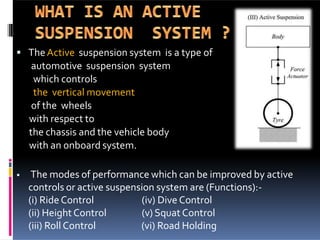
 TheActive suspension system is a type of
automotive suspension system
which controls
the vertical movement
of the wheels
with respect to
the chassis and the vehicle body
with an onboard system.
 The modes of performance which can be improved by active
controls or active suspension system are (Functions):-
(i) Ride Control (iv) Dive Control
(ii) Height Control (v) Squat Control
(iii) Roll Control (vi) Road Holding
The various levels of active qualities in
suspensions may be divided into the following
categories:-
1. Passive Suspensions
2. Self Leveling Suspensions
3. Semi-Active Suspension
- Slow Active
- Low Bandwidth
- High Bandwidth
4. Full Active Suspension System
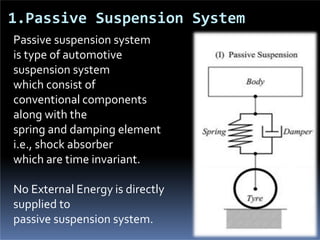
1.Passive Suspension System
Passive suspension system
is type of automotive
suspension system
which consist of
conventional components
along with the
spring and damping element
i.e., shock absorber
which are time invariant.
No External Energy is directly
supplied to
passive suspension system.
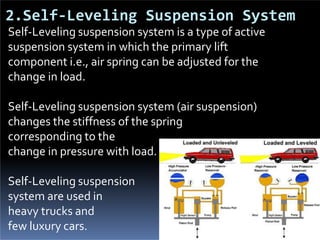
2.Self-Leveling Suspension System
Self-Leveling suspension system is a type of active
suspension system in which the primary lift
component i.e., air spring can be adjusted for the
change in load.
Self-Leveling suspension system (air suspension)
changes the stiffness of the spring
corresponding to the
change in pressure with load.
Self-Leveling suspension
system are used in
heavy trucks and
few luxury cars.
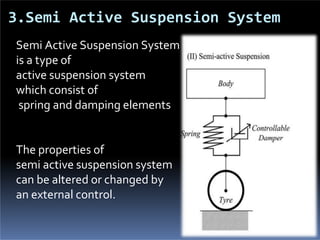
3.Semi Active Suspension System
Semi Active Suspension System
is a type of
active suspension system
which consist of
spring and damping elements
The properties of
semi active suspension system
can be altered or changed by
an external control.
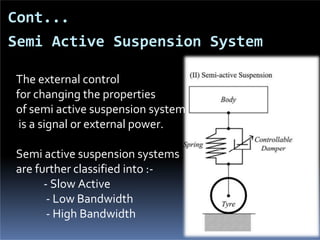
Semi Active Suspension System
The external control
for changing the properties
of semi active suspension system
is a signal or external power.
Semi active suspension systems
are further classified into :-
- Slow Active
- Low Bandwidth
- High Bandwidth
Cont...
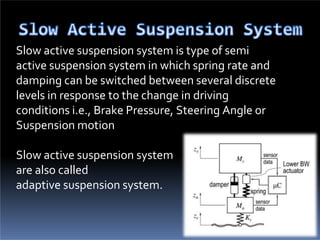
Slow active suspension system is type of semi
active suspension system in which spring rate and
damping can be switched between several discrete
levels in response to the change in driving
conditions i.e., Brake Pressure, Steering Angle or
Suspension motion
Slow active suspension system
are also called
adaptive suspension system.
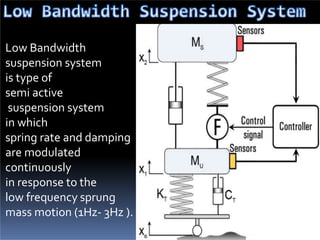
Low Bandwidth
suspension system
is type of
semi active
suspension system
in which
spring rate and damping
are modulated
continuously
in response to the
low frequency sprung
mass motion (1Hz- 3Hz ).
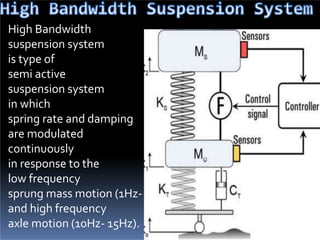
High Bandwidth
suspension system
is type of
semi active
suspension system
in which
spring rate and damping
are modulated
continuously
in response to the
low frequency
sprung mass motion (1Hz- 3Hz )
and high frequency
axle motion (10Hz- 15Hz).
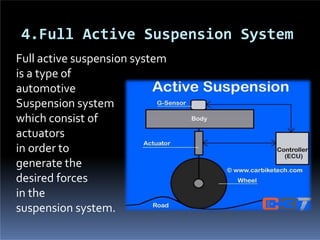
Full active suspension system
is a type of
automotive
Suspension system
which consist of
actuators
in order to
generate the
desired forces
in the
suspension system.
4.Full Active Suspension System
IMPORTANT PROPERTIES
Spring rate
 The spring rate (or suspension rate) is a component in
setting the vehicle's ride height or its location in the
suspension stroke.Vehicles which carry heavy loads will
often have heavier springs to compensate for the
additional weight that would otherwise collapse a vehicle
to the bottom of its travel (stroke).
 Springs that are too hard or too soft cause the
suspension to become ineffective because they fail to
properly isolate the vehicle from the road.
 Vehicles that commonly experience suspension loads
heavier than normal have heavy or hard springs with a
spring rate close to the upper limit for that vehicle's
weight.
DAMPING
 Damping is the control of motion or oscillation, as
seen with the use of hydraulic gates and valves in a
vehicles shock absorber.This may also vary,
intentionally or unintentionally. Like spring rate, the
optimal damping for comfort may be less than for
control.
 ROLL CENTER HEIGHT
 This is important to body roll and to front to rear roll
stiffness distribution. However, the roll stiffness
distribution in most cars is set more by the antiroll
bars than the RCH.The height of the roll center is
related to the amount of jacking forces experienced.
VIBRATION MODES OF THE
SUSPENSION ELEMENTS
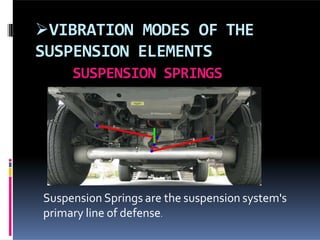
SUSPENSION SPRINGS
Suspension Springs are the suspension system's
primary line of defense.
These variables within the surface ofthe
street or the backcountry road send force
up through the wheels. .
The suspension spring's task is to absorb
this power and carry your wheels back to a
condition of equilibrium.
You will find several standard types
of Suspension Springs usedon
contemporary vehicles: Leaf Springs,Coil
Springs,Torsion Bars, and AirSprings.
SUSPENSION BUSHINGS
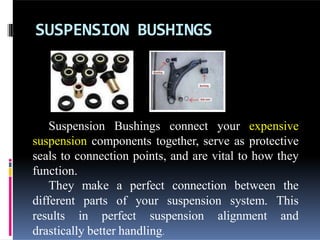
Suspension Bushings connect your expensive
suspension components together, serve as protective
seals to connection points, and are vital to how they
function.
They make a perfect connection between the
different parts of your suspension system. This
results in perfect suspension alignment and
drastically better handling.
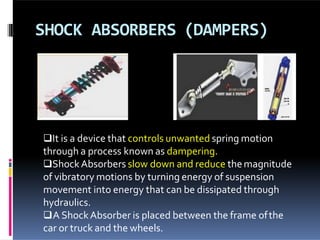
SHOCK ABSORBERS (DAMPERS)
It is a device that controls unwanted spring motion
through a process known as dampering.
ShockAbsorbers slow down and reduce themagnitude
of vibratory motions by turning energy of suspension
movement into energy that can be dissipated through
hydraulics.
A ShockAbsorber is placed between the frame ofthe
car or truck and the wheels.
Some productions vehicles with active
Suspension
MitsubishiGalant- "Dynamic ECS", world’s first production
semi-active electronically controlled suspension
system(1987)
BMW M3 - "BOGE adjustable damping" system(1989)
InfinitiQ45 - "Full-ActiveSuspension (FAS)", world's first
production fully active suspension system(1990)
LexusGS- Active Stabilizer SuspensionSystem(2007)
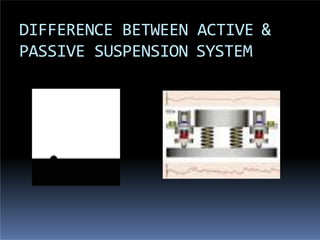
DIFFERENCE BETWEEN ACTIVE &
PASSIVE SUSPENSION SYSTEM
Let us consider the work of passive vibration isolation
system by the example of a suspension bracket of the
automobile. In any suspension bracket there are
elastic elements, which soften pushes and impacts of
the road.Other not less important element of a
suspension bracket is the shock-absorber -- the device
which is intended to terminate excited the oscillation.
Many drivers think that shock-absorbers is only the
means to maintain comfort.Actually functions of this
element of a suspension bracket are directly
connected to maintenance of contact of a wheel with
road, i.e. with controllability of the automobile and
traffic safety.
First animation shows that too hard suspension
system of a car results in throwing of the car on
unevenness of the road, while too soft suspension
system will swing the car, which results in lost of the
contact between the wheels and the road.
In second animation active vibration isolation
system among the spring there is feedback circuit
which consists of a piezoelectric accelerometer, an
analog control circuit, and an electromagnetic
transducer.The spring supports the weight of the
table top and the device which is mounted on the
table.The motion of the table top is detected by a
highly sensitive piezoelectric accelerometer
consisting of a mass resting on a piezoelectric disc
and covered by a housing.
MODEL OF ACTIVE SUSPENSION
SYSTEM
 The model can be used for determining the
adjustable arm’s angle for which the system
produces a required force.
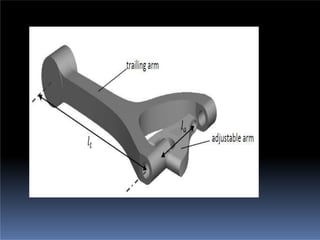
 The trailing arm joins the unsprung mass (wheel
unit) to the sprung mass (the car body) and
provides a connection to the primary spring and
damper.The adjustable arm defines the position
at which the secondary spring is attached to the
suspension system.
ADVANTAGES
Improved Steering, Handling and
Braking
In a rigid suspension, if one wheel jogs or bounces, the entire
axle tilts, causing the opposing wheel to tip in or out at the top,
no longer rolling straight ahead, an effect called "bump steer".
Rigid axles are also less responsive on turns and vehicles
carrying heavy loads are subject to instability called "shimmy",
caused by forces translated across the axle from wheel to
wheel.
During hard braking, solid beam suspension can cause the
front of the vehicle to nose dive and twist. Independent front
suspension (IFS) corrects or vastly improves all of these effects
by allowing wheels on the same axle to respond independently
to driving conditions.
 RideQuality
Ride quality is a concern that has evolved with our
culture's increasing dependency on automobiles for
recreational and commuter travel.
Overall ride quality, or how comfortable a car feels to ride
in or drive, is measured by a combination of factors,
including noise and vibration, the translation of bumpy road
surface to passengers, the smoothness of the car's steering
and how well a car handles and corners.
Active suspension system solves some of these problems
by de-coupling the front wheels, improving overall stability
and creating isolation between the suspension and the
vehicle chassis.
 Size and Fuel Efficiency
It is difficult to beat a solid axle for strength and
simplicity, but the price of that strength is size and mass.
For heavy duty vehicles and the solid steel cruisers of the
1940s and 1950s, a rigid axle made good design sense.
As passenger vehicles have gotten smaller and more
performance-oriented, heavy, bulky, rigid axles are no
longer practical, particularly because heavier vehicles burn
more fuel. Independent front suspensions have evolved
with modern car materials, creating lighter, more flexible
and responsive vehicles.
DISADVANTAGES
Need for a large external power source
Complex control algorithms
Complex closed-loop control systems.
Requirement of fast-acting devices
Increased cost
In the case of active suspension system, as in any
other innovations of automotive technology, today's
innovation is tomorrow's standard feature.
Inspite of its high initial cost, let us expect to see
them in the Indian roads soon.The trickle-down
effect will take some time, but it'll happen and when
such a time comes we can expect much lesser
accidents, less fatalities and more comfort in driving
the roads.
Conclusion
THANK YOU

ACTIVE SUSPENSION SYSTEM

  • 1.
    By:- TB-39 :Gupta DevRakesh TB-41:Malanthara Arun Santosh TB-45: Gagan Nir TB-52: Bhattad Bharat Mukesh
  • 2.
     TheActive suspensionsystem is a type of automotive suspension system which controls the vertical movement of the wheels with respect to the chassis and the vehicle body with an onboard system.  The modes of performance which can be improved by active controls or active suspension system are (Functions):- (i) Ride Control (iv) Dive Control (ii) Height Control (v) Squat Control (iii) Roll Control (vi) Road Holding
  • 3.
    The various levelsof active qualities in suspensions may be divided into the following categories:- 1. Passive Suspensions 2. Self Leveling Suspensions 3. Semi-Active Suspension - Slow Active - Low Bandwidth - High Bandwidth 4. Full Active Suspension System
  • 4.
    1.Passive Suspension System Passivesuspension system is type of automotive suspension system which consist of conventional components along with the spring and damping element i.e., shock absorber which are time invariant. No External Energy is directly supplied to passive suspension system.
  • 5.
    2.Self-Leveling Suspension System Self-Levelingsuspension system is a type of active suspension system in which the primary lift component i.e., air spring can be adjusted for the change in load. Self-Leveling suspension system (air suspension) changes the stiffness of the spring corresponding to the change in pressure with load. Self-Leveling suspension system are used in heavy trucks and few luxury cars.
  • 6.
    3.Semi Active SuspensionSystem Semi Active Suspension System is a type of active suspension system which consist of spring and damping elements The properties of semi active suspension system can be altered or changed by an external control.
  • 7.
    Semi Active SuspensionSystem The external control for changing the properties of semi active suspension system is a signal or external power. Semi active suspension systems are further classified into :- - Slow Active - Low Bandwidth - High Bandwidth Cont...
  • 8.
    Slow active suspensionsystem is type of semi active suspension system in which spring rate and damping can be switched between several discrete levels in response to the change in driving conditions i.e., Brake Pressure, Steering Angle or Suspension motion Slow active suspension system are also called adaptive suspension system.
  • 9.
    Low Bandwidth suspension system istype of semi active suspension system in which spring rate and damping are modulated continuously in response to the low frequency sprung mass motion (1Hz- 3Hz ).
  • 10.
    High Bandwidth suspension system istype of semi active suspension system in which spring rate and damping are modulated continuously in response to the low frequency sprung mass motion (1Hz- 3Hz ) and high frequency axle motion (10Hz- 15Hz).
  • 11.
    Full active suspensionsystem is a type of automotive Suspension system which consist of actuators in order to generate the desired forces in the suspension system. 4.Full Active Suspension System
  • 12.
    IMPORTANT PROPERTIES Spring rate The spring rate (or suspension rate) is a component in setting the vehicle's ride height or its location in the suspension stroke.Vehicles which carry heavy loads will often have heavier springs to compensate for the additional weight that would otherwise collapse a vehicle to the bottom of its travel (stroke).  Springs that are too hard or too soft cause the suspension to become ineffective because they fail to properly isolate the vehicle from the road.  Vehicles that commonly experience suspension loads heavier than normal have heavy or hard springs with a spring rate close to the upper limit for that vehicle's weight.
  • 13.
    DAMPING  Damping isthe control of motion or oscillation, as seen with the use of hydraulic gates and valves in a vehicles shock absorber.This may also vary, intentionally or unintentionally. Like spring rate, the optimal damping for comfort may be less than for control.  ROLL CENTER HEIGHT  This is important to body roll and to front to rear roll stiffness distribution. However, the roll stiffness distribution in most cars is set more by the antiroll bars than the RCH.The height of the roll center is related to the amount of jacking forces experienced.
  • 14.
    VIBRATION MODES OFTHE SUSPENSION ELEMENTS SUSPENSION SPRINGS Suspension Springs are the suspension system's primary line of defense.
  • 15.
    These variables withinthe surface ofthe street or the backcountry road send force up through the wheels. . The suspension spring's task is to absorb this power and carry your wheels back to a condition of equilibrium. You will find several standard types of Suspension Springs usedon contemporary vehicles: Leaf Springs,Coil Springs,Torsion Bars, and AirSprings.
  • 16.
    SUSPENSION BUSHINGS Suspension Bushingsconnect your expensive suspension components together, serve as protective seals to connection points, and are vital to how they function. They make a perfect connection between the different parts of your suspension system. This results in perfect suspension alignment and drastically better handling.
  • 17.
    SHOCK ABSORBERS (DAMPERS) Itis a device that controls unwanted spring motion through a process known as dampering. ShockAbsorbers slow down and reduce themagnitude of vibratory motions by turning energy of suspension movement into energy that can be dissipated through hydraulics. A ShockAbsorber is placed between the frame ofthe car or truck and the wheels.
  • 18.
    Some productions vehicleswith active Suspension MitsubishiGalant- "Dynamic ECS", world’s first production semi-active electronically controlled suspension system(1987) BMW M3 - "BOGE adjustable damping" system(1989) InfinitiQ45 - "Full-ActiveSuspension (FAS)", world's first production fully active suspension system(1990) LexusGS- Active Stabilizer SuspensionSystem(2007)
  • 19.
    DIFFERENCE BETWEEN ACTIVE& PASSIVE SUSPENSION SYSTEM
  • 20.
    Let us considerthe work of passive vibration isolation system by the example of a suspension bracket of the automobile. In any suspension bracket there are elastic elements, which soften pushes and impacts of the road.Other not less important element of a suspension bracket is the shock-absorber -- the device which is intended to terminate excited the oscillation. Many drivers think that shock-absorbers is only the means to maintain comfort.Actually functions of this element of a suspension bracket are directly connected to maintenance of contact of a wheel with road, i.e. with controllability of the automobile and traffic safety.
  • 21.
    First animation showsthat too hard suspension system of a car results in throwing of the car on unevenness of the road, while too soft suspension system will swing the car, which results in lost of the contact between the wheels and the road. In second animation active vibration isolation system among the spring there is feedback circuit which consists of a piezoelectric accelerometer, an analog control circuit, and an electromagnetic transducer.The spring supports the weight of the table top and the device which is mounted on the table.The motion of the table top is detected by a highly sensitive piezoelectric accelerometer consisting of a mass resting on a piezoelectric disc and covered by a housing.
  • 22.
    MODEL OF ACTIVESUSPENSION SYSTEM  The model can be used for determining the adjustable arm’s angle for which the system produces a required force.  The trailing arm joins the unsprung mass (wheel unit) to the sprung mass (the car body) and provides a connection to the primary spring and damper.The adjustable arm defines the position at which the secondary spring is attached to the suspension system.
  • 24.
    ADVANTAGES Improved Steering, Handlingand Braking In a rigid suspension, if one wheel jogs or bounces, the entire axle tilts, causing the opposing wheel to tip in or out at the top, no longer rolling straight ahead, an effect called "bump steer". Rigid axles are also less responsive on turns and vehicles carrying heavy loads are subject to instability called "shimmy", caused by forces translated across the axle from wheel to wheel. During hard braking, solid beam suspension can cause the front of the vehicle to nose dive and twist. Independent front suspension (IFS) corrects or vastly improves all of these effects by allowing wheels on the same axle to respond independently to driving conditions.
  • 25.
     RideQuality Ride qualityis a concern that has evolved with our culture's increasing dependency on automobiles for recreational and commuter travel. Overall ride quality, or how comfortable a car feels to ride in or drive, is measured by a combination of factors, including noise and vibration, the translation of bumpy road surface to passengers, the smoothness of the car's steering and how well a car handles and corners. Active suspension system solves some of these problems by de-coupling the front wheels, improving overall stability and creating isolation between the suspension and the vehicle chassis.
  • 26.
     Size andFuel Efficiency It is difficult to beat a solid axle for strength and simplicity, but the price of that strength is size and mass. For heavy duty vehicles and the solid steel cruisers of the 1940s and 1950s, a rigid axle made good design sense. As passenger vehicles have gotten smaller and more performance-oriented, heavy, bulky, rigid axles are no longer practical, particularly because heavier vehicles burn more fuel. Independent front suspensions have evolved with modern car materials, creating lighter, more flexible and responsive vehicles.
  • 27.
    DISADVANTAGES Need for alarge external power source Complex control algorithms Complex closed-loop control systems. Requirement of fast-acting devices Increased cost
  • 28.
    In the caseof active suspension system, as in any other innovations of automotive technology, today's innovation is tomorrow's standard feature. Inspite of its high initial cost, let us expect to see them in the Indian roads soon.The trickle-down effect will take some time, but it'll happen and when such a time comes we can expect much lesser accidents, less fatalities and more comfort in driving the roads. Conclusion
  • 29.