TRACTION CONTROL SYSTEM
BY :- G . SAI MANOHAR
ROLL NO :- 18311A0315
BRANCH :- MECHANICAL
YEAR :- B-TECH 2ND YEAR
SECTION :- MECH-B1
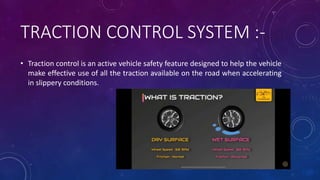
WHAT IS TRACTION ?
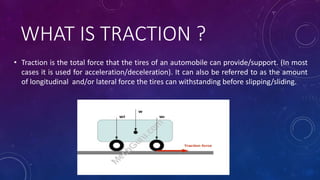
• Traction is the total force that the tires of an automobile can provide/support. (In most
cases it is used for acceleration/deceleration). It can also be referred to as the amount
of longitudinal and/or lateral force the tires can withstanding before slipping/sliding.
NEED FOR TRACTION CONTROL :-
• Acceleration of a vehicle is limited by two factors power of the engine and
traction force between the tire and road surface .
• Thus it is necessary to have traction control in order to maintain the vehicle
motion in adverse conditions like slippery surface or in climbing hills.
TRACTION CONTROL SYSTEM :-
• Traction control is an active vehicle safety feature designed to help the vehicle
make effective use of all the traction available on the road when accelerating
in slippery conditions.
T.C.S AND A.B.S :-
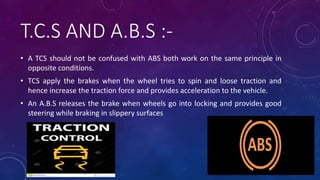
• A TCS should not be confused with ABS both work on the same principle in
opposite conditions.
• TCS apply the brakes when the wheel tries to spin and loose traction and
hence increase the traction force and provides acceleration to the vehicle.
• An A.B.S releases the brake when wheels go into locking and provides good
steering while braking in slippery surfaces
HISTORY OF T.C.S :-
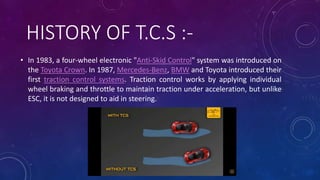
• In 1983, a four-wheel electronic "Anti-Skid Control" system was introduced on
the Toyota Crown. In 1987, Mercedes-Benz, BMW and Toyota introduced their
first traction control systems. Traction control works by applying individual
wheel braking and throttle to maintain traction under acceleration, but unlike
ESC, it is not designed to aid in steering.
WORKING OF T.C.S :-
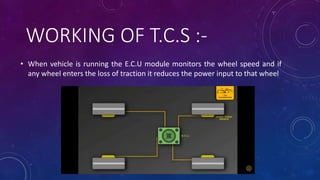
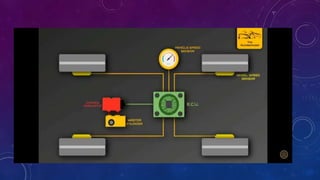
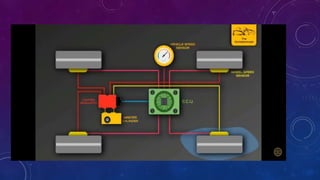
• When vehicle is running the E.C.U module monitors the wheel speed and if
any wheel enters the loss of traction it reduces the power input to that wheel
TYPES OF T.C.S :-
• Controlling the wheel slippage is the aim of traction control system based on
the mode of control it can be broadly classified into :-
1. Torque managed TCS
2. Brake applied TCS
• Torque management in TCS is obtained by :-
1. Retarding of ignition timing
2. Reduce or cut of fuel injection pulses to one or more cylinders
3. Increase EGR flow
CHEVY MALIBU :-
BUICK LACROSSE :-
HYUNDAI GENESIS :-
ADVANTAGES :-
• Easy installation. Traction control systems often use the same infrastructure
as anti-lock brakes, making factory direct installation of traction control easier
for manufacturers
• Safety for weather conditions. Traction control systems present effective
automatic control for hydroplaning in snow and rain conditions
• Insurance discounts. Auto insurance customers can often receive a discount
for traction control and similar systems, since these top-rated safety features
have proven safety values to insurers
DISADVANTAGES :-
• Cost of purchase. The high-functioning gear that's involved in traction control
can make a car an increasingly expensive purchase.
• Cost of maintenance. A vast range of things can damage traction control or
anti-lock brake sensors, and with each of these carrying a hefty price tag, the
cost of repairs can easily spin out of control.
• Limited use. Traction control systems are not ideal for all kinds of situations.
APPLICATIONS :-
• IN ROAD CARS
• IN RACE CARS
• IN MOTORCYCLES
• IN OFF ROAD VEHICLES
Traction control system

Traction control system

  • 1.
    TRACTION CONTROL SYSTEM BY:- G . SAI MANOHAR ROLL NO :- 18311A0315 BRANCH :- MECHANICAL YEAR :- B-TECH 2ND YEAR SECTION :- MECH-B1
  • 2.
    WHAT IS TRACTION? • Traction is the total force that the tires of an automobile can provide/support. (In most cases it is used for acceleration/deceleration). It can also be referred to as the amount of longitudinal and/or lateral force the tires can withstanding before slipping/sliding.
  • 3.
    NEED FOR TRACTIONCONTROL :- • Acceleration of a vehicle is limited by two factors power of the engine and traction force between the tire and road surface . • Thus it is necessary to have traction control in order to maintain the vehicle motion in adverse conditions like slippery surface or in climbing hills.
  • 5.
    TRACTION CONTROL SYSTEM:- • Traction control is an active vehicle safety feature designed to help the vehicle make effective use of all the traction available on the road when accelerating in slippery conditions.
  • 6.
    T.C.S AND A.B.S:- • A TCS should not be confused with ABS both work on the same principle in opposite conditions. • TCS apply the brakes when the wheel tries to spin and loose traction and hence increase the traction force and provides acceleration to the vehicle. • An A.B.S releases the brake when wheels go into locking and provides good steering while braking in slippery surfaces
  • 7.
    HISTORY OF T.C.S:- • In 1983, a four-wheel electronic "Anti-Skid Control" system was introduced on the Toyota Crown. In 1987, Mercedes-Benz, BMW and Toyota introduced their first traction control systems. Traction control works by applying individual wheel braking and throttle to maintain traction under acceleration, but unlike ESC, it is not designed to aid in steering.
  • 8.
    WORKING OF T.C.S:- • When vehicle is running the E.C.U module monitors the wheel speed and if any wheel enters the loss of traction it reduces the power input to that wheel
  • 11.
    TYPES OF T.C.S:- • Controlling the wheel slippage is the aim of traction control system based on the mode of control it can be broadly classified into :- 1. Torque managed TCS 2. Brake applied TCS • Torque management in TCS is obtained by :- 1. Retarding of ignition timing 2. Reduce or cut of fuel injection pulses to one or more cylinders 3. Increase EGR flow
  • 12.
  • 13.
  • 14.
  • 15.
    ADVANTAGES :- • Easyinstallation. Traction control systems often use the same infrastructure as anti-lock brakes, making factory direct installation of traction control easier for manufacturers • Safety for weather conditions. Traction control systems present effective automatic control for hydroplaning in snow and rain conditions • Insurance discounts. Auto insurance customers can often receive a discount for traction control and similar systems, since these top-rated safety features have proven safety values to insurers
  • 16.
    DISADVANTAGES :- • Costof purchase. The high-functioning gear that's involved in traction control can make a car an increasingly expensive purchase. • Cost of maintenance. A vast range of things can damage traction control or anti-lock brake sensors, and with each of these carrying a hefty price tag, the cost of repairs can easily spin out of control. • Limited use. Traction control systems are not ideal for all kinds of situations.
  • 17.
    APPLICATIONS :- • INROAD CARS • IN RACE CARS • IN MOTORCYCLES • IN OFF ROAD VEHICLES