DESIGN AND FABRICATION OF CROSS LINK
FOUR WHEEL STEERING
PROJECT REVIEW
1
13/04/2015DATE
P R O J E C T M E M B E R S :
R . K O U S I K P R A B H U ( 7 2 0 7 1 2 11 4 0 6 8 )
G . PA L PA N D I A N ( 7 2 0 7 1 2 11 4 1 0 3 )
B . P R E M N AT H ( 7 2 0 7 1 2 11 4 111 )
M . R A J A R A M ( 7 2 0 7 1 2 11 4 1 2 2 )
P R O J E C T G U I D E :
M r . C . A . J A G A D I S H M . E ,
A S S I S T A N T P R O F E S S O R
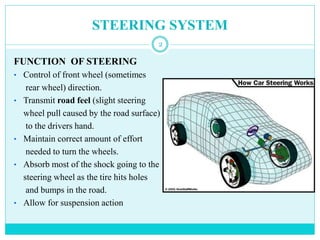
STEERING SYSTEM
FUNCTION OF STEERING
• Control of front wheel (sometimes
rear wheel) direction.
• Transmit road feel (slight steering
wheel pull caused by the road surface)
to the drivers hand.
• Maintain correct amount of effort
needed to turn the wheels.
• Absorb most of the shock going to the
steering wheel as the tire hits holes
and bumps in the road.
• Allow for suspension action
2
OBJECTIVE
3
The main objectives for our project
• To reduce turning radius
• To improve handling and stability of vehicle
• To reduce driver work load
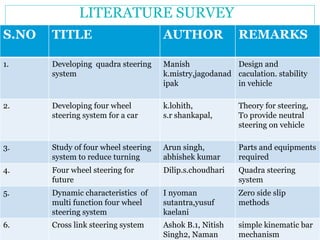
LITERATURE SURVEY
S.NO TITLE AUTHOR REMARKS
1. Developing quadra steering
system
Manish
k.mistry,jagodanad
ipak
Design and
caculation. stability
in vehicle
2. Developing four wheel
steering system for a car
k.lohith,
s.r shankapal,
Theory for steering,
To provide neutral
steering on vehicle
3. Study of four wheel steering
system to reduce turning
Arun singh,
abhishek kumar
Parts and equipments
required
4. Four wheel steering for
future
Dilip.s.choudhari Quadra steering
system
5. Dynamic characteristics of
multi function four wheel
steering system
I nyoman
sutantra,yusuf
kaelani
Zero side slip
methods
6. Cross link steering system Ashok B.1, Nitish
Singh2, Naman
simple kinematic bar
mechanism
4
ABOUT EXISTING SYSTEM AND ITS DRAWBACKS
 A steering system is used to change the direction of motion of the vehicle
and to make the vehicle turn either left or right.
 For this purpose, a steering wheel, a steering rod, and a rack and pinion is
connected to the wheels only on the front.
 Thus making only the front wheels to steer.
 The rear wheels remain constant.
 This makes the rear wheels skid when the vehicle turns.
5
FOUR WHEEL STEERING
 Four-wheel steering (or all wheel steering) is a system employed to improve
steering response.
 Increased vehicle stability while manoeuvring at high speed.
 It also decreases turning radius at low speed.
 By controlling the steering angle of all four wheels, this steering system helps
reduce driver’s steering workload at low speed.
6
HISTORY OF 4WS
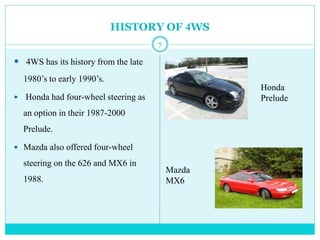
 4WS has its history from the late
1980’s to early 1990’s.
 Honda had four-wheel steering as
an option in their 1987-2000
Prelude.
 Mazda also offered four-wheel
steering on the 626 and MX6 in
1988.
Honda
Prelude
Mazda
MX6
7
CROSS LINK MECHANISM
8
 The material selected for cross bar
and side bar is duplex 2205 stainless
steel hollow pipes of 25.4mm
diameter and 2mm thickness due to
its high tensile strength and its
fracture toughness.
 The setup requires the use of three
ball joints along with a steering rack
and pinion assembly and a modified
knuckle for the attachment of shaft in
the rear end diagonally.
 The material selected for the bar is a
type of super stainless steel having
following properties [2]:
 Ultimate strength = 620 MPa Yield
Strength = 570 MPa Density = 7805
Kg/m3
NOMAL MODE
WORKING
9
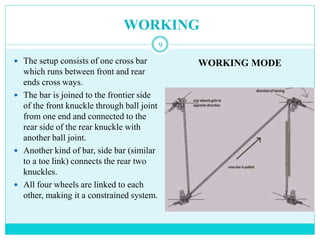
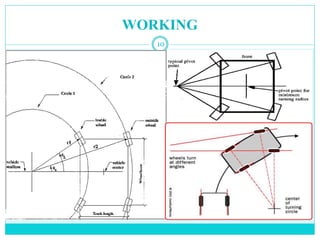
 The setup consists of one cross bar
which runs between front and rear
ends cross ways.
 The bar is joined to the frontier side
of the front knuckle through ball joint
from one end and connected to the
rear side of the rear knuckle with
another ball joint.
 Another kind of bar, side bar (similar
to a toe link) connects the rear two
knuckles.
 All four wheels are linked to each
other, making it a constrained system.
WORKING MODE
WORKING
10
AT LOW SPEED
rear wheels are turned
in opposite direction
of front wheels
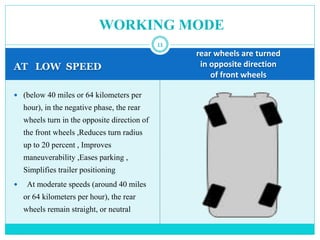
 (below 40 miles or 64 kilometers per
hour), in the negative phase, the rear
wheels turn in the opposite direction of
the front wheels ,Reduces turn radius
up to 20 percent , Improves
maneuverability ,Eases parking ,
Simplifies trailer positioning
 At moderate speeds (around 40 miles
or 64 kilometers per hour), the rear
wheels remain straight, or neutral
WORKING MODE
11
CALCULATION
12
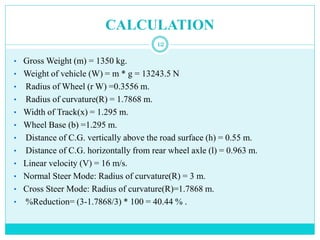
• Gross Weight (m) = 1350 kg.
• Weight of vehicle (W) = m * g = 13243.5 N
• Radius of Wheel (r W) =0.3556 m.
• Radius of curvature(R) = 1.7868 m.
• Width of Track(x) = 1.295 m.
• Wheel Base (b) =1.295 m.
• Distance of C.G. vertically above the road surface (h) = 0.55 m.
• Distance of C.G. horizontally from rear wheel axle (l) = 0.963 m.
• Linear velocity (V) = 16 m/s.
• Normal Steer Mode: Radius of curvature(R) = 3 m.
• Cross Steer Mode: Radius of curvature(R)=1.7868 m.
• %Reduction= (3-1.7868/3) * 100 = 40.44 % .
ADVANTAGES OF 4WS
 Vehicles move smoothly both in the city and on winding roads.
 Added stability means vehicles can be driven safely.
 Quick and responsive control system will allow gentle steering
operation.
 At high speeds, the four wheel steering system avoids skidding in cars.
 At slow speeds, the four wheel steering system helps in reducing
turning radius by 21% which has its applications in parking.
 The mechanism can be controlled electronically or hydraulically.
13
DISADVANTAGES OF 4WS
 Complex links to connect front and rear wheels.
 Expensive.
 Additional weight to the vehicle.
14
RECENT APPLICATIONS
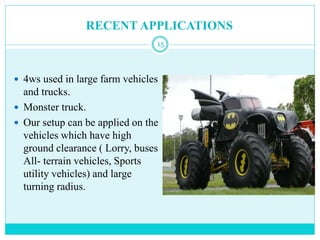
 4ws used in large farm vehicles
and trucks.
 Monster truck.
 Our setup can be applied on the
vehicles which have high
ground clearance ( Lorry, buses
All- terrain vehicles, Sports
utility vehicles) and large
turning radius.
15
2WS 4WS
 Only front wheels are steered.
 Turning radius is large.
 Steering response and stability are
less.
 Less complicated.
 More complicate for lane change.
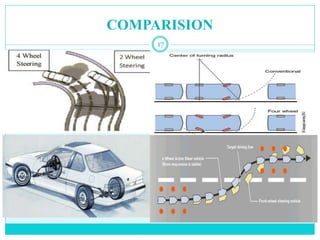
 Both front and rear wheels are
steered.
 Turning radius is smaller than
2WS.
 Steering response and stability are
high.
 More complicated.
 Easily taking lane change
COMPARISON
16
COMPARISION
17
REFERENCE
 [1] PACEJKA, H. B. 2006. Tyre Mechanics and Vehicle Dynamics,
Butterworth-Heinemann .
 [2] Bansal, R.K. 2010. A textbook of Strength of Materials, Laxmi
Publications.
 [3] REIMPELL, J. 2001. The Automotive Chassis - Engineering
Principles, Butterworth-Heinemann .
 [4] William F. Milliken, Douglas L. Milliken, 1995. Race Car Vehicle
Dynamics , Society of Automotive Engineers
 [5] Swanson Analysis Systems, Inc. ANSYS software (Version 14.0).
 [6] Dassault Systèmes SolidWorks Corp., a subsidiary of Dassault
Systèmes, S. A. (Vélizy, France) Solidworks software
(December9,2009), version 4.
18
19
THANK YOU

Final 151016152601-lva1-app6891

  • 1.
    DESIGN AND FABRICATIONOF CROSS LINK FOUR WHEEL STEERING PROJECT REVIEW 1 13/04/2015DATE P R O J E C T M E M B E R S : R . K O U S I K P R A B H U ( 7 2 0 7 1 2 11 4 0 6 8 ) G . PA L PA N D I A N ( 7 2 0 7 1 2 11 4 1 0 3 ) B . P R E M N AT H ( 7 2 0 7 1 2 11 4 111 ) M . R A J A R A M ( 7 2 0 7 1 2 11 4 1 2 2 ) P R O J E C T G U I D E : M r . C . A . J A G A D I S H M . E , A S S I S T A N T P R O F E S S O R
  • 2.
    STEERING SYSTEM FUNCTION OFSTEERING • Control of front wheel (sometimes rear wheel) direction. • Transmit road feel (slight steering wheel pull caused by the road surface) to the drivers hand. • Maintain correct amount of effort needed to turn the wheels. • Absorb most of the shock going to the steering wheel as the tire hits holes and bumps in the road. • Allow for suspension action 2
  • 3.
    OBJECTIVE 3 The main objectivesfor our project • To reduce turning radius • To improve handling and stability of vehicle • To reduce driver work load
  • 4.
    LITERATURE SURVEY S.NO TITLEAUTHOR REMARKS 1. Developing quadra steering system Manish k.mistry,jagodanad ipak Design and caculation. stability in vehicle 2. Developing four wheel steering system for a car k.lohith, s.r shankapal, Theory for steering, To provide neutral steering on vehicle 3. Study of four wheel steering system to reduce turning Arun singh, abhishek kumar Parts and equipments required 4. Four wheel steering for future Dilip.s.choudhari Quadra steering system 5. Dynamic characteristics of multi function four wheel steering system I nyoman sutantra,yusuf kaelani Zero side slip methods 6. Cross link steering system Ashok B.1, Nitish Singh2, Naman simple kinematic bar mechanism 4
  • 5.
    ABOUT EXISTING SYSTEMAND ITS DRAWBACKS  A steering system is used to change the direction of motion of the vehicle and to make the vehicle turn either left or right.  For this purpose, a steering wheel, a steering rod, and a rack and pinion is connected to the wheels only on the front.  Thus making only the front wheels to steer.  The rear wheels remain constant.  This makes the rear wheels skid when the vehicle turns. 5
  • 6.
    FOUR WHEEL STEERING Four-wheel steering (or all wheel steering) is a system employed to improve steering response.  Increased vehicle stability while manoeuvring at high speed.  It also decreases turning radius at low speed.  By controlling the steering angle of all four wheels, this steering system helps reduce driver’s steering workload at low speed. 6
  • 7.
    HISTORY OF 4WS 4WS has its history from the late 1980’s to early 1990’s.  Honda had four-wheel steering as an option in their 1987-2000 Prelude.  Mazda also offered four-wheel steering on the 626 and MX6 in 1988. Honda Prelude Mazda MX6 7
  • 8.
    CROSS LINK MECHANISM 8 The material selected for cross bar and side bar is duplex 2205 stainless steel hollow pipes of 25.4mm diameter and 2mm thickness due to its high tensile strength and its fracture toughness.  The setup requires the use of three ball joints along with a steering rack and pinion assembly and a modified knuckle for the attachment of shaft in the rear end diagonally.  The material selected for the bar is a type of super stainless steel having following properties [2]:  Ultimate strength = 620 MPa Yield Strength = 570 MPa Density = 7805 Kg/m3 NOMAL MODE
  • 9.
    WORKING 9  The setupconsists of one cross bar which runs between front and rear ends cross ways.  The bar is joined to the frontier side of the front knuckle through ball joint from one end and connected to the rear side of the rear knuckle with another ball joint.  Another kind of bar, side bar (similar to a toe link) connects the rear two knuckles.  All four wheels are linked to each other, making it a constrained system. WORKING MODE
  • 10.
  • 11.
    AT LOW SPEED rearwheels are turned in opposite direction of front wheels  (below 40 miles or 64 kilometers per hour), in the negative phase, the rear wheels turn in the opposite direction of the front wheels ,Reduces turn radius up to 20 percent , Improves maneuverability ,Eases parking , Simplifies trailer positioning  At moderate speeds (around 40 miles or 64 kilometers per hour), the rear wheels remain straight, or neutral WORKING MODE 11
  • 12.
    CALCULATION 12 • Gross Weight(m) = 1350 kg. • Weight of vehicle (W) = m * g = 13243.5 N • Radius of Wheel (r W) =0.3556 m. • Radius of curvature(R) = 1.7868 m. • Width of Track(x) = 1.295 m. • Wheel Base (b) =1.295 m. • Distance of C.G. vertically above the road surface (h) = 0.55 m. • Distance of C.G. horizontally from rear wheel axle (l) = 0.963 m. • Linear velocity (V) = 16 m/s. • Normal Steer Mode: Radius of curvature(R) = 3 m. • Cross Steer Mode: Radius of curvature(R)=1.7868 m. • %Reduction= (3-1.7868/3) * 100 = 40.44 % .
  • 13.
    ADVANTAGES OF 4WS Vehicles move smoothly both in the city and on winding roads.  Added stability means vehicles can be driven safely.  Quick and responsive control system will allow gentle steering operation.  At high speeds, the four wheel steering system avoids skidding in cars.  At slow speeds, the four wheel steering system helps in reducing turning radius by 21% which has its applications in parking.  The mechanism can be controlled electronically or hydraulically. 13
  • 14.
    DISADVANTAGES OF 4WS Complex links to connect front and rear wheels.  Expensive.  Additional weight to the vehicle. 14
  • 15.
    RECENT APPLICATIONS  4wsused in large farm vehicles and trucks.  Monster truck.  Our setup can be applied on the vehicles which have high ground clearance ( Lorry, buses All- terrain vehicles, Sports utility vehicles) and large turning radius. 15
  • 16.
    2WS 4WS  Onlyfront wheels are steered.  Turning radius is large.  Steering response and stability are less.  Less complicated.  More complicate for lane change.  Both front and rear wheels are steered.  Turning radius is smaller than 2WS.  Steering response and stability are high.  More complicated.  Easily taking lane change COMPARISON 16
  • 17.
  • 18.
    REFERENCE  [1] PACEJKA,H. B. 2006. Tyre Mechanics and Vehicle Dynamics, Butterworth-Heinemann .  [2] Bansal, R.K. 2010. A textbook of Strength of Materials, Laxmi Publications.  [3] REIMPELL, J. 2001. The Automotive Chassis - Engineering Principles, Butterworth-Heinemann .  [4] William F. Milliken, Douglas L. Milliken, 1995. Race Car Vehicle Dynamics , Society of Automotive Engineers  [5] Swanson Analysis Systems, Inc. ANSYS software (Version 14.0).  [6] Dassault Systèmes SolidWorks Corp., a subsidiary of Dassault Systèmes, S. A. (Vélizy, France) Solidworks software (December9,2009), version 4. 18
  • 19.