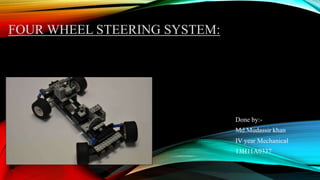
FOUR WHEEL STEERING SYSTEM:
Done by:-
Md.Mudassir khan
IV year Mechanical
13H11A0337
CONTENTS:
i. Contents
ii. Introduction
iii. Steering system
iv. Working principle
v. Types of 4 wheel steering system
vi. Functions of steering system
vii. Advantages
viii. Disadvantages
ix. Applications
x. Conclusions
ABSTRACT:
The purpose of this report is to discuss about 4 wheel steering system and its’ mechanism. Here we
discuss the 4 wheel system mechanism which we have made as a project.
First we gave an introduction about the 4WS ,then we briefly discuss about different types of 4WS
mechanism and their functioning.
We briefly describe our project. Its’ design, working methodology, working mechanism, cost
analysis.
Then there are some applications of this mechanism for which this system is now being used widely.
After that some advantages and disadvantages of 4WS are pointed out one by one with description.
INTRODUCTION:
4 wheel steering is a method developed in automobile industry for the effective turning of the vehicle
and to increase the maneuverability. In a typical front wheel steering system the rear wheels do not
turn in the direction of the curve and thus curb on the efficiency of the steering. In four wheel steering
the rear wheels turn with the front wheels thus increasing the efficiency of the vehicle. The direction
of steering the rear wheels relative to the front wheels depends on the operating conditions. At low
speed wheel movement is pronounced, so that rear wheels are steered in the opposite direction to that
of front wheels. At high speed, when steering adjustments are subtle, the front wheels and the rear
wheels turn in the same direction.
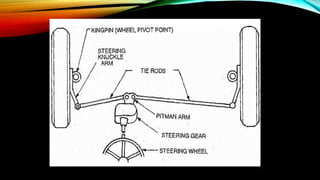
STEERING SYSTEM:
• Steering is the collection of components and
linkages which allow a vehicle to follow the
desired course. To get the desire output, input is
given by a function which is called steering
wheel. The most conventional steering
arrangement is to turn the front wheels using a
hand operated steering wheel which is
positioned in front of the driver via the steering
column, which may contain universal joints to
allow it to deviate somewhat from a straight
line. Other arrangements are sometimes found
on different types of vehicles for example, a
tiller or rear wheel steering. Tracked vehicles
such as bulldozers and tanks usually employ
differential steering that is, the tracks are made
to move at different speeds or even in opposite
directions, using clutches and brakes, to bring
about a change of direction
• As we are discussing about car steering
system so there are various types of
steering system based on the movement of
wheels.
I. 2 Wheel Steering.
ii. 4 Wheel Steering.
iii. Power Steering.
iv. Speed Sensitive Steering.
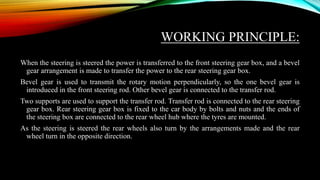
WORKING PRINCIPLE:
When the steering is steered the power is transferred to the front steering gear box, and a bevel
gear arrangement is made to transfer the power to the rear steering gear box.
Bevel gear is used to transmit the rotary motion perpendicularly, so the one bevel gear is
introduced in the front steering rod. Other bevel gear is connected to the transfer rod.
Two supports are used to support the transfer rod. Transfer rod is connected to the rear steering
gear box. Rear steering gear box is fixed to the car body by bolts and nuts and the ends of
the steering box are connected to the rear wheel hub where the tyres are mounted.
As the steering is steered the rear wheels also turn by the arrangements made and the rear
wheel turn in the opposite direction.
TYPES OF STEERING SYSYEM:
There are mainly 3 types of 4WS mechanism
i. Mechanical 4 Wheel System.
ii. Hydraulic 4 Wheel System.
iii. Electro Hydraulic 4 Wheel System.
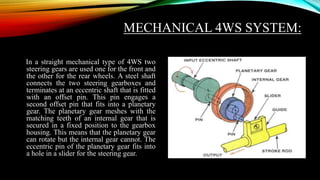
MECHANICAL 4WS SYSTEM:
In a straight mechanical type of 4WS two
steering gears are used one for the front and
the other for the rear wheels. A steel shaft
connects the two steering gearboxes and
terminates at an eccentric shaft that is fitted
with an offset pin. This pin engages a
second offset pin that fits into a planetary
gear. The planetary gear meshes with the
matching teeth of an internal gear that is
secured in a fixed position to the gearbox
housing. This means that the planetary gear
can rotate but the internal gear cannot. The
eccentric pin of the planetary gear fits into
a hole in a slider for the steering gear.
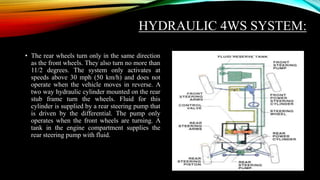
HYDRAULIC 4WS SYSTEM:
• The rear wheels turn only in the same direction
as the front wheels. They also turn no more than
11/2 degrees. The system only activates at
speeds above 30 mph (50 km/h) and does not
operate when the vehicle moves in reverse. A
two way hydraulic cylinder mounted on the rear
stub frame turn the wheels. Fluid for this
cylinder is supplied by a rear steering pump that
is driven by the differential. The pump only
operates when the front wheels are turning. A
tank in the engine compartment supplies the
rear steering pump with fluid.
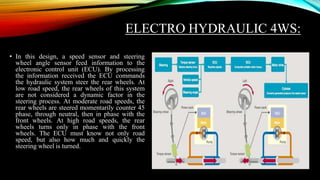
ELECTRO HYDRAULIC 4WS:
• In this design, a speed sensor and steering
wheel angle sensor feed information to the
electronic control unit (ECU). By processing
the information received the ECU commands
the hydraulic system steer the rear wheels. At
low road speed, the rear wheels of this system
are not considered a dynamic factor in the
steering process. At moderate road speeds, the
rear wheels are steered momentarily counter 45
phase, through neutral, then in phase with the
front wheels. At high road speeds, the rear
wheels turns only in phase with the front
wheels. The ECU must know not only road
speed, but also how much and quickly the
steering wheel is turned.
FUNCTIONS OF THE STEERING
SYSTEM:
To control the angular motion the wheels and thus the direction of motion of the
vehicle.
To provide directional stability of the vehicle while going straight ahead.
To facilitate straight ahead condition of the vehicle after completing a turn.
The road irregularities must be damped to the maximum possible extent. This should
co-exist with the road feel for the driver so that he can feel the road condition
without experiencing the effects of moving over it.
To minimize tyre wear and increase the life of the tyres.
ADVANTAGES:
i. Superior cornering stability
ii. Improved steering response and precision
iii. High speed straight line stability
iv. Improved rapid lane changing maneuvers
v. Smaller turning radius
DISADVANTAGES:
i. Expensive Construction
ii. Complex Mechanism
iii. Higher Maintenance Cost
APPLICATIONS:
i. Parking
ii. Junctions
iii. Slippery surfaces
iv. Turning On Narrow Road
v. U - turn
CONCLUSIONS:
• Advantageous to 2WS
• Complex and expensive
• Cost may drop as the system becomes
common
Four Wheel Steering System.

Four Wheel Steering System.

  • 1.
    FOUR WHEEL STEERINGSYSTEM: Done by:- Md.Mudassir khan IV year Mechanical 13H11A0337
  • 2.
    CONTENTS: i. Contents ii. Introduction iii.Steering system iv. Working principle v. Types of 4 wheel steering system vi. Functions of steering system vii. Advantages viii. Disadvantages ix. Applications x. Conclusions
  • 3.
    ABSTRACT: The purpose ofthis report is to discuss about 4 wheel steering system and its’ mechanism. Here we discuss the 4 wheel system mechanism which we have made as a project. First we gave an introduction about the 4WS ,then we briefly discuss about different types of 4WS mechanism and their functioning. We briefly describe our project. Its’ design, working methodology, working mechanism, cost analysis. Then there are some applications of this mechanism for which this system is now being used widely. After that some advantages and disadvantages of 4WS are pointed out one by one with description.
  • 4.
    INTRODUCTION: 4 wheel steeringis a method developed in automobile industry for the effective turning of the vehicle and to increase the maneuverability. In a typical front wheel steering system the rear wheels do not turn in the direction of the curve and thus curb on the efficiency of the steering. In four wheel steering the rear wheels turn with the front wheels thus increasing the efficiency of the vehicle. The direction of steering the rear wheels relative to the front wheels depends on the operating conditions. At low speed wheel movement is pronounced, so that rear wheels are steered in the opposite direction to that of front wheels. At high speed, when steering adjustments are subtle, the front wheels and the rear wheels turn in the same direction.
  • 5.
    STEERING SYSTEM: • Steeringis the collection of components and linkages which allow a vehicle to follow the desired course. To get the desire output, input is given by a function which is called steering wheel. The most conventional steering arrangement is to turn the front wheels using a hand operated steering wheel which is positioned in front of the driver via the steering column, which may contain universal joints to allow it to deviate somewhat from a straight line. Other arrangements are sometimes found on different types of vehicles for example, a tiller or rear wheel steering. Tracked vehicles such as bulldozers and tanks usually employ differential steering that is, the tracks are made to move at different speeds or even in opposite directions, using clutches and brakes, to bring about a change of direction • As we are discussing about car steering system so there are various types of steering system based on the movement of wheels. I. 2 Wheel Steering. ii. 4 Wheel Steering. iii. Power Steering. iv. Speed Sensitive Steering.
  • 7.
    WORKING PRINCIPLE: When thesteering is steered the power is transferred to the front steering gear box, and a bevel gear arrangement is made to transfer the power to the rear steering gear box. Bevel gear is used to transmit the rotary motion perpendicularly, so the one bevel gear is introduced in the front steering rod. Other bevel gear is connected to the transfer rod. Two supports are used to support the transfer rod. Transfer rod is connected to the rear steering gear box. Rear steering gear box is fixed to the car body by bolts and nuts and the ends of the steering box are connected to the rear wheel hub where the tyres are mounted. As the steering is steered the rear wheels also turn by the arrangements made and the rear wheel turn in the opposite direction.
  • 8.
    TYPES OF STEERINGSYSYEM: There are mainly 3 types of 4WS mechanism i. Mechanical 4 Wheel System. ii. Hydraulic 4 Wheel System. iii. Electro Hydraulic 4 Wheel System.
  • 9.
    MECHANICAL 4WS SYSTEM: Ina straight mechanical type of 4WS two steering gears are used one for the front and the other for the rear wheels. A steel shaft connects the two steering gearboxes and terminates at an eccentric shaft that is fitted with an offset pin. This pin engages a second offset pin that fits into a planetary gear. The planetary gear meshes with the matching teeth of an internal gear that is secured in a fixed position to the gearbox housing. This means that the planetary gear can rotate but the internal gear cannot. The eccentric pin of the planetary gear fits into a hole in a slider for the steering gear.
  • 10.
    HYDRAULIC 4WS SYSTEM: •The rear wheels turn only in the same direction as the front wheels. They also turn no more than 11/2 degrees. The system only activates at speeds above 30 mph (50 km/h) and does not operate when the vehicle moves in reverse. A two way hydraulic cylinder mounted on the rear stub frame turn the wheels. Fluid for this cylinder is supplied by a rear steering pump that is driven by the differential. The pump only operates when the front wheels are turning. A tank in the engine compartment supplies the rear steering pump with fluid.
  • 11.
    ELECTRO HYDRAULIC 4WS: •In this design, a speed sensor and steering wheel angle sensor feed information to the electronic control unit (ECU). By processing the information received the ECU commands the hydraulic system steer the rear wheels. At low road speed, the rear wheels of this system are not considered a dynamic factor in the steering process. At moderate road speeds, the rear wheels are steered momentarily counter 45 phase, through neutral, then in phase with the front wheels. At high road speeds, the rear wheels turns only in phase with the front wheels. The ECU must know not only road speed, but also how much and quickly the steering wheel is turned.
  • 12.
    FUNCTIONS OF THESTEERING SYSTEM: To control the angular motion the wheels and thus the direction of motion of the vehicle. To provide directional stability of the vehicle while going straight ahead. To facilitate straight ahead condition of the vehicle after completing a turn. The road irregularities must be damped to the maximum possible extent. This should co-exist with the road feel for the driver so that he can feel the road condition without experiencing the effects of moving over it. To minimize tyre wear and increase the life of the tyres.
  • 13.
    ADVANTAGES: i. Superior corneringstability ii. Improved steering response and precision iii. High speed straight line stability iv. Improved rapid lane changing maneuvers v. Smaller turning radius
  • 14.
    DISADVANTAGES: i. Expensive Construction ii.Complex Mechanism iii. Higher Maintenance Cost
  • 15.
    APPLICATIONS: i. Parking ii. Junctions iii.Slippery surfaces iv. Turning On Narrow Road v. U - turn
  • 16.
    CONCLUSIONS: • Advantageous to2WS • Complex and expensive • Cost may drop as the system becomes common