DIF-FFT
    Presented by :
   Aleem Alsanbani
  Saleem Almaqashi
Fast Fourier Transform FFT

- A fast Fourier transform (FFT) is an efficient algorithm to compute
   the discrete Fourier transform (DFT) and inverse of DFT.

-   There are many FFT algorithms which involves a wide range of
    mathematics,. A Discrete Fourier transform decomposes a
    sequence of values into components of different frequencies.

-   This operation is very useful in many fields but computing it
    directly from the definition is often too slow to be practical .
Cont ..

•   FFT are special algorithms for speedier implementation of DFT.

•   FFT requires a smaller number of arithmetic operations such
    as multiplications and additions than DFT.


•   FFT also requires lesser computational time than DFT .
Fast Fourier Transform Algorithms

•   Direct computation of the DFT is less efficient because it does
    not exploit the properties of symmetry and periodicity of the
    phase factor WN = e-j2π/N .
•   These properties are:

       - Symmetry property.
       - Periodicity property.

•   As we already know that all computationally efficient algorithms
    for DFT are collectively known as FFT Algorithms and these
    algorithms exploit the above two properties of phase factor, WN.
FFT Algorithms Classification Based On
    Decimation

•   Another classification of FFT algorithms based on Decimation of
    s(n) :r S(K). Decimation means decomposition into decimal
    parts. On the basis of decimation process, FFT algorithms are
    of two types:


•   1. Decimation-in-Time FFT algorithms.

•   2. Decimation-in-Frequency FFT algorithms.
Cont..

•   Decimation-in-Time Algorithms: sequence s(n) will be broken
    up into odd numbered and even numbered subsequences.
•   This algorithm was first proposed by Cooley and Tukey in 1965.

•   Decimation-in-Frequency Algorithms. the sequence s(n) will
    be. Broken up into two equal halves.
•   This algorithm was first proposed by Gentlemen and Sande in
    1966.
•   Computation reduction factor of FFT algorithms .
•    Number of computations required for direct DFT / Number of
    computations required for FFT algorithm

•          = N2 / N / 2 log2 (N)
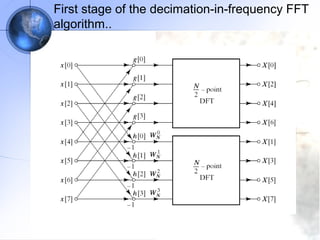
decimation-in-frequency FFT algorithm

•   In decimation-in-frequency FFT algorithm, the output DFT
    sequence S(K) is broken into smaller and smaller
    subsequences. For the derivation of this algorithm, the number
    of points or samples in a given sequence should be N = 2r
    where r > 0. For this purpose, we can first-divide the input
    sequence into the first-half and the second-half of the points.

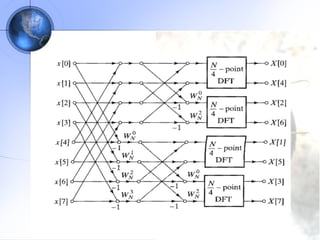
•   Flow graph of complete decimation-in-frequency (DIF)
    decomposition of an N-point DFT computation (N = 8).
Steps for Computation of Decimation in Frequency
    FFT Algorithm
•   Given below are the important steps for the computation of DIF
    FFT algorithms.

•   1. Data shuffling is not required but whole sequence is divided
    in two parts: first half and second half. From these we calculate
    g(n) and h(n) as follows:

•               g(n) = s(n) +s(n+N/2 )

•   and         h(n) = s(n)-s(n+N/2 )

•   where          n = 0, 1, ..., N/2 -1

    Finally data shuffling is performed. It is also performed by Bit
    reversal.
Number Of Complex Multiplications Required In
    DIF- FFT Algorithm


•   Number of complex multiplications required in decimation-m-.
    FFT algorithm are the same as that required in decimation-in-
    time FFT algorithm.

•   Number of complex multiplication required in these DFT
    algorithms are N/2 log2iV, where N= 2r, r>0 and N is the total
    number of points (or samples) in a discrete-time sequence.
    Thus the total computations (number of multiplication and
    addition operations) are the same in both FFT algorithms.
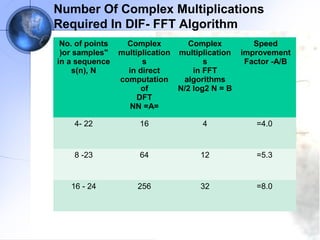
•   Now we will compare the computational complexity for the direct
    computation of the DFT and FFT algorithm. This comparison is
    given in Table
Number Of Complex Multiplications
Required In DIF- FFT Algorithm
 No. of points     Complex        Complex           Speed
 (or samples"    multiplication multiplication   improvement
in a sequence          s               s          Factor -A/B
     s(n(, N       in direct        in FFT
                 computation     algorithms
                       of       N/2 log2 N = B
                      DFT
                    NN =A=

    4- 22             16              4             =4.0


    8 -23             64             12             =5.3


   16 - 24           256             32             =8.0
First stage of the decimation-in-frequency FFT
algorithm..
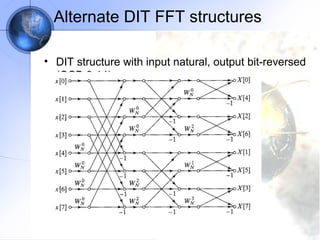
Alternate DIT FFT structures

• DIT structure with input natural, output bit-reversed
  (OSB 9.14):
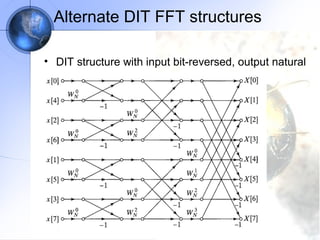
Alternate DIT FFT structures

• DIT structure with input bit-reversed, output natural
Radix-2 Decimation-In-Frequency Solved
  Example Part1

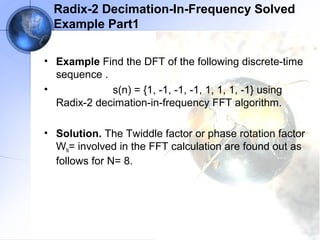
• Example Find the DFT of the following discrete-time
  sequence .
•            s(n) = {1, -1, -1, -1, 1, 1, 1, -1} using
  Radix-2 decimation-in-frequency FFT algorithm.

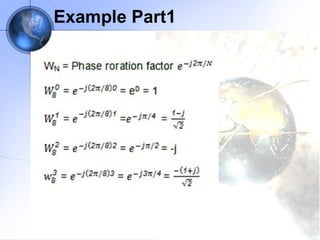
• Solution. The Twiddle factor or phase rotation factor
  WN= involved in the FFT calculation are found out as
  follows for N= 8.
Example Part1
Example Part1
Radix-2 decimation-in-frequency Solved
    Example Part2

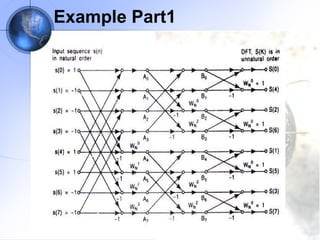
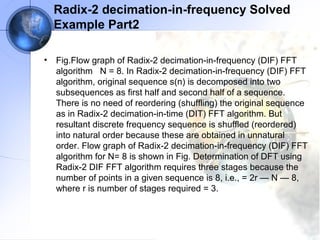
•   Fig.Flow graph of Radix-2 decimation-in-frequency (DIF) FFT
    algorithm N = 8. In Radix-2 decimation-in-frequency (DIF) FFT
    algorithm, original sequence s(n) is decomposed into two
    subsequences as first half and second half of a sequence.
    There is no need of reordering (shuffling) the original sequence
    as in Radix-2 decimation-in-time (DIT) FFT algorithm. But
    resultant discrete frequency sequence is shuffled (reordered)
    into natural order because these are obtained in unnatural
    order. Flow graph of Radix-2 decimation-in-frequency (DIF) FFT
    algorithm for N= 8 is shown in Fig. Determination of DFT using
    Radix-2 DIF FFT algorithm requires three stages because the
    number of points in a given sequence is 8, i.e., = 2r — N — 8,
    where r is number of stages required = 3.
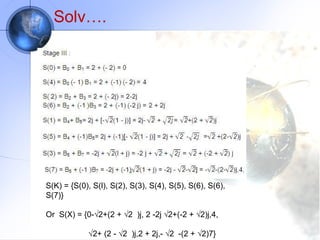
Solv.
Stage I :

        A0 = s(0) + s(4) = 1 + 1 = 2
        A1 = s(l) + s(5) = -1 + 1 =0
        A2 = s(2) + s(6) = -1 + 1 = 0
        A3 = s(3) + s(7) = -1 - 1 = -2
        A4 = [s(0)+(-1) s(4)] W80 = [1 + (-1) (1)] x 1 =0
        A5 = [s(1) + (-1) s(5)]W81 = [-1 + (-1)(1)]((1-j) /√2= - √2(l - j)
        A6 = [s(2) + (-1) s(6)]W82 = [-1 + (-1) x 1] (- j) =2j

        A7 = [s(3) + (-1) s(7)]W83 = [-1 + (-1)(-1)]{(-(1-j) /√2} = 0
Solv….


S(K) = {S(0), S(l), S(2), S(3), S(4), S(5), S(6), S(6),
S(7)}

Or S(X) = {0-√2+(2 + √2 )j, 2 -2j √2+(-2 + √2)j,4,

             √2+ (2 - √2 )j,2 + 2j,- √2 -(2 + √2)7}
Conclusions

• Radix 22, 24… Structure uses less adders and
  multipliers but still has good efficiency processing
  DIF DFT


• Common Factor Algorithm and Butterfly Structure
  enable this architecture to reuse its modules
  numerous times
References

•   [1],Shousheng He and Torkelson, M. “A new approach to pipeline FFT
    processor,” Proceedings of IPPS '96, 15-19, pp766 –770. April 1996
•   [2] Alan V.Oppenheim, Ronald W. Schafer, “ Discrete-time signal
    processing “ 2nd edition
•   [3] Zhangde Wang “INDEX MAPPING FOR ONE TO MULTI
    DIMENSIONS “Electronics Letters Publication Volume: 25, pp: 781-782 Jun
    1989
•   [4] He, S. & Torkelson, M., A systolic array implementation of common
    factor algorithm to compute DFT, Proc. Int. Symp. on Parallel Architectures,
    Algorithms and Networks, Kanazawa, Japan, pp. 374-381, 1994.
•   [5]IJung-YeolOH and Myoung-Seob LIM , ‘Fast Fourier Transform Algorithm
    for Low-Power and Area-Efficient
    Implementation’EICETRANS.COMMUN.,VOL.E89–B, APRI
•   [6]BURRUS, c. s.: 'Index mappings for multidimensional formulation
    of the DFT and convolution',IEEE Trans., 1977, ASSP-25, (6), pp. 239-242
_________
  _____
    __

Dif fft

  • 1.
    DIF-FFT Presented by : Aleem Alsanbani Saleem Almaqashi
  • 2.
    Fast Fourier TransformFFT - A fast Fourier transform (FFT) is an efficient algorithm to compute the discrete Fourier transform (DFT) and inverse of DFT. - There are many FFT algorithms which involves a wide range of mathematics,. A Discrete Fourier transform decomposes a sequence of values into components of different frequencies. - This operation is very useful in many fields but computing it directly from the definition is often too slow to be practical .
  • 3.
    Cont .. • FFT are special algorithms for speedier implementation of DFT. • FFT requires a smaller number of arithmetic operations such as multiplications and additions than DFT. • FFT also requires lesser computational time than DFT .
  • 4.
    Fast Fourier TransformAlgorithms • Direct computation of the DFT is less efficient because it does not exploit the properties of symmetry and periodicity of the phase factor WN = e-j2π/N . • These properties are: - Symmetry property. - Periodicity property. • As we already know that all computationally efficient algorithms for DFT are collectively known as FFT Algorithms and these algorithms exploit the above two properties of phase factor, WN.
  • 5.
    FFT Algorithms ClassificationBased On Decimation • Another classification of FFT algorithms based on Decimation of s(n) :r S(K). Decimation means decomposition into decimal parts. On the basis of decimation process, FFT algorithms are of two types: • 1. Decimation-in-Time FFT algorithms. • 2. Decimation-in-Frequency FFT algorithms.
  • 6.
    Cont.. • Decimation-in-Time Algorithms: sequence s(n) will be broken up into odd numbered and even numbered subsequences. • This algorithm was first proposed by Cooley and Tukey in 1965. • Decimation-in-Frequency Algorithms. the sequence s(n) will be. Broken up into two equal halves. • This algorithm was first proposed by Gentlemen and Sande in 1966. • Computation reduction factor of FFT algorithms . • Number of computations required for direct DFT / Number of computations required for FFT algorithm • = N2 / N / 2 log2 (N)
  • 7.
    decimation-in-frequency FFT algorithm • In decimation-in-frequency FFT algorithm, the output DFT sequence S(K) is broken into smaller and smaller subsequences. For the derivation of this algorithm, the number of points or samples in a given sequence should be N = 2r where r > 0. For this purpose, we can first-divide the input sequence into the first-half and the second-half of the points. • Flow graph of complete decimation-in-frequency (DIF) decomposition of an N-point DFT computation (N = 8).
  • 8.
    Steps for Computationof Decimation in Frequency FFT Algorithm • Given below are the important steps for the computation of DIF FFT algorithms. • 1. Data shuffling is not required but whole sequence is divided in two parts: first half and second half. From these we calculate g(n) and h(n) as follows: • g(n) = s(n) +s(n+N/2 ) • and h(n) = s(n)-s(n+N/2 ) • where n = 0, 1, ..., N/2 -1 Finally data shuffling is performed. It is also performed by Bit reversal.
  • 9.
    Number Of ComplexMultiplications Required In DIF- FFT Algorithm • Number of complex multiplications required in decimation-m-. FFT algorithm are the same as that required in decimation-in- time FFT algorithm. • Number of complex multiplication required in these DFT algorithms are N/2 log2iV, where N= 2r, r>0 and N is the total number of points (or samples) in a discrete-time sequence. Thus the total computations (number of multiplication and addition operations) are the same in both FFT algorithms. • Now we will compare the computational complexity for the direct computation of the DFT and FFT algorithm. This comparison is given in Table
  • 10.
    Number Of ComplexMultiplications Required In DIF- FFT Algorithm No. of points Complex Complex Speed (or samples" multiplication multiplication improvement in a sequence s s Factor -A/B s(n(, N in direct in FFT computation algorithms of N/2 log2 N = B DFT NN =A= 4- 22 16 4 =4.0 8 -23 64 12 =5.3 16 - 24 256 32 =8.0
  • 11.
    First stage ofthe decimation-in-frequency FFT algorithm..
  • 13.
    Alternate DIT FFTstructures • DIT structure with input natural, output bit-reversed (OSB 9.14):
  • 14.
    Alternate DIT FFTstructures • DIT structure with input bit-reversed, output natural
  • 15.
    Radix-2 Decimation-In-Frequency Solved Example Part1 • Example Find the DFT of the following discrete-time sequence . • s(n) = {1, -1, -1, -1, 1, 1, 1, -1} using Radix-2 decimation-in-frequency FFT algorithm. • Solution. The Twiddle factor or phase rotation factor WN= involved in the FFT calculation are found out as follows for N= 8.
  • 16.
  • 17.
  • 18.
    Radix-2 decimation-in-frequency Solved Example Part2 • Fig.Flow graph of Radix-2 decimation-in-frequency (DIF) FFT algorithm N = 8. In Radix-2 decimation-in-frequency (DIF) FFT algorithm, original sequence s(n) is decomposed into two subsequences as first half and second half of a sequence. There is no need of reordering (shuffling) the original sequence as in Radix-2 decimation-in-time (DIT) FFT algorithm. But resultant discrete frequency sequence is shuffled (reordered) into natural order because these are obtained in unnatural order. Flow graph of Radix-2 decimation-in-frequency (DIF) FFT algorithm for N= 8 is shown in Fig. Determination of DFT using Radix-2 DIF FFT algorithm requires three stages because the number of points in a given sequence is 8, i.e., = 2r — N — 8, where r is number of stages required = 3.
  • 19.
    Solv. Stage I : A0 = s(0) + s(4) = 1 + 1 = 2 A1 = s(l) + s(5) = -1 + 1 =0 A2 = s(2) + s(6) = -1 + 1 = 0 A3 = s(3) + s(7) = -1 - 1 = -2 A4 = [s(0)+(-1) s(4)] W80 = [1 + (-1) (1)] x 1 =0 A5 = [s(1) + (-1) s(5)]W81 = [-1 + (-1)(1)]((1-j) /√2= - √2(l - j) A6 = [s(2) + (-1) s(6)]W82 = [-1 + (-1) x 1] (- j) =2j A7 = [s(3) + (-1) s(7)]W83 = [-1 + (-1)(-1)]{(-(1-j) /√2} = 0
  • 20.
    Solv…. S(K) = {S(0),S(l), S(2), S(3), S(4), S(5), S(6), S(6), S(7)} Or S(X) = {0-√2+(2 + √2 )j, 2 -2j √2+(-2 + √2)j,4, √2+ (2 - √2 )j,2 + 2j,- √2 -(2 + √2)7}
  • 21.
    Conclusions • Radix 22,24… Structure uses less adders and multipliers but still has good efficiency processing DIF DFT • Common Factor Algorithm and Butterfly Structure enable this architecture to reuse its modules numerous times
  • 22.
    References • [1],Shousheng He and Torkelson, M. “A new approach to pipeline FFT processor,” Proceedings of IPPS '96, 15-19, pp766 –770. April 1996 • [2] Alan V.Oppenheim, Ronald W. Schafer, “ Discrete-time signal processing “ 2nd edition • [3] Zhangde Wang “INDEX MAPPING FOR ONE TO MULTI DIMENSIONS “Electronics Letters Publication Volume: 25, pp: 781-782 Jun 1989 • [4] He, S. & Torkelson, M., A systolic array implementation of common factor algorithm to compute DFT, Proc. Int. Symp. on Parallel Architectures, Algorithms and Networks, Kanazawa, Japan, pp. 374-381, 1994. • [5]IJung-YeolOH and Myoung-Seob LIM , ‘Fast Fourier Transform Algorithm for Low-Power and Area-Efficient Implementation’EICETRANS.COMMUN.,VOL.E89–B, APRI • [6]BURRUS, c. s.: 'Index mappings for multidimensional formulation of the DFT and convolution',IEEE Trans., 1977, ASSP-25, (6), pp. 239-242
  • 23.