Presented By:
Iffat Anjum
Roll : Rk-554
MSc 1st Semester
Date: 04/05/2014
•
•
•
▫ Forward Fourier and Inverse Fourier
transforms
•
•
2
• Fourier Transform, named after Joseph Fourier, is a
mathematical transformation employed to transform signals
between time(or spatial) domain and frequency domain.
• It is a tool that breaks a waveform (a function or signal) into an
alternate representation, characterized by sine and cosines.
• It shows that any waveform can be re-written as the weighted
sum of sinusoidal functions.
3
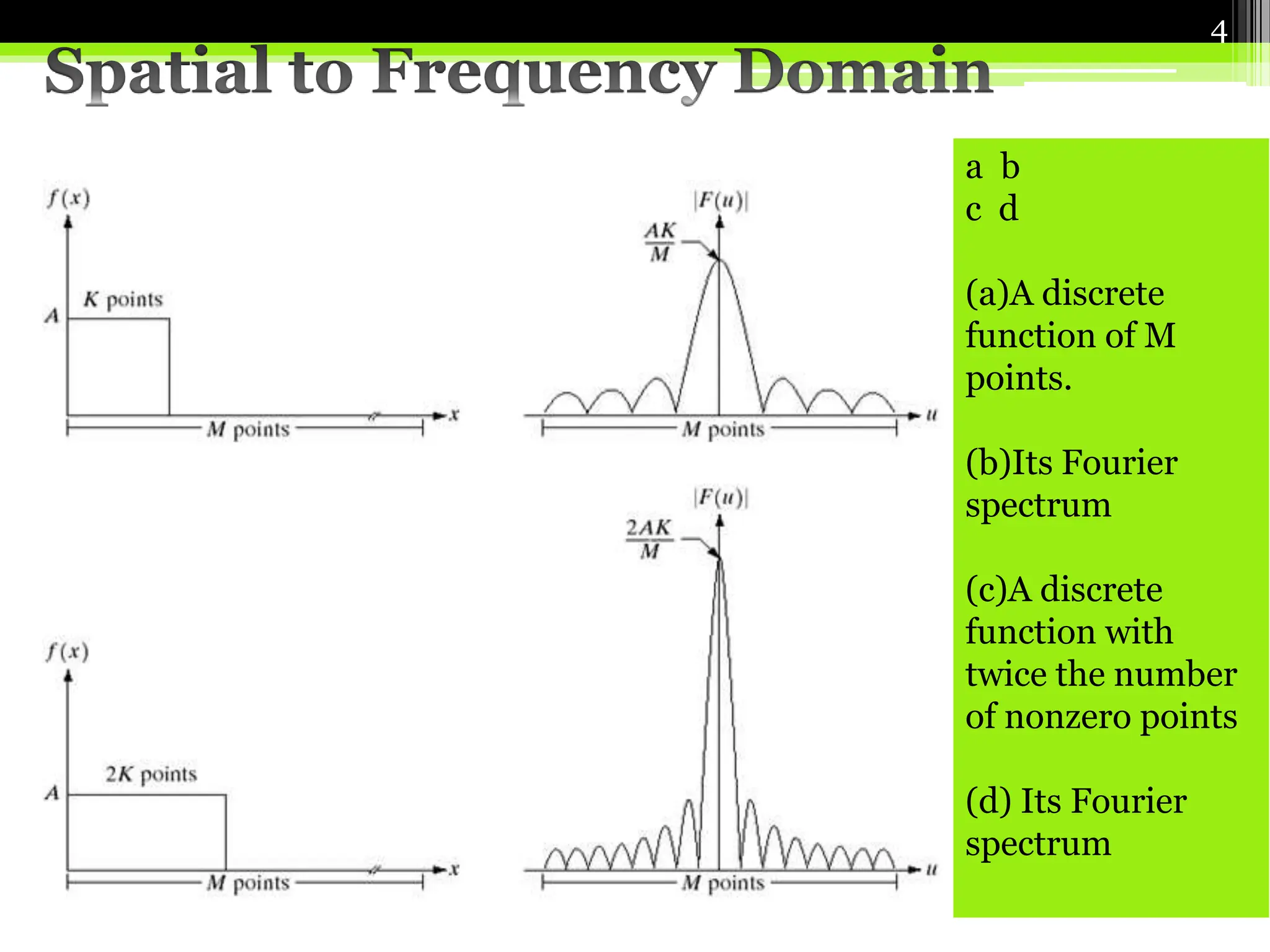
a b
c d
(a)A discrete
function of M
points.
(b)Its Fourier
spectrum
(c)A discrete
function with
twice the number
of nonzero points
(d) Its Fourier
spectrum
4
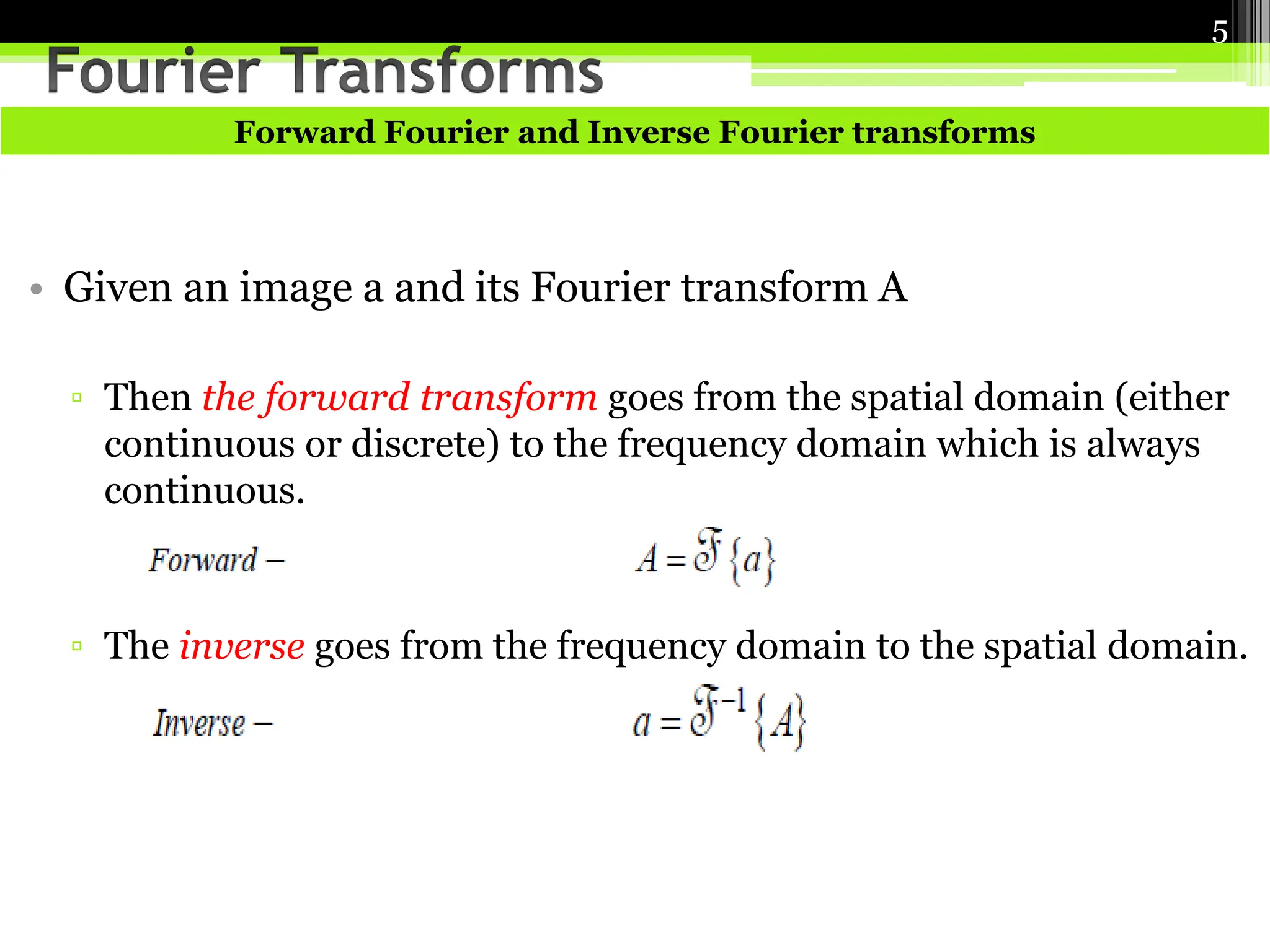
• Given an image a and its Fourier transform A
▫ Then the forward transform goes from the spatial domain (either
continuous or discrete) to the frequency domain which is always
continuous.
▫ The inverse goes from the frequency domain to the spatial domain.
Forward Fourier and Inverse Fourier transforms
5
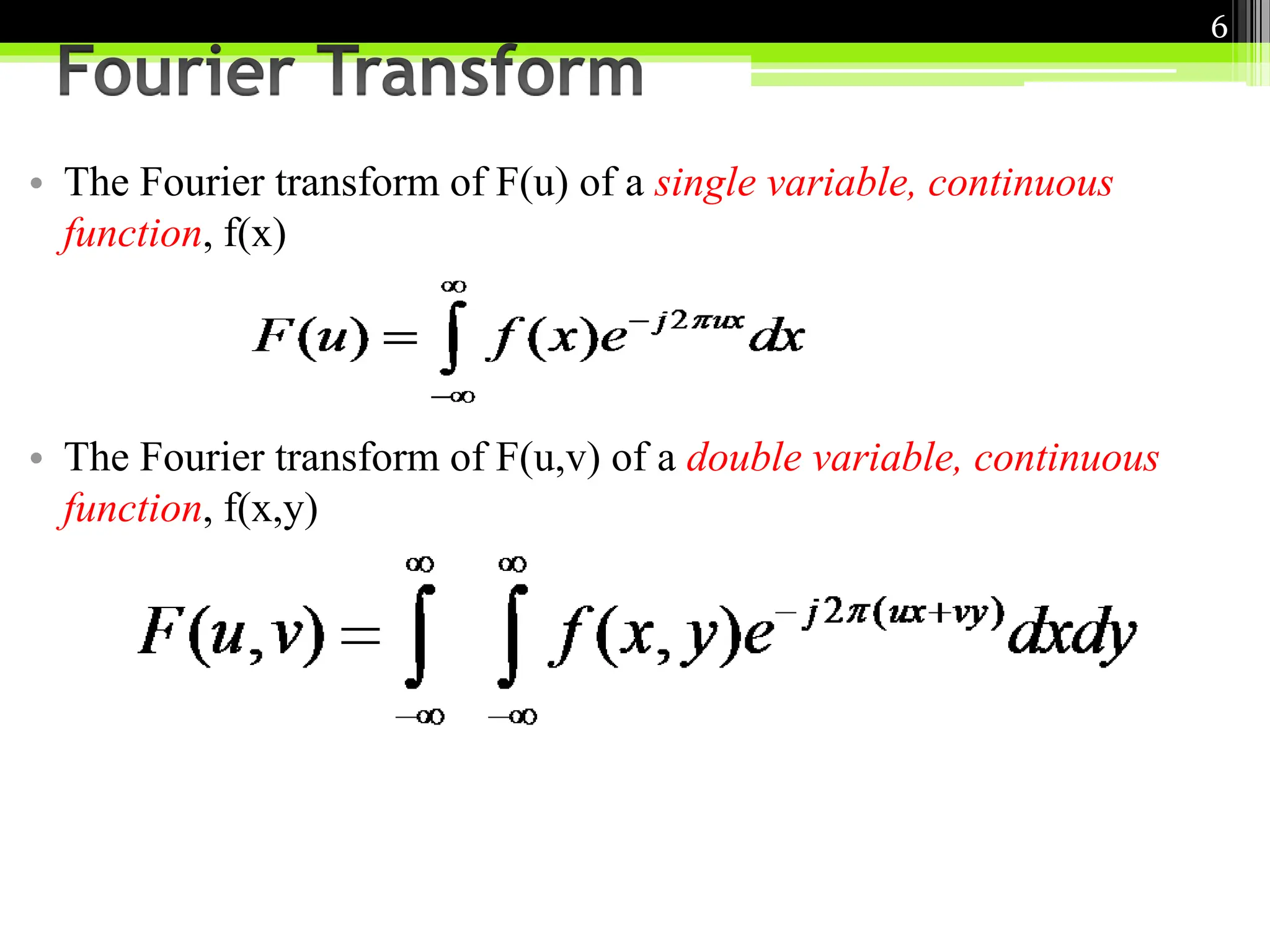
• The Fourier transform of F(u) of a single variable, continuous
function, f(x)
• The Fourier transform of F(u,v) of a double variable, continuous
function, f(x,y)
6
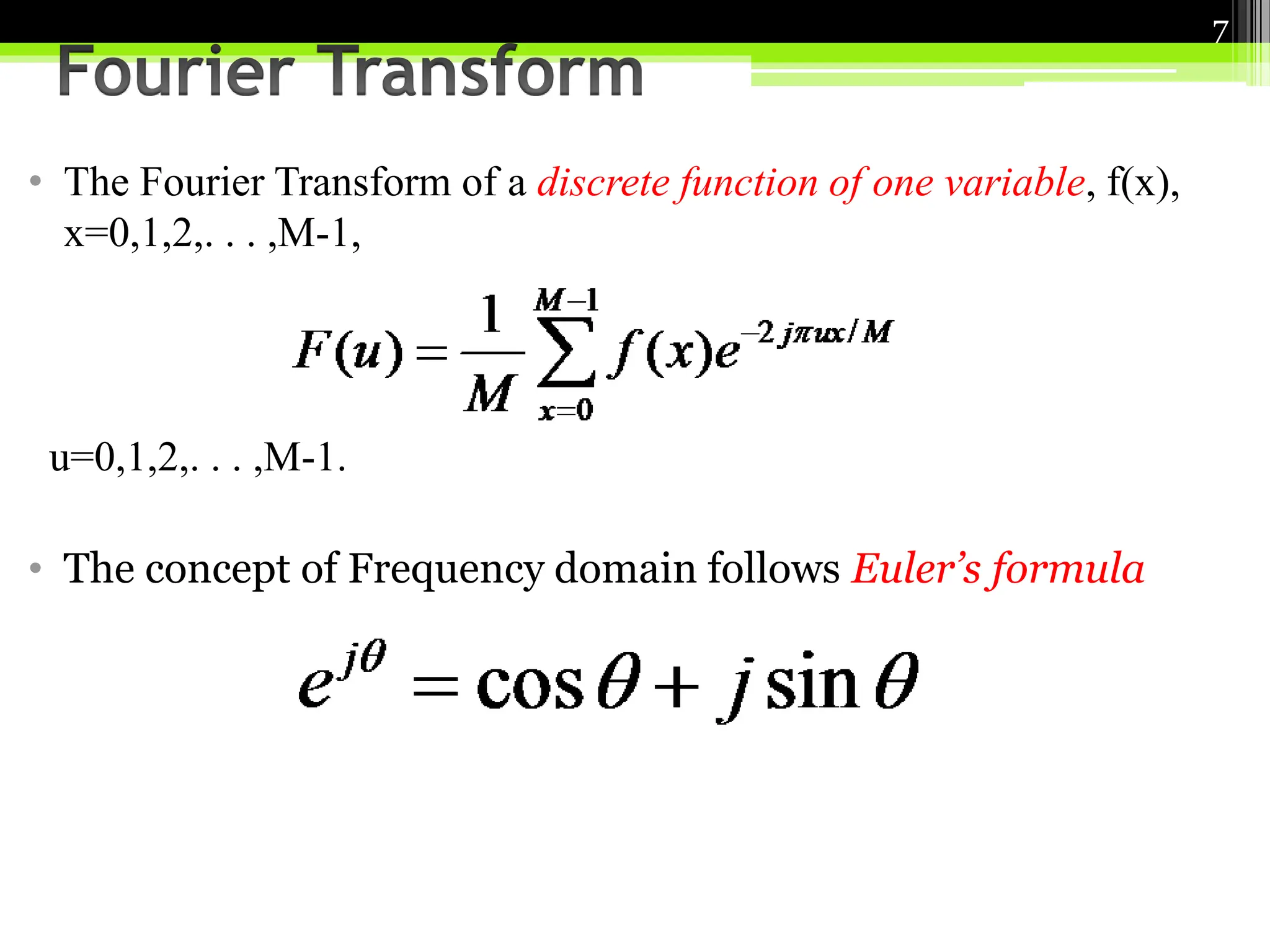
• The Fourier Transform of a discrete function of one variable, f(x),
x=0,1,2,. . . ,M-1,
u=0,1,2,. . . ,M-1.
• The concept of Frequency domain follows Euler’s formula
7
• Fourier Transform (in one dimension)
• Each term of the Fourier transform is composed of the sum of all values of
the function f(x).
• The values of f(x) are multiplied by sine and cosines of various
frequencies.
• Each of the M term of F(u) is called the frequency component of the
transform.
• The domain (values of u) over which the values of F(u) range is
appropriately called the frequency domain.
8
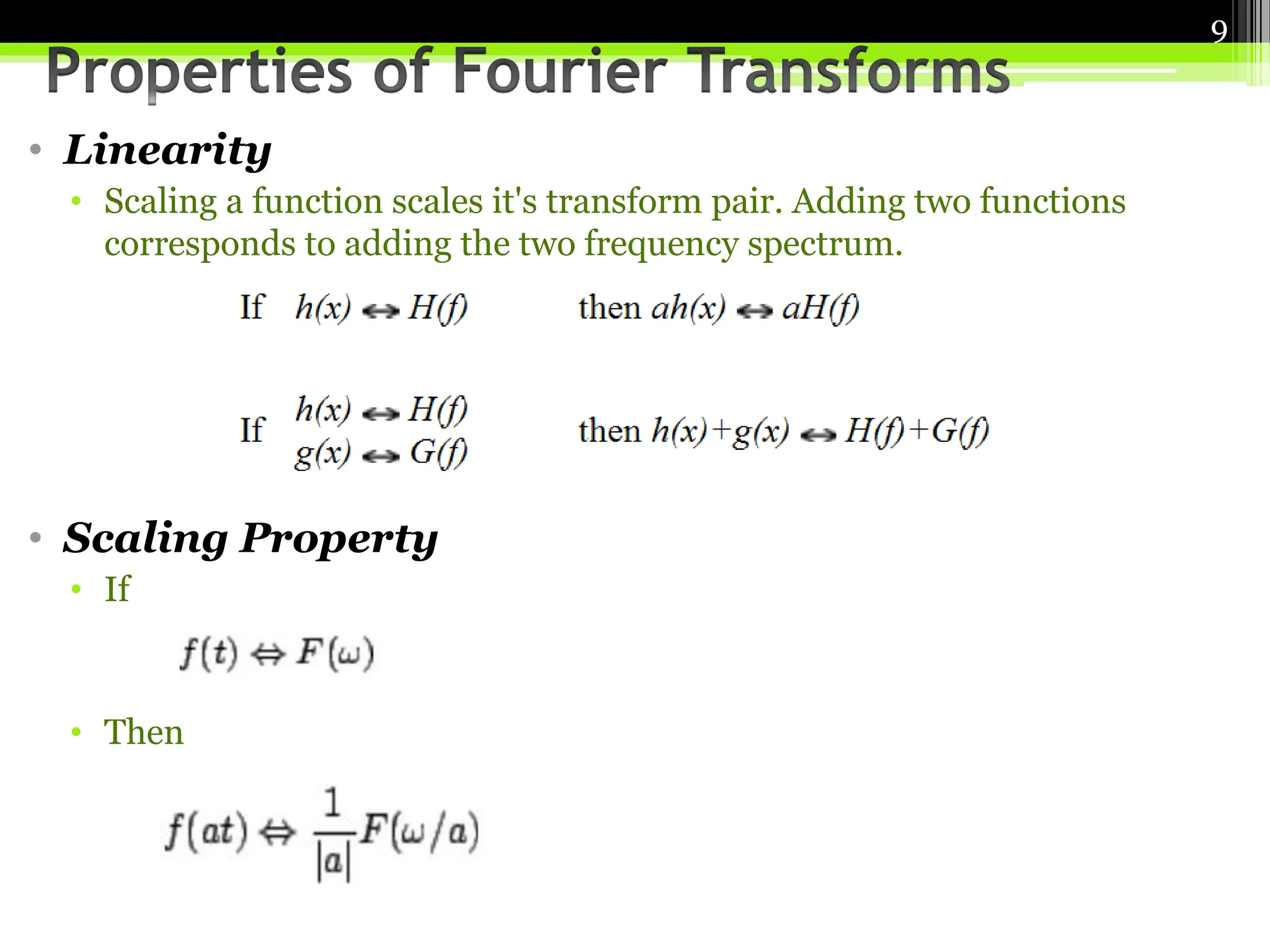
• Linearity
• Scaling a function scales it's transform pair. Adding two functions
corresponds to adding the two frequency spectrum.
• Scaling Property
• If
• Then
9
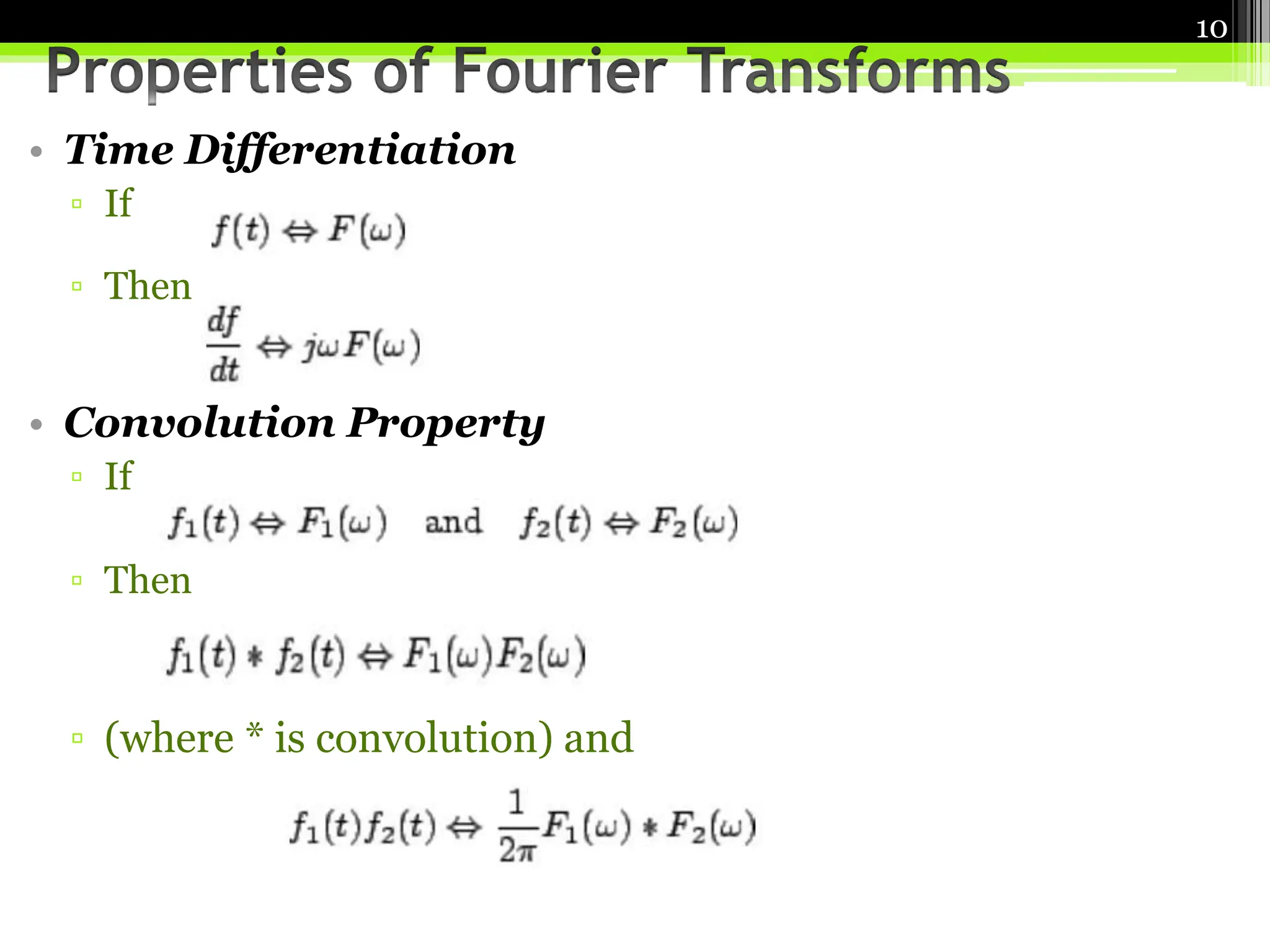
• Time Differentiation
▫ If
▫ Then
• Convolution Property
▫ If
▫ Then
▫ (where * is convolution) and
10
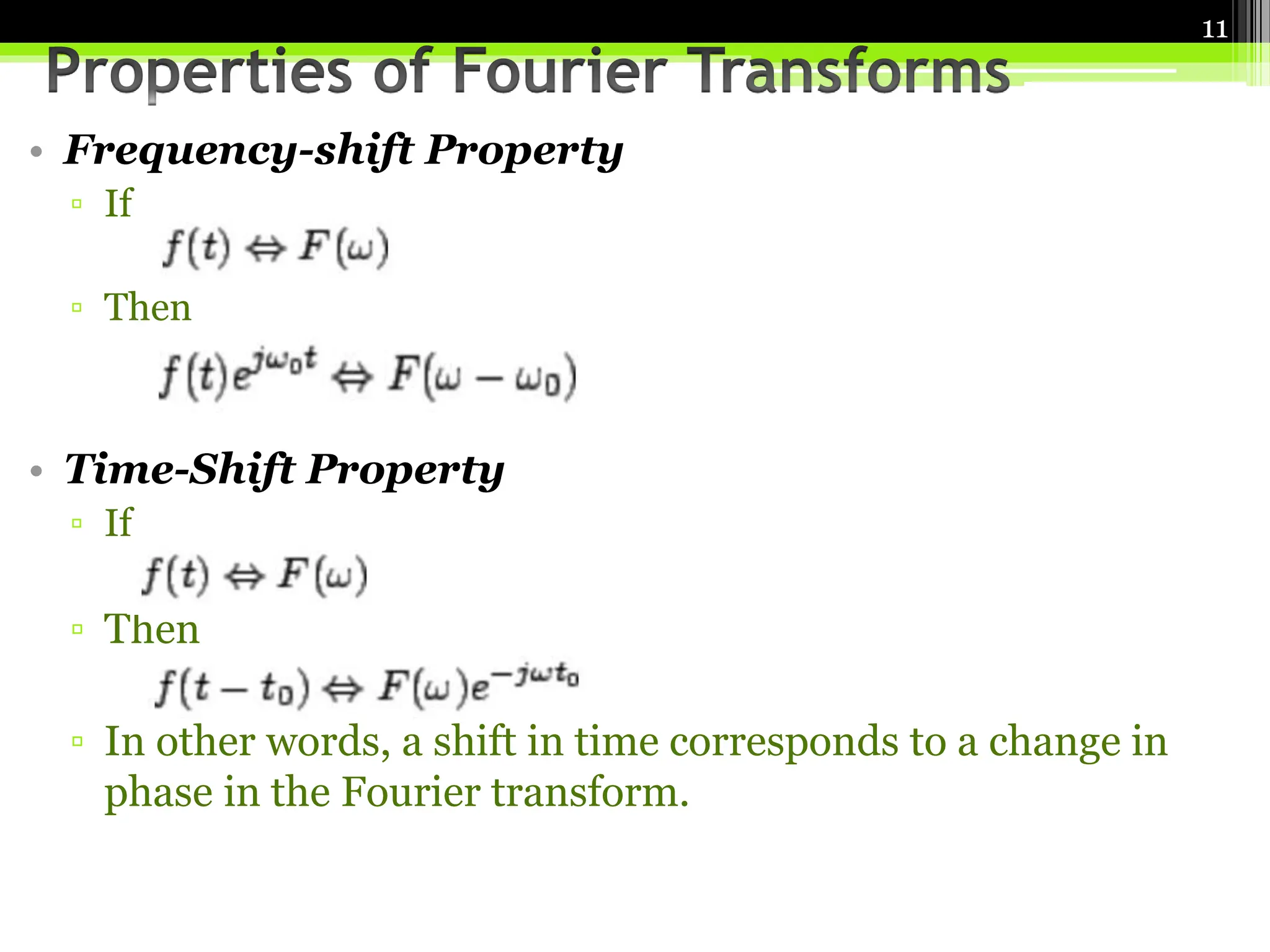
• Frequency-shift Property
▫ If
▫ Then
• Time-Shift Property
▫ If
▫ Then
▫ In other words, a shift in time corresponds to a change in
phase in the Fourier transform.
11
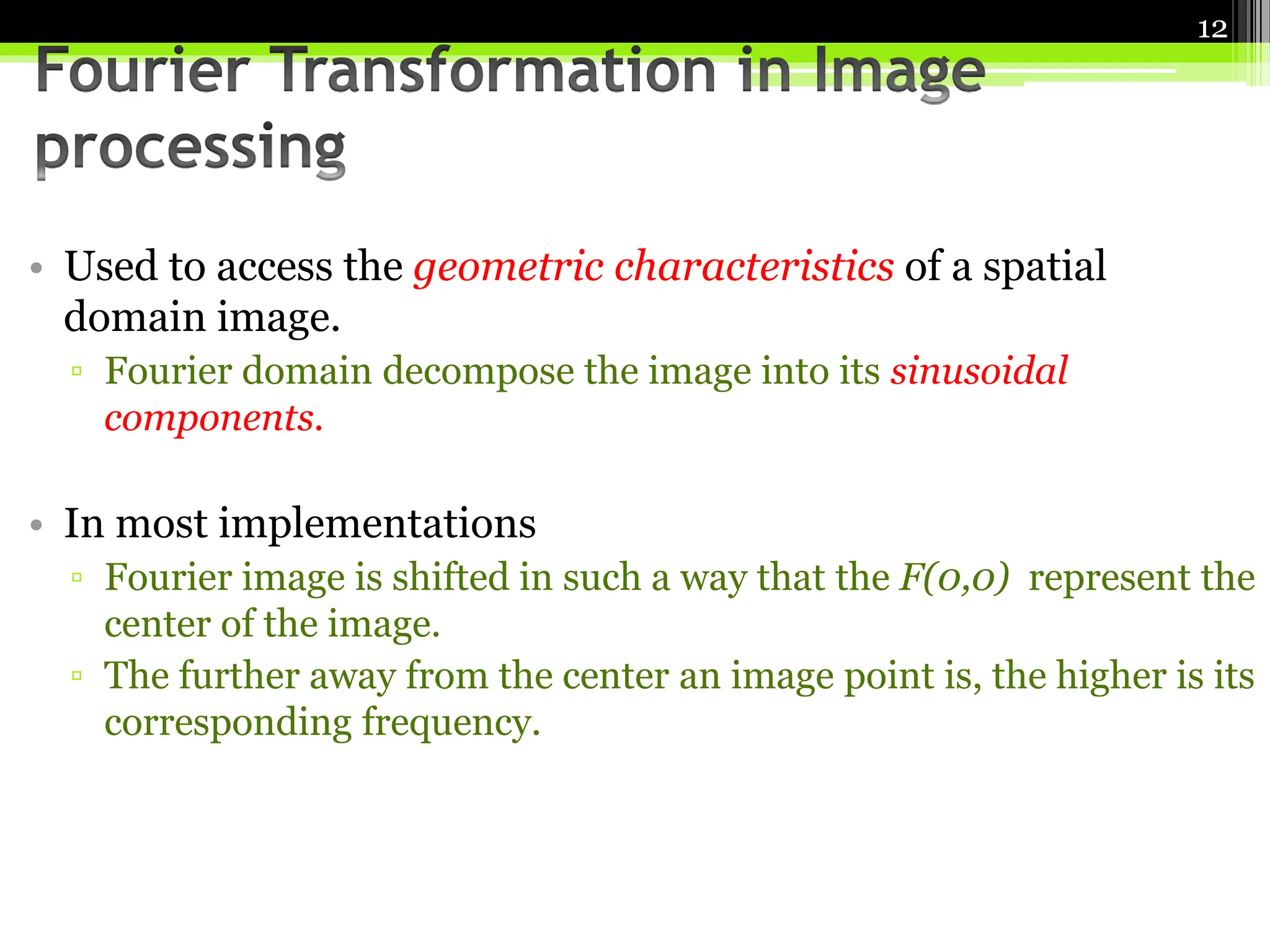
• Used to access the geometric characteristics of a spatial
domain image.
▫ Fourier domain decompose the image into its sinusoidal
components.
• In most implementations
▫ Fourier image is shifted in such a way that the F(0,0) represent the
center of the image.
▫ The further away from the center an image point is, the higher is its
corresponding frequency.
12
• The Fourier Transform is used in a wide range in image
processing
▫ Image filtering,
▫ Image applications
 Image analysis,
 Image filtering,
 Image reconstruction, and
 Image compression.
13
• Fundamentals of Image Processing
Ian T. Young
Jan J. Gerbrands
Lucas J. van Vliet
Delft University of Technology
•http://ocw.usu.edu/Electrical_and_Computer_Engineering/Signals_and_Syste
ms/5_6node6.html
•http://www.thefouriertransform.com/transform/properties.php
•http://homepages.inf.ed.ac.uk/rbf/HIPR2/fourier.htm
14
15

fouriertransformsiffatanjum-141026230143-conversion-gate01.pdf

  • 1.
    Presented By: Iffat Anjum Roll: Rk-554 MSc 1st Semester Date: 04/05/2014
  • 2.
    • • • ▫ Forward Fourierand Inverse Fourier transforms • • 2
  • 3.
    • Fourier Transform,named after Joseph Fourier, is a mathematical transformation employed to transform signals between time(or spatial) domain and frequency domain. • It is a tool that breaks a waveform (a function or signal) into an alternate representation, characterized by sine and cosines. • It shows that any waveform can be re-written as the weighted sum of sinusoidal functions. 3
  • 4.
    a b c d (a)Adiscrete function of M points. (b)Its Fourier spectrum (c)A discrete function with twice the number of nonzero points (d) Its Fourier spectrum 4
  • 5.
    • Given animage a and its Fourier transform A ▫ Then the forward transform goes from the spatial domain (either continuous or discrete) to the frequency domain which is always continuous. ▫ The inverse goes from the frequency domain to the spatial domain. Forward Fourier and Inverse Fourier transforms 5
  • 6.
    • The Fouriertransform of F(u) of a single variable, continuous function, f(x) • The Fourier transform of F(u,v) of a double variable, continuous function, f(x,y) 6
  • 7.
    • The FourierTransform of a discrete function of one variable, f(x), x=0,1,2,. . . ,M-1, u=0,1,2,. . . ,M-1. • The concept of Frequency domain follows Euler’s formula 7
  • 8.
    • Fourier Transform(in one dimension) • Each term of the Fourier transform is composed of the sum of all values of the function f(x). • The values of f(x) are multiplied by sine and cosines of various frequencies. • Each of the M term of F(u) is called the frequency component of the transform. • The domain (values of u) over which the values of F(u) range is appropriately called the frequency domain. 8
  • 9.
    • Linearity • Scalinga function scales it's transform pair. Adding two functions corresponds to adding the two frequency spectrum. • Scaling Property • If • Then 9
  • 10.
    • Time Differentiation ▫If ▫ Then • Convolution Property ▫ If ▫ Then ▫ (where * is convolution) and 10
  • 11.
    • Frequency-shift Property ▫If ▫ Then • Time-Shift Property ▫ If ▫ Then ▫ In other words, a shift in time corresponds to a change in phase in the Fourier transform. 11
  • 12.
    • Used toaccess the geometric characteristics of a spatial domain image. ▫ Fourier domain decompose the image into its sinusoidal components. • In most implementations ▫ Fourier image is shifted in such a way that the F(0,0) represent the center of the image. ▫ The further away from the center an image point is, the higher is its corresponding frequency. 12
  • 13.
    • The FourierTransform is used in a wide range in image processing ▫ Image filtering, ▫ Image applications  Image analysis,  Image filtering,  Image reconstruction, and  Image compression. 13
  • 14.
    • Fundamentals ofImage Processing Ian T. Young Jan J. Gerbrands Lucas J. van Vliet Delft University of Technology •http://ocw.usu.edu/Electrical_and_Computer_Engineering/Signals_and_Syste ms/5_6node6.html •http://www.thefouriertransform.com/transform/properties.php •http://homepages.inf.ed.ac.uk/rbf/HIPR2/fourier.htm 14
  • 15.