






COMPUTER ASSISTED INSTRUCTION
INTRODUCTION
Computers have become omnipresent
and ubiquitous today and found in every
walk of life.
Computer influence every sphere of
human activity and bring many changes
in education, health care, scientific
research, social sciences, law, music and
painting.
DEFINITIONS:
 Computer-assisted instruction (CAI) is an interactive
instructional technique whereby a computer is used to
present the instructional material and monitor the
learning that takes place.
OR
 A self-learning technique, usually offline/online,
involving the interaction of students with
programmed instructional materials.
TERMINOLOGY
Terminology Meaning
CBT Computer Based Training/Test
CAI Computer Assisted Instruction
CAL Computer Assisted Learning
WBT Web Based Training/Tutorial
CALL Computer Assisted Language Learning
WBI Web Based Instruction
MODES OF CAI
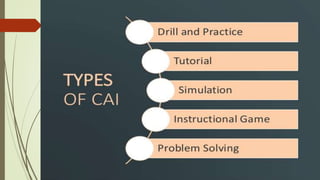
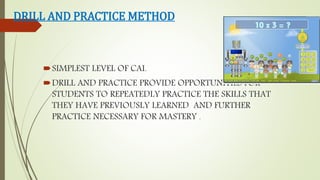
DRILL AND PRACTICE METHOD
SIMPLEST LEVEL OF CAI.
DRILL AND PRACTICE PROVIDE OPPORTUNITIES FOR
STUDENTS TO REPEATEDLY PRACTICE THE SKILLS THAT
THEY HAVE PREVIOUSLY LEARNED AND FURTHER
PRACTICE NECESSARY FOR MASTERY .
CRITERIA OF DRILL AND PRACTICE METHOD
Format is interactive
 User can establish the pace
Provision made the progression in levels of difficulty
Items of same level came selected at random
Employs motivational technique
Rewards presented for correct responses
Incorrect responses handled appropriately
Teacher can modify content
TUTORIAL MODE
 The program tutors or teaches the student a body of
knowledge by presenting information and asking questions
,giving hints if students.
 Tutorials can free the faculty members from teaching some of
the routine basic material.
 At the same time the students may find the tutorials more
interesting and fun than the instructor’s lecture.
SIMULATION
Clear direction
Simple keyboard paddle use
Realistic situation for role playing
High level of interest is maintained throughout
Results predicted in user impulse
Varying levels of difficulty
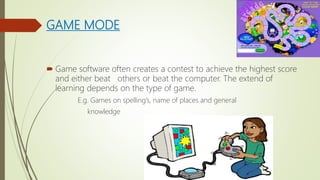
GAME MODE
 Game software often creates a contest to achieve the highest score
and either beat others or beat the computer. The extend of
learning depends on the type of game.
E.g. Games on spelling’s, name of places and general
knowledge
ADVANTAGES OF CAI
 One-to-one interaction
 Great motivator
 Freedom to experiment with different options
 Instantaneous response/immediate feedback to the
answers elicited
 Self pacing - allow students to proceed at their own pace
 Helps teacher can devote more time to individual
students
Cont.
Privacy helps the shy and slow learner to learns
 Individual attention
 learn more and more rapidly
 Multimedia helps to understand difficult concepts
through multi-sensory approach
 Self-directed learning – students can decide when,
where, and what to learn
LIMITATIONS OF CAI
May feel overwhelmed by the
information and resources available
Over use of multimedia may divert the
attention from the content
Learning becomes too mechanical
Non availability of good CAI packages
Lack of infrastructure
INTRODUCTION
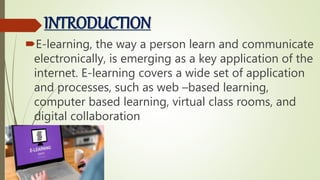
E-learning, the way a person learn and communicate
electronically, is emerging as a key application of the
internet. E-learning covers a wide set of application
and processes, such as web –based learning,
computer based learning, virtual class rooms, and
digital collaboration
DEFINITION
“Computer assisted learning is to convey a vast amount
of information in a very short period if time.it is powerful
of reinforcing concepts and topics first introduced to
students through textbook and discussion in the
classroom. Computer assessed learning enables in a
powerful way to comprehend complex concepts”
-Prof .Hussein Ashram
It refers to anything delivered, enabled, or mediated by
electronic technology for the explicit purpose of learning
TYPES OF COMPUTER ASSISTED LEARNING
Computer Assisted Instruction-When computer is
used as an aid to teaching method of instruction, it is
called computer assisted instruction.
 Computer Managed Instruction-It is defined as the
use of computer programs for the online management
of the instructional process.
MODELS OF COMPUTERASSISTEDLEARNING
DRILL AND PRACTICE MODE
TUTORIAL METHOD
LABORATORY MODE
CASE-SIMULATION MODE
CONSULTANT ROLE
PURPOSES OF CAL
It supports educational and organisational goals
Improved training cost
Decreased material cost
Increased productivity
Standardization
Cont.
It supports the learner’s development.
Real time access
Freedom to fail
Improved retention
Personalized learning
Cont.
Nurtures a learning organization and community
Ongoing access to resource
Knowledge management
Encourage sharing
Learners of choice
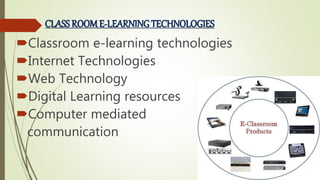
CLASS ROOME-LEARNING TECHNOLOGIES
Classroom e-learning technologies
Internet Technologies
Web Technology
Digital Learning resources
Computer mediated
communication
Digital learning resources
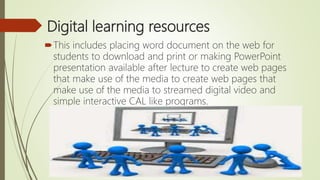
This includes placing word document on the web for
students to download and print or making PowerPoint
presentation available after lecture to create web pages
that make use of the media to create web pages that
make use of the media to streamed digital video and
simple interactive CAL like programs.
ADVANTAGES OF COMPUTER ASSISTED LEARNING
 Each student receives instruction at his own pace.
 Each student responds continuously as he receives instruction.
 All units learning are broken down into sub units and small elements of
learning.
 Students can access the computer at any place.
 Students can learn through their own ways and style. i.e., through examples
through case studies or through problems.
 Students can test their learning at any time of progress.
 The computer is consistent, relevant and approving of every student.
 The program author can update a computer lesson as anew knowledge is
identified.
DISADVANTAGES OF COMPUTER ASSISTED
LEARNING
 Cost Factors
 Content control
 Lack of formal communication among user
 With excessive use of CAL, artistic competence of students takes a back seat.
 It produces more mental and physical stress as compared to other methods
of teaching.
 It does not help in developing language proficiency which depends more on
direct experience with the reality.
 As students cannot interact with the computers in a human language, the
mechanical response by punching keys can become dull and frustrating.
Computer mediated communication
Email-The most popular internet tool used for exchange
messages between individuals
Mailing List - It uses to enable communication among
groups of people. Individuals send e mails to list email
address and receive a copy of all emails send to that
address.
Computer Conferencing -It enables group of people to
hold discussion by reading and posting text messages on a
computer system
Video Conferencing-A means by small group of
geographical distant people can hold discussion at real
time, during which they are able to hear and see each
other.
Hybrid system-Systems such as a web board combine
threaded discussion list IRC. Email lists allowing users to
switch between the people depending on the nature of
discussion. It also offers facility to share documents and
images
CONCLUSION
Technology results in new designs and devices as also new ideas and
process. Educational technology is the application of the scientific
knowledge in a systematic way to improve the efficiency of the
process of learning and instruction. It is considered as the technology
of education more than technology in education.
BIBLIOGRAPHY
 Shebeer P. Basheer(2015),TEXTBOOK OF NURSING EDUCATION,1st Edition,
Emmess Medical Publishers, Bangalore Page No.159-165
 R Sudha (2013), NURSING EDUCATION PRINCIPLES AND CONCEPTS, 1st Edition,
Jaypee Publication New Delhi, Page No.104.
 B. Sankaranarayan, B. Sindhu,(2003),LEARNING AND TEACHING NURSING, 1ST
Brainfill, OF NURSINGEDUCATION,1ST Edition, Jaypee Publication, New Delhi, P
Calicut, Page no.197-201
 K.P NEERAJA(2003), TEXTBOOK age No.324-326
 B.T Basvanthappa(2009), NURSING EDUCATION, 2nd Edition, Jaypee Publications,
New Delhi, Pageno.632-633
NET REFERENCE
 Wikieducator.org/computer_assisted_learning
 Britanica.com/topic/CAI
 Ncbi.nlm.nih.gov/pubmed
 Resources.intensescholl.com

JOURNALREFERENCE
 TNNMC Journal Nursing Education, Jan-June 13,VOL-1,Page No.11-14
 Journal of Nursing education.2007,Feb Vol.46,Page No.75-76
Computer assisted instruction