


SUB-CUTANEOUS
INJECTION
MRS. PRIYADARSHINI
JOHN
ASSOT. PROFESSOR
D.Y.P.S.O.N
MISS.JAYS GEORGE
1ST YR MSC(N)
D.Y.P.S.O.N
DEFINITION
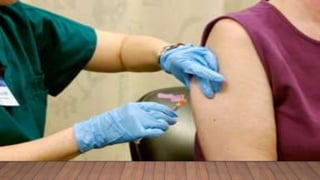
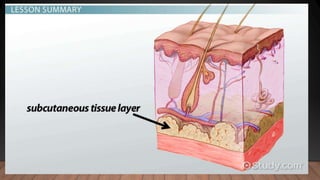
Administering Medication Into The
Subcutaneous Tissue Is Called As
Subcutaneous Injection
PURPOSE
 To Get Rapid And Systemic Effect Of The
Drug.
Some Medicines That Cannot Be administered
Orally Due To Poor Absorption In GI Tract.
When The Drug Is Toxic And Irritating To The
Gastrointestinal Mucosa.
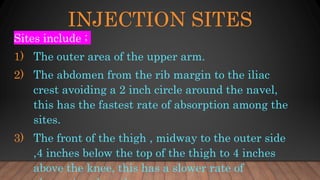
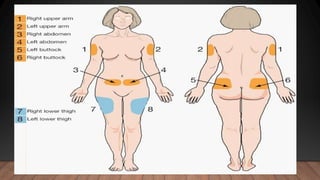
INJECTION SITES
Sites include ;
1) The outer area of the upper arm.
2) The abdomen from the rib margin to the iliac
crest avoiding a 2 inch circle around the navel,
this has the fastest rate of absorption among the
sites.
3) The front of the thigh , midway to the outer side
,4 inches below the top of the thigh to 4 inches
above the knee, this has a slower rate of
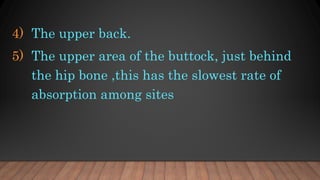
4) The upper back.
5) The upper area of the buttock, just behind
the hip bone ,this has the slowest rate of
absorption among sites
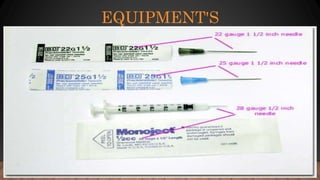
EQUIPMENT'S
ARTICLES
A Tray Containing ;
•Sterile Pre dish With Medication Card
•Sterile Syringe
•Prescribed Medication
•Spirit Swab
•Clean Gloves
•Kidney Tray
PROCEDURE
NURSING ACTION
• Assemble equipment and
check physicians order
• Identify patient carefully
• Explain procedure to the
patient , the drug that is to be
administered , site and how he
has to co operate.
RATIONALE
• Avoids medication error from
occurring
• Ensures that right procedure
is done on right patient.
• Encourage co operation and
always reduce anxiety
• Wash hands
• Withdraw medicine from an
ampule / vial as prescribed.
• Assembles all the equipment
including loaded medication in
syringe near the patient’s
bedside.
• Pull curtains
• Help patient assume position
depending on site selected
• Reduces spread of micro-
organisms
• Provide privacy
• Ensures free access to injection
site.
• Assess the area ,checks for
lumps , nodules , tenderness,
hardness , swelling , scaring ,
itching , burning sensation.
• Wear gloves
• Clean the area around the
injection site with an alcohol
swab use firm circular motion,
while moving outward (5
diameter) allow the site for dry.
• Good observation helps in
establishing the correct
location , site and avoids
damage to tissue.
• Reduces spread of micro
organisms
• Friction help clean the skin
• Remove the needle cap with non
dominant hand, pulling straight
off.
• Grasp and pinch the area
surrounding the injection site or
spread skin at site
• Hold the syringe in dominant
hand between thumb and
forefinger. Inject needle quickly at
an angle of 45 – 90 degree
depending on amount of tissue
turgor of tissue and length of
• Less risk of an accidental needle
prick.
• Provides for easy and less painful
entry into subcutaneous tissue
• Subcutaneous tissue is abundant
in well nourished , well hydrated
people and sparse is emaciated
dehydrated on very thin people.
• After insertion release the tissue and
immediately move your non
dominant hand to steady lower end
of syringe. Slide your dominant hand
to top of the barrel.
• Aspirate if recommended ,by pulling
back gently on the plunger to
determine whether needle is in a
blood vessel. If blood appears ,
withdraws needle and discard. Do
not aspirate for heparin/ insulin.
• Injection solution into compressed
tissue results in pressure against
fibres and creates discomfort the non
dominant hand secures the needles
and allows for smooth aspiration.
• Discomfort and serious reactions
may occur if a drug intended for s/c
administration enters into the blood
stream.
• Heparin is anticoagulant and can
cause bruising on aspiration. Insulin
needle is very small and aspiration
will not give relevant information
• Inject medication slowly, if no
blood appears.
• Withdraw needle quickly at the
same angle as it was inserted ,
while applying counter traction
around the injection site with
non dominant hand.
• Rapid injection of medication
creates pressure in the tissues
and results in discomfort.
• Slow withdrawal of the needle
pulls tissue and causes
discomfort. Applying counter
traction around the site helps
in preventing pulling of tissues
when needle is withdrawn.
• Do not massage a heparin
/insulin injection site.
• Do not discard syringe and
needle without recapping.
• Assist patient to a comfortable
position.
• Massaging heparin can lead to
bruising and after insulin will
contribute to unpredictable
absorption.
• Proper disposal prevents
accidental needle stick injury.
• Wash hands after removing
gloves.
• Document medication
administration with date , time
dosage , route , site and nurses
sign.
• Evaluate response of the patient
to the medication.
TERMINATION OF THE PROCEDURE
Dismantle all the articles in an appropriate manner ;
 syringe in an antiseptic bowl.
Glass syringes to be sent for autoclaving .
Disposible syringes to be sent for crushing in an
shredder.
Steel needle are washed and sent for autoclaving.
Wash the kidney tray and place it in the cupboard.
Knife dish is washed and sent for autoclaving
COMPLICATIONS
•Infection
•Pyrogenic reactions
•Allergic reactions
Subcutaneous injection