Forecasting
What is Forecasting? Process of predicting a future event and it is a mere guess. It is the estimating the future demand for products and services are commonly referred as a sales forecast Underlying basis of all business decisions: Production Inventory Personnel Facilities
NEED OF DEMAND FORECASTING New facility planning Production planning Workforce scheduling Financial planning
Short-range forecast Up to 1 year (usually less than 3 months) Job scheduling, worker assignments, plan for purchasing Medium-range forecast 3 months to 3 years Sales & production planning, budgeting Long-range forecast 3 years, or more New product planning, facility location Forecasts by Time Horizon
Types of Forecasts Economic forecasts Address the future business conditions (e.g., inflation rate, money supply, etc.) Technological forecasts Predict the rate of technological progress Predict acceptance of  new  products Demand forecasts Predict sales of  existing  products
Features of demand forecasting It generally assume the same underlying reasons Forecasts are rarely perfect Forecast for group items will be more perfect than the individual items Forecast accuracy decreases as the time period covered by the forecast
Seven Steps in Forecasting Determine the purpose of the forecast Select the items to be forecasted Determine the time horizon of the forecast Select the forecasting model(s) Gather the data Make the forecast Validate and implement results
Objectives of demand forecasting Short range objectives Formulation of production strategy and policy Formulation of pricing policies Planning and control of sales Financial planning
Objectives of demand forecasting Medium or Long range objectives Long range planning for production capacity Labour requirements Restructuring the capital structure
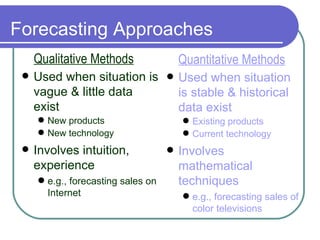
Forecasting Approaches Used when situation is stable & historical data exist Existing products Current technology Involves mathematical techniques e.g., forecasting sales of color televisions Quantitative Methods Used when situation is vague & little data exist New products New technology Involves intuition, experience e.g., forecasting sales on Internet Qualitative Methods
Qualitative Methods Jury of executive opinion Pool opinions of high-level executives, sometimes augment by statistical models Delphi method or judge mental method Panel of experts, queried iteratively Sales force composite Estimates from individual salespersons are reviewed for reasonableness, then aggregated   Consumer (Market research) Survey Ask the customer
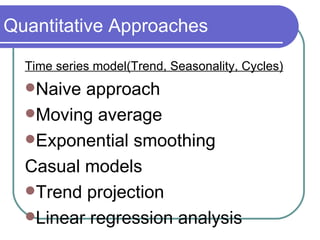
Quantitative Approaches Time series model(Trend, Seasonality, Cycles) Naive approach Moving average Exponential smoothing Casual models Trend projection Linear regression analysis
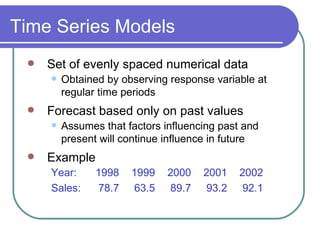
Set of evenly spaced numerical data Obtained by observing response variable at regular time periods Forecast based only on past values Assumes that factors influencing past and present will continue influence in future Example Year: 1998 1999 2000 2001 2002 Sales: 78.7 63.5 89.7 93.2 92.1 Time Series Models
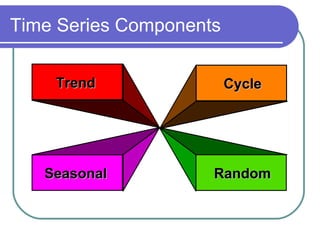
Time Series Components Trend Seasonal Cycle Random
Persistent, overall upward or downward pattern Due to population, technology etc. Several years duration  Trend Component
Regular pattern of up & down fluctuations Due to weather, customs, etc. Occurs within 1 year  Seasonal Component
Repeating up & down movements Due to interactions of factors influencing economy Can be anywhere between 2-30+ years duration  Cyclical Component
Erratic, unsystematic, ‘residual’ fluctuations Due to random variation or unforeseen events Union strike Tornado Short duration & non-repeating   Random Component
1.Naive Approach Assumes demand in  next   period is equal to the actual demand in  most recent   period e.g., If May sales were 48, then June sales will be 48 Sometimes cost effective & efficient
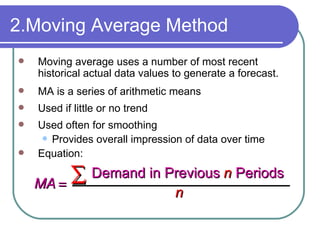
Moving average uses a number of most recent historical actual data values to generate a forecast. MA is a series of arithmetic means  Used if little or no trend Used often   for smoothing Provides overall impression of data over time Equation: 2.Moving Average Method MA n n   Demand in   Previous   Periods
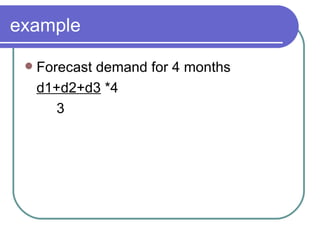
example Forecast demand for 4 months d1+d2+d3  *4 3
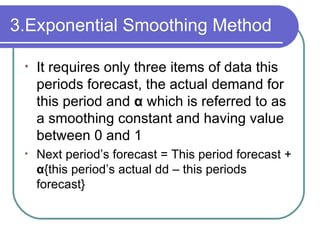
3.Exponential Smoothing Method It requires only three items of data this periods forecast, the actual demand for this period and  α   which is referred to as a smoothing constant and having value between 0 and 1  Next period’s forecast = This period forecast +  α { this period’s actual dd – this periods forecast}
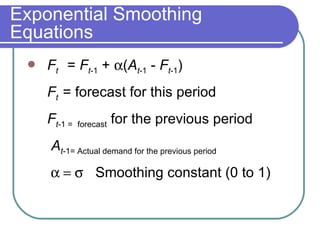
F t   =  F t -1  +   ( A t -1  -  F t -1 ) F t = forecast for this period F t -1 = forecast  for the previous period   A t -1= Actual demand for the previous period  Smoothing constant (0 to 1) Exponential Smoothing Equations
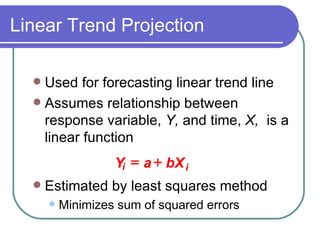
Used for forecasting linear trend line Assumes relationship between response variable,  Y,  and time,  X,  is a linear function Estimated by least squares method Minimizes sum of squared errors Linear Trend Projection i Y a bX i  
Answers: ‘ how strong   is the linear relationship between the variables?’ Coefficient of correlation Sample correlation coefficient denoted   r Range:  -1  <  r  <  1 Measures degree of association Used mainly for understanding Correlation
Linear regression analysis The demand or sales forecast is a dependent variable and other factors are independent variables
Factors to be considered in the selection of forecasting method Cost and accuracy Data available Time span Nature of products and services Impulse response and noise dampening
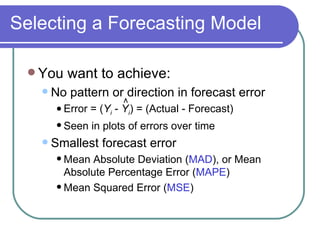
You want to achieve: No pattern or direction in forecast error Error = ( Y i  -  Y i ) = (Actual - Forecast) Seen in plots of errors over time Smallest forecast error Mean Absolute Deviation ( MAD ), or Mean Absolute Percentage Error ( MAPE ) Mean Squared Error ( MSE ) Selecting a Forecasting Model ^
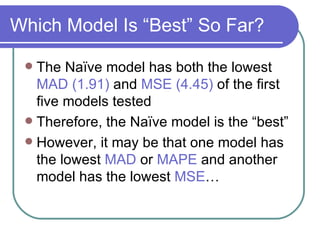
Which Model Is “Best” So Far? The Naïve model has both the lowest  MAD (1.91)  and  MSE (4.45)  of the first five models tested Therefore, the Naïve model is the “best” However, it may be that one model has the lowest  MAD  or  MAPE  and another model has the lowest  MSE …
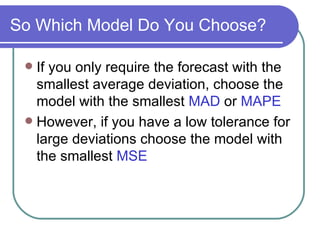
So Which Model Do You Choose? If you only require the forecast with the smallest average deviation, choose the model with the smallest  MAD  or  MAPE However, if you have a low tolerance for large deviations choose the model with the smallest  MSE

Class notes forecasting

  • 1.
  • 2.
    What is Forecasting?Process of predicting a future event and it is a mere guess. It is the estimating the future demand for products and services are commonly referred as a sales forecast Underlying basis of all business decisions: Production Inventory Personnel Facilities
  • 3.
    NEED OF DEMANDFORECASTING New facility planning Production planning Workforce scheduling Financial planning
  • 4.
    Short-range forecast Upto 1 year (usually less than 3 months) Job scheduling, worker assignments, plan for purchasing Medium-range forecast 3 months to 3 years Sales & production planning, budgeting Long-range forecast 3 years, or more New product planning, facility location Forecasts by Time Horizon
  • 5.
    Types of ForecastsEconomic forecasts Address the future business conditions (e.g., inflation rate, money supply, etc.) Technological forecasts Predict the rate of technological progress Predict acceptance of new products Demand forecasts Predict sales of existing products
  • 6.
    Features of demandforecasting It generally assume the same underlying reasons Forecasts are rarely perfect Forecast for group items will be more perfect than the individual items Forecast accuracy decreases as the time period covered by the forecast
  • 7.
    Seven Steps inForecasting Determine the purpose of the forecast Select the items to be forecasted Determine the time horizon of the forecast Select the forecasting model(s) Gather the data Make the forecast Validate and implement results
  • 8.
    Objectives of demandforecasting Short range objectives Formulation of production strategy and policy Formulation of pricing policies Planning and control of sales Financial planning
  • 9.
    Objectives of demandforecasting Medium or Long range objectives Long range planning for production capacity Labour requirements Restructuring the capital structure
  • 10.
    Forecasting Approaches Usedwhen situation is stable & historical data exist Existing products Current technology Involves mathematical techniques e.g., forecasting sales of color televisions Quantitative Methods Used when situation is vague & little data exist New products New technology Involves intuition, experience e.g., forecasting sales on Internet Qualitative Methods
  • 11.
    Qualitative Methods Juryof executive opinion Pool opinions of high-level executives, sometimes augment by statistical models Delphi method or judge mental method Panel of experts, queried iteratively Sales force composite Estimates from individual salespersons are reviewed for reasonableness, then aggregated Consumer (Market research) Survey Ask the customer
  • 12.
    Quantitative Approaches Timeseries model(Trend, Seasonality, Cycles) Naive approach Moving average Exponential smoothing Casual models Trend projection Linear regression analysis
  • 13.
    Set of evenlyspaced numerical data Obtained by observing response variable at regular time periods Forecast based only on past values Assumes that factors influencing past and present will continue influence in future Example Year: 1998 1999 2000 2001 2002 Sales: 78.7 63.5 89.7 93.2 92.1 Time Series Models
  • 14.
    Time Series ComponentsTrend Seasonal Cycle Random
  • 15.
    Persistent, overall upwardor downward pattern Due to population, technology etc. Several years duration Trend Component
  • 16.
    Regular pattern ofup & down fluctuations Due to weather, customs, etc. Occurs within 1 year Seasonal Component
  • 17.
    Repeating up &down movements Due to interactions of factors influencing economy Can be anywhere between 2-30+ years duration Cyclical Component
  • 18.
    Erratic, unsystematic, ‘residual’fluctuations Due to random variation or unforeseen events Union strike Tornado Short duration & non-repeating Random Component
  • 19.
    1.Naive Approach Assumesdemand in next period is equal to the actual demand in most recent period e.g., If May sales were 48, then June sales will be 48 Sometimes cost effective & efficient
  • 20.
    Moving average usesa number of most recent historical actual data values to generate a forecast. MA is a series of arithmetic means Used if little or no trend Used often for smoothing Provides overall impression of data over time Equation: 2.Moving Average Method MA n n   Demand in Previous Periods
  • 21.
    example Forecast demandfor 4 months d1+d2+d3 *4 3
  • 22.
    3.Exponential Smoothing MethodIt requires only three items of data this periods forecast, the actual demand for this period and α which is referred to as a smoothing constant and having value between 0 and 1 Next period’s forecast = This period forecast + α { this period’s actual dd – this periods forecast}
  • 23.
    F t = F t -1 +  ( A t -1 - F t -1 ) F t = forecast for this period F t -1 = forecast for the previous period A t -1= Actual demand for the previous period  Smoothing constant (0 to 1) Exponential Smoothing Equations
  • 24.
    Used for forecastinglinear trend line Assumes relationship between response variable, Y, and time, X, is a linear function Estimated by least squares method Minimizes sum of squared errors Linear Trend Projection i Y a bX i  
  • 25.
    Answers: ‘ howstrong is the linear relationship between the variables?’ Coefficient of correlation Sample correlation coefficient denoted r Range: -1 < r < 1 Measures degree of association Used mainly for understanding Correlation
  • 26.
    Linear regression analysisThe demand or sales forecast is a dependent variable and other factors are independent variables
  • 27.
    Factors to beconsidered in the selection of forecasting method Cost and accuracy Data available Time span Nature of products and services Impulse response and noise dampening
  • 28.
    You want toachieve: No pattern or direction in forecast error Error = ( Y i - Y i ) = (Actual - Forecast) Seen in plots of errors over time Smallest forecast error Mean Absolute Deviation ( MAD ), or Mean Absolute Percentage Error ( MAPE ) Mean Squared Error ( MSE ) Selecting a Forecasting Model ^
  • 29.
    Which Model Is“Best” So Far? The Naïve model has both the lowest MAD (1.91) and MSE (4.45) of the first five models tested Therefore, the Naïve model is the “best” However, it may be that one model has the lowest MAD or MAPE and another model has the lowest MSE …
  • 30.
    So Which ModelDo You Choose? If you only require the forecast with the smallest average deviation, choose the model with the smallest MAD or MAPE However, if you have a low tolerance for large deviations choose the model with the smallest MSE

Editor's Notes

  • #5 At this point, it may be useful to point out the “time horizons” considered by different industries. For example, some colleges and universities look 30 to fifty years ahead, industries engaged in long distance transportation (steam ship, railroad) or provision of basic power (electrical and gas utilities, etc.) also look far ahead (20 to 100 years). Ask them to give examples of industries having much shorter long-range horizons.
  • #6 One can use an example based upon one’s college or university. Students can be asked why each of these forecast types is important to the college. Once they begin to appreciate the importance, one can then begin to discuss the problems. For example, is predicting “demand” merely as simple as predicting the number of students who will graduate from high school next year (i.e., a simple counting exercise)?
  • #8 A point to be made here is that one requires a forecasting “plan,” not merely the selection of a particular forecasting methodology.
  • #11 This slide distinguishes between Quantitative and Qualitative forecasting. If you accept the argument that the future is one of perpetual, and perhaps significant change, you may wish to ask students to consider whether quantitative forecasting will ever be sufficient in the future - or will we always need to employ qualitative forecasting also. (Consider Tupperware’s ‘jury of executive opinion.’)
  • #12 This slide outlines several qualitative methods of forecasting. Ask students to give examples of occasions when each might be appropriate. The next several slides elaborate on these qualitative methods.
  • #14 This and subsequent slide frame a discussion on time series - and introduce the various components.
  • #20 This slide introduces the naïve approach. Subsequent slides introduce other methodologies.
  • #21 At this point, you might discuss the impact of the number of periods included in the calculation. The more periods you include, the closer you come to the overall average; the fewer, the closer you come to the value in the previous period. What is the tradeoff?
  • #23 This slide introduces the exponential smoothing method of time series forecasting. The following slide contains the equations, and an example follows.
  • #24 You may wish to discuss several points: - this is just a moving average wherein every point in included in the forecast, but the weights of the points continuously decrease as they extend further back in time. - the equation actually used to calculate the forecast is convenient for programming on the computer since it requires as data only the actual and forecast values from the previous time point. - we need a formal process and criteria for choosing the “best” smoothing constant.
  • #25 This slide introduces the equation produced in linear trend progression.
  • #26 This slide can frame the start of a discussion of correlation.. You should probably expect to add to this a discussion of cause and effect, emphasizing in particular that correlation does not imply a cause and effect relationship. Ask student to suggest examples of significant correlation of unrelated phenomenon.
  • #29 This slide introduces overall guideline for selecting a forecasting model. You may also wish to re-emphasize the role of scatter plots, and discuss the role of “understanding what is going on” (especially in limiting one’s choice of model).