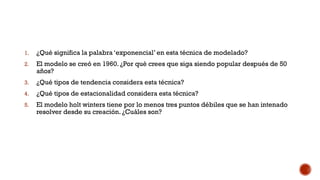
1. ¿Qué significa la palabra ‘exponencial’ en esta técnica de modelado?
2. El modelo se creó en 1960. ¿Por qué crees que siga siendo popular después de 50
años?
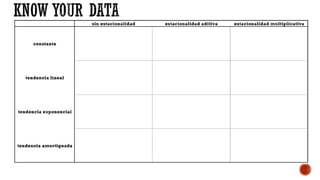
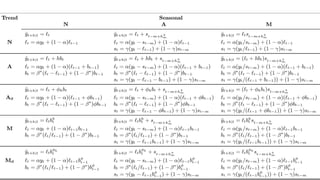
3. ¿Qué tipos de tendencia considera esta técnica?
4. ¿Qué tipos de estacionalidad considera esta técnica?
5. El modelo holt winters tiene por lo menos tres puntos débiles que se han intenado
resolver desde su creación. ¿Cuáles son?
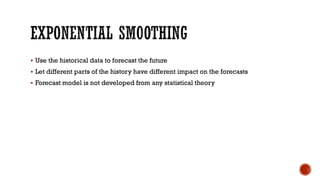
 Use the historical data to forecast the future
 Let different parts of the history have different impact on the forecasts
 Forecast model is not developed from any statistical theory
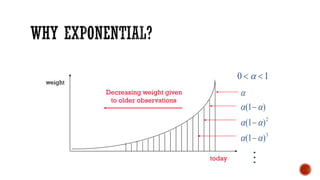
weight
today
Decreasing weight given
to older observations
0 1 

 
 
 
( )
( )
( )
1
1
1
2
3




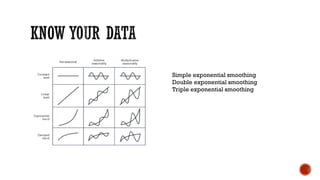
Simple exponential smoothing
Double exponential smoothing
Triple exponential smoothing
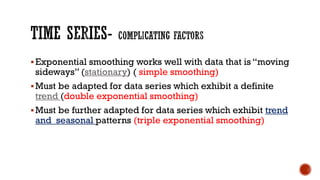
Exponential smoothing works well with data that is “moving
sideways” (stationary) ( simple smoothing)
Must be adapted for data series which exhibit a definite
trend (double exponential smoothing)
Must be further adapted for data series which exhibit trend
and seasonal patterns (triple exponential smoothing)
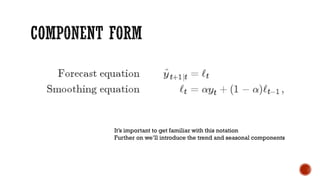
It’s important to get familiar with this notation
Further on we’ll introduce the trend and seasonal components
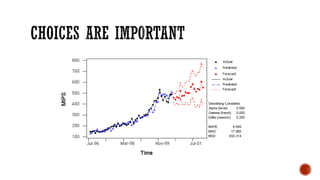
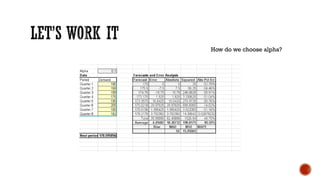
How do we choose alpha?
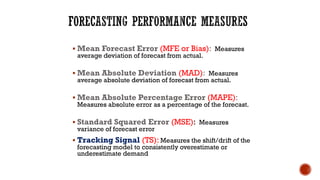
 Mean Forecast Error (MFE or Bias): Measures
average deviation of forecast from actual.
 Mean Absolute Deviation (MAD): Measures
average absolute deviation of forecast from actual.
 Mean Absolute Percentage Error (MAPE):
Measures absolute error as a percentage of the forecast.
 Standard Squared Error (MSE): Measures
variance of forecast error
 Tracking Signal (TS): Measures the shift/drift of the
forecasting model to consistently overestimate or
underestimate demand
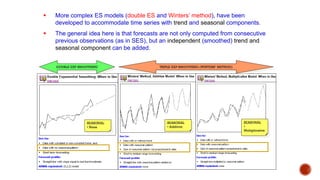
SEASONAL
• None
SEASONAL
• Additive
SEASONAL
•
Multiplicative
DOUBLE EXP SMOOTHING TRIPLE EXP SMOOTHING (WINTERS’ METHOD)
 More complex ES models (double ES and Winters’ method), have been
developed to accommodate time series with trend and seasonal components.
 The general idea here is that forecasts are not only computed from consecutive
previous observations (as in SES), but an independent (smoothed) trend and
seasonal component can be added.
Exponential smoothing

Exponential smoothing

  • 2.
    1. ¿Qué significala palabra ‘exponencial’ en esta técnica de modelado? 2. El modelo se creó en 1960. ¿Por qué crees que siga siendo popular después de 50 años? 3. ¿Qué tipos de tendencia considera esta técnica? 4. ¿Qué tipos de estacionalidad considera esta técnica? 5. El modelo holt winters tiene por lo menos tres puntos débiles que se han intenado resolver desde su creación. ¿Cuáles son?
  • 3.
     Use thehistorical data to forecast the future  Let different parts of the history have different impact on the forecasts  Forecast model is not developed from any statistical theory
  • 4.
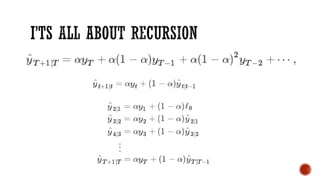
    weight today Decreasing weight given toolder observations 0 1         ( ) ( ) ( ) 1 1 1 2 3    
  • 6.
    Simple exponential smoothing Doubleexponential smoothing Triple exponential smoothing
  • 7.
    Exponential smoothing workswell with data that is “moving sideways” (stationary) ( simple smoothing) Must be adapted for data series which exhibit a definite trend (double exponential smoothing) Must be further adapted for data series which exhibit trend and seasonal patterns (triple exponential smoothing)
  • 11.
    It’s important toget familiar with this notation Further on we’ll introduce the trend and seasonal components
  • 12.
    How do wechoose alpha?
  • 13.
     Mean ForecastError (MFE or Bias): Measures average deviation of forecast from actual.  Mean Absolute Deviation (MAD): Measures average absolute deviation of forecast from actual.  Mean Absolute Percentage Error (MAPE): Measures absolute error as a percentage of the forecast.  Standard Squared Error (MSE): Measures variance of forecast error  Tracking Signal (TS): Measures the shift/drift of the forecasting model to consistently overestimate or underestimate demand
  • 15.
    SEASONAL • None SEASONAL • Additive SEASONAL • Multiplicative DOUBLEEXP SMOOTHING TRIPLE EXP SMOOTHING (WINTERS’ METHOD)  More complex ES models (double ES and Winters’ method), have been developed to accommodate time series with trend and seasonal components.  The general idea here is that forecasts are not only computed from consecutive previous observations (as in SES), but an independent (smoothed) trend and seasonal component can be added.