Forces stabilizing nucleic acid
structure
GAURAV
19mslsbf03
MSc Life science (Bioinformatics)
Contents
 Hydrogen bonding
 Base stacking
 Hydrophobic interaction
 Ionic bonding
Why there is need of forces in DNA for
its stability??
So that its both strands remain together and
show double helix configuration for maximum
stability.
Hydrogen bonding
• Hydrogen bonds are electrostatic in character. In general a
hydrogen bond X - H ... Y is formed if a hydrogen atom connects two
atoms of higher electronegativity.
• Since these bonds are electrostatic, their strength depends on the
partial charges located on the component atoms in the bond.
• The interaction between two water molecules, probably the most
common hydrogen bonding interaction on the planet
• Under the influence of a hydrogen bond, the H becomes more
electropositive and X,Y becoming more negative. This affect
increases the affinity of X,Y for H and strengthens the interaction. If
Y is the oxygen of the -OH group, the hydrogen attached to it is
more positive and hence becomes a better donor.
Contd...
Image adapted from :
https://courses.lumenlearning.com/introchem/chapter/hydrogen-bonding/
https://www.quora.com/What-is-the-number-of-hydrogen-bonds-in-a-double-helical-B-
DNA-structure-of-100-base-pairs-with-20-adenines-and-10-thymines-in-one-of-the-two-
strands
Base Stacking
• Bases in solution pile up like coins in a roll.
• In aqueous solution, the bases in a single stranded oligonucleotide
are stacked such that the base planes are separated by their van der
Waals distance of 3.4A , parallel to one another.
• Base stacking is the least understood but, undoubtedly most
important force stabilizing helices.
• Stacking is a diffusion controlled, additive, and stabilized by weak
forces.
• The enthalpies associated with base stacking are favorable, while
the entropy associated with the stacking of the bases is strongly
unfavorable.
• The stacking reaction is overall favorable, however, since the
entropy and enthalpy of the solvent are both strongly favorable.
• Stacking is made-up of two separate forces: hydrophobic effect and
London dispersion forces.
Contd...
• The DNA sequence. Some combinations of base pairs
form more stable interactions than others.
• Base in DNA are planar so have the ability to stack.
• Base-stacking interactions increase with increasing salt
concentration, as high salt concentrations mask the
destabilizing charge repulsion between the two
negatively charged phosphodiester backbones.
• DNA double strand stability therefore increases with
increasing salt concentration. Divalent cations such as
Mg2+ are more stabilizing than Na+ ions, and some
metal ions bind to specific loci on the DNA duplex.
Contd..
•
Image adapted from :
https://ww2.chemistry.gatech.edu/~lw26/structure/molecular_int
eractions/mol_int.html
Hydrophobic Interactions
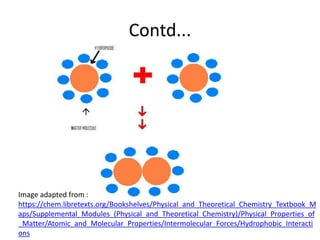
• If a hydrophobic base is dissolved in water, the water molecules cluster
around it in an order fashion.
• This is caused by the fact that they cannot form H-bonds with the non-
polar base and adopt an ordered "clathrate" structure to maximize H-
bonding with itself.
• This ordering is a very unfavorable entropy change for the water.
• Burying this hydrophobic base in the stack, releases this water and results
in an overall entropy gain for water
• The importance of the hydrophobic effect in helix formation is seen by
considering the effect on the energetics of solvent interactions upon
folding the non-polar bases into the helical structure.
• The hydrophobic interactions between the planar base pairs stabilize the
bases on the inside of the helix, so these provide stability to the structure
but do not contribute to the specificity.
• Hydrophobic Interactions are important for the folding, stability and
biological activity.
Contd...
Image adapted from :
https://chem.libretexts.org/Bookshelves/Physical_and_Theoretical_Chemistry_Textbook_M
aps/Supplemental_Modules_(Physical_and_Theoretical_Chemistry)/Physical_Properties_of
_Matter/Atomic_and_Molecular_Properties/Intermolecular_Forces/Hydrophobic_Interacti
ons
Ionic interactions
• Ion-ion repulsion of the negatively charged
phosphate make DNA duplex unstable.
• However the presence of Mg2+ and cationic
proteins with abundant Arginine and Lysine
residues that stabilizes the double helix.
• Double-stranded helix structure thus,
promoted by having phosphates on outside,
interact with H2O and counter ions (K+ ,
Mg2+, etc.)
Contd...
Image adapted from :
https://www.researchgate.net/figure/1-Schematic-illustration-of-bonding-interactions-
between-double-stranded-DNA-and-small_fig1_318249761
References
• https://www.slideshare.net/SanjeevKumar156
1/dna-and-forces-stabilizes-dna-structure
• http://www.nsm.buffalo.edu/~koudelka/Lectu
re2.pdf
• https://www.slideshare.net/negasiteklay1/bas
e-pairing-base-stacking-and-nucleic-acid-
structure
Forces stabilizing nucleic acid structure

Forces stabilizing nucleic acid structure

  • 1.
    Forces stabilizing nucleicacid structure GAURAV 19mslsbf03 MSc Life science (Bioinformatics)
  • 2.
    Contents  Hydrogen bonding Base stacking  Hydrophobic interaction  Ionic bonding
  • 3.
    Why there isneed of forces in DNA for its stability?? So that its both strands remain together and show double helix configuration for maximum stability.
  • 4.
    Hydrogen bonding • Hydrogenbonds are electrostatic in character. In general a hydrogen bond X - H ... Y is formed if a hydrogen atom connects two atoms of higher electronegativity. • Since these bonds are electrostatic, their strength depends on the partial charges located on the component atoms in the bond. • The interaction between two water molecules, probably the most common hydrogen bonding interaction on the planet • Under the influence of a hydrogen bond, the H becomes more electropositive and X,Y becoming more negative. This affect increases the affinity of X,Y for H and strengthens the interaction. If Y is the oxygen of the -OH group, the hydrogen attached to it is more positive and hence becomes a better donor.
  • 5.
    Contd... Image adapted from: https://courses.lumenlearning.com/introchem/chapter/hydrogen-bonding/ https://www.quora.com/What-is-the-number-of-hydrogen-bonds-in-a-double-helical-B- DNA-structure-of-100-base-pairs-with-20-adenines-and-10-thymines-in-one-of-the-two- strands
  • 6.
    Base Stacking • Basesin solution pile up like coins in a roll. • In aqueous solution, the bases in a single stranded oligonucleotide are stacked such that the base planes are separated by their van der Waals distance of 3.4A , parallel to one another. • Base stacking is the least understood but, undoubtedly most important force stabilizing helices. • Stacking is a diffusion controlled, additive, and stabilized by weak forces. • The enthalpies associated with base stacking are favorable, while the entropy associated with the stacking of the bases is strongly unfavorable. • The stacking reaction is overall favorable, however, since the entropy and enthalpy of the solvent are both strongly favorable. • Stacking is made-up of two separate forces: hydrophobic effect and London dispersion forces.
  • 7.
    Contd... • The DNAsequence. Some combinations of base pairs form more stable interactions than others. • Base in DNA are planar so have the ability to stack. • Base-stacking interactions increase with increasing salt concentration, as high salt concentrations mask the destabilizing charge repulsion between the two negatively charged phosphodiester backbones. • DNA double strand stability therefore increases with increasing salt concentration. Divalent cations such as Mg2+ are more stabilizing than Na+ ions, and some metal ions bind to specific loci on the DNA duplex.
  • 8.
    Contd.. • Image adapted from: https://ww2.chemistry.gatech.edu/~lw26/structure/molecular_int eractions/mol_int.html
  • 9.
    Hydrophobic Interactions • Ifa hydrophobic base is dissolved in water, the water molecules cluster around it in an order fashion. • This is caused by the fact that they cannot form H-bonds with the non- polar base and adopt an ordered "clathrate" structure to maximize H- bonding with itself. • This ordering is a very unfavorable entropy change for the water. • Burying this hydrophobic base in the stack, releases this water and results in an overall entropy gain for water • The importance of the hydrophobic effect in helix formation is seen by considering the effect on the energetics of solvent interactions upon folding the non-polar bases into the helical structure. • The hydrophobic interactions between the planar base pairs stabilize the bases on the inside of the helix, so these provide stability to the structure but do not contribute to the specificity. • Hydrophobic Interactions are important for the folding, stability and biological activity.
  • 10.
    Contd... Image adapted from: https://chem.libretexts.org/Bookshelves/Physical_and_Theoretical_Chemistry_Textbook_M aps/Supplemental_Modules_(Physical_and_Theoretical_Chemistry)/Physical_Properties_of _Matter/Atomic_and_Molecular_Properties/Intermolecular_Forces/Hydrophobic_Interacti ons
  • 11.
    Ionic interactions • Ion-ionrepulsion of the negatively charged phosphate make DNA duplex unstable. • However the presence of Mg2+ and cationic proteins with abundant Arginine and Lysine residues that stabilizes the double helix. • Double-stranded helix structure thus, promoted by having phosphates on outside, interact with H2O and counter ions (K+ , Mg2+, etc.)
  • 12.
    Contd... Image adapted from: https://www.researchgate.net/figure/1-Schematic-illustration-of-bonding-interactions- between-double-stranded-DNA-and-small_fig1_318249761
  • 13.