
Ethics in assisted reproductive
technologies
Presented by:
Gaurav
19mslsbf03
MSc Bioinformatics
Presented to:
Dr. Monisha Dhiman
Department of microbiology
Contents
• Assisted Reproductive Technologies (ART)
• First Successful IVF: Birth of Louise Brown in 1978
• Rapid developments in the field of ART
• Moral panic
• Ethics
• Ethical issues
• Ethical concerns
• Moral issues
• Social issues
• Religion
• Case study
Assisted Reproductive Technologies
(ART)
• All treatments or procedures that include the in
vitro handling of human oocytes and human
sperm or embryos for the purpose of establishing
a pregnancy.
(in vitro fertilization and transcervical embryo
transfer, gamete intrafallopian transfer, zygote
intrafallopian transfer, tubal embryo transfer,
gamete and embryo cryopreservation, oocyte
and embryo donation, gestational surrogacy)
First Successful IVF: Birth of Louise
Brown in 1978
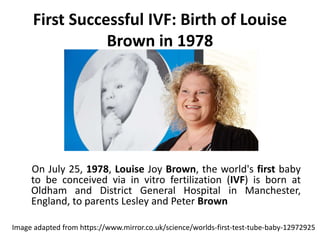
On July 25, 1978, Louise Joy Brown, the world's first baby
to be conceived via in vitro fertilization (IVF) is born at
Oldham and District General Hospital in Manchester,
England, to parents Lesley and Peter Brown
Image adapted from https://www.mirror.co.uk/science/worlds-first-test-tube-baby-12972925
Since 1978 more than one million
children born worldwide
Rapid developments in the field of ART
• “Moral panic” about the changes that IVF
brought about.
• Continuous ethical dilemmas
• Legislation
Moral panic
• No society has been neutral about reproduction
• social values
• morals
• fears
• Separation of sex from reproduction
• Reproduction with the involvement of a third
party
• Gender issues
• Pronatalist attitudes
Ethics
• Bypassing the natural method of conception.
• The creation of life in the laboratory.
• Fertilization of more embryos than will be needed.
• Discarding of excess embryos.
• Unnatural environment for embryos.
• Use of untested technology.
• Not affordable for many.
• Misallocation of medical resources.
• Creation of embryos, then freezing them, and keeping them "in limbo".
• Exposure of embryos to unnatural substances.
• Destruction of embryos in research.
• Potential to create embryos for medical purposes.
• Potential to select embryos (PGD).
• Potential to modify embryos.
• Facilitation of the idea that embryos are commodities.
• Financial rewards for IVF doctors dissuade them from recommending other methods to couples.
• Infertility is treated as a disease and not as a symptom of underlying medical problems.
Ethical Issues
•When is the embryo a human life?
•The gametes are already coded for sex, hair colour, eye
colour, etc, therefore it is argued it is always a human
life
•Created to live - always a human?
•Who has the right to decide who lives or dies?
•The fact that life is created in a laboratory
•More than just one embryo is fertilized, therefore some
must be discarded
•Embryos can be exposed to unnatural substances
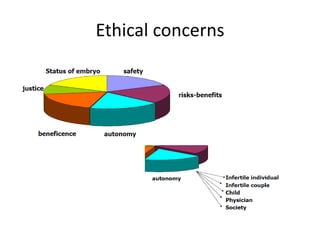
Ethical concerns
Contd...
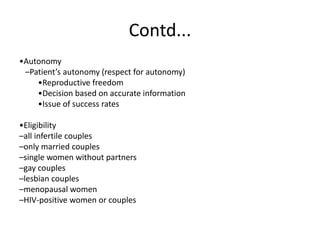
•Autonomy
–Patient’s autonomy (respect for autonomy)
•Reproductive freedom
•Decision based on accurate information
•Issue of success rates
•Eligibility
–all infertile couples
–only married couples
–single women without partners
–gay couples
–lesbian couples
–menopausal women
–HIV-positive women or couples
Moral Issues
•Disability - the embryo is ‘not fully human’ - more right to termination?
•Human life begins at conception, ie death occurs when that life is
terminated
•What about the left over embryos?
•Can killing one embryo be justified to save another?
•Skips the natural method of contraception
•Tossing out of other embryos
•Destruction of embryos in research
•Potential to genetically modify embryos
Social issues
•Is IVF available to all people?
•What is the sociological impact of a woman having more than one IVF child
in one pregnancy?
•Destruction of embryos due to a disability - disabled rejected by society
•Disability - determines the value and dignity of humans
•Unnatural environment for embryos
•Use of untested technology
•Expensive
•Selected embryos used - ‘Designer Babies’
•Others used in medical research
Religion
•Roman Catholic church - opposed
•Inability to conceive - God telling us to adopt
•Suffering makes us stronger
•Face pain and suffer for our god
•Embryos are human lives - as much right as
living, breathing humans to live.
Case study
•A gay couple, Janice and Lisa, had been in a stable relationship for over five
years and decided to have a family. One would become pregnant using
donor sperm, and they would both raise the child in a loving environment.
The women had top private health cover, so could easily afford the
procedure, both were professional women and could also easily afford the
costs associated with raising a child, however, neither disclosed their
sexual preference when they entered the programme. (There was formal
opportunity to do so in the various application forms)
•Upon discovering the nature of their relationship the Director of the clinic,
refused to allow them to continue in the programme on the basis that the
legislation allows for couples where conception cannot occur naturally. He
stated that a preliminary medical examination revealed both women could
in fact conceive naturally, their problem in not achieving conception was
due to a sexual preference, not a biological problem, thus they did not
actually need the in-vitro procedure to have a baby, moreover given that
the couple were gay, they did not qualify for access to the programme.
• Ethical issue found is eligibility as both can conceive naturally.
References
• https://www.gfmer.ch/Medical_education_En
/PGC_RH_2004/Pdf/Ethics_IVF-PGC2004.pdf
• https://www.hindawi.com/journals/ogi/2012/
686253/
Thanks!

Ethics in assisted reproductive technologies

  • 1.
    Ethics in assistedreproductive technologies Presented by: Gaurav 19mslsbf03 MSc Bioinformatics Presented to: Dr. Monisha Dhiman Department of microbiology
  • 2.
    Contents • Assisted ReproductiveTechnologies (ART) • First Successful IVF: Birth of Louise Brown in 1978 • Rapid developments in the field of ART • Moral panic • Ethics • Ethical issues • Ethical concerns • Moral issues • Social issues • Religion • Case study
  • 3.
    Assisted Reproductive Technologies (ART) •All treatments or procedures that include the in vitro handling of human oocytes and human sperm or embryos for the purpose of establishing a pregnancy. (in vitro fertilization and transcervical embryo transfer, gamete intrafallopian transfer, zygote intrafallopian transfer, tubal embryo transfer, gamete and embryo cryopreservation, oocyte and embryo donation, gestational surrogacy)
  • 4.
    First Successful IVF:Birth of Louise Brown in 1978 On July 25, 1978, Louise Joy Brown, the world's first baby to be conceived via in vitro fertilization (IVF) is born at Oldham and District General Hospital in Manchester, England, to parents Lesley and Peter Brown Image adapted from https://www.mirror.co.uk/science/worlds-first-test-tube-baby-12972925
  • 5.
    Since 1978 morethan one million children born worldwide Rapid developments in the field of ART • “Moral panic” about the changes that IVF brought about. • Continuous ethical dilemmas • Legislation
  • 6.
    Moral panic • Nosociety has been neutral about reproduction • social values • morals • fears • Separation of sex from reproduction • Reproduction with the involvement of a third party • Gender issues • Pronatalist attitudes
  • 7.
    Ethics • Bypassing thenatural method of conception. • The creation of life in the laboratory. • Fertilization of more embryos than will be needed. • Discarding of excess embryos. • Unnatural environment for embryos. • Use of untested technology. • Not affordable for many. • Misallocation of medical resources. • Creation of embryos, then freezing them, and keeping them "in limbo". • Exposure of embryos to unnatural substances. • Destruction of embryos in research. • Potential to create embryos for medical purposes. • Potential to select embryos (PGD). • Potential to modify embryos. • Facilitation of the idea that embryos are commodities. • Financial rewards for IVF doctors dissuade them from recommending other methods to couples. • Infertility is treated as a disease and not as a symptom of underlying medical problems.
  • 8.
    Ethical Issues •When isthe embryo a human life? •The gametes are already coded for sex, hair colour, eye colour, etc, therefore it is argued it is always a human life •Created to live - always a human? •Who has the right to decide who lives or dies? •The fact that life is created in a laboratory •More than just one embryo is fertilized, therefore some must be discarded •Embryos can be exposed to unnatural substances
  • 9.
  • 10.
    Contd... •Autonomy –Patient’s autonomy (respectfor autonomy) •Reproductive freedom •Decision based on accurate information •Issue of success rates •Eligibility –all infertile couples –only married couples –single women without partners –gay couples –lesbian couples –menopausal women –HIV-positive women or couples
  • 11.
    Moral Issues •Disability -the embryo is ‘not fully human’ - more right to termination? •Human life begins at conception, ie death occurs when that life is terminated •What about the left over embryos? •Can killing one embryo be justified to save another? •Skips the natural method of contraception •Tossing out of other embryos •Destruction of embryos in research •Potential to genetically modify embryos
  • 12.
    Social issues •Is IVFavailable to all people? •What is the sociological impact of a woman having more than one IVF child in one pregnancy? •Destruction of embryos due to a disability - disabled rejected by society •Disability - determines the value and dignity of humans •Unnatural environment for embryos •Use of untested technology •Expensive •Selected embryos used - ‘Designer Babies’ •Others used in medical research
  • 13.
    Religion •Roman Catholic church- opposed •Inability to conceive - God telling us to adopt •Suffering makes us stronger •Face pain and suffer for our god •Embryos are human lives - as much right as living, breathing humans to live.
  • 14.
    Case study •A gaycouple, Janice and Lisa, had been in a stable relationship for over five years and decided to have a family. One would become pregnant using donor sperm, and they would both raise the child in a loving environment. The women had top private health cover, so could easily afford the procedure, both were professional women and could also easily afford the costs associated with raising a child, however, neither disclosed their sexual preference when they entered the programme. (There was formal opportunity to do so in the various application forms) •Upon discovering the nature of their relationship the Director of the clinic, refused to allow them to continue in the programme on the basis that the legislation allows for couples where conception cannot occur naturally. He stated that a preliminary medical examination revealed both women could in fact conceive naturally, their problem in not achieving conception was due to a sexual preference, not a biological problem, thus they did not actually need the in-vitro procedure to have a baby, moreover given that the couple were gay, they did not qualify for access to the programme. • Ethical issue found is eligibility as both can conceive naturally.
  • 15.
  • 16.