What are FORCES? This is a quick recap of Year 8 List as many as you can
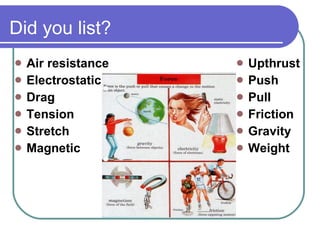
Did you list? Upthrust Push Pull Friction Gravity Weight Air resistance Electrostatic Drag Tension Stretch Magnetic
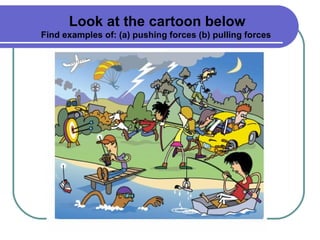
Look at the cartoon below Find examples of: (a) pushing forces (b) pulling forces
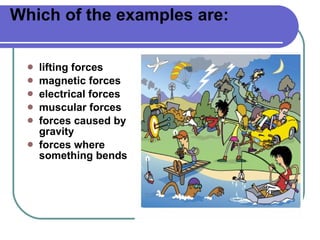
Which of the examples are: lifting forces magnetic forces electrical forces  muscular forces forces caused by gravity forces where something bends
In general we say forces can start objects moving, speed up, slow down, or change the direction of moving objects.  can cause them to turn, bend or twist. can also prevent motion; for example, a handbrake on a car stops it from rolling down a hill.
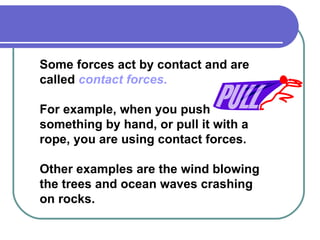
Some forces act by contact and are called  contact forces .   For example, when you push something by hand, or pull it with a rope, you are using contact forces.  Other examples are the wind blowing the trees and ocean waves crashing on rocks.
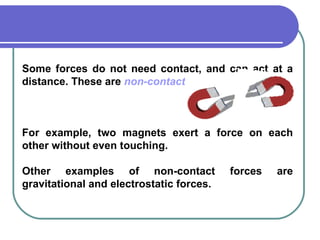
Some forces do not need contact, and can act at a distance. These are  non-contact   forces.  For example, two magnets exert a force on each other without even touching.  Other examples of non-contact forces are gravitational and electrostatic forces.
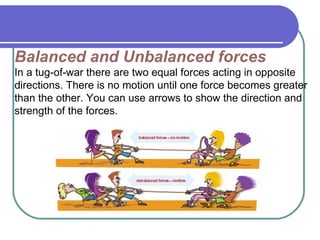
Balanced and Unbalanced forces In a tug-of-war there are two equal forces acting in opposite directions. There is no motion until one force becomes greater than the other. You can use arrows to show the direction and strength of the forces .
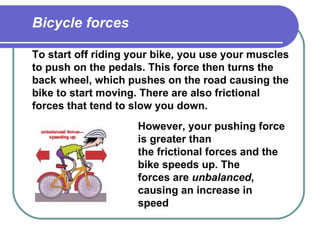
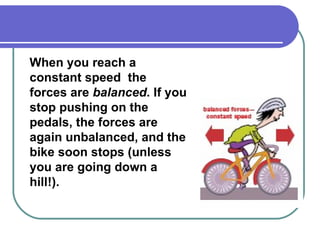
Bicycle forces To start off riding your bike, you use your muscles to push on the pedals. This force then turns the back wheel, which pushes on the road causing the bike to start moving. There are also frictional forces that tend to slow you down. However, your pushing force is greater than the frictional forces and the bike speeds up. The forces are  unbalanced , causing an increase in speed
When you reach a constant speed  the forces are  balanced . If you stop pushing on the pedals, the forces are again unbalanced, and the bike soon stops (unless you are going down a hill!).
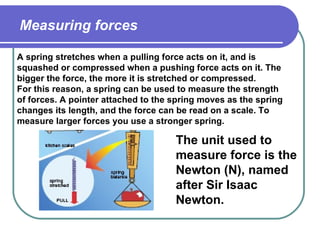
A spring stretches when a pulling force acts on it, and is squashed or compressed when a pushing force acts on it. The bigger the force, the more it is stretched or compressed.  For this reason, a spring can be used to measure the strength of forces. A pointer attached to the spring moves as the spring changes its length, and the force can be read on a scale. To measure larger forces you use a stronger spring. The unit used to measure force is the Newton (N), named after Sir Isaac Newton. Measuring forces
Mass and Weight Mass  is the amount of matter in an object, sometimes understood as the measure of inertia of an  object.  In the SI system, mass is measured in kilograms(kg). Weight  is the force exerted on that object by gravity. In the SI system, weight is measured in  Newtons (N).
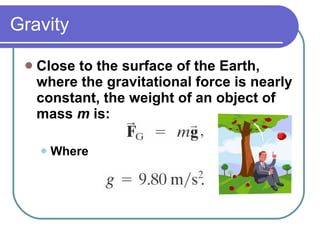
Gravity Close to the surface of the Earth, where the gravitational force is nearly constant, the weight of an object of mass  m  is: Where
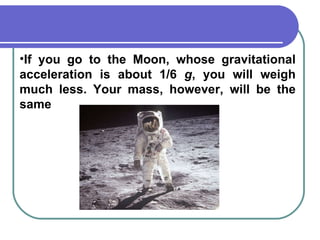
If you go to the Moon, whose gravitational acceleration is about 1/6  g , you will weigh much less. Your mass, however, will be the same
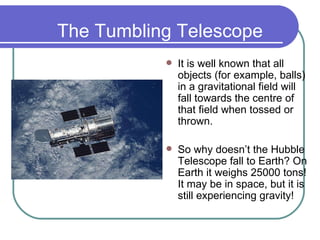
The Tumbling Telescope It is well known that all objects (for example, balls) in a gravitational field will fall towards the centre of that field when tossed or thrown. So why doesn’t the Hubble Telescope fall to Earth? On Earth it weighs 25000 tons! It may be in space, but it is still experiencing gravity!
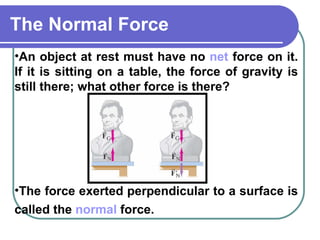
The Normal Force An object at rest must have no  net  force on it. If it is sitting on a table, the force of gravity is still there; what other force is there? The force exerted perpendicular to a surface is called the  normal  force.
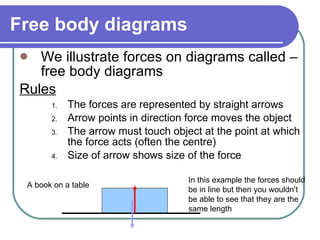
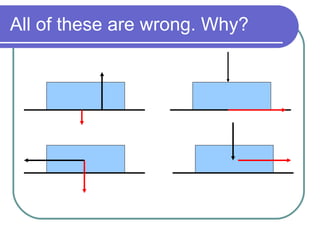
Free body diagrams We illustrate forces on diagrams called – free body diagrams Rules The forces are represented by straight arrows Arrow points in direction force moves the object The arrow must touch object at the point at which the force acts (often the centre) Size of arrow shows size of the force A book on a table In this example the forces should be in line but then you wouldn’t be able to see that they are the same length
All of these are wrong. Why?
Now try these Draw free body diagrams of the forces for Apple on a table Surfer on a wave Aeroplane taking off You on a trampoline
Newton’s  Laws of Motion I.  Law of Inertia II.  F=ma III.  Action-Reaction
While most people know what Newton's laws say, many people do not know what they mean (or simply do not believe what they mean).
Newton’s Laws of Motion 1 st  Law   –  An object at rest will stay at rest, and an object in motion will stay in motion with constant speed and travel in a straight line, unless acted upon by an unbalanced force. It is often referred to as the Law of Inertia 2 nd  Law  –  Force equals mass times acceleration. 3 rd  Law  –  For every action there is an equal and opposite reaction.
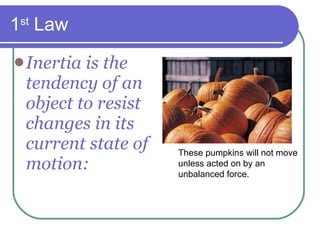
1 st  Law Inertia is the  tendency of an object to resist changes in its current state of motion: These pumpkins will not move unless acted on by an unbalanced force.
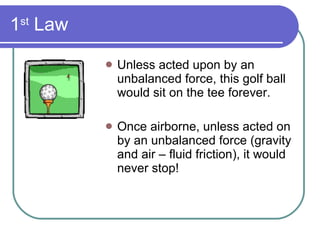
1 st  Law  Unless acted upon by an unbalanced force, this golf ball would sit on the tee forever.  Once airborne, unless acted on by an unbalanced force (gravity and air – fluid friction), it would never stop!
Why then, do we observe every day objects in motion slowing down and becoming motionless seemingly without an outside force?
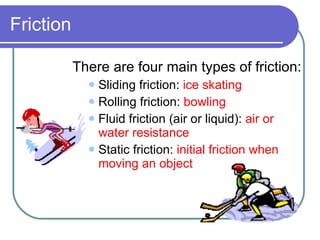
Friction There are four main types of friction: Sliding friction:  ice skating Rolling friction:  bowling Fluid friction (air or liquid):  air or water resistance Static friction:  initial friction when moving an object
Slide a book across a table and watch it slide to a rest position.  The book comes to a rest because of the  presence  of a force - that force being the  force of friction  - which brings the book to a rest position.
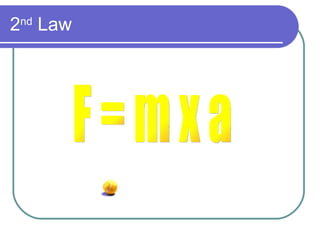
2 nd  Law F = m x a
2 nd  Law Mass is in kilograms  Acceleration is in m/s/s,  Force is in Newton's (N). One Newton is the force required to accelerate one kilogram of mass at one metre/second/second.
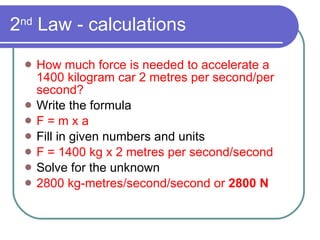
2 nd  Law - calculations How much force is needed to accelerate a 1400 kilogram car 2 metres per second/per second? Write the formula F = m x a Fill in given numbers and units F = 1400 kg x 2 metres per second/second Solve for the unknown 2800 kg-metres/second/second or  2800 N
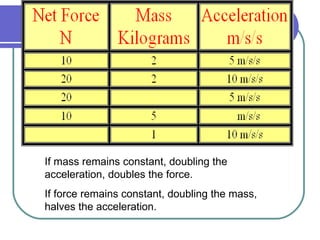
If mass remains constant, doubling the acceleration, doubles the force. If force remains constant, doubling the mass, halves the acceleration.
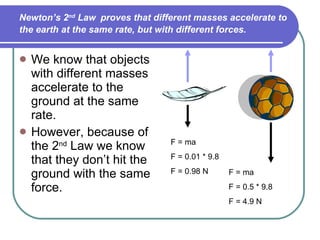
Newton’s 2 nd  Law   proves that different masses accelerate to the earth at the same rate, but with different forces. We know that objects with different masses accelerate to the ground at the same rate. However, because of the 2 nd  Law we know that they don’t hit the ground with the same force. F = ma F = 0.01 * 9.8 F = 0.98 N F = ma F = 0.5 * 9.8 F = 4.9 N
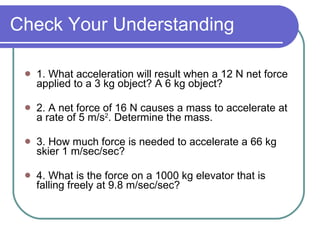
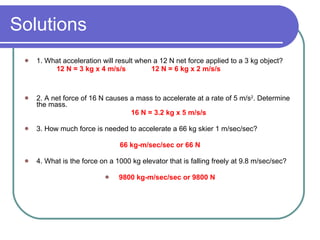
Check Your Understanding 1. What acceleration will result when a 12 N net force applied to a 3 kg object? A 6 kg object?   2. A net force of 16 N causes a mass to accelerate at a rate of 5 m/s 2 . Determine the mass. 3. How much force is needed to accelerate a 66 kg skier 1 m/sec/sec? 4. What is the force on a 1000 kg elevator that is falling freely at 9.8 m/sec/sec?
Solutions 1. What acceleration will result when a 12 N net force applied to a 3 kg object?  12 N = 3 kg x 4 m/s/s  12 N = 6 kg x 2 m/s/s   2. A net force of 16 N causes a mass to accelerate at a rate of 5 m/s 2 . Determine the mass. 16 N = 3.2 kg x 5 m/s/s   3. How much force is needed to accelerate a 66 kg skier 1 m/sec/sec? 66 kg-m/sec/sec or 66 N 4. What is the force on a 1000 kg elevator that is falling freely at 9.8 m/sec/sec?   9800 kg-m/sec/sec or 9800 N
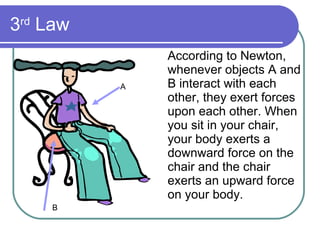
3 rd  Law According to Newton, whenever objects A and B interact with each other, they exert forces upon each other. When you sit in your chair, your body exerts a downward force on the chair and the chair exerts an upward force on your body.  A B
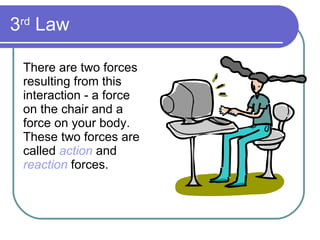
3 rd  Law There are two forces resulting from this interaction - a force on the chair and a force on your body. These two forces are called  action  and  reaction  forces.
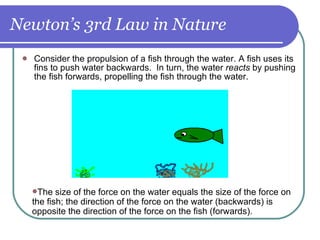
Newton’s 3rd Law in Nature Consider the propulsion of a fish through the water. A fish uses its fins to push water backwards.  In turn, the water  reacts  by pushing the fish forwards, propelling the fish through the water. The size of the force on the water equals the size of the force on the fish; the direction of the force on the water (backwards) is opposite the direction of the force on the fish (forwards).
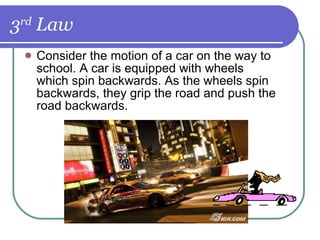
3 rd  Law Consider the motion of a car on the way to school. A car is equipped with wheels which spin backwards. As the wheels spin backwards, they grip the road and push the road backwards.
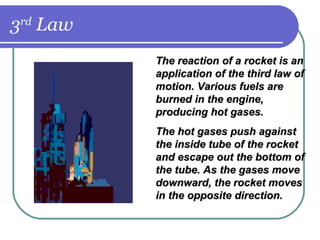
3 rd  Law The reaction of a rocket is an application of the third law of motion. Various fuels are burned in the engine, producing hot gases.  The hot gases push against the inside tube of the rocket and escape out the bottom of the tube. As the gases move downward, the rocket moves in the opposite direction.
Satellites Newton’s Laws are used to enable us to put objects in space. We have sent rockets, space shuttle and satellites into orbit. You will watch excerpts of Apollo 13
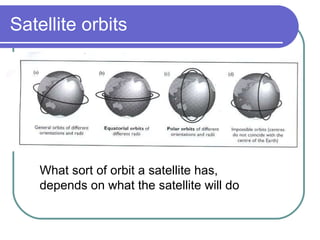
Satellite orbits What sort of orbit a satellite has, depends on what the satellite will do
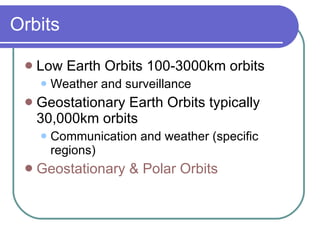
Orbits Low Earth Orbits 100-3000km orbits Weather and surveillance Geostationary Earth Orbits typically 30,000km orbits Communication and weather (specific regions) Geostationary & Polar Orbits
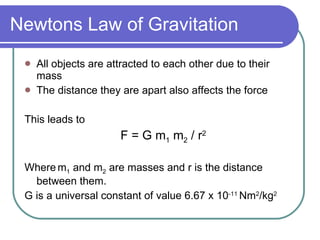
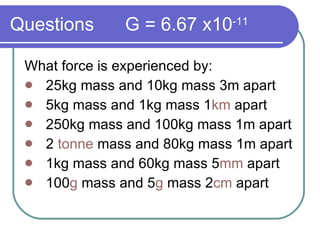
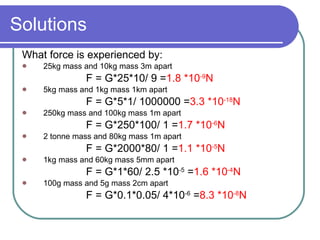
Newtons Law of Gravitation All objects are attracted to each other due to their mass  The distance they are apart also affects the force This leads to  F = G m 1  m 2  / r 2 Where   m 1  and m 2  are masses and r is the distance between them. G is a universal constant of value 6.67 x 10 -11  Nm 2 /kg 2
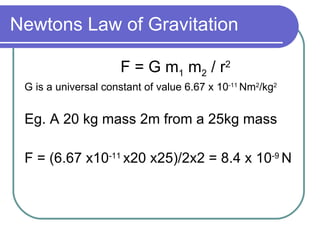
Newtons Law of Gravitation F = G m 1  m 2  / r 2 G is a universal constant of value 6.67 x 10 -11  Nm 2 /kg 2 Eg. A 20 kg mass 2m from a 25kg mass F = (6.67 x10 -11  x20 x25)/2x2 = 8.4 x 10 -9  N
Questions  G = 6.67 x10 -11 What force is experienced by: 25kg mass and 10kg mass 3m apart 5kg mass and 1kg mass 1 km  apart 250kg mass and 100kg mass 1m apart 2  tonne  mass and 80kg mass 1m apart 1kg mass and 60kg mass 5 mm  apart 100 g  mass and 5 g  mass 2 cm  apart
Solutions What force is experienced by: 25kg mass and 10kg mass 3m apart F = G*25*10/ 9 = 1.8 *10 -9 N 5kg mass and 1kg mass 1km apart F = G*5*1/ 1000000 = 3.3 *10 -18 N 250kg mass and 100kg mass 1m apart F = G*250*100/ 1 = 1.7 *10 -6 N 2 tonne mass and 80kg mass 1m apart F = G*2000*80/ 1 = 1.1 *10 -5 N 1kg mass and 60kg mass 5mm apart F = G*1*60/ 2.5 *10 -5  = 1.6 *10 -4 N 100g mass and 5g mass 2cm apart F = G*0.1*0.05/ 4*10 -6  = 8.3 *10 -8 N
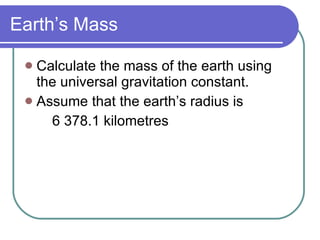
Earth’s Mass Calculate the mass of the earth using the universal gravitation constant. Assume that the earth’s radius is  6 378.1 kilometres