Models of the Universe
•The model of the solar
system today traces its
history back to the ancient
Greek astronomy.
•You have studied the sun, moon, stars, and
other celestial bodies in your Elementary
Science.
•As you move to Junior High School, you
came to understand the occurrence of
eclipses, solar system, and constellations.
Likewise, in the previous quarter, you have
learned how the elements in the universe
originated from the Big Bang. In this
module, we will look at the views of the
ancient Greeks about the universe and
understand how the model of the Solar
System originated.
Activity 1
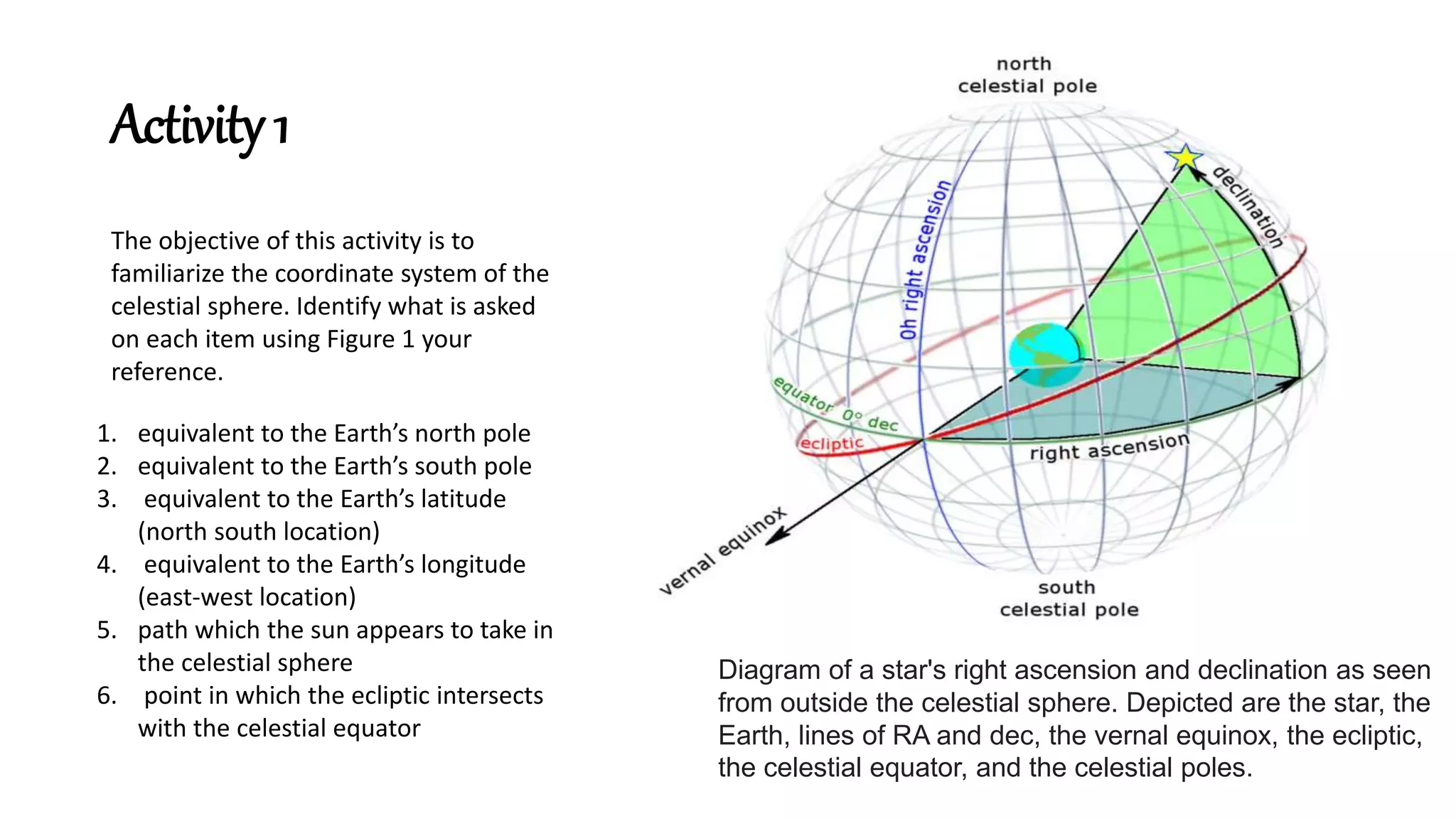
The objective of this activity is to
familiarize the coordinate system of the
celestial sphere. Identify what is asked
on each item using Figure 1 your
reference.
1. equivalent to the Earth’s north pole
2. equivalent to the Earth’s south pole
3. equivalent to the Earth’s latitude
(north south location)
4. equivalent to the Earth’s longitude
(east-west location)
5. path which the sun appears to take in
the celestial sphere
6. point in which the ecliptic intersects
with the celestial equator
Diagram of a star's right ascension and declination as seen
from outside the celestial sphere. Depicted are the star, the
Earth, lines of RA and dec, the vernal equinox, the ecliptic,
the celestial equator, and the celestial poles.
HOW GREEKS KNOWTHAT THE EARTH IS ROUND
Even before Plato, the Greeks have deduced that the Earth is spherical based on
the observation that the shadow cast by the Earth during a lunar eclipse is
circular and that the only shape that can cast a circular shadow at whatever
direction it is pointed is a sphere.
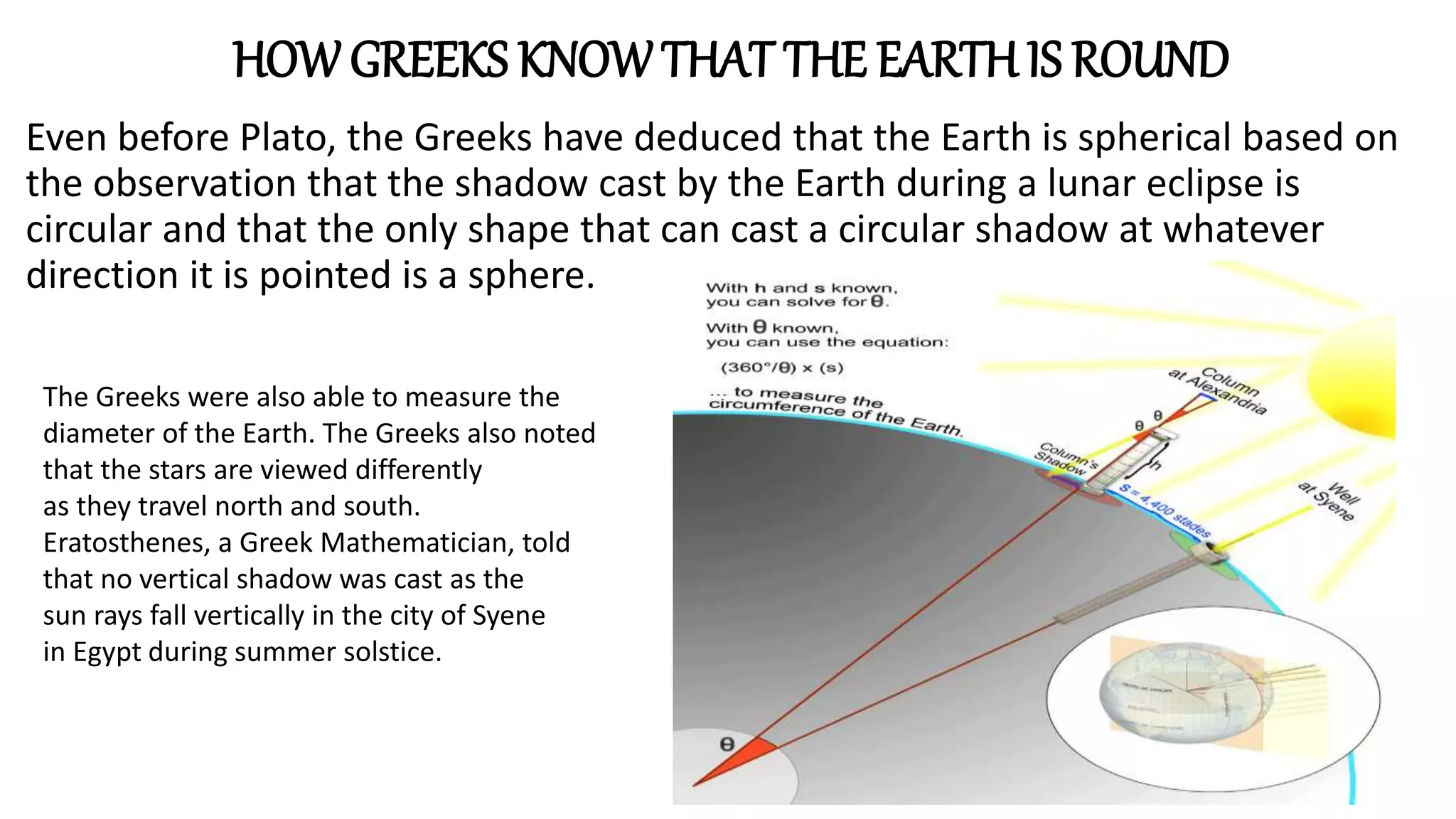
The Greeks were also able to measure the
diameter of the Earth. The Greeks also noted
that the stars are viewed differently
as they travel north and south.
Eratosthenes, a Greek Mathematician, told
that no vertical shadow was cast as the
sun rays fall vertically in the city of Syene
in Egypt during summer solstice.
•Eratosthenes noted that at the same time a shadow was
cast as the sun rays fell at an angle of 7.2° [one fiftieth
(1/50) of a circle in ancient Greek writings] in the city of
Alexandria. He assumed that the sun was so distant that
the rays fall parallel to each other on the Earth’s surface
and that the difference in the shadows cast in the two
cities was due to the curvature of Earth’s round surface.
The distance between Syene and Alexandria was found to
be 5000 stadia (approx. 800 km). Thus, Eratosthenes
thought the Earth’s circumference must be 50 x 5000 stadia
or 250,000 stadia (40,000 kilometers). Now, what is the
significance of the spherical shape of Earth? The sense of
symmetry by Greeks demands a spherical Earth located at
the center of the sphere of heavens.
ASTRONOMICAL EVENTS KNOWN TO MEN BEFORE THE
ADVENT OF TELESCOPES
• Before the advent of telescopes, humans depended on
their senses to grasp the universe. Ancient Babylonian,
Assyrian, and Egyptian knew the length of the year and
Egyptians, adopted a calendar based on 365 days a year.
The Egyptians also kept track of the yearly cycle of the star
Sirius which corresponds to the flooding of Nile. Early
Chinese civilizations kept track of the comets, meteors, and
dark spots of the Sun. Mayan civilization also developed a
calendar based on the movements of Venus. Meanwhile,
the Polynesians utilized the stars for navigation.
Diurnal Motion
• In modern astronomy, diurnal motion is defined as the
apparent daily motion of stars and other celestial bodies
across the sky due to Earth’s rotation. Man has observed
the sun rising from the east and set in the west. The Greek
astronomers have described ‘fixed stars’ moving in the sky
at the same arrangement and speed as most of the stars
are. Stars whose movements deviate from what seems to
be fixed stars were called ‘planetes’ which means
‘wandering stars’ in Greek. The seven wandering stars are
the Sun, moon, Mercury, Venus, Mars, Jupiter, and Saturn.
Annual Motion
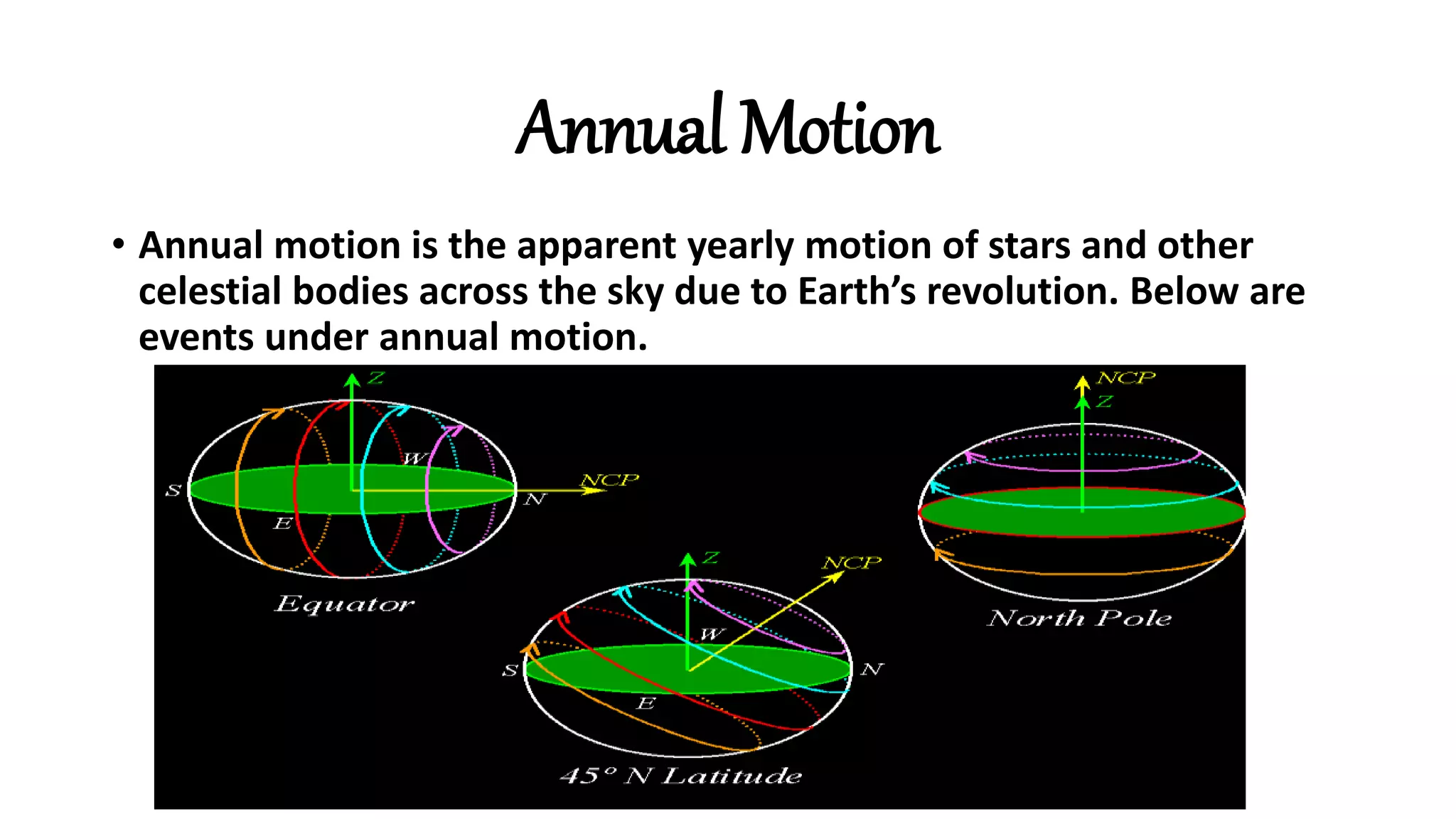
• Annual motion is the apparent yearly motion of stars and other
celestial bodies across the sky due to Earth’s revolution. Below are
events under annual motion.
Zodiac and the Ecliptic
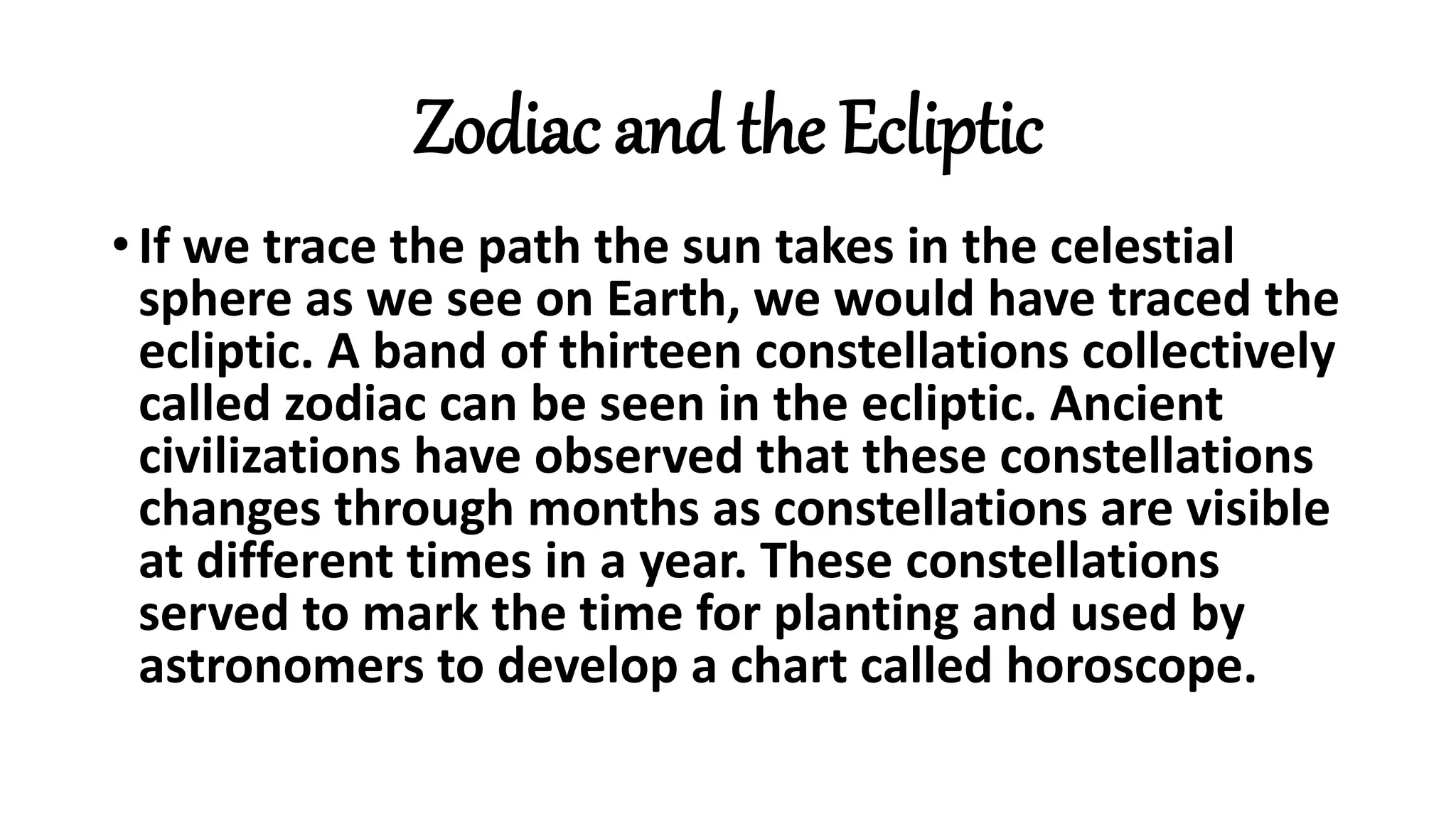
• If we trace the path the sun takes in the celestial
sphere as we see on Earth, we would have traced the
ecliptic. A band of thirteen constellations collectively
called zodiac can be seen in the ecliptic. Ancient
civilizations have observed that these constellations
changes through months as constellations are visible
at different times in a year. These constellations
served to mark the time for planting and used by
astronomers to develop a chart called horoscope.
Equinoxes and Solstices
• Equinoxes are the two days in a year in which the sun crosses
the celestial equator occurring near March 20 (vernal equinox)
and near September 22 (autumnal equinox). Midway between
these two equinoxes is the solstices. Solstices are the two days
in a year in which the Sun is at the farthest declination (north or
south) from the celestial equator. Ancient Greeks and Early
Chinese civilizations have recorded solstices by observing the
declination of the sun for several days before and after the
solstice. The calculated half-way between the days with the
equal declination of the sun at noon would be the solstice. This
method also applies for equinoxes.
Precession
• Hipparchus in 150 BCE has discovered based on his observation
that the north celestial pole has changed during the period of a
half - century. He noticed that the slow and continuous change
in the direction in which the sky is moving. We understand at
present that precession is the slow ‘wobbling’ of Earth’s axis of
rotation due to the gravitational pull of the Moon and Sun.
Figure 3 illustrates the 26,000-year cycle of precession. About
5,000 years ago the north celestial pole is located at the star
Thuban. At present, the north celestial pole is located near the
star Polaris and will be located at the star Vega after 14,000
years.
Eclipse
• Eclipses occur when either the Earth or moon cast a
shadow into each other. A solar eclipse occurs when the
moon passes between the Earth and sun with the moon
casting a shadow on the Earth’s surface. A lunar eclipse
occurs when the Earth is directly aligned between the sun
and moon with the Earth casting a shadow on the moon.
Take note that a solar eclipse may occur only during the
new moon phase, while a lunar eclipse may occur only
during the full moon phase.
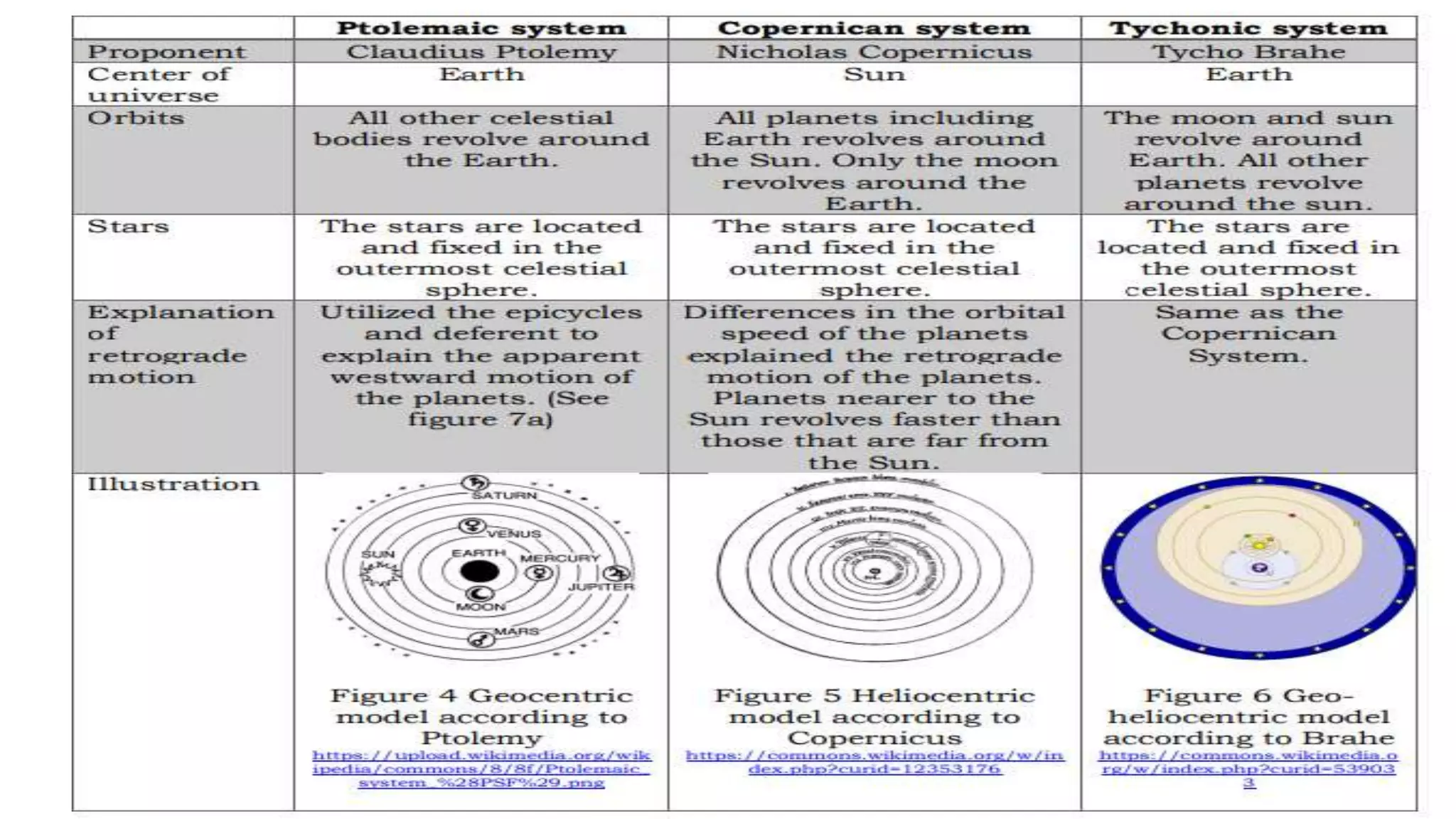
MODELS OF THE UNIVERSE
•Throughout the history of
astronomy, models of the universe
have been projected. The table
below describes the model of the
universe.
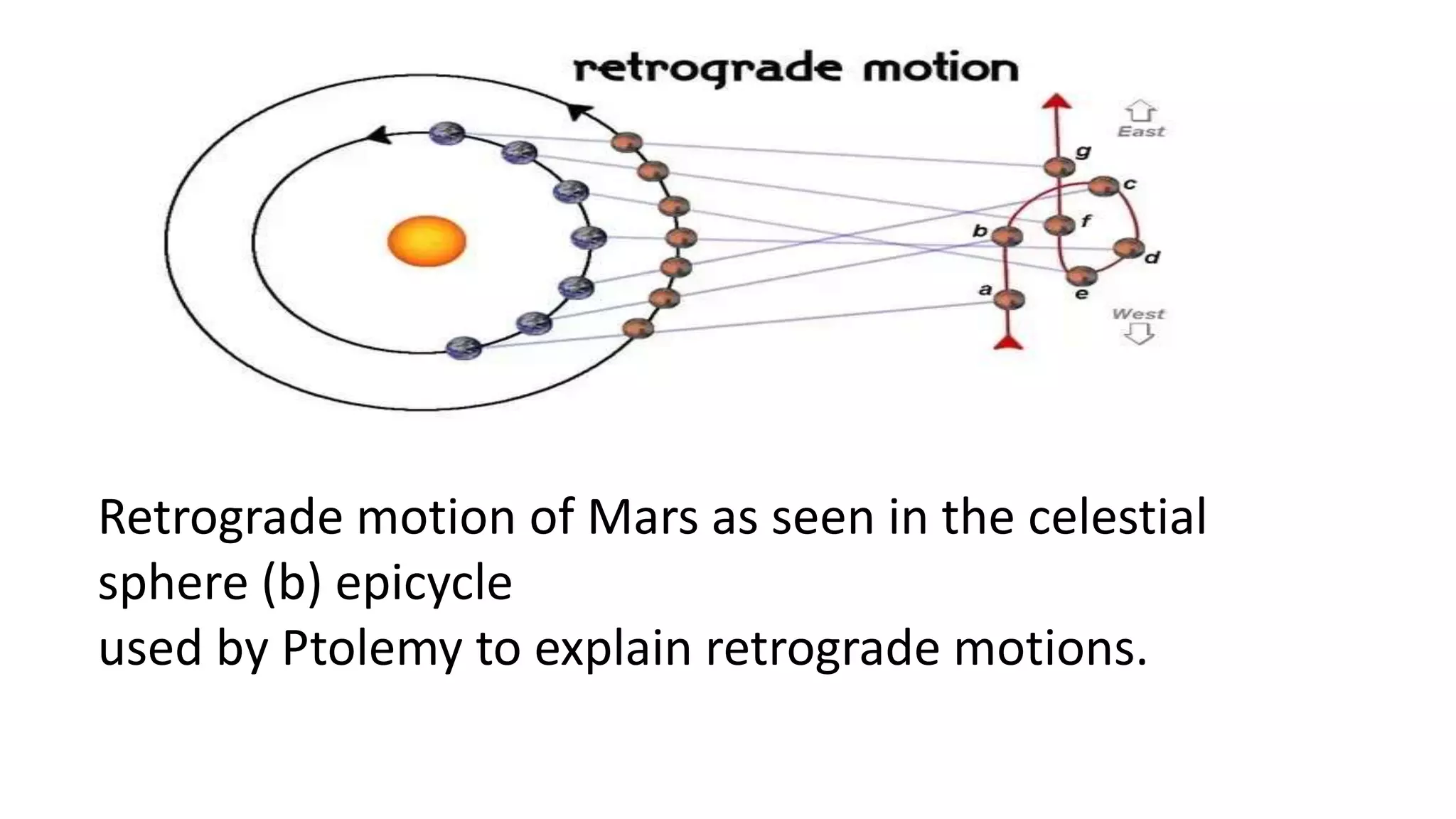
Retrograde motion of Mars as seen in the celestial
sphere (b) epicycle
used by Ptolemy to explain retrograde motions.
• Planets usually rise from east to west as we see in the celestial
sphere. However, it was observed by the ancient astronomers
that the planets seem to move westward for several weeks and
move eastward again in the succeeding weeks. In our current
situation, we can explain that these retrograde motions were
due to the difference in the period of revolution of the planets
around the sun as seen in figure 7a. With Earth being closer to
the sun, it moves faster than the planets farther from the Sun.
Ptolemy in his time held the belief that the Earth does not
revolve and is the center of the universe. The epicycle was used
to explain these retrograde motions. Here, a planet revolves in
an orbit called epicycle while the center of the epicycle revolves
around Earth. This path of revolution of the epicycle is called
deferent.
TYCHO BRAHE AND JOHANNES KEPLER
•Tycho Brahe, a Danish astronomer continuously
and precisely recorded the position of the sun,
moon, and planets for over 20 years using
instruments that are like giant protractors. He
noted based on his observations that the positions
of the planets differ from those that were
published. However, he was not able to develop a
better model than Ptolemy’s as he didn’t have the
ability to analyze his data. Years before his death, he
hired Johannes Kepler as a research assistant
Johannes Kepler as a research assistant to aid in
analyzing his data. Brahe was reluctant to provide
such data to Kepler, but at his death, the
observational data was possessed by Kepler.
Being knowledgeable in geometry, Kepler was
able to derive from Brahe’s data that the orbital
path of Mars was elliptical contrary to the
previous investigators who were trying to fit the
planetary paths in circles. Generalizing his results,
he was able to formulate the three laws of
planetary motion:
1. Law of Ellipse: orbits of all the planets are elliptical with
the Sun at one focus of the ellipse. An ellipse is a
somewhat flattened circle. It is a closed curve in which
the sum of the distances from any point on the ellipse to
foci (two points inside) is constant.
2. Law of Equal Areas: a line joining a planet and the Sun
sweeps out equal areas in space in equal intervals of time.
Thus, a planet moves fastest when it is nearest to the sun
3. Law of Harmony: the square of a planet’s orbital period
(years) is proportional to the cube of the semimajor axis
of its orbit (in astronomical units or AU) or 𝑃 2 = 𝑎 3 .
Thus, the larger the orbit’s size, the longer it takes to orbit
the sun.
Law of Harmony
You have learned about the ancient Greek astronomy and the development of the model of the solar
system. Answer the questions in two to three sentences.
1. Using a ball and a Frisbee, how would you explain to a flat-earther friend that the Earth is round?
______________________________________________________________________________
______________________________________________________________________________
______________________________________________________________________________
______________________________________________________________________________
2. Why was Tycho Brahe’s work essential in the development of Kepler’s law of planetary motion?
______________________________________________________________________________
______________________________________________________________________________
______________________________________________________________________________
______________________________________________________________________________

Models-of-the-Universe.pptx

  • 1.
    Models of theUniverse
  • 2.
    •The model ofthe solar system today traces its history back to the ancient Greek astronomy.
  • 3.
    •You have studiedthe sun, moon, stars, and other celestial bodies in your Elementary Science. •As you move to Junior High School, you came to understand the occurrence of eclipses, solar system, and constellations. Likewise, in the previous quarter, you have learned how the elements in the universe originated from the Big Bang. In this module, we will look at the views of the ancient Greeks about the universe and understand how the model of the Solar System originated.
  • 4.
    Activity 1 The objectiveof this activity is to familiarize the coordinate system of the celestial sphere. Identify what is asked on each item using Figure 1 your reference. 1. equivalent to the Earth’s north pole 2. equivalent to the Earth’s south pole 3. equivalent to the Earth’s latitude (north south location) 4. equivalent to the Earth’s longitude (east-west location) 5. path which the sun appears to take in the celestial sphere 6. point in which the ecliptic intersects with the celestial equator Diagram of a star's right ascension and declination as seen from outside the celestial sphere. Depicted are the star, the Earth, lines of RA and dec, the vernal equinox, the ecliptic, the celestial equator, and the celestial poles.
  • 5.
    HOW GREEKS KNOWTHATTHE EARTH IS ROUND Even before Plato, the Greeks have deduced that the Earth is spherical based on the observation that the shadow cast by the Earth during a lunar eclipse is circular and that the only shape that can cast a circular shadow at whatever direction it is pointed is a sphere. The Greeks were also able to measure the diameter of the Earth. The Greeks also noted that the stars are viewed differently as they travel north and south. Eratosthenes, a Greek Mathematician, told that no vertical shadow was cast as the sun rays fall vertically in the city of Syene in Egypt during summer solstice.
  • 6.
    •Eratosthenes noted thatat the same time a shadow was cast as the sun rays fell at an angle of 7.2° [one fiftieth (1/50) of a circle in ancient Greek writings] in the city of Alexandria. He assumed that the sun was so distant that the rays fall parallel to each other on the Earth’s surface and that the difference in the shadows cast in the two cities was due to the curvature of Earth’s round surface. The distance between Syene and Alexandria was found to be 5000 stadia (approx. 800 km). Thus, Eratosthenes thought the Earth’s circumference must be 50 x 5000 stadia or 250,000 stadia (40,000 kilometers). Now, what is the significance of the spherical shape of Earth? The sense of symmetry by Greeks demands a spherical Earth located at the center of the sphere of heavens.
  • 7.
    ASTRONOMICAL EVENTS KNOWNTO MEN BEFORE THE ADVENT OF TELESCOPES • Before the advent of telescopes, humans depended on their senses to grasp the universe. Ancient Babylonian, Assyrian, and Egyptian knew the length of the year and Egyptians, adopted a calendar based on 365 days a year. The Egyptians also kept track of the yearly cycle of the star Sirius which corresponds to the flooding of Nile. Early Chinese civilizations kept track of the comets, meteors, and dark spots of the Sun. Mayan civilization also developed a calendar based on the movements of Venus. Meanwhile, the Polynesians utilized the stars for navigation.
  • 8.
    Diurnal Motion • Inmodern astronomy, diurnal motion is defined as the apparent daily motion of stars and other celestial bodies across the sky due to Earth’s rotation. Man has observed the sun rising from the east and set in the west. The Greek astronomers have described ‘fixed stars’ moving in the sky at the same arrangement and speed as most of the stars are. Stars whose movements deviate from what seems to be fixed stars were called ‘planetes’ which means ‘wandering stars’ in Greek. The seven wandering stars are the Sun, moon, Mercury, Venus, Mars, Jupiter, and Saturn.
  • 10.
    Annual Motion • Annualmotion is the apparent yearly motion of stars and other celestial bodies across the sky due to Earth’s revolution. Below are events under annual motion.
  • 11.
    Zodiac and theEcliptic • If we trace the path the sun takes in the celestial sphere as we see on Earth, we would have traced the ecliptic. A band of thirteen constellations collectively called zodiac can be seen in the ecliptic. Ancient civilizations have observed that these constellations changes through months as constellations are visible at different times in a year. These constellations served to mark the time for planting and used by astronomers to develop a chart called horoscope.
  • 13.
    Equinoxes and Solstices •Equinoxes are the two days in a year in which the sun crosses the celestial equator occurring near March 20 (vernal equinox) and near September 22 (autumnal equinox). Midway between these two equinoxes is the solstices. Solstices are the two days in a year in which the Sun is at the farthest declination (north or south) from the celestial equator. Ancient Greeks and Early Chinese civilizations have recorded solstices by observing the declination of the sun for several days before and after the solstice. The calculated half-way between the days with the equal declination of the sun at noon would be the solstice. This method also applies for equinoxes.
  • 15.
    Precession • Hipparchus in150 BCE has discovered based on his observation that the north celestial pole has changed during the period of a half - century. He noticed that the slow and continuous change in the direction in which the sky is moving. We understand at present that precession is the slow ‘wobbling’ of Earth’s axis of rotation due to the gravitational pull of the Moon and Sun. Figure 3 illustrates the 26,000-year cycle of precession. About 5,000 years ago the north celestial pole is located at the star Thuban. At present, the north celestial pole is located near the star Polaris and will be located at the star Vega after 14,000 years.
  • 17.
    Eclipse • Eclipses occurwhen either the Earth or moon cast a shadow into each other. A solar eclipse occurs when the moon passes between the Earth and sun with the moon casting a shadow on the Earth’s surface. A lunar eclipse occurs when the Earth is directly aligned between the sun and moon with the Earth casting a shadow on the moon. Take note that a solar eclipse may occur only during the new moon phase, while a lunar eclipse may occur only during the full moon phase.
  • 19.
    MODELS OF THEUNIVERSE •Throughout the history of astronomy, models of the universe have been projected. The table below describes the model of the universe.
  • 21.
    Retrograde motion ofMars as seen in the celestial sphere (b) epicycle used by Ptolemy to explain retrograde motions.
  • 22.
    • Planets usuallyrise from east to west as we see in the celestial sphere. However, it was observed by the ancient astronomers that the planets seem to move westward for several weeks and move eastward again in the succeeding weeks. In our current situation, we can explain that these retrograde motions were due to the difference in the period of revolution of the planets around the sun as seen in figure 7a. With Earth being closer to the sun, it moves faster than the planets farther from the Sun. Ptolemy in his time held the belief that the Earth does not revolve and is the center of the universe. The epicycle was used to explain these retrograde motions. Here, a planet revolves in an orbit called epicycle while the center of the epicycle revolves around Earth. This path of revolution of the epicycle is called deferent.
  • 23.
    TYCHO BRAHE ANDJOHANNES KEPLER •Tycho Brahe, a Danish astronomer continuously and precisely recorded the position of the sun, moon, and planets for over 20 years using instruments that are like giant protractors. He noted based on his observations that the positions of the planets differ from those that were published. However, he was not able to develop a better model than Ptolemy’s as he didn’t have the ability to analyze his data. Years before his death, he hired Johannes Kepler as a research assistant
  • 24.
    Johannes Kepler asa research assistant to aid in analyzing his data. Brahe was reluctant to provide such data to Kepler, but at his death, the observational data was possessed by Kepler. Being knowledgeable in geometry, Kepler was able to derive from Brahe’s data that the orbital path of Mars was elliptical contrary to the previous investigators who were trying to fit the planetary paths in circles. Generalizing his results, he was able to formulate the three laws of planetary motion:
  • 25.
    1. Law ofEllipse: orbits of all the planets are elliptical with the Sun at one focus of the ellipse. An ellipse is a somewhat flattened circle. It is a closed curve in which the sum of the distances from any point on the ellipse to foci (two points inside) is constant. 2. Law of Equal Areas: a line joining a planet and the Sun sweeps out equal areas in space in equal intervals of time. Thus, a planet moves fastest when it is nearest to the sun 3. Law of Harmony: the square of a planet’s orbital period (years) is proportional to the cube of the semimajor axis of its orbit (in astronomical units or AU) or 𝑃 2 = 𝑎 3 . Thus, the larger the orbit’s size, the longer it takes to orbit the sun.
  • 28.
  • 29.
    You have learnedabout the ancient Greek astronomy and the development of the model of the solar system. Answer the questions in two to three sentences. 1. Using a ball and a Frisbee, how would you explain to a flat-earther friend that the Earth is round? ______________________________________________________________________________ ______________________________________________________________________________ ______________________________________________________________________________ ______________________________________________________________________________ 2. Why was Tycho Brahe’s work essential in the development of Kepler’s law of planetary motion? ______________________________________________________________________________ ______________________________________________________________________________ ______________________________________________________________________________ ______________________________________________________________________________