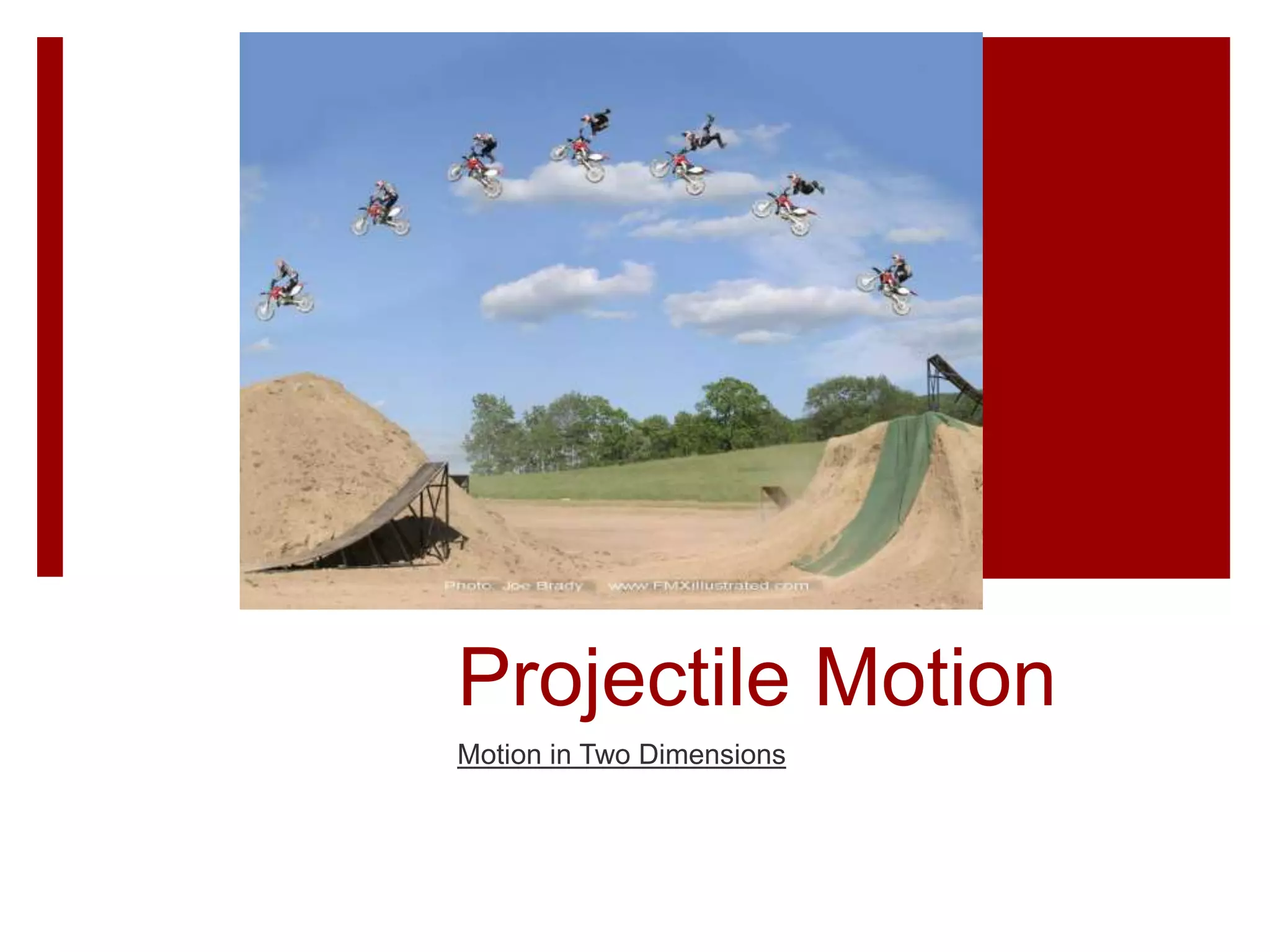
Projectile Motion
Motion in Two Dimensions
A Question to Begin
 At the instant a horizontally pointed cannon ball is
fired, a cannonball held at the cannon’s side is
released and drops to the ground. Which cannonball
strikes the ground first, the one fired from the cannon
or the one dropped?
What is a Projectile?
 Any object that continues in motion by its own inertia and is
influenced only by the downward force of gravity (and air resistance)
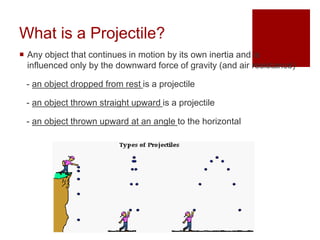
- an object dropped from rest is a projectile
- an object thrown straight upward is a projectile
- an object thrown upward at an angle to the horizontal
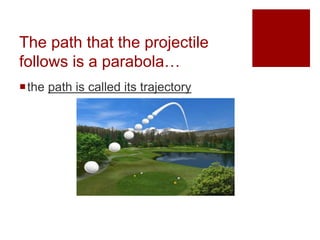
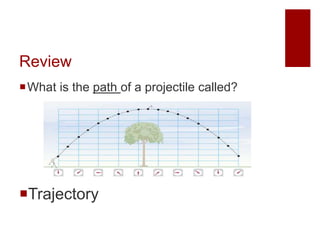
The path that the projectile
follows is a parabola…
the path is called its trajectory
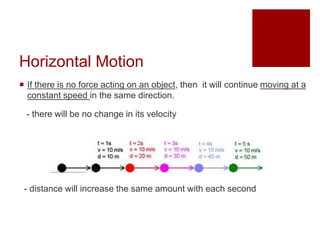
Horizontal Motion
 If there is no force acting on an object, then it will continue moving at a
constant speed in the same direction.
- there will be no change in its velocity
- distance will increase the same amount with each second
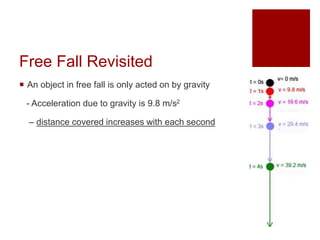
Free Fall Revisited
 An object in free fall is only acted on by gravity
- Acceleration due to gravity is 9.8 m/s2
– distance covered increases with each second
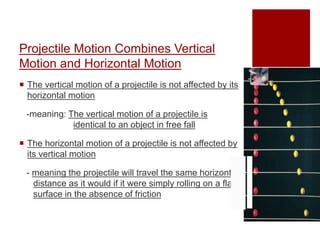
Projectile Motion Combines Vertical
Motion and Horizontal Motion
 The vertical motion of a projectile is not affected by its
horizontal motion
-meaning: The vertical motion of a projectile is
identical to an object in free fall
 The horizontal motion of a projectile is not affected by
its vertical motion
- meaning the projectile will travel the same horizontal
distance as it would if it were simply rolling on a flat
surface in the absence of friction
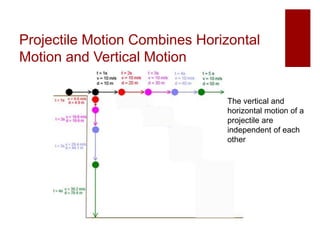
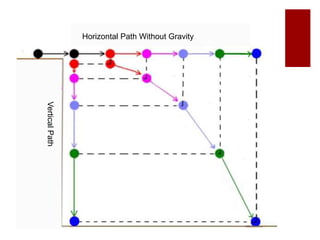
Projectile Motion Combines Horizontal
Motion and Vertical Motion
The vertical and
horizontal motion of a
projectile are
independent of each
other
Horizontal Path Without Gravity
Vertical
Path
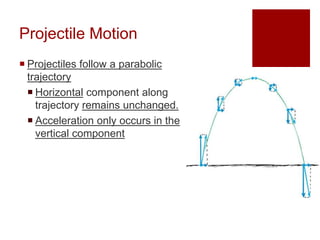
Projectile Motion
 Projectiles follow a parabolic
trajectory
 Horizontal component along
trajectory remains unchanged.
 Acceleration only occurs in the
vertical component
Projectile Motion and
Complementary Angles
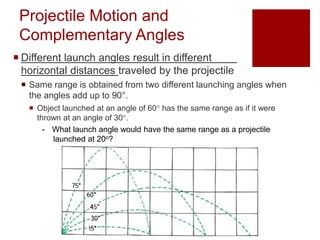
 Different launch angles result in different
horizontal distances traveled by the projectile
 Same range is obtained from two different launching angles when
the angles add up to 90°.
 Object launched at an angle of 60 has the same range as if it were
thrown at an angle of 30.
- What launch angle would have the same range as a projectile
launched at 20o?
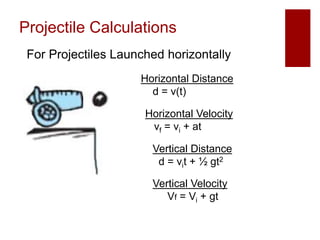
Projectile Calculations
Horizontal Distance
d = v(t)
Vertical Velocity
Vf = Vi + gt
For Projectiles Launched horizontally
Horizontal Velocity
vf = vi + at
Vertical Distance
d = vit + ½ gt2
Review
What is the path of a projectile called?
Trajectory
Review
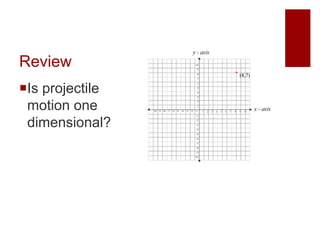
Is projectile
motion one
dimensional?
No, it is 2
dimensional-
vertical and
horizontal
Review
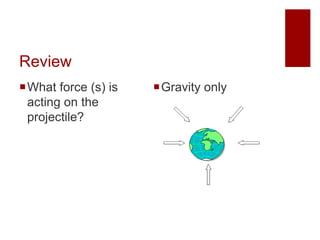
What force (s) is
acting on the
projectile?
Gravity only
Review
 Which direction,
horizontal or vertical
has acceleration?
 Which direction,
horizontal or vertical
has constant speed?
 Vertical
 Horizontal
Review
 Two identical balls roll
off the edge of a table.
One leaves the table
travelling twice the
speed of the other.
Which ball hits the floor
first?
 Both hit the ground at
the same time. The
difference in horizontal
velocity does not affect
the vertical time.
Review
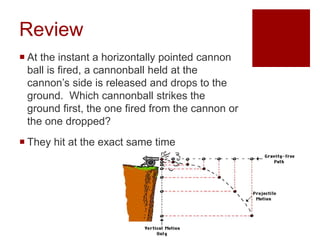
 At the instant a horizontally pointed cannon
ball is fired, a cannonball held at the
cannon’s side is released and drops to the
ground. Which cannonball strikes the
ground first, the one fired from the cannon or
the one dropped?
 They hit at the exact same time
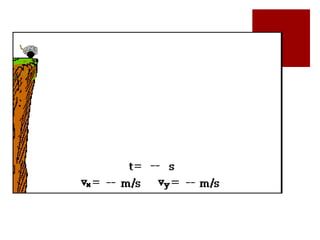
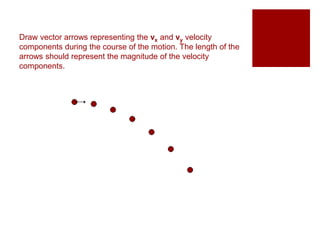
Draw vector arrows representing the vx and vy velocity
components during the course of the motion. The length of the
arrows should represent the magnitude of the velocity
components.
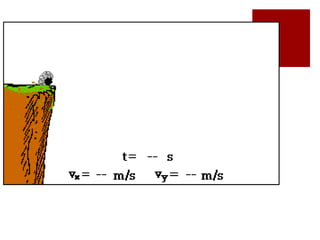
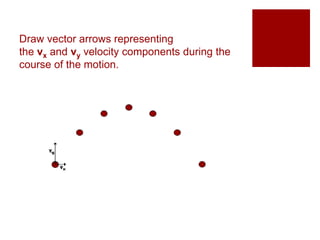
Draw vector arrows representing
the vx and vy velocity components during the
course of the motion.

projectile motion1.ppt

  • 1.
  • 2.
    A Question toBegin  At the instant a horizontally pointed cannon ball is fired, a cannonball held at the cannon’s side is released and drops to the ground. Which cannonball strikes the ground first, the one fired from the cannon or the one dropped?
  • 3.
    What is aProjectile?  Any object that continues in motion by its own inertia and is influenced only by the downward force of gravity (and air resistance) - an object dropped from rest is a projectile - an object thrown straight upward is a projectile - an object thrown upward at an angle to the horizontal
  • 4.
    The path thatthe projectile follows is a parabola… the path is called its trajectory
  • 5.
    Horizontal Motion  Ifthere is no force acting on an object, then it will continue moving at a constant speed in the same direction. - there will be no change in its velocity - distance will increase the same amount with each second
  • 6.
    Free Fall Revisited An object in free fall is only acted on by gravity - Acceleration due to gravity is 9.8 m/s2 – distance covered increases with each second
  • 7.
    Projectile Motion CombinesVertical Motion and Horizontal Motion  The vertical motion of a projectile is not affected by its horizontal motion -meaning: The vertical motion of a projectile is identical to an object in free fall  The horizontal motion of a projectile is not affected by its vertical motion - meaning the projectile will travel the same horizontal distance as it would if it were simply rolling on a flat surface in the absence of friction
  • 8.
    Projectile Motion CombinesHorizontal Motion and Vertical Motion The vertical and horizontal motion of a projectile are independent of each other
  • 9.
    Horizontal Path WithoutGravity Vertical Path
  • 11.
    Projectile Motion  Projectilesfollow a parabolic trajectory  Horizontal component along trajectory remains unchanged.  Acceleration only occurs in the vertical component
  • 13.
    Projectile Motion and ComplementaryAngles  Different launch angles result in different horizontal distances traveled by the projectile  Same range is obtained from two different launching angles when the angles add up to 90°.  Object launched at an angle of 60 has the same range as if it were thrown at an angle of 30. - What launch angle would have the same range as a projectile launched at 20o?
  • 14.
    Projectile Calculations Horizontal Distance d= v(t) Vertical Velocity Vf = Vi + gt For Projectiles Launched horizontally Horizontal Velocity vf = vi + at Vertical Distance d = vit + ½ gt2
  • 15.
    Review What is thepath of a projectile called? Trajectory
  • 16.
    Review Is projectile motion one dimensional? No,it is 2 dimensional- vertical and horizontal
  • 17.
    Review What force (s)is acting on the projectile? Gravity only
  • 18.
    Review  Which direction, horizontalor vertical has acceleration?  Which direction, horizontal or vertical has constant speed?  Vertical  Horizontal
  • 19.
    Review  Two identicalballs roll off the edge of a table. One leaves the table travelling twice the speed of the other. Which ball hits the floor first?  Both hit the ground at the same time. The difference in horizontal velocity does not affect the vertical time.
  • 20.
    Review  At theinstant a horizontally pointed cannon ball is fired, a cannonball held at the cannon’s side is released and drops to the ground. Which cannonball strikes the ground first, the one fired from the cannon or the one dropped?  They hit at the exact same time
  • 21.
    Draw vector arrowsrepresenting the vx and vy velocity components during the course of the motion. The length of the arrows should represent the magnitude of the velocity components.
  • 22.
    Draw vector arrowsrepresenting the vx and vy velocity components during the course of the motion.