The Laws of Motion
Prof. Samirsinh P Parmar
Mail: samirddu@gmail.com
Asst. Professor, Department of Civil Engineering,
Faculty of Technology,
Dharmasinh Desai University, Nadiad-387001
Gujarat, INDIA
CL-101 ENGINEERING MECHANICS
B. Tech Semester-I
Content of the presentation
• Force and Mass
• Types of Forces
• Contact forces
• Field forces
• Newtons laws of motion
• Sample Examples
• Explanation
• It’s not Newton’s Laws
• Its Rishi Kanad laws
• Proof of stolen three laws of motion.
The Laws of Motion
• Newton’s first law
• Force
• Mass
• Newton’s second law
• Newton’s third law
• Examples
Isaac Newton’s work represents one of the greatest
contributions to science ever made by an individual.
Biggest case of early plagiarism in
human history is contributed by Sir
Isaac Newton
Dynamics
• Describes the relationship between the motion of objects in our
everyday world and the forces acting on them
• Language of Dynamics
• Force: The measure of interaction between two objects (pull or push).
It is a vector quantity – it has a magnitude and direction
• Mass: The measure of how difficult it is to change object’s velocity
(sluggishness or inertia of the object)
Force and Motion
Forces
• The measure of interaction
between two objects (pull or
push)
• Vector quantity: has
magnitude and direction
• May be a contact force or a
field force
• Contact forces result from
physical contact between two
objects
• Field forces act between
disconnected objects
• Also called “action at a distance”
Forces
• Gravitational Force
• Archimedes Force
• Friction Force
• Tension Force
• Spring Force
• Normal Force
Vector Nature of Force
• Vector force: has magnitude and direction
• Net Force: a resultant force acting on object
• You must use the rules of vector addition to obtain the net
force on an object
......
3
2
1 



  F
F
F
F
Fnet





2 2
1 2
1 1
2
| | 2.24 N
tan ( ) 26.6
F F F
F
F
 
  
  
Newton’s First Law
• An object at rest tends to stay at rest and an
object in motion tends to stay in motion with
the same speed and in the same direction
unless acted upon by an unbalanced force
 An object at rest remains at rest as long as no net force acts on it
 An object moving with constant velocity continues to move with the same
speed and in the same direction (the same velocity) as long as no net force
acts on it
 “Keep on doing what it is doing”
First Law Of Motion
It states that:
a) A body moving with a
certain velocity will move in
the same direction with the
same velocity, if the total
force acting on it is zero.
b) A body at rest will continue
to be at rest until an external
force acts on it.
Newton’s First Law
• An object at rest tends to stay at rest and an
object in motion tends to stay in motion with
the same speed and in the same direction
unless acted upon by an unbalanced force
 When forces are balanced, the acceleration of the object is zero
 Object at rest: v = 0 and a = 0
 Object in motion: v  0 and a = 0
 The net force is defined as the vector sum of all the external forces
exerted on the object. If the net force is zero, forces are balanced.
When forces are balances, the object can be stationary, or move
with constant velocity.
Mass and Inertia
 Every object continues in its state of rest, or uniform motion in a
straight line, unless it is compelled to change that state by unbalanced
forces impressed upon it
 Inertia is a property of objects to resist changes is motion!
 Mass is a measure of the amount of inertia.
 Mass is a measure of the resistance of an object to changes in its
velocity
 Mass is an inherent property of an object
 Scalar quantity and SI unit: kg
Newton’s Second Law
• The acceleration of an object is directly
proportional to the net force acting on it
and inversely proportional to its mass
m
F
m
F
a net






a
m
F
Fnet




 
Newton’s Second Law
Units of Force
• Newton’s second law:
• SI unit of force is a Newton (N)
• US Customary unit of force is a pound (lb)
• 1 N = 0.225 lb
• Weight, also measured in lbs. is a force (mass x acceleration).
• What is the acceleration in that case?
2
s
m
kg
1
N
1 
a
m
F
Fnet




 
More about Newton’s 2nd Law
• You must be certain about which body we are applying it to
• Fnet must be the vector sum of all the forces that act on that body
• Only forces that act on that body are to be included in the vector sum
• Net force component along an
axis gives rise to the acceleration
along that same axis
x
x
net ma
F 
, y
y
net ma
F 
,
Sample Problem
• One or two forces act on a puck that moves over frictionless ice along an x axis, in one-
dimensional motion. The puck's mass is m = 0.20 kg. Forces F1 and F2 and are directed
along the x axis and have magnitudes F1 = 4.0 N and F2 = 2.0 N. Force F3 is directed at
angle  = 30° and has magnitude F3 = 1.0 N. In each situation, what is the acceleration of
the puck?
x
x
net ma
F 
,
2
1
1
m/s
20
kg
2
.
0
N
0
.
4
)




m
F
a
ma
F
a
x
x
2
2
1
2
1
m/s
10
kg
2
.
0
N
0
.
2
N
0
.
4
)







m
F
F
a
ma
F
F
b
x
x
2
2
3
3
,
3
2
,
3
m/s
7
.
5
kg
2
.
0
N
0
.
2
30
cos
N
0
.
1
cos
cos
)










m
F
F
a
F
F
ma
F
F
c
x
x
x
x


Gravitational Force
• Gravitational force is a vector
• Expressed by Newton’s Law of Universal Gravitation:
• G – gravitational constant
• M – mass of the Earth
• m – mass of an object
• R – radius of the Earth
• Direction: pointing downward
2
R
mM
G
Fg 
Weight
• The magnitude of the gravitational force acting on an
object of mass m near the Earth’s surface is called the
weight w of the object: w = mg
• g can also be found from the Law of Universal Gravitation
• Weight has a unit of N
• Weight depends upon location
mg
F
w g 

2
2
m/s
8
.
9


R
M
G
g
R = 6,400 km
2
R
mM
G
Fg 
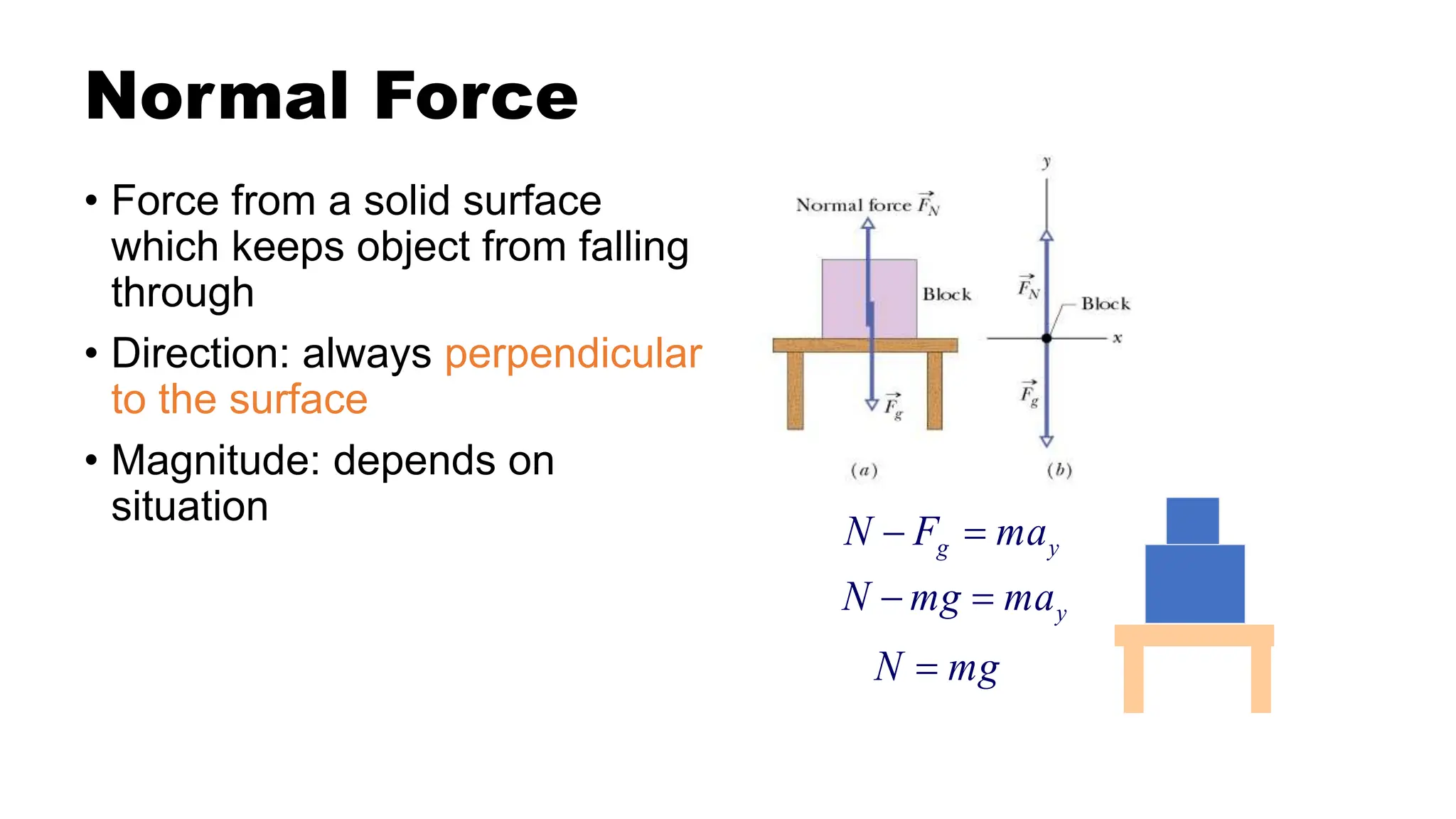
Normal Force
• Force from a solid surface
which keeps object from falling
through
• Direction: always perpendicular
to the surface
• Magnitude: depends on
situation
mg
F
w g 

y
g ma
F
N 

mg
N 
y
ma
mg
N 

Tension Force: T
• A taut rope exerts forces on
whatever holds its ends
• Direction: always along the
cord (rope, cable, string ……)
and away from the object
• Magnitude: depend on
situation
T1
T2
T1 = T = T2
Newton’s Third Law
• If object 1 and object 2 interact, the force
exerted by object 1 on object 2 is equal in
magnitude but opposite in direction to the
force exerted by object 2 on object 1
B
on
A
on F
F




 Equivalent to saying a single isolated force cannot exist
Newton’s Third Law cont.
• F12 may be called the
action force and F21 the
reaction force
• Actually, either force can be
the action or the reaction
force
• The action and reaction
forces act on different
objects
Some Action-Reaction Pairs
2
R
mM
G
Fg 
2
R
mM
G
Fg 
2
R
Gm
M
Ma
Fg 

2
R
GM
m
mg
Fg 

Some Action-Reaction Pairs
Free Body Diagram
• The most important step in
solving problems involving
Newton’s Laws is to draw the
free body diagram
• Be sure to include only the
forces acting on the object of
interest
• Include any field forces acting
on the object
• Do not assume the normal
force equals the weight
F hand on book
F Earth on book
Hints for Problem-Solving
• Read the problem carefully at least once
• Draw a picture of the system, identify the object of primary interest, and indicate forces with
arrows
• Label each force in the picture in a way that will bring to mind what physical quantity the
label stands for (e.g., T for tension)
• Draw a free-body diagram of the object of interest, based on the labeled picture.
• If additional objects are involved, draw separate free-body diagram for them
• Choose a convenient coordinate system for each object
• Apply Newton’s second law. The x- and y-components of Newton second law should be
taken from the vector equation and written individually. This often results in two equations
and two unknowns
• Solve for the desired unknown quantity, and substitute the numbers
x
x
net ma
F 
, y
y
net ma
F 
,
Objects in Equilibrium
• Objects that are either at rest or moving with constant
velocity are said to be in equilibrium
• Acceleration of an object can be modeled as zero:
• Mathematically, the net force acting on the object is zero
• Equivalent to the set of component equations given by
0

 x
F 0

 y
F
0

F

0

a

Equilibrium, Example 1
• A lamp is suspended from a chain of
negligible mass
• The forces acting on the lamp are
• the downward force of gravity
• the upward tension in the chain
• Applying equilibrium gives
0 0
     
 y g g
F T F T F
Equilibrium, Example 2
• A traffic light weighing 100 N hangs from a vertical cable
tied to two other cables that are fastened to a support.
The upper cables make angles of 37° and 53° with the
horizontal. Find the tension in each of the three cables.
 Conceptualize the traffic light
 Assume cables don’t break
 Nothing is moving
 Categorize as an equilibrium problem
 No movement, so acceleration is zero
 Model as an object in equilibrium
0

 x
F 0

 y
F
Equilibrium, Example 2
• Need 2 free-body diagrams
• Apply equilibrium equation to light
• Apply equilibrium equations to knot
N
F
T
F
T
F
g
g
y
100
0
0
3
3







N
F
T
F
T
F
g
g
y
100
0
0
3
3







N
T
T
N
T
T
T
T
N
T
T
T
T
T
F
T
T
T
T
F
y
y
y
y
x
x
x
80
33
.
1
60
33
.
1
53
cos
37
cos
0
100
53
sin
37
sin
0
53
cos
37
cos
1
2
1
1
1
2
2
1
3
2
1
2
1
2
1


































Accelerating Objects
• If an object that can be modeled as a particle experiences an
acceleration, there must be a nonzero net force acting on it
• Draw a free-body diagram
• Apply Newton’s Second Law in component form
a
m
F




x
x ma
F 
 y
y ma
F 

Accelerating Objects, Example 1
• A man weighs himself with a scale in an elevator. While
the elevator is at rest, he measures a weight of 800 N.
• What weight does the scale read if the elevator accelerates
upward at 2.0 m/s2? a = 2.0 m/s2
• What weight does the scale read if the elevator accelerates
downward at 2.0 m/s2? a = - 2.0 m/s2
N
624
)
8
.
9
0
.
2
(
80 


N
 Upward:
 Downward:
ma
mg
N
Fy 



mg
N
N
80
m/s
8
.
9
N
800
)
(
2







g
w
m
a
g
m
ma
mg
N
N
N 1560
)
8
.
9
0
.
2
(
80 


mg
N 
N
624
)
8
.
9
0
.
2
(
80 



N
mg
N  mg
N
Newton Stole idea of laws from
Sanskrit Scripts of “ Rishi Kanad”
Ref: https://www.ajer.org/papers/Vol-9-issue-7/K09078792.pdf
Laws of Motion.pptx
Laws of Motion.pptx
Laws of Motion.pptx

Laws of Motion.pptx

  • 1.
    The Laws ofMotion Prof. Samirsinh P Parmar Mail: samirddu@gmail.com Asst. Professor, Department of Civil Engineering, Faculty of Technology, Dharmasinh Desai University, Nadiad-387001 Gujarat, INDIA CL-101 ENGINEERING MECHANICS B. Tech Semester-I
  • 2.
    Content of thepresentation • Force and Mass • Types of Forces • Contact forces • Field forces • Newtons laws of motion • Sample Examples • Explanation • It’s not Newton’s Laws • Its Rishi Kanad laws • Proof of stolen three laws of motion.
  • 3.
    The Laws ofMotion • Newton’s first law • Force • Mass • Newton’s second law • Newton’s third law • Examples Isaac Newton’s work represents one of the greatest contributions to science ever made by an individual. Biggest case of early plagiarism in human history is contributed by Sir Isaac Newton
  • 4.
    Dynamics • Describes therelationship between the motion of objects in our everyday world and the forces acting on them • Language of Dynamics • Force: The measure of interaction between two objects (pull or push). It is a vector quantity – it has a magnitude and direction • Mass: The measure of how difficult it is to change object’s velocity (sluggishness or inertia of the object)
  • 5.
  • 6.
    Forces • The measureof interaction between two objects (pull or push) • Vector quantity: has magnitude and direction • May be a contact force or a field force • Contact forces result from physical contact between two objects • Field forces act between disconnected objects • Also called “action at a distance”
  • 7.
    Forces • Gravitational Force •Archimedes Force • Friction Force • Tension Force • Spring Force • Normal Force
  • 8.
    Vector Nature ofForce • Vector force: has magnitude and direction • Net Force: a resultant force acting on object • You must use the rules of vector addition to obtain the net force on an object ...... 3 2 1       F F F F Fnet      2 2 1 2 1 1 2 | | 2.24 N tan ( ) 26.6 F F F F F        
  • 9.
    Newton’s First Law •An object at rest tends to stay at rest and an object in motion tends to stay in motion with the same speed and in the same direction unless acted upon by an unbalanced force  An object at rest remains at rest as long as no net force acts on it  An object moving with constant velocity continues to move with the same speed and in the same direction (the same velocity) as long as no net force acts on it  “Keep on doing what it is doing”
  • 10.
    First Law OfMotion It states that: a) A body moving with a certain velocity will move in the same direction with the same velocity, if the total force acting on it is zero. b) A body at rest will continue to be at rest until an external force acts on it.
  • 11.
    Newton’s First Law •An object at rest tends to stay at rest and an object in motion tends to stay in motion with the same speed and in the same direction unless acted upon by an unbalanced force  When forces are balanced, the acceleration of the object is zero  Object at rest: v = 0 and a = 0  Object in motion: v  0 and a = 0  The net force is defined as the vector sum of all the external forces exerted on the object. If the net force is zero, forces are balanced. When forces are balances, the object can be stationary, or move with constant velocity.
  • 12.
    Mass and Inertia Every object continues in its state of rest, or uniform motion in a straight line, unless it is compelled to change that state by unbalanced forces impressed upon it  Inertia is a property of objects to resist changes is motion!  Mass is a measure of the amount of inertia.  Mass is a measure of the resistance of an object to changes in its velocity  Mass is an inherent property of an object  Scalar quantity and SI unit: kg
  • 13.
    Newton’s Second Law •The acceleration of an object is directly proportional to the net force acting on it and inversely proportional to its mass m F m F a net       a m F Fnet      
  • 14.
  • 15.
    Units of Force •Newton’s second law: • SI unit of force is a Newton (N) • US Customary unit of force is a pound (lb) • 1 N = 0.225 lb • Weight, also measured in lbs. is a force (mass x acceleration). • What is the acceleration in that case? 2 s m kg 1 N 1  a m F Fnet      
  • 16.
    More about Newton’s2nd Law • You must be certain about which body we are applying it to • Fnet must be the vector sum of all the forces that act on that body • Only forces that act on that body are to be included in the vector sum • Net force component along an axis gives rise to the acceleration along that same axis x x net ma F  , y y net ma F  ,
  • 17.
    Sample Problem • Oneor two forces act on a puck that moves over frictionless ice along an x axis, in one- dimensional motion. The puck's mass is m = 0.20 kg. Forces F1 and F2 and are directed along the x axis and have magnitudes F1 = 4.0 N and F2 = 2.0 N. Force F3 is directed at angle  = 30° and has magnitude F3 = 1.0 N. In each situation, what is the acceleration of the puck? x x net ma F  , 2 1 1 m/s 20 kg 2 . 0 N 0 . 4 )     m F a ma F a x x 2 2 1 2 1 m/s 10 kg 2 . 0 N 0 . 2 N 0 . 4 )        m F F a ma F F b x x 2 2 3 3 , 3 2 , 3 m/s 7 . 5 kg 2 . 0 N 0 . 2 30 cos N 0 . 1 cos cos )           m F F a F F ma F F c x x x x  
  • 18.
    Gravitational Force • Gravitationalforce is a vector • Expressed by Newton’s Law of Universal Gravitation: • G – gravitational constant • M – mass of the Earth • m – mass of an object • R – radius of the Earth • Direction: pointing downward 2 R mM G Fg 
  • 19.
    Weight • The magnitudeof the gravitational force acting on an object of mass m near the Earth’s surface is called the weight w of the object: w = mg • g can also be found from the Law of Universal Gravitation • Weight has a unit of N • Weight depends upon location mg F w g   2 2 m/s 8 . 9   R M G g R = 6,400 km 2 R mM G Fg 
  • 20.
    Normal Force • Forcefrom a solid surface which keeps object from falling through • Direction: always perpendicular to the surface • Magnitude: depends on situation mg F w g   y g ma F N   mg N  y ma mg N  
  • 21.
    Tension Force: T •A taut rope exerts forces on whatever holds its ends • Direction: always along the cord (rope, cable, string ……) and away from the object • Magnitude: depend on situation T1 T2 T1 = T = T2
  • 22.
    Newton’s Third Law •If object 1 and object 2 interact, the force exerted by object 1 on object 2 is equal in magnitude but opposite in direction to the force exerted by object 2 on object 1 B on A on F F      Equivalent to saying a single isolated force cannot exist
  • 23.
    Newton’s Third Lawcont. • F12 may be called the action force and F21 the reaction force • Actually, either force can be the action or the reaction force • The action and reaction forces act on different objects
  • 24.
    Some Action-Reaction Pairs 2 R mM G Fg 2 R mM G Fg  2 R Gm M Ma Fg   2 R GM m mg Fg  
  • 25.
  • 26.
    Free Body Diagram •The most important step in solving problems involving Newton’s Laws is to draw the free body diagram • Be sure to include only the forces acting on the object of interest • Include any field forces acting on the object • Do not assume the normal force equals the weight F hand on book F Earth on book
  • 27.
    Hints for Problem-Solving •Read the problem carefully at least once • Draw a picture of the system, identify the object of primary interest, and indicate forces with arrows • Label each force in the picture in a way that will bring to mind what physical quantity the label stands for (e.g., T for tension) • Draw a free-body diagram of the object of interest, based on the labeled picture. • If additional objects are involved, draw separate free-body diagram for them • Choose a convenient coordinate system for each object • Apply Newton’s second law. The x- and y-components of Newton second law should be taken from the vector equation and written individually. This often results in two equations and two unknowns • Solve for the desired unknown quantity, and substitute the numbers x x net ma F  , y y net ma F  ,
  • 28.
    Objects in Equilibrium •Objects that are either at rest or moving with constant velocity are said to be in equilibrium • Acceleration of an object can be modeled as zero: • Mathematically, the net force acting on the object is zero • Equivalent to the set of component equations given by 0   x F 0   y F 0  F  0  a 
  • 29.
    Equilibrium, Example 1 •A lamp is suspended from a chain of negligible mass • The forces acting on the lamp are • the downward force of gravity • the upward tension in the chain • Applying equilibrium gives 0 0        y g g F T F T F
  • 30.
    Equilibrium, Example 2 •A traffic light weighing 100 N hangs from a vertical cable tied to two other cables that are fastened to a support. The upper cables make angles of 37° and 53° with the horizontal. Find the tension in each of the three cables.  Conceptualize the traffic light  Assume cables don’t break  Nothing is moving  Categorize as an equilibrium problem  No movement, so acceleration is zero  Model as an object in equilibrium 0   x F 0   y F
  • 31.
    Equilibrium, Example 2 •Need 2 free-body diagrams • Apply equilibrium equation to light • Apply equilibrium equations to knot N F T F T F g g y 100 0 0 3 3        N F T F T F g g y 100 0 0 3 3        N T T N T T T T N T T T T T F T T T T F y y y y x x x 80 33 . 1 60 33 . 1 53 cos 37 cos 0 100 53 sin 37 sin 0 53 cos 37 cos 1 2 1 1 1 2 2 1 3 2 1 2 1 2 1                                  
  • 32.
    Accelerating Objects • Ifan object that can be modeled as a particle experiences an acceleration, there must be a nonzero net force acting on it • Draw a free-body diagram • Apply Newton’s Second Law in component form a m F     x x ma F   y y ma F  
  • 33.
    Accelerating Objects, Example1 • A man weighs himself with a scale in an elevator. While the elevator is at rest, he measures a weight of 800 N. • What weight does the scale read if the elevator accelerates upward at 2.0 m/s2? a = 2.0 m/s2 • What weight does the scale read if the elevator accelerates downward at 2.0 m/s2? a = - 2.0 m/s2 N 624 ) 8 . 9 0 . 2 ( 80    N  Upward:  Downward: ma mg N Fy     mg N N 80 m/s 8 . 9 N 800 ) ( 2        g w m a g m ma mg N N N 1560 ) 8 . 9 0 . 2 ( 80    mg N  N 624 ) 8 . 9 0 . 2 ( 80     N mg N  mg N
  • 34.
    Newton Stole ideaof laws from Sanskrit Scripts of “ Rishi Kanad” Ref: https://www.ajer.org/papers/Vol-9-issue-7/K09078792.pdf