Forces
What is a force?Something that causes acceleration
Types of ForcesContact ForcesAction-at-a-Distance ForcesFrictional Force Tension Force Normal Force Air Resistance Force Applied Force Spring ForceGravitational ForceElectrical ForceMagnetic Force
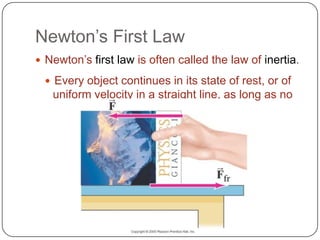
Newton’s First LawNewton’s first law is often called the law of inertia.Every object continues in its state of rest, or of uniform velocity in a straight line, as long as no net force acts on it.
If an object is at rest, or in a state of constant motion, it is said to be in a state of equilibrium.Two typesStatic EquilibriumThe object is resting at one locationDynamic EquilibriumThe object is moving, with a constant velocityBathtub
Common Examples of the 1st LawBlood rushes from your head to your feet while quickly stopping when riding on a descending elevator. The head of a hammer can be tightened onto the wooden handle by banging the bottom of the handle against a hard surface. A brick is painlessly broken over the hand of a physics teacher by slamming it with a hammer. (CAUTION: do not attempt this at home!) http://www.youtube.com/watch?v=uV8c7p9JDhw&feature=relatedTo dislodge ketchup from the bottom of a ketchup bottle, it is often turned upside down and thrusted downward at high speeds and then abruptly halted. Headrests are placed in cars to prevent whiplash injuries during rear-end collisions. While riding a skateboard (or wagon or bicycle), you fly forward off the board when hitting a curb or rock or other object which abruptly halts the motion of the skateboard.
Newton’s Second LawForce is a vector, so F=ma is true along each coordinate axis.The unit of force in the SI system is the newton (N).Note that the pound is a unit of force, not of mass, and can therefore be equated to newtons but not to kilograms.
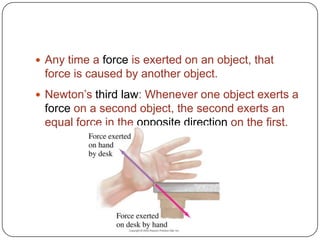
Any time a force is exerted on an object, that force is caused by another object.Newton’s third law: Whenever one object exerts a force on a second object, the second exerts an equal force in the opposite direction on the first.
A key to the correct application of the third law is that the forces are exerted on different objects. Make sure you don’t use them as if they were acting on the same object.
4-5 Newton’s Third Law of MotionRocket propulsion can also be explained using Newton’s third law: hot gases from combustion spew out of the tail of the rocket at high speeds. The reaction force is what propels the rocket.Note that the rocket does not need anything to “push” against.
4-6 Weight – the Force of Gravity; and the Normal ForceWeight is the force exerted on an object by gravity. Close to the surface of the Earth, where the gravitational force is nearly constant, the weight is:
4-6 Weight – the Force of Gravity; and the Normal ForceAn object at rest must have no net force on it. If it is sitting on a table, the force of gravity is still there; what other force is there?The force exerted perpendicular to a surface iscalled the normal force. It is exactly as large as needed to balance the force from the object (if the required force gets too big, something breaks!)
Drawing Free-Body DiagramsA book is at rest on a table top. Diagram the forces acting on the book. See answer.A girl is suspended motionless from the ceiling by two ropes. Diagram the forces acting on the combination of girl and bar. See answer.A flying squirrel is gliding (no wingflaps) from a tree to the ground at constant velocity. Consider air resistance. Diagram the forces acting on the squirrel. See answer.A rightward force is applied to a book in order to move it across a desk with a rightward acceleration. Consider frictional forces. Neglect air resistance. Diagram the forces acting on the book. See answer.A rightward force is applied to a book in order to move it across a desk at constant velocity. Consider frictional forces. Neglect air resistance. Diagram the forces acting on the book. See answer.A skydiver is descending with a constant velocity. Consider air resistance. Diagram the forces acting upon the skydiver. See answer.A football is moving upwards towards its peak after having been booted by the punter. Diagram the forces acting upon the football as it rises upward towards its peak. See answer.A car is coasting to the right and slowing down. Diagram the forces acting upon the car. See answer.

Forces

  • 1.
  • 2.
    What is aforce?Something that causes acceleration
  • 3.
    Types of ForcesContactForcesAction-at-a-Distance ForcesFrictional Force Tension Force Normal Force Air Resistance Force Applied Force Spring ForceGravitational ForceElectrical ForceMagnetic Force
  • 4.
    Newton’s First LawNewton’sfirst law is often called the law of inertia.Every object continues in its state of rest, or of uniform velocity in a straight line, as long as no net force acts on it.
  • 5.
    If an objectis at rest, or in a state of constant motion, it is said to be in a state of equilibrium.Two typesStatic EquilibriumThe object is resting at one locationDynamic EquilibriumThe object is moving, with a constant velocityBathtub
  • 6.
    Common Examples ofthe 1st LawBlood rushes from your head to your feet while quickly stopping when riding on a descending elevator. The head of a hammer can be tightened onto the wooden handle by banging the bottom of the handle against a hard surface. A brick is painlessly broken over the hand of a physics teacher by slamming it with a hammer. (CAUTION: do not attempt this at home!) http://www.youtube.com/watch?v=uV8c7p9JDhw&feature=relatedTo dislodge ketchup from the bottom of a ketchup bottle, it is often turned upside down and thrusted downward at high speeds and then abruptly halted. Headrests are placed in cars to prevent whiplash injuries during rear-end collisions. While riding a skateboard (or wagon or bicycle), you fly forward off the board when hitting a curb or rock or other object which abruptly halts the motion of the skateboard.
  • 7.
    Newton’s Second LawForceis a vector, so F=ma is true along each coordinate axis.The unit of force in the SI system is the newton (N).Note that the pound is a unit of force, not of mass, and can therefore be equated to newtons but not to kilograms.
  • 8.
    Any time aforce is exerted on an object, that force is caused by another object.Newton’s third law: Whenever one object exerts a force on a second object, the second exerts an equal force in the opposite direction on the first.
  • 9.
    A key tothe correct application of the third law is that the forces are exerted on different objects. Make sure you don’t use them as if they were acting on the same object.
  • 10.
    4-5 Newton’s ThirdLaw of MotionRocket propulsion can also be explained using Newton’s third law: hot gases from combustion spew out of the tail of the rocket at high speeds. The reaction force is what propels the rocket.Note that the rocket does not need anything to “push” against.
  • 11.
    4-6 Weight –the Force of Gravity; and the Normal ForceWeight is the force exerted on an object by gravity. Close to the surface of the Earth, where the gravitational force is nearly constant, the weight is:
  • 12.
    4-6 Weight –the Force of Gravity; and the Normal ForceAn object at rest must have no net force on it. If it is sitting on a table, the force of gravity is still there; what other force is there?The force exerted perpendicular to a surface iscalled the normal force. It is exactly as large as needed to balance the force from the object (if the required force gets too big, something breaks!)
  • 13.
    Drawing Free-Body DiagramsAbook is at rest on a table top. Diagram the forces acting on the book. See answer.A girl is suspended motionless from the ceiling by two ropes. Diagram the forces acting on the combination of girl and bar. See answer.A flying squirrel is gliding (no wingflaps) from a tree to the ground at constant velocity. Consider air resistance. Diagram the forces acting on the squirrel. See answer.A rightward force is applied to a book in order to move it across a desk with a rightward acceleration. Consider frictional forces. Neglect air resistance. Diagram the forces acting on the book. See answer.A rightward force is applied to a book in order to move it across a desk at constant velocity. Consider frictional forces. Neglect air resistance. Diagram the forces acting on the book. See answer.A skydiver is descending with a constant velocity. Consider air resistance. Diagram the forces acting upon the skydiver. See answer.A football is moving upwards towards its peak after having been booted by the punter. Diagram the forces acting upon the football as it rises upward towards its peak. See answer.A car is coasting to the right and slowing down. Diagram the forces acting upon the car. See answer.