How to Use This Presentation To View the presentation as a slideshow with effects  select  “View”  on the menu bar and click on  “Slide Show.” To advance through the presentation, click the right-arrow key or the space bar. From the resources slide, click on any resource to see a presentation for that resource. From the Chapter menu screen click on any lesson to go directly to that lesson’s presentation. You may exit the slide show at any time by pressing  the  Esc  key.
Resources Chapter Presentation Transparencies Standardized Test Prep Sample Problems Visual Concepts
Table of Contents Section 1  Changes in Motion Section 2  Newton's First Law Section 3  Newton's Second and Third Laws Section 4  Everyday Forces Forces and the Laws of Motion Chapter  4
Objectives Describe   how force affects the motion of an object.  Interpret   and  construct   free body diagrams. Section 1  Changes in Motion Chapter  4
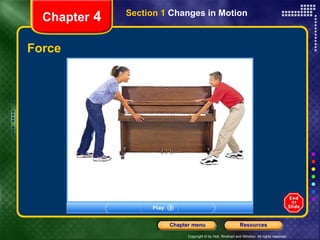
Force Chapter  4 Section 1  Changes in Motion
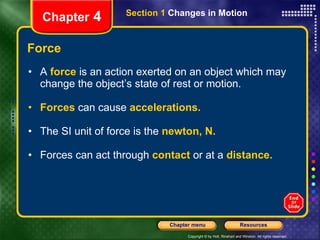
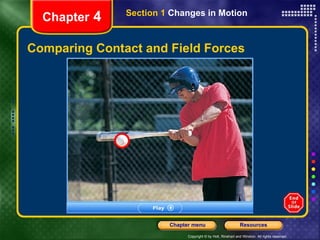
Force A  force   is an action   exerted on an object which may change the object’s state of rest or motion. Forces   can cause   accelerations. The SI unit of force is the   newton, N. Forces can act through   contact   or at a   distance. Chapter  4 Section 1  Changes in Motion
Comparing Contact and Field Forces Chapter  4 Section 1  Changes in Motion
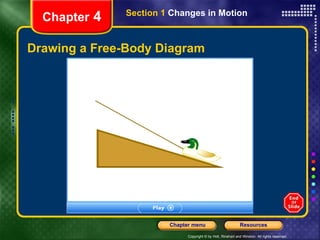
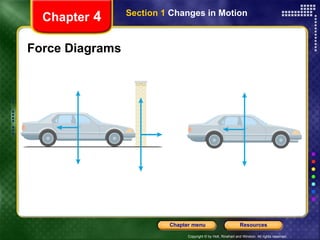
Force Diagrams The effect of a force depends on both  magnitude  and   direction. Thus, force is a   vector   quantity. Diagrams that show force vectors as arrows are called   force diagrams.   Force diagrams that show only the forces acting on a single object are called   free-body diagrams. Chapter  4 Section 1  Changes in Motion
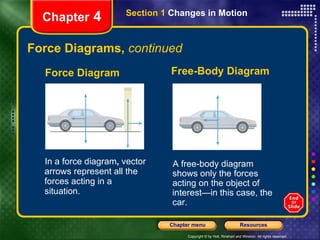
Force Diagrams,  continued In a force diagram ,   vector arrows represent all the forces acting in a situation.   Chapter  4 Section 1  Changes in Motion A free-body diagram   shows only the forces acting on the object of interest—in this case, the car. Force Diagram Free-Body Diagram
Drawing a Free-Body Diagram Chapter  4 Section 1  Changes in Motion
Objectives Explain   the relationship between the motion of an object and the net external force acting on the object. Determine   the net external force on an object. Calculate   the force required to bring an object into equilibrium. Section 2  Newton’s First Law Chapter  4
Newton’s First Law An   object at rest remains at rest, and an object in motion continues in motion with constant velocity (that is, constant speed in a straight line) unless the object experiences a net external force. In other words, when the net external force on an object is zero, the object’s acceleration (or the change in the object’s velocity) is zero. Chapter  4 Section 2  Newton’s First Law
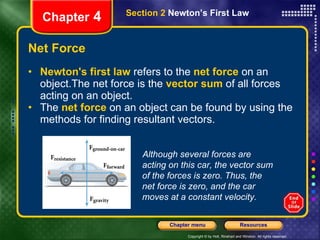
Net Force Newton's first law  refers to the   net force   on an object.The   net force   is the   vector sum   of all forces acting on an object.  The  net force  on an object can be found by using the methods for finding resultant vectors.  Chapter  4 Section 2  Newton’s First Law Although several forces are acting on this car, the vector sum of the forces is zero. Thus, the net force is zero, and the car moves at a constant velocity.
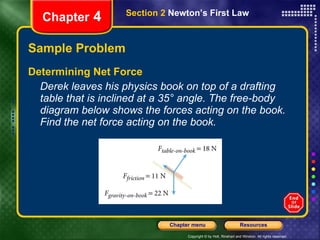
Sample Problem Determining Net Force Derek leaves his physics book on top of a drafting table that is inclined at a 35° angle. The free-body diagram below shows the forces acting on the book. Find the net force acting on the book. Chapter  4 Section 2  Newton’s First Law
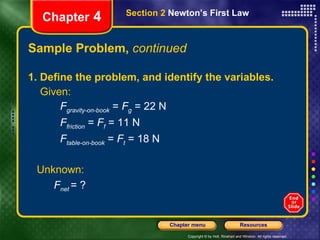
Sample Problem,  continued 1. Define the problem, and identify the variables. Given:   F gravity-on-book  =  F g  = 22 N F friction  =  F f  = 11 N F table-on-book  =  F t  = 18 N Chapter  4 Section 2  Newton’s First Law   Unknown:   F net  = ?
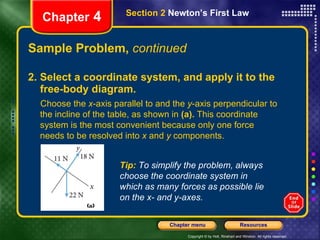
Sample Problem,  continued 2. Select a coordinate system, and apply it to the free-body diagram. Chapter  4 Section 2  Newton’s First Law Tip:   To simplify the problem, always choose the coordinate system in which as many forces as possible lie on the x- and y-axes. Choose the  x -axis parallel to and the  y -axis perpendicular to the incline of the table, as shown in  (a).  This coordinate system is the most convenient because only one force needs to be resolved into  x  and  y  components.
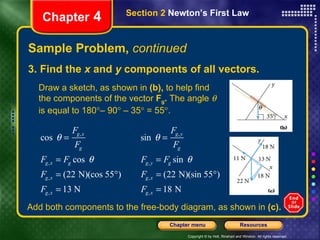
Sample Problem,  continued 3. Find the  x  and  y  components of all vectors. Chapter  4 Section 2  Newton’s First Law Add both components to the free-body diagram, as shown in  (c). Draw a sketch, as shown in  (b),  to help find the components of the vector  F g .  The angle    is equal to 180  – 90   – 35   = 55  .
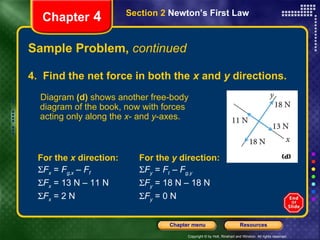
Sample Problem,  continued For the  y  direction:  F y  =  F t  –  F g,y    F y  = 18 N – 18 N  F y  = 0 N Chapter  4 Section 2  Newton’s First Law 4.  Find the net force in both the  x  and  y  directions. Diagram  (d)  shows another free-body diagram of the book, now with forces acting only along the  x - and  y -axes. For the  x  direction:   F x  =  F g,x  –  F f  F x  = 13 N – 11 N   F x  = 2 N
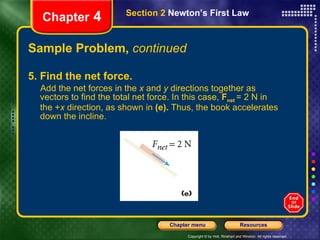
Sample Problem,  continued 5. Find the net force. Add the net forces in the  x  and  y  directions together as vectors to find the total net force. In this case,  F net  = 2 N in the + x  direction, as shown in  (e).  Thus, the book accelerates down the incline. Chapter  4 Section 2  Newton’s First Law
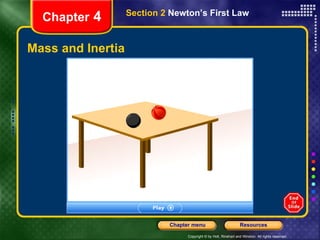
Inertia Inertia   is the tendency of an object to resist being moved or, if the object is moving, to resist a change in speed or direction. Newton’s first law   is often referred to as the   law of inertia   because it states that in the absence of a net force, a body will preserve its state of motion.  Mass   is a measure of inertia. Chapter  4 Section 2  Newton’s First Law
Mass and Inertia Chapter  4 Section 2  Newton’s First Law
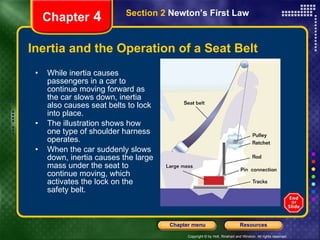
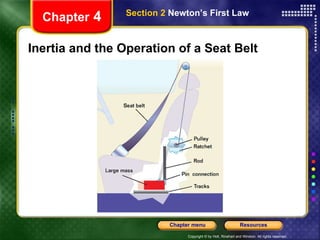
Inertia and the Operation of a Seat Belt While inertia causes passengers in a car to continue moving forward as the car slows down, inertia also causes seat belts to lock into place. The illustration shows how one type of shoulder harness operates. When the car suddenly slows down, inertia causes the large mass under the seat to continue moving, which activates the lock on the safety belt. Chapter  4 Section 2  Newton’s First Law
Equilibrium Equilibrium   is the state in which the net force on an object is zero. Objects that are either   at rest   or moving with   constant velocity   are said to be in equilibrium. Newton’s first law   describes objects in equilibrium. Tip:  To determine whether a body is in equilibrium, find the net force. If the net force is zero, the body is in equilibrium. If there is a net force, a second force equal and opposite to this net force will put the body in equilibrium. Chapter  4 Section 2  Newton’s First Law
Objectives Describe   an object’s acceleration in terms of its mass and the net force acting on it. Predict   the direction and magnitude of the acceleration caused by a known net force. I dentify   action-reaction pairs. Section 3  Newton’s Second and Third Laws Chapter  4
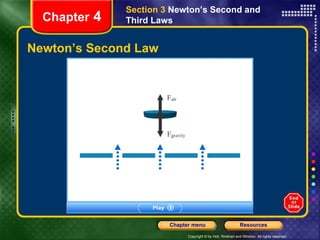
Newton’s Second Law The acceleration of an object is directly proportional to the net force acting on the object and inversely proportional to the object’s mass.  F  =  m a net force = mass    acceleration Chapter  4 Section 3  Newton’s Second and Third Laws  F   represents the vector sum of all external forces acting on the object, or the net force.
Newton’s Second Law Chapter  4 Section 3  Newton’s Second and Third Laws
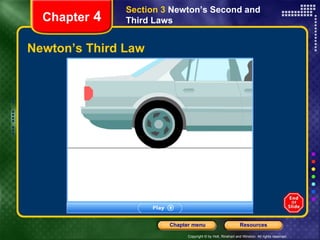
Newton’s Third Law If two objects interact, the magnitude of the force exerted on object 1 by object 2 is equal to the magnitude of the force simultaneously exerted on object 2 by object 1, and these two forces are opposite in direction. In other words,  for every action, there is an equal and opposite reaction.  Because the forces coexist, either force can be called the action or the reaction. Chapter  4 Section 3  Newton’s Second and Third Laws
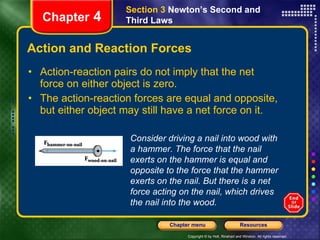
Action and Reaction Forces Action-reaction pairs do not imply that the net force on either object is zero.  The action-reaction forces are equal and opposite, but either object may still have a net force on it. Chapter  4 Section 3  Newton’s Second and Third Laws Consider driving a nail into wood with a hammer. The force that the nail exerts on the hammer is equal and opposite to the force that the hammer exerts on the nail. But there is a net force acting on the nail, which drives the nail into the wood.
Newton’s Third Law Chapter  4 Section 3  Newton’s Second and Third Laws
Objectives Explain   the difference between mass and weight. Find  the direction and magnitude of normal forces. Describe   air resistance as a form of friction. Use   coefficients of friction to calculate frictional force. Section 4  Everyday Forces Chapter  4
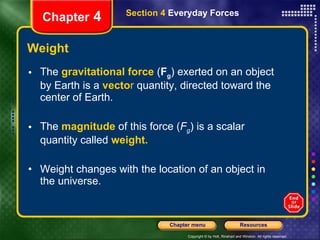
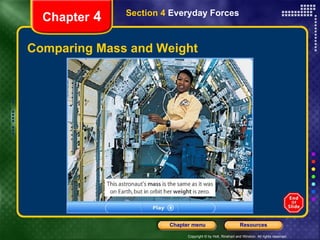
Weight The  gravitational force   ( F g ) exerted on an object by Earth is a   vecto r  quantity, directed toward the center of Earth. The  magnitude   of this force ( F g ) is a scalar quantity called   weight. Weight changes with the location of an object in the universe. Chapter  4 Section 4  Everyday Forces
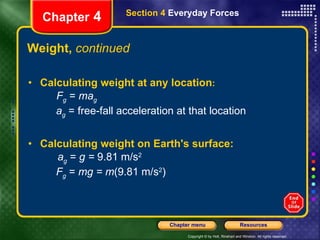
Weight,  continued Calculating weight at any location : F g  =  ma g   a g  = free-fall acceleration at that location Calculating weight on Earth's surface: a g  =  g =  9.81 m/s 2 F g  =  mg = m (9.81 m/s 2 ) Chapter  4 Section 4  Everyday Forces
Comparing Mass and Weight Chapter  4 Section 4  Everyday Forces
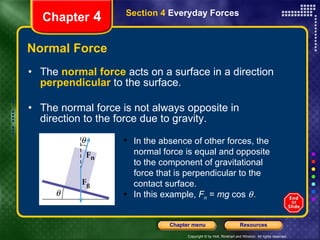
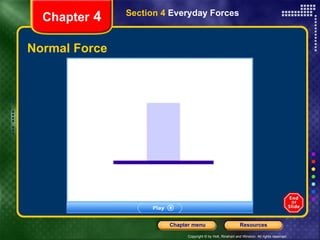
Normal Force The   normal force   acts on a surface in a direction   perpendicular  to the surface. The normal force is not always opposite in direction to the force due to gravity. Chapter  4 Section 4  Everyday Forces In the absence of other forces, the normal force is equal and opposite to the component of gravitational force that is perpendicular to the contact surface.  In this example,  F n  =  mg  cos   .
Normal Force Chapter  4 Section 4  Everyday Forces
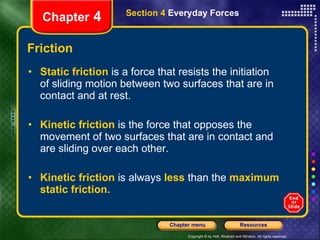
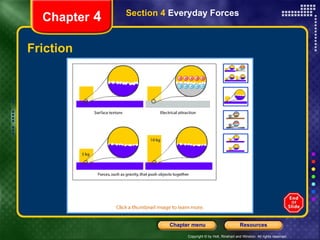
Friction Static friction   is a force that resists the initiation of sliding motion between two surfaces that are in contact and at rest. Kinetic friction   is the force that opposes the movement of two surfaces that are in contact and are sliding over each other. Kinetic friction   is always   less   than the   maximum static friction. Chapter  4 Section 4  Everyday Forces
Friction Chapter  4 Section 4  Everyday Forces
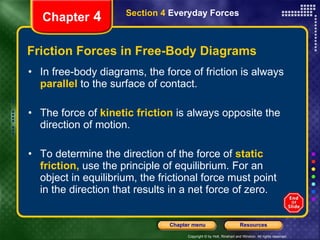
Friction Forces in Free-Body Diagrams In free-body diagrams, the force of friction is always   parallel   to the surface of contact. The force of   kinetic friction   is always opposite the direction of motion.   To determine the direction of the force of   static friction,   use the principle of equilibrium. For an object in equilibrium, the frictional force must point in the direction that results in a net force of zero. Chapter  4 Section 4  Everyday Forces
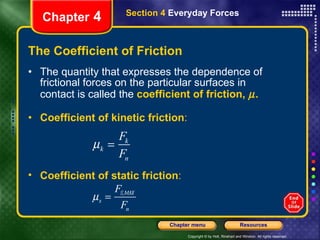
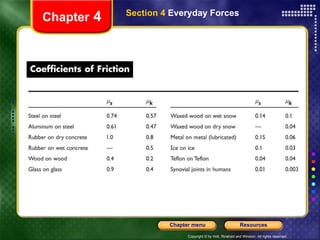
The Coefficient of Friction The quantity that expresses the dependence of frictional forces on the particular surfaces in contact is called the   coefficient of friction,   . Coefficient of kinetic friction : Chapter  4 Section 4  Everyday Forces Coefficient of static friction :
Chapter  4 Section 4  Everyday Forces
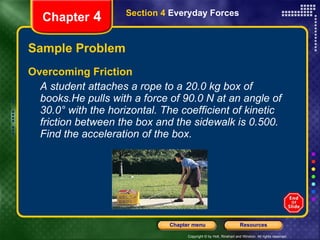
Sample Problem Overcoming Friction   A student attaches a rope to a 20.0 kg box of books.He pulls with a force of 90.0 N at an angle of 30.0° with the horizontal. The coefficient of kinetic friction between the box and the sidewalk is 0.500. Find the acceleration of the box. Chapter  4 Section 4  Everyday Forces
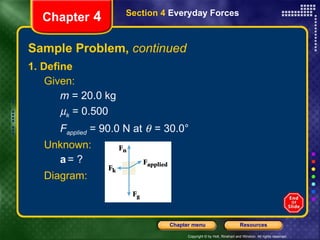
Sample Problem,  continued 1. Define Given:   m  = 20.0 kg   k  = 0.500 F applied  = 90.0 N at    = 30.0° Unknown:   a   = ? Diagram:   Chapter  4 Section 4  Everyday Forces
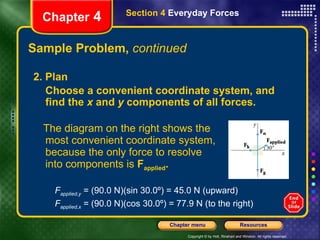
Sample Problem,  continued The diagram on the right shows the most convenient coordinate system, because the only force to resolve  into components is  F applied . Chapter  4 Section 4  Everyday Forces 2. Plan Choose a convenient coordinate system, and find the  x  and  y  components of all forces.   F applied,y  = (90.0 N)(sin 30.0º) = 45.0 N (upward) F applied,x  = (90.0 N)(cos 30.0º) = 77.9 N (to the right)
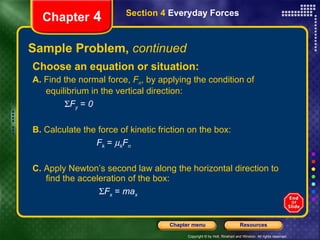
Sample Problem,  continued Choose an equation or situation: A.  Find the normal force,  F n , by applying the condition of equilibrium in the vertical direction:   F y   =  0 B.  Calculate the force of kinetic friction on the box: F k  =   k F n C.  Apply Newton’s second law along the horizontal direction to find the acceleration of the box:    F x   =  ma x Chapter  4 Section 4  Everyday Forces
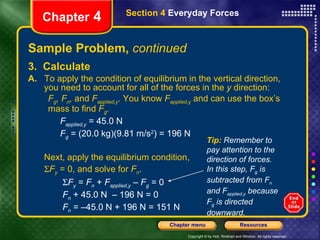
Sample Problem,  continued 3.  Calculate A.   To apply the condition of equilibrium in the vertical direction, you need to account for all of the forces in the  y  direction:  F g , F n ,  and  F applied,y .  You know  F applied,y   and can use the box’s mass to find  F g . F applied,y   = 45.0 N F g   = (20.0 kg)(9.81 m/s 2 ) = 196 N Next, apply the equilibrium condition,   F y   = 0, and solve for  F n .    F y   =  F n  +  F applied,y   –  F g  = 0   F n  + 45.0 N  – 196 N = 0   F n  = –45.0 N + 196 N = 151 N Chapter  4 Section 4  Everyday Forces Tip:  Remember to pay attention to the direction of forces. In this step, F g  is subtracted from F n  and F applied,y  because F g  is directed  downward.
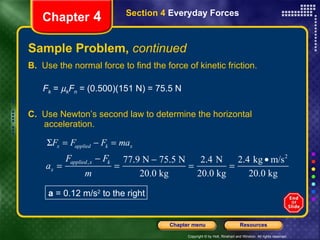
Sample Problem,  continued B.   Use the normal force to find the force of kinetic friction. F k  =   k F n  = (0.500)(151 N) = 75.5 N C.   Use Newton’s second law to determine the horizontal acceleration. Chapter  4 Section 4  Everyday Forces a  = 0.12 m/s 2  to the right
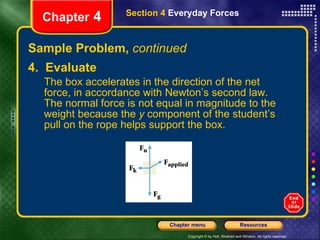
Sample Problem,  continued 4.  Evaluate The box accelerates in the direction of the net force, in accordance with Newton’s second law. The normal force is not equal in magnitude to the weight because the  y  component of the student’s pull on the rope helps support the box. Chapter  4 Section 4  Everyday Forces
Air Resistance Air resistance   is a form of  friction.  Whenever an object moves through a fluid medium, such as air or water, the fluid provides a resistance to the object’s motion.  For a falling object, when the upward force of air resistance balances the downward gravitational force, the net force on the object is zero. The object continues to move downward with a constant maximum speed, called the   terminal speed. Chapter  4 Section 4  Everyday Forces
Fundamental Forces There are four   fundamental forces : Electromagnetic force Gravitational force Strong nuclear force Weak nuclear force The four fundamental forces are all  field forces. Chapter  4 Section 4  Everyday Forces
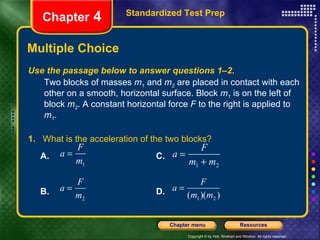
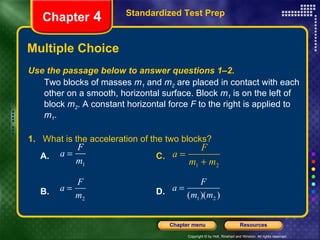
Multiple Choice Standardized Test Prep Chapter  4 Use the passage below to answer questions 1–2. Two blocks of masses  m 1  and  m 2  are placed in contact with each other on a smooth, horizontal surface. Block  m 1  is on the left of block  m 2 . A constant horizontal force  F  to the right is applied to  m 1 . 1.   What is the acceleration of the two blocks? A.  C. B. D.
Multiple Choice,  continued Use the passage below to answer questions 1–2. Two blocks of masses  m 1  and  m 2  are placed in contact with each other on a smooth, horizontal surface. Block  m 1  is on the left of block  m 2 . A constant horizontal force  F  to the right is applied to  m 1 . 2.   What is the horizontal force acting on  m 2 ? F.   m 1 a G.   m 2 a H.  ( m 1  +  m 2 ) a J.   m 1 m 2 a Standardized Test Prep Chapter  4
Multiple Choice,  continued 3.   A crate is pulled to the right with a force of 82.0 N, to the left with a force of 115 N, upward with a force of 565 N, and downward with a force of 236 N. Find the magnitude and direction of the net force on the crate. A.  3.30 N at 96° counterclockwise from the positive x-axis B.   3.30 N at 6° counterclockwise from the positive x-axis C.   3.30 x 10 2  at 96° counterclockwise from the positive x-axis D.   3.30 x 10 2  at 6° counterclockwise from the positive x-axis Standardized Test Prep Chapter  4
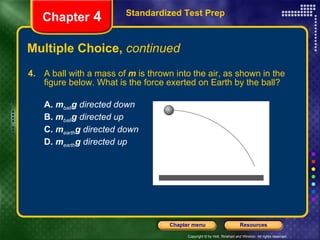
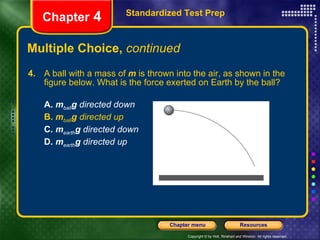
Multiple Choice,  continued 4.   A ball with a mass of  m  is thrown into the air, as shown in the figure below. What is the force exerted on Earth by the ball? A.   m ball g  directed down B.   m ball g  directed up C.   m earth g  directed down D.   m earth g  directed up Standardized Test Prep Chapter  4
Multiple Choice,  continued 5.   A freight train has a mass of 1.5 x 10 7  kg. If the locomotive can exert a constant pull of 7.5 x 10 5  N, how long would it take to increase the speed of the train from rest to 85 km/h? (Disregard friction.) A.  4.7 x 10 2 s B.   4.7s C.   5.0 x 10 -2 s D.   5.0 x 10 4 s Standardized Test Prep Chapter  4
Multiple Choice,  continued Use the passage below to answer questions 6–7. A truck driver slams on the brakes and skids  to a stop through a displacement   x . Standardized Test Prep Chapter  4 6.   If the truck’s mass doubles, find the truck’s skidding distance in terms of   x . (Hint: Increasing the mass increases the normal force.) A.    x/4 B.    x C.   2  x D.   4  x
Multiple Choice,  continued Use the passage below to answer questions 6–7. A truck driver slams on the brakes and skids  to a stop through a displacement   x . Standardized Test Prep Chapter  4 7.   If the truck’s initial velocity were halved, what would be the truck’s skidding distance? A.    x/4 B.    x C.   2  x D.   4  x
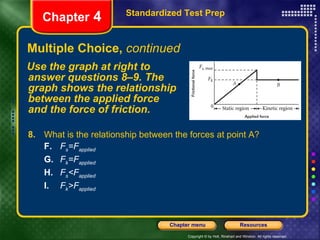
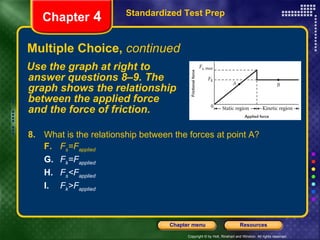
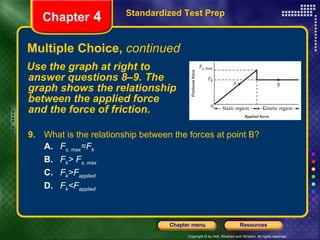
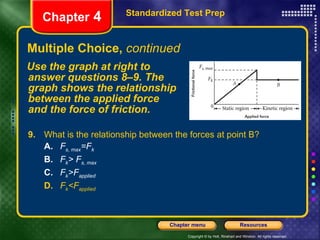
Multiple Choice,  continued Use the graph at right to answer questions 8–9. The graph shows the relationship between the applied force and the force of friction. Standardized Test Prep Chapter  4 8.   What is the relationship between the forces at point A? F. F s =F applied G. F k =F applied H. F s <F applied I. F k >F applied
Multiple Choice,  continued Use the graph at right to answer questions 8–9. The graph shows the relationship between the applied force and the force of friction. Standardized Test Prep Chapter  4 9.   What is the relationship between the forces at point B? A. F s, max =F k B. F k > F s, max C. F k >F applied D. F k <F applied
Short Response Base your answers to questions 10–12 on the information below.   A 3.00 kg ball is dropped from rest from the  roof of a building 176.4 m high.While the ball  is falling, a horizontal wind exerts a constant  force of 12.0 N on the ball.  10. How long does the ball take to hit the ground? Standardized Test Prep Chapter  4
Short Response Base your answers to questions 10–12 on the information below. A 3.00 kg ball is dropped from rest from the  roof of a building 176.4 m high.While the ball  is falling, a horizontal wind exerts a constant  force of 12.0 N on the ball.  10. How long does the ball take to hit the ground? Answer:  6.00 s Standardized Test Prep Chapter  4
Short Response,  continued Standardized Test Prep Chapter  4 Base your answers to questions 10–12 on the information below. A 3.00 kg ball is dropped from rest from the  roof of a building 176.4 m high.While the ball  is falling, a horizontal wind exerts a constant  force of 12.0 N on the ball.  11.  How far from the building does the ball hit the ground?
Base your answers to questions 10–12 on the information below. A 3.00 kg ball is dropped from rest from the  roof of a building 176.4 m high.While the ball  is falling, a horizontal wind exerts a constant  force of 12.0 N on the ball.  11.  How far from the building does the ball hit the ground? Answer:  72.0 m Short Response,  continued Standardized Test Prep Chapter  4
Base your answers to questions 10–12 on the information below.   A 3.00 kg ball is dropped from rest from the  roof of a building 176.4 m high.While the ball  is falling, a horizontal wind exerts a constant  force of 12.0 N on the ball.  12.  When the ball hits the ground, what is its speed? Short Response,  continued Standardized Test Prep Chapter  4
Base your answers to questions 10–12 on the information below. A 3.00 kg ball is dropped from rest from the  roof of a building 176.4 m high.While the ball  is falling, a horizontal wind exerts a constant  force of 12.0 N on the ball.  12.  When the ball hits the ground, what is its speed? Answer:  63.6 m/s Short Response,  continued Standardized Test Prep Chapter  4
Base your answers to questions 13–15 on the passage. A crate rests on the horizontal bed of a pickup truck. For each situation described below, indicate the motion of the crate relative to the ground, the motion of the crate relative to the truck, and whether the crate will hit the front wall of the truck bed, the back wall, or neither. Disregard friction. 13.  Starting at rest, the truck accelerates to the right. Short Response,  continued Standardized Test Prep Chapter  4
Short Response,  continued Standardized Test Prep Chapter  4 Base your answers to questions 13–15 on the passage. A crate rests on the horizontal bed of a pickup truck. For each situation described below, indicate the motion of the crate relative to the ground, the motion of the crate relative to the truck, and whether the crate will hit the front wall of the truck bed, the back wall, or neither. Disregard friction. 13.  Starting at rest, the truck accelerates to the right. Answer:  at rest, moves to the left, hits back wall
Short Response,  continued Standardized Test Prep Chapter  4 Base your answers to questions 13–15 on the passage. A crate rests on the horizontal bed of a pickup truck. For each situation described below, indicate the motion of the crate relative to the ground, the motion of the crate relative to the truck, and whether the crate will hit the front wall of the truck bed, the back wall, or neither. Disregard friction. 14.  The crate is at rest relative to the truck while the   truck moves with a constant velocity to the right.
Base your answers to questions 13–15 on the passage. A crate rests on the horizontal bed of a pickup truck. For each situation described below, indicate the motion of the crate relative to the ground, the motion of the crate relative to the truck, and whether the crate will hit the front wall of the truck bed, the back wall, or neither. Disregard friction. 14.  The crate is at rest relative to the truck while the  truck moves with a constant velocity to the right.  Answer:  moves to the right, at rest, neither Short Response,  continued Standardized Test Prep Chapter  4
Base your answers to questions 13–15 on the passage. A crate rests on the horizontal bed of a pickup truck. For each situation described below, indicate the motion of the crate relative to the ground, the motion of the crate relative to the truck, and whether the crate will hit the front wall of the truck bed, the back wall, or neither. Disregard friction. 15.  The truck in item 14 slows down. Short Response,  continued Standardized Test Prep Chapter  4
Base your answers to questions 13–15 on the passage. A crate rests on the horizontal bed of a pickup truck. For each situation described below, indicate the motion of the crate relative to the ground, the motion of the crate relative to the truck, and whether the crate will hit the front wall of the truck bed, the back wall, or neither. Disregard friction. 15.  The truck in item 14 slows down.  Answer:  moves to the right, moves to the right, hits front wall Short Response,  continued Standardized Test Prep Chapter  4
16.  A student pulls a rope attached to a 10.0 kg wooden sled and moves the sled across dry snow. The student  pulls with a force of 15.0 N at an angle of 45.0º.  If   k  between the sled and the snow is 0.040, what is the sled’s acceleration? Show your work. Extended Response Standardized Test Prep Chapter  4
16.  A student pulls a rope attached to a 10.0 kg wooden sled and moves the sled across dry snow. The student  pulls with a force of 15.0 N at an angle of 45.0º.  If   k  between the sled and the snow is 0.040, what is the sled’s acceleration? Show your work. Answer:  0.71 m/s 2 Extended Response Standardized Test Prep Chapter  4
Extended Response,  continued Standardized Test Prep Chapter  4 17.  You can keep a 3 kg book from dropping by pushing it horizontally against a wall. Draw force diagrams, and identify all the forces involved. How do they  combine to result in a zero net force? Will the force  you must supply to hold the book up be different for  different types of walls? Design a series of experiments to test your answer. Identify exactly which measurements will be necessary and what equipment you will need.
17.  You can keep a 3 kg book from dropping by pushing it horizontally against a wall. Draw force diagrams, and identify all the forces involved. How do they  combine to result in a zero net force? Will the force  you must supply to hold the book up be different for  different types of walls? Design a series of experiments to test your answer. Identify exactly which measurements will be necessary and what equipment you will need. Answer:  Plans should involve measuring forces such  as weight, applied force, normal force, and friction. Extended Response,  continued Standardized Test Prep Chapter  4
Force Diagrams Chapter  4 Section 1  Changes in Motion
Inertia and the Operation of a Seat Belt Chapter  4 Section 2  Newton’s First Law

Hp 04 win

  • 1.
    How to UseThis Presentation To View the presentation as a slideshow with effects select “View” on the menu bar and click on “Slide Show.” To advance through the presentation, click the right-arrow key or the space bar. From the resources slide, click on any resource to see a presentation for that resource. From the Chapter menu screen click on any lesson to go directly to that lesson’s presentation. You may exit the slide show at any time by pressing the Esc key.
  • 2.
    Resources Chapter PresentationTransparencies Standardized Test Prep Sample Problems Visual Concepts
  • 3.
    Table of ContentsSection 1 Changes in Motion Section 2 Newton's First Law Section 3 Newton's Second and Third Laws Section 4 Everyday Forces Forces and the Laws of Motion Chapter 4
  • 4.
    Objectives Describe how force affects the motion of an object. Interpret and construct free body diagrams. Section 1 Changes in Motion Chapter 4
  • 5.
    Force Chapter 4 Section 1 Changes in Motion
  • 6.
    Force A force is an action exerted on an object which may change the object’s state of rest or motion. Forces can cause accelerations. The SI unit of force is the newton, N. Forces can act through contact or at a distance. Chapter 4 Section 1 Changes in Motion
  • 7.
    Comparing Contact andField Forces Chapter 4 Section 1 Changes in Motion
  • 8.
    Force Diagrams Theeffect of a force depends on both magnitude and direction. Thus, force is a vector quantity. Diagrams that show force vectors as arrows are called force diagrams. Force diagrams that show only the forces acting on a single object are called free-body diagrams. Chapter 4 Section 1 Changes in Motion
  • 9.
    Force Diagrams, continued In a force diagram , vector arrows represent all the forces acting in a situation. Chapter 4 Section 1 Changes in Motion A free-body diagram shows only the forces acting on the object of interest—in this case, the car. Force Diagram Free-Body Diagram
  • 10.
    Drawing a Free-BodyDiagram Chapter 4 Section 1 Changes in Motion
  • 11.
    Objectives Explain the relationship between the motion of an object and the net external force acting on the object. Determine the net external force on an object. Calculate the force required to bring an object into equilibrium. Section 2 Newton’s First Law Chapter 4
  • 12.
    Newton’s First LawAn object at rest remains at rest, and an object in motion continues in motion with constant velocity (that is, constant speed in a straight line) unless the object experiences a net external force. In other words, when the net external force on an object is zero, the object’s acceleration (or the change in the object’s velocity) is zero. Chapter 4 Section 2 Newton’s First Law
  • 13.
    Net Force Newton'sfirst law refers to the net force on an object.The net force is the vector sum of all forces acting on an object. The net force on an object can be found by using the methods for finding resultant vectors. Chapter 4 Section 2 Newton’s First Law Although several forces are acting on this car, the vector sum of the forces is zero. Thus, the net force is zero, and the car moves at a constant velocity.
  • 14.
    Sample Problem DeterminingNet Force Derek leaves his physics book on top of a drafting table that is inclined at a 35° angle. The free-body diagram below shows the forces acting on the book. Find the net force acting on the book. Chapter 4 Section 2 Newton’s First Law
  • 15.
    Sample Problem, continued 1. Define the problem, and identify the variables. Given: F gravity-on-book = F g = 22 N F friction = F f = 11 N F table-on-book = F t = 18 N Chapter 4 Section 2 Newton’s First Law Unknown: F net = ?
  • 16.
    Sample Problem, continued 2. Select a coordinate system, and apply it to the free-body diagram. Chapter 4 Section 2 Newton’s First Law Tip: To simplify the problem, always choose the coordinate system in which as many forces as possible lie on the x- and y-axes. Choose the x -axis parallel to and the y -axis perpendicular to the incline of the table, as shown in (a). This coordinate system is the most convenient because only one force needs to be resolved into x and y components.
  • 17.
    Sample Problem, continued 3. Find the x and y components of all vectors. Chapter 4 Section 2 Newton’s First Law Add both components to the free-body diagram, as shown in (c). Draw a sketch, as shown in (b), to help find the components of the vector F g . The angle  is equal to 180  – 90  – 35  = 55  .
  • 18.
    Sample Problem, continued For the y direction:  F y = F t – F g,y  F y = 18 N – 18 N  F y = 0 N Chapter 4 Section 2 Newton’s First Law 4. Find the net force in both the x and y directions. Diagram (d) shows another free-body diagram of the book, now with forces acting only along the x - and y -axes. For the x direction:  F x = F g,x – F f  F x = 13 N – 11 N  F x = 2 N
  • 19.
    Sample Problem, continued 5. Find the net force. Add the net forces in the x and y directions together as vectors to find the total net force. In this case, F net = 2 N in the + x direction, as shown in (e). Thus, the book accelerates down the incline. Chapter 4 Section 2 Newton’s First Law
  • 20.
    Inertia Inertia is the tendency of an object to resist being moved or, if the object is moving, to resist a change in speed or direction. Newton’s first law is often referred to as the law of inertia because it states that in the absence of a net force, a body will preserve its state of motion. Mass is a measure of inertia. Chapter 4 Section 2 Newton’s First Law
  • 21.
    Mass and InertiaChapter 4 Section 2 Newton’s First Law
  • 22.
    Inertia and theOperation of a Seat Belt While inertia causes passengers in a car to continue moving forward as the car slows down, inertia also causes seat belts to lock into place. The illustration shows how one type of shoulder harness operates. When the car suddenly slows down, inertia causes the large mass under the seat to continue moving, which activates the lock on the safety belt. Chapter 4 Section 2 Newton’s First Law
  • 23.
    Equilibrium Equilibrium is the state in which the net force on an object is zero. Objects that are either at rest or moving with constant velocity are said to be in equilibrium. Newton’s first law describes objects in equilibrium. Tip: To determine whether a body is in equilibrium, find the net force. If the net force is zero, the body is in equilibrium. If there is a net force, a second force equal and opposite to this net force will put the body in equilibrium. Chapter 4 Section 2 Newton’s First Law
  • 24.
    Objectives Describe an object’s acceleration in terms of its mass and the net force acting on it. Predict the direction and magnitude of the acceleration caused by a known net force. I dentify action-reaction pairs. Section 3 Newton’s Second and Third Laws Chapter 4
  • 25.
    Newton’s Second LawThe acceleration of an object is directly proportional to the net force acting on the object and inversely proportional to the object’s mass.  F = m a net force = mass  acceleration Chapter 4 Section 3 Newton’s Second and Third Laws  F represents the vector sum of all external forces acting on the object, or the net force.
  • 26.
    Newton’s Second LawChapter 4 Section 3 Newton’s Second and Third Laws
  • 27.
    Newton’s Third LawIf two objects interact, the magnitude of the force exerted on object 1 by object 2 is equal to the magnitude of the force simultaneously exerted on object 2 by object 1, and these two forces are opposite in direction. In other words, for every action, there is an equal and opposite reaction. Because the forces coexist, either force can be called the action or the reaction. Chapter 4 Section 3 Newton’s Second and Third Laws
  • 28.
    Action and ReactionForces Action-reaction pairs do not imply that the net force on either object is zero. The action-reaction forces are equal and opposite, but either object may still have a net force on it. Chapter 4 Section 3 Newton’s Second and Third Laws Consider driving a nail into wood with a hammer. The force that the nail exerts on the hammer is equal and opposite to the force that the hammer exerts on the nail. But there is a net force acting on the nail, which drives the nail into the wood.
  • 29.
    Newton’s Third LawChapter 4 Section 3 Newton’s Second and Third Laws
  • 30.
    Objectives Explain the difference between mass and weight. Find the direction and magnitude of normal forces. Describe air resistance as a form of friction. Use coefficients of friction to calculate frictional force. Section 4 Everyday Forces Chapter 4
  • 31.
    Weight The gravitational force ( F g ) exerted on an object by Earth is a vecto r quantity, directed toward the center of Earth. The magnitude of this force ( F g ) is a scalar quantity called weight. Weight changes with the location of an object in the universe. Chapter 4 Section 4 Everyday Forces
  • 32.
    Weight, continuedCalculating weight at any location : F g = ma g a g = free-fall acceleration at that location Calculating weight on Earth's surface: a g = g = 9.81 m/s 2 F g = mg = m (9.81 m/s 2 ) Chapter 4 Section 4 Everyday Forces
  • 33.
    Comparing Mass andWeight Chapter 4 Section 4 Everyday Forces
  • 34.
    Normal Force The normal force acts on a surface in a direction perpendicular to the surface. The normal force is not always opposite in direction to the force due to gravity. Chapter 4 Section 4 Everyday Forces In the absence of other forces, the normal force is equal and opposite to the component of gravitational force that is perpendicular to the contact surface. In this example, F n = mg cos  .
  • 35.
    Normal Force Chapter 4 Section 4 Everyday Forces
  • 36.
    Friction Static friction is a force that resists the initiation of sliding motion between two surfaces that are in contact and at rest. Kinetic friction is the force that opposes the movement of two surfaces that are in contact and are sliding over each other. Kinetic friction is always less than the maximum static friction. Chapter 4 Section 4 Everyday Forces
  • 37.
    Friction Chapter 4 Section 4 Everyday Forces
  • 38.
    Friction Forces inFree-Body Diagrams In free-body diagrams, the force of friction is always parallel to the surface of contact. The force of kinetic friction is always opposite the direction of motion. To determine the direction of the force of static friction, use the principle of equilibrium. For an object in equilibrium, the frictional force must point in the direction that results in a net force of zero. Chapter 4 Section 4 Everyday Forces
  • 39.
    The Coefficient ofFriction The quantity that expresses the dependence of frictional forces on the particular surfaces in contact is called the coefficient of friction,  . Coefficient of kinetic friction : Chapter 4 Section 4 Everyday Forces Coefficient of static friction :
  • 40.
    Chapter 4Section 4 Everyday Forces
  • 41.
    Sample Problem OvercomingFriction A student attaches a rope to a 20.0 kg box of books.He pulls with a force of 90.0 N at an angle of 30.0° with the horizontal. The coefficient of kinetic friction between the box and the sidewalk is 0.500. Find the acceleration of the box. Chapter 4 Section 4 Everyday Forces
  • 42.
    Sample Problem, continued 1. Define Given: m = 20.0 kg  k = 0.500 F applied = 90.0 N at  = 30.0° Unknown: a = ? Diagram: Chapter 4 Section 4 Everyday Forces
  • 43.
    Sample Problem, continued The diagram on the right shows the most convenient coordinate system, because the only force to resolve into components is F applied . Chapter 4 Section 4 Everyday Forces 2. Plan Choose a convenient coordinate system, and find the x and y components of all forces. F applied,y = (90.0 N)(sin 30.0º) = 45.0 N (upward) F applied,x = (90.0 N)(cos 30.0º) = 77.9 N (to the right)
  • 44.
    Sample Problem, continued Choose an equation or situation: A. Find the normal force, F n , by applying the condition of equilibrium in the vertical direction:   F y = 0 B. Calculate the force of kinetic friction on the box: F k =  k F n C. Apply Newton’s second law along the horizontal direction to find the acceleration of the box:  F x = ma x Chapter 4 Section 4 Everyday Forces
  • 45.
    Sample Problem, continued 3. Calculate A. To apply the condition of equilibrium in the vertical direction, you need to account for all of the forces in the y direction: F g , F n , and F applied,y . You know F applied,y and can use the box’s mass to find F g . F applied,y = 45.0 N F g = (20.0 kg)(9.81 m/s 2 ) = 196 N Next, apply the equilibrium condition,  F y = 0, and solve for F n .  F y = F n + F applied,y – F g = 0 F n + 45.0 N – 196 N = 0 F n = –45.0 N + 196 N = 151 N Chapter 4 Section 4 Everyday Forces Tip: Remember to pay attention to the direction of forces. In this step, F g is subtracted from F n and F applied,y because F g is directed downward.
  • 46.
    Sample Problem, continued B. Use the normal force to find the force of kinetic friction. F k =  k F n = (0.500)(151 N) = 75.5 N C. Use Newton’s second law to determine the horizontal acceleration. Chapter 4 Section 4 Everyday Forces a = 0.12 m/s 2 to the right
  • 47.
    Sample Problem, continued 4. Evaluate The box accelerates in the direction of the net force, in accordance with Newton’s second law. The normal force is not equal in magnitude to the weight because the y component of the student’s pull on the rope helps support the box. Chapter 4 Section 4 Everyday Forces
  • 48.
    Air Resistance Airresistance is a form of friction. Whenever an object moves through a fluid medium, such as air or water, the fluid provides a resistance to the object’s motion. For a falling object, when the upward force of air resistance balances the downward gravitational force, the net force on the object is zero. The object continues to move downward with a constant maximum speed, called the terminal speed. Chapter 4 Section 4 Everyday Forces
  • 49.
    Fundamental Forces Thereare four fundamental forces : Electromagnetic force Gravitational force Strong nuclear force Weak nuclear force The four fundamental forces are all field forces. Chapter 4 Section 4 Everyday Forces
  • 50.
    Multiple Choice StandardizedTest Prep Chapter 4 Use the passage below to answer questions 1–2. Two blocks of masses m 1 and m 2 are placed in contact with each other on a smooth, horizontal surface. Block m 1 is on the left of block m 2 . A constant horizontal force F to the right is applied to m 1 . 1. What is the acceleration of the two blocks? A. C. B. D.
  • 51.
    Multiple Choice StandardizedTest Prep Chapter 4 Use the passage below to answer questions 1–2. Two blocks of masses m 1 and m 2 are placed in contact with each other on a smooth, horizontal surface. Block m 1 is on the left of block m 2 . A constant horizontal force F to the right is applied to m 1 . 1. What is the acceleration of the two blocks? A. C. B. D.
  • 52.
    Multiple Choice, continued Use the passage below to answer questions 1–2. Two blocks of masses m 1 and m 2 are placed in contact with each other on a smooth, horizontal surface. Block m 1 is on the left of block m 2 . A constant horizontal force F to the right is applied to m 1 . 2. What is the horizontal force acting on m 2 ? F. m 1 a G. m 2 a H. ( m 1 + m 2 ) a J. m 1 m 2 a Standardized Test Prep Chapter 4
  • 53.
    Multiple Choice, continued Use the passage below to answer questions 1–2. Two blocks of masses m 1 and m 2 are placed in contact with each other on a smooth, horizontal surface. Block m 1 is on the left of block m 2 . A constant horizontal force F to the right is applied to m 1 . 2. What is the horizontal force acting on m 2 ? F. m 1 a G. m 2 a H. ( m 1 + m 2 ) a J. m 1 m 2 a Standardized Test Prep Chapter 4
  • 54.
    Multiple Choice, continued 3. A crate is pulled to the right with a force of 82.0 N, to the left with a force of 115 N, upward with a force of 565 N, and downward with a force of 236 N. Find the magnitude and direction of the net force on the crate. A. 3.30 N at 96° counterclockwise from the positive x-axis B. 3.30 N at 6° counterclockwise from the positive x-axis C. 3.30 x 10 2 at 96° counterclockwise from the positive x-axis D. 3.30 x 10 2 at 6° counterclockwise from the positive x-axis Standardized Test Prep Chapter 4
  • 55.
    Multiple Choice, continued 3. A crate is pulled to the right with a force of 82.0 N, to the left with a force of 115 N, upward with a force of 565 N, and downward with a force of 236 N. Find the magnitude and direction of the net force on the crate. A. 3.30 N at 96° counterclockwise from the positive x-axis B. 3.30 N at 6° counterclockwise from the positive x-axis C. 3.30 x 10 2 at 96° counterclockwise from the positive x-axis D. 3.30 x 10 2 at 6° counterclockwise from the positive x-axis Standardized Test Prep Chapter 4
  • 56.
    Multiple Choice, continued 4. A ball with a mass of m is thrown into the air, as shown in the figure below. What is the force exerted on Earth by the ball? A. m ball g directed down B. m ball g directed up C. m earth g directed down D. m earth g directed up Standardized Test Prep Chapter 4
  • 57.
    Multiple Choice, continued 4. A ball with a mass of m is thrown into the air, as shown in the figure below. What is the force exerted on Earth by the ball? A. m ball g directed down B. m ball g directed up C. m earth g directed down D. m earth g directed up Standardized Test Prep Chapter 4
  • 58.
    Multiple Choice, continued 5. A freight train has a mass of 1.5 x 10 7 kg. If the locomotive can exert a constant pull of 7.5 x 10 5 N, how long would it take to increase the speed of the train from rest to 85 km/h? (Disregard friction.) A. 4.7 x 10 2 s B. 4.7s C. 5.0 x 10 -2 s D. 5.0 x 10 4 s Standardized Test Prep Chapter 4
  • 59.
    Multiple Choice, continued 5. A freight train has a mass of 1.5 x 10 7 kg. If the locomotive can exert a constant pull of 7.5 x 10 5 N, how long would it take to increase the speed of the train from rest to 85 km/h? (Disregard friction.) A. 4.7 x 10 2 s B. 4.7s C. 5.0 x 10 -2 s D. 5.0 x 10 4 s Standardized Test Prep Chapter 4
  • 60.
    Multiple Choice, continued Use the passage below to answer questions 6–7. A truck driver slams on the brakes and skids to a stop through a displacement  x . Standardized Test Prep Chapter 4 6. If the truck’s mass doubles, find the truck’s skidding distance in terms of  x . (Hint: Increasing the mass increases the normal force.) A.  x/4 B.  x C. 2  x D. 4  x
  • 61.
    Multiple Choice, continued Use the passage below to answer questions 6–7. A truck driver slams on the brakes and skids to a stop through a displacement  x . Standardized Test Prep Chapter 4 6. If the truck’s mass doubles, find the truck’s skidding distance in terms of  x . (Hint: Increasing the mass increases the normal force.) A.  x/4 B.  x C. 2  x D. 4  x
  • 62.
    Multiple Choice, continued Use the passage below to answer questions 6–7. A truck driver slams on the brakes and skids to a stop through a displacement  x . Standardized Test Prep Chapter 4 7. If the truck’s initial velocity were halved, what would be the truck’s skidding distance? A.  x/4 B.  x C. 2  x D. 4  x
  • 63.
    Multiple Choice, continued Use the passage below to answer questions 6–7. A truck driver slams on the brakes and skids to a stop through a displacement  x . Standardized Test Prep Chapter 4 7. If the truck’s initial velocity were halved, what would be the truck’s skidding distance? A.  x/4 B.  x C. 2  x D. 4  x
  • 64.
    Multiple Choice, continued Use the graph at right to answer questions 8–9. The graph shows the relationship between the applied force and the force of friction. Standardized Test Prep Chapter 4 8. What is the relationship between the forces at point A? F. F s =F applied G. F k =F applied H. F s <F applied I. F k >F applied
  • 65.
    Multiple Choice, continued Use the graph at right to answer questions 8–9. The graph shows the relationship between the applied force and the force of friction. Standardized Test Prep Chapter 4 8. What is the relationship between the forces at point A? F. F s =F applied G. F k =F applied H. F s <F applied I. F k >F applied
  • 66.
    Multiple Choice, continued Use the graph at right to answer questions 8–9. The graph shows the relationship between the applied force and the force of friction. Standardized Test Prep Chapter 4 9. What is the relationship between the forces at point B? A. F s, max =F k B. F k > F s, max C. F k >F applied D. F k <F applied
  • 67.
    Multiple Choice, continued Use the graph at right to answer questions 8–9. The graph shows the relationship between the applied force and the force of friction. Standardized Test Prep Chapter 4 9. What is the relationship between the forces at point B? A. F s, max =F k B. F k > F s, max C. F k >F applied D. F k <F applied
  • 68.
    Short Response Baseyour answers to questions 10–12 on the information below. A 3.00 kg ball is dropped from rest from the roof of a building 176.4 m high.While the ball is falling, a horizontal wind exerts a constant force of 12.0 N on the ball. 10. How long does the ball take to hit the ground? Standardized Test Prep Chapter 4
  • 69.
    Short Response Baseyour answers to questions 10–12 on the information below. A 3.00 kg ball is dropped from rest from the roof of a building 176.4 m high.While the ball is falling, a horizontal wind exerts a constant force of 12.0 N on the ball. 10. How long does the ball take to hit the ground? Answer: 6.00 s Standardized Test Prep Chapter 4
  • 70.
    Short Response, continued Standardized Test Prep Chapter 4 Base your answers to questions 10–12 on the information below. A 3.00 kg ball is dropped from rest from the roof of a building 176.4 m high.While the ball is falling, a horizontal wind exerts a constant force of 12.0 N on the ball. 11. How far from the building does the ball hit the ground?
  • 71.
    Base your answersto questions 10–12 on the information below. A 3.00 kg ball is dropped from rest from the roof of a building 176.4 m high.While the ball is falling, a horizontal wind exerts a constant force of 12.0 N on the ball. 11. How far from the building does the ball hit the ground? Answer: 72.0 m Short Response, continued Standardized Test Prep Chapter 4
  • 72.
    Base your answersto questions 10–12 on the information below. A 3.00 kg ball is dropped from rest from the roof of a building 176.4 m high.While the ball is falling, a horizontal wind exerts a constant force of 12.0 N on the ball. 12. When the ball hits the ground, what is its speed? Short Response, continued Standardized Test Prep Chapter 4
  • 73.
    Base your answersto questions 10–12 on the information below. A 3.00 kg ball is dropped from rest from the roof of a building 176.4 m high.While the ball is falling, a horizontal wind exerts a constant force of 12.0 N on the ball. 12. When the ball hits the ground, what is its speed? Answer: 63.6 m/s Short Response, continued Standardized Test Prep Chapter 4
  • 74.
    Base your answersto questions 13–15 on the passage. A crate rests on the horizontal bed of a pickup truck. For each situation described below, indicate the motion of the crate relative to the ground, the motion of the crate relative to the truck, and whether the crate will hit the front wall of the truck bed, the back wall, or neither. Disregard friction. 13. Starting at rest, the truck accelerates to the right. Short Response, continued Standardized Test Prep Chapter 4
  • 75.
    Short Response, continued Standardized Test Prep Chapter 4 Base your answers to questions 13–15 on the passage. A crate rests on the horizontal bed of a pickup truck. For each situation described below, indicate the motion of the crate relative to the ground, the motion of the crate relative to the truck, and whether the crate will hit the front wall of the truck bed, the back wall, or neither. Disregard friction. 13. Starting at rest, the truck accelerates to the right. Answer: at rest, moves to the left, hits back wall
  • 76.
    Short Response, continued Standardized Test Prep Chapter 4 Base your answers to questions 13–15 on the passage. A crate rests on the horizontal bed of a pickup truck. For each situation described below, indicate the motion of the crate relative to the ground, the motion of the crate relative to the truck, and whether the crate will hit the front wall of the truck bed, the back wall, or neither. Disregard friction. 14. The crate is at rest relative to the truck while the truck moves with a constant velocity to the right.
  • 77.
    Base your answersto questions 13–15 on the passage. A crate rests on the horizontal bed of a pickup truck. For each situation described below, indicate the motion of the crate relative to the ground, the motion of the crate relative to the truck, and whether the crate will hit the front wall of the truck bed, the back wall, or neither. Disregard friction. 14. The crate is at rest relative to the truck while the truck moves with a constant velocity to the right. Answer: moves to the right, at rest, neither Short Response, continued Standardized Test Prep Chapter 4
  • 78.
    Base your answersto questions 13–15 on the passage. A crate rests on the horizontal bed of a pickup truck. For each situation described below, indicate the motion of the crate relative to the ground, the motion of the crate relative to the truck, and whether the crate will hit the front wall of the truck bed, the back wall, or neither. Disregard friction. 15. The truck in item 14 slows down. Short Response, continued Standardized Test Prep Chapter 4
  • 79.
    Base your answersto questions 13–15 on the passage. A crate rests on the horizontal bed of a pickup truck. For each situation described below, indicate the motion of the crate relative to the ground, the motion of the crate relative to the truck, and whether the crate will hit the front wall of the truck bed, the back wall, or neither. Disregard friction. 15. The truck in item 14 slows down. Answer: moves to the right, moves to the right, hits front wall Short Response, continued Standardized Test Prep Chapter 4
  • 80.
    16. Astudent pulls a rope attached to a 10.0 kg wooden sled and moves the sled across dry snow. The student pulls with a force of 15.0 N at an angle of 45.0º. If  k between the sled and the snow is 0.040, what is the sled’s acceleration? Show your work. Extended Response Standardized Test Prep Chapter 4
  • 81.
    16. Astudent pulls a rope attached to a 10.0 kg wooden sled and moves the sled across dry snow. The student pulls with a force of 15.0 N at an angle of 45.0º. If  k between the sled and the snow is 0.040, what is the sled’s acceleration? Show your work. Answer: 0.71 m/s 2 Extended Response Standardized Test Prep Chapter 4
  • 82.
    Extended Response, continued Standardized Test Prep Chapter 4 17. You can keep a 3 kg book from dropping by pushing it horizontally against a wall. Draw force diagrams, and identify all the forces involved. How do they combine to result in a zero net force? Will the force you must supply to hold the book up be different for different types of walls? Design a series of experiments to test your answer. Identify exactly which measurements will be necessary and what equipment you will need.
  • 83.
    17. Youcan keep a 3 kg book from dropping by pushing it horizontally against a wall. Draw force diagrams, and identify all the forces involved. How do they combine to result in a zero net force? Will the force you must supply to hold the book up be different for different types of walls? Design a series of experiments to test your answer. Identify exactly which measurements will be necessary and what equipment you will need. Answer: Plans should involve measuring forces such as weight, applied force, normal force, and friction. Extended Response, continued Standardized Test Prep Chapter 4
  • 84.
    Force Diagrams Chapter 4 Section 1 Changes in Motion
  • 85.
    Inertia and theOperation of a Seat Belt Chapter 4 Section 2 Newton’s First Law