Vectors
Vector  a quantity that requires both magnitude and direction
Examples: Velocity, Force, Acceleration
Scalar
Scalar  a quantity that can be described by magnitude only
Examples: Speed, Mass, Temperature, Pressure
Dr. Ihab Naeim
&
Dr. Ihab Naeim
3 18.08.2023
Addition & subtraction of vectors are usually carried out by the use of components.
A quantity which does not depend on direction is called a scalar quantity.
The component form of
is ( x , y ).
solid
Resultant
• The sum of two or more vectors
– For vectors in the same direction, add arithmetically.
– For vectors in opposite directions, subtract arithmetically.
– Two vectors that don’t act in the same or opposite direction:
• use parallelogram rule.
– Two vectors at right angles to each other
• use Pythagorean Theorem: R2 = x2 + y2.
R =  x2+y2
Dr. Ihab Naeim
 Vector Addition
 Vector Components
 Component Addition
 Vector Resolution
 Resultants
R= A + B
Parallelogram rule: Finding the resultant geometrically
Generally applies for rectangular and nonrectangular vectors
Parallelogram for Vector Addition
R= A + B
First, draw the two vectors tail to tail
Example:
• Using the Parallelogram rule, find the value of the
resultant vector for the given figure.
• Choices:
A. 9 cm
B. 20 cm
C. 10 cm
D. 22 cm
Head to Tail Method
Vectors
Vector components
• Vertical and horizontal components of a
vector are perpendicular to each other
• Determined by resolution.
<=>
Vector a in Polar
Coordinates
Vector a in
Cartesian
Coordinates
X
Y
R

→R
→R
→Y
→X
Finding vector components by resolution
Example:
From Polar Coordinates (r,θ)
to Cartesian Coordinates (x,y)
From Cartesian Coordinates (x,y)
to Polar Coordinates (r,θ)
•x = r . cos( θ )
•y = r . sin( θ )
•r = √ ( x2 + y2 )
•θ = tan-1 ( y / x )
Referring to the figure, which of the following are true statements?
A. 50 N is the resultant of the 30 and 40 N vectors.
B. The 30 N vector can be considered a component of the 50 N
vector.
C. The 40 N vector can be considered a component of the 50 N
vector.
D. All of the above are correct.
Vectors
CHECK YOUR UNDERSTANDING θ 37O
Referring to the figure, which of the following are true statements?
A. 100 km/h is the resultant of the 80 and 60 km/h vectors.
B. The 80 km/h vector can be considered a component of the 100 km/h
vector.
C. The 60 km/h vector can be considered a component of the 100 km/h
vector.
D. All of the above are correct.
Vectors
CHECK YOUR UNDERSTANDING
EXAMPLES:
#. If an airplane heading north with speed vP = 400 km/h faces a westbound wind (‫الغرب‬ ‫نحو‬ ‫)ريح‬
of speed vA = 300 km/h, the resultant velocity of the plane is:
A. 500 km/h, north-west  B. 700 km/h, north-east
C. 500 km/h, north-east D. 700 km/h, north-west
#
#
Linear Motion
INSTANTANEOUS SPEED:
The speed at any instant of time
Speed  scalar quantity
requiring magnitude only to
describe how fast a body is.
Velocity  vector quantity requiring magnitude & direction. It
describes how fast and in what direction.
CONSTANT VELOCITY:
Means motion in straight line at a constant speed.
CHANGING VELOCITY:
If either the speed or the direction (or both) changes,
then the velocity changes.
Acceleration  Is the change in velocity per unit time.
Dimensions: Length/Time2 : (L/T2) ; Units: m/s2
EXAMPLE:
ُُ‫نجز‬ُ‫ي‬
Acceleration
Acceleration Acceleration
EXAMPLE:
EXAMPLE:
Deceleration
Deceleration Deceleration
- ve
EXAMPLE:
Acceleration as a vector: geometrical representation
Acceleration
–
+
Uniformly accelerated motion and free fall
Characterized by the constant acceleration  its direction &
magnitude are unchanging.
EXAMPLES:
ACCELERATED MOTION:
Equations for motion in straight line with constant acceleration:
Displacement is a vector pointing from the initial to the final position and with magnitude
equals the shortest distance between the initial and final position
t
g.


2
.
2
1 t
g
d 
EXAMPLE:
EXAMPLE:
Free Fall
When acceleration a = g = 9.8 m/s2
— free fall
• Acceleration is g when air
resistance is negligible.
• Acceleration depends on force
(weight) and inertia.
t
g.


2
.
2
1 t
g
d 
Non-Free Fall
When acceleration of fall is less than g, non-free fall
• occurs when air resistance is non-negligible.
• depends on two things:
• speed and
• frontal surface area.
Terminal speed
• occurs when acceleration terminates (when air
resistance equals weight and net force is zero).
Terminal velocity
• same as terminal speed, with direction implied or
specified.





 


m
R
mg
m
F
a net
EXAMPLE:
Upward
Downward
Final velocity at top of the path, vf = 0
g
=
+
9.8
m/s
2
vi
When an object is thrown vertically upward, its speed is uniformly decreased by the
force of gravity until it stops for an instant at its peak before falling back to the ground.
EXAMPLE:
A ball is thrown vertically upward with
initial speed 1 m/s, determine the time
for it to reach the highest altitude.
vf = vi + a t
vf = 0 m/s
vi = 1 m/s
a = – g = – 9.8 m/s2
t = ?
t = [ vf – vi ] / a
= [0 – 1m/s] / (– 9.8m/s2)
= 0.1 s
For upward motion take
g = - 9.8 m/s2 (negative)
and for downward motion
take g = 9.8 m/s2 (positive)
• is a vector (has magnitude and direction).
• is any push or pull.
• Tends to change the state of motion of an
object.
• Tends to produce acceleration in the
direction of its application.
• But, for instance, opposite and equal forces
cancel each other, resulting in zero
acceleration
• SI unit of force is Newton (N)
Force and Law of Inertia
The force:
Inertia:
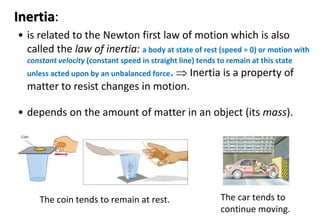
• is related to the Newton first law of motion which is also
called the law of inertia: a body at state of rest (speed = 0) or motion with
constant velocity (constant speed in straight line) tends to remain at this state
unless acted upon by an unbalanced force.  Inertia is a property of
matter to resist changes in motion.
• depends on the amount of matter in an object (its mass).
The car tends to
continue moving.
The coin tends to remain at rest.
Mass:
• is a measure of the inertia:
• The greater the mass of a body the greater is its resistance to
motion
• SI unit is: Kilogram (kg):
• 1 kg = 0.0685 slug =
Force and the Law of acceleration
Newton second law (the law of acceleration):
F = m a
F  the total force.
m  mass.
a  acceleration.
SI unit of force = Newton (N)
 From Newton 2nd law: 1 N = 1 kg m/s2
or in British system: 1 lb = 1 slug ft/s2.
In other metric system: 1 dyne = 1 g cm/s2.
EXAMPLE:
EXAMPLE:
Gravity and weight
Weight:
• The force on an object due to gravity
• Scientific unit of force is the newton (N)
• Free fall  acceleration due to gravity
= g = 9.8 m/s2. (g = 32.2 ft/s2, British
system).
• Newton second law: F = m a , for free
fall, a = g, F = Fw 
EXAMPLE:
Magnitude of FN = magnitude of Fw
EXAMPLE:
Near the earth’s surface:
• The acceleration due to gravity = g = 9.80 m/s2
• The weight =
Fw = m g = (75.0 kg) (9.80 m/s2) = 735 N.
EXAMPLE: Astronaut mass = m = 75.0 kg
Near the moon’s surface:
• The acceleration due to gravity = g = 1.63 m/s2
• The weight =
Fw = m g = (75.0 kg) (1.63 m/s2) = 122 N .
So mass remains the same, but the weight varies according
to the gravitational pull  mass is a fundamental quantity.
Mass:
• The amount of inertia or material in an object.
• Units: kg
Volume:
• Measures the space occupied by an object.
• Units: [Length]3  m3, cm3, Liter (L), ft3, …
Same volumes but different masses
Air Lead
• is a force that resists the relative motion of two objects in
contact.
• depends on the kinds of material and how much they are
pressed together.
• is due to tiny surface bumps and to “stickiness” of the atoms
on a material’s surface.
Example: Friction between a crate on a smooth wooden floor is less
than that on a rough floor.
Higher µ  two rough surfaces; smaller µ  two smooth surfaces (not too smooth)
Static friction:
The two surfaces are at
rest relative to each other
kinetic friction:
The two surfaces are in
relative motion
N
k F


N
s F


Static friction >Kinetic friction
The total, or net, force acting on an object is the resultant
of all the forces.
Example: If you pull on a box with 10 N and a friend pulls
oppositely with 5 N, the net force is 5 N in the direction you
are pulling.
EXAMPLE:
EXAMPLE:
Newton’s Third Law of Motion
Action and reaction forces
• one force is called the action force; the other force is
called the reaction force.
• are co-pairs of a single interaction.
• neither force exists without the other.
• are equal in strength and opposite in direction.
• always act on different objects.
The action and reaction forces are
Perpendicular
Parallel
Same direction
Law of Action and Reaction
The third law of motion, the law of action and reaction, can
be stated as follows: To every action there is always an
opposed equal reaction.
Example: Tires of car push back against the road while the road
pushes the tires forward.
Newton’s Third Law of Motion
Simple rule to identify action and reaction
• Identify the interaction—one thing interacts with another
– Action: Object A exerts a force on object B.
– Reaction: Object B exerts a force on object A.
Example: Action—rocket (object A) exerts force on
gas (object B).
Reaction—gas (object B) exerts force on
rocket (object A).
Two different objects
Work
Two things occur whenever work is done:
• application of force
• movement of something by that force
Work is a transferred energy during the motion (displacement).
If you push against a stationary brick wall for several minutes, you do
no work
A. on the wall.
B. at all.
C. Both of the above.
D. None of the above.
Work
CHECK YOUR NEIGHBOR
If you push against a stationary brick wall for several minutes, you do
no work
A. on the wall.
B. at all.
C. Both of the above.
D. None of the above.
Explanation:
You may do work on your muscles, but not on the wall.
Work
CHECK YOUR ANSWER
Work
Examples:
• Twice as much work is done in
lifting 2 loads 1 story high versus
lifting 1 load the same vertical
distance.
Reason: force needed to lift twice the load
is twice as much.
• Twice as much work is done in
lifting a load 2 stories instead of 1
story.
Reason: distance is twice as great.
Work
Example:
• a weightlifter raising a barbell from the
floor does work on the barbell.
British system (or U.S. system)
SI system:
Work done by a force not in the direction of motion
Note: Work by force
perpendicular ( =90o) to
the direction of motion is
zero. E.g. work by the
weight = 0 J in previous
example
They do the same amount of work. However, Junaid must exert more energy
because he pushes into the ground more than Sami, who pushes more in the
direction of the motion.
EXAMPLE:
EXAMPLE:
Energy
Units:
SI system: Joule (J)
U.S. system: ft Ib
Energy is defined as the ability to do work.
Forms of energy:
Mechanical Energy
• The mechanical energy of a body or a system is
due to its position, its motion, or its internal
structure.
There are two forms of mechanical energy:
• Potential energy
• Kinetic energy
Potential Energy
#. Gravitational potential energy is determined by the position
of an object relative to a particular reference level.
Example:
• water in an elevated reservoir ُ
ِ‫ُمرتفع‬ِ‫الماءُفيُخزان‬
Gravitational potential energy
• Equal to the work done (force required to
move it upward  the vertical distance
moved against gravity) in lifting it
• In equation form:
𝐸𝑝 = 𝑚 𝑔 ℎ
Kinetic Energy
• Energy of motion
• Kinetic energy is due to the mass and the velocity of a moving
object
• is given by the formula:
𝐸𝑘 =
1
2
𝑚 𝑣2
• If object speed is doubled  kinetic energy is quadrupled.
Kinetic Energy
Kinetic energy and work of a moving object
• Equal to the work required to bring it from rest to that
speed, or the work the object can do while being brought
to rest. In other words, if all the work is transferred into
kinetic energy then:
total work = net force  displacement  kinetic energy,
or F × s  1/2 m v2
Conservation of Energy
Law of conservation of energy
• Energy cannot be created or destroyed; it may be
transformed from one form into another, but the total
amount of energy never changes.
Mechanical Energy = Potential Energy + Kinetic Energy
Example: Energy transforms without net loss or net gain in
the operation of a pile driver.
• conservation of mechanical energy
• Solving for the velocity 𝒗 = 𝟐 𝒈 𝒉
CH2-rev_orig2.pptx

CH2-rev_orig2.pptx

  • 2.
    Vectors Vector  aquantity that requires both magnitude and direction Examples: Velocity, Force, Acceleration Scalar Scalar  a quantity that can be described by magnitude only Examples: Speed, Mass, Temperature, Pressure Dr. Ihab Naeim &
  • 3.
    Dr. Ihab Naeim 318.08.2023 Addition & subtraction of vectors are usually carried out by the use of components. A quantity which does not depend on direction is called a scalar quantity. The component form of is ( x , y ). solid
  • 4.
    Resultant • The sumof two or more vectors – For vectors in the same direction, add arithmetically. – For vectors in opposite directions, subtract arithmetically. – Two vectors that don’t act in the same or opposite direction: • use parallelogram rule. – Two vectors at right angles to each other • use Pythagorean Theorem: R2 = x2 + y2. R =  x2+y2 Dr. Ihab Naeim  Vector Addition  Vector Components  Component Addition  Vector Resolution  Resultants R= A + B
  • 5.
    Parallelogram rule: Findingthe resultant geometrically Generally applies for rectangular and nonrectangular vectors Parallelogram for Vector Addition R= A + B First, draw the two vectors tail to tail
  • 6.
    Example: • Using theParallelogram rule, find the value of the resultant vector for the given figure. • Choices: A. 9 cm B. 20 cm C. 10 cm D. 22 cm Head to Tail Method
  • 7.
    Vectors Vector components • Verticaland horizontal components of a vector are perpendicular to each other • Determined by resolution. <=> Vector a in Polar Coordinates Vector a in Cartesian Coordinates X Y R  →R →R →Y →X
  • 8.
    Finding vector componentsby resolution Example: From Polar Coordinates (r,θ) to Cartesian Coordinates (x,y) From Cartesian Coordinates (x,y) to Polar Coordinates (r,θ) •x = r . cos( θ ) •y = r . sin( θ ) •r = √ ( x2 + y2 ) •θ = tan-1 ( y / x )
  • 9.
    Referring to thefigure, which of the following are true statements? A. 50 N is the resultant of the 30 and 40 N vectors. B. The 30 N vector can be considered a component of the 50 N vector. C. The 40 N vector can be considered a component of the 50 N vector. D. All of the above are correct. Vectors CHECK YOUR UNDERSTANDING θ 37O
  • 10.
    Referring to thefigure, which of the following are true statements? A. 100 km/h is the resultant of the 80 and 60 km/h vectors. B. The 80 km/h vector can be considered a component of the 100 km/h vector. C. The 60 km/h vector can be considered a component of the 100 km/h vector. D. All of the above are correct. Vectors CHECK YOUR UNDERSTANDING
  • 11.
    EXAMPLES: #. If anairplane heading north with speed vP = 400 km/h faces a westbound wind (‫الغرب‬ ‫نحو‬ ‫)ريح‬ of speed vA = 300 km/h, the resultant velocity of the plane is: A. 500 km/h, north-west  B. 700 km/h, north-east C. 500 km/h, north-east D. 700 km/h, north-west # #
  • 12.
    Linear Motion INSTANTANEOUS SPEED: Thespeed at any instant of time Speed  scalar quantity requiring magnitude only to describe how fast a body is.
  • 13.
    Velocity  vectorquantity requiring magnitude & direction. It describes how fast and in what direction. CONSTANT VELOCITY: Means motion in straight line at a constant speed. CHANGING VELOCITY: If either the speed or the direction (or both) changes, then the velocity changes.
  • 14.
    Acceleration  Isthe change in velocity per unit time. Dimensions: Length/Time2 : (L/T2) ; Units: m/s2
  • 15.
  • 16.
  • 17.
  • 18.
  • 19.
  • 20.
  • 21.
    Acceleration as avector: geometrical representation Acceleration – +
  • 22.
    Uniformly accelerated motionand free fall Characterized by the constant acceleration  its direction & magnitude are unchanging. EXAMPLES: ACCELERATED MOTION: Equations for motion in straight line with constant acceleration: Displacement is a vector pointing from the initial to the final position and with magnitude equals the shortest distance between the initial and final position t g.   2 . 2 1 t g d 
  • 23.
  • 24.
  • 25.
    Free Fall When accelerationa = g = 9.8 m/s2 — free fall • Acceleration is g when air resistance is negligible. • Acceleration depends on force (weight) and inertia. t g.   2 . 2 1 t g d 
  • 26.
    Non-Free Fall When accelerationof fall is less than g, non-free fall • occurs when air resistance is non-negligible. • depends on two things: • speed and • frontal surface area. Terminal speed • occurs when acceleration terminates (when air resistance equals weight and net force is zero). Terminal velocity • same as terminal speed, with direction implied or specified.          m R mg m F a net
  • 27.
  • 28.
    Upward Downward Final velocity attop of the path, vf = 0 g = + 9.8 m/s 2 vi When an object is thrown vertically upward, its speed is uniformly decreased by the force of gravity until it stops for an instant at its peak before falling back to the ground. EXAMPLE: A ball is thrown vertically upward with initial speed 1 m/s, determine the time for it to reach the highest altitude. vf = vi + a t vf = 0 m/s vi = 1 m/s a = – g = – 9.8 m/s2 t = ? t = [ vf – vi ] / a = [0 – 1m/s] / (– 9.8m/s2) = 0.1 s For upward motion take g = - 9.8 m/s2 (negative) and for downward motion take g = 9.8 m/s2 (positive)
  • 29.
    • is avector (has magnitude and direction). • is any push or pull. • Tends to change the state of motion of an object. • Tends to produce acceleration in the direction of its application. • But, for instance, opposite and equal forces cancel each other, resulting in zero acceleration • SI unit of force is Newton (N) Force and Law of Inertia The force:
  • 30.
    Inertia: • is relatedto the Newton first law of motion which is also called the law of inertia: a body at state of rest (speed = 0) or motion with constant velocity (constant speed in straight line) tends to remain at this state unless acted upon by an unbalanced force.  Inertia is a property of matter to resist changes in motion. • depends on the amount of matter in an object (its mass). The car tends to continue moving. The coin tends to remain at rest.
  • 31.
    Mass: • is ameasure of the inertia: • The greater the mass of a body the greater is its resistance to motion • SI unit is: Kilogram (kg): • 1 kg = 0.0685 slug =
  • 32.
    Force and theLaw of acceleration Newton second law (the law of acceleration): F = m a F  the total force. m  mass. a  acceleration. SI unit of force = Newton (N)  From Newton 2nd law: 1 N = 1 kg m/s2 or in British system: 1 lb = 1 slug ft/s2. In other metric system: 1 dyne = 1 g cm/s2.
  • 33.
  • 34.
  • 35.
    Gravity and weight Weight: •The force on an object due to gravity • Scientific unit of force is the newton (N) • Free fall  acceleration due to gravity = g = 9.8 m/s2. (g = 32.2 ft/s2, British system). • Newton second law: F = m a , for free fall, a = g, F = Fw 
  • 36.
  • 37.
    Magnitude of FN= magnitude of Fw EXAMPLE:
  • 38.
    Near the earth’ssurface: • The acceleration due to gravity = g = 9.80 m/s2 • The weight = Fw = m g = (75.0 kg) (9.80 m/s2) = 735 N. EXAMPLE: Astronaut mass = m = 75.0 kg Near the moon’s surface: • The acceleration due to gravity = g = 1.63 m/s2 • The weight = Fw = m g = (75.0 kg) (1.63 m/s2) = 122 N . So mass remains the same, but the weight varies according to the gravitational pull  mass is a fundamental quantity.
  • 39.
    Mass: • The amountof inertia or material in an object. • Units: kg Volume: • Measures the space occupied by an object. • Units: [Length]3  m3, cm3, Liter (L), ft3, … Same volumes but different masses Air Lead
  • 40.
    • is aforce that resists the relative motion of two objects in contact. • depends on the kinds of material and how much they are pressed together. • is due to tiny surface bumps and to “stickiness” of the atoms on a material’s surface. Example: Friction between a crate on a smooth wooden floor is less than that on a rough floor.
  • 42.
    Higher µ two rough surfaces; smaller µ  two smooth surfaces (not too smooth)
  • 43.
    Static friction: The twosurfaces are at rest relative to each other kinetic friction: The two surfaces are in relative motion N k F   N s F   Static friction >Kinetic friction
  • 46.
    The total, ornet, force acting on an object is the resultant of all the forces. Example: If you pull on a box with 10 N and a friend pulls oppositely with 5 N, the net force is 5 N in the direction you are pulling.
  • 48.
  • 49.
  • 51.
    Newton’s Third Lawof Motion Action and reaction forces • one force is called the action force; the other force is called the reaction force. • are co-pairs of a single interaction. • neither force exists without the other. • are equal in strength and opposite in direction. • always act on different objects. The action and reaction forces are Perpendicular Parallel Same direction
  • 52.
    Law of Actionand Reaction The third law of motion, the law of action and reaction, can be stated as follows: To every action there is always an opposed equal reaction. Example: Tires of car push back against the road while the road pushes the tires forward.
  • 53.
    Newton’s Third Lawof Motion Simple rule to identify action and reaction • Identify the interaction—one thing interacts with another – Action: Object A exerts a force on object B. – Reaction: Object B exerts a force on object A. Example: Action—rocket (object A) exerts force on gas (object B). Reaction—gas (object B) exerts force on rocket (object A). Two different objects
  • 54.
    Work Two things occurwhenever work is done: • application of force • movement of something by that force Work is a transferred energy during the motion (displacement).
  • 55.
    If you pushagainst a stationary brick wall for several minutes, you do no work A. on the wall. B. at all. C. Both of the above. D. None of the above. Work CHECK YOUR NEIGHBOR
  • 56.
    If you pushagainst a stationary brick wall for several minutes, you do no work A. on the wall. B. at all. C. Both of the above. D. None of the above. Explanation: You may do work on your muscles, but not on the wall. Work CHECK YOUR ANSWER
  • 57.
    Work Examples: • Twice asmuch work is done in lifting 2 loads 1 story high versus lifting 1 load the same vertical distance. Reason: force needed to lift twice the load is twice as much. • Twice as much work is done in lifting a load 2 stories instead of 1 story. Reason: distance is twice as great.
  • 58.
    Work Example: • a weightlifterraising a barbell from the floor does work on the barbell. British system (or U.S. system) SI system:
  • 61.
    Work done bya force not in the direction of motion Note: Work by force perpendicular ( =90o) to the direction of motion is zero. E.g. work by the weight = 0 J in previous example
  • 63.
    They do thesame amount of work. However, Junaid must exert more energy because he pushes into the ground more than Sami, who pushes more in the direction of the motion.
  • 66.
  • 68.
  • 69.
    Energy Units: SI system: Joule(J) U.S. system: ft Ib Energy is defined as the ability to do work. Forms of energy:
  • 70.
    Mechanical Energy • Themechanical energy of a body or a system is due to its position, its motion, or its internal structure. There are two forms of mechanical energy: • Potential energy • Kinetic energy
  • 71.
    Potential Energy #. Gravitationalpotential energy is determined by the position of an object relative to a particular reference level. Example: • water in an elevated reservoir ُ ِ‫ُمرتفع‬ِ‫الماءُفيُخزان‬
  • 72.
    Gravitational potential energy •Equal to the work done (force required to move it upward  the vertical distance moved against gravity) in lifting it • In equation form: 𝐸𝑝 = 𝑚 𝑔 ℎ
  • 74.
    Kinetic Energy • Energyof motion • Kinetic energy is due to the mass and the velocity of a moving object • is given by the formula: 𝐸𝑘 = 1 2 𝑚 𝑣2 • If object speed is doubled  kinetic energy is quadrupled.
  • 75.
    Kinetic Energy Kinetic energyand work of a moving object • Equal to the work required to bring it from rest to that speed, or the work the object can do while being brought to rest. In other words, if all the work is transferred into kinetic energy then: total work = net force  displacement  kinetic energy, or F × s  1/2 m v2
  • 78.
    Conservation of Energy Lawof conservation of energy • Energy cannot be created or destroyed; it may be transformed from one form into another, but the total amount of energy never changes. Mechanical Energy = Potential Energy + Kinetic Energy
  • 79.
    Example: Energy transformswithout net loss or net gain in the operation of a pile driver. • conservation of mechanical energy • Solving for the velocity 𝒗 = 𝟐 𝒈 𝒉

Editor's Notes

  • #11 D. All of the above are correct.
  • #56 A. on the wall.
  • #57 A. on the wall.