Forces
• Newton’s Laws         • Free body diagrams
  of Motion
                        • Atwood device
• Weight
                        • Static and kinetic friction
• Free fall
                        • Coefficients of friction
• Force and motion
                        • Air resistance
  problems in 1-D
                        • Terminal velocity
• Normal force
• Tension
Examples of Forces
• A force is just a push or pull. Examples:
  – an object’s weight
  – tension in a rope
  – a left hook to the schnozola
  – friction
  – attraction between an electron and proton
• Bodies don’t have to be in contact to
  exert forces on each other, e.g., gravity.
Fundamental Forces of Nature
• Gravity
  – Attraction between any two bodies w/ mass
  – Weakest but most dominant
• Electromagnetic
  – Forces between any two bodies w/ charge
  – Attractive or repulsive
• Weak nuclear force – responsible for
  radioactive decay
• Strong nuclear force – holds quarks
  together (constituents of protons and
  neutrons)
Newton’s Laws of Motion
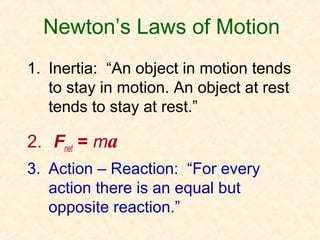
1. Inertia: “An object in motion tends
   to stay in motion. An object at rest
   tends to stay at rest.”

2. Fnet = ma
3. Action – Reaction: “For every
   action there is an equal but
   opposite reaction.”
1st Law: Inertia
 “An object in motion tends to stay in motion;
    an object at rest tends to stay at rest.”

• A moving body will continue moving
  in the same direction with the same
  speed until some net force acts on it.
• A body at rest will remain at rest
  unless a net force acts on it.
• Summing it up: It takes a net force
  to change a body’s velocity.
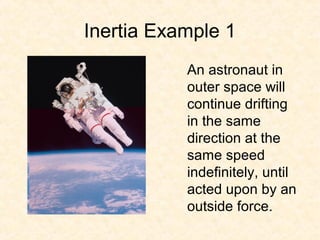
Inertia Example 1
           An astronaut in
           outer space will
           continue drifting
           in the same
           direction at the
           same speed
           indefinitely, until
           acted upon by an
           outside force.
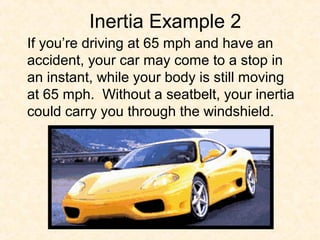
Inertia Example 2
If you’re driving at 65 mph and have an
accident, your car may come to a stop in
an instant, while your body is still moving
at 65 mph. Without a seatbelt, your inertia
could carry you through the windshield.
2 Law: Fnet = m a
        nd

• The acceleration an object undergoes is
  directly proportion to the net force acting on it.
• Mass is the constant of proportionality.
• For a given mass, if Fnet doubles, triples, etc. in
  size, so does a.
• For a given Fnet if m doubles, a is cut in half.
• Fnet and a are vectors; m is a scalar.
• Fnet and a always point in the same direction.
• The 1st law is really a special case of the 2nd
  law (if net force is zero, so is acceleration).
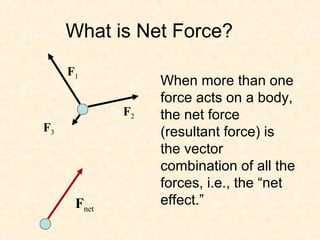
What is Net Force?
     F1
                  When more than one
                  force acts on a body,
             F2   the net force
F3                (resultant force) is
                  the vector
                  combination of all the
                  forces, i.e., the “net
      Fnet        effect.”
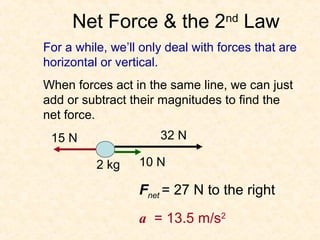
Net Force & the 2nd Law
For a while, we’ll only deal with forces that are
horizontal or vertical.
When forces act in the same line, we can just
add or subtract their magnitudes to find the
net force.
 15 N                 32 N

          2 kg    10 N

                  Fnet = 27 N to the right
                  a = 13.5 m/s2
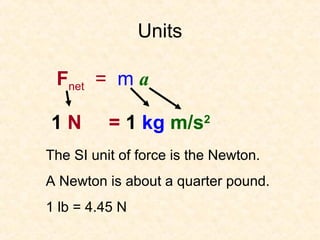
Units

 Fnet = m a

1N        = 1 kg m/s2
The SI unit of force is the Newton.
A Newton is about a quarter pound.
1 lb = 4.45 N
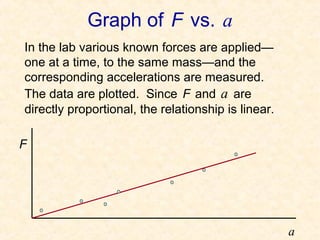
Graph of F vs. a
In the lab various known forces are applied—
one at a time, to the same mass—and the
corresponding accelerations are measured.
The data are plotted. Since F and a are
directly proportional, the relationship is linear.
F


                                                     a
Slope
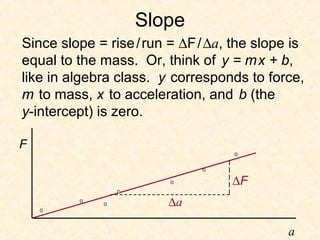
Since slope = rise / run = ∆F / ∆a, the slope is
equal to the mass. Or, think of y = m x + b,
like in algebra class. y corresponds to force,
m to mass, x to acceleration, and b (the
y-intercept) is zero.

F

                                   ∆F
                        ∆a

                                             a
W = mg
• Weight = mass × acceleration due to gravity.

• This follows directly from F = m a.

• Weight is the force of gravity on a body.
• Near the surface of the Earth,
  g = 9.8 m/s2.
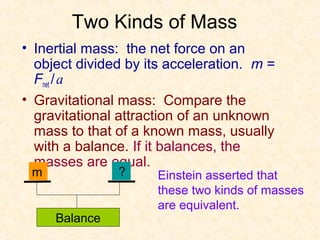
Two Kinds of Mass
• Inertial mass: the net force on an
  object divided by its acceleration. m =
  Fnet / a
• Gravitational mass: Compare the
  gravitational attraction of an unknown
  mass to that of a known mass, usually
  with a balance. If it balances, the
  masses are equal.
 m             ?      Einstein asserted that
                      these two kinds of masses
                      are equivalent.
     Balance
“For every action there’s an
Action - Reaction         equal but opposite reaction.”
 • If you hit a tennis ball with a racquet,
   the force on the ball due to the racquet
   is the same as the force on the racquet
   due to the ball, except in the opposite
   direction.
 • If you drop an apple, the Earth pulls on
   the apple just as hard as the apple pulls
   on the Earth.
 • If you fire a rifle, the bullet pushes the
   rifle backwards just as hard as the rifle
   pushes the bullet forwards.
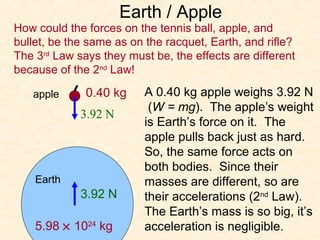
Earth / Apple
How could the forces on the tennis ball, apple, and
bullet, be the same as on the racquet, Earth, and rifle?
The 3rd Law says they must be, the effects are different
because of the 2nd Law!

   apple      0.40 kg     A 0.40 kg apple weighs 3.92 N
                           (W = mg). The apple’s weight
             3.92 N
                          is Earth’s force on it. The
                          apple pulls back just as hard.
                          So, the same force acts on
                          both bodies. Since their
    Earth                 masses are different, so are
             3.92 N       their accelerations (2nd Law).
                          The Earth’s mass is so big, it’s
    5.98 × 1024 kg        acceleration is negligible.
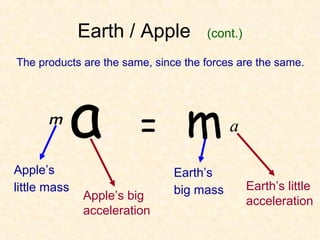
Earth / Apple          (cont.)

The products are the same, since the forces are the same.


      m
              a         =        m        a

Apple’s                        Earth’s
little mass                    big mass        Earth’s little
              Apple’s big                      acceleration
              acceleration
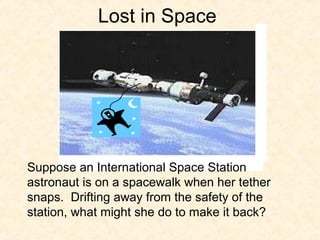
Lost in Space


Suppose an International Space Station
astronaut is on a spacewalk when her tether
snaps. Drifting away from the safety of the
station, what might she do to make it back?
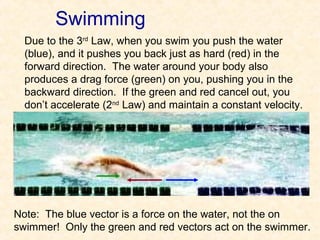
Swimming
  Due to the 3rd Law, when you swim you push the water
  (blue), and it pushes you back just as hard (red) in the
  forward direction. The water around your body also
  produces a drag force (green) on you, pushing you in the
  backward direction. If the green and red cancel out, you
  don’t accelerate (2nd Law) and maintain a constant velocity.


Note: The blue vector is a force on the water, not the on
swimmer! Only the green and red vectors act on the swimmer.
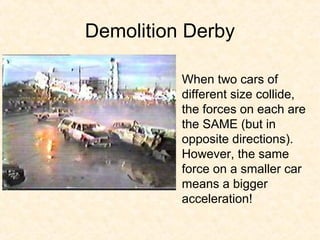
Demolition Derby

          When two cars of
          different size collide,
          the forces on each are
          the SAME (but in
          opposite directions).
          However, the same
          force on a smaller car
          means a bigger
          acceleration!
Free fall
• An object is in free fall if the only force
  acting on it is gravity.
• It doesn’t matter which way it’s moving.
• A shell in a cannon is not in freefall until
  it leaves the barrel of the cannon.
  (There are other forces acting on it while
  inside the barrel.)
• For an object in free fall, a = -g, if:
  – we ignore air resistance.
  – don’t stray too far from Earth.
Freefall       (cont.)
• Any launched object is in freefall the
  entire time it’s in the air, if:
  – we ignore air resistance.
  – it has no propulsion system.
• With the previous condition met,
  a = -g = -9.8 m/s2 everywhere:
  – on the way up
  – at its peak
  – on the way down
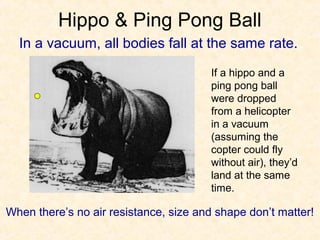
Hippo & Ping Pong Ball
  In a vacuum, all bodies fall at the same rate.

                                       If a hippo and a
                                       ping pong ball
                                       were dropped
                                       from a helicopter
                                       in a vacuum
                                       (assuming the
                                       copter could fly
                                       without air), they’d
                                       land at the same
                                       time.

When there’s no air resistance, size and shape don’t matter!
Misconceptions
• If an object is moving, there must be
  some force making it move. Wrong! It
  could be moving without accelerating.

• If v = 0, then   a and Fnet must be zero.
  Wrong! Think of a projectile shot straight up at
  its peak.

• An object must move in the direction of
  the net force. Wrong! It must accelerate that
  way but not necessarily move that way.
Misconceptions               (cont.)
• Heavy objects must fall faster than light
  ones. Wrong! The rate is the same in a vacuum.
• When a big object collides with a little one,
  the big one hits the little one harder than
  the little one hits the big one. Wrong! The 3rd
  Law says they hit it each other with the same force.

• If an object accelerates, its speed must
  change. Wrong! It could be turning at constant
  speed.
Projectile confusion
a ≠ 0 at the vertex (peak) of a projectile’s
trajectory. Velocity can be zero there, but not
acceleration!

If a were zero at the vertex, Fnet would have
to be zero as well (by the 2nd law), which
means gravity would have to be turned off!

a = -g throughout the whole trip, including
the high point !
Forces & Kinematics
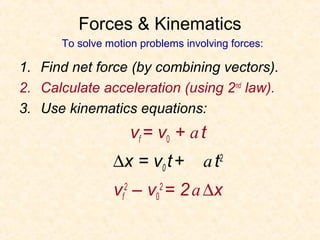
      To solve motion problems involving forces:

1. Find net force (by combining vectors).
2. Calculate acceleration (using 2nd law).
3. Use kinematics equations:
                    vf = v0 + a t
                ∆x = v0 t +        a t2
                vf2 – v02 = 2 a ∆x
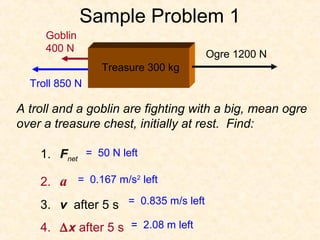
Sample Problem 1
     Goblin
     400 N
                                      Ogre 1200 N
                Treasure 300 kg
  Troll 850 N

A troll and a goblin are fighting with a big, mean ogre
over a treasure chest, initially at rest. Find:

    1. Fnet = 50 N left

    2. a = 0.167 m/s2 left
    3. v after 5 s = 0.835 m/s left
    4. ∆x after 5 s = 2.08 m left
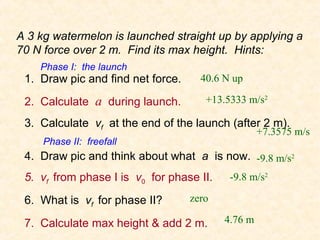
A 3 kg watermelon is launched straight up by applying a
70 N force over 2 m. Find its max height. Hints:
    Phase I: the launch
 1. Draw pic and find net force.     40.6 N up

 2. Calculate a during launch.        +13.5333 m/s2

 3. Calculate vf at the end of the launch (after 2 m).
                                                   +7.3575 m/s
     Phase II: freefall
 4. Draw pic and think about what a is now. -9.8 m/s2
 5. vf from phase I is v0 for phase II.    -9.8 m/s2

 6. What is vf for phase II?       zero

 7. Calculate max height & add 2 m.       4.76 m
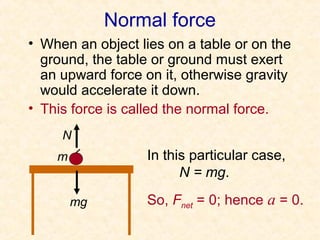
Normal force
• When an object lies on a table or on the
  ground, the table or ground must exert
  an upward force on it, otherwise gravity
  would accelerate it down.
• This force is called the normal force.
     N
    m              In this particular case,
                         N = mg.

        mg         So, Fnet = 0; hence a = 0.
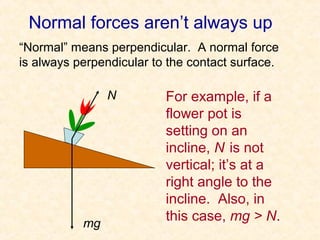
Normal forces aren’t always up
“Normal” means perpendicular. A normal force
is always perpendicular to the contact surface.

                N         For example, if a
                          flower pot is
                          setting on an
                          incline, N is not
                          vertical; it’s at a
                          right angle to the
                          incline. Also, in
           mg
                          this case, mg > N.
Normal force directions
• Up
  – You’re standing on level ground.
  – You’re at the bottom of a circle while flying a loop-
    the-loop in a plane.
• Sideways
  – A ladder leans up against a wall.
  – You’re against the wall on the “Round Up” ride
    when the floor drops out.
• At an angle
  – A race car takes a turn on a banked track.
• Down
  – You’re in a roller coaster at the top of a loop.
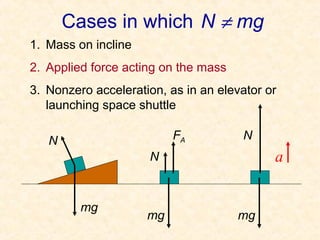
Cases in which N ≠ mg
1. Mass on incline
2. Applied force acting on the mass
3. Nonzero acceleration, as in an elevator or
   launching space shuttle

   N                      FA          N
                     N                      a


         mg
                     mg               mg
When does N = mg ?

If the following conditions are satisfied,
   then N = mg:
• The object is on a level surface.
• There’s nothing pushing it down or
  pulling it up.
• The object is not accelerating vertically.
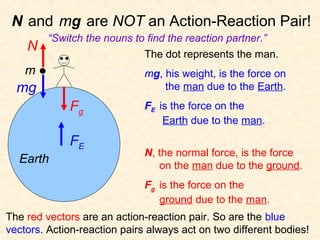
N and mg are NOT an Action-Reaction Pair!
         “Switch the nouns to find the reaction partner.”
    N                        The dot represents the man.
    m                         mg, his weight, is the force on
  mg                              the man due to the Earth.
             Fg               FE is the force on the
                                  Earth due to the man.

             FE
                              N, the normal force, is the force
  Earth                          on the man due to the ground.
                              Fg is the force on the
                                 ground due to the man.
The red vectors are an action-reaction pair. So are the blue
vectors. Action-reaction pairs always act on two different bodies!
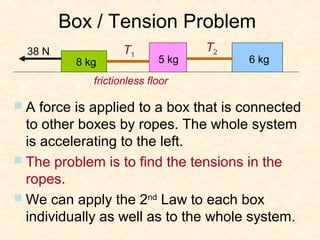
Box / Tension Problem
  38 N              T1             T2
          8 kg              5 kg        6 kg

             frictionless floor

A   force is applied to a box that is connected
  to other boxes by ropes. The whole system
  is accelerating to the left.
 The problem is to find the tensions in the
  ropes.
 We can apply the 2nd Law to each box
  individually as well as to the whole system.
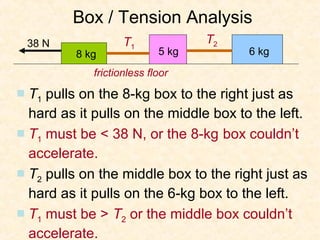
Box / Tension Analysis
 38 N               T1             T2
          8 kg              5 kg        6 kg

             frictionless floor
 T1 pulls on the 8-kg box to the right just as
  hard as it pulls on the middle box to the left.
 T1 must be < 38 N, or the 8-kg box couldn’t
  accelerate.
 T2 pulls on the middle box to the right just as
  hard as it pulls on the 6-kg box to the left.
 T1 must be > T2 or the middle box couldn’t
  accelerate.
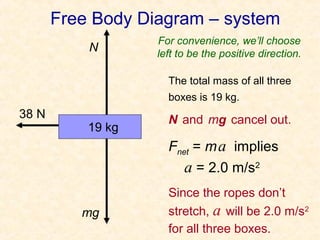
Free Body Diagram – system
                   For convenience, we’ll choose
           N       left to be the positive direction.

                     The total mass of all three
                     boxes is 19 kg.
38 N                 N and mg cancel out.
           19 kg
                     Fnet = m a implies
                        a = 2.0 m/s2
                     Since the ropes don’t
          mg         stretch, a will be 2.0 m/s2
                     for all three boxes.
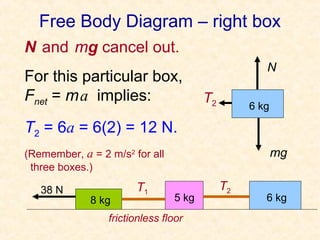
Free Body Diagram – right box
N and mg cancel out.
                                                    N
For this particular box,
Fnet = m a implies:                    T2        6 kg

T2 = 6a = 6(2) = 12 N.
(Remember, a = 2 m/s2 for all                           mg
 three boxes.)

   38 N                T1                   T2
             8 kg               5 kg                6 kg
                 frictionless floor
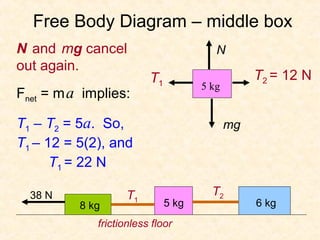
Free Body Diagram – middle box
N and mg cancel                         N
out again.
                         T1                      T2 = 12 N
                                     5 kg
Fnet = m a implies:

T1 – T2 = 5a. So,                           mg
T1 – 12 = 5(2), and
      T1 = 22 N

  38 N             T1                  T2
          8 kg                5 kg               6 kg
             frictionless floor
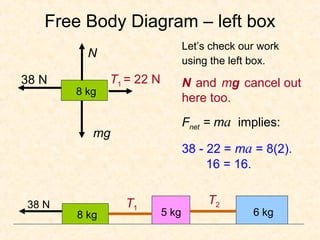
Free Body Diagram – left box
                                 Let’s check our work
         N
                                 using the left box.
38 N          T1 = 22 N          N and mg cancel out
       8 kg
                                 here too.
                                 Fnet = ma implies:
          mg
                                 38 - 22 = ma = 8(2).
                                      16 = 16.


38 N            T1                    T2
       8 kg               5 kg                 6 kg
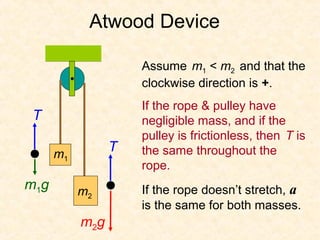
Atwood Device

                     Assume m1 < m2 and that the
                     clockwise direction is +.
                     If the rope & pulley have
T                    negligible mass, and if the
                     pulley is frictionless, then T is
      m1
                 T   the same throughout the
                     rope.
m1g        m2        If the rope doesn’t stretch, a
                     is the same for both masses.
           m2g
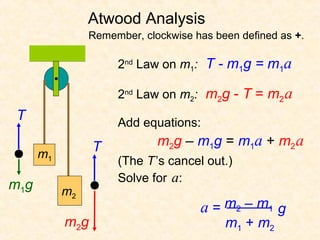
Atwood Analysis
                Remember, clockwise has been defined as +.

                     2nd Law on m1: T - m1g = m1a

                     2nd Law on m2: m2g - T = m2 a
T                    Add equations:
                 T           m2g – m1g = m1a + m2 a
      m1
                     (The T ’s cancel out.)
                     Solve for a:
m1g        m2
                                     a = m2 – m1 g
           m2g                            m1 + m2
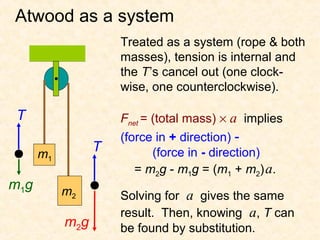
Atwood as a system
                     Treated as a system (rope & both
                     masses), tension is internal and
                     the T ’s cancel out (one clock-
                     wise, one counterclockwise).

T                    Fnet = (total mass) × a implies
                     (force in + direction) -
      m1
                 T         (force in - direction)
                        = m2g - m1g = (m1 + m2) a.
m1g        m2        Solving for a gives the same
                     result. Then, knowing a, T can
           m2g       be found by substitution.
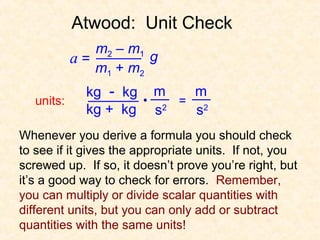
Atwood: Unit Check
               m2 – m1
            a=         g
               m1 + m2
              kg - kg    m    m
   units:                   = 2
              kg + kg    s2   s
Whenever you derive a formula you should check
to see if it gives the appropriate units. If not, you
screwed up. If so, it doesn’t prove you’re right, but
it’s a good way to check for errors. Remember,
you can multiply or divide scalar quantities with
different units, but you can only add or subtract
quantities with the same units!
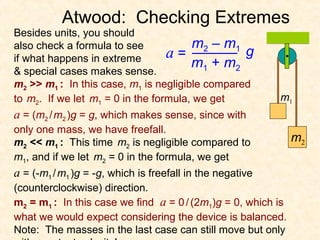
Atwood: Checking Extremes
Besides units, you should
also check a formula to see            m2 – m1
if what happens in extreme        a=             g
                                       m1 + m2
& special cases makes sense.
m2 >> m1 : In this case, m1 is negligible compared
to m2. If we let m1 = 0 in the formula, we get             m1
a = (m2 / m2 )g = g, which makes sense, since with
only one mass, we have freefall.
m2 << m1 : This time m2 is negligible compared to             m2
m1, and if we let m2 = 0 in the formula, we get
a = (-m1 / m1 )g = -g, which is freefall in the negative
(counterclockwise) direction.
m2 = m1 : In this case we find a = 0 / (2m1)g = 0, which is
what we would expect considering the device is balanced.
Note: The masses in the last case can still move but only
Friction
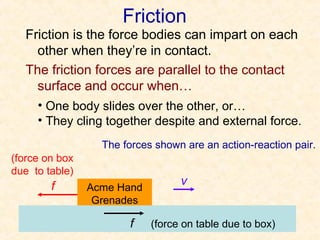
   Friction is the force bodies can impart on each
     other when they’re in contact.
   The friction forces are parallel to the contact
     surface and occur when…
     • One body slides over the other, or…
     • They cling together despite and external force.
                  The forces shown are an action-reaction pair.
(force on box
due to table)
        f                         v
                Acme Hand
                 Grenades

                       f    (force on table due to box)
Friction Facts
• Friction is due to electrostatic attraction between
  the atoms of the objects in contact.
• It can speed you up, slow you down, or make you
  turn.
• It allows you to walk, turn a corner on your bike,
  warm your hands in the winter, and see a meteor
  shower.
• Friction often creates waste heat.
• It makes you push harder / longer to attain a
  given acceleration.
• Like any force, it always has an action-reaction
  pair.
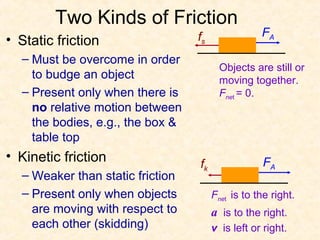
Two Kinds of Friction
                                  fs               FA
• Static friction
  – Must be overcome in order
                                         Objects are still or
    to budge an object                   moving together.
  – Present only when there is           Fnet = 0.
    no relative motion between
    the bodies, e.g., the box &
    table top
• Kinetic friction                                 FA
                                  fk
  – Weaker than static friction
  – Present only when objects          Fnet is to the right.
    are moving with respect to         a is to the right.
    each other (skidding)              v is left or right.
Friction Strength
The magnitude of the friction force is
  proportional to:
• how hard the two bodies are pressed
  together (the normal force, N ).
• the materials from which the bodies are
  made (the coefficient of friction, µ ).
Attributes that have little or no effect:
• sliding speed
• contact area
Coefficients of Friction
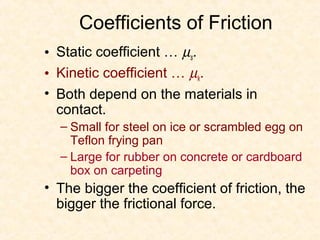
• Static coefficient … µs.
• Kinetic coefficient … µk.
• Both depend on the materials in
  contact.
  – Small for steel on ice or scrambled egg on
    Teflon frying pan
  – Large for rubber on concrete or cardboard
    box on carpeting
• The bigger the coefficient of friction, the
  bigger the frictional force.
Static Friction Force
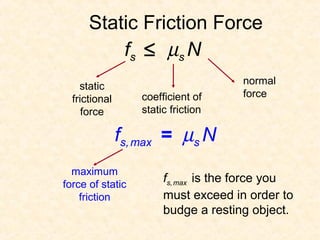
          fs ≤ µs N
                                     normal
    static
                  coefficient of     force
  frictional
     force        static friction

               fs, max = µs N
  maximum
force of static
                       fs, max is the force you
    friction           must exceed in order to
                       budge a resting object.
Static friction force varies
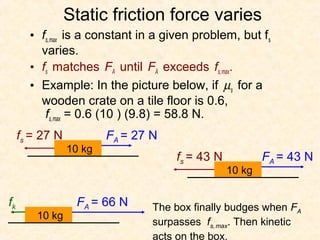
       • fs, max is a constant in a given problem, but fs
         varies.
       • fs matches FA until FA exceeds fs, max.
       • Example: In the picture below, if µs for a
         wooden crate on a tile floor is 0.6,
          fs, max = 0.6 (10 ) (9.8) = 58.8 N.
     fs = 27 N           FA = 27 N
                 10 kg
                                      fs = 43 N           FA = 43 N
                                                  10 kg


fk                FA = 66 N      The box finally budges when FA
         10 kg
                                 surpasses fs, max. Then kinetic
                                 acts on the box.
Kinetic Friction
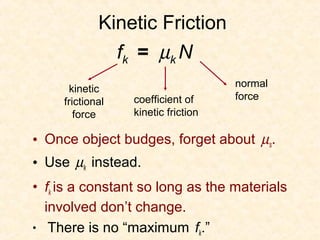
                  fk = µk N
                                       normal
      kinetic
                    coefficient of     force
     frictional
        force       kinetic friction

• Once object budges, forget about µs.
• Use µk instead.
• fk is a constant so long as the materials
  involved don’t change.
• There is no “maximum fk.”
µ values
• Typically, 0 < µk < µs < 1.
• This is why it’s harder to budge an object
  than to keep it moving.
• If µk > 1, it would be easier to lift an object
  and carry it than to slide across the floor.
• Dimensionless (µ’s have no units, as is
  apparent from f = µ N).
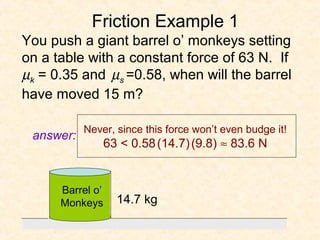
Friction Example 1
You push a giant barrel o’ monkeys setting
on a table with a constant force of 63 N. If
µk = 0.35 and µs =0.58, when will the barrel
have moved 15 m?

           Never, since this force won’t even budge it!
 answer:
                  63 < 0.58 (14.7) (9.8) ≈ 83.6 N


      Barrel o’
      Monkeys       14.7 kg
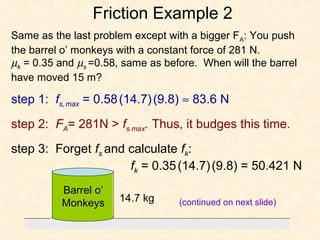
Friction Example 2
Same as the last problem except with a bigger FA: You push
the barrel o’ monkeys with a constant force of 281 N.
µk = 0.35 and µs =0.58, same as before. When will the barrel
have moved 15 m?

step 1: fs, max = 0.58 (14.7) (9.8) ≈ 83.6 N
step 2: FA= 281N > fs max. Thus, it budges this time.
                        ,


step 3: Forget fs and calculate fk:
                      fk = 0.35 (14.7) (9.8) = 50.421 N
          Barrel o’
          Monkeys     14.7 kg      (continued on next slide)
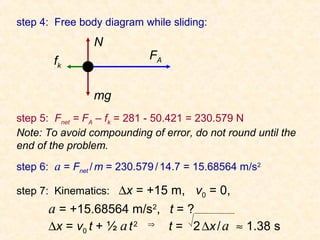
step 4: Free body diagram while sliding:
                            Friction Example 2 (continued)


                N
        fk                                FA


                mg
step 5: Fnet = FA – fk = 281 - 50.421 = 230.579 N
Note: To avoid compounding of error, do not round until the
end of the problem.
step 6: a = Fnet / m = 230.579 / 14.7 = 15.68564 m/s2

step 7: Kinematics: ∆x = +15 m, v0 = 0,
      a = +15.68564 m/s2, t = ?
      ∆x = v0 t + ½ a t 2 ⇒ t = 2 ∆x / a ≈ 1.38 s
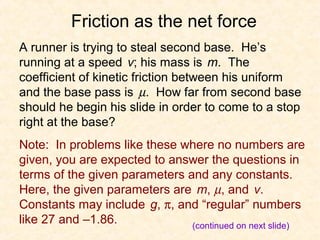
Friction as the net force
A runner is trying to steal second base. He’s
running at a speed v; his mass is m. The
coefficient of kinetic friction between his uniform
and the base pass is µ. How far from second base
should he begin his slide in order to come to a stop
right at the base?
Note: In problems like these where no numbers are
given, you are expected to answer the questions in
terms of the given parameters and any constants.
Here, the given parameters are m, µ, and v.
Constants may include g, π, and “regular” numbers
like 27 and –1.86.             (continued on next slide)
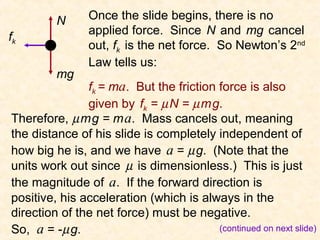
N      Once the slide begins, there is no
                                   Friction as the net force (cont.)


                applied force. Since N and mg cancel
fk
                out, fk is the net force. So Newton’s 2nd
                Law tells us:
         mg
               fk = ma. But the friction force is also
               given by fk = µ N = µ m g.
Therefore, µ m g = m a. Mass cancels out, meaning
the distance of his slide is completely independent of
how big he is, and we have a = µ g. (Note that the
units work out since µ is dimensionless.) This is just
the magnitude of a. If the forward direction is
positive, his acceleration (which is always in the
direction of the net force) must be negative.
So, a = -µ g.                            (continued on next slide)
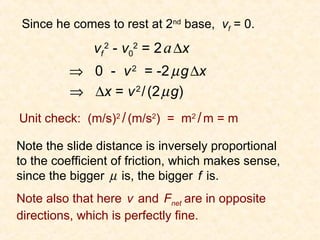
Since he comes to rest at 2nd base, vf = 0.
                    Friction as the net force (last)


              vf 2 - v02 = 2 a ∆x
         ⇒ 0 - v 2 = -2 µ g ∆x
         ⇒ ∆x = v 2 / (2 µ g)
Unit check: (m/s)2 / (m/s2) = m2 / m = m

Note the slide distance is inversely proportional
to the coefficient of friction, which makes sense,
since the bigger µ is, the bigger f is.
Note also that here v and Fnet are in opposite
directions, which is perfectly fine.
Scales
• A scale is NOT necessarily a weight meter.
• A scale is a normal force meter.
• A scale might lie about your weight if
  – you’re on an incline.
  – someone pushes down or pulls up on you.
  – you’re in an elevator.
• You’re actual weight doesn’t change in the
  above cases.
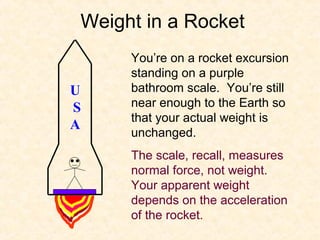
Weight in a Rocket
     You’re on a rocket excursion
     standing on a purple
U    bathroom scale. You’re still
S    near enough to the Earth so
     that your actual weight is
A
     unchanged.
     The scale, recall, measures
     normal force, not weight.
     Your apparent weight
     depends on the acceleration
     of the rocket.
Rocket:


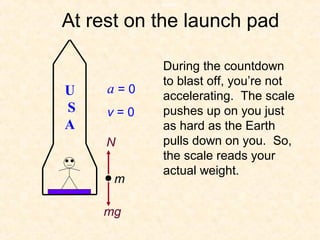
At rest on the launch pad

           During the countdown
           to blast off, you’re not
U    a=0   accelerating. The scale
S    v=0   pushes up on you just
A          as hard as the Earth
     N     pulls down on you. So,
           the scale reads your
           actual weight.
      m

    mg
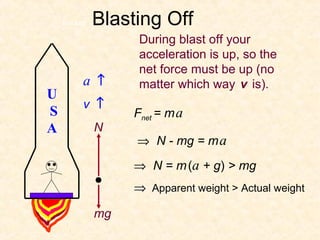
Rocket:   Blasting Off
                    During blast off your
                    acceleration is up, so the
                    net force must be up (no
         a ↑        matter which way v is).
U
         v ↑
S                  Fnet = m a
A             N
                   ⇒ N - mg = m a
                   ⇒ N = m (a + g) > mg
                   ⇒ Apparent weight > Actual weight

              mg
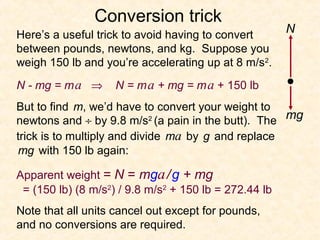
Rocket:   Conversion trick
Here’s a useful trick to avoid having to convert       N
between pounds, newtons, and kg. Suppose you
weigh 150 lb and you’re accelerating up at 8 m/s2.
N - mg = m a ⇒         N = m a + mg = m a + 150 lb
But to find m, we’d have to convert your weight to
newtons and ÷ by 9.8 m/s2 (a pain in the butt). The mg
trick is to multiply and divide ma by g and replace
mg with 150 lb again:

Apparent weight = N = mga / g + mg
 = (150 lb) (8 m/s2) / 9.8 m/s2 + 150 lb = 272.44 lb
Note that all units cancel out except for pounds,
and no conversions are required.
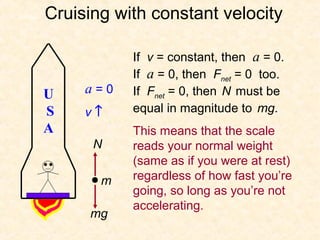
Rocket:   Cruising with constant velocity

                     If v = constant, then a = 0.
                     If a = 0, then Fnet = 0 too.
          U    a=0   If Fnet = 0, then N must be
          S    v↑    equal in magnitude to mg.
          A          This means that the scale
                N    reads your normal weight
                     (same as if you were at rest)
                 m   regardless of how fast you’re
                     going, so long as you’re not
                     accelerating.
               mg
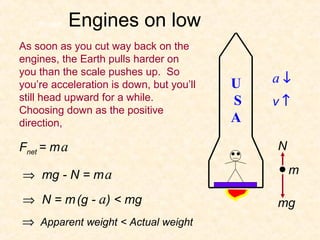
Rocket:   Engines on low
As soon as you cut way back on the
engines, the Earth pulls harder on
you than the scale pushes up. So
you’re acceleration is down, but you’ll   U   a↓
still head upward for a while.            S   v↑
Choosing down as the positive
direction,                                A

Fnet = m a                                    N

⇒ mg - N = m a                                    m

⇒ N = m (g - a) < mg                          mg
⇒ Apparent weight < Actual weight
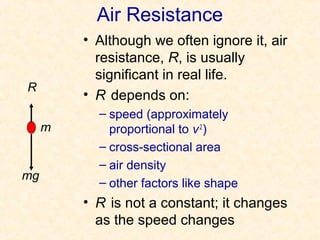
Air Resistance
         • Although we often ignore it, air
           resistance, R, is usually
           significant in real life.
R
         • R depends on:
           – speed (approximately
     m       proportional to v 2 )
           – cross-sectional area
           – air density
mg
           – other factors like shape
         • R is not a constant; it changes
           as the speed changes
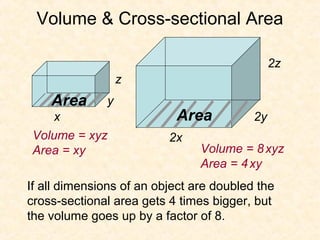
Volume & Cross-sectional Area

                                               2z
                  z
    Area      y
   x                       Area           2y
Volume = xyz              2x
Area = xy                       Volume = 8 xyz
                                Area = 4 xy
If all dimensions of an object are doubled the
cross-sectional area gets 4 times bigger, but
the volume goes up by a factor of 8.
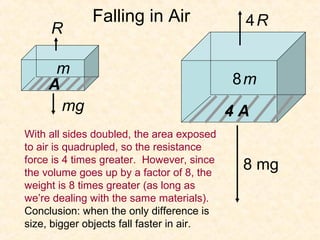
Falling in Air                4R
     R

      m
     A                                     8m
       mg                                  4A
With all sides doubled, the area exposed
to air is quadrupled, so the resistance
force is 4 times greater. However, since
the volume goes up by a factor of 8, the
                                            8 mg
weight is 8 times greater (as long as
we’re dealing with the same materials).
Conclusion: when the only difference is
size, bigger objects fall faster in air.
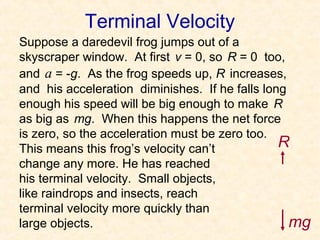
Terminal Velocity
Suppose a daredevil frog jumps out of a
skyscraper window. At first v = 0, so R = 0 too,
and a = -g. As the frog speeds up, R increases,
and his acceleration diminishes. If he falls long
enough his speed will be big enough to make R
as big as mg. When this happens the net force
is zero, so the acceleration must be zero too.
This means this frog’s velocity can’t           R
change any more. He has reached
his terminal velocity. Small objects,
like raindrops and insects, reach
terminal velocity more quickly than
large objects.                                    mg
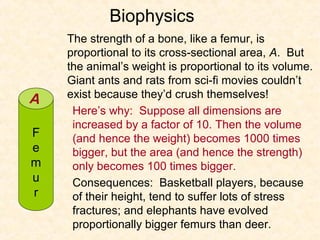
Biophysics
    The strength of a bone, like a femur, is
    proportional to its cross-sectional area, A. But
    the animal’s weight is proportional to its volume.
    Giant ants and rats from sci-fi movies couldn’t
A   exist because they’d crush themselves!
     Here’s why: Suppose all dimensions are
     increased by a factor of 10. Then the volume
F    (and hence the weight) becomes 1000 times
e    bigger, but the area (and hence the strength)
m    only becomes 100 times bigger.
u    Consequences: Basketball players, because
r    of their height, tend to suffer lots of stress
     fractures; and elephants have evolved
     proportionally bigger femurs than deer.

Chap5

  • 1.
    Forces • Newton’s Laws • Free body diagrams of Motion • Atwood device • Weight • Static and kinetic friction • Free fall • Coefficients of friction • Force and motion • Air resistance problems in 1-D • Terminal velocity • Normal force • Tension
  • 2.
    Examples of Forces •A force is just a push or pull. Examples: – an object’s weight – tension in a rope – a left hook to the schnozola – friction – attraction between an electron and proton • Bodies don’t have to be in contact to exert forces on each other, e.g., gravity.
  • 3.
    Fundamental Forces ofNature • Gravity – Attraction between any two bodies w/ mass – Weakest but most dominant • Electromagnetic – Forces between any two bodies w/ charge – Attractive or repulsive • Weak nuclear force – responsible for radioactive decay • Strong nuclear force – holds quarks together (constituents of protons and neutrons)
  • 4.
    Newton’s Laws ofMotion 1. Inertia: “An object in motion tends to stay in motion. An object at rest tends to stay at rest.” 2. Fnet = ma 3. Action – Reaction: “For every action there is an equal but opposite reaction.”
  • 5.
    1st Law: Inertia “An object in motion tends to stay in motion; an object at rest tends to stay at rest.” • A moving body will continue moving in the same direction with the same speed until some net force acts on it. • A body at rest will remain at rest unless a net force acts on it. • Summing it up: It takes a net force to change a body’s velocity.
  • 6.
    Inertia Example 1 An astronaut in outer space will continue drifting in the same direction at the same speed indefinitely, until acted upon by an outside force.
  • 7.
    Inertia Example 2 Ifyou’re driving at 65 mph and have an accident, your car may come to a stop in an instant, while your body is still moving at 65 mph. Without a seatbelt, your inertia could carry you through the windshield.
  • 8.
    2 Law: Fnet= m a nd • The acceleration an object undergoes is directly proportion to the net force acting on it. • Mass is the constant of proportionality. • For a given mass, if Fnet doubles, triples, etc. in size, so does a. • For a given Fnet if m doubles, a is cut in half. • Fnet and a are vectors; m is a scalar. • Fnet and a always point in the same direction. • The 1st law is really a special case of the 2nd law (if net force is zero, so is acceleration).
  • 9.
    What is NetForce? F1 When more than one force acts on a body, F2 the net force F3 (resultant force) is the vector combination of all the forces, i.e., the “net Fnet effect.”
  • 10.
    Net Force &the 2nd Law For a while, we’ll only deal with forces that are horizontal or vertical. When forces act in the same line, we can just add or subtract their magnitudes to find the net force. 15 N 32 N 2 kg 10 N Fnet = 27 N to the right a = 13.5 m/s2
  • 11.
    Units Fnet =m a 1N = 1 kg m/s2 The SI unit of force is the Newton. A Newton is about a quarter pound. 1 lb = 4.45 N
  • 12.
    Graph of Fvs. a In the lab various known forces are applied— one at a time, to the same mass—and the corresponding accelerations are measured. The data are plotted. Since F and a are directly proportional, the relationship is linear. F a
  • 13.
    Slope Since slope =rise / run = ∆F / ∆a, the slope is equal to the mass. Or, think of y = m x + b, like in algebra class. y corresponds to force, m to mass, x to acceleration, and b (the y-intercept) is zero. F ∆F ∆a a
  • 14.
    W = mg •Weight = mass × acceleration due to gravity. • This follows directly from F = m a. • Weight is the force of gravity on a body. • Near the surface of the Earth, g = 9.8 m/s2.
  • 15.
    Two Kinds ofMass • Inertial mass: the net force on an object divided by its acceleration. m = Fnet / a • Gravitational mass: Compare the gravitational attraction of an unknown mass to that of a known mass, usually with a balance. If it balances, the masses are equal. m ? Einstein asserted that these two kinds of masses are equivalent. Balance
  • 16.
    “For every actionthere’s an Action - Reaction equal but opposite reaction.” • If you hit a tennis ball with a racquet, the force on the ball due to the racquet is the same as the force on the racquet due to the ball, except in the opposite direction. • If you drop an apple, the Earth pulls on the apple just as hard as the apple pulls on the Earth. • If you fire a rifle, the bullet pushes the rifle backwards just as hard as the rifle pushes the bullet forwards.
  • 17.
    Earth / Apple Howcould the forces on the tennis ball, apple, and bullet, be the same as on the racquet, Earth, and rifle? The 3rd Law says they must be, the effects are different because of the 2nd Law! apple 0.40 kg A 0.40 kg apple weighs 3.92 N (W = mg). The apple’s weight 3.92 N is Earth’s force on it. The apple pulls back just as hard. So, the same force acts on both bodies. Since their Earth masses are different, so are 3.92 N their accelerations (2nd Law). The Earth’s mass is so big, it’s 5.98 × 1024 kg acceleration is negligible.
  • 18.
    Earth / Apple (cont.) The products are the same, since the forces are the same. m a = m a Apple’s Earth’s little mass big mass Earth’s little Apple’s big acceleration acceleration
  • 19.
    Lost in Space Supposean International Space Station astronaut is on a spacewalk when her tether snaps. Drifting away from the safety of the station, what might she do to make it back?
  • 20.
    Swimming Dueto the 3rd Law, when you swim you push the water (blue), and it pushes you back just as hard (red) in the forward direction. The water around your body also produces a drag force (green) on you, pushing you in the backward direction. If the green and red cancel out, you don’t accelerate (2nd Law) and maintain a constant velocity. Note: The blue vector is a force on the water, not the on swimmer! Only the green and red vectors act on the swimmer.
  • 21.
    Demolition Derby When two cars of different size collide, the forces on each are the SAME (but in opposite directions). However, the same force on a smaller car means a bigger acceleration!
  • 22.
    Free fall • Anobject is in free fall if the only force acting on it is gravity. • It doesn’t matter which way it’s moving. • A shell in a cannon is not in freefall until it leaves the barrel of the cannon. (There are other forces acting on it while inside the barrel.) • For an object in free fall, a = -g, if: – we ignore air resistance. – don’t stray too far from Earth.
  • 23.
    Freefall (cont.) • Any launched object is in freefall the entire time it’s in the air, if: – we ignore air resistance. – it has no propulsion system. • With the previous condition met, a = -g = -9.8 m/s2 everywhere: – on the way up – at its peak – on the way down
  • 24.
    Hippo & PingPong Ball In a vacuum, all bodies fall at the same rate. If a hippo and a ping pong ball were dropped from a helicopter in a vacuum (assuming the copter could fly without air), they’d land at the same time. When there’s no air resistance, size and shape don’t matter!
  • 25.
    Misconceptions • If anobject is moving, there must be some force making it move. Wrong! It could be moving without accelerating. • If v = 0, then a and Fnet must be zero. Wrong! Think of a projectile shot straight up at its peak. • An object must move in the direction of the net force. Wrong! It must accelerate that way but not necessarily move that way.
  • 26.
    Misconceptions (cont.) • Heavy objects must fall faster than light ones. Wrong! The rate is the same in a vacuum. • When a big object collides with a little one, the big one hits the little one harder than the little one hits the big one. Wrong! The 3rd Law says they hit it each other with the same force. • If an object accelerates, its speed must change. Wrong! It could be turning at constant speed.
  • 27.
    Projectile confusion a ≠0 at the vertex (peak) of a projectile’s trajectory. Velocity can be zero there, but not acceleration! If a were zero at the vertex, Fnet would have to be zero as well (by the 2nd law), which means gravity would have to be turned off! a = -g throughout the whole trip, including the high point !
  • 28.
    Forces & Kinematics To solve motion problems involving forces: 1. Find net force (by combining vectors). 2. Calculate acceleration (using 2nd law). 3. Use kinematics equations: vf = v0 + a t ∆x = v0 t + a t2 vf2 – v02 = 2 a ∆x
  • 29.
    Sample Problem 1 Goblin 400 N Ogre 1200 N Treasure 300 kg Troll 850 N A troll and a goblin are fighting with a big, mean ogre over a treasure chest, initially at rest. Find: 1. Fnet = 50 N left 2. a = 0.167 m/s2 left 3. v after 5 s = 0.835 m/s left 4. ∆x after 5 s = 2.08 m left
  • 30.
    A 3 kgwatermelon is launched straight up by applying a 70 N force over 2 m. Find its max height. Hints: Phase I: the launch 1. Draw pic and find net force. 40.6 N up 2. Calculate a during launch. +13.5333 m/s2 3. Calculate vf at the end of the launch (after 2 m). +7.3575 m/s Phase II: freefall 4. Draw pic and think about what a is now. -9.8 m/s2 5. vf from phase I is v0 for phase II. -9.8 m/s2 6. What is vf for phase II? zero 7. Calculate max height & add 2 m. 4.76 m
  • 31.
    Normal force • Whenan object lies on a table or on the ground, the table or ground must exert an upward force on it, otherwise gravity would accelerate it down. • This force is called the normal force. N m In this particular case, N = mg. mg So, Fnet = 0; hence a = 0.
  • 32.
    Normal forces aren’talways up “Normal” means perpendicular. A normal force is always perpendicular to the contact surface. N For example, if a flower pot is setting on an incline, N is not vertical; it’s at a right angle to the incline. Also, in mg this case, mg > N.
  • 33.
    Normal force directions •Up – You’re standing on level ground. – You’re at the bottom of a circle while flying a loop- the-loop in a plane. • Sideways – A ladder leans up against a wall. – You’re against the wall on the “Round Up” ride when the floor drops out. • At an angle – A race car takes a turn on a banked track. • Down – You’re in a roller coaster at the top of a loop.
  • 34.
    Cases in whichN ≠ mg 1. Mass on incline 2. Applied force acting on the mass 3. Nonzero acceleration, as in an elevator or launching space shuttle N FA N N a mg mg mg
  • 35.
    When does N= mg ? If the following conditions are satisfied, then N = mg: • The object is on a level surface. • There’s nothing pushing it down or pulling it up. • The object is not accelerating vertically.
  • 36.
    N and mgare NOT an Action-Reaction Pair! “Switch the nouns to find the reaction partner.” N The dot represents the man. m mg, his weight, is the force on mg the man due to the Earth. Fg FE is the force on the Earth due to the man. FE N, the normal force, is the force Earth on the man due to the ground. Fg is the force on the ground due to the man. The red vectors are an action-reaction pair. So are the blue vectors. Action-reaction pairs always act on two different bodies!
  • 37.
    Box / TensionProblem 38 N T1 T2 8 kg 5 kg 6 kg frictionless floor A force is applied to a box that is connected to other boxes by ropes. The whole system is accelerating to the left.  The problem is to find the tensions in the ropes.  We can apply the 2nd Law to each box individually as well as to the whole system.
  • 38.
    Box / TensionAnalysis 38 N T1 T2 8 kg 5 kg 6 kg frictionless floor  T1 pulls on the 8-kg box to the right just as hard as it pulls on the middle box to the left.  T1 must be < 38 N, or the 8-kg box couldn’t accelerate.  T2 pulls on the middle box to the right just as hard as it pulls on the 6-kg box to the left.  T1 must be > T2 or the middle box couldn’t accelerate.
  • 39.
    Free Body Diagram– system For convenience, we’ll choose N left to be the positive direction. The total mass of all three boxes is 19 kg. 38 N N and mg cancel out. 19 kg Fnet = m a implies a = 2.0 m/s2 Since the ropes don’t mg stretch, a will be 2.0 m/s2 for all three boxes.
  • 40.
    Free Body Diagram– right box N and mg cancel out. N For this particular box, Fnet = m a implies: T2 6 kg T2 = 6a = 6(2) = 12 N. (Remember, a = 2 m/s2 for all mg three boxes.) 38 N T1 T2 8 kg 5 kg 6 kg frictionless floor
  • 41.
    Free Body Diagram– middle box N and mg cancel N out again. T1 T2 = 12 N 5 kg Fnet = m a implies: T1 – T2 = 5a. So, mg T1 – 12 = 5(2), and T1 = 22 N 38 N T1 T2 8 kg 5 kg 6 kg frictionless floor
  • 42.
    Free Body Diagram– left box Let’s check our work N using the left box. 38 N T1 = 22 N N and mg cancel out 8 kg here too. Fnet = ma implies: mg 38 - 22 = ma = 8(2). 16 = 16. 38 N T1 T2 8 kg 5 kg 6 kg
  • 43.
    Atwood Device Assume m1 < m2 and that the clockwise direction is +. If the rope & pulley have T negligible mass, and if the pulley is frictionless, then T is m1 T the same throughout the rope. m1g m2 If the rope doesn’t stretch, a is the same for both masses. m2g
  • 44.
    Atwood Analysis Remember, clockwise has been defined as +. 2nd Law on m1: T - m1g = m1a 2nd Law on m2: m2g - T = m2 a T Add equations: T m2g – m1g = m1a + m2 a m1 (The T ’s cancel out.) Solve for a: m1g m2 a = m2 – m1 g m2g m1 + m2
  • 45.
    Atwood as asystem Treated as a system (rope & both masses), tension is internal and the T ’s cancel out (one clock- wise, one counterclockwise). T Fnet = (total mass) × a implies (force in + direction) - m1 T (force in - direction) = m2g - m1g = (m1 + m2) a. m1g m2 Solving for a gives the same result. Then, knowing a, T can m2g be found by substitution.
  • 46.
    Atwood: Unit Check m2 – m1 a= g m1 + m2 kg - kg m m units: = 2 kg + kg s2 s Whenever you derive a formula you should check to see if it gives the appropriate units. If not, you screwed up. If so, it doesn’t prove you’re right, but it’s a good way to check for errors. Remember, you can multiply or divide scalar quantities with different units, but you can only add or subtract quantities with the same units!
  • 47.
    Atwood: Checking Extremes Besidesunits, you should also check a formula to see m2 – m1 if what happens in extreme a= g m1 + m2 & special cases makes sense. m2 >> m1 : In this case, m1 is negligible compared to m2. If we let m1 = 0 in the formula, we get m1 a = (m2 / m2 )g = g, which makes sense, since with only one mass, we have freefall. m2 << m1 : This time m2 is negligible compared to m2 m1, and if we let m2 = 0 in the formula, we get a = (-m1 / m1 )g = -g, which is freefall in the negative (counterclockwise) direction. m2 = m1 : In this case we find a = 0 / (2m1)g = 0, which is what we would expect considering the device is balanced. Note: The masses in the last case can still move but only
  • 48.
    Friction Friction is the force bodies can impart on each other when they’re in contact. The friction forces are parallel to the contact surface and occur when… • One body slides over the other, or… • They cling together despite and external force. The forces shown are an action-reaction pair. (force on box due to table) f v Acme Hand Grenades f (force on table due to box)
  • 49.
    Friction Facts • Frictionis due to electrostatic attraction between the atoms of the objects in contact. • It can speed you up, slow you down, or make you turn. • It allows you to walk, turn a corner on your bike, warm your hands in the winter, and see a meteor shower. • Friction often creates waste heat. • It makes you push harder / longer to attain a given acceleration. • Like any force, it always has an action-reaction pair.
  • 50.
    Two Kinds ofFriction fs FA • Static friction – Must be overcome in order Objects are still or to budge an object moving together. – Present only when there is Fnet = 0. no relative motion between the bodies, e.g., the box & table top • Kinetic friction FA fk – Weaker than static friction – Present only when objects Fnet is to the right. are moving with respect to a is to the right. each other (skidding) v is left or right.
  • 51.
    Friction Strength The magnitudeof the friction force is proportional to: • how hard the two bodies are pressed together (the normal force, N ). • the materials from which the bodies are made (the coefficient of friction, µ ). Attributes that have little or no effect: • sliding speed • contact area
  • 52.
    Coefficients of Friction •Static coefficient … µs. • Kinetic coefficient … µk. • Both depend on the materials in contact. – Small for steel on ice or scrambled egg on Teflon frying pan – Large for rubber on concrete or cardboard box on carpeting • The bigger the coefficient of friction, the bigger the frictional force.
  • 53.
    Static Friction Force fs ≤ µs N normal static coefficient of force frictional force static friction fs, max = µs N maximum force of static fs, max is the force you friction must exceed in order to budge a resting object.
  • 54.
    Static friction forcevaries • fs, max is a constant in a given problem, but fs varies. • fs matches FA until FA exceeds fs, max. • Example: In the picture below, if µs for a wooden crate on a tile floor is 0.6, fs, max = 0.6 (10 ) (9.8) = 58.8 N. fs = 27 N FA = 27 N 10 kg fs = 43 N FA = 43 N 10 kg fk FA = 66 N The box finally budges when FA 10 kg surpasses fs, max. Then kinetic acts on the box.
  • 55.
    Kinetic Friction fk = µk N normal kinetic coefficient of force frictional force kinetic friction • Once object budges, forget about µs. • Use µk instead. • fk is a constant so long as the materials involved don’t change. • There is no “maximum fk.”
  • 56.
    µ values • Typically,0 < µk < µs < 1. • This is why it’s harder to budge an object than to keep it moving. • If µk > 1, it would be easier to lift an object and carry it than to slide across the floor. • Dimensionless (µ’s have no units, as is apparent from f = µ N).
  • 57.
    Friction Example 1 Youpush a giant barrel o’ monkeys setting on a table with a constant force of 63 N. If µk = 0.35 and µs =0.58, when will the barrel have moved 15 m? Never, since this force won’t even budge it! answer: 63 < 0.58 (14.7) (9.8) ≈ 83.6 N Barrel o’ Monkeys 14.7 kg
  • 58.
    Friction Example 2 Sameas the last problem except with a bigger FA: You push the barrel o’ monkeys with a constant force of 281 N. µk = 0.35 and µs =0.58, same as before. When will the barrel have moved 15 m? step 1: fs, max = 0.58 (14.7) (9.8) ≈ 83.6 N step 2: FA= 281N > fs max. Thus, it budges this time. , step 3: Forget fs and calculate fk: fk = 0.35 (14.7) (9.8) = 50.421 N Barrel o’ Monkeys 14.7 kg (continued on next slide)
  • 59.
    step 4: Freebody diagram while sliding: Friction Example 2 (continued) N fk FA mg step 5: Fnet = FA – fk = 281 - 50.421 = 230.579 N Note: To avoid compounding of error, do not round until the end of the problem. step 6: a = Fnet / m = 230.579 / 14.7 = 15.68564 m/s2 step 7: Kinematics: ∆x = +15 m, v0 = 0, a = +15.68564 m/s2, t = ? ∆x = v0 t + ½ a t 2 ⇒ t = 2 ∆x / a ≈ 1.38 s
  • 60.
    Friction as thenet force A runner is trying to steal second base. He’s running at a speed v; his mass is m. The coefficient of kinetic friction between his uniform and the base pass is µ. How far from second base should he begin his slide in order to come to a stop right at the base? Note: In problems like these where no numbers are given, you are expected to answer the questions in terms of the given parameters and any constants. Here, the given parameters are m, µ, and v. Constants may include g, π, and “regular” numbers like 27 and –1.86. (continued on next slide)
  • 61.
    N Once the slide begins, there is no Friction as the net force (cont.) applied force. Since N and mg cancel fk out, fk is the net force. So Newton’s 2nd Law tells us: mg fk = ma. But the friction force is also given by fk = µ N = µ m g. Therefore, µ m g = m a. Mass cancels out, meaning the distance of his slide is completely independent of how big he is, and we have a = µ g. (Note that the units work out since µ is dimensionless.) This is just the magnitude of a. If the forward direction is positive, his acceleration (which is always in the direction of the net force) must be negative. So, a = -µ g. (continued on next slide)
  • 62.
    Since he comesto rest at 2nd base, vf = 0. Friction as the net force (last) vf 2 - v02 = 2 a ∆x ⇒ 0 - v 2 = -2 µ g ∆x ⇒ ∆x = v 2 / (2 µ g) Unit check: (m/s)2 / (m/s2) = m2 / m = m Note the slide distance is inversely proportional to the coefficient of friction, which makes sense, since the bigger µ is, the bigger f is. Note also that here v and Fnet are in opposite directions, which is perfectly fine.
  • 63.
    Scales • A scaleis NOT necessarily a weight meter. • A scale is a normal force meter. • A scale might lie about your weight if – you’re on an incline. – someone pushes down or pulls up on you. – you’re in an elevator. • You’re actual weight doesn’t change in the above cases.
  • 64.
    Weight in aRocket You’re on a rocket excursion standing on a purple U bathroom scale. You’re still S near enough to the Earth so that your actual weight is A unchanged. The scale, recall, measures normal force, not weight. Your apparent weight depends on the acceleration of the rocket.
  • 65.
    Rocket: At rest onthe launch pad During the countdown to blast off, you’re not U a=0 accelerating. The scale S v=0 pushes up on you just A as hard as the Earth N pulls down on you. So, the scale reads your actual weight. m mg
  • 66.
    Rocket: Blasting Off During blast off your acceleration is up, so the net force must be up (no a ↑ matter which way v is). U v ↑ S Fnet = m a A N ⇒ N - mg = m a ⇒ N = m (a + g) > mg ⇒ Apparent weight > Actual weight mg
  • 67.
    Rocket: Conversion trick Here’s a useful trick to avoid having to convert N between pounds, newtons, and kg. Suppose you weigh 150 lb and you’re accelerating up at 8 m/s2. N - mg = m a ⇒ N = m a + mg = m a + 150 lb But to find m, we’d have to convert your weight to newtons and ÷ by 9.8 m/s2 (a pain in the butt). The mg trick is to multiply and divide ma by g and replace mg with 150 lb again: Apparent weight = N = mga / g + mg = (150 lb) (8 m/s2) / 9.8 m/s2 + 150 lb = 272.44 lb Note that all units cancel out except for pounds, and no conversions are required.
  • 68.
    Rocket: Cruising with constant velocity If v = constant, then a = 0. If a = 0, then Fnet = 0 too. U a=0 If Fnet = 0, then N must be S v↑ equal in magnitude to mg. A This means that the scale N reads your normal weight (same as if you were at rest) m regardless of how fast you’re going, so long as you’re not accelerating. mg
  • 69.
    Rocket: Engines on low As soon as you cut way back on the engines, the Earth pulls harder on you than the scale pushes up. So you’re acceleration is down, but you’ll U a↓ still head upward for a while. S v↑ Choosing down as the positive direction, A Fnet = m a N ⇒ mg - N = m a m ⇒ N = m (g - a) < mg mg ⇒ Apparent weight < Actual weight
  • 70.
    Air Resistance • Although we often ignore it, air resistance, R, is usually significant in real life. R • R depends on: – speed (approximately m proportional to v 2 ) – cross-sectional area – air density mg – other factors like shape • R is not a constant; it changes as the speed changes
  • 71.
    Volume & Cross-sectionalArea 2z z Area y x Area 2y Volume = xyz 2x Area = xy Volume = 8 xyz Area = 4 xy If all dimensions of an object are doubled the cross-sectional area gets 4 times bigger, but the volume goes up by a factor of 8.
  • 72.
    Falling in Air 4R R m A 8m mg 4A With all sides doubled, the area exposed to air is quadrupled, so the resistance force is 4 times greater. However, since the volume goes up by a factor of 8, the 8 mg weight is 8 times greater (as long as we’re dealing with the same materials). Conclusion: when the only difference is size, bigger objects fall faster in air.
  • 73.
    Terminal Velocity Suppose adaredevil frog jumps out of a skyscraper window. At first v = 0, so R = 0 too, and a = -g. As the frog speeds up, R increases, and his acceleration diminishes. If he falls long enough his speed will be big enough to make R as big as mg. When this happens the net force is zero, so the acceleration must be zero too. This means this frog’s velocity can’t R change any more. He has reached his terminal velocity. Small objects, like raindrops and insects, reach terminal velocity more quickly than large objects. mg
  • 74.
    Biophysics The strength of a bone, like a femur, is proportional to its cross-sectional area, A. But the animal’s weight is proportional to its volume. Giant ants and rats from sci-fi movies couldn’t A exist because they’d crush themselves! Here’s why: Suppose all dimensions are increased by a factor of 10. Then the volume F (and hence the weight) becomes 1000 times e bigger, but the area (and hence the strength) m only becomes 100 times bigger. u Consequences: Basketball players, because r of their height, tend to suffer lots of stress fractures; and elephants have evolved proportionally bigger femurs than deer.