MASONRY WALL
AND ITS TYPES
What We Are Going To Learn
• What is mean by masonry wall ?
• Advantages of masonry wall.
• Various types of masonry walls.
• Failure of masonry walls.
What is mean by masonry walls ?
• A Structure made up of individual blocks of
materials such as stone, brick, concrete, hollow
blocks, cellular concrete
• Usually placed in horizontal courses/direction.
• Cemented together with some form of mortar.
Advantages of masonry wall
• Increase the thermal mass of a building.
• Provide a structure with reduced life-cycle costs.
• Very heat resistant & thus provides good fire
protection.
• More resistant to projectiles.
• Stone masonry
• Brick masonry
• Hollow block concrete masonry
• Reinforced masonry
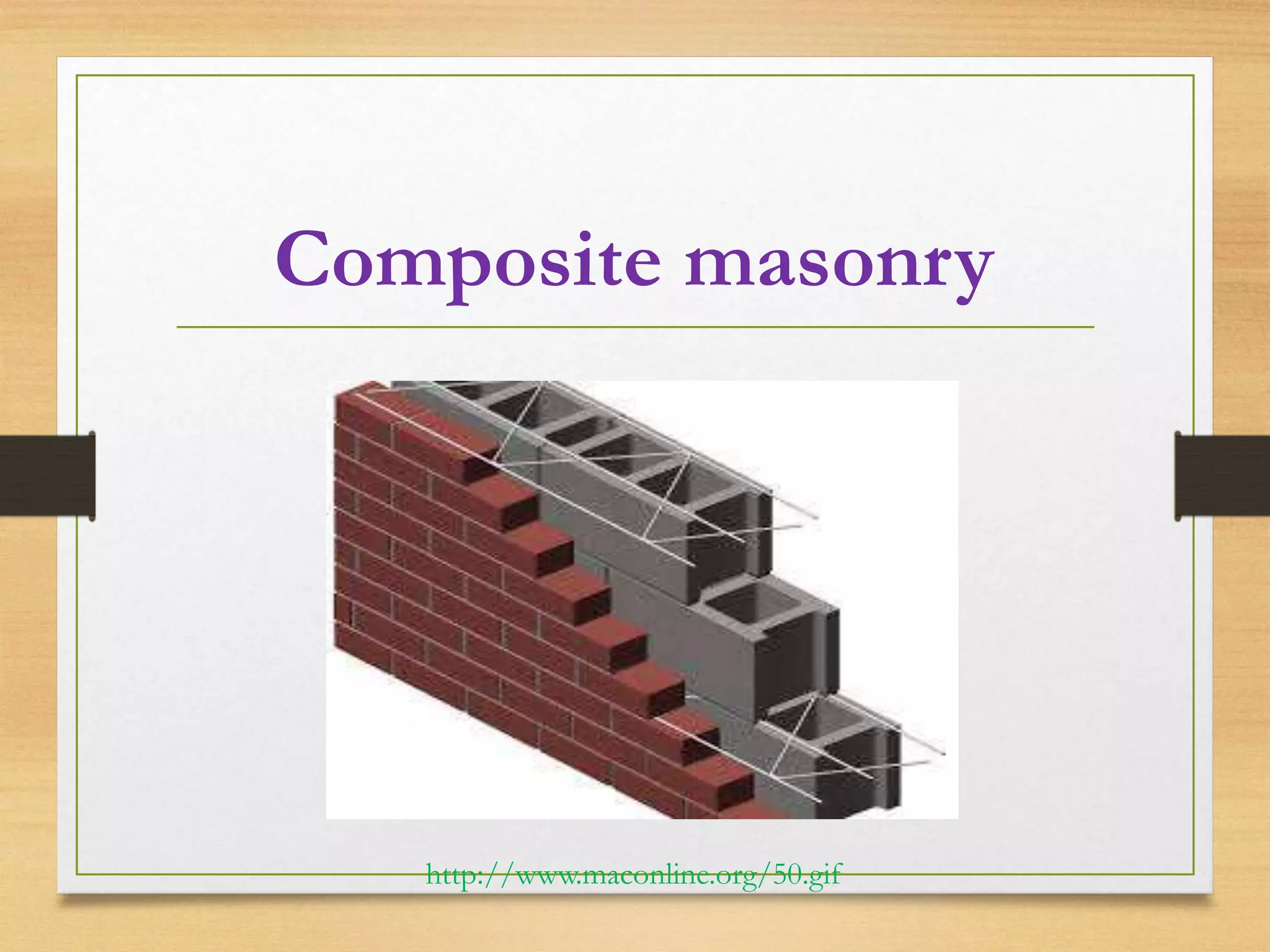
• Composite masonry
Types of masonry
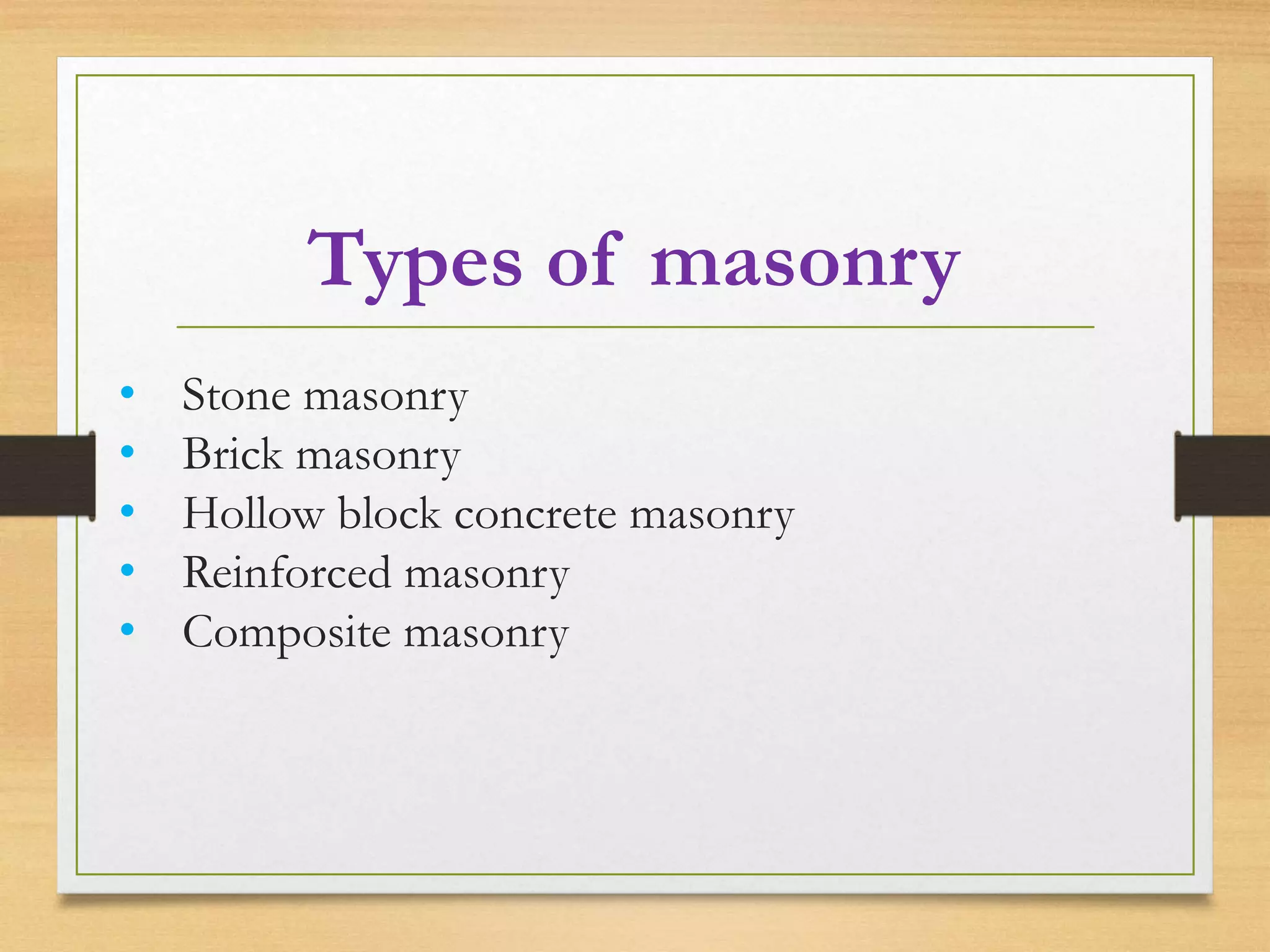
http://www.staff.city.ac.uk/earthquakes/MasonryStone/images/StoneMasonryWallDetail.png
Stone masonry
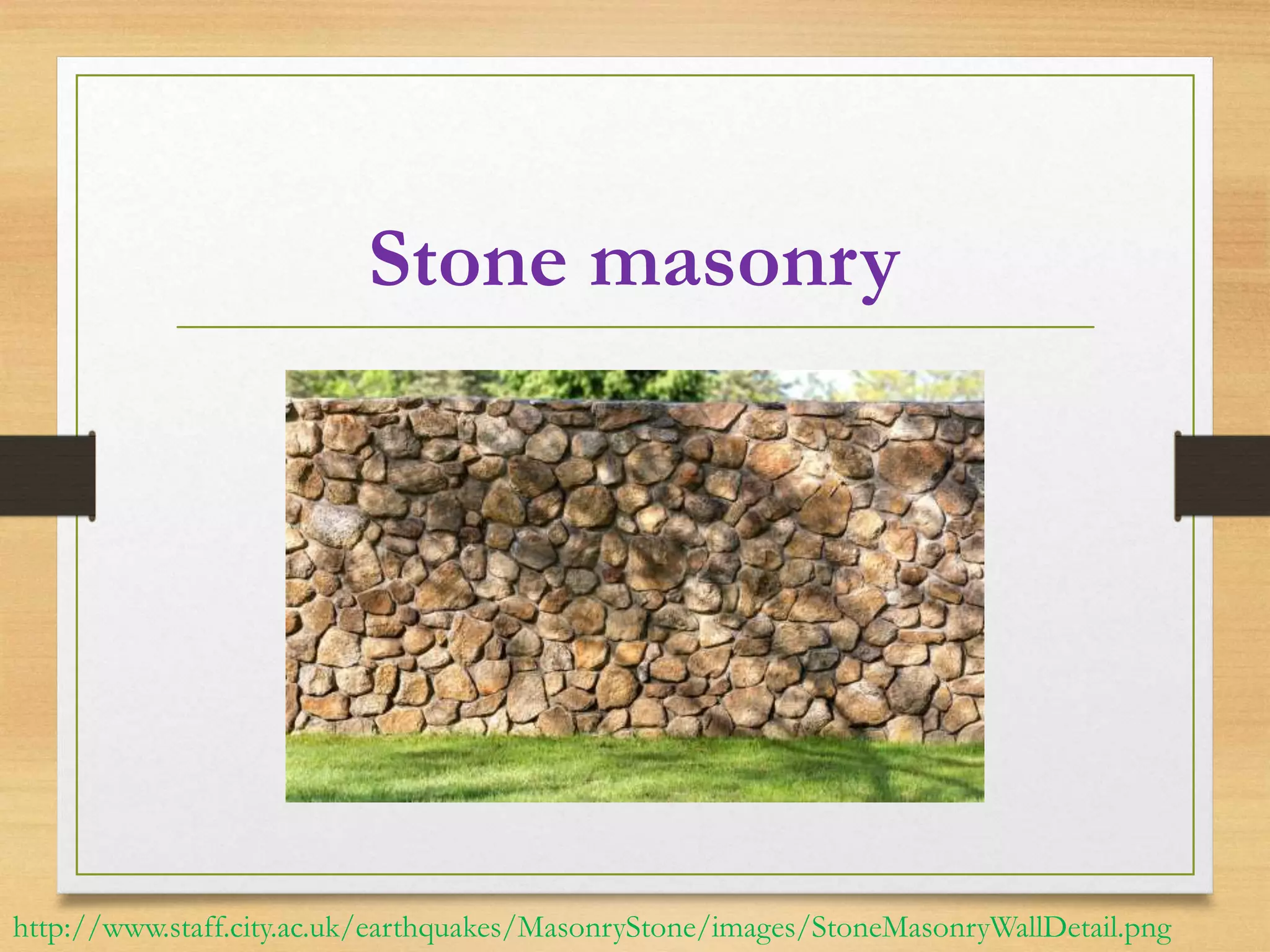
Brick masonry
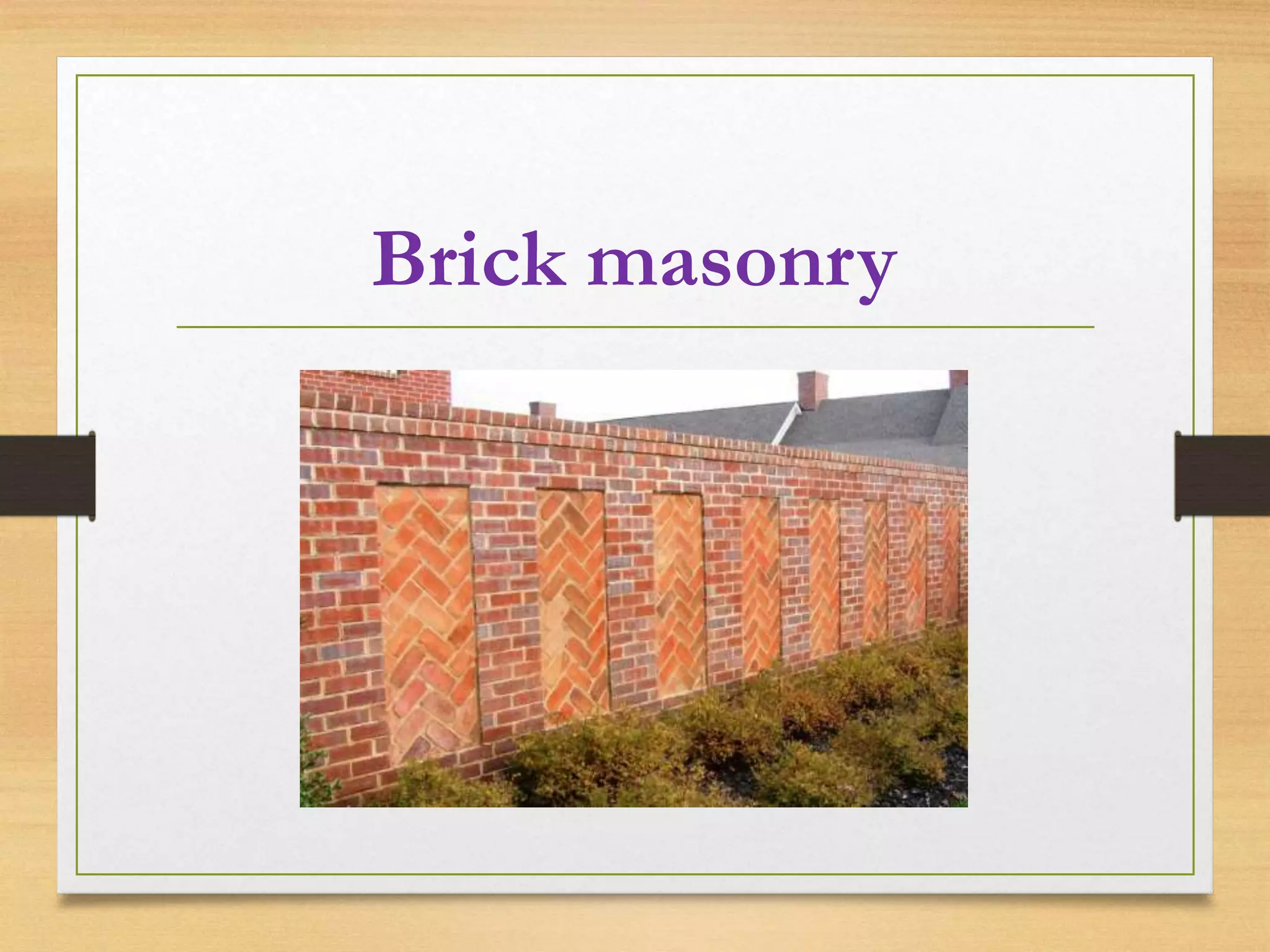
http://content.answcdn.com/main/content/img/McGrawHill/atchitecture/f0184-03.png
Hollow block masonry
http://www.world-housing.net/uploads/101068_074_18.jpg
Reinforced masonry
http://www.maconline.org/50.gif
Composite masonry
• The wall may fall straight out in a monolithic
piece at a 90 degree angle, similar to a falling
tree;
• The wall may crumble straight down in a so-
called "curtain" fall collapse
• The wall may collapse in an inward / outward
fashion, with the top falling inward and the
bottom outward.
Failure of masonry
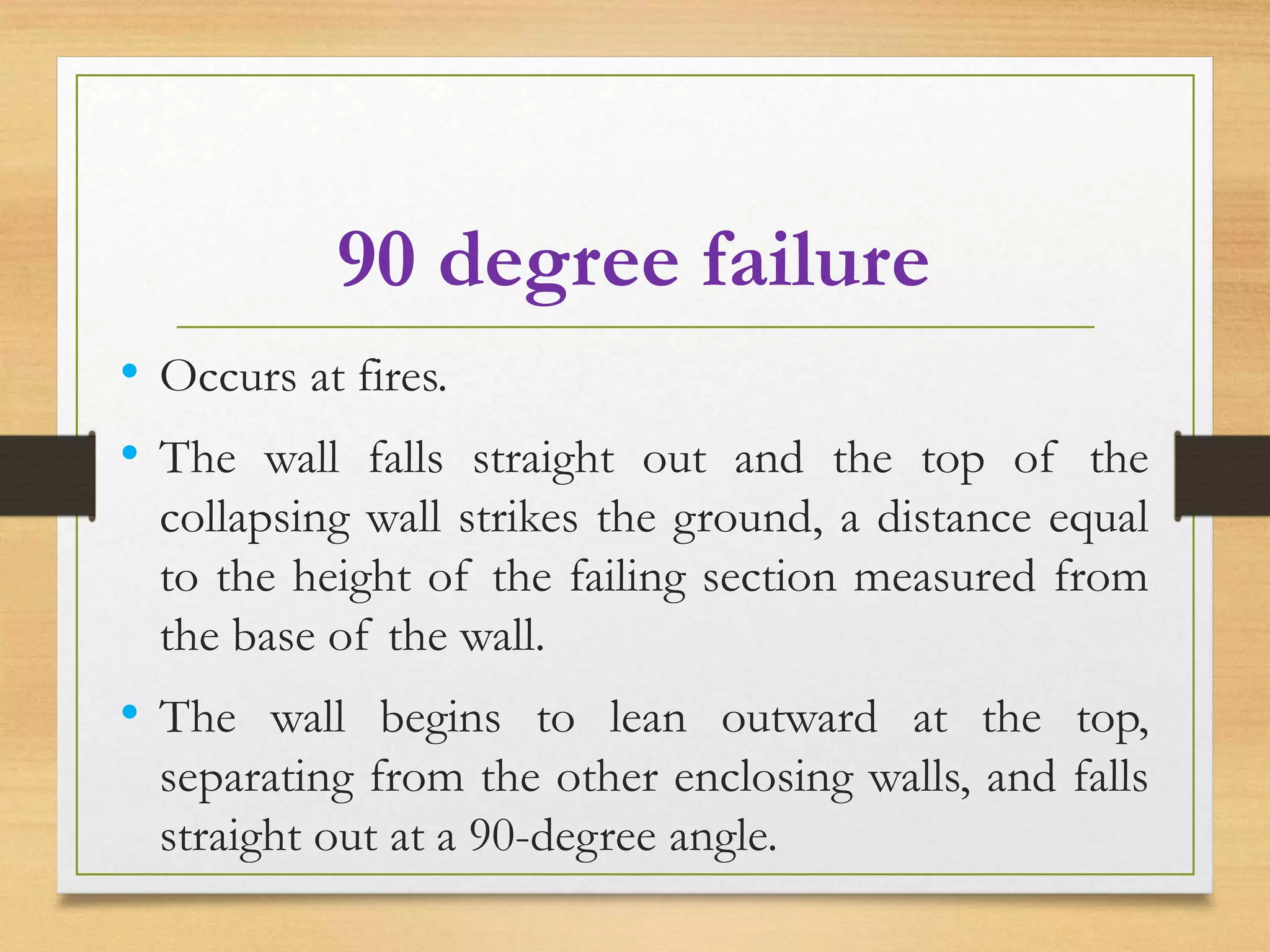
• Occurs at fires.
• The wall falls straight out and the top of the
collapsing wall strikes the ground, a distance equal
to the height of the failing section measured from
the base of the wall.
• The wall begins to lean outward at the top,
separating from the other enclosing walls, and falls
straight out at a 90-degree angle.
90 degree failure
• The exterior masonry wall drops like a falling
curtain cut loose at the top.
• The wall crumbles and falls straight down, with
bricks and mortar forming a pile on the ground
near the base of the wall.
• The collapse of the brick veneer, brick cavity, or
masonry-backed stonewall often occurs in a
curtain-fall manner
Curtain fall collapse
• When a masonry wall becomes unstable and
begins to lean inward, it does not always mean that
the wall will fall inward.
• When a section of the broken wall falls inward,
the lower portion of the wall may kick outward, or
the upper portion may initially fall inward but then
slide down and outward into the street, bottom
first..
Inward/outword collapse
• By increasing the mortar joint thickness, the
strength of the masonry will decrease
• The maximum compressive strength of models
was obtained when the thickness of the mortar
joint was 7.5 mm.
Extras
This Presentation is Brought to you
by
An Civil Engineering Blog

Types of masonry and its failure types

  • 1.
  • 2.
    What We AreGoing To Learn • What is mean by masonry wall ? • Advantages of masonry wall. • Various types of masonry walls. • Failure of masonry walls.
  • 3.
    What is meanby masonry walls ? • A Structure made up of individual blocks of materials such as stone, brick, concrete, hollow blocks, cellular concrete • Usually placed in horizontal courses/direction. • Cemented together with some form of mortar.
  • 4.
    Advantages of masonrywall • Increase the thermal mass of a building. • Provide a structure with reduced life-cycle costs. • Very heat resistant & thus provides good fire protection. • More resistant to projectiles.
  • 5.
    • Stone masonry •Brick masonry • Hollow block concrete masonry • Reinforced masonry • Composite masonry Types of masonry
  • 6.
  • 7.
  • 8.
  • 9.
  • 10.
  • 11.
    • The wallmay fall straight out in a monolithic piece at a 90 degree angle, similar to a falling tree; • The wall may crumble straight down in a so- called "curtain" fall collapse • The wall may collapse in an inward / outward fashion, with the top falling inward and the bottom outward. Failure of masonry
  • 12.
    • Occurs atfires. • The wall falls straight out and the top of the collapsing wall strikes the ground, a distance equal to the height of the failing section measured from the base of the wall. • The wall begins to lean outward at the top, separating from the other enclosing walls, and falls straight out at a 90-degree angle. 90 degree failure
  • 13.
    • The exteriormasonry wall drops like a falling curtain cut loose at the top. • The wall crumbles and falls straight down, with bricks and mortar forming a pile on the ground near the base of the wall. • The collapse of the brick veneer, brick cavity, or masonry-backed stonewall often occurs in a curtain-fall manner Curtain fall collapse
  • 14.
    • When amasonry wall becomes unstable and begins to lean inward, it does not always mean that the wall will fall inward. • When a section of the broken wall falls inward, the lower portion of the wall may kick outward, or the upper portion may initially fall inward but then slide down and outward into the street, bottom first.. Inward/outword collapse
  • 15.
    • By increasingthe mortar joint thickness, the strength of the masonry will decrease • The maximum compressive strength of models was obtained when the thickness of the mortar joint was 7.5 mm. Extras
  • 16.
    This Presentation isBrought to you by An Civil Engineering Blog