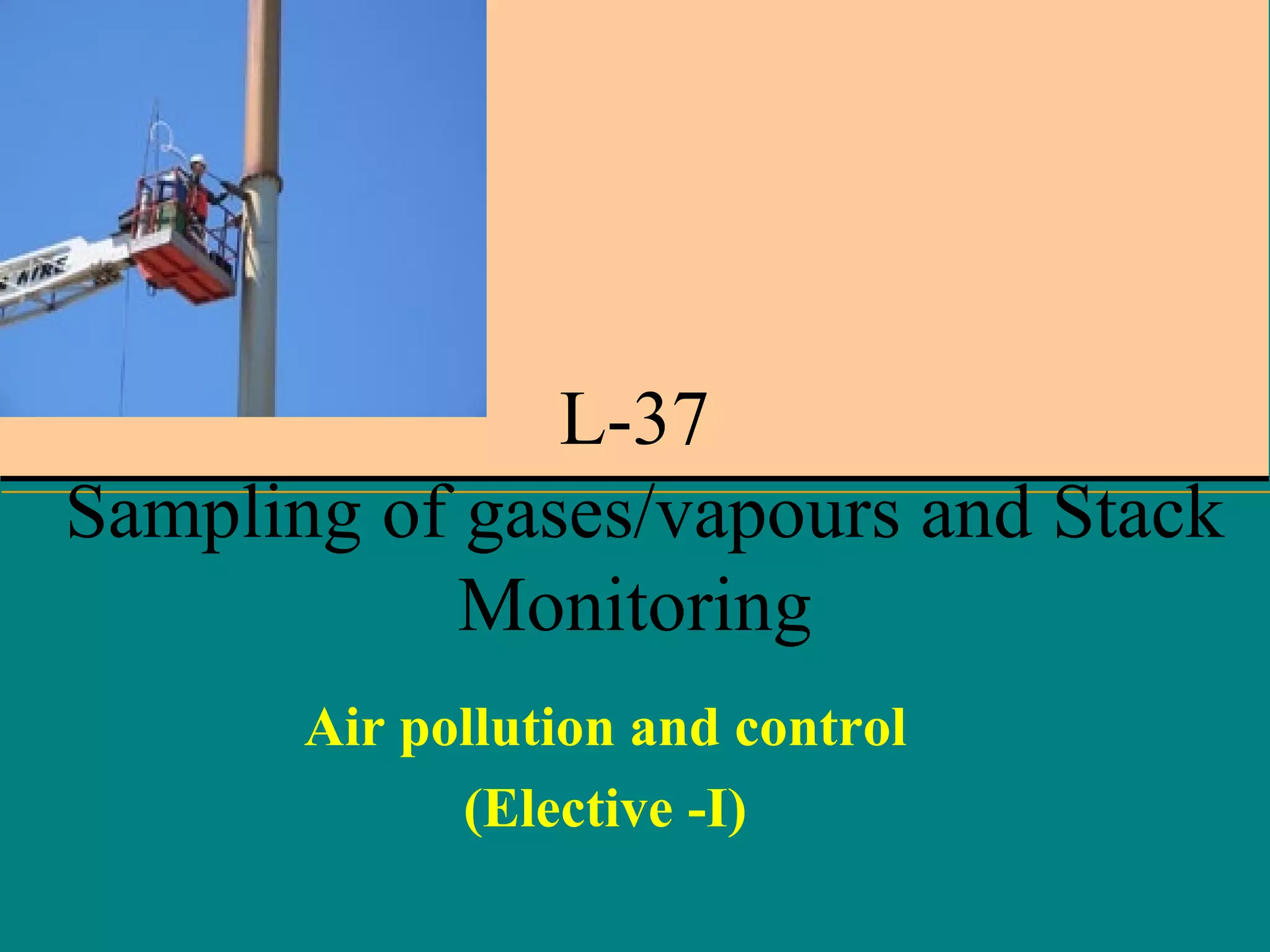
L-37
Sampling of gases/vapours and Stack
Monitoring
Air pollution and control
(Elective -I)
Devices for general use

15-10-2013

Page 2
Meters
• They are used to determine accurately the
volume of the gas collected. They are fitted
with manometers and thermometers to
indicate the pressure and temperature of
the gas stream sampled.

Page 3

15-10-2013
Probes
• These are tubes suitable for penetrating
into the gas stream and should be
constructed of materials which are noncorrosive and which can withstand special
temperature conditions.
• Also, they should be constructed of
materials which do not react with the
substances to be sampled.
Page 4

15-10-2013
• Therefore, they should be made of stainless
steel or preferably of glass or quartz.
• A probe should have suitable length and
diameter.
• To ensure isokinetic sampling conditions, the
opening of the probe should face the gas
stream to be sampled.
Page 5

15-10-2013
Suction Devices
• Any suction device which has the
required volumetric capacity can be
used. Vacuum pumps driven by
electric motors are very commonly
used.

Page 6

15-10-2013
Gaseous sampling methods
• Sample methods include
1. Wet chemical (Absorption),
2. Condensation or freeze out
3. Gas sampling into bags, syringes
4. On sorbent tubes(Adsorption )
5. Direct read instruments and,
6. Isokinetic methods (Particulate sampling)
1. Absorbers
• In this process, effluent gases are passed through
absorbers (scrubbers) which contain liquid
absorbents that remove one or more of the pollutants
in the gas stream. The efficiency of this process
depends on
• (1) amount of surface contact between gas and
liquid
• (2) contact time
• (3) concentration of absorbing medium
• (4) speed of reaction between the absorbent and gas.
• Absorbents are being used to remove sulphur
dioxide, hydrogen sulphide, sulphur trioxide
and fluorides and oxides of nitrogen.
• The equipment using the principle of
absorption for the removal of gaseous
pollutants includes: (I) packed tower, (2) plate
tower, (3) bubble cap plate tower, (4) spray
tower, and (5) liquid jet scrubber absorbers.
Selective chromatographic absorption of gases
on small pellets may offer much higher rates
than those achieved in packed towers.
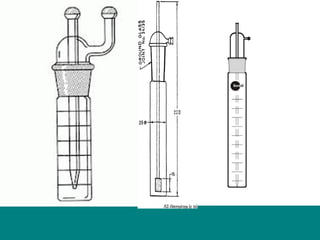
• A gas can be sampled by means of a
suitable absorption reagent. For this
purpose, V-shaped absorbers are used.
These absorbers are filled with a
certain measured amount of reagent
and fitted with a porous glass
partition, so that the air or gas led into
them passes through the reagent
solution in the form of fine bubbles
thus ensuring intimate contact.
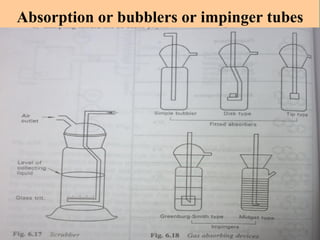
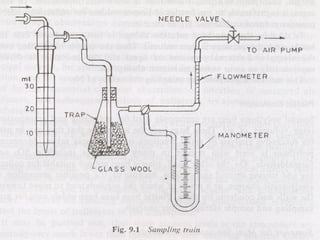
Absorption or bubblers or impinger tubes
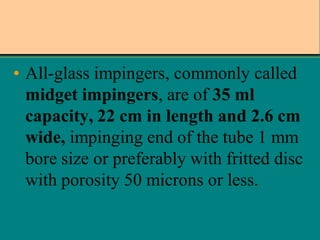
• All-glass impingers, commonly called
midget impingers, are of 35 ml
capacity, 22 cm in length and 2.6 cm
wide, impinging end of the tube 1 mm
bore size or preferably with fritted disc
with porosity 50 microns or less.
Page 14

15-10-2013
2. Bags and Containers and tubes
• The use of bags and containers allows the
collection of air in its natural state without any
concentration of pollutants. The technique is
not suitable for collection of samples of large
quantities of air, but may be convenient for the
collection of pollutants those are present in
relatively larger quantities or those permit the
determination by chromatographic or infrared
gas analysis or other such instrumental
techniques where only a small, quantity of
pollutants is required.
• For example, carbon monoxide can
be collected in small bags from
different locations and analysed in
the laboratory by infrared gas
analyser
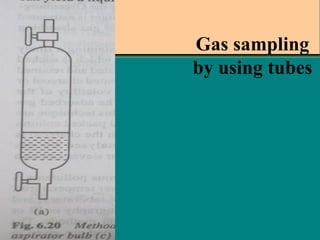
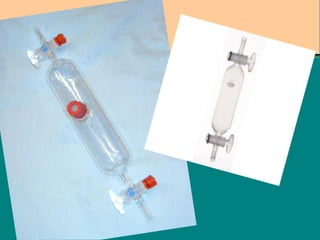
Gas Sampling tubes
• The Gas Sampling Tube shown opposite has
two stopcocks at either end to allow the flow
of gas through the tube.
• The gas can be extracted by piercing the
septum port on the side arm with a syringe.
The stopcocks can be either glass or other
synthetic material and can be
manufactured a range of capacities.
Gas sampling
by using tubes
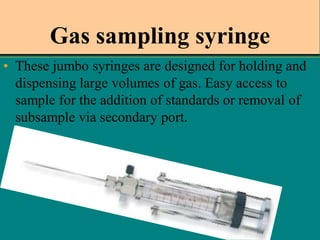
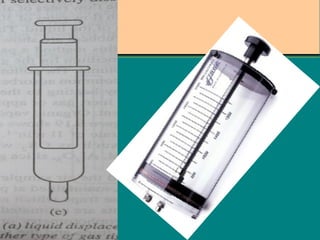
Gas sampling syringe
• These jumbo syringes are designed for holding and
dispensing large volumes of gas. Easy access to
sample for the addition of standards or removal of
subsample via secondary port.
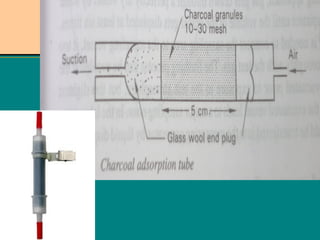
3. Adsorption
• Activated charcoal or silica gel or any other
suitable adsorbent is filled to separate out
desired gases.
• Organic pollutants thus separated are analysed
by gas chromatography.
• After adsorption charcoal is washed with
solvent and then analysed by gas
chromatography.
• Used for ozone and light hydrocarbons
4. Freeze out or condensation
• Here the gas stream sampled is cooled in
suitable containers, thus bringing about
the condensation of the volatile
substances present. As in the case of
absorption devices, here also the
condensation traps can be arranged either
in series or parallel, at decreasing
temperatures.
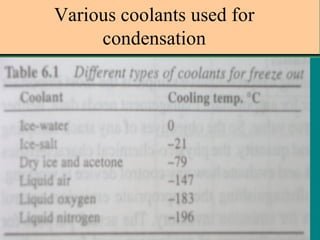
• By using various coolants, e.g., ice, liquid
air, or liquid nitrogen-the components can
be separated by fractional condensation.
• This method is used in particular for the
sampling of odoriferous substances.
Various coolants used for
condensation
Stack Gas Monitoring
Types of Monitoring
Source Monitoring

General Objectives
• Source monitoring may be carried out to:
– Determine emission rates, and assess
how these are affected by process
variations
– Evaluate pollution control devices
– Evaluate emission compliance with
NAAQS
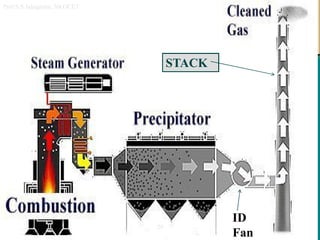
Prof S S Jahagirdar, NKOCET

STACK

29

ID
Fan
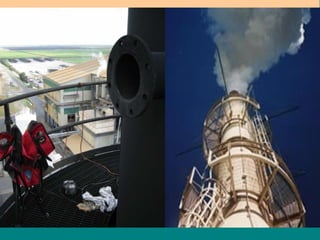
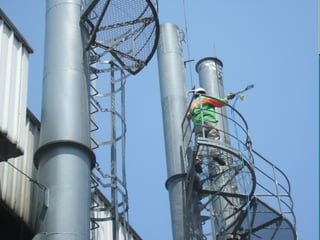
• Stack or source emissions monitoring involves
taking direct measurements of an emission
source, usually at an industrial or
manufacturing facility.
• Often the source emission sampling is a
requirement for annual monitoring in the site
environmental licence.
• Hence, the purpose is often to demonstrate
compliance of emissions with the legislative
requirements and the environmental
performance commitments of a company.
• Other circumstances where stack testing is
required include development of new
processes and products, and testing to allow
optimisation of existing processes.
• For example, stack emission testing data can
provide an important indication of the
efficiency of a combustion process, or a
particular production, as this type of testing
allows the compounds that are being emitted
as a waste product via the stack to be
quantified.
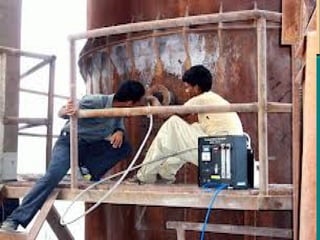
• The process of stack testing is complex,
and generally involves collection of
samples at the source of emissions (often
a stack) with the samples subsequently
lodged with an appropriately certified
laboratory for analysis.
• Given the range of compounds that can
be tested, the methods and sampling
instrumentation involved in source
emission testing is varied.
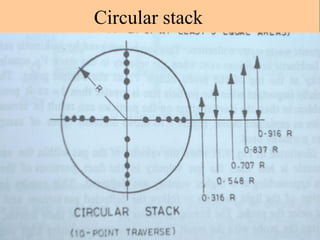
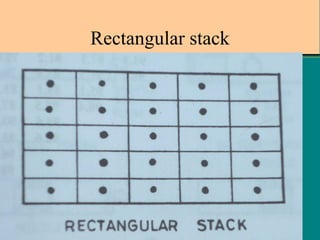
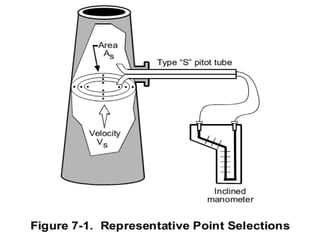
Traverse points
• For the sample to become representative
it should be collected across at various
points across stack. This is essential as
there will be variation in velocity and
temperature across cross section of stack.
Traverse points are to be located to
achieve this.
Reference table for selecting
traverse points
Circular stack
Rectangular stack
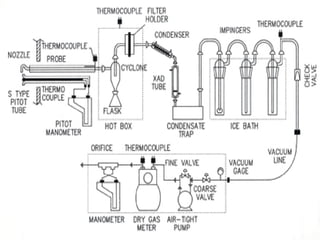
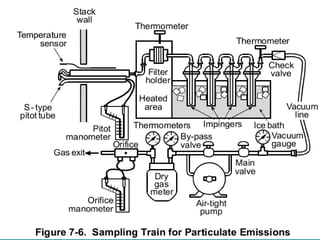
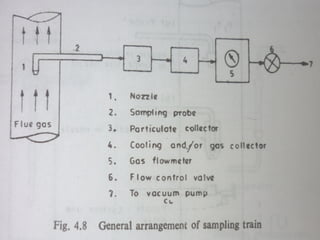
Sampling Train
• For sampling of particulates and gases in
stack monitoring all components of stack
monitoring kit are to be attached in
logical series.
• Such assembly is known as ‘sampling
train’
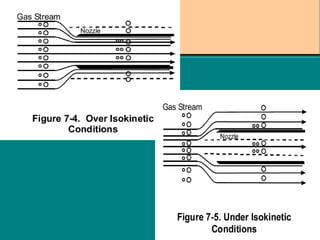
ISOKINETIC SAMPLING
• To obtain a representative sample independent
of particle size, it is necessary to remove the
sample stream isokinetically, i.e. with the
same velocity as the main stream.
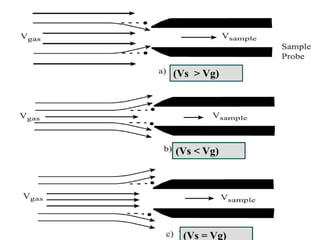
• The following Figure shows the pattern of the
flow lines in the vicinity of a thin-walled
sampling probe.
(Vs > Vg)

(Vs < Vg)

(Vs = Vg)
Vs
Vg

Vs
Vg
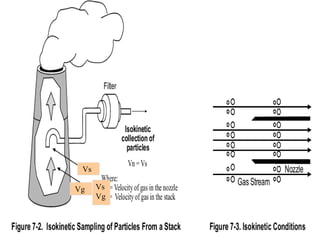
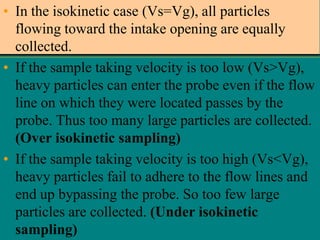
• In the isokinetic case (Vs=Vg), all particles
flowing toward the intake opening are equally
collected.
• If the sample taking velocity is too low (Vs>Vg),
heavy particles can enter the probe even if the flow
line on which they were located passes by the
probe. Thus too many large particles are collected.
(Over isokinetic sampling)
• If the sample taking velocity is too high (Vs<Vg),
heavy particles fail to adhere to the flow lines and
end up bypassing the probe. So too few large
particles are collected. (Under isokinetic
sampling)
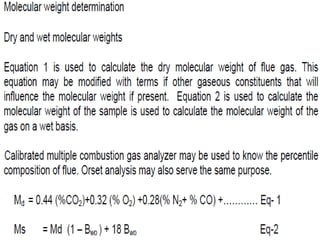
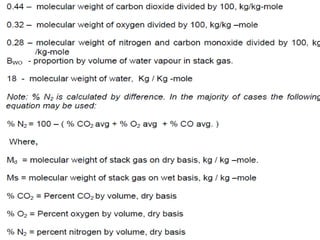
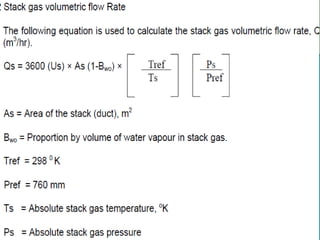
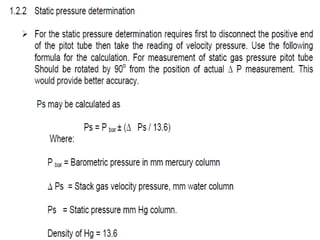
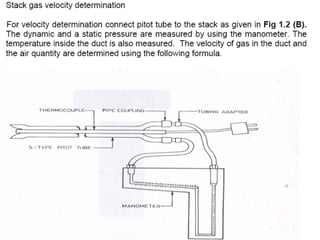
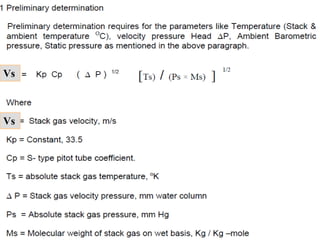
Mathematical equations used in
Stack Monitoring
Vs

Vs
Theory Questions
Q 1. Write short notes on
1. Stack monitoring.
2. Iso-Kinetic sampling. (May 2011,Dec 2009, 6
marks)
3. Selection of Traverse points in stack monitoring
Q2. Draw neat diagram of a ‘Sampling Train’.
Give equations for determination of Pressure and
Stack gas velocity.
Q3. Explain various principle of waste gas
sampling. (Dec 2010,8 marks)
Q4. List various devices used for sampling of gases
and vapours. Explain any two. (Dec 2010,9 marks)
Q5. Discuss devices used for sampling of gases and
vapours (May 2009, 8 marks).
Q6. List various devices used for sampling of gases
and vapours. Explain any one in detail. (Nov 2008,
May 2011,9 marks)
Q7. Draw neat sketch of a particulate ‘Sampling
Train’. Write formula for calculation of stack gas
velocity inside the stack. (Dec 2008, May 2011, 8
marks)
Q8. What is stack sampling? How to collect a
representative sample? (Dec 2010, 8 marks)
Q9. Explain various devices used for sampling of
gases and vapours. (May 2011, 8 marks)

L 37 final

  • 1.
    L-37 Sampling of gases/vapoursand Stack Monitoring Air pollution and control (Elective -I)
  • 2.
    Devices for generaluse 15-10-2013 Page 2
  • 3.
    Meters • They areused to determine accurately the volume of the gas collected. They are fitted with manometers and thermometers to indicate the pressure and temperature of the gas stream sampled. Page 3 15-10-2013
  • 4.
    Probes • These aretubes suitable for penetrating into the gas stream and should be constructed of materials which are noncorrosive and which can withstand special temperature conditions. • Also, they should be constructed of materials which do not react with the substances to be sampled. Page 4 15-10-2013
  • 5.
    • Therefore, theyshould be made of stainless steel or preferably of glass or quartz. • A probe should have suitable length and diameter. • To ensure isokinetic sampling conditions, the opening of the probe should face the gas stream to be sampled. Page 5 15-10-2013
  • 6.
    Suction Devices • Anysuction device which has the required volumetric capacity can be used. Vacuum pumps driven by electric motors are very commonly used. Page 6 15-10-2013
  • 7.
    Gaseous sampling methods •Sample methods include 1. Wet chemical (Absorption), 2. Condensation or freeze out 3. Gas sampling into bags, syringes 4. On sorbent tubes(Adsorption ) 5. Direct read instruments and, 6. Isokinetic methods (Particulate sampling)
  • 8.
    1. Absorbers • Inthis process, effluent gases are passed through absorbers (scrubbers) which contain liquid absorbents that remove one or more of the pollutants in the gas stream. The efficiency of this process depends on • (1) amount of surface contact between gas and liquid • (2) contact time • (3) concentration of absorbing medium • (4) speed of reaction between the absorbent and gas.
  • 9.
    • Absorbents arebeing used to remove sulphur dioxide, hydrogen sulphide, sulphur trioxide and fluorides and oxides of nitrogen. • The equipment using the principle of absorption for the removal of gaseous pollutants includes: (I) packed tower, (2) plate tower, (3) bubble cap plate tower, (4) spray tower, and (5) liquid jet scrubber absorbers. Selective chromatographic absorption of gases on small pellets may offer much higher rates than those achieved in packed towers.
  • 10.
    • A gascan be sampled by means of a suitable absorption reagent. For this purpose, V-shaped absorbers are used. These absorbers are filled with a certain measured amount of reagent and fitted with a porous glass partition, so that the air or gas led into them passes through the reagent solution in the form of fine bubbles thus ensuring intimate contact.
  • 12.
    Absorption or bubblersor impinger tubes
  • 13.
    • All-glass impingers,commonly called midget impingers, are of 35 ml capacity, 22 cm in length and 2.6 cm wide, impinging end of the tube 1 mm bore size or preferably with fritted disc with porosity 50 microns or less.
  • 14.
  • 15.
    2. Bags andContainers and tubes • The use of bags and containers allows the collection of air in its natural state without any concentration of pollutants. The technique is not suitable for collection of samples of large quantities of air, but may be convenient for the collection of pollutants those are present in relatively larger quantities or those permit the determination by chromatographic or infrared gas analysis or other such instrumental techniques where only a small, quantity of pollutants is required.
  • 16.
    • For example,carbon monoxide can be collected in small bags from different locations and analysed in the laboratory by infrared gas analyser
  • 17.
    Gas Sampling tubes •The Gas Sampling Tube shown opposite has two stopcocks at either end to allow the flow of gas through the tube. • The gas can be extracted by piercing the septum port on the side arm with a syringe. The stopcocks can be either glass or other synthetic material and can be manufactured a range of capacities.
  • 18.
  • 20.
    Gas sampling syringe •These jumbo syringes are designed for holding and dispensing large volumes of gas. Easy access to sample for the addition of standards or removal of subsample via secondary port.
  • 22.
    3. Adsorption • Activatedcharcoal or silica gel or any other suitable adsorbent is filled to separate out desired gases. • Organic pollutants thus separated are analysed by gas chromatography. • After adsorption charcoal is washed with solvent and then analysed by gas chromatography. • Used for ozone and light hydrocarbons
  • 24.
    4. Freeze outor condensation • Here the gas stream sampled is cooled in suitable containers, thus bringing about the condensation of the volatile substances present. As in the case of absorption devices, here also the condensation traps can be arranged either in series or parallel, at decreasing temperatures.
  • 25.
    • By usingvarious coolants, e.g., ice, liquid air, or liquid nitrogen-the components can be separated by fractional condensation. • This method is used in particular for the sampling of odoriferous substances.
  • 26.
    Various coolants usedfor condensation
  • 27.
  • 28.
    Types of Monitoring SourceMonitoring General Objectives • Source monitoring may be carried out to: – Determine emission rates, and assess how these are affected by process variations – Evaluate pollution control devices – Evaluate emission compliance with NAAQS
  • 29.
    Prof S SJahagirdar, NKOCET STACK 29 ID Fan
  • 33.
    • Stack orsource emissions monitoring involves taking direct measurements of an emission source, usually at an industrial or manufacturing facility. • Often the source emission sampling is a requirement for annual monitoring in the site environmental licence. • Hence, the purpose is often to demonstrate compliance of emissions with the legislative requirements and the environmental performance commitments of a company.
  • 34.
    • Other circumstanceswhere stack testing is required include development of new processes and products, and testing to allow optimisation of existing processes. • For example, stack emission testing data can provide an important indication of the efficiency of a combustion process, or a particular production, as this type of testing allows the compounds that are being emitted as a waste product via the stack to be quantified.
  • 35.
    • The processof stack testing is complex, and generally involves collection of samples at the source of emissions (often a stack) with the samples subsequently lodged with an appropriately certified laboratory for analysis. • Given the range of compounds that can be tested, the methods and sampling instrumentation involved in source emission testing is varied.
  • 36.
    Traverse points • Forthe sample to become representative it should be collected across at various points across stack. This is essential as there will be variation in velocity and temperature across cross section of stack. Traverse points are to be located to achieve this.
  • 37.
    Reference table forselecting traverse points
  • 38.
  • 39.
  • 41.
    Sampling Train • Forsampling of particulates and gases in stack monitoring all components of stack monitoring kit are to be attached in logical series. • Such assembly is known as ‘sampling train’
  • 45.
    ISOKINETIC SAMPLING • Toobtain a representative sample independent of particle size, it is necessary to remove the sample stream isokinetically, i.e. with the same velocity as the main stream. • The following Figure shows the pattern of the flow lines in the vicinity of a thin-walled sampling probe.
  • 46.
    (Vs > Vg) (Vs< Vg) (Vs = Vg)
  • 47.
  • 49.
    • In theisokinetic case (Vs=Vg), all particles flowing toward the intake opening are equally collected. • If the sample taking velocity is too low (Vs>Vg), heavy particles can enter the probe even if the flow line on which they were located passes by the probe. Thus too many large particles are collected. (Over isokinetic sampling) • If the sample taking velocity is too high (Vs<Vg), heavy particles fail to adhere to the flow lines and end up bypassing the probe. So too few large particles are collected. (Under isokinetic sampling)
  • 50.
    Mathematical equations usedin Stack Monitoring
  • 56.
  • 57.
    Theory Questions Q 1.Write short notes on 1. Stack monitoring. 2. Iso-Kinetic sampling. (May 2011,Dec 2009, 6 marks) 3. Selection of Traverse points in stack monitoring Q2. Draw neat diagram of a ‘Sampling Train’. Give equations for determination of Pressure and Stack gas velocity. Q3. Explain various principle of waste gas sampling. (Dec 2010,8 marks)
  • 58.
    Q4. List variousdevices used for sampling of gases and vapours. Explain any two. (Dec 2010,9 marks) Q5. Discuss devices used for sampling of gases and vapours (May 2009, 8 marks). Q6. List various devices used for sampling of gases and vapours. Explain any one in detail. (Nov 2008, May 2011,9 marks) Q7. Draw neat sketch of a particulate ‘Sampling Train’. Write formula for calculation of stack gas velocity inside the stack. (Dec 2008, May 2011, 8 marks) Q8. What is stack sampling? How to collect a representative sample? (Dec 2010, 8 marks)
  • 59.
    Q9. Explain variousdevices used for sampling of gases and vapours. (May 2011, 8 marks)