1
Emission Gas Analyzer
StudentName: Muhammad Jawhar
Class: 4 Stage – Group:A1
CourseTitle: Automotive lab
Department: Mechanical and Mechatronics Engineering
College of Engineering
Salahaddin University-Erbil
Academic Year 2021-2022
2
Introduction
An exhaust gas analyser or exhaust carbon monoxide (CO) analyser is an instrument for the
measurement of carbon monoxide among other gases in the exhaust, caused by an incorrect
combustion, the Lambda coefficient measurement is the most common.The principles used for
CO sensors (and other types of gas) are infrared gas sensors and chemical gas sensors. Carbon
monoxide sensors are used to assess the CO amount during an Ministry of Transport test.[1]
In
order to be used for such test it must be a pproved as suitable for use in the scheme. In the UK,
a list of acceptable exhaust gas analysers for use within the MOT test is available via
the Driver and Vehicle Standards Agency website.
are scientific gadgets that action the fixation or nature of a particular vaporous compound
inside a combination of various gases. They are utilized across a wide scope of businesses—
like agribusiness, manufacturing, and waste administration—to help office proprietors and
chiefs screen gas levels in their tasks to guarantee the numbers are inside the worthy reach for
the wellbeing of workers and the nature of products and cycles. Ongoing gas analysis
upgrades effectiveness, wellbeing, product quality, and guarantees ecological consistency.
Choosing the correct analyzer to meet your organization’s requirements can appear to be an
overwhelming errand. There are different advancements to look over–each working under
various working standards and each with various qualities and shortcomings. Coming up next
is an outline of probably the most well-known kinds of industry gas analyzers, a portrayal of
how they work, and the conditions where they work best.
Pellistor/Catalytic Bead (CB) Industrial Gas Analyzers
These detectors utilize reactant ignition to quantify burnable gases at Lower Explosive Level
(LEL) fixations. This sort of sensor has been in need for almost a century and works by
estimating the temperature contrast between two dots – one idle one and one covered in a
chemical catalyst. As they are warmed, the one with the impetus will warm more. They react
to a full scope of combustible gases, including hydrogen, methane, butane, propane, carbon
monoxide, or acetylene where there might be outrageous variances in temperature or
humidity.
Point/Non-Dispersive Infrared (PIR/NDIR) Industrial Gas Analyzers
Infrared industrial gas analyzers measure about two frequencies – one at the gas absorbing
frequency and one at a reference wavelength that isn’t consumed by the gas. These gas
detectors function admirably for distinguishing hydrocarbon gases, particularly in low-oxygen
conditions. They additionally function admirably for recognizing high convergences of
3
silicones, hydride gases, or halogenated hydrocarbons. These sensors ought not to be utilized
where hydrogen might be available, however, as the gas doesn’t retain infrared light.
Tunable/Enhanced Laser Diode Spectroscopy (TLDS/ELDS) Industrial Gas Analyzers
These gas analyzers work through a sensor laser optical innovation that perceives and dissects
a gas’ consonant unique fingerprint. These sensors enjoy the upper hand over some others
since they don’t give bogus cautions because of impedance gases, as the profoundly specific
innovation can identify each gas’s unique harmonic fingerprint. They are likewise
insusceptible to harming since they are optical gadgets. They are truly adept at recognizing
methane, water fume, and different gases.
Electrochemical (EC) Industrial Gas Analyzers
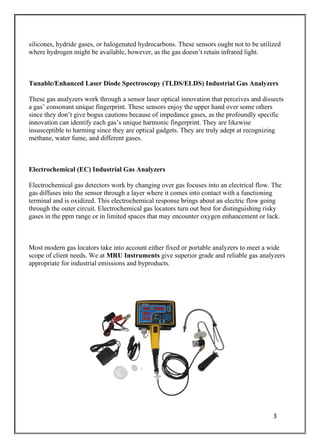
Electrochemical gas detectors work by changing over gas focuses into an electrical flow. The
gas diffuses into the sensor through a layer where it comes into contact with a functioning
terminal and is oxidized. This electrochemical response brings about an electric flow going
through the outer circuit. Electrochemical gas locators turn out best for distinguishing risky
gases in the ppm range or in limited spaces that may encounter oxygen enhancement or lack.
Most modern gas locators take into account either fixed or portable analyzers to meet a wide
scope of client needs. We at MRU Instruments give superior grade and reliable gas analyzers
appropriate for industrial emissions and byproducts.
4
Lambda Coefficient Measurement
The presence of oxygen in the exhaust gases indicates that the combustion of the mixture was
not perfect, resulting in contaminant gases. Thus measuring the proportion of oxygen in the
exhaust gases of these engines can monitor and measure these emissions. This measurement is
performed in the MOT test through Lambda coefficient measurement.The Lambda
coefficient (λ) is obtained from the relationship between air and gasoline involved in
combustion of the mixture. It is a measure of the efficiency of the gasoline engine by
measuring the percentage of oxygen in the exhaust.When gasoline engines operate with
a stoichiometric mixture of 14.7: 1 the value of lambda (λ) is "1".
Mixing ratio = weight of fuel / weight of air
- Expressed as mass ratio: 14.7 kg of air per 1 kg. of fuel.
- Expressed as volume ratio: 10,000 liters of air per 1 liter of fuel.
With this relationship theoretically a complete combustion of gasoline is achieved and
greenhouse gas emissions would be minimal. The coefficient is defined as Lambda
coefficient
If Lambda > 1 = lean mixture, excess of air. If Lambda < 1 = rich mixture, excess of
gasoline.
• A lean mixture contains an excess of oxygen. The surplus oxygen will react with
nitrogen to (oxides of nitrogen), if the temperature is high enough (around
1600°C) for enough time to permit so.
• A rich mixture contains a deficit of oxygen. This makes it impossible for all fuel
to combust completely to carbon dioxide and water vapour. Hence, some fuel will
remain as a hydrocarbon, or it will react only to carbon monoxide (CO). The
carbon monoxide concentration in exhaust gases is closely related, and almost
proportional to the air fuel ratio in the rich regions. It is, therefore, of great value
when tuning an engine.
• Carbon dioxide emitted is theoretically directly proportional to the fuel consumed
at a given and constant air fuel ratio. Less carbon dioxide will be emitted per litre
of fuel if λ < 1, since some fuel won't be able to combust completely.
A NEW GENERATION IN PORTABLE EMISSIONS
MONITORING EQUIPMENT
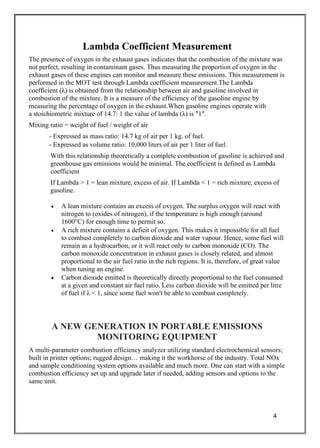
A multi-parameter combustion efficiency analyzer utilizing standard electrochemical sensors;
built in printer options; rugged design… making it the workhorse of the industry. Total NOx
and sample conditioning system options available and much more. One can start with a simple
combustion efficiency set up and upgrade later if needed, adding sensors and options to the
same unit.
5
PORTABLE COMPLIANCE-LEVEL COMBUSTION
EMISSIONS ANALYZER
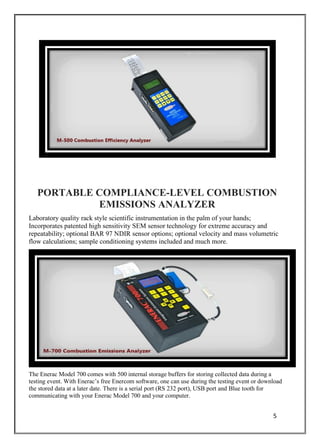
Laboratory quality rack style scientific instrumentation in the palm of your hands;
Incorporates patented high sensitivity SEM sensor technology for extreme accuracy and
repeatability; optional BAR 97 NDIR sensor options; optional velocity and mass volumetric
flow calculations; sample conditioning systems included and much more.
The Enerac Model 700 comes with 500 internal storage buffers for storing collected data during a
testing event. With Enerac’s free Enercom software, one can use during the testing event or download
the stored data at a later date. There is a serial port (RS 232 port), USB port and Blue tooth for
communicating with your Enerac Model 700 and your computer.
6
Discussion
➢ Measuring the exhaust gas is an excellent way to optimize fuel and air input. Nova
manufactures continuous and portable analyzers for this purpose. An emission gas
analyzer will enable you to measure the concentrations of various gases and adjust
burners on a boiler to help achieve optimal combustion.
Features of Enerac 700 Portable Combustion Gas Analyser
• Rugged durable design
• SEM sensors are available in Dual Ranges
• Easy access for replacing sensors in the field
• Portable hand-held, weighs only 2.8kg
• Proprietary temperature control system for reliable NO
• True NOx Readings at Multiple Levels
• Built-In Printer
• Extremely accurate and reliable data for emissions reporting requirements
• Two Year Warranty
➢ Efficient combustion also reduces emission of pollutants such as nitric oxide
(NO), nitrogen dioxide (NO2), sulfur dioxide (SO2), and particulate matter. A
gas analyzer will help measure various gas pollutants in the exhaust for
environmental reasons. One term that frequently arises in this application is
‘CEMS’.

automotive lab 3.pdf

  • 1.
    1 Emission Gas Analyzer StudentName:Muhammad Jawhar Class: 4 Stage – Group:A1 CourseTitle: Automotive lab Department: Mechanical and Mechatronics Engineering College of Engineering Salahaddin University-Erbil Academic Year 2021-2022
  • 2.
    2 Introduction An exhaust gasanalyser or exhaust carbon monoxide (CO) analyser is an instrument for the measurement of carbon monoxide among other gases in the exhaust, caused by an incorrect combustion, the Lambda coefficient measurement is the most common.The principles used for CO sensors (and other types of gas) are infrared gas sensors and chemical gas sensors. Carbon monoxide sensors are used to assess the CO amount during an Ministry of Transport test.[1] In order to be used for such test it must be a pproved as suitable for use in the scheme. In the UK, a list of acceptable exhaust gas analysers for use within the MOT test is available via the Driver and Vehicle Standards Agency website. are scientific gadgets that action the fixation or nature of a particular vaporous compound inside a combination of various gases. They are utilized across a wide scope of businesses— like agribusiness, manufacturing, and waste administration—to help office proprietors and chiefs screen gas levels in their tasks to guarantee the numbers are inside the worthy reach for the wellbeing of workers and the nature of products and cycles. Ongoing gas analysis upgrades effectiveness, wellbeing, product quality, and guarantees ecological consistency. Choosing the correct analyzer to meet your organization’s requirements can appear to be an overwhelming errand. There are different advancements to look over–each working under various working standards and each with various qualities and shortcomings. Coming up next is an outline of probably the most well-known kinds of industry gas analyzers, a portrayal of how they work, and the conditions where they work best. Pellistor/Catalytic Bead (CB) Industrial Gas Analyzers These detectors utilize reactant ignition to quantify burnable gases at Lower Explosive Level (LEL) fixations. This sort of sensor has been in need for almost a century and works by estimating the temperature contrast between two dots – one idle one and one covered in a chemical catalyst. As they are warmed, the one with the impetus will warm more. They react to a full scope of combustible gases, including hydrogen, methane, butane, propane, carbon monoxide, or acetylene where there might be outrageous variances in temperature or humidity. Point/Non-Dispersive Infrared (PIR/NDIR) Industrial Gas Analyzers Infrared industrial gas analyzers measure about two frequencies – one at the gas absorbing frequency and one at a reference wavelength that isn’t consumed by the gas. These gas detectors function admirably for distinguishing hydrocarbon gases, particularly in low-oxygen conditions. They additionally function admirably for recognizing high convergences of
  • 3.
    3 silicones, hydride gases,or halogenated hydrocarbons. These sensors ought not to be utilized where hydrogen might be available, however, as the gas doesn’t retain infrared light. Tunable/Enhanced Laser Diode Spectroscopy (TLDS/ELDS) Industrial Gas Analyzers These gas analyzers work through a sensor laser optical innovation that perceives and dissects a gas’ consonant unique fingerprint. These sensors enjoy the upper hand over some others since they don’t give bogus cautions because of impedance gases, as the profoundly specific innovation can identify each gas’s unique harmonic fingerprint. They are likewise insusceptible to harming since they are optical gadgets. They are truly adept at recognizing methane, water fume, and different gases. Electrochemical (EC) Industrial Gas Analyzers Electrochemical gas detectors work by changing over gas focuses into an electrical flow. The gas diffuses into the sensor through a layer where it comes into contact with a functioning terminal and is oxidized. This electrochemical response brings about an electric flow going through the outer circuit. Electrochemical gas locators turn out best for distinguishing risky gases in the ppm range or in limited spaces that may encounter oxygen enhancement or lack. Most modern gas locators take into account either fixed or portable analyzers to meet a wide scope of client needs. We at MRU Instruments give superior grade and reliable gas analyzers appropriate for industrial emissions and byproducts.
  • 4.
    4 Lambda Coefficient Measurement Thepresence of oxygen in the exhaust gases indicates that the combustion of the mixture was not perfect, resulting in contaminant gases. Thus measuring the proportion of oxygen in the exhaust gases of these engines can monitor and measure these emissions. This measurement is performed in the MOT test through Lambda coefficient measurement.The Lambda coefficient (λ) is obtained from the relationship between air and gasoline involved in combustion of the mixture. It is a measure of the efficiency of the gasoline engine by measuring the percentage of oxygen in the exhaust.When gasoline engines operate with a stoichiometric mixture of 14.7: 1 the value of lambda (λ) is "1". Mixing ratio = weight of fuel / weight of air - Expressed as mass ratio: 14.7 kg of air per 1 kg. of fuel. - Expressed as volume ratio: 10,000 liters of air per 1 liter of fuel. With this relationship theoretically a complete combustion of gasoline is achieved and greenhouse gas emissions would be minimal. The coefficient is defined as Lambda coefficient If Lambda > 1 = lean mixture, excess of air. If Lambda < 1 = rich mixture, excess of gasoline. • A lean mixture contains an excess of oxygen. The surplus oxygen will react with nitrogen to (oxides of nitrogen), if the temperature is high enough (around 1600°C) for enough time to permit so. • A rich mixture contains a deficit of oxygen. This makes it impossible for all fuel to combust completely to carbon dioxide and water vapour. Hence, some fuel will remain as a hydrocarbon, or it will react only to carbon monoxide (CO). The carbon monoxide concentration in exhaust gases is closely related, and almost proportional to the air fuel ratio in the rich regions. It is, therefore, of great value when tuning an engine. • Carbon dioxide emitted is theoretically directly proportional to the fuel consumed at a given and constant air fuel ratio. Less carbon dioxide will be emitted per litre of fuel if λ < 1, since some fuel won't be able to combust completely. A NEW GENERATION IN PORTABLE EMISSIONS MONITORING EQUIPMENT A multi-parameter combustion efficiency analyzer utilizing standard electrochemical sensors; built in printer options; rugged design… making it the workhorse of the industry. Total NOx and sample conditioning system options available and much more. One can start with a simple combustion efficiency set up and upgrade later if needed, adding sensors and options to the same unit.
  • 5.
    5 PORTABLE COMPLIANCE-LEVEL COMBUSTION EMISSIONSANALYZER Laboratory quality rack style scientific instrumentation in the palm of your hands; Incorporates patented high sensitivity SEM sensor technology for extreme accuracy and repeatability; optional BAR 97 NDIR sensor options; optional velocity and mass volumetric flow calculations; sample conditioning systems included and much more. The Enerac Model 700 comes with 500 internal storage buffers for storing collected data during a testing event. With Enerac’s free Enercom software, one can use during the testing event or download the stored data at a later date. There is a serial port (RS 232 port), USB port and Blue tooth for communicating with your Enerac Model 700 and your computer.
  • 6.
    6 Discussion ➢ Measuring theexhaust gas is an excellent way to optimize fuel and air input. Nova manufactures continuous and portable analyzers for this purpose. An emission gas analyzer will enable you to measure the concentrations of various gases and adjust burners on a boiler to help achieve optimal combustion. Features of Enerac 700 Portable Combustion Gas Analyser • Rugged durable design • SEM sensors are available in Dual Ranges • Easy access for replacing sensors in the field • Portable hand-held, weighs only 2.8kg • Proprietary temperature control system for reliable NO • True NOx Readings at Multiple Levels • Built-In Printer • Extremely accurate and reliable data for emissions reporting requirements • Two Year Warranty ➢ Efficient combustion also reduces emission of pollutants such as nitric oxide (NO), nitrogen dioxide (NO2), sulfur dioxide (SO2), and particulate matter. A gas analyzer will help measure various gas pollutants in the exhaust for environmental reasons. One term that frequently arises in this application is ‘CEMS’.