Practical
Concerns
in EGA
Kevin P Menard, Ph.D. MBA
Sept 29, 2015
Internal usage only
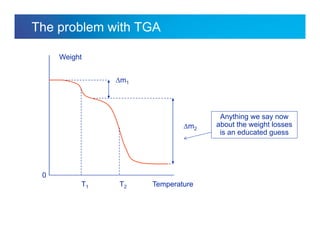
The problem with TGA
Anything we say now
about the weight losses
is an educated guess
Temperature
Weight
0
m1
m2
T1 T2
Internal usage only
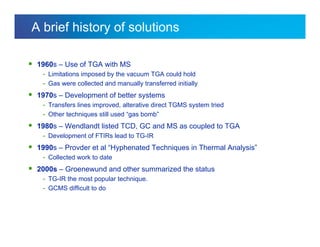
A brief history of solutions
 1960s – Use of TGA with MS
- Limitations imposed by the vacuum TGA could hold
- Gas were collected and manually transferred initially
 1970s – Development of better systems
- Transfers lines improved, alterative direct TGMS system tried
- Other techniques still used “gas bomb”
 1980s – Wendlandt listed TCD, GC and MS as coupled to TGA
- Development of FTIRs lead to TG-IR
 1990s – Provder et al “Hyphenated Techniques in Thermal Analysis”
- Collected work to date
 2000s – Groenewund and other summarized the status
- TG-IR the most popular technique.
- GCMS difficult to do
Internal usage only
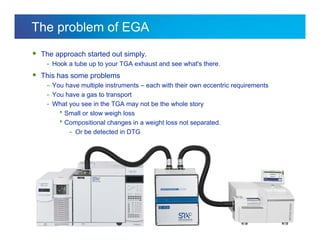
The problem of EGA
 The approach started out simply.
- Hook a tube up to your TGA exhaust and see what's there.
 This has some problems
- You have multiple instruments – each with their own eccentric requirements
- You have a gas to transport
- What you see in the TGA may not be the whole story
Small or slow weigh loss
Compositional changes in a weight loss not separated.
- Or be detected in DTG
Internal usage only
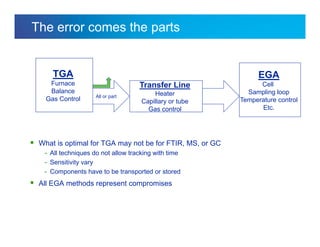
The error comes the parts
 What is optimal for TGA may not be for FTIR, MS, or GC
- All techniques do not allow tracking with time
- Sensitivity vary
- Components have to be transported or stored
 All EGA methods represent compromises
TGA
Furnace
Balance
Gas Control All or part
Transfer Line
Heater
Capillary or tube
Gas control
EGA
Cell
Sampling loop
Temperature control
Etc.
Internal usage only
The TGA
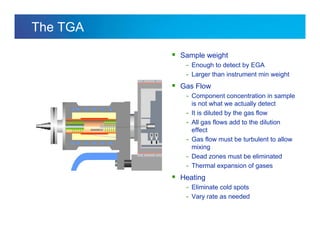
 Sample weight
- Enough to detect by EGA
- Larger than instrument min weight
 Gas Flow
- Component concentration in sample
is not what we actually detect
- It is diluted by the gas flow
- All gas flows add to the dilution
effect
- Gas flow must be turbulent to allow
mixing
- Dead zones must be eliminated
- Thermal expansion of gases
 Heating
- Eliminate cold spots
- Vary rate as needed
Internal usage only
Min Weight Concept and application to EGA
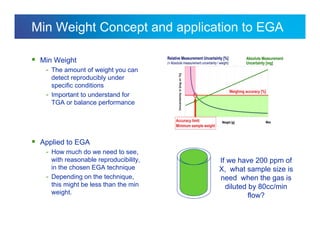
 Min Weight
- The amount of weight you can
detect reproducibly under
specific conditions
- Important to understand for
TGA or balance performance
 Applied to EGA
- How much do we need to see,
with reasonable reproducibility,
in the chosen EGA technique
- Depending on the technique,
this might be less than the min
weight.
If we have 200 ppm of
X, what sample size is
need when the gas is
diluted by 80cc/min
flow?
Internal usage only
Transfer lines
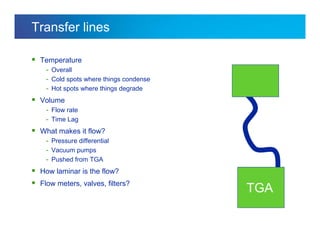
 Temperature
- Overall
- Cold spots where things condense
- Hot spots where things degrade
 Volume
- Flow rate
- Time Lag
 What makes it flow?
- Pressure differential
- Vacuum pumps
- Pushed from TGA
 How laminar is the flow?
 Flow meters, valves, filters?
TGA
Internal usage only
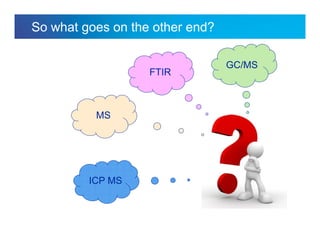
So what goes on the other end?
GC/MS
MS
FTIR
ICP MS
Internal usage only
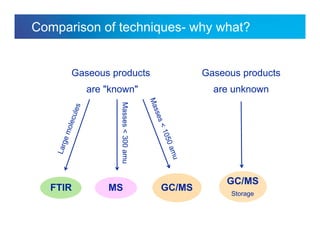
Comparison of techniques- why what?
Gaseous products
are "known"
Gaseous products
are unknown
Masses<300amu
FTIR
GC/MS
Storage
MS GC/MS
Internal usage only
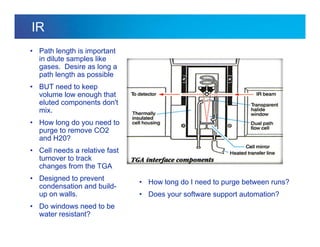
IR
• Path length is important
in dilute samples like
gases. Desire as long a
path length as possible
• BUT need to keep
volume low enough that
eluted components don't
mix.
• How long do you need to
purge to remove CO2
and H20?
• Cell needs a relative fast
turnover to track
changes from the TGA
• Designed to prevent
condensation and build-
up on walls.
• Do windows need to be
water resistant?
• How long do I need to purge between runs?
• Does your software support automation?
Internal usage only
D
C
B
A
x
x
x
x
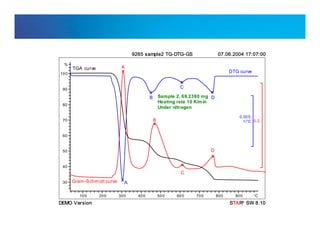
Sample 2, 69.2380 mg
Heating rate 10 K/min
Under nitrogen
Gram-Schmidt curve
0.2
TGA curve
%
30
40
50
60
70
80
90
100
°C100 200 300 400 500 600 700 800 900
D
C
B
A
X
X
X
X
DTG curve
1/°C
0.005
9265 sample2 TG-DTG-GS 07.06.2004 17:07:00
SW 8.10e
RTASDEMO Version
Internal usage only
Chemigrams
m/m0;[-]
Temperature
0
TG
DTG
1
CO
HCL
Internal usage only
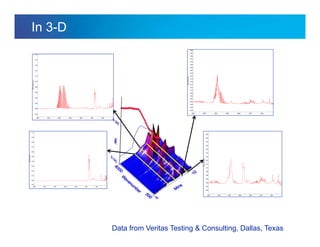
In 3-D
-0.01
0.00
0.01
0.02
0.03
0.04
0.05
0.06
0.07
0.08
0.09
0.10
Absorbance
1000150020002500300035004000
TFS
-0.02
0.00
0.02
0.04
0.06
0.08
0.10
0.12
0.14
0.16
0.18
0.20
Absorbance
1000150020002500300035004000
-0.04
-0.02
0.00
0.02
0.04
0.06
0.08
0.10
0.12
0.14
0.16
0.18
0.20
0.22
0.24
0.26
0.28
0.30
0.32
0.34
0.36
0.38
Absorbance
1000150020002500300035004000
-0.02
0.00
0.02
0.04
0.06
0.08
0.10
0.12
0.14
0.16
0.18
0.20
0.22
0.24
0.26
0.28
Absorbance
1000150020002500300035004000
Data from Veritas Testing & Consulting, Dallas, Texas
Internal usage only
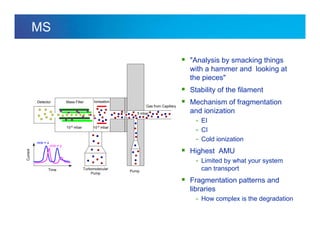
MS
 "Analysis by smacking things
with a hammer and looking at
the pieces"
 Stability of the filament
 Mechanism of fragmentation
and ionization
- EI
- CI
- Cold ionization
 Highest AMU
- Limited by what your system
can transport
 Fragmentation patterns and
libraries
- How complex is the degradation
Pump
Gas from Capillary
Mass Filter Ionisation
Turbomolecular
Pump
Detector
10-6
mbar 10-4
mbar
5 mbar
Time
Current
m/e = x
m/e = y
Internal usage only
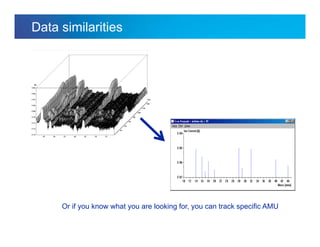
Data similarities
Or if you know what you are looking for, you can track specific AMU
Internal usage only
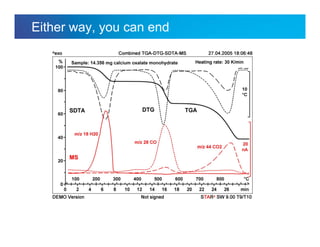
Either way, you can end
Internal usage only
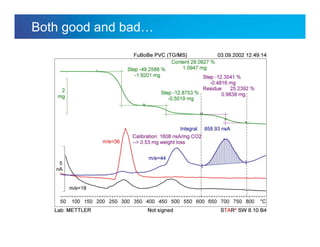
Both good and bad…
Internal usage only
GCMS
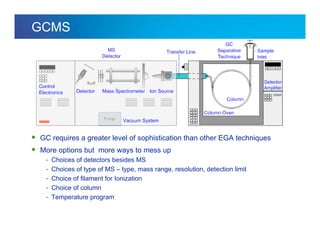
 GC requires a greater level of sophistication than other EGA techniques
 More options but more ways to mess up
- Choices of detectors besides MS
- Choices of type of MS – type, mass range, resolution, detection limit
- Choice of filament for Ionization
- Choice of column
- Temperature program
Internal usage only
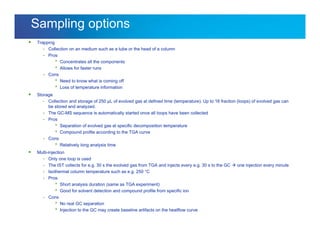
Sampling options
 Trapping
- Collection on an medium such as a tube or the head of a column
- Pros
 Concentrates all the components
 Allows for faster runs
- Cons
 Need to know what is coming off
 Loss of temperature information
 Storage
- Collection and storage of 250 µL of evolved gas at defined time (temperature). Up to 16 fraction (loops) of evolved gas can
be stored and analyzed.
- The GC-MS sequence is automatically started once all loops have been collected
- Pros
 Separation of evolved gas at specific decomposition temperature
 Compound profile according to the TGA curve
- Cons
 Relatively long analysis time
 Multi-injection
- Only one loop is used
- The IST collects for e.g. 30 s the evolved gas from TGA and injects every e.g. 30 s to the GC  one injection every minute
- Isothermal column temperature such as e.g. 250 °C
- Pros
 Short analysis duration (same as TGA experiment)
 Good for solvent detection and compound profile from specific ion
- Cons
 No real GC separation
 Injection to the GC may create baseline artifacts on the heatflow curve
Internal usage only
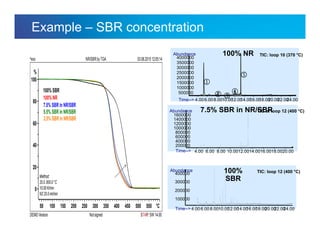
Example – SBR concentration
4.00 6.00 8.00 10.0012.0014.0016.0018.0020.00
200000
400000
600000
800000
1000000
1200000
1400000
1600000
Time-->
Abundance 7.5% SBR in NR/SBRTIC of loop 12 (400 °C)
4.006.008.0010.0012.0014.0016.0018.0020.0022.0024.00
100000
200000
300000
400000
Time-->
Abundance 100%
SBR
TIC: loop 12 (400 °C)
4.006.008.0010.0012.0014.0016.0018.0020.0022.0024.00
500000
1000000
1500000
2000000
2500000
3000000
3500000
4000000
Time-->
Abundance


100% NR TIC: loop 10 (370 °C)



Internal usage only
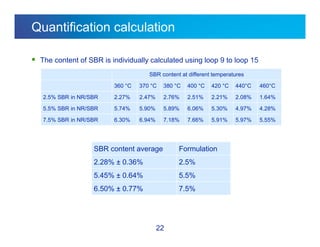
Quantification calculation
 The content of SBR is individually calculated using loop 9 to loop 15
22
SBR content at different temperatures
360 °C 370 °C 380 °C 400 °C 420 °C 440°C 460°C
2.5% SBR in NR/SBR 2.27% 2.47% 2.76% 2.51% 2.21% 2.08% 1.64%
5.5% SBR in NR/SBR 5.74% 5.90% 5.89% 6.06% 5.30% 4.97% 4.28%
7.5% SBR in NR/SBR 6.30% 6.94% 7.18% 7.66% 5.91% 5.97% 5.55%
SBR content average Formulation
2.28% ± 0.36% 2.5%
5.45% ± 0.64% 5.5%
6.50% ± 0.77% 7.5%
Internal usage only
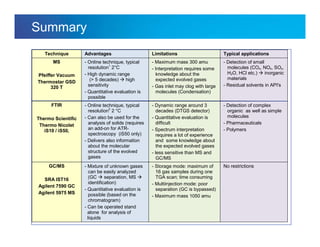
Summary
Technique Advantages Limitations Typical applications
MS
Pfeiffer Vacuum
Thermostar GSD
320 T
- Online technique, typical
resolution1
2°C
- High dynamic range
(> 5 decades)  high
sensitivity
- Quantitative evaluation is
possible
- Maximum mass 300 amu
- Interpretation requires some
knowledge about the
expected evolved gases
- Gas inlet may clog with large
molecules (Condensation)
- Detection of small
molecules (COx, NOx, SOx,
H2O, HCl etc.)  inorganic
materials
- Residual solvents in API's
FTIR
Thermo Scientific
Thermo Nicolet
iS10 / iS50,
- Online technique, typical
resolution2
2 °C
- Can also be used for the
analysis of solids (requires
an add-on for ATR-
spectroscopy (iS50 only)
- Delivers also information
about the molecular
structure of the evolved
gases
- Dynamic range around 3
decades (DTGS detector)
- Quantitative evaluation is
difficult
- Spectrum interpretation
requires a lot of experience
and some knowledge about
the expected evolved gases
- less sensitive than MS and
GC/MS
- Detection of complex
organic as well as simple
molecules
- Pharmaceuticals
- Polymers
GC/MS
SRA IST16
Agilent 7590 GC
Agilent 5975 MS
- Mixture of unknown gases
can be easily analyzed
(GC  separation, MS 
identification)
- Quantitative evaluation is
possible (based on the
chromatogram)
- Can be operated stand
alone for analysis of
liquids
- Storage mode: maximum of
16 gas samples during one
TGA scan; time consuming
- Multiinjection mode: poor
separation (GC is bypassed)
- Maximum mass 1050 amu
No restrictions

Practical concerns in ega

  • 1.
    Practical Concerns in EGA Kevin PMenard, Ph.D. MBA Sept 29, 2015
  • 2.
    Internal usage only Theproblem with TGA Anything we say now about the weight losses is an educated guess Temperature Weight 0 m1 m2 T1 T2
  • 3.
    Internal usage only Abrief history of solutions  1960s – Use of TGA with MS - Limitations imposed by the vacuum TGA could hold - Gas were collected and manually transferred initially  1970s – Development of better systems - Transfers lines improved, alterative direct TGMS system tried - Other techniques still used “gas bomb”  1980s – Wendlandt listed TCD, GC and MS as coupled to TGA - Development of FTIRs lead to TG-IR  1990s – Provder et al “Hyphenated Techniques in Thermal Analysis” - Collected work to date  2000s – Groenewund and other summarized the status - TG-IR the most popular technique. - GCMS difficult to do
  • 4.
    Internal usage only Theproblem of EGA  The approach started out simply. - Hook a tube up to your TGA exhaust and see what's there.  This has some problems - You have multiple instruments – each with their own eccentric requirements - You have a gas to transport - What you see in the TGA may not be the whole story Small or slow weigh loss Compositional changes in a weight loss not separated. - Or be detected in DTG
  • 5.
    Internal usage only Theerror comes the parts  What is optimal for TGA may not be for FTIR, MS, or GC - All techniques do not allow tracking with time - Sensitivity vary - Components have to be transported or stored  All EGA methods represent compromises TGA Furnace Balance Gas Control All or part Transfer Line Heater Capillary or tube Gas control EGA Cell Sampling loop Temperature control Etc.
  • 6.
    Internal usage only TheTGA  Sample weight - Enough to detect by EGA - Larger than instrument min weight  Gas Flow - Component concentration in sample is not what we actually detect - It is diluted by the gas flow - All gas flows add to the dilution effect - Gas flow must be turbulent to allow mixing - Dead zones must be eliminated - Thermal expansion of gases  Heating - Eliminate cold spots - Vary rate as needed
  • 7.
    Internal usage only MinWeight Concept and application to EGA  Min Weight - The amount of weight you can detect reproducibly under specific conditions - Important to understand for TGA or balance performance  Applied to EGA - How much do we need to see, with reasonable reproducibility, in the chosen EGA technique - Depending on the technique, this might be less than the min weight. If we have 200 ppm of X, what sample size is need when the gas is diluted by 80cc/min flow?
  • 8.
    Internal usage only Transferlines  Temperature - Overall - Cold spots where things condense - Hot spots where things degrade  Volume - Flow rate - Time Lag  What makes it flow? - Pressure differential - Vacuum pumps - Pushed from TGA  How laminar is the flow?  Flow meters, valves, filters? TGA
  • 9.
    Internal usage only Sowhat goes on the other end? GC/MS MS FTIR ICP MS
  • 10.
    Internal usage only Comparisonof techniques- why what? Gaseous products are "known" Gaseous products are unknown Masses<300amu FTIR GC/MS Storage MS GC/MS
  • 11.
    Internal usage only IR •Path length is important in dilute samples like gases. Desire as long a path length as possible • BUT need to keep volume low enough that eluted components don't mix. • How long do you need to purge to remove CO2 and H20? • Cell needs a relative fast turnover to track changes from the TGA • Designed to prevent condensation and build- up on walls. • Do windows need to be water resistant? • How long do I need to purge between runs? • Does your software support automation?
  • 12.
    Internal usage only D C B A x x x x Sample2, 69.2380 mg Heating rate 10 K/min Under nitrogen Gram-Schmidt curve 0.2 TGA curve % 30 40 50 60 70 80 90 100 °C100 200 300 400 500 600 700 800 900 D C B A X X X X DTG curve 1/°C 0.005 9265 sample2 TG-DTG-GS 07.06.2004 17:07:00 SW 8.10e RTASDEMO Version
  • 13.
  • 14.
    Internal usage only In3-D -0.01 0.00 0.01 0.02 0.03 0.04 0.05 0.06 0.07 0.08 0.09 0.10 Absorbance 1000150020002500300035004000 TFS -0.02 0.00 0.02 0.04 0.06 0.08 0.10 0.12 0.14 0.16 0.18 0.20 Absorbance 1000150020002500300035004000 -0.04 -0.02 0.00 0.02 0.04 0.06 0.08 0.10 0.12 0.14 0.16 0.18 0.20 0.22 0.24 0.26 0.28 0.30 0.32 0.34 0.36 0.38 Absorbance 1000150020002500300035004000 -0.02 0.00 0.02 0.04 0.06 0.08 0.10 0.12 0.14 0.16 0.18 0.20 0.22 0.24 0.26 0.28 Absorbance 1000150020002500300035004000 Data from Veritas Testing & Consulting, Dallas, Texas
  • 15.
    Internal usage only MS "Analysis by smacking things with a hammer and looking at the pieces"  Stability of the filament  Mechanism of fragmentation and ionization - EI - CI - Cold ionization  Highest AMU - Limited by what your system can transport  Fragmentation patterns and libraries - How complex is the degradation Pump Gas from Capillary Mass Filter Ionisation Turbomolecular Pump Detector 10-6 mbar 10-4 mbar 5 mbar Time Current m/e = x m/e = y
  • 16.
    Internal usage only Datasimilarities Or if you know what you are looking for, you can track specific AMU
  • 17.
  • 18.
    Internal usage only Bothgood and bad…
  • 19.
    Internal usage only GCMS GC requires a greater level of sophistication than other EGA techniques  More options but more ways to mess up - Choices of detectors besides MS - Choices of type of MS – type, mass range, resolution, detection limit - Choice of filament for Ionization - Choice of column - Temperature program
  • 20.
    Internal usage only Samplingoptions  Trapping - Collection on an medium such as a tube or the head of a column - Pros  Concentrates all the components  Allows for faster runs - Cons  Need to know what is coming off  Loss of temperature information  Storage - Collection and storage of 250 µL of evolved gas at defined time (temperature). Up to 16 fraction (loops) of evolved gas can be stored and analyzed. - The GC-MS sequence is automatically started once all loops have been collected - Pros  Separation of evolved gas at specific decomposition temperature  Compound profile according to the TGA curve - Cons  Relatively long analysis time  Multi-injection - Only one loop is used - The IST collects for e.g. 30 s the evolved gas from TGA and injects every e.g. 30 s to the GC  one injection every minute - Isothermal column temperature such as e.g. 250 °C - Pros  Short analysis duration (same as TGA experiment)  Good for solvent detection and compound profile from specific ion - Cons  No real GC separation  Injection to the GC may create baseline artifacts on the heatflow curve
  • 21.
    Internal usage only Example– SBR concentration 4.00 6.00 8.00 10.0012.0014.0016.0018.0020.00 200000 400000 600000 800000 1000000 1200000 1400000 1600000 Time--> Abundance 7.5% SBR in NR/SBRTIC of loop 12 (400 °C) 4.006.008.0010.0012.0014.0016.0018.0020.0022.0024.00 100000 200000 300000 400000 Time--> Abundance 100% SBR TIC: loop 12 (400 °C) 4.006.008.0010.0012.0014.0016.0018.0020.0022.0024.00 500000 1000000 1500000 2000000 2500000 3000000 3500000 4000000 Time--> Abundance   100% NR TIC: loop 10 (370 °C)   
  • 22.
    Internal usage only Quantificationcalculation  The content of SBR is individually calculated using loop 9 to loop 15 22 SBR content at different temperatures 360 °C 370 °C 380 °C 400 °C 420 °C 440°C 460°C 2.5% SBR in NR/SBR 2.27% 2.47% 2.76% 2.51% 2.21% 2.08% 1.64% 5.5% SBR in NR/SBR 5.74% 5.90% 5.89% 6.06% 5.30% 4.97% 4.28% 7.5% SBR in NR/SBR 6.30% 6.94% 7.18% 7.66% 5.91% 5.97% 5.55% SBR content average Formulation 2.28% ± 0.36% 2.5% 5.45% ± 0.64% 5.5% 6.50% ± 0.77% 7.5%
  • 23.
    Internal usage only Summary TechniqueAdvantages Limitations Typical applications MS Pfeiffer Vacuum Thermostar GSD 320 T - Online technique, typical resolution1 2°C - High dynamic range (> 5 decades)  high sensitivity - Quantitative evaluation is possible - Maximum mass 300 amu - Interpretation requires some knowledge about the expected evolved gases - Gas inlet may clog with large molecules (Condensation) - Detection of small molecules (COx, NOx, SOx, H2O, HCl etc.)  inorganic materials - Residual solvents in API's FTIR Thermo Scientific Thermo Nicolet iS10 / iS50, - Online technique, typical resolution2 2 °C - Can also be used for the analysis of solids (requires an add-on for ATR- spectroscopy (iS50 only) - Delivers also information about the molecular structure of the evolved gases - Dynamic range around 3 decades (DTGS detector) - Quantitative evaluation is difficult - Spectrum interpretation requires a lot of experience and some knowledge about the expected evolved gases - less sensitive than MS and GC/MS - Detection of complex organic as well as simple molecules - Pharmaceuticals - Polymers GC/MS SRA IST16 Agilent 7590 GC Agilent 5975 MS - Mixture of unknown gases can be easily analyzed (GC  separation, MS  identification) - Quantitative evaluation is possible (based on the chromatogram) - Can be operated stand alone for analysis of liquids - Storage mode: maximum of 16 gas samples during one TGA scan; time consuming - Multiinjection mode: poor separation (GC is bypassed) - Maximum mass 1050 amu No restrictions