MODULE VI
CONTROL LOGIC DESIGN
1
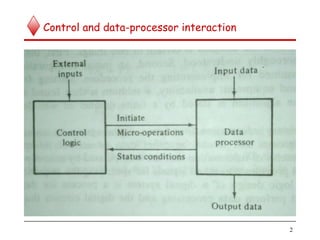
Control and data-processor interaction
2
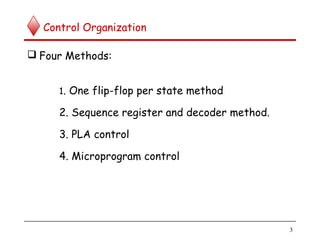
Control Organization
 Four Methods:
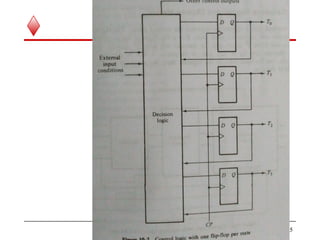
1. One flip-flop per state method
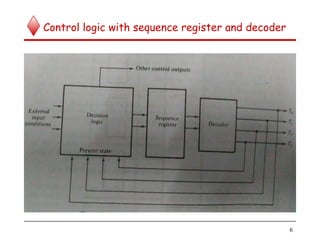
2. Sequence register and decoder method.
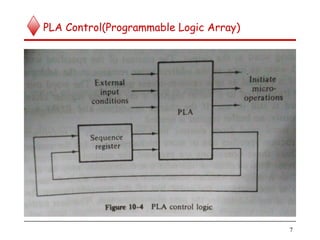
3. PLA control
4. Microprogram control
3
One flip-flop per state method
4
5
Control logic with sequence register and decoder
6
PLA Control(Programmable Logic Array)
7
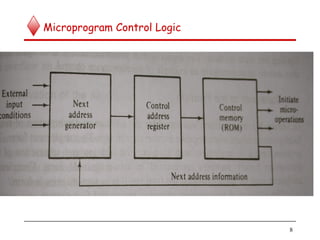
Microprogram Control Logic
8
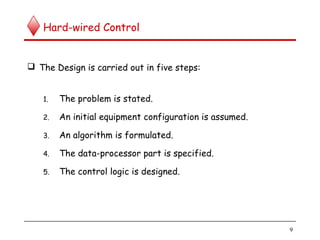
Hard-wired Control
 The Design is carried out in five steps:
1. The problem is stated.
2. An initial equipment configuration is assumed.
3. An algorithm is formulated.
4. The data-processor part is specified.
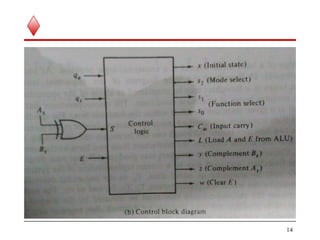
5. The control logic is designed.
9
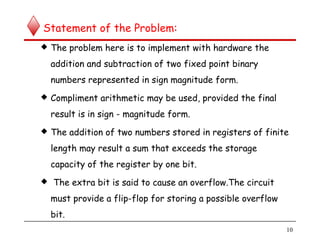
Statement of the Problem:
 The problem here is to implement with hardware the
addition and subtraction of two fixed point binary
numbers represented in sign magnitude form.
 Compliment arithmetic may be used, provided the final
result is in sign - magnitude form.
 The addition of two numbers stored in registers of finite
length may result a sum that exceeds the storage
capacity of the register by one bit.
 The extra bit is said to cause an overflow.The circuit
must provide a flip-flop for storing a possible overflow
bit.
10
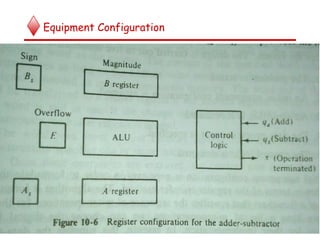
Equipment Configuration
11
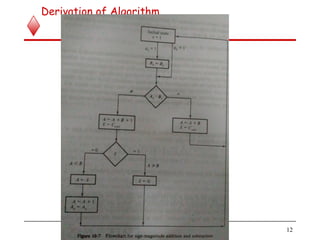
Derivation of Algorithm
12
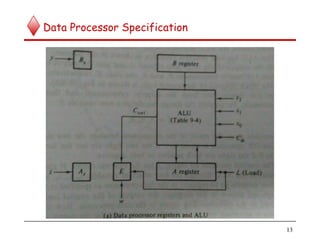
Data Processor Specification
13
14
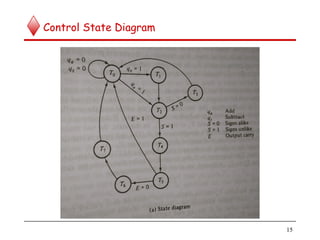
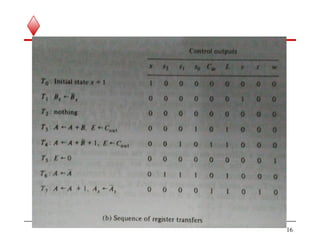
Control State Diagram
15
16
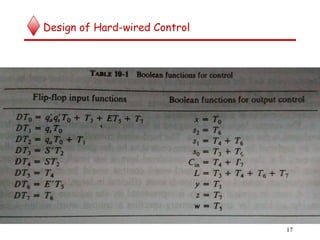
Design of Hard-wired Control
17
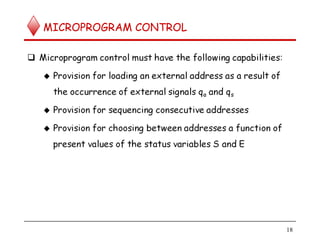
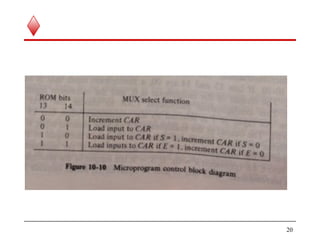
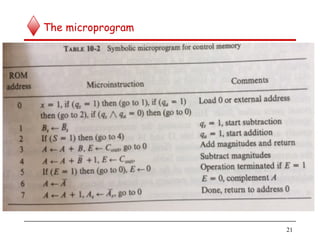
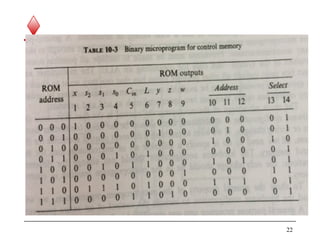
MICROPROGRAM CONTROL
18
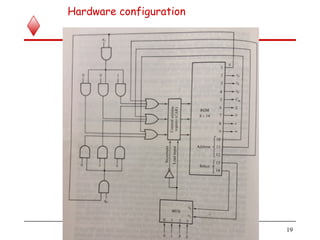
Hardware configuration
19
20
The microprogram
21
22
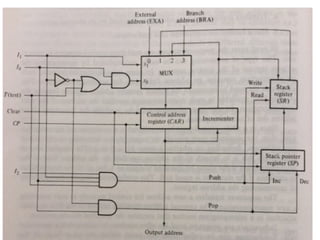
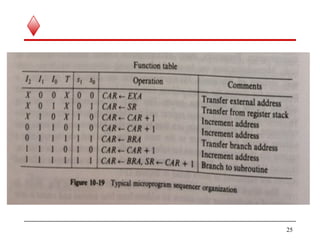
Microprogram Sequencer
 Address sequencing capabilities of a typical sequencer:
1. increments the present address for control memory
2. Branches to an address as specified by the address
field of the microinstruction
3. Branches to a given address if a specified status bit is
equal to 1.
4. Transfers control to a new address as specified by an
external source.
5. Has a facility for subroutine call and returns.
23
24
25
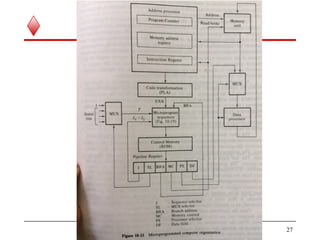
Microprogrammed CPU Organization
26
27

Module vi