Stack Organization
Prof. Neeraj Bhargava
Kapil Chauhan
Department of Computer Science
School of Engineering & Systems Sciences
MDS University, Ajmer
Stack Organization
 Stack:- A stack storage device that stores
information in such a manner that the item stored
last is the first item retrieved.
 Also called last-in first-out(LIFO) list. Useful for
compound arithmetic operations and nested
subroutine calls.
Stack Organization
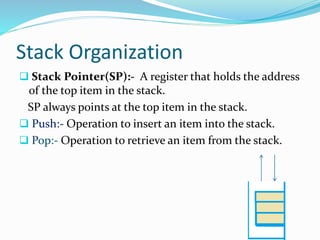
 Stack Pointer(SP):- A register that holds the address
of the top item in the stack.
SP always points at the top item in the stack.
 Push:- Operation to insert an item into the stack.
 Pop:- Operation to retrieve an item from the stack.
Register Stack
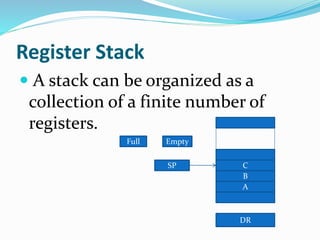
 A stack can be organized as a
collection of a finite number of
registers.
C
B
A
DR
SP
EmptyFull
Register Stack
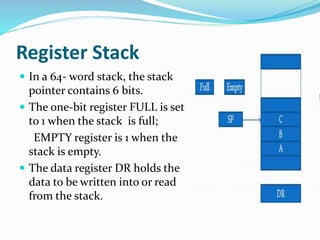
 In a 64- word stack, the stack
pointer contains 6 bits.
 The one-bit register FULL is set
to 1 when the stack is full;
EMPTY register is 1 when the
stack is empty.
 The data register DR holds the
data to be written into or read
from the stack.
Stack Operation Reverse Polish
Notation (postfix)
 Reverse polish notation: is a postfix
notation(places operators after operands).
 (Example)
Infix notation A + B
Reverse Polish notation AB+ also called
postfix.
Stack Operation Reverse Polish
Notation (postfix)
 A stack organization is very effective for evaluating
arithmetic expression.
A * B + C * D  (AB*)+(CD*)  AB* CD*+
( 3 * 4 ) + ( 5 * 6 )  34 * 56 *+
first convert the arithmetic expression into the equal to polish
notation.
Push the operands into stack in the order in which they appear.
Use the 2 top most operation for evaluation.
The stack is pop and the result often the operation is again push into
the stack
Finally only the result of the operation is left on stack top.
Stack operation
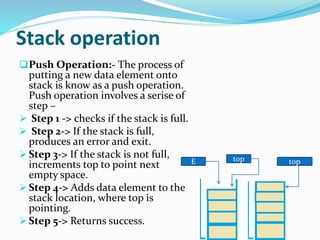
Push Operation:- The process of
putting a new data element onto
stack is know as a push operation.
Push operation involves a serise of
step –
 Step 1 -> checks if the stack is full.
 Step 2-> If the stack is full,
produces an error and exit.
 Step 3-> If the stack is not full,
increments top to point next
empty space.
 Step 4-> Adds data element to the
stack location, where top is
pointing.
 Step 5-> Returns success.
E toptop
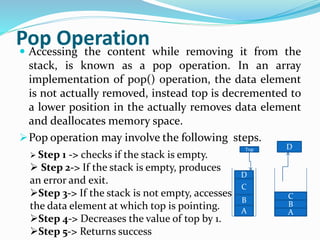
Pop Operation Accessing the content while removing it from the
stack, is known as a pop operation. In an array
implementation of pop() operation, the data element
is not actually removed, instead top is decremented to
a lower position in the actually removes data element
and deallocates memory space.
Pop operation may involve the following steps.
 Step 1 -> checks if the stack is empty.
 Step 2-> If the stack is empty, produces
an error and exit.
Step 3-> If the stack is not empty, accesses
the data element at which top is pointing.
Step 4-> Decreases the value of top by 1.
Step 5-> Returns success
D
C
A
B
Top
A
B
C
D

Stack organization

  • 1.
    Stack Organization Prof. NeerajBhargava Kapil Chauhan Department of Computer Science School of Engineering & Systems Sciences MDS University, Ajmer
  • 2.
    Stack Organization  Stack:-A stack storage device that stores information in such a manner that the item stored last is the first item retrieved.  Also called last-in first-out(LIFO) list. Useful for compound arithmetic operations and nested subroutine calls.
  • 3.
    Stack Organization  StackPointer(SP):- A register that holds the address of the top item in the stack. SP always points at the top item in the stack.  Push:- Operation to insert an item into the stack.  Pop:- Operation to retrieve an item from the stack.
  • 4.
    Register Stack  Astack can be organized as a collection of a finite number of registers. C B A DR SP EmptyFull
  • 5.
    Register Stack  Ina 64- word stack, the stack pointer contains 6 bits.  The one-bit register FULL is set to 1 when the stack is full; EMPTY register is 1 when the stack is empty.  The data register DR holds the data to be written into or read from the stack.
  • 6.
    Stack Operation ReversePolish Notation (postfix)  Reverse polish notation: is a postfix notation(places operators after operands).  (Example) Infix notation A + B Reverse Polish notation AB+ also called postfix.
  • 7.
    Stack Operation ReversePolish Notation (postfix)  A stack organization is very effective for evaluating arithmetic expression. A * B + C * D  (AB*)+(CD*)  AB* CD*+ ( 3 * 4 ) + ( 5 * 6 )  34 * 56 *+ first convert the arithmetic expression into the equal to polish notation. Push the operands into stack in the order in which they appear. Use the 2 top most operation for evaluation. The stack is pop and the result often the operation is again push into the stack Finally only the result of the operation is left on stack top.
  • 8.
    Stack operation Push Operation:-The process of putting a new data element onto stack is know as a push operation. Push operation involves a serise of step –  Step 1 -> checks if the stack is full.  Step 2-> If the stack is full, produces an error and exit.  Step 3-> If the stack is not full, increments top to point next empty space.  Step 4-> Adds data element to the stack location, where top is pointing.  Step 5-> Returns success. E toptop
  • 9.
    Pop Operation Accessingthe content while removing it from the stack, is known as a pop operation. In an array implementation of pop() operation, the data element is not actually removed, instead top is decremented to a lower position in the actually removes data element and deallocates memory space. Pop operation may involve the following steps.  Step 1 -> checks if the stack is empty.  Step 2-> If the stack is empty, produces an error and exit. Step 3-> If the stack is not empty, accesses the data element at which top is pointing. Step 4-> Decreases the value of top by 1. Step 5-> Returns success D C A B Top A B C D