Data Transfer and Manipulation   By:- Gaurav Pal(8136)
Data Transfer and Manipulation Most computer instructions can be classified into three categories: Data transfer, 2) Data manipulation,  3) Program control instructions
Data Transfer Instruction Data transfer instructions move data from one place in the computer to another without changing the data content The most common transfers are between memory and processor registers,between processor registers and input or output,and between the processor registers themselves.
Typical Data Transfer Instruction : »  Load : transfer from memory to a processor register, usually an AC ( memory read) »  Store : transfer from a processor register into memory ( memory write) »  Move : transfer from one register to another register »  Exchange : swap information between two registers or a register and a memory word »  Input/Output : transfer data among processor registers and input/output device »  Push/Pop : transfer data between processor registers and a memory stack NAME Mnemonic Load LD Store ST Move MOV Exchange XCH Input IN Output OUT Push PUSH pop POP
Data Manipulation Instruction Data Manipulation Instructions perform operations on data and provide the computational capabilities for the computer. It is divided into three basic types: Arithmetic,  2) Logical and bit manipulation, 3) Shift Instruction
Arithmetic Insructions NAME Mnemonic Increment INC Decrement DEC Add ADD Subtract SUB Multiply MUL Divide DIV Add with carry ADDC Subtract with borrow SUBB Negate (2’s  complement) NEG
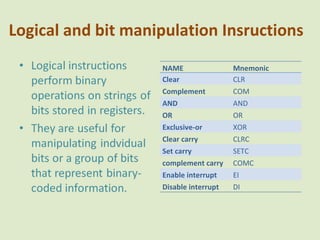
Logical and bit manipulation Insructions NAME Mnemonic Clear CLR Complement COM AND AND OR OR Exclusive-or XOR Clear carry CLRC Set carry  SETC complement carry COMC Enable interrupt EI Disable interrupt DI
Shift Instructions NAME Mnemonic Logical shift right SHR Logical shift left SHL Arithmetic shift right SHRA Arithmetic shift left SHLA Rotate right ROR Rotate left ROL Rotate right through carry RORC Rotate left through carry ROLC
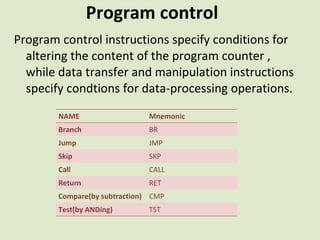
Program control Program control instructions specify conditions for altering the content of the program counter , while data transfer and manipulation instructions specify condtions for data-processing operations. NAME Mnemonic Branch BR Jump JMP Skip SKP Call CALL Return RET Compare(by subtraction) CMP Test(by ANDing) TST
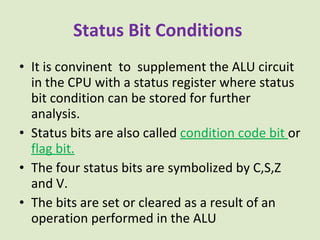
Status Bit Conditions  It is convinent  to  supplement the ALU circuit in the CPU with a status register where status  bit condition can be stored for further analysis. Status bits are also called  condition code bit  or  flag bit. The four status bits are symbolized by C,S,Z and V. The bits are set or cleared as a result of an operation performed in the ALU
4-bit status register
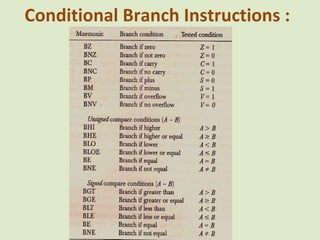
Conditional Branch Instructions :
Subroutine Call and Return It is a self-contained sequence of instructions that performs a given computational task. During the execution of a program,a subroutine may call when it is called, a branch is executed to the beginning of the subroutine to start executing its set of instructions. After the subroutine has been executed,a branch is made back to the main program.
A subroutine call is implemented with the following microoperations: CALL: SP← SP-1 :  Decrement stack point M[SP] ←PC  : Push content of PC onto the stack PC← Effective Address  : Transfer control to the subroutine RETURN: PC ← M[SP]  : Pop stack and transfer to PC SP ← SP+1  : Increment stack pointer
Program Interrupt »  Transfer program control from a currently running program to another service program as a result of an external or internal generated request » Control returns to the original program after the service program is executed
Types of Interrupts 1) External Interrupts » come from I/O device, from a timing device, from a circuit monitoring the power supply, or from any other external source 2) Internal Interrupts or TRAP » caused by register overflow, attempt to divide by zero, an invalid operation code, stack overflow, and protection violation 3) Software Interrupts » initiated by executing an instruction ( INT or RST) » used by the programmer to initiate an interrupt procedure at any desired point in the program

Data transfer and manipulation

  • 1.
    Data Transfer andManipulation By:- Gaurav Pal(8136)
  • 2.
    Data Transfer andManipulation Most computer instructions can be classified into three categories: Data transfer, 2) Data manipulation, 3) Program control instructions
  • 3.
    Data Transfer InstructionData transfer instructions move data from one place in the computer to another without changing the data content The most common transfers are between memory and processor registers,between processor registers and input or output,and between the processor registers themselves.
  • 4.
    Typical Data TransferInstruction : » Load : transfer from memory to a processor register, usually an AC ( memory read) » Store : transfer from a processor register into memory ( memory write) » Move : transfer from one register to another register » Exchange : swap information between two registers or a register and a memory word » Input/Output : transfer data among processor registers and input/output device » Push/Pop : transfer data between processor registers and a memory stack NAME Mnemonic Load LD Store ST Move MOV Exchange XCH Input IN Output OUT Push PUSH pop POP
  • 5.
    Data Manipulation InstructionData Manipulation Instructions perform operations on data and provide the computational capabilities for the computer. It is divided into three basic types: Arithmetic, 2) Logical and bit manipulation, 3) Shift Instruction
  • 6.
    Arithmetic Insructions NAMEMnemonic Increment INC Decrement DEC Add ADD Subtract SUB Multiply MUL Divide DIV Add with carry ADDC Subtract with borrow SUBB Negate (2’s complement) NEG
  • 7.
    Logical and bitmanipulation Insructions NAME Mnemonic Clear CLR Complement COM AND AND OR OR Exclusive-or XOR Clear carry CLRC Set carry SETC complement carry COMC Enable interrupt EI Disable interrupt DI
  • 8.
    Shift Instructions NAMEMnemonic Logical shift right SHR Logical shift left SHL Arithmetic shift right SHRA Arithmetic shift left SHLA Rotate right ROR Rotate left ROL Rotate right through carry RORC Rotate left through carry ROLC
  • 9.
    Program control Programcontrol instructions specify conditions for altering the content of the program counter , while data transfer and manipulation instructions specify condtions for data-processing operations. NAME Mnemonic Branch BR Jump JMP Skip SKP Call CALL Return RET Compare(by subtraction) CMP Test(by ANDing) TST
  • 10.
    Status Bit Conditions It is convinent to supplement the ALU circuit in the CPU with a status register where status bit condition can be stored for further analysis. Status bits are also called condition code bit or flag bit. The four status bits are symbolized by C,S,Z and V. The bits are set or cleared as a result of an operation performed in the ALU
  • 11.
  • 12.
  • 13.
    Subroutine Call andReturn It is a self-contained sequence of instructions that performs a given computational task. During the execution of a program,a subroutine may call when it is called, a branch is executed to the beginning of the subroutine to start executing its set of instructions. After the subroutine has been executed,a branch is made back to the main program.
  • 14.
    A subroutine callis implemented with the following microoperations: CALL: SP← SP-1 : Decrement stack point M[SP] ←PC : Push content of PC onto the stack PC← Effective Address : Transfer control to the subroutine RETURN: PC ← M[SP] : Pop stack and transfer to PC SP ← SP+1 : Increment stack pointer
  • 15.
    Program Interrupt » Transfer program control from a currently running program to another service program as a result of an external or internal generated request » Control returns to the original program after the service program is executed
  • 16.
    Types of Interrupts1) External Interrupts » come from I/O device, from a timing device, from a circuit monitoring the power supply, or from any other external source 2) Internal Interrupts or TRAP » caused by register overflow, attempt to divide by zero, an invalid operation code, stack overflow, and protection violation 3) Software Interrupts » initiated by executing an instruction ( INT or RST) » used by the programmer to initiate an interrupt procedure at any desired point in the program