MAMMALS BES, Grade 4 Animal Unit
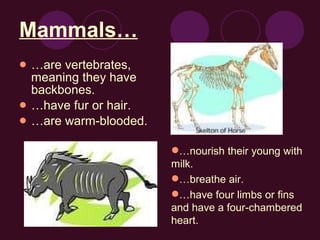
Mammals… … are vertebrates, meaning they have backbones. … have fur or hair. … are warm-blooded. … nourish their young with milk. … breathe air. … have four limbs or fins and have a four-chambered heart.
Mammals are a  very diverse group! Some mammals live on land, while others are aquatic animals. Mammals very in size from tiny rodents to enormous elephants. Some mammals can fly, while others walk on land. Mammals have adapted to live in a variety of habitats.
Mammals can further be  divided into three groups: Monotremes Marsupials Placental mammals Let’s look a little more closely at each of these groups!
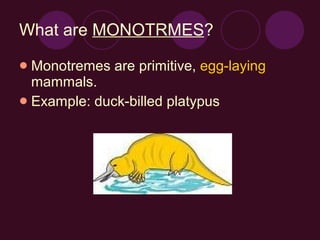
What are  MONOTRMES ? Monotremes are primitive,  egg-laying  mammals. Example: duck-billed platypus
What are  MARSUPIALS ? Marsupials give birth to very underdeveloped young. The young then develop in the mother’s  pouch . Examples: kangaroos and koalas
What are  PLACENTAL  mammals? Placental mammals give birth to more  developed young .  Placental mammals have a longer gestation period than marsupials. Examples: humans and dogs
The  diets  of mammals  differ  as well. Some mammals are  carnivores . Eat meat (other animals) Examples: dolphins and tigers Some mammals are  herbivores . Eat plants Examples: cows and pandas Some mammals are  omnivores . Eat both plants and meat (other animals) Examples: people and some bears Some mammals are  insectivores . Eat insects Examples: aardvark and anteaters
Directions: Find a  partner  of the opposite gender. Together  read  the text on mammals.  As you read,  highlight  important information. Complete the  web  on the back of the paper.

Mammals

  • 1.
    MAMMALS BES, Grade4 Animal Unit
  • 2.
    Mammals… … arevertebrates, meaning they have backbones. … have fur or hair. … are warm-blooded. … nourish their young with milk. … breathe air. … have four limbs or fins and have a four-chambered heart.
  • 3.
    Mammals are a very diverse group! Some mammals live on land, while others are aquatic animals. Mammals very in size from tiny rodents to enormous elephants. Some mammals can fly, while others walk on land. Mammals have adapted to live in a variety of habitats.
  • 4.
    Mammals can furtherbe divided into three groups: Monotremes Marsupials Placental mammals Let’s look a little more closely at each of these groups!
  • 5.
    What are MONOTRMES ? Monotremes are primitive, egg-laying mammals. Example: duck-billed platypus
  • 6.
    What are MARSUPIALS ? Marsupials give birth to very underdeveloped young. The young then develop in the mother’s pouch . Examples: kangaroos and koalas
  • 7.
    What are PLACENTAL mammals? Placental mammals give birth to more developed young . Placental mammals have a longer gestation period than marsupials. Examples: humans and dogs
  • 8.
    The diets of mammals differ as well. Some mammals are carnivores . Eat meat (other animals) Examples: dolphins and tigers Some mammals are herbivores . Eat plants Examples: cows and pandas Some mammals are omnivores . Eat both plants and meat (other animals) Examples: people and some bears Some mammals are insectivores . Eat insects Examples: aardvark and anteaters
  • 9.
    Directions: Find a partner of the opposite gender. Together read the text on mammals. As you read, highlight important information. Complete the web on the back of the paper.