








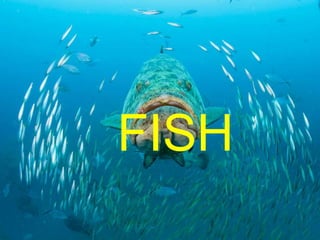


























FISH
ETYMOLOGY
 The word for fish in English and the
other Germanic
languages (German fisch; Gothic fisks) is
inherited from Proto-Germanic, and is related to
the Latin piscis and Old Irish īasc, though the
exact root is unknown; some authorities
reconstruct an Proto-Indo-European root *peysk-,
attested only in Italic, Celtic, and Germanic.
 The English word once had a much broader
usage than its current biological meaning.
Names such
as starfish, jellyfish, shellfish and cuttlefish attest
to almost any fully aquatic animal (including
whales) once being 'fish'. "Correcting" such
names (e.g. to 'sea star') is an attempt to
retroactively apply the current meaning of 'fish' to
EVOLUTION
 Fish, as vertebrata, developed as sister of the tunicata. As
the tetrapods emerged deep within the fishes group, as
sister of the lungfish, characteristics of fish are typically
shared by tetrapods, including having vertebrae and a
cranium.
 Dunkleosteus was a gigantic, 10-metre (33 ft)
long prehistoric fish of class Placodermi.
 Lower jaw of the placoderm Eastmanosteus pustulosus,
showing the shearing structures ("teeth") on its oral surface;
from the Devonian of Wisconsin.
 Early fish from the fossil record are represented by a group
of small, jawless, armored fish known as ostracoderms.
Jawless fish lineages are mostly extinct. An extant clade,
the lampreys may approximate ancient pre-jawed fish. The
first jaws are found in Placodermi fossils. They lacked
distinct teeth, having instead the oral surfaces of their jaw
 The diversity of jawed vertebrates may
indicate the evolutionary advantage of
a jawed mouth. It is unclear if the advantage
of a hinged jaw is greater biting force,
improved respiration, or a combination of
factors.
 Fish may have evolved from a creature
similar to a coral-like sea squirt, whose
larvae resemble primitive fish in important
ways. The first ancestors of fish may
have kept the larval form into adulthood (as
some sea squirts do today), although
perhaps the reverse is the case.
TAXONOMY
Fish are a paraphyletic group:
that is, any clade containing all
fish also contains the tetrapods,
which are not fish. For this
reason, groups such as the
class Pisces seen in older
reference works are no longer
used in formal classifications.
Traditional classification
divides fish into
three extant classes, and with
extinct forms sometimes
classified within the tree,
sometimes as their own
classes
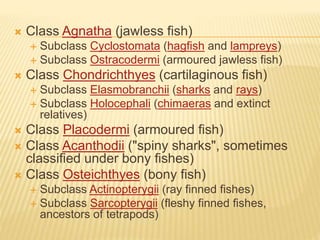
 Class Agnatha (jawless fish)
 Subclass Cyclostomata (hagfish and lampreys)
 Subclass Ostracodermi (armoured jawless fish)
 Class Chondrichthyes (cartilaginous fish)
 Subclass Elasmobranchii (sharks and rays)
 Subclass Holocephali (chimaeras and extinct
relatives)
 Class Placodermi (armoured fish)
 Class Acanthodii ("spiny sharks", sometimes
classified under bony fishes)
 Class Osteichthyes (bony fish)
 Subclass Actinopterygii (ray finned fishes)
 Subclass Sarcopterygii (fleshy finned fishes,
ancestors of tetrapods)
 The above scheme is the one most
commonly encountered in non-specialist and
general works. Many of the above groups are
paraphyletic, in that they have given rise to
successive groups: Agnathans are ancestral
to Chondrichthyes, who again have given
rise to Acanthodiians, the ancestors of
Osteichthyes. With the arrival of phylogenetic
nomenclature, the fishes has been split up
into a more detailed scheme, with the
following major groups
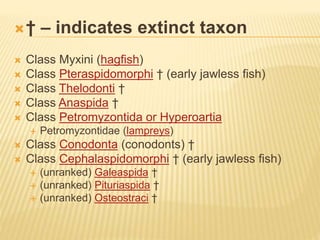
† – indicates extinct taxon
 Class Myxini (hagfish)
 Class Pteraspidomorphi † (early jawless fish)
 Class Thelodonti †
 Class Anaspida †
 Class Petromyzontida or Hyperoartia
 Petromyzontidae (lampreys)
 Class Conodonta (conodonts) †
 Class Cephalaspidomorphi † (early jawless fish)
 (unranked) Galeaspida †
 (unranked) Pituriaspida †
 (unranked) Osteostraci †
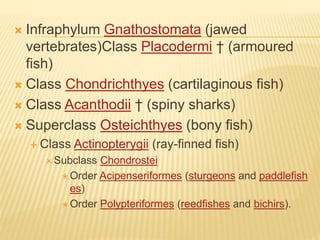
 Infraphylum Gnathostomata (jawed
vertebrates)Class Placodermi † (armoured
fish)
 Class Chondrichthyes (cartilaginous fish)
 Class Acanthodii † (spiny sharks)
 Superclass Osteichthyes (bony fish)
 Class Actinopterygii (ray-finned fish)
 Subclass Chondrostei
 Order Acipenseriformes (sturgeons and paddlefish
es)
 Order Polypteriformes (reedfishes and bichirs).
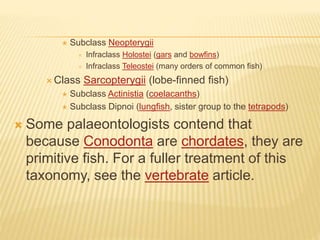
 Subclass Neopterygii
 Infraclass Holostei (gars and bowfins)
 Infraclass Teleostei (many orders of common fish)
 Class Sarcopterygii (lobe-finned fish)
 Subclass Actinistia (coelacanths)
 Subclass Dipnoi (lungfish, sister group to the tetrapods)
 Some palaeontologists contend that
because Conodonta are chordates, they are
primitive fish. For a fuller treatment of this
taxonomy, see the vertebrate article.
The position of hagfish in the
phylum Chordata is not settled.
Phylogenetic research in 1998
and 1999 supported the idea
that the hagfish and the
lampreys form a natural group,
the Cyclostomata, that is a sister
group of the Gnathostomata.
 The various fish groups account for more than
half of vertebrate species. There are almost
28,000 known extant species, of which almost
27,000 are bony fish, with 970 sharks, rays, and
chimeras and about 108 hagfish and
lampreys.[17] A third of these species fall within
the nine largest families; from largest to
smallest, these families
are Cyprinidae, Gobiidae, Cichlidae, Characidae
, Loricariidae, Balitoridae, Serranidae, Labridae,
and Scorpaenidae. About 64 families
are monotypic, containing only one species. The
final total of extant species may grow to exceed
32,500.
Diversity
 The term "fish" most precisely describes any non-
tetrapod craniate (i.e. an animal with a skull and in
most cases a backbone) that has gills throughout life
and whose limbs, if any, are in the shape of
fins. Unlike groupings such as birds or mammals, fish
are not a single clade but a paraphyletic collection
of taxa, including hagfishes, lampreys, sharks and
rays, ray-finned fish, coelacanths,
and lungfish. Indeed, lungfish and coelacanths are
closer relatives of tetrapods (such as mammals,
birds, amphibians, etc.) than of other fish such as ray-
finned fish or sharks, so the last common ancestor of
all fish is also an ancestor to tetrapods. As
paraphyletic groups are no longer recognised in
modern systematic biology, the use of the term "fish"
as a biological group must be avoided.
 Many types of aquatic animals commonly referred to
as "fish" are not fish in the sense given above;
examples
include shellfish, cuttlefish, starfish, crayfish and jellyfi
sh. In earlier times, even biologists did not make a
distinction – sixteenth century natural historians
classified also seals, whales, amphibians, crocodiles,
even hippopotamuses, as well as a host of aquatic
invertebrates, as fish. However, according to the
definition above, all mammals,
including cetaceans like whales and dolphins, are not
fish. In some contexts, especially in aquaculture, the
true fish are referred to as finfish (or fin fish) to
distinguish them from these other animals.
 A typical fish is ectothermic, has
a streamlined body for rapid swimming,
extracts oxygen from water using gills or
uses an accessory breathing organ to
breathe atmospheric oxygen, has two sets of
paired fins, usually one or two (rarely three)
dorsal fins, an anal fin, and a tail fin, has
jaws, has skin that is usually covered
with scales, and lays eggs.
 Each criterion has exceptions. Tuna, swordfish, and some
species of sharks show some warm-blooded
adaptations – they can heat their bodies significantly
above ambient water temperature. Streamlining and
swimming performance varies from fish such
as tuna, salmon, and jacks that can cover 10–20 body-
lengths per second to species such as eels and rays that
swim no more than 0.5 body-lengths per second. Many
groups of freshwater fish extract oxygen from the air as
well as from the water using a variety of different
structures. Lungfish have paired lungs similar to those of
tetrapods, gouramis have a structure called the labyrinth
organ that performs a similar function, while many catfish,
such as Corydoras extract oxygen via the intestine or
stomach.
 Body shape and the arrangement of the fins is highly
variable, covering such seemingly un-fishlike forms
as seahorses, pufferfish, anglerfish, and gulpers.
Similarly, the surface of the skin may be naked (as
in moray eels), or covered with scales of a variety of
different types usually defined as placoid (typical of
sharks and rays), cosmoid (fossil lungfish and
coelacanths), ganoid (various fossil fish but also
living gars and bichirs), cycloid, and ctenoid (these last
two are found on most bony fish). There are even fish that
live mostly on land or lay their eggs on land near
water. Mudskippers feed and interact with one another on
mudflats and go underwater to hide in their burrows. A
single, undescribed species of Phreatobius, has been
called a true "land fish" as this worm-like catfish strictly
lives among waterlogged leaf litter. Many species live
in underground lakes, underground rivers or aquifers and
are popularly known as cavefish.
 Fish range in size from the huge 16-metre (52 ft) whale
shark to the tiny 8-millimetre (0.3 in) stout infantfish.
 Fish species diversity is roughly divided equally between
marine (oceanic) and freshwater ecosystems. Coral
reefs in the Indo-Pacific constitute the center of diversity
for marine fishes, whereas continental freshwater fishes
are most diverse in large river basins of tropical
rainforests, especially the Amazon, Congo,
and Mekong basins. More than 5,600 fish species
inhabit Neotropical freshwaters alone, such
that Neotropical fishes represent about 10% of
all vertebrate species on the Earth. Exceptionally rich
sites in the Amazon basin, such as Cantão State Park,
can contain more freshwater fish species than occur in all
of Europe.
 The deepest living fish in the ocean so far found is the
Mariana snailfish (Pseudoliparis swirei) which lives at
deeps of 8,000 meters (26,200 feet) along the Mariana
Trench near Guam.
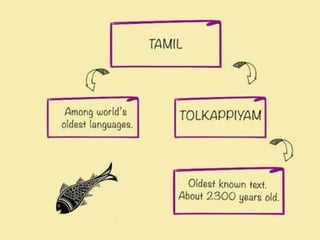
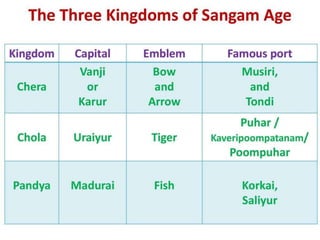
FISH IN TAMIL
SANGAM
LITERATURE
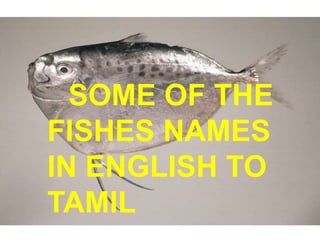
SOME OF THE
FISHES NAMES
IN ENGLISH TO
TAMIL
MYTH OF FISH IN
SIDDHA MEDICINE
A particular taste of
food when taken in
combination with its inimical
taste food might yield
poisonous effects due to
dietetic incompatibilities. E.g.
Milk and fish should never be
taken together.
MARINE BIOLOGICAL HISTORY
 Without water there is no life. Water is life.
Life began in a fresh water pond nearly 2.5
billion years ago in the form of
cyanobacteria. Those bacteria used light,
water, and carbon dioxide to produce oxygen
and biomass. These species got their start
on Earth in freshwater systems on continents
and gradually evolved to exist in brackish
water environments, then higher salt ones,
marine and hyper saline (salt crust)
environments.
 In the Cambrian era (543-488 million years
ago) the first invertebrates developed in
the oceans. The first vertebrates, fish-like
creatures, appeared in the Ordovician age
(488-444 million years ago). Later the fish
evolved and multiplied in the Silurian era
(444-416 million years ago). So we can
say that vertebrate life began with the
fish. Water is the fluid of almost every
living organism.
 An ovum comprises 80% water and the fertilised
egg comprises 96% water. Water makes up
about 71% of the Earth’s surface. To break the
numbers down, 96.5% of all the Earth’s water is
contained within the oceans as salt water, while
the remaining 3.5% is freshwater lakes and
frozen water locked up in glaciers and the polar
ice caps. The adult human body averages
approximately 65% water. The brain and heart
are composed of 73% water, and the lungs are
about 83% water. The skin contains 64% water,
muscles and kidneys are 79%, and even the
bones are watery: 31%.
 Water is essential for life to start and to be
sustained. It is in the water that we find fish. As
water is life itself, we can say that fish are
creatures that breathe life. In the search for
extra-terrestrial life, humans search for water.
Without water there can be no life. If water is
found, then life is a possibility. Underwater we
can find hills and valleys, plants and animals.
So almost everything is the same underwater as
on land. Only one thing is different: the denizens
of water get ‘life’ more intensively.
 Which animals are at home in the sky and the earth?
Yes, the birds. But can they stay in the sky for a very
long time without landing? Swifts and certain sea
birds apart, birds have to sleep on land. Fish can
subsist in both deep and shallow water. They have
the ability to swim to deeper and shallower places.
They can remain in either environment for many
days. They can perceive darkness and light, as do
many animals. Some fish can leave the water for
days and breath the air; some can even fly a little.
What wonderful creatures they are. In fish there is
everything: sky and earth, water and air. But they are
different. Are they animals? Can we put them into the
animal kingdom?
 Earthly life begins in water. Animals moved from
water to land; but many of them returned to the
water. When fish crawled on to the land again
and accommodated to the land environment,
snakes, possessing the rudiments of legs and
feet appeared. How can we classify or define
the fish? Fish can swim in water, but so do a
number of land animals. Swimming is not
dependent on an organ or a skeletal formation;
it is just a mode of the activity of fish.
 The world’s waters are full of strange and
fascinating creatures. Some fish are weird
and alien-looking, seeming to come from
another world. Some of these splendid
creatures of the sea feature mesmerising
looks and unique features that make them
stand out among their peers. Fish are a
perfect example of biodiversity, since they
come in countless shapes, colours and sizes.
In their own perfection.
FISH IN ANCIENT MYTHOLOGY AND IN CULTURE
 The fish was sacred in Greco-Roman mythology,
where it held the symbolic meaning of change and
transformation. We see this in the myth of Aphrodite
and Eros when they turned themselves into fish in
order to escape from the ferocious Typhon. In
Christianity, the fish is a symbol of abundance and
faith as observed in the Biblical story of the 5 loaves
and 2 fishes. There are also several Biblical
references to Christ and his disciples being ‘fishers of
men’. Here, man is represented as the
transformational fish and the ocean is a symbol of the
abyss of sin in which man finds himself
 In Christianity the fish symbol is a pictorial
representation of the Greek word ichthys, which
itself was used as an acronym for Iesous
Christos, Theou Yios, Soter, meaning ‘Jesus
Christ, God’s Son, Saviour Pagan traditions
recognised the fish as a feminine symbol of
fertility and an attribute of the Goddess. Water is
a natural emblem of the flow of the Divine
Mother principle, and as such, all creatures of
the water (including fish) are aspects of the
fertility and power of the female deity.
 As an ancient Celtic symbol, the symbolic
meaning of fish (salmon, specifically) dealt
with knowledge, wisdom, inspiration and
prophecy. Ancient Celts believed the salmon
derived its wisdom from consuming sacred
hazel nuts that dropped into the Well of
Wisdom (The Well of Segais). Further, they
believed that eating this salmon would mean
gaining both wisdom and poetic inspiration.
 In ancient Eastern Indian mythology, the fish is a
symbol of transformation and creation. This is
observed in the ancient flood myth in which
Vishnu transformed himself into a fish (Matsya)
to save the world from a great flood. In this
form, he guided King Manu’s boat to safety.
Ancient African creation myths tell of Mangala,
the creator, planting seeds in the cosmic womb.
From these seeds two fish erupted, and were
set forth into the cosmos upon the waters of
creation. We see from this myth the symbolic
meaning of fish yet again deals with fertility and
creativity by embodying a new phase of initial
life.
 In Norse and ancient European cultures, the fish
had symbolic meanings of adaptability,
determination, and the flow of life. It was
observed by these cultures that fish often
display enormous attributes of adaptability in the
wild, and they adopted these characteristics for
themselves. Enki, in Sumerian mythology, was a
mischievous god of wisdom, magic and
incantations who resides in the ocean under the
earth. He was half man and half fish.
 In China, the fish is symbolic of unity and
fidelity as it is noted that fish (particularly koi)
often swim together in pairs. With this in
mind, fish are often given as wedding gifts in
the form of charms or figurines to present the
newly wed couple with an auspicious sign of
fidelity and perfect union. They also
represent fertility and abundance due to their
ability to reproduce in speed and volume.
Furthermore, in Buddhism, the fish
symbolises happiness and freedom.
FISH IN ASTROLOGY
 Strengths: Compassionate, artistic, intuitive,
gentle, wise, and musical. Weaknesses:
Fearful, overly trusting, sad, desire to escape
reality; can be a victim or a martyr. Pisces
likes: Being alone, sleeping, music, romance,
visual media, swimming, spiritual themes.
Pisces dislikes: Know-it-alls, being criticised,
the past coming back to haunt, cruelty of any
kind.
 Pisces is symbolised by two fish swimming in
opposite directions. Pisces often feel as if they are
being pulled in different directions, making it difficult
to make concrete decisions. It’s a pair of Fish, a
symbol that prompts others to suggest that these
people ‘go with the flow’ and ‘don’t make waves’.
Pisces alternate between reality and non-reality in
keeping with their introspective natures; their voyage
between consciousness and an unconscious dream
state says much about their intuitive, almost psychic
natures. Pisces are compassionate, charitable and
will quickly put the needs of others ahead of their
own.
 . Pisces is a sensitive sign— both sensitive
to criticism and sensitive to others’ feelings.
Easily touched by human suffering. They
believe in people, are deeply hurt by
compassionless human behaviour, and have
a hard time saying no. Rude realities are
avoided either through escapist behaviour or
self-delusion. Pisces retreat into their own
world, self-pitying and giving pep talks to
themselves.
 Pisces-influenced people feel a great deal, and
also feel misunderstood much of the time.
They’re not quite pushovers, but they’re
certainly sensitive. They can also be quite
romantic, dreaming up delicious treats for their
lover. Hopefully, any kindness will be
reciprocated, because the Fish can certainly
turn blue if they’re not. Pisces are generally
gentle, easy-going people, who are on the shy
and reticent side. Some find Pisces’ tendency to
be late for appointments, spaced-out behaviour,
and absent-mindedness amount to
irresponsibility.
HEALTHY DIET
 Fish is a low-fat high quality protein. Fish is filled
with omega-3 fatty acids and vitamins such as D
and B2 (riboflavin). Fish is rich in calcium and
phosphorus and a great source of minerals,
such as iron, zinc, iodine, magnesium, and
potassium. The American Heart
Association recommends eating fish at least two
times per week as part of a healthy diet. Fish is
packed with protein, vitamins, and nutrients that
can lower blood pressure and help reduce the
risk of a heart attack or stroke.
 Fish is among the healthiest foods on the
planet.
 It’s loaded with important nutrients, such as
protein and vitamin D.
 Fish is also a great source of omega-3 fatty
acids, which are incredibly important for our
body and brain.
 Here some of the health benefits of eating
fish that are supported by research.
HIGH IN IMPORTANT NUTRIENTS
 Fish is packed with many nutrients that most people are lacking.
 This includes high-quality protein, iodine, and various vitamins
and minerals.
 Fatty species are sometimes considered the healthiest. That’s
because fatty fish, including salmon, trout, sardines, tuna, and
mackerel, are higher in fat-based nutrients.
 This includes vitamin D, a fat-soluble nutrient that many people
are lacking.
 Fatty fish also boast omega-3 fatty acids, which are crucial for
optimal body and brain function and strongly linked to a reduced
risk of many diseases.
 To meet your omega-3 requirements, eating fatty fish at least
once or twice a week is recommended. If you are a vegan, opt for
omega-3 supplements made from microalgae.
LOWER’S THE RISK OF HEART ATTACKS AND
STROKES
 Heart attacks and strokes are the two most common
causes of premature death in the world.
 Fish is considered one of the most heart-healthy
foods you can eat.
 Unsurprisingly, many large observational studies show
that people who eat fish regularly have a lower risk of
heart attacks, strokes, and death from heart.
 In one study in more than 40,000 men in the United
States, those who regularly ate one or more servings of
fish per week had a 15% lower risk of heart disease.
 Researchers believe that fatty types of fish are even more
beneficial for heart health due to their high omega-3 fatty
acid content.
CONTAIN NUTRIENTS THAT ARE CRUCIAL
DURING DEVELOPMENT
 Omega-3 fatty acids are essential for growth and
development.
 The omega-3 fat docosahexaenoic acid (DHA) is
especially important for brain and eye development.
 For this reason, it’s often recommended that pregnant
and breastfeeding women eat enough omega-3 fatty
acids.
 However, some fish are high in mercury, which is linked to
brain developmental problems.
 Thus, pregnant women should only eat low-mercury fish,
such as salmon, sardines, and trout, and no more than 12
ounces (340 grams) per week.
 They should also avoid raw and uncooked fish because it
may contain microorganisms that can harm the fetus.
BOOST BRAIN HEALTH
 Brain function often declines with aging.
 While mild mental decline is normal, serious
neurodegenerative ailments like Alzheimer’s
disease also exist.
 Many observational studies show that people
who eat more fish have slower rates of mental
decline .
 Studies also reveal that people who eat fish
every week have more gray matter — our
brain’s major functional tissue — in the parts of
the brain that regulate emotion and memory.
MAY HELP PREVENT AND TREAT DEPRESSION
 Depression is a common mental condition.
 It’s characterized by low mood, sadness, decreased
energy, and loss of interest in life and activities.
 Although it isn’t discussed nearly as much as heart
disease or obesity, depression is currently one of the
world’s biggest health problems.
 Studies have found that people who eat fish regularly are
much less likely to become depressed.
 Numerous controlled trials also reveal that omega-3 fatty
acids may fight depression and significantly increase the
effectiveness of antidepressant medications.
 Fish and omega-3 fatty acids may also aid other mental
conditions, such as bipolar disorder.
A GOOD DIETARY SOURCES OF VITAMIN D
 Vitamin D functions like a steroid hormone in your body
— and a whopping 41.6% of the U.S. population is
deficient or low in it.
 Fish and fish products are among the best dietary
sources of vitamin D. Fatty fish like salmon and herring
contain the highest amounts.
 A single 4-ounce (113-gram) serving of
cooked salmon packs around 100% of the recommended
intake of vitamin D.
 Some fish oils, such as cod liver oil, are also very high in
vitamin D, providing more than 200% of the Daily Value
(DV) in a single tablespoon (15 ml).
 If we don’t get much sun and don’t eat fatty fish regularly,
we may want to consider taking a vitamin D supplement.
MAY REDUCE YOUR RISK OF AUTOIMMUNE
DISEASES
 Autoimmune diseases like type 1 diabetes occur
when your immune system mistakenly attacks
and destroys healthy body tissues.
 Several studies link omega-3 or fish oil intake to
a reduced risk of type 1 diabetes in children, as
well as a form of autoimmune diabetes in adults.
 The omega-3 fatty acids and vitamin D in fish
and fish oils may be responsible.
 Some experts believe that fish intake may also
lower your risk of rheumatoid arthritis and
multiple sclerosis, but the current evidence is
weak at best.
MAY HELP PREVENT ASTHMA
 Asthma is a common disease characterized
by chronic inflammation of airways.
 Rates of this condition have increased
dramatically over the past few decades.
 Studies show that regular fish consumption is
linked to a 24% lower risk of asthma in
children and in adults.
PROTECT OF VISION IN OLD AGE
 Age-related macular degeneration (AMD) is a leading
cause of vision impairment and blindness that mostly
affects older adults.
 Some evidence suggests that fish and omega-3 fatty
acids may protect against this disease.
 In one study, regular fish intake was linked to a 42%
lower risk of Age-related macular degeneration in
women.
 Another study found that eating fatty fish once per
week was linked to a 53% decreased risk of
neovascular (“wet”) Age-related macular
degeneration.
FISH MAY IMPROVE SLEEP QUALITY
 Sleep disorders have become incredibly
common worldwide.
 Increased exposure to blue light may play a
role, but some researchers believe that vitamin
D deficiency may also be involved.
 In a 6-month study in 95 middle-aged men, a
meal with salmon 3 times per week led to
improvements in both sleep and daily
functioning.
 The researchers speculated that this was
caused by the vitamin D content.
HEALTHY HEART AND BRAIN
 Eating fish is an important source of omega-3
fatty acids. These essential nutrients keep our
heart and brain healthy. Two omega-3 fatty
acids found in fish are EPA (eicosapentaenoic
acid) and DHA (docosahexaenoic acid). Our
bodies don't produce omega-3 fatty acids so we
must get them through the food we eat. Omega-
3 fatty acids are found in every kind of fish, but
are especially high in fatty fish. Some good
choices are salmon, trout, sardines, herring,
canned mackerel, canned light tuna, and
oysters.
OMEGA-3 FATTY ACIDS
 Help maintain a healthy heart by lowering blood
pressure and reducing the risk of sudden death,
heart attack, abnormal heart rhythms, and
strokes.
 Aid healthy brain function and infant
development of vision and nerves during
pregnancy.
 May decrease the risk of depression, ADHD,
Alzheimer’s disease, dementia, and diabetes.
 May prevent inflammation and reduce the risk of
arthritis.
GROUP ANALYSIS IN HOMEOPATHY
 The group analysis approach to
homeopathy is not new. Farrington used
kingdom analysis in 1880 and Leeser used
periodic table information in 1935.
However it was not until the 1990s that the
first modern application of group analysis
began to emerge. Group analysis is an
attempt to identify a mechanism for
understanding groups of related remedies
according to natural classification of the
various sources used in homeopathic
 The prime movers of group analysis of the
modern era are Jan Scholten and Rajan
Sankaran. Scholten has defined group
analysis as the process of looking at a group
of remedies and extracting what is common
from that group. Scholten realised that
homeopathic practitioners have generally
used symptoms as almost the only guide to
the remedy, without really considering the
source of the drug. It is, however, becoming
very clear that the symptomatology of any
drug is intimately related to the source it is
drawn from, and that each drug has in it the
essence of its source.
AN OUTLINE
 Fish are the oldest of the vertebrate groups and
have the greatest number of species at around
33, 100 currently identified. They live almost
anywhere there is enough water , from the
highest mountain streams right down to the
deepest ocean abyss. They are found in both
fresh water and sea water. Almost all are cold
blooded, able to turn the coldest most uninviting
waters into areas of high productivity. Body is
streamlined, provided with both paired and
unpaired fins. Respiration is done by gills.
THEME
GRIEF HARMONY
SELF PROTECTION RESTLESS
MOTION DIFFICULTY
ANTHROPHOBIA
INDOLENT ATTITUDE
WEEPING TENDENCY
COMMUNICATION ISSUES
WEAK BUT TENDENCY TO BE
STRONG WITHOUT OTHERS
SUPPORT.
INTRODUCTION
 FISH, the symbol of eternal life, was the first and most
fascinating creation that gracefully swam across the vast
sea.
 From the beginning until now, fish has undergone many
changes in their development.Today there are many more
species of fish than any other class of BACK BONE
ANIMALS. FISH choose their own medium of temperature
and salinity. The size of fish has a wide range of
variation.They are the most colorful creatures. They have
BEAUTIFUL STRUCTURE and GRACEFUL
MOVEMENTS ... The fish conveys GOOD OMEN OF
PROSPERITY. Fish is the main survival food for most of
the people of coastal region.
THE FISH PLAYS IMPORTANT
ROLE IN THE LIFE OF HUMAN
BEINGS. IT IS NOT MERELY
THE ECONOMICAL SOURCE
OF THE PEOPLE BUT ALSO
HAS OTHER MEDICINAL
IMPORTANCE.
PHYLUM- CHORDATA
GROUP- VERTEBRATA
SUB.PHYLUM- GNATHOSTOMATA
SPECIES - PISCES
 TYPES:
 GENERALLY THERE ARE THREE TYPES OF
THE FISH: -
 1.CARTILAGINOUS: It is made of firm but
flexible substance with tough horny skin ...
 2.BONY: They have bony skeleton and are
covered with horny scales.
 3.LUNGFISH: They have both LUNGS AND
GILLS and usually live in fresh water.Their fins
resemble legs ...
IMPORTANT REMEDIES
 1.SEPIA [CUTTLE FISH]
 2.MUREX PURPURA [PURPLE FISH]
 3.AMBRA GRESIA [AMBERGRIS FROM WHALES]
 4.MEDUSA [[JELLY FISH]
 5.ASTERIAS RUBENS [RED STAR FISH]
 6.MEDUSA [JELLY FISH]
 7.LIMULUS [KING CRAB]
 8.ASTACUS FLUVIATILIS [SHELL FISH]
 9.HOMARUS [LOBSTER]
 10. PYRARA [FISH FROM AMAZON]
 11.OLEUM JECORIS ASELLI [COD LIVER OIL]
 12. PROPYLAMINE -TRIMETHYLAMINUM [HERRING
BRINE]
 13.ERYTHRINUS(RED MULLET FISH)
 14. TRACHINUS DRACO (STING FISH)
 15.ICHYTHYOLUM(FISH FOSSIL)
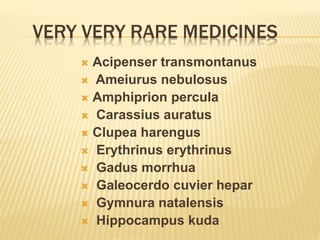
VERY VERY RARE MEDICINES
 Acipenser transmontanus
 Ameiurus nebulosus
 Amphiprion percula
 Carassius auratus
 Clupea harengus
 Erythrinus erythrinus
 Gadus morrhua
 Galeocerdo cuvier hepar
 Gymnura natalensis
 Hippocampus kuda
 Lepomis gibbosus
 Oncorhynchus
tshawytscha
 Chinook Salmon
 Ostracion cubicus
 Paracanthurus hepatus
 Blue Tang
 Pleuronectes platessa
 Silurus glanis
 Thunnus alalunga
 Urolophus halleri
USES OF FISH
 BESIDES BEING USED AS FOOD, FISH LIVER IS AN
IMPORTANT SOURCE OF OIL CONTAINING VITAMIN A and
VIT.D
 -A LARGE AMOUNT OF PHOSPHORUS AND OTHER
ELEMENTS IS ALSO PRESENT IN FISHES.
 -2 TYPES OF OILS ARE EXTRACTED FROM THE FISH- LIVER
OIL AND BODY OIL.
 THE LIVER OIL CONTAINS VITAMIN A and D.
 BODY OIL CONTAINS TRACES OF VIT A and D.
 -THE BODY OIL IS USED FOR PAINTING, VARNISH, SOAP,
CANDLE, LEATHER INDUSTRY.
 -THE SCALES WHICH ARE PRESENT ON THE BODY, ARE
USED FOR COSMETICS.
 -FISH FINS ARE USED IN CHINA FOR PREPARING SOAP.
 -THE LIVER OIL CONTAINS 55-75% FAT, 5-10% PROTEINS
AND WATER.
MYTHS AND
BELIEFS
 Since ages, fish considered as a SIGN OF
PROSPERITY.
 according to some old customs, A NEWLY
MARRIED BRIDE CARRIES FISH TO HER
HUSBAND'S HOUSE AS A SYMBOL OF
PROSPERITY AND FERTILITY.
 Some believe when you get a fish in your
dream, you are going to have a hike in your
income or some financial gains.Thus, fish is
considered as a SIGN OF PROSPERITY.
DOCTRINE OF
SIGNATURE