FIREWALL
BY Mr Tapan Kumar Khilar
2
Firewalls
Effective means of protection a local
system or network of systems from
network-based security threats while
affording access to the outside world via
WAN`s or the Internet
Benefits to using a firewall
– · Protect your network or PC
– · Prevent viruses and worms on your network
– · Prevent malicious attackers from getting
into your network
– · Prevent ad-ware, malware, and spyware
– · Prevent loss of sensitive or valuable
company information
– · Prevent Denial of Service (DoS) attacks
– · Authenticate users, log users (accounting),
and authorize users only for certain
content or applications
Firewall Design
Principles
• The firewall is inserted between the
premises network and the Internet
• Aims:
– Establish a controlled link
– Protect the premises network from
Internet-based attacks
– Provide a single choke point
Firewall Characteristics
• Design goals:
– All traffic from inside to outside must
pass through the firewall (physically
blocking all access to the local network
except via the firewall)
– Only authorized traffic (defined by the
local security police) will be allowed to
pass
Firewall Characteristics
• Design goals:
– The firewall itself is immune to
penetration (use of trusted system with
a secure operating system)
Firewall Characteristics
• Service control
– Determines the types of Internet services
that can be accessed.
• Log Record
– Record all activity into log.
Generation of Firewalls
– Application-based
(Windows firewall)
– Hardware based
i- Packet filter(stateful & stateless)
iii-Application – level firewall(proxy)
iii-NAT Firewall
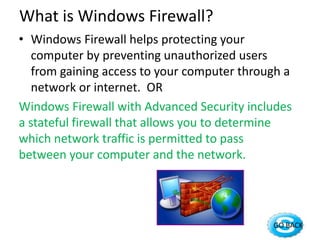
What is Windows Firewall?
• Windows Firewall helps protecting your
computer by preventing unauthorized users
from gaining access to your computer through a
network or internet. OR
Windows Firewall with Advanced Security includes
a stateful firewall that allows you to determine
which network traffic is permitted to pass
between your computer and the network.
GO BACK
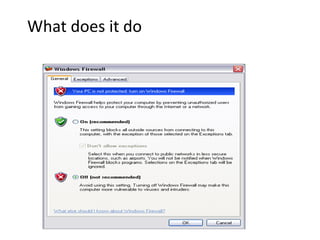
What does it do
• Firewall prevents hackers or malicious
programs, worms from gaining access to
your computer through internet or network.
• Firewall restricts these hackers and malicious
programs based on the predefined rules or
firewall settings.
• Ask for your permission to block or unblock
certain connection requests.
• Create a record (a security log)
GO BACK
What does it do
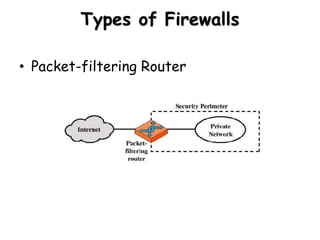
Types of Firewalls
• Packet-filtering Router
Hardware firewall
• Packet-filtering Router(stateless)
– Applies a set of rules to each incoming IP
packet and then forwards or discards the
packet
– Filter packets going in both directions
– work at the network level
– The packet filter is typically set up as a list of
rules based on matches to fields in the IP or
TCP header
– Two default policies (discard or forward)
– Work in physical,datalink and network layer in
osi.
• Advantages:
– Simplicity
– Transparency to users
– High speed
– low impact on network performance.
• Disadvantages:
– Difficulty of setting up packet filter rules
– Lack of Authentication
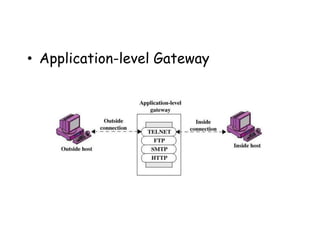
• Application-level Gateway
– Also called proxy server
– Acts as a relay of application-level traffic
– Incoming or outgoing packets cannot
access services for which there is no
proxy
– filter application specific commands
– can also be used to log user activity and
logins.
– work at the application layer
Types of Firewalls
• Advantages:
– Higher security than packet filters
– Only need to scrutinize a few allowable
applications
– Easy to log and audit all incoming traffic
• Disadvantages:
– having a significant impact on network
performance, not transparent to end users
and require manual configuration of each
client computer.
Types of Firewalls
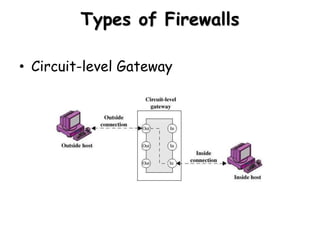
• Circuit-level Gateway
Types of Firewalls
• Circuit-level Gateway
– Stand-alone system .
– Specialized function performed by an
Application-level Gateway
– Sets up two TCP connections
– The gateway typically relays TCP segments
from one connection to the other without
examining the contents
– work at the session layer
Types of Firewalls
• Circuit-level Gateway
– The security function consists of
determining which connections will be
allowed
– Typically use is a situation in which the
system administrator trusts the internal
users
– An example is the SOCKS package
Advantage:-
ď‚§ Relatively inexpensive
ď‚§ Hiding information about the private network
Disadvantages:
they do not filter individual packets.
DMZ (demilitarized zone)
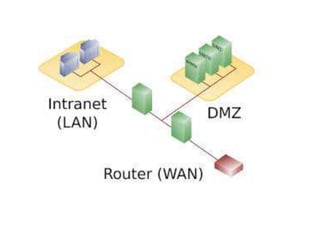
In computer networks, a DMZ (demilitarized zone)
is a physical or logical sub-network that separates
an internal local area network (LAN) from other
untrusted networks, usually the Internet.
External-facing servers, resources and services are
located in the DMZ so they are accessible from the
Internet but the rest of the internal LAN remains
unreachable.
This provides an additional layer of security to the
LAN as it restricts the ability of hackers to directly
access internal servers and data via the Internet.
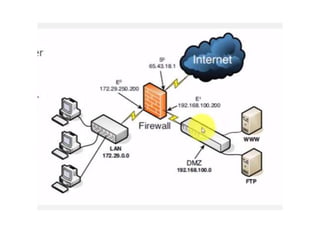
DMZ
Any service that is being provided to users on the
Internet should be placed in the DMZ. The most
common of these services are: Web,
Mail, DNS, FTP, and VoIP. The systems running
these services in the DMZ are reachable
by hackers and cybercriminals around the world
and need to be hardened to withstand constant
attack.
Firewall
Firewall
Firewall
Firewall
Firewall
Firewall
Firewall
Firewall
Firewall

Firewall

  • 1.
  • 2.
    2 Firewalls Effective means ofprotection a local system or network of systems from network-based security threats while affording access to the outside world via WAN`s or the Internet
  • 3.
    Benefits to usinga firewall – · Protect your network or PC – · Prevent viruses and worms on your network – · Prevent malicious attackers from getting into your network – · Prevent ad-ware, malware, and spyware – · Prevent loss of sensitive or valuable company information – · Prevent Denial of Service (DoS) attacks – · Authenticate users, log users (accounting), and authorize users only for certain content or applications
  • 4.
    Firewall Design Principles • Thefirewall is inserted between the premises network and the Internet • Aims: – Establish a controlled link – Protect the premises network from Internet-based attacks – Provide a single choke point
  • 5.
    Firewall Characteristics • Designgoals: – All traffic from inside to outside must pass through the firewall (physically blocking all access to the local network except via the firewall) – Only authorized traffic (defined by the local security police) will be allowed to pass
  • 6.
    Firewall Characteristics • Designgoals: – The firewall itself is immune to penetration (use of trusted system with a secure operating system)
  • 7.
    Firewall Characteristics • Servicecontrol – Determines the types of Internet services that can be accessed. • Log Record – Record all activity into log.
  • 8.
    Generation of Firewalls –Application-based (Windows firewall) – Hardware based i- Packet filter(stateful & stateless) iii-Application – level firewall(proxy) iii-NAT Firewall
  • 9.
    What is WindowsFirewall? • Windows Firewall helps protecting your computer by preventing unauthorized users from gaining access to your computer through a network or internet. OR Windows Firewall with Advanced Security includes a stateful firewall that allows you to determine which network traffic is permitted to pass between your computer and the network. GO BACK
  • 10.
    What does itdo • Firewall prevents hackers or malicious programs, worms from gaining access to your computer through internet or network. • Firewall restricts these hackers and malicious programs based on the predefined rules or firewall settings. • Ask for your permission to block or unblock certain connection requests. • Create a record (a security log) GO BACK
  • 11.
  • 12.
    Types of Firewalls •Packet-filtering Router
  • 13.
    Hardware firewall • Packet-filteringRouter(stateless) – Applies a set of rules to each incoming IP packet and then forwards or discards the packet – Filter packets going in both directions – work at the network level – The packet filter is typically set up as a list of rules based on matches to fields in the IP or TCP header – Two default policies (discard or forward) – Work in physical,datalink and network layer in osi.
  • 14.
    • Advantages: – Simplicity –Transparency to users – High speed – low impact on network performance. • Disadvantages: – Difficulty of setting up packet filter rules – Lack of Authentication
  • 15.
  • 16.
    • Application-level Gateway –Also called proxy server – Acts as a relay of application-level traffic – Incoming or outgoing packets cannot access services for which there is no proxy – filter application specific commands – can also be used to log user activity and logins. – work at the application layer
  • 17.
    Types of Firewalls •Advantages: – Higher security than packet filters – Only need to scrutinize a few allowable applications – Easy to log and audit all incoming traffic • Disadvantages: – having a significant impact on network performance, not transparent to end users and require manual configuration of each client computer.
  • 18.
    Types of Firewalls •Circuit-level Gateway
  • 19.
    Types of Firewalls •Circuit-level Gateway – Stand-alone system . – Specialized function performed by an Application-level Gateway – Sets up two TCP connections – The gateway typically relays TCP segments from one connection to the other without examining the contents – work at the session layer
  • 20.
    Types of Firewalls •Circuit-level Gateway – The security function consists of determining which connections will be allowed – Typically use is a situation in which the system administrator trusts the internal users – An example is the SOCKS package
  • 21.
    Advantage:- ď‚§ Relatively inexpensive ď‚§Hiding information about the private network Disadvantages: they do not filter individual packets.
  • 22.
    DMZ (demilitarized zone) Incomputer networks, a DMZ (demilitarized zone) is a physical or logical sub-network that separates an internal local area network (LAN) from other untrusted networks, usually the Internet. External-facing servers, resources and services are located in the DMZ so they are accessible from the Internet but the rest of the internal LAN remains unreachable. This provides an additional layer of security to the LAN as it restricts the ability of hackers to directly access internal servers and data via the Internet.
  • 23.
    DMZ Any service thatis being provided to users on the Internet should be placed in the DMZ. The most common of these services are: Web, Mail, DNS, FTP, and VoIP. The systems running these services in the DMZ are reachable by hackers and cybercriminals around the world and need to be hardened to withstand constant attack.