FIREWALLS
PRESENTED BY,
R.RAMADEVI,
II – M. SC(CS&IT).
UNDERSTANDING FIREWALLS
• Firewalls come in many different shapes and size and sometime the firewall
is actually a collection of several different computer.
• All communication must pass through the firewall.The effectiveness of the
firewall is greatly reduced if an alternative network routing path
• The firewall permits only traffic that is authorized.The firewall cannot be
relied upon to differentiate between authorized and unauthorized traffic
• The firewall can withstand attacks upon itself.The firewall is relied upon to
stop attacks and nothing is deployed to protect the firewall
• Firewall strengths and weaknesses:
Firewall are singular in purpose .compromises do not need to be made
between security and usability
Firewall are excellent auditor. Plenty of disk space or remote logging
capabilities
Firewall are very good at alerting appropriate people of specified events
• Firewall weaknesses:
Firewall are only as effective as the rules they are configured to enforce
Firewall cannot stop social engineering attacks or an authorized user
intentionally using their access for malicious
packet filters
Application gateways
Circuit _ level gateways
Stateful packet _ inspection engines
Combination of above is dynamic packet filter
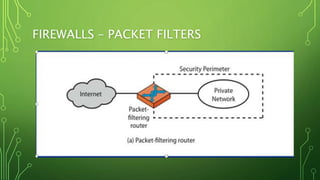
FIREWALLS – PACKET FILTERS
• Simplest of components
• Uses transport-layer information only
• IP Source Address, Destination Address
• Protocol/Next Header (TCP, UDP, ICMP, etc)
• TCP or UDP source & destination ports
• TCP Flags (SYN, ACK, FIN, RST, PSH, etc)
• ICMP message type
• Examples
• DNS uses port 53
• No incoming port 53 packets except known trusted servers
SECURITY & PERFORMANCE OF PACKET FILTERS
• IP address spoofing
• Fake source address to be trusted
• Add filters on router to block
• Tiny fragment attacks
• Split TCP header info over several tiny packets
• Either discard or reassemble before check
• Degradation depends on number of rules applied at any point
• Order rules so that most common traffic is dealt with first
• Correctness is more important than speed
PORT NUMBERING
• TCP connection
• Server port is number less than 1024
• Client port is number between 1024 and 16383
• Permanent assignment
• Ports <1024 assigned permanently
• 20,21 for FTP 23 for Telnet
• 25 for server SMTP 80 for HTTP
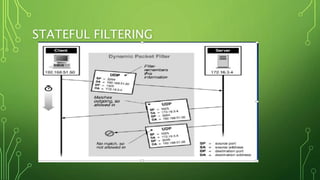
FIREWALLS – STATEFUL PACKET FILTERS
• Traditional packet filters do not examine higher layer context
• ie matching return packets with outgoing flow
• Stateful packet filters address this need
• They examine each IP packet in context
• Keep track of client-server sessions
• Check each packet validly belongs to one
STATEFUL FILTERING
FIREWALL OUTLINES
• Packet filtering
• Application gateways
• Circuit gateways
• Combination of above is dynamic packet filter
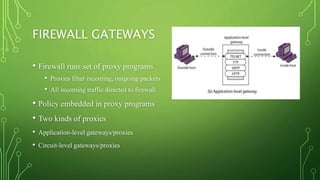
FIREWALL GATEWAYS
• Firewall runs set of proxy programs
• Proxies filter incoming, outgoing packets
• All incoming traffic directed to firewall
• Policy embedded in proxy programs
• Two kinds of proxies
• Application-level gateways/proxies
• Circuit-level gateways/proxies
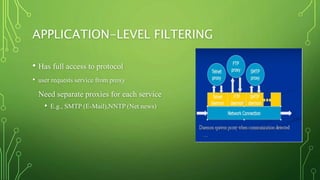
APPLICATION-LEVEL FILTERING
• Has full access to protocol
• user requests service from proxy
Need separate proxies for each service
• E.g., SMTP (E-Mail),NNTP (Net news)
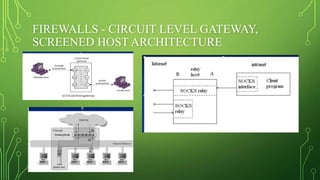
FIREWALLS - CIRCUIT LEVEL GATEWAY,
SCREENED HOST ARCHITECTURE
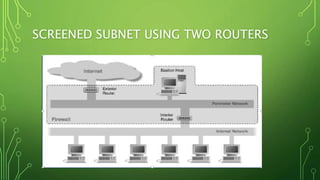
SCREENED SUBNET USING TWO ROUTERS
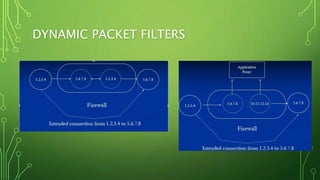
DYNAMIC PACKET FILTERS
• Most common
• Provide good administrators protection and full transparency
• Network given full control over traffic
• Captures semantics of a connection
DYNAMIC PACKET FILTERS
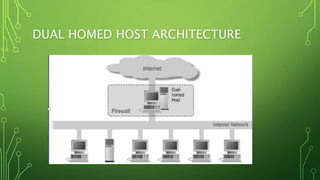
DUAL HOMED HOST ARCHITECTURE
ADDITIONAL FIREWALL FUNCTIONS
Firewalls are ideally situated for performing several additional function
These function include network address transation(NAT) one ip address to

another details logging of traffic and encryption necessary communication
channel(VPNs)
NETWORK ADDRESS TRANSLATION(NAT)
• Static nat
• Dynamic nat
• port address translation
• Auditind and logging
• Virtual private network
NETWORK ADDRESS TRANSLATION(NAT)
• NAT is usually implemented in a firewall separately from the policy or rule
set
• It useful to remember that just because a NAT has been defind to translate
addresses between one host and another
THANK YOU

Firewall in Network Security

  • 1.
  • 2.
    UNDERSTANDING FIREWALLS • Firewallscome in many different shapes and size and sometime the firewall is actually a collection of several different computer. • All communication must pass through the firewall.The effectiveness of the firewall is greatly reduced if an alternative network routing path • The firewall permits only traffic that is authorized.The firewall cannot be relied upon to differentiate between authorized and unauthorized traffic
  • 3.
    • The firewallcan withstand attacks upon itself.The firewall is relied upon to stop attacks and nothing is deployed to protect the firewall • Firewall strengths and weaknesses: Firewall are singular in purpose .compromises do not need to be made between security and usability Firewall are excellent auditor. Plenty of disk space or remote logging capabilities Firewall are very good at alerting appropriate people of specified events
  • 4.
    • Firewall weaknesses: Firewallare only as effective as the rules they are configured to enforce Firewall cannot stop social engineering attacks or an authorized user intentionally using their access for malicious packet filters Application gateways Circuit _ level gateways Stateful packet _ inspection engines Combination of above is dynamic packet filter
  • 5.
  • 6.
    FIREWALLS – PACKETFILTERS • Simplest of components • Uses transport-layer information only • IP Source Address, Destination Address • Protocol/Next Header (TCP, UDP, ICMP, etc) • TCP or UDP source & destination ports • TCP Flags (SYN, ACK, FIN, RST, PSH, etc) • ICMP message type • Examples • DNS uses port 53 • No incoming port 53 packets except known trusted servers
  • 7.
    SECURITY & PERFORMANCEOF PACKET FILTERS • IP address spoofing • Fake source address to be trusted • Add filters on router to block • Tiny fragment attacks • Split TCP header info over several tiny packets • Either discard or reassemble before check • Degradation depends on number of rules applied at any point • Order rules so that most common traffic is dealt with first • Correctness is more important than speed
  • 8.
    PORT NUMBERING • TCPconnection • Server port is number less than 1024 • Client port is number between 1024 and 16383 • Permanent assignment • Ports <1024 assigned permanently • 20,21 for FTP 23 for Telnet • 25 for server SMTP 80 for HTTP
  • 9.
    FIREWALLS – STATEFULPACKET FILTERS • Traditional packet filters do not examine higher layer context • ie matching return packets with outgoing flow • Stateful packet filters address this need • They examine each IP packet in context • Keep track of client-server sessions • Check each packet validly belongs to one
  • 10.
  • 11.
    FIREWALL OUTLINES • Packetfiltering • Application gateways • Circuit gateways • Combination of above is dynamic packet filter
  • 12.
    FIREWALL GATEWAYS • Firewallruns set of proxy programs • Proxies filter incoming, outgoing packets • All incoming traffic directed to firewall • Policy embedded in proxy programs • Two kinds of proxies • Application-level gateways/proxies • Circuit-level gateways/proxies
  • 13.
    APPLICATION-LEVEL FILTERING • Hasfull access to protocol • user requests service from proxy Need separate proxies for each service • E.g., SMTP (E-Mail),NNTP (Net news)
  • 14.
    FIREWALLS - CIRCUITLEVEL GATEWAY, SCREENED HOST ARCHITECTURE
  • 15.
  • 16.
    DYNAMIC PACKET FILTERS •Most common • Provide good administrators protection and full transparency • Network given full control over traffic • Captures semantics of a connection
  • 17.
  • 18.
    DUAL HOMED HOSTARCHITECTURE
  • 19.
    ADDITIONAL FIREWALL FUNCTIONS Firewallsare ideally situated for performing several additional function These function include network address transation(NAT) one ip address to another details logging of traffic and encryption necessary communication channel(VPNs)
  • 20.
    NETWORK ADDRESS TRANSLATION(NAT) •Static nat • Dynamic nat • port address translation • Auditind and logging • Virtual private network
  • 21.
    NETWORK ADDRESS TRANSLATION(NAT) •NAT is usually implemented in a firewall separately from the policy or rule set • It useful to remember that just because a NAT has been defind to translate addresses between one host and another
  • 22.