Topic
Controlling points, Faults, Causes
and Remedies Involved in
Different Finishing Processes of
Knit Fabric
SUPERVISING FACULTY:
RAJIB SAHA
ASSISTANT PROFESSOR
DEPARTMENT OF TEXTILE ENGINEERING
SOUTHEAST UNIVERSITY
Prepared ByNAME ID NUMBER
IMRAN HOSSAIN 2009000400079
MD.SAIFUDDIN KHAN 2009000400034
Faruk Ahammed 2009000400007
TANZIR 2009000400016
MD.AMINUL ISLAM 2009000400104
Introduction
In textile manufacturing, finishing refers to the
processes that convert the woven or knitted cloth into
a usable material and more specifically to any process
performed after dyeing the yarn or fabric to improve
the look, performance, or "hand" (feel) of the finished
textile or clothing. The precise meaning depends on
context.
Objects
To improve the appearance of the fabric,
To improve the feel of the fabric by softening, stiffening, etc.
To improve wearing qualities of cloth by making it shrink
resistant, crease resistant or free from pills and soiling.
To make garments hold their shape and enable them to be
worn without ironing.
To impart special properties to the fabric for specific end
uses.
To set the texture of certain fabrics and make others
dimensionally stable.
To produce stronger and more durable fabrics.
Classification
Mechanical Chemical
Permanent
Or Durable
Temporary
Permanent
Or Durable
Temporary
Calendarin
g Raising Starching
Finishing
Resin,
Softening,
Mercirization,
Water
Repellent.
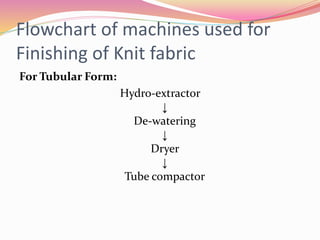
Flowchart of machines used for
Finishing of Knit fabric
For Tubular Form:
Hydro-extractor
↓
De-watering
↓
Dryer
↓
Tube compactor
For Open Form :
Hydro-extractor
↓
De-watering
↓
Dryer
↓
Slitter
↓
Stenter
↓
Open Compactor
Hydro Extractor
Functions:
To extract water from fabric.
It is used for collar, cuff, and when fabric quantity is
low.
Controlling point:
Speed
Hydro Extractor
Faults Causes Remedies
Crease Mark
 Damp fabric moving at
high speed in twisted
form, in the Hydro
extractor (Centrifuge)
 Use anti Crease, during
the Scouring & the
Dyeing process
 (The use of anti Crease,
swells the Cellulose &
prevents the formation of
Crease marks)
 Spread the fabric in loose
& open form & not in the
rope form, in the Hydro
Extractor.
Dewatering
Function:
To remove excess water from the fabric, about 70-75%.
Facilates the use of softener.
Controlling points:
Speed
Padder Pressure
Ballooning
Dewatering
Faults Causes Remedies
Wet Squeezer Marks
 These marks are caused due
to the excessive pressure, of
the squeezer rolls of the
Padding Mangle, on the wet
fabric
 Use the Padding mangle,
only for the application of
the softener.
 Use a hydro extractor
(Centrifuge) for the
extraction, to avoid the
squeezer roll marks.
 Soon after extraction, open
the fabric manually, to
prevent crease marks in the
damp fabric.
Softener Mark
 Improper mixing of the
Softener.
 Improper running time of
the fabric during application
of softener.
 Entanglement of the fabric
during application of
softener.
 Maintaining proper reel
sped & pumps speed.
 Proper Mixing of the
softener before addition.
 Prevent the entanglement of
the fabric during application
of softener.
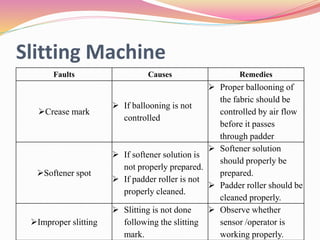
Slitting Machine
Function:
Slit the tube fabric into open from
Remove excess water from fabric about 70-75% water
Controlling points:
Slitting point
Speed
Padder Pressure
Ballooning
Slitting Machine
Faults Causes Remedies
Crease mark
 If ballooning is not
controlled
 Proper ballooning of
the fabric should be
controlled by air flow
before it passes
through padder
Softener spot
 If softener solution is
not properly prepared.
 If padder roller is not
properly cleaned.
 Softener solution
should properly be
prepared.
 Padder roller should be
cleaned properly.
Improper slitting
 Slitting is not done
following the slitting
mark.
 Observe whether
sensor /operator is
working properly.
Dryer
Function:
 To dry the fabric
 Both open & tube form fabric can be dried here
 Mainly GSM highly fabric is dried.
Controlling points:
 Speed
 Temperature
Dryer
Faults Causes Remedies
Overheating and Shade
Variation.
 If speed and temperature
of fabric is not properly
controlled.
 Temperature & speed
should be controlled
properly.
Stenter
Function:
Sometimes used to dry wet fabric
Controlled GSM of fabric
Controlled Dia of fabric
Controlled shrinkage of fabric
Controlled Spirality of fabric
Item set of synthetic Fabric.
Controlling point:
Temperature & Speed:
 For curing of pigment dyed fabric
Stenter
 For Heat Setting
Fabric type Temperature Speed
Lycra 190°c 17-20 m/min
Polyester 185°c 17-20m/min
Stenter
Overfeed
Padder pressure
Skew and Bow
Stenter
Faults Causes Remedies
Startch stains and white lines on
finished cloth
 Starch stains and white lines
on the finished cloth are
produced because of
incomplete dissolution of the
starch in the padding liquour.
 Fabric should be desized and
restarched.
Longitudinal Creases
 Longitudinal creases are
produced if the cloth passes
on non-uniform cylinders
after starching.
 The cloth should be padded
in a solution of hot water and
dried on an even surface.
Wrong and narrow width
 Frequent stoppages during
mercerization or drying
produce cloth with non-
uniform width.
 Cloth should be passed again
through the Stenter to get the
required width.
Stenter
Faults Causes Remedies
Softener Mark
 Improper mixing of the Softener.
 Improper running time of the
fabric during application of
softener.
 Entanglement of the fabric
during application of softener.
 Maintaining proper reel sped &
pumps speed.
 Proper Mixing of the softener
before addition.
 Prevent the entanglement of the
fabric during application of
softener.
Crease Mark
 Poor opening of the fabric rope.
 Shock cooling of synthetic
material.
 If pump pressure & reel speed is
not equal
 Due to high speed m/c running.
 Maintaining proper reel sped &
pumps speed.
 Lower rate rising and cooling the
temperature.
 Reducing the m/c load.
 Higher liquor ratio
GSM variation & width variation for
 Improper heat setting  Mention properly heat setting.
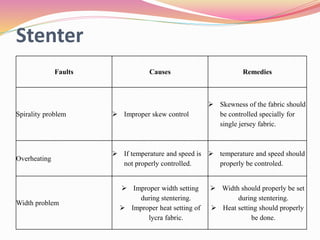
Stenter
Faults Causes Remedies
Spirality problem  Improper skew control
 Skewness of the fabric should
be controlled specially for
single jersey fabric.
Overheating
 If temperature and speed is
not properly controlled.
 temperature and speed should
properly be controled.
Width problem
 Improper width setting
during stentering.
 Improper heat setting of
lycra fabric.
 Width should properly be set
during stentering.
 Heat setting should properly
be done.
Compactor
Function:
Increases G.S.M. of fabric
Control dia of fabric
Calendar the fabric
CompactorControlling points:
Overfeed
Width
Padder pressure:
Chart Of Padder Pressure For Different Types of fabrics:
Fabric Pressure (lb/inch2)
Single jersey 9-18
1*1 RIB 18-33
Double pique 18-27
Others 18
Compactor
Faults Causes Remedies
Folding Marks
 High pressure of the fabric Take
Down rollers of the Knitting
machine, on the grey fabric, is
one of the main causes.
 Too much pressure of the feeding
rolls of the Calendar &
Compactor is, the primary cause
of the folding marks, in the
knitted fabric.
 Adjust the gap between the two
rolls, as per the thickness of the
fabric sheet (Pique, S.J. etc.)
 Gap between the two Calendar
rolls should be just enough, to let
the rolls remove, the wrinkles in
the fabric, but put no pressure on
the fabric sheet, especially in the
case of Pique & structured
fabrics
Skewing or Diagonal Grain Lines
(Wales)
 Improper feeding of the fabric,
while Calendaring &
Compacting.
 Keep a slit line on one side of the
tubular fabric.
 Use the slit line, as a reference
line, to keep the grain lines
straight, while feeding the fabric
slowly, on the Calender, or the
Compactor machines
Compactor
Faults Causes Remedies
GSM Variation
 Roll to roll variation in
the, process parameters,
of the fabric, like;
Overfeed & Widthwise
stretching of the dyed
fabric, on the Stenter,
Calendar & Compactor
machines.
 Roll to roll variation in
the fabric stitch length.
 Make sure that all the
fabric rolls in a lot, are
processed under the same
process parameters.
 The Knitting Machine
settings, like; the Quality
Pulley diameter etc.
should never be
disturbed.
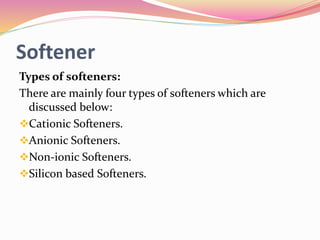
Softener
Softening treatment is one of the most important chemical after treatments in
the textile industry. By softening treatment textile can achieve not only soft
handle but also:
 Some smoothness.
 More flexibility.
 Drape and Pliability.
 Antistatic properties.
 Luster.
 Soft handle.
Softener
Types of softeners:
There are mainly four types of softeners which are
discussed below:
Cationic Softeners.
Anionic Softeners.
Non-ionic Softeners.
Silicon based Softeners.
Softener
Chemical Softness Lubricity Hydro-
philicity
Substant
ivity
Stability
to
yellowin
g
None
foaming
Anionic + ++ ++ – ++ –
Cationic +++ – – +++ – +
Non-ionic + – – – ++ +
Silicones +++ +++ – to + +++ +++ to + ++
Comparison among various properties of different softeners :
ConclusionWe all have tried our level best in accomplishing the project. Although we know
there was a vast chance and field for working with the project but due to some lack of
time we came up with best. We are greatly thankful to the management and staffs of
the companies namely “MASCO TEXTILES INDUSTRIES”, “NAZ BANGLADESH LTD”
AND “PADMA POLY COTTON KNIT FABRICS LTD”. Without their constant support
it could not have been possible. In our project we came up mainly with different kinds
of finishing faults in different machines and their remedies. We express our heartiest
thanks to our project supervisor and honorable teacher, RAJIB SAHA, Assistant
Professor of the Department of Textile Engineering for his logical guidelines, constant
inspirations, necessary instructions and proper supervision. We could have done
much better if we could have gathered more practical based knowledge.
.
Thanks Giving
First of all, I am grateful to the ALMIGHTY ALLAH for enabling us to
complete the project successfully.
I would also like to thank our respected teachers of SOUTHEAST
UNIVERSITY for giving us the opportunity and helping us in all possible
ways to finish the project successfully and also for their valuable
suggestions. My deepest appreciation goes to our honorable Chairman
Professor SYED FAKHRUL HASSAN, Head, Department of Textile
Engineering, SEU and A.N.M AHMEDULLAH SIR, CO-ORDINATOR
OF THE DEPARTMENT for their continuous encouragement and valuable
suggestions. We express our heartiest thanks to our project supervisor and
honorable teacher, RAJIB SAHA, Assistant Professor of the department for
his logical guidelines, constant inspirations, necessary instructions and
proper supervision
A special thanks to all other faculty members for their continuous
encouragement and valuable suggestions all throughout our work.
Thanks To All

Controlling points, Faults, Causes and Remedies Involved in Different Finishing Processes of Knit Fabric

  • 2.
    Topic Controlling points, Faults,Causes and Remedies Involved in Different Finishing Processes of Knit Fabric
  • 3.
    SUPERVISING FACULTY: RAJIB SAHA ASSISTANTPROFESSOR DEPARTMENT OF TEXTILE ENGINEERING SOUTHEAST UNIVERSITY
  • 4.
    Prepared ByNAME IDNUMBER IMRAN HOSSAIN 2009000400079 MD.SAIFUDDIN KHAN 2009000400034 Faruk Ahammed 2009000400007 TANZIR 2009000400016 MD.AMINUL ISLAM 2009000400104
  • 5.
    Introduction In textile manufacturing,finishing refers to the processes that convert the woven or knitted cloth into a usable material and more specifically to any process performed after dyeing the yarn or fabric to improve the look, performance, or "hand" (feel) of the finished textile or clothing. The precise meaning depends on context.
  • 6.
    Objects To improve theappearance of the fabric, To improve the feel of the fabric by softening, stiffening, etc. To improve wearing qualities of cloth by making it shrink resistant, crease resistant or free from pills and soiling. To make garments hold their shape and enable them to be worn without ironing. To impart special properties to the fabric for specific end uses. To set the texture of certain fabrics and make others dimensionally stable. To produce stronger and more durable fabrics.
  • 7.
    Classification Mechanical Chemical Permanent Or Durable Temporary Permanent OrDurable Temporary Calendarin g Raising Starching Finishing Resin, Softening, Mercirization, Water Repellent.
  • 8.
    Flowchart of machinesused for Finishing of Knit fabric For Tubular Form: Hydro-extractor ↓ De-watering ↓ Dryer ↓ Tube compactor
  • 9.
    For Open Form: Hydro-extractor ↓ De-watering ↓ Dryer ↓ Slitter ↓ Stenter ↓ Open Compactor
  • 10.
    Hydro Extractor Functions: To extractwater from fabric. It is used for collar, cuff, and when fabric quantity is low. Controlling point: Speed
  • 11.
    Hydro Extractor Faults CausesRemedies Crease Mark  Damp fabric moving at high speed in twisted form, in the Hydro extractor (Centrifuge)  Use anti Crease, during the Scouring & the Dyeing process  (The use of anti Crease, swells the Cellulose & prevents the formation of Crease marks)  Spread the fabric in loose & open form & not in the rope form, in the Hydro Extractor.
  • 12.
    Dewatering Function: To remove excesswater from the fabric, about 70-75%. Facilates the use of softener. Controlling points: Speed Padder Pressure Ballooning
  • 13.
    Dewatering Faults Causes Remedies WetSqueezer Marks  These marks are caused due to the excessive pressure, of the squeezer rolls of the Padding Mangle, on the wet fabric  Use the Padding mangle, only for the application of the softener.  Use a hydro extractor (Centrifuge) for the extraction, to avoid the squeezer roll marks.  Soon after extraction, open the fabric manually, to prevent crease marks in the damp fabric. Softener Mark  Improper mixing of the Softener.  Improper running time of the fabric during application of softener.  Entanglement of the fabric during application of softener.  Maintaining proper reel sped & pumps speed.  Proper Mixing of the softener before addition.  Prevent the entanglement of the fabric during application of softener.
  • 14.
    Slitting Machine Function: Slit thetube fabric into open from Remove excess water from fabric about 70-75% water Controlling points: Slitting point Speed Padder Pressure Ballooning
  • 15.
    Slitting Machine Faults CausesRemedies Crease mark  If ballooning is not controlled  Proper ballooning of the fabric should be controlled by air flow before it passes through padder Softener spot  If softener solution is not properly prepared.  If padder roller is not properly cleaned.  Softener solution should properly be prepared.  Padder roller should be cleaned properly. Improper slitting  Slitting is not done following the slitting mark.  Observe whether sensor /operator is working properly.
  • 16.
    Dryer Function:  To drythe fabric  Both open & tube form fabric can be dried here  Mainly GSM highly fabric is dried. Controlling points:  Speed  Temperature
  • 17.
    Dryer Faults Causes Remedies Overheatingand Shade Variation.  If speed and temperature of fabric is not properly controlled.  Temperature & speed should be controlled properly.
  • 18.
    Stenter Function: Sometimes used todry wet fabric Controlled GSM of fabric Controlled Dia of fabric Controlled shrinkage of fabric Controlled Spirality of fabric Item set of synthetic Fabric. Controlling point: Temperature & Speed:  For curing of pigment dyed fabric
  • 19.
    Stenter  For HeatSetting Fabric type Temperature Speed Lycra 190°c 17-20 m/min Polyester 185°c 17-20m/min
  • 20.
  • 21.
    Stenter Faults Causes Remedies Startchstains and white lines on finished cloth  Starch stains and white lines on the finished cloth are produced because of incomplete dissolution of the starch in the padding liquour.  Fabric should be desized and restarched. Longitudinal Creases  Longitudinal creases are produced if the cloth passes on non-uniform cylinders after starching.  The cloth should be padded in a solution of hot water and dried on an even surface. Wrong and narrow width  Frequent stoppages during mercerization or drying produce cloth with non- uniform width.  Cloth should be passed again through the Stenter to get the required width.
  • 22.
    Stenter Faults Causes Remedies SoftenerMark  Improper mixing of the Softener.  Improper running time of the fabric during application of softener.  Entanglement of the fabric during application of softener.  Maintaining proper reel sped & pumps speed.  Proper Mixing of the softener before addition.  Prevent the entanglement of the fabric during application of softener. Crease Mark  Poor opening of the fabric rope.  Shock cooling of synthetic material.  If pump pressure & reel speed is not equal  Due to high speed m/c running.  Maintaining proper reel sped & pumps speed.  Lower rate rising and cooling the temperature.  Reducing the m/c load.  Higher liquor ratio GSM variation & width variation for  Improper heat setting  Mention properly heat setting.
  • 23.
    Stenter Faults Causes Remedies Spiralityproblem  Improper skew control  Skewness of the fabric should be controlled specially for single jersey fabric. Overheating  If temperature and speed is not properly controlled.  temperature and speed should properly be controled. Width problem  Improper width setting during stentering.  Improper heat setting of lycra fabric.  Width should properly be set during stentering.  Heat setting should properly be done.
  • 24.
    Compactor Function: Increases G.S.M. offabric Control dia of fabric Calendar the fabric
  • 25.
    CompactorControlling points: Overfeed Width Padder pressure: ChartOf Padder Pressure For Different Types of fabrics: Fabric Pressure (lb/inch2) Single jersey 9-18 1*1 RIB 18-33 Double pique 18-27 Others 18
  • 26.
    Compactor Faults Causes Remedies FoldingMarks  High pressure of the fabric Take Down rollers of the Knitting machine, on the grey fabric, is one of the main causes.  Too much pressure of the feeding rolls of the Calendar & Compactor is, the primary cause of the folding marks, in the knitted fabric.  Adjust the gap between the two rolls, as per the thickness of the fabric sheet (Pique, S.J. etc.)  Gap between the two Calendar rolls should be just enough, to let the rolls remove, the wrinkles in the fabric, but put no pressure on the fabric sheet, especially in the case of Pique & structured fabrics Skewing or Diagonal Grain Lines (Wales)  Improper feeding of the fabric, while Calendaring & Compacting.  Keep a slit line on one side of the tubular fabric.  Use the slit line, as a reference line, to keep the grain lines straight, while feeding the fabric slowly, on the Calender, or the Compactor machines
  • 27.
    Compactor Faults Causes Remedies GSMVariation  Roll to roll variation in the, process parameters, of the fabric, like; Overfeed & Widthwise stretching of the dyed fabric, on the Stenter, Calendar & Compactor machines.  Roll to roll variation in the fabric stitch length.  Make sure that all the fabric rolls in a lot, are processed under the same process parameters.  The Knitting Machine settings, like; the Quality Pulley diameter etc. should never be disturbed.
  • 28.
    Softener Softening treatment isone of the most important chemical after treatments in the textile industry. By softening treatment textile can achieve not only soft handle but also:  Some smoothness.  More flexibility.  Drape and Pliability.  Antistatic properties.  Luster.  Soft handle.
  • 29.
    Softener Types of softeners: Thereare mainly four types of softeners which are discussed below: Cationic Softeners. Anionic Softeners. Non-ionic Softeners. Silicon based Softeners.
  • 30.
    Softener Chemical Softness LubricityHydro- philicity Substant ivity Stability to yellowin g None foaming Anionic + ++ ++ – ++ – Cationic +++ – – +++ – + Non-ionic + – – – ++ + Silicones +++ +++ – to + +++ +++ to + ++ Comparison among various properties of different softeners :
  • 31.
    ConclusionWe all havetried our level best in accomplishing the project. Although we know there was a vast chance and field for working with the project but due to some lack of time we came up with best. We are greatly thankful to the management and staffs of the companies namely “MASCO TEXTILES INDUSTRIES”, “NAZ BANGLADESH LTD” AND “PADMA POLY COTTON KNIT FABRICS LTD”. Without their constant support it could not have been possible. In our project we came up mainly with different kinds of finishing faults in different machines and their remedies. We express our heartiest thanks to our project supervisor and honorable teacher, RAJIB SAHA, Assistant Professor of the Department of Textile Engineering for his logical guidelines, constant inspirations, necessary instructions and proper supervision. We could have done much better if we could have gathered more practical based knowledge. .
  • 32.
    Thanks Giving First ofall, I am grateful to the ALMIGHTY ALLAH for enabling us to complete the project successfully. I would also like to thank our respected teachers of SOUTHEAST UNIVERSITY for giving us the opportunity and helping us in all possible ways to finish the project successfully and also for their valuable suggestions. My deepest appreciation goes to our honorable Chairman Professor SYED FAKHRUL HASSAN, Head, Department of Textile Engineering, SEU and A.N.M AHMEDULLAH SIR, CO-ORDINATOR OF THE DEPARTMENT for their continuous encouragement and valuable suggestions. We express our heartiest thanks to our project supervisor and honorable teacher, RAJIB SAHA, Assistant Professor of the department for his logical guidelines, constant inspirations, necessary instructions and proper supervision A special thanks to all other faculty members for their continuous encouragement and valuable suggestions all throughout our work.
  • 33.