FABRIC FINISHING
TECHNIQUES
(TXT-175)
Presentation by:
Abdul Subhan (AMM 01)
What is Textile Finishing?
In textile manufacturing, finishing refers to the processes
that convert the woven or knitted cloth into a usable
material and more specifically to any process performed
after dyeing the yarn or fabric to improve the look,
performance, or "hand" (feel) of the finished textile or
clothing.
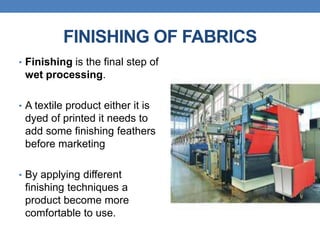
FINISHING OF FABRICS
• Finishing is the final step of
wet processing.
• A textile product either it is
dyed of printed it needs to
add some finishing feathers
before marketing
• By applying different
finishing techniques a
product become more
comfortable to use.
Finishing Processes
Finishing processes can be divided into two broad classes:
physical and chemical. In most cases finishing comprises 3
stages:
• Washing
• Drying
• Pressing and aesthetics
Washing
• Washing processes are essential to ensure that fabrics
are not contaminated and are preparatory for other
finishing stages. Processes that are carried out during
washing include:
1. Bleaching: Whitens the fabric by destroying the colour
in the fabric
2. Carbonizing: Removing vegetable from wool in an
acidic treatment
3. Desizing: Removing any sizing in the warp threads
4. Scouring: Removing any dirt, wax or grease accumula:
ted in the manufacture process.
Drying
• During drying, most performance-enhancing chemical
finishes are applied. Chemical finishes can be either
subtractive or additive. An additive finish increases the
mass of the fabric by absorbing onto the surface or into
the fibre.
Classification of Finishing by degree
• Permanent Finishes: It involves a chemical change in
fiber structure and do not change throughout the life of a
fabric
• Durable Finishes: Usually lasts throughout the life of a
fabric, effectiveness becomes diminished after each
cleaning and near the end of normal use life of the fabrics,
the finishing is nearly removed
• Semi-Durable Finishes: Usually last several launderings
or dry cleaning and many are removal in home laundering
or dry cleaning
• Temporary Finishes: Removed or substantionaly
diminished the first time an article is laundered or dry
cleaning
Objectives of Finishing
1. To improve attractiveness of the fabric
2. To increase the life time or durability of the fabric
3. To meet up specific requirement of the fabric for achieve
the final goal
In the end
• Finishing plays an important role in the modern age.
• Everyone likes to wear finished products with some
special types of finishing.
• Finishing of the fabric depends on the requirement of the
buyer.
• Different types of finishing machines are used in finishing
operating
Fabric finishing techniques by Subhan

Fabric finishing techniques by Subhan

  • 1.
  • 2.
    What is TextileFinishing? In textile manufacturing, finishing refers to the processes that convert the woven or knitted cloth into a usable material and more specifically to any process performed after dyeing the yarn or fabric to improve the look, performance, or "hand" (feel) of the finished textile or clothing.
  • 3.
    FINISHING OF FABRICS •Finishing is the final step of wet processing. • A textile product either it is dyed of printed it needs to add some finishing feathers before marketing • By applying different finishing techniques a product become more comfortable to use.
  • 4.
    Finishing Processes Finishing processescan be divided into two broad classes: physical and chemical. In most cases finishing comprises 3 stages: • Washing • Drying • Pressing and aesthetics
  • 5.
    Washing • Washing processesare essential to ensure that fabrics are not contaminated and are preparatory for other finishing stages. Processes that are carried out during washing include: 1. Bleaching: Whitens the fabric by destroying the colour in the fabric 2. Carbonizing: Removing vegetable from wool in an acidic treatment 3. Desizing: Removing any sizing in the warp threads 4. Scouring: Removing any dirt, wax or grease accumula: ted in the manufacture process.
  • 6.
    Drying • During drying,most performance-enhancing chemical finishes are applied. Chemical finishes can be either subtractive or additive. An additive finish increases the mass of the fabric by absorbing onto the surface or into the fibre.
  • 7.
    Classification of Finishingby degree • Permanent Finishes: It involves a chemical change in fiber structure and do not change throughout the life of a fabric • Durable Finishes: Usually lasts throughout the life of a fabric, effectiveness becomes diminished after each cleaning and near the end of normal use life of the fabrics, the finishing is nearly removed • Semi-Durable Finishes: Usually last several launderings or dry cleaning and many are removal in home laundering or dry cleaning • Temporary Finishes: Removed or substantionaly diminished the first time an article is laundered or dry cleaning
  • 8.
    Objectives of Finishing 1.To improve attractiveness of the fabric 2. To increase the life time or durability of the fabric 3. To meet up specific requirement of the fabric for achieve the final goal
  • 9.
    In the end •Finishing plays an important role in the modern age. • Everyone likes to wear finished products with some special types of finishing. • Finishing of the fabric depends on the requirement of the buyer. • Different types of finishing machines are used in finishing operating