SEMINAR ON TEXTILE
FINISHING
Aastha Singh
12tt001
8/21/2015 1TIT&S,BHIWANI
INTRODUCTION
 Textile Finishing is a process used in manufacturing
of fiber, fabric, or clothing.
 Finishing involves subjecting the textile material to
different physical and chemical treatments, so as to
impart required functional properties to it.
 For example wash and wear finish for a cotton fabric
is necessary to make it crease free or wrinkle free.
8/21/2015 2TIT&S,BHIWANI
IMPORTANCE
 To improve fabric attractiveness.
 To improve serviceability.
 To give desirable qualities to fabric.
 To improve the feel of the fabric.
 To cover faults in the original fabric.
 To improve wearing qualities of fabric by making it shrink or
crease resistant.
 To set garment shape. E.g. Durable press.[4]
 To import special properties to the fabric for special end uses such
as waterproofing, flame-proofing etc.
 To strengthen the fabric by coating or laminating.
 To produce novelty effects e.g. organdie fabrics by parchment
sing
8/21/2015 3TIT&S,BHIWANI
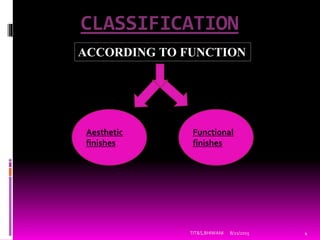
CLASSIFICATION
ACCORDING TO FUNCTION
Aesthetic
finishes
Functional
finishes
8/21/2015 4TIT&S,BHIWANI
Functional Finishes improve
the performance
properties of the fabric ;
like durability, strength etc.
 Antimicrobial/Antiseptic
 Crease resistant
 Durable Press
 Flame Resistant
 Mothproof
 Shrinkage Control
 Soil Release
 Water Proof/Repellant
Aesthetic Finishes modify the
appearance and /or hand or
drape of the fabrics.[5]
 Mercerization
 Napping And Sueding
 Shearing
 Softening
 Stiffening
8/21/2015 5TIT&S,BHIWANI
MERCERIZATION
 Mercerization is a treatment for cotton that gives
fabric a lustrous appearance.
 Alters the chemical structure of the cotton fiber.
The structure of the fiber changes from alpha-
cellulose to beta-cellulose.
 Results in the swelling of the cell wall of the
cotton fiber. This causes increases in the surface
area and reflectance, and gives the fiber a softer
feel.
8/21/2015TIT&S,BHIWANI 6
AESTHETICFINISH
8/21/2015 7TIT&S,BHIWANI
AESTHETICFINISH
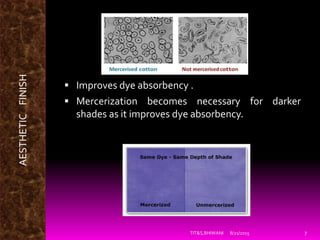
 Improves dye absorbency .
 Mercerization becomes necessary for darker
shades as it improves dye absorbency.
NAPPING
 It is a mechanical finish.
 Fibers are raised from woven/knitted fabrics by
rotating, bristled, wire covered brushes.
 Overall effect is raised fibers from fabric surface.
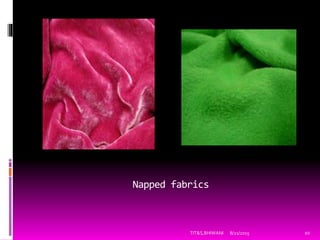
 Napped fabrics have softer handle.
 Better insulation properties due to more air
entrapment.
 Mainly used as blankets, winter clothing.
8/21/2015TIT&S,BHIWANI 8
AESTHETICFINISH
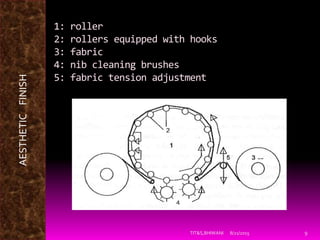
1: roller
2: rollers equipped with hooks
3: fabric
4: nib cleaning brushes
5: fabric tension adjustment
8/21/2015TIT&S,BHIWANI 9
AESTHETICFINISH
8/21/2015TIT&S,BHIWANI 10
Napped fabrics
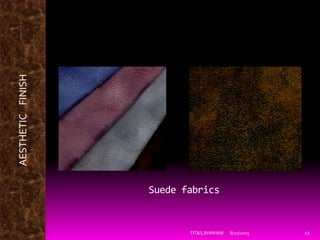
SUEDING
 It is a mechanical finish.
 Similar to napping.
 Produces a soft, suede-like surface.
 Sand paper like material is used instead of
rotating wire covered cylinder.
8/21/2015TIT&S,BHIWANI 11
AESTHETICFINISH
Suede fabrics
8/21/2015TIT&S,BHIWANI 12
AESTHETICFINISH
STIFFENING
• Forming a film on the surface of a fiber influences
the touch of the product and has a stiffening
effect.
• Stiffening agents
1. Starches – finishing of cotton cloth. Ex: potato ,
wheat, corn.
2. Dextrines – used for dyed and printed fabrics. No
undue effect on the dye or print.
3. Natural gum – mainly used in printing as well as
finishing process.
4. Resins
8/21/2015TIT&S,BHIWANI 13
AESTHETICFINISH
8/21/2015TIT&S,BHIWANI 14
Acid stiffening
 Fine yarn cotton fabrics can be finished to be
both stiff and transparent by this process.
 It involves rapid immersion in sulphuric acid,
followed by immediate neutralization in sodium
hydroxide.
 The finish is permanent. This finish is also known
as Organdi finish or Parchmentisation.
AESTHETICFINISH
SOFTENING
 Required for more pleasant hand and better
drapeability.
 Fabrics are harsher and stiffer because of their
construction or due to some prior finishing process.
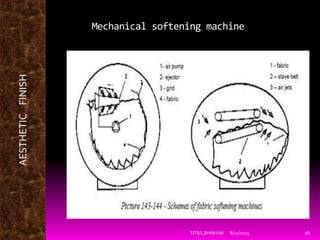
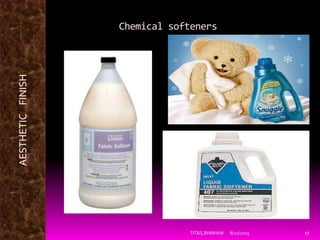
 Softening can be done by either mechanical or
chemical process.
8/21/2015TIT&S,BHIWANI 15
AESTHETICFINISH
Mechanical softening machine
8/21/2015TIT&S,BHIWANI 16
AESTHETICFINISH
Chemical softeners
8/21/2015TIT&S,BHIWANI 17
AESTHETICFINISH
CREASE RESISTANCE
8/21/2015TIT&S,BHIWANI 18
FUNCTIONALFINISH
Cotton, rayon and flax are more
susceptible to wrinkle OR crease.
Crease occurs due to the hydrogen bonds
of the cellulosic molecules in the
amorphous region.
Due to application of heat or moisture,
the hydrogen bond breaks and new
hydrogen bond occurs at new dimension.
Therefore creasing can be reduced if the
hydrogen bond formation can be
reduced.
 Creasing can be controlled by physical deposition of
a suitable polymeric material in amorphous region.[1]
 Or the hydroxy groups of adjacent macromolecules
may be reacted with bifunctional agents.
 Reacting cotton with acidified formaldehyde.
 CRF finishes are resin finishes.
 The fabric is saturated with resin and then the resin
is cured at temperatures of about 360°F.
 The fabric becomes stiffer, less absorbent and more
resistant to wrinkling.
8/21/2015TIT&S,BHIWANI 19
FUNCTIONALFINISH
ADVANTAGES:
 Improves comfort.
 Decreases pilling. [2]
 Increases ease of maintenance.
 Betters dimensional stability.
 Chemical treated cotton fabric dry more easily.
DISADVANTAGES:
 Decreased breaking strength( up to 28%).
 Decreased tearing strength.( up to 19%)
8/21/2015TIT&S,BHIWANI 20
FUNCTIONALFINISH
SOIL RELEASE
 What is soiling of textiles?
 Dirt or soil get attracted to textile material.
 Development of static charge electricity in
hydrophilic textiles, making them prone to soiling.
 Re-deposition of soil during washing.
 Hydrophobic materials are not wetted properly
during laundering.
 Mainly observed in polyester fabrics.
8/21/2015TIT&S,BHIWANI 21
FUNCTIONALFINISH
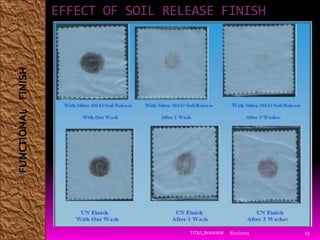
Advantages of soil release:
 Making the fibers more absorbent
(hydrophilic).
 Permitting better wettability for improved soil
removal.
 Done by using hydrophilic finishes.
 Facilitates soil release during washing.
 Prevent soil redeposition.
 Also, reduces static charge by maintaining
moisture on the fabric surface.
 Thus soil attraction during wear can be
reduced.
8/21/2015TIT&S,BHIWANI 22
FUNCTIONALFINISH
8/21/2015TIT&S,BHIWANI 23
EFFECT OF SOIL RELEASE FINISH
FUNCTIONALFINISH
ANTIMICROBIAL
8/21/2015TIT&S,BHIWANI 24
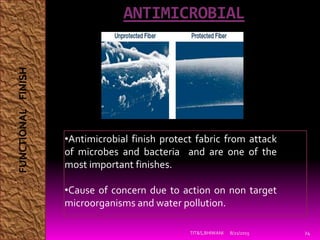
•Antimicrobial finish protect fabric from attack
of microbes and bacteria and are one of the
most important finishes.
•Cause of concern due to action on non target
microorganisms and water pollution.
FUNCTIONALFINISH
 Natural fibers such as cotton are more susceptible
than synthetics.
 Their porous hydrophilic structure retains water,
oxygen and nutrients, providing a perfect
environment for bacterial growth.
 The enzymes that degrade cotton are cellulase and
cellobiase and these reduce strength and produce
foul smell and color.
 Smelling spots and even holes are created on the
exposed fabric.
8/21/2015TIT&S,BHIWANI 25
FUNCTIONALFINISH
NATURAL PLANTS WHICH ARE USED
IN MAKING ANTIMICROBIAL FINISH
- CHITIN
- SERICIN
- NEEM EXTRACT
- NATURAL DYES
- ALOEVERA
- TEATREE
- EUCALYPTUS OIL
- AZUKAI BEANS
- TULSI LEAVES
8/21/2015TIT&S,BHIWANI 26
FUNCTIONALFINISH
CHITIN
 Chitin, is a natural, non-toxic , microbial resistant and
biodegradable polymer.[3]
 Chitin is one of the most abundant polysaccharides
found in nature , derived from marine shells and
mollusks.
 Chitin is applied on to the fabric by padding the
cotton fabric with a mixture of chitin and citric acid
followed by high temperature curing.
 The fixation of chitosan citrate solution onto cotton
fabrics followed by dry- cure process.
8/21/2015TIT&S,BHIWANI 27
FUNCTIONALFINISH
NEEM
8/21/2015TIT&S,BHIWANI 28
Photographs of (a) untreated and (b) neem seed
extract (5% w/v) treated cotton/PET blend (against
B.Subtilis bacteria)[6]
FUNCTIONALFINISH
 Neem has been recognized as one of the most
promising sources of compounds with insect
control, antimicrobial and medicinal properties.
 Work has been reported on its textile application as
an antimicrobial agent.
 Few patents based on the use of neem oil as an
antibacterial agent has been reported.
8/21/2015TIT&S,BHIWANI 29
FUNCTIONALFINISH
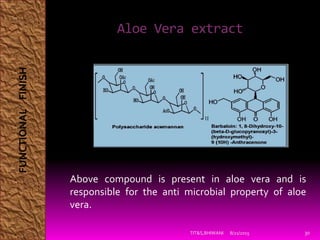
Aloe Vera extract
8/21/2015TIT&S,BHIWANI 30
Above compound is present in aloe vera and is
responsible for the anti microbial property of aloe
vera.
FUNCTIONALFINISH
8/21/2015TIT&S,BHIWANI 31
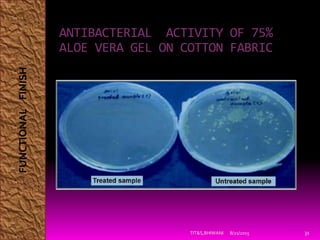
ANTIBACTERIAL ACTIVITY OF 75%
ALOE VERA GEL ON COTTON FABRIC
FUNCTIONALFINISH
8/21/2015TIT&S,BHIWANI 32
DEO2 FINISHED FABRIC
FUNCTIONALFINISH
 DEO2 arrests the growth of fungi and bacteria.
 Keeps fabric fresh and anti-odour even after day-
long wearing in humid and warm climate.
 Long-lasting (50 home washes) Anti-Microbial
property.
 Anti-Odor
 Avoids spread of infections from microbial
infestation.
 Reduces staining and degradation of fabrics by
providing better-UV protection.
8/21/2015TIT&S,BHIWANI 33
FUNCTIONALFINISH
FLAME RESISTANCE
8/21/2015TIT&S,BHIWANI 34
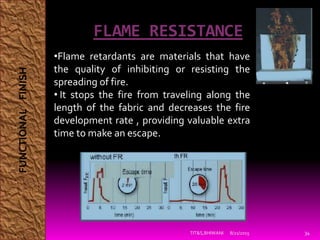
•Flame retardants are materials that have
the quality of inhibiting or resisting the
spreading of fire.
• It stops the fire from traveling along the
length of the fabric and decreases the fire
development rate , providing valuable extra
time to make an escape.
FUNCTIONALFINISH
 Fabric burns because of pyrolytic decomposition
of the fiber substrate.
 The products of this decomposition include
combustible gases, non combustible gases and
carbonaceous character.
HOWTO FLAME RETARDANTS WORK?
 Fire retardants interfere with combustion at
different stages of the process.
The different mechanisms are:
-ENDOTHERMIC DEGRADATION
- DILUTION OF FUEL
-THERMAL SHIELDING
8/21/2015TIT&S,BHIWANI 35
FUNCTIONALFINISH
- DILUTION OF GAS PHASE
- GAS PHASE RADICAL QUENCHING
Flame retardants interfere with flame at different
stages to cool the fabric and keep the temperature
below ignition temperature.
8/21/2015TIT&S,BHIWANI 36
FUNCTIONALFINISH
CONCLUSION
Fabric finishes play a major role in the garment. These
finishes are derived from both natural as well as
manmade sources. Finishes improve appearance of
fabric along with its performance and hence are divided
on the basis of aesthetic and functional properties. These
finishes come from both natural as well as manmade
sources. Finishes decrease crease, improve flame
retardation, provide softness and stiffness, decrease
pilling, raise fibers from fabric surface and also provide
protection against microbes, insects and bacteria.
Overall finishes play an important role in determining
cost and improving quality of fabric.
8/21/2015TIT&S,BHIWANI 37
REFERENCES
1. Dr.V. A . SHENAI,TECHNOLOGYOFTEXTILE
FINISHING
2. INDIAN JOURNAL OF fiber &TEXTILE RESEARCH
VOL. 34, JUNE 2009, PP 183-186
3. ALY A S, HASHEM A & SAYED HUSSEIN S, INDIAN
JOURNAL OF fiber &TEXTILE RESEARCHVOL. 29,
2004, P.NO 218
4. HTTP://TEXTILELEARNER.BLOGSPOT.IN/
5. WWW.fiber2FASHION.COM/INDUSTRY.../5/FLAM
E-RETARDANT-FINISHES1.ASP
6. M JOSHII, SWALI, S RAJENDRAN – JOURNALOF
APPLIED POLYMER SCIENCE, OCTOBER 2007,
VOL 106, PG-793-800
8/21/2015TIT&S,BHIWANI 38
8/21/2015TIT&S,BHIWANI 39

Seminar on textile finishing

  • 1.
    SEMINAR ON TEXTILE FINISHING AasthaSingh 12tt001 8/21/2015 1TIT&S,BHIWANI
  • 2.
    INTRODUCTION  Textile Finishingis a process used in manufacturing of fiber, fabric, or clothing.  Finishing involves subjecting the textile material to different physical and chemical treatments, so as to impart required functional properties to it.  For example wash and wear finish for a cotton fabric is necessary to make it crease free or wrinkle free. 8/21/2015 2TIT&S,BHIWANI
  • 3.
    IMPORTANCE  To improvefabric attractiveness.  To improve serviceability.  To give desirable qualities to fabric.  To improve the feel of the fabric.  To cover faults in the original fabric.  To improve wearing qualities of fabric by making it shrink or crease resistant.  To set garment shape. E.g. Durable press.[4]  To import special properties to the fabric for special end uses such as waterproofing, flame-proofing etc.  To strengthen the fabric by coating or laminating.  To produce novelty effects e.g. organdie fabrics by parchment sing 8/21/2015 3TIT&S,BHIWANI
  • 4.
  • 5.
    Functional Finishes improve theperformance properties of the fabric ; like durability, strength etc.  Antimicrobial/Antiseptic  Crease resistant  Durable Press  Flame Resistant  Mothproof  Shrinkage Control  Soil Release  Water Proof/Repellant Aesthetic Finishes modify the appearance and /or hand or drape of the fabrics.[5]  Mercerization  Napping And Sueding  Shearing  Softening  Stiffening 8/21/2015 5TIT&S,BHIWANI
  • 6.
    MERCERIZATION  Mercerization isa treatment for cotton that gives fabric a lustrous appearance.  Alters the chemical structure of the cotton fiber. The structure of the fiber changes from alpha- cellulose to beta-cellulose.  Results in the swelling of the cell wall of the cotton fiber. This causes increases in the surface area and reflectance, and gives the fiber a softer feel. 8/21/2015TIT&S,BHIWANI 6 AESTHETICFINISH
  • 7.
    8/21/2015 7TIT&S,BHIWANI AESTHETICFINISH  Improvesdye absorbency .  Mercerization becomes necessary for darker shades as it improves dye absorbency.
  • 8.
    NAPPING  It isa mechanical finish.  Fibers are raised from woven/knitted fabrics by rotating, bristled, wire covered brushes.  Overall effect is raised fibers from fabric surface.  Napped fabrics have softer handle.  Better insulation properties due to more air entrapment.  Mainly used as blankets, winter clothing. 8/21/2015TIT&S,BHIWANI 8 AESTHETICFINISH
  • 9.
    1: roller 2: rollersequipped with hooks 3: fabric 4: nib cleaning brushes 5: fabric tension adjustment 8/21/2015TIT&S,BHIWANI 9 AESTHETICFINISH
  • 10.
  • 11.
    SUEDING  It isa mechanical finish.  Similar to napping.  Produces a soft, suede-like surface.  Sand paper like material is used instead of rotating wire covered cylinder. 8/21/2015TIT&S,BHIWANI 11 AESTHETICFINISH
  • 12.
  • 13.
    STIFFENING • Forming afilm on the surface of a fiber influences the touch of the product and has a stiffening effect. • Stiffening agents 1. Starches – finishing of cotton cloth. Ex: potato , wheat, corn. 2. Dextrines – used for dyed and printed fabrics. No undue effect on the dye or print. 3. Natural gum – mainly used in printing as well as finishing process. 4. Resins 8/21/2015TIT&S,BHIWANI 13 AESTHETICFINISH
  • 14.
    8/21/2015TIT&S,BHIWANI 14 Acid stiffening Fine yarn cotton fabrics can be finished to be both stiff and transparent by this process.  It involves rapid immersion in sulphuric acid, followed by immediate neutralization in sodium hydroxide.  The finish is permanent. This finish is also known as Organdi finish or Parchmentisation. AESTHETICFINISH
  • 15.
    SOFTENING  Required formore pleasant hand and better drapeability.  Fabrics are harsher and stiffer because of their construction or due to some prior finishing process.  Softening can be done by either mechanical or chemical process. 8/21/2015TIT&S,BHIWANI 15 AESTHETICFINISH
  • 16.
  • 17.
  • 18.
    CREASE RESISTANCE 8/21/2015TIT&S,BHIWANI 18 FUNCTIONALFINISH Cotton,rayon and flax are more susceptible to wrinkle OR crease. Crease occurs due to the hydrogen bonds of the cellulosic molecules in the amorphous region. Due to application of heat or moisture, the hydrogen bond breaks and new hydrogen bond occurs at new dimension. Therefore creasing can be reduced if the hydrogen bond formation can be reduced.
  • 19.
     Creasing canbe controlled by physical deposition of a suitable polymeric material in amorphous region.[1]  Or the hydroxy groups of adjacent macromolecules may be reacted with bifunctional agents.  Reacting cotton with acidified formaldehyde.  CRF finishes are resin finishes.  The fabric is saturated with resin and then the resin is cured at temperatures of about 360°F.  The fabric becomes stiffer, less absorbent and more resistant to wrinkling. 8/21/2015TIT&S,BHIWANI 19 FUNCTIONALFINISH
  • 20.
    ADVANTAGES:  Improves comfort. Decreases pilling. [2]  Increases ease of maintenance.  Betters dimensional stability.  Chemical treated cotton fabric dry more easily. DISADVANTAGES:  Decreased breaking strength( up to 28%).  Decreased tearing strength.( up to 19%) 8/21/2015TIT&S,BHIWANI 20 FUNCTIONALFINISH
  • 21.
    SOIL RELEASE  Whatis soiling of textiles?  Dirt or soil get attracted to textile material.  Development of static charge electricity in hydrophilic textiles, making them prone to soiling.  Re-deposition of soil during washing.  Hydrophobic materials are not wetted properly during laundering.  Mainly observed in polyester fabrics. 8/21/2015TIT&S,BHIWANI 21 FUNCTIONALFINISH
  • 22.
    Advantages of soilrelease:  Making the fibers more absorbent (hydrophilic).  Permitting better wettability for improved soil removal.  Done by using hydrophilic finishes.  Facilitates soil release during washing.  Prevent soil redeposition.  Also, reduces static charge by maintaining moisture on the fabric surface.  Thus soil attraction during wear can be reduced. 8/21/2015TIT&S,BHIWANI 22 FUNCTIONALFINISH
  • 23.
    8/21/2015TIT&S,BHIWANI 23 EFFECT OFSOIL RELEASE FINISH FUNCTIONALFINISH
  • 24.
    ANTIMICROBIAL 8/21/2015TIT&S,BHIWANI 24 •Antimicrobial finishprotect fabric from attack of microbes and bacteria and are one of the most important finishes. •Cause of concern due to action on non target microorganisms and water pollution. FUNCTIONALFINISH
  • 25.
     Natural fiberssuch as cotton are more susceptible than synthetics.  Their porous hydrophilic structure retains water, oxygen and nutrients, providing a perfect environment for bacterial growth.  The enzymes that degrade cotton are cellulase and cellobiase and these reduce strength and produce foul smell and color.  Smelling spots and even holes are created on the exposed fabric. 8/21/2015TIT&S,BHIWANI 25 FUNCTIONALFINISH
  • 26.
    NATURAL PLANTS WHICHARE USED IN MAKING ANTIMICROBIAL FINISH - CHITIN - SERICIN - NEEM EXTRACT - NATURAL DYES - ALOEVERA - TEATREE - EUCALYPTUS OIL - AZUKAI BEANS - TULSI LEAVES 8/21/2015TIT&S,BHIWANI 26 FUNCTIONALFINISH
  • 27.
    CHITIN  Chitin, isa natural, non-toxic , microbial resistant and biodegradable polymer.[3]  Chitin is one of the most abundant polysaccharides found in nature , derived from marine shells and mollusks.  Chitin is applied on to the fabric by padding the cotton fabric with a mixture of chitin and citric acid followed by high temperature curing.  The fixation of chitosan citrate solution onto cotton fabrics followed by dry- cure process. 8/21/2015TIT&S,BHIWANI 27 FUNCTIONALFINISH
  • 28.
    NEEM 8/21/2015TIT&S,BHIWANI 28 Photographs of(a) untreated and (b) neem seed extract (5% w/v) treated cotton/PET blend (against B.Subtilis bacteria)[6] FUNCTIONALFINISH
  • 29.
     Neem hasbeen recognized as one of the most promising sources of compounds with insect control, antimicrobial and medicinal properties.  Work has been reported on its textile application as an antimicrobial agent.  Few patents based on the use of neem oil as an antibacterial agent has been reported. 8/21/2015TIT&S,BHIWANI 29 FUNCTIONALFINISH
  • 30.
    Aloe Vera extract 8/21/2015TIT&S,BHIWANI30 Above compound is present in aloe vera and is responsible for the anti microbial property of aloe vera. FUNCTIONALFINISH
  • 31.
    8/21/2015TIT&S,BHIWANI 31 ANTIBACTERIAL ACTIVITYOF 75% ALOE VERA GEL ON COTTON FABRIC FUNCTIONALFINISH
  • 32.
  • 33.
     DEO2 arreststhe growth of fungi and bacteria.  Keeps fabric fresh and anti-odour even after day- long wearing in humid and warm climate.  Long-lasting (50 home washes) Anti-Microbial property.  Anti-Odor  Avoids spread of infections from microbial infestation.  Reduces staining and degradation of fabrics by providing better-UV protection. 8/21/2015TIT&S,BHIWANI 33 FUNCTIONALFINISH
  • 34.
    FLAME RESISTANCE 8/21/2015TIT&S,BHIWANI 34 •Flameretardants are materials that have the quality of inhibiting or resisting the spreading of fire. • It stops the fire from traveling along the length of the fabric and decreases the fire development rate , providing valuable extra time to make an escape. FUNCTIONALFINISH
  • 35.
     Fabric burnsbecause of pyrolytic decomposition of the fiber substrate.  The products of this decomposition include combustible gases, non combustible gases and carbonaceous character. HOWTO FLAME RETARDANTS WORK?  Fire retardants interfere with combustion at different stages of the process. The different mechanisms are: -ENDOTHERMIC DEGRADATION - DILUTION OF FUEL -THERMAL SHIELDING 8/21/2015TIT&S,BHIWANI 35 FUNCTIONALFINISH
  • 36.
    - DILUTION OFGAS PHASE - GAS PHASE RADICAL QUENCHING Flame retardants interfere with flame at different stages to cool the fabric and keep the temperature below ignition temperature. 8/21/2015TIT&S,BHIWANI 36 FUNCTIONALFINISH
  • 37.
    CONCLUSION Fabric finishes playa major role in the garment. These finishes are derived from both natural as well as manmade sources. Finishes improve appearance of fabric along with its performance and hence are divided on the basis of aesthetic and functional properties. These finishes come from both natural as well as manmade sources. Finishes decrease crease, improve flame retardation, provide softness and stiffness, decrease pilling, raise fibers from fabric surface and also provide protection against microbes, insects and bacteria. Overall finishes play an important role in determining cost and improving quality of fabric. 8/21/2015TIT&S,BHIWANI 37
  • 38.
    REFERENCES 1. Dr.V. A. SHENAI,TECHNOLOGYOFTEXTILE FINISHING 2. INDIAN JOURNAL OF fiber &TEXTILE RESEARCH VOL. 34, JUNE 2009, PP 183-186 3. ALY A S, HASHEM A & SAYED HUSSEIN S, INDIAN JOURNAL OF fiber &TEXTILE RESEARCHVOL. 29, 2004, P.NO 218 4. HTTP://TEXTILELEARNER.BLOGSPOT.IN/ 5. WWW.fiber2FASHION.COM/INDUSTRY.../5/FLAM E-RETARDANT-FINISHES1.ASP 6. M JOSHII, SWALI, S RAJENDRAN – JOURNALOF APPLIED POLYMER SCIENCE, OCTOBER 2007, VOL 106, PG-793-800 8/21/2015TIT&S,BHIWANI 38
  • 39.