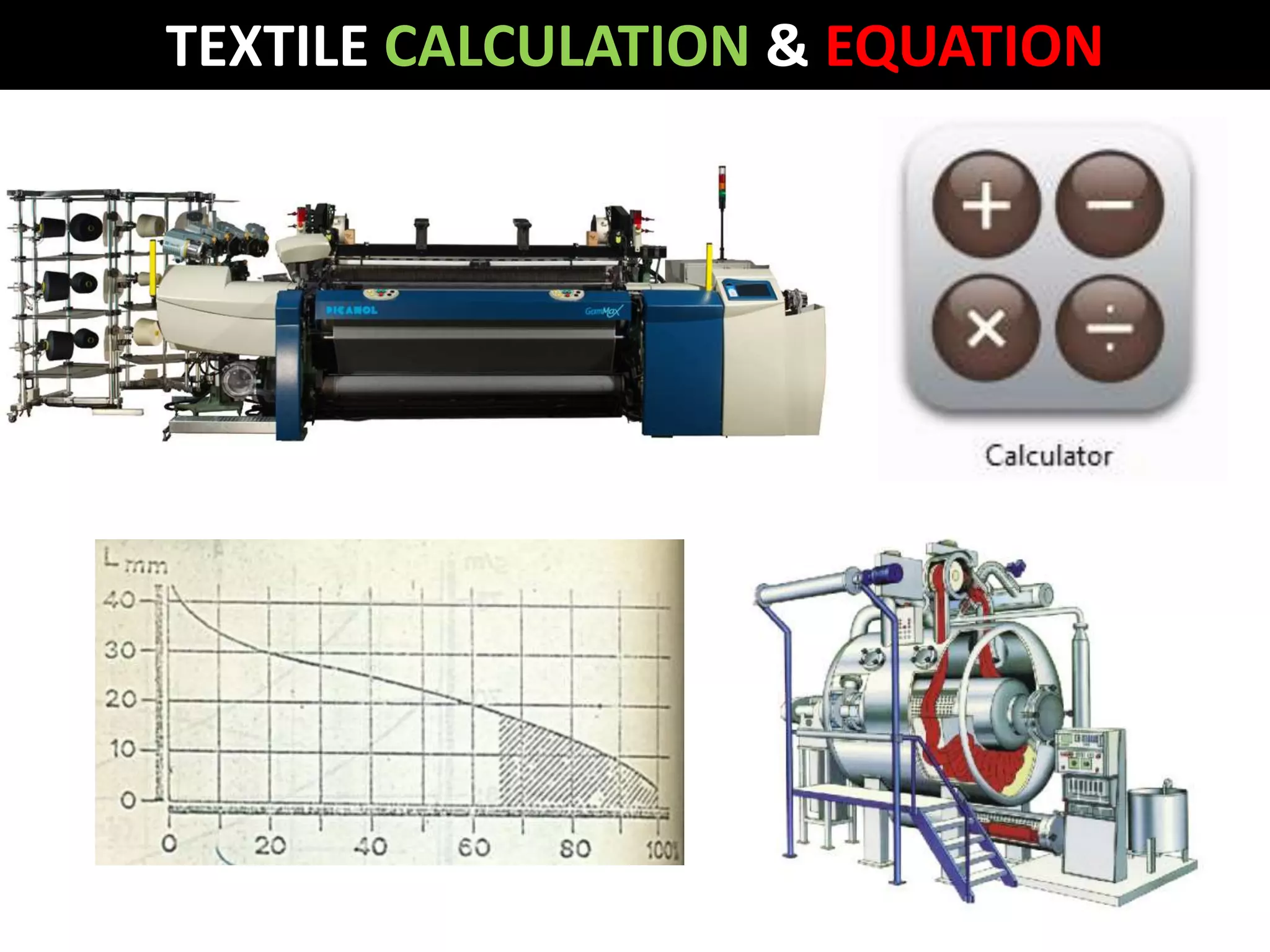
TEXTILE CALCULATION & EQUATION
Name : MAZADUL HASAN SHESHIR
ID: 2010000400008
Batch: 13th Batch (Session 2009-2013)
Department: Wet Processing Technology
Email: mazadulhasan@yahoo.com
Blog: www. Textilelab.blogspot.com
Southeast University
Department of Textile Engineering
PREPARED BY ©right
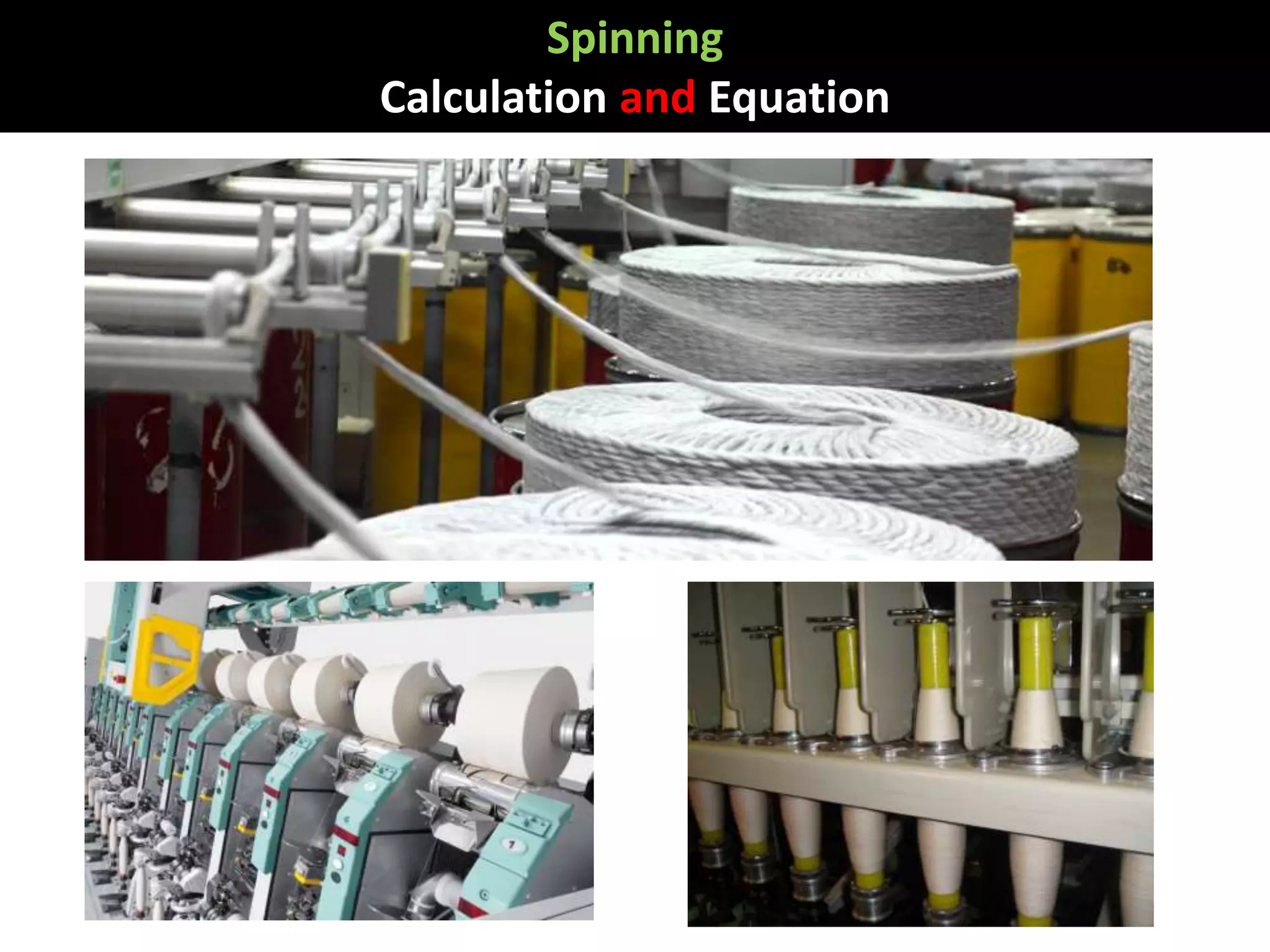
Spinning
Calculation and Equation
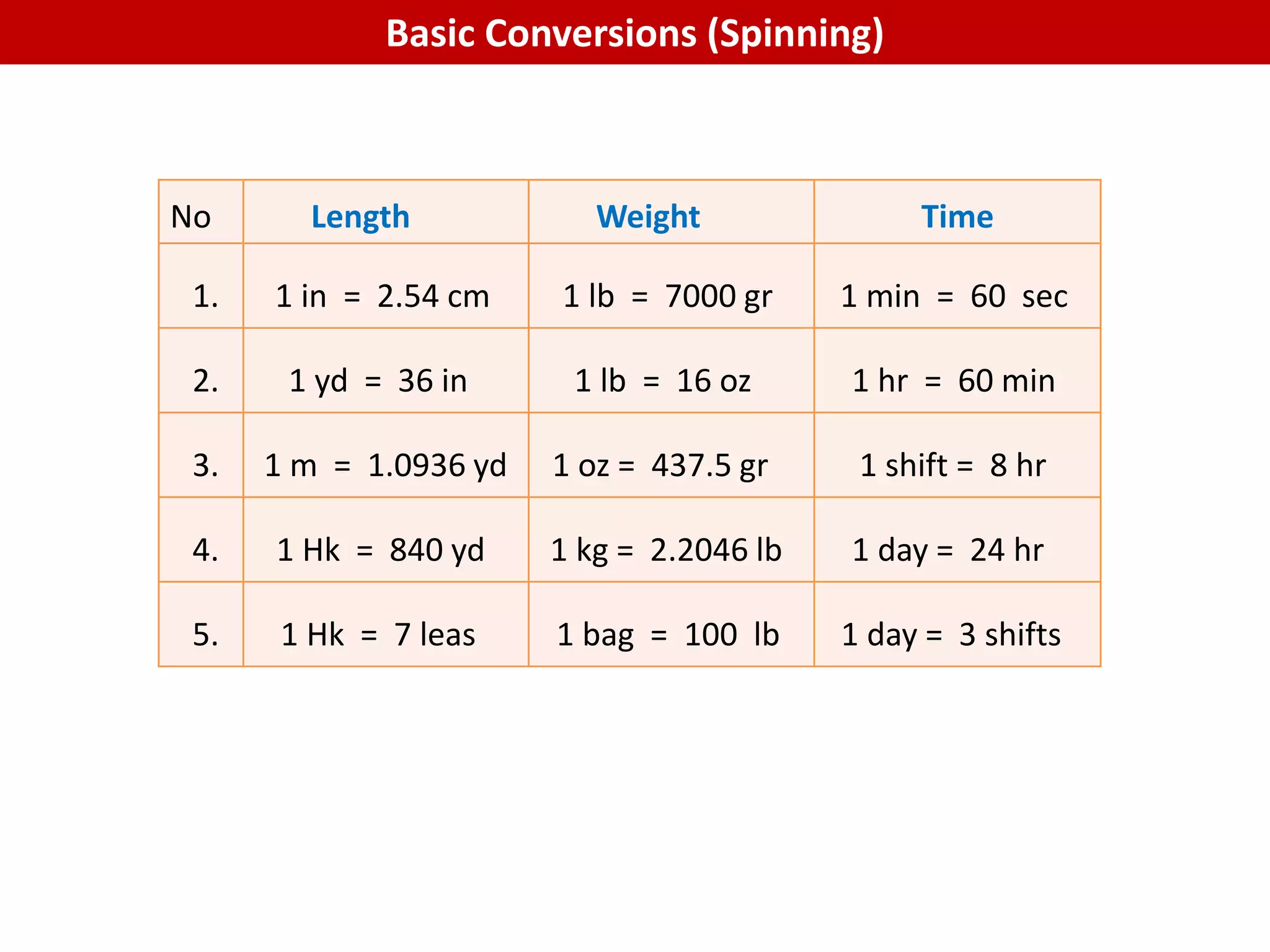
Basic Conversions (Spinning)
No Length Weight Time
1. 1 in = 2.54 cm 1 lb = 7000 gr 1 min = 60 sec
2. 1 yd = 36 in 1 lb = 16 oz 1 hr = 60 min
3. 1 m = 1.0936 yd 1 oz = 437.5 gr 1 shift = 8 hr
4. 1 Hk = 840 yd 1 kg = 2.2046 lb 1 day = 24 hr
5. 1 Hk = 7 leas 1 bag = 100 lb 1 day = 3 shifts
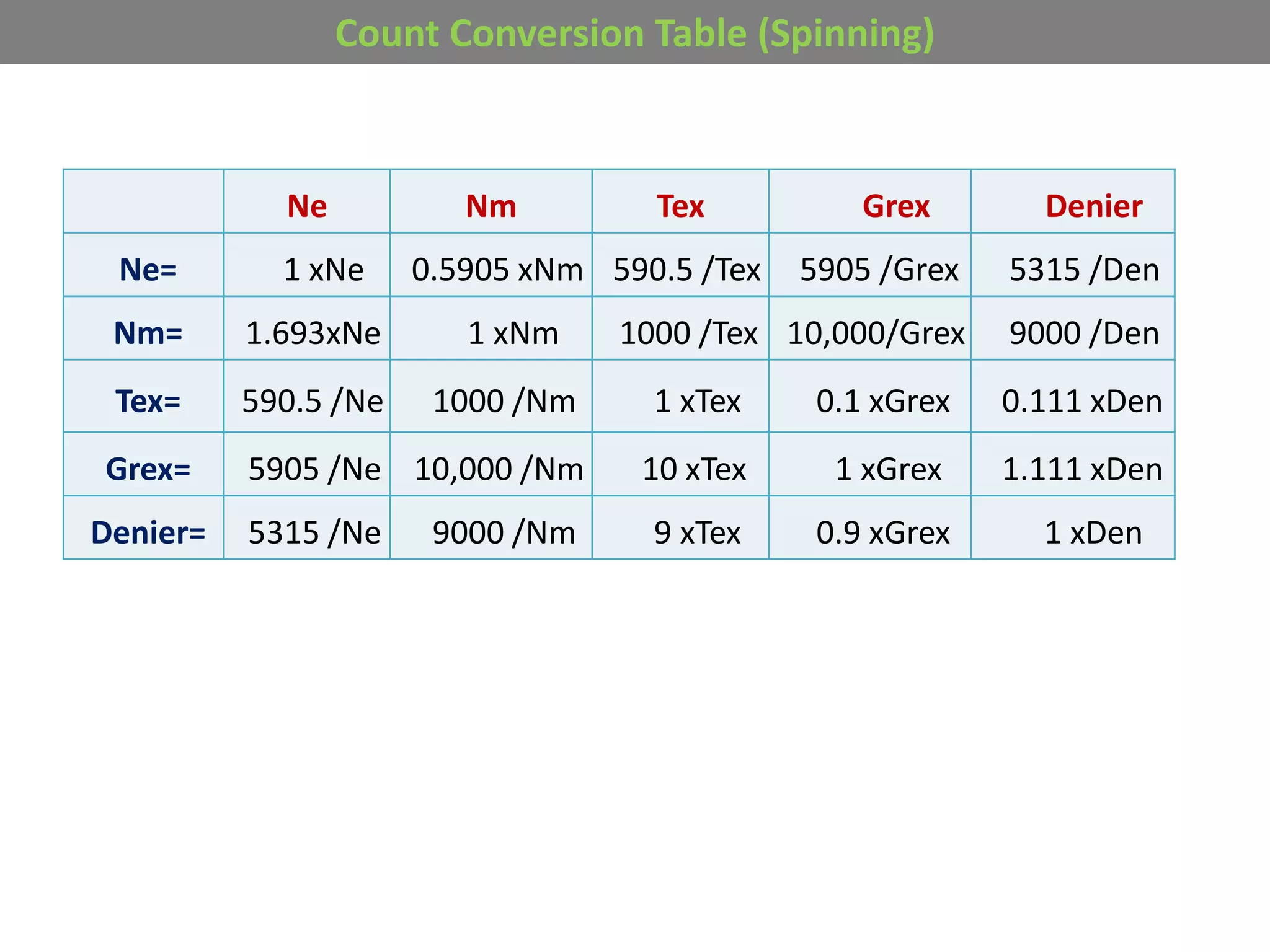
Count Conversion Table (Spinning)
Ne Nm Tex Grex Denier
Ne= 1 xNe 0.5905 xNm 590.5 /Tex 5905 /Grex 5315 /Den
Nm= 1.693xNe 1 xNm 1000 /Tex 10,000/Grex 9000 /Den
Tex= 590.5 /Ne 1000 /Nm 1 xTex 0.1 xGrex 0.111 xDen
Grex= 5905 /Ne 10,000 /Nm 10 xTex 1 xGrex 1.111 xDen
Denier= 5315 /Ne 9000 /Nm 9 xTex 0.9 xGrex 1 xDen
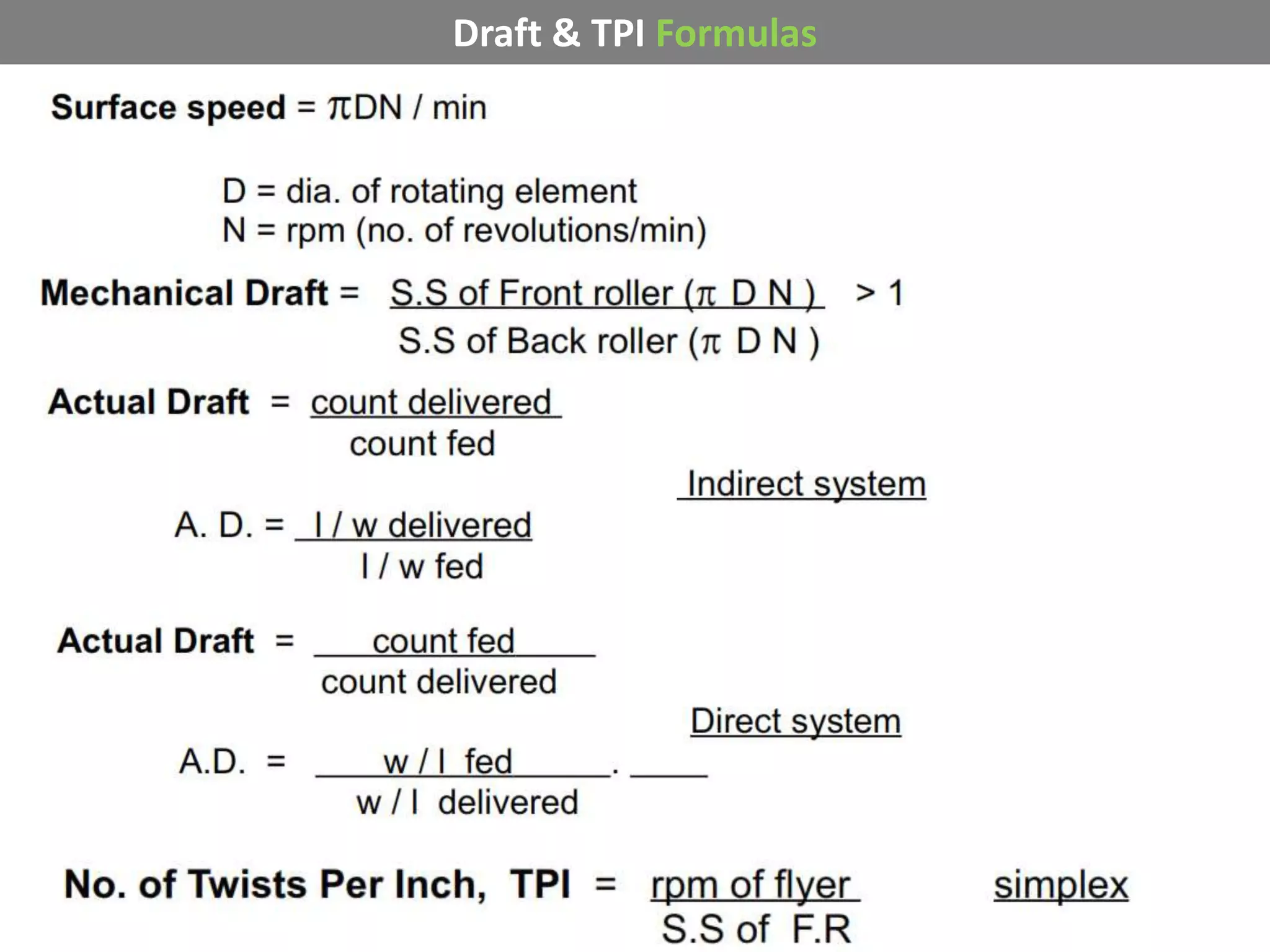
Draft & TPI Formulas
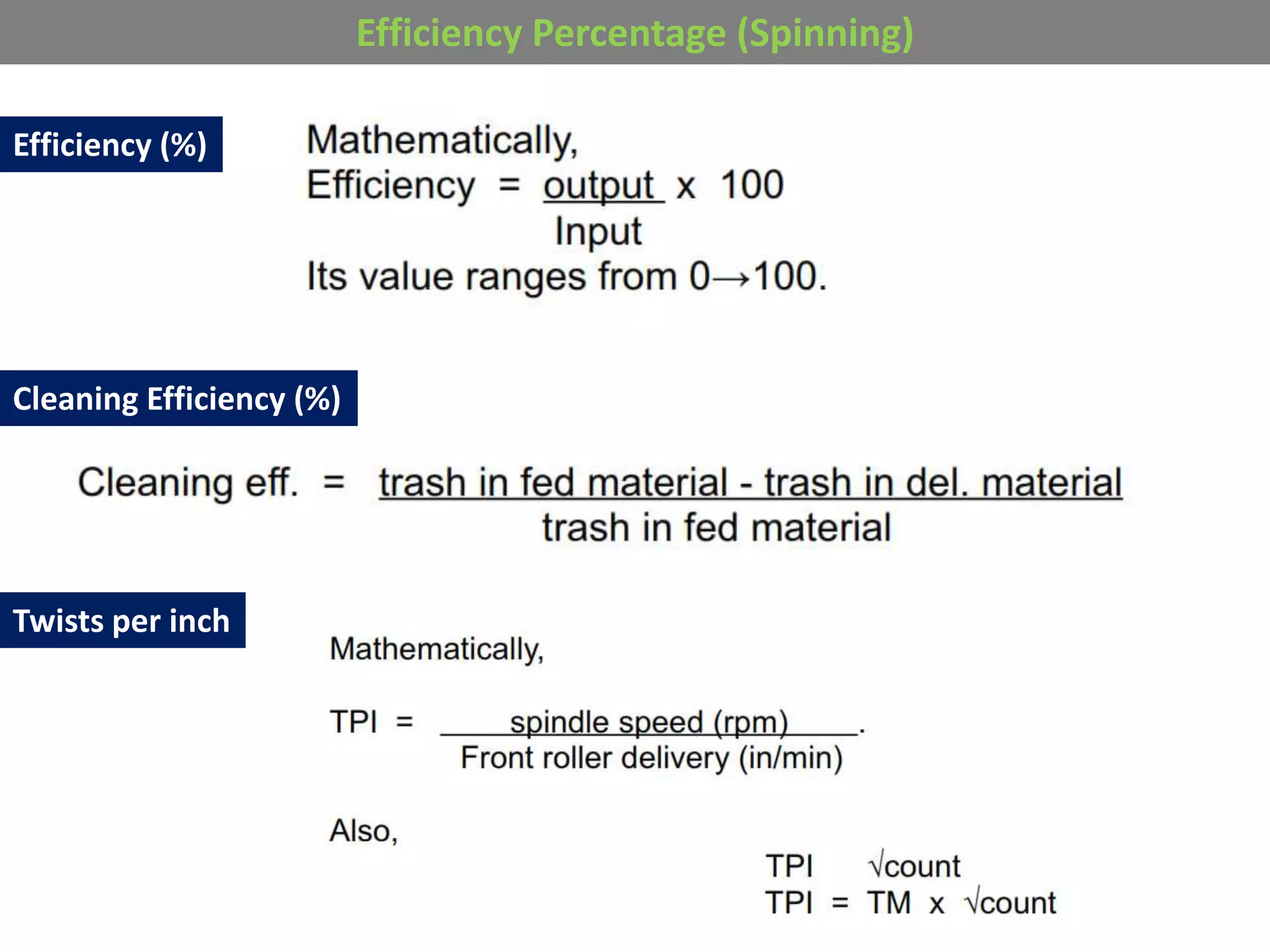
Efficiency Percentage (Spinning)
Cleaning Efficiency (%)
Efficiency (%)
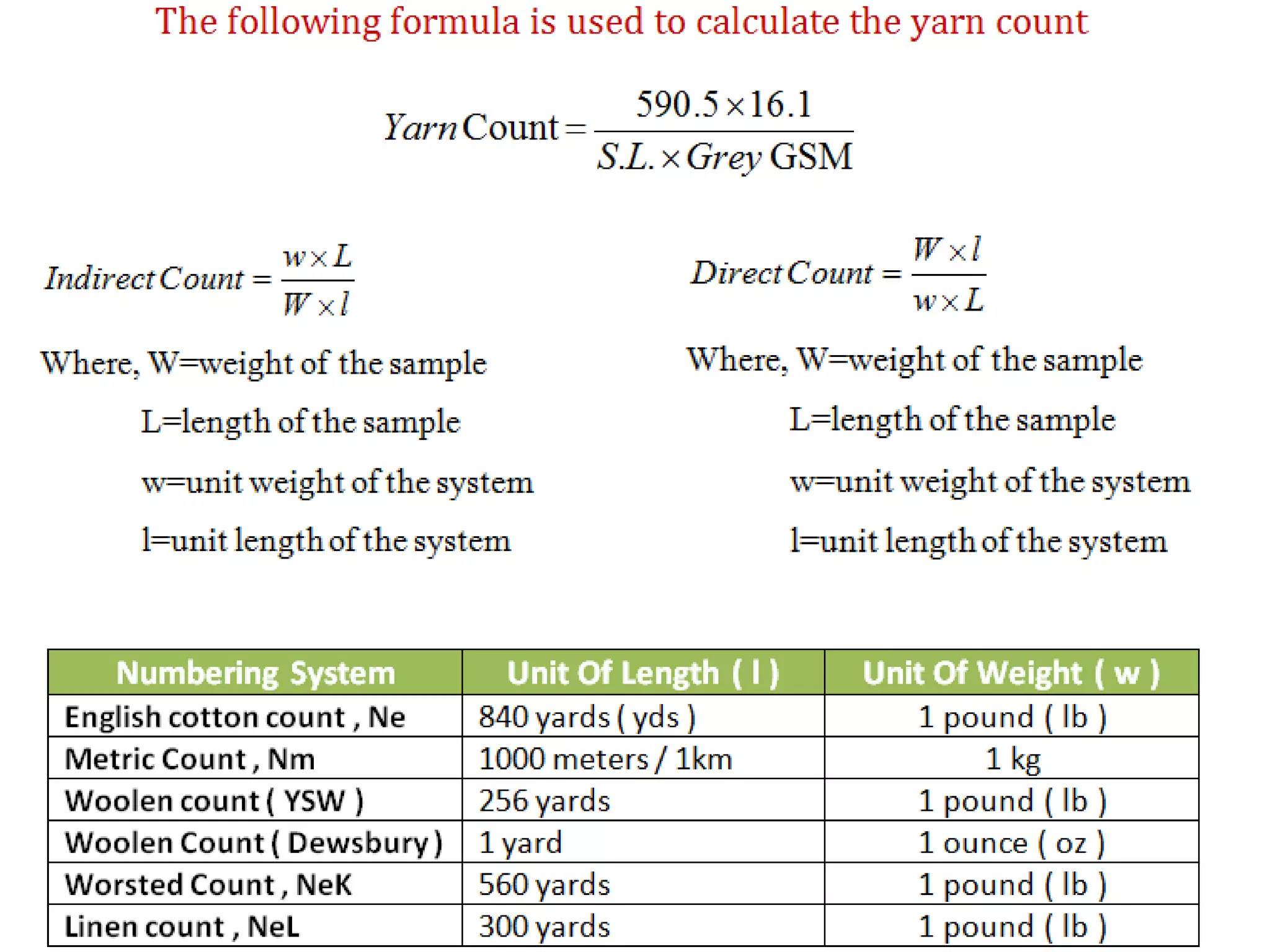
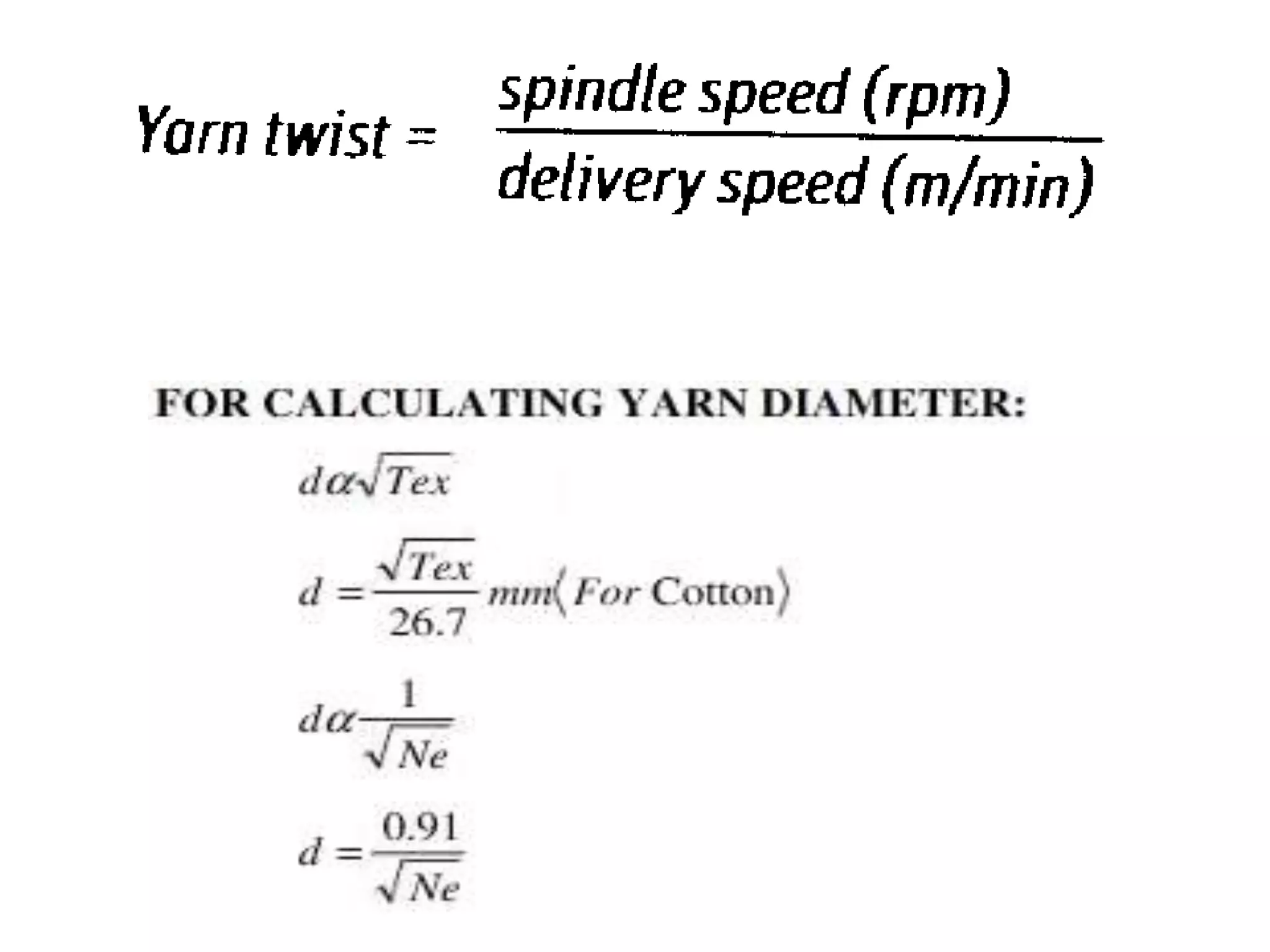
Twists per inch
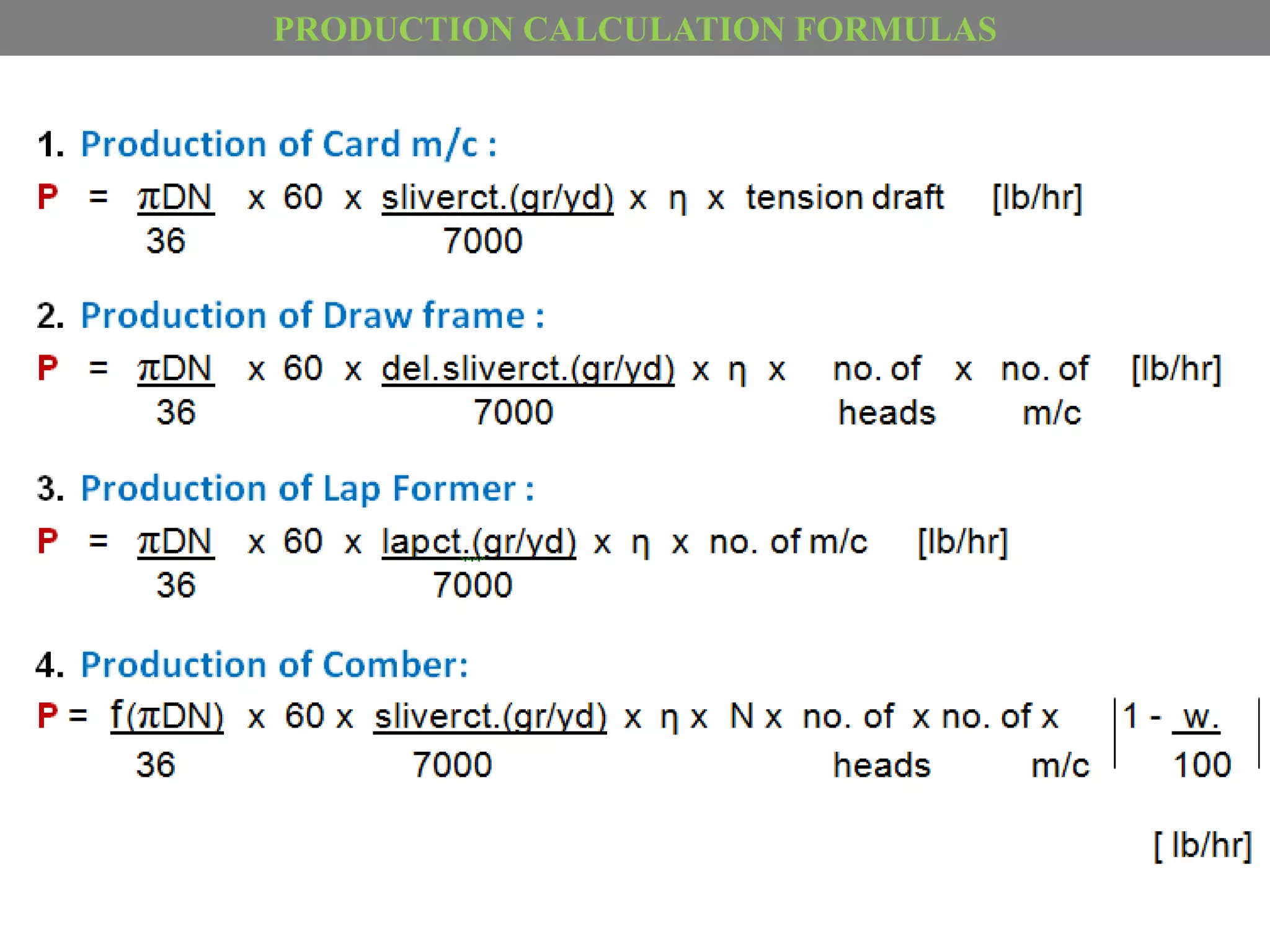
PRODUCTION CALCULATION FORMULAS
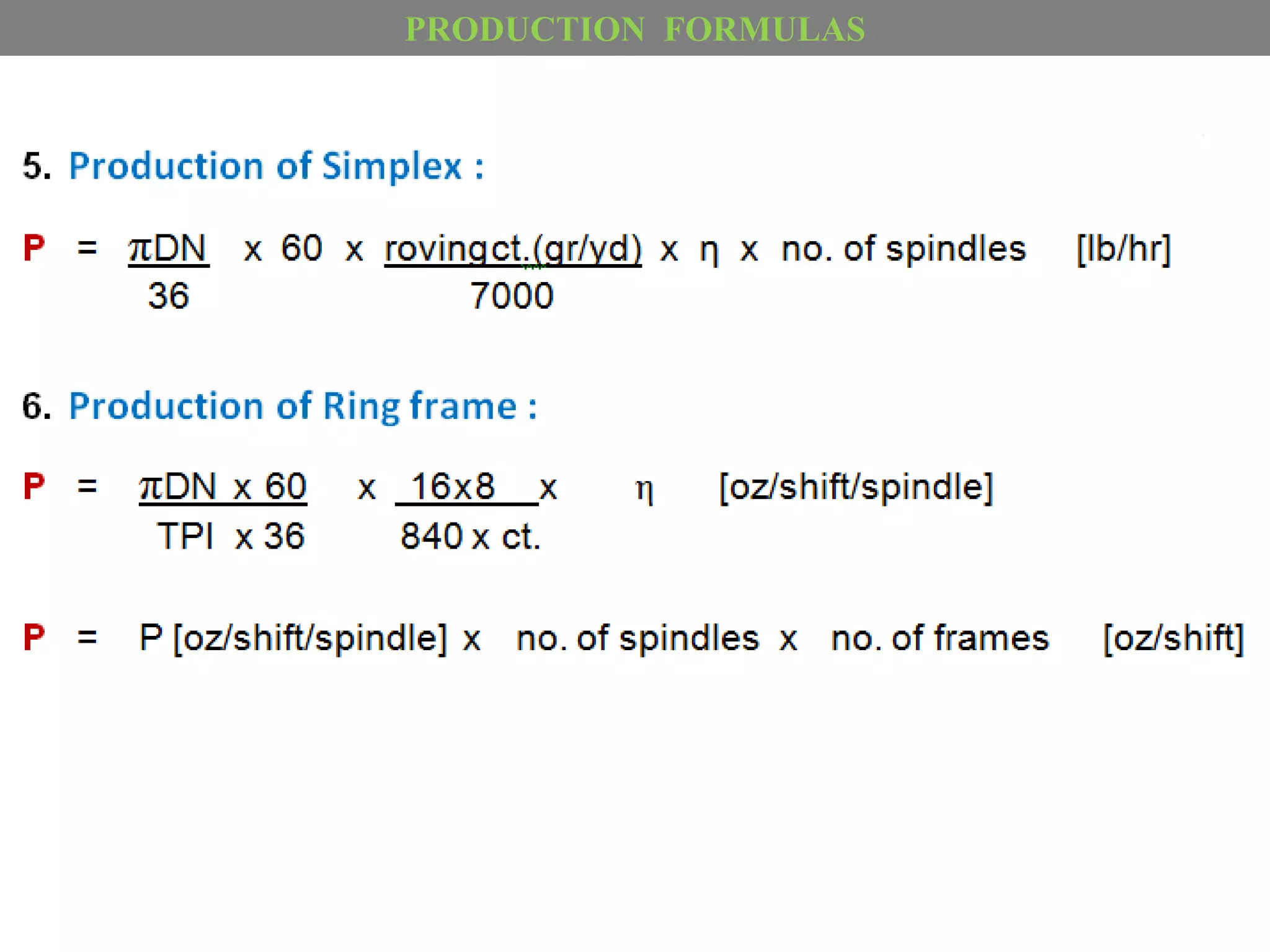
PRODUCTION FORMULAS
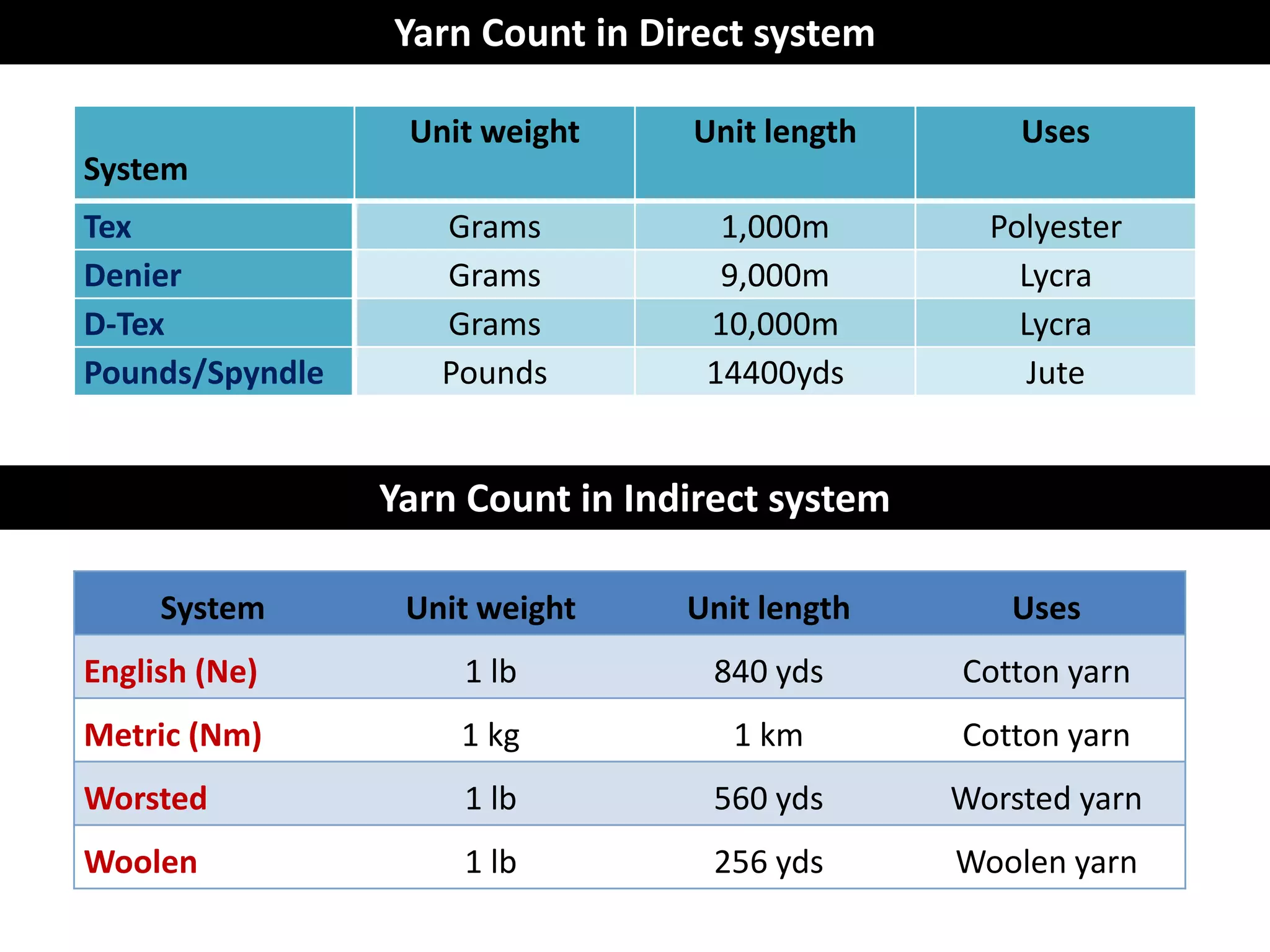
Yarn Count in Direct system
System
Unit weight Unit length Uses
Tex Grams 1,000m Polyester
Denier Grams 9,000m Lycra
D-Tex Grams 10,000m Lycra
Pounds/Spyndle Pounds 14400yds Jute
Yarn Count in Indirect system
System Unit weight Unit length Uses
English (Ne) 1 lb 840 yds Cotton yarn
Metric (Nm) 1 kg 1 km Cotton yarn
Worsted 1 lb 560 yds Worsted yarn
Woolen 1 lb 256 yds Woolen yarn
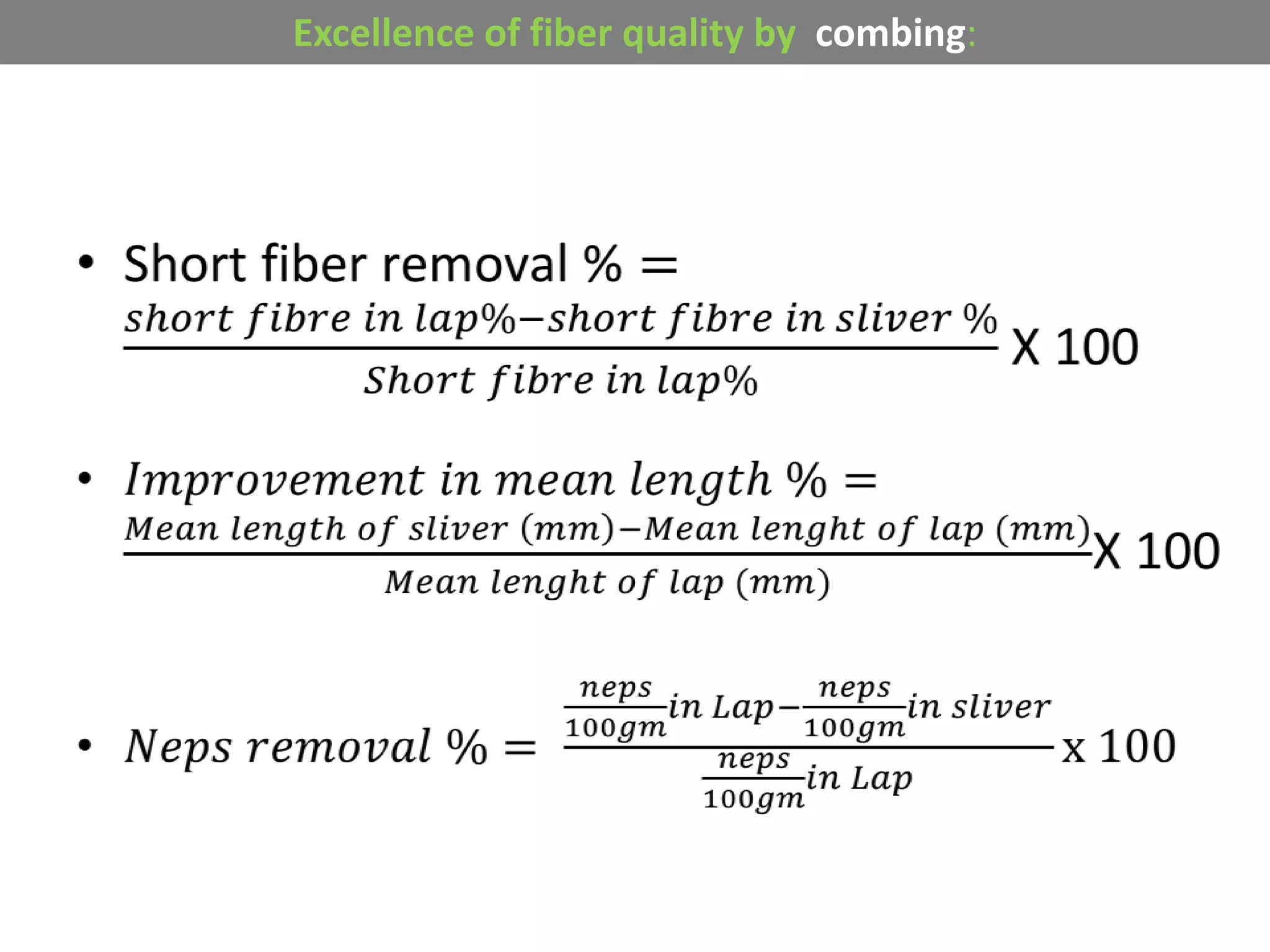
Excellence of fiber quality by combing:
Fabric (Knitting & Weaving)
Calculation and Equation
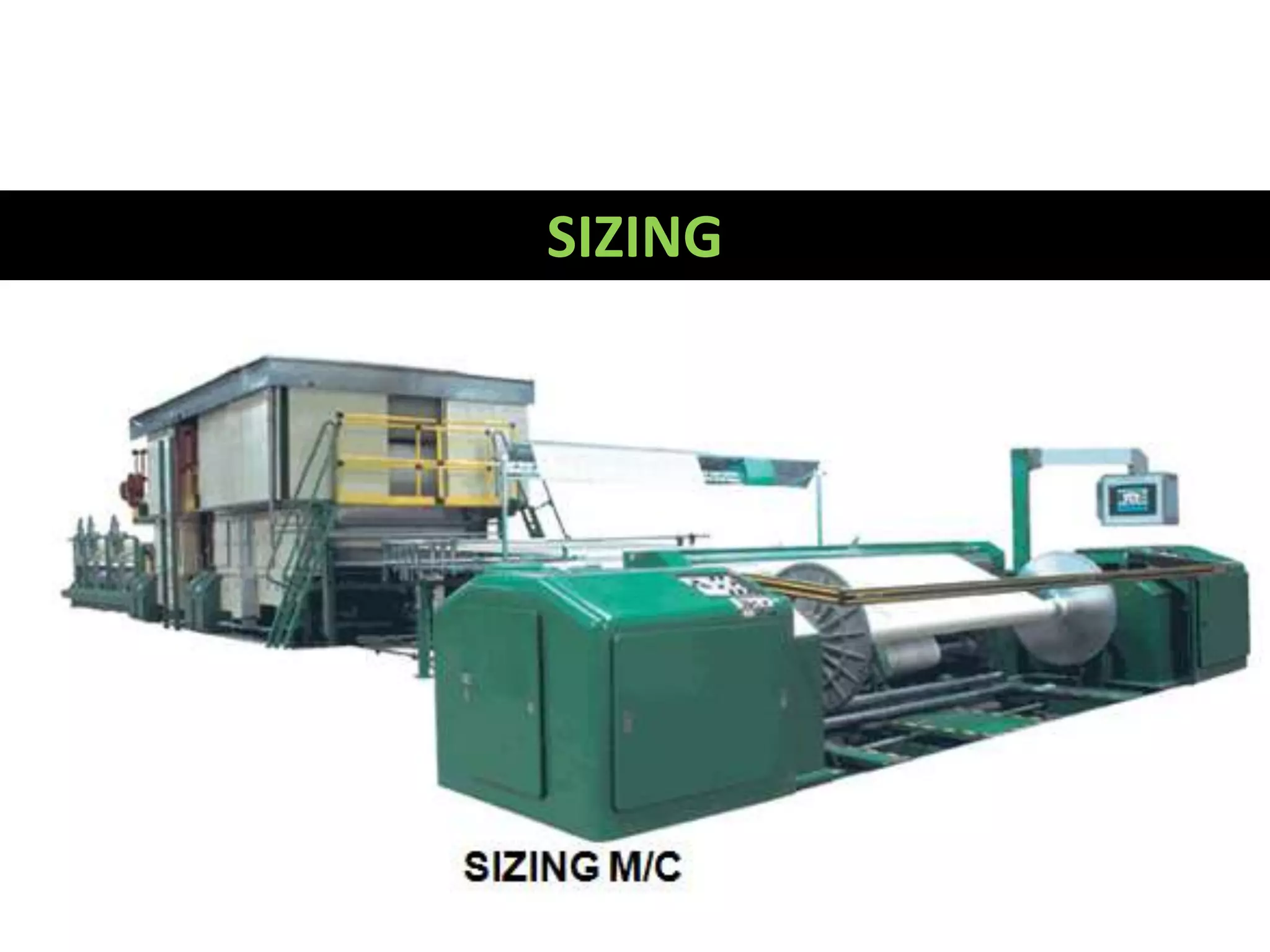
SIZING
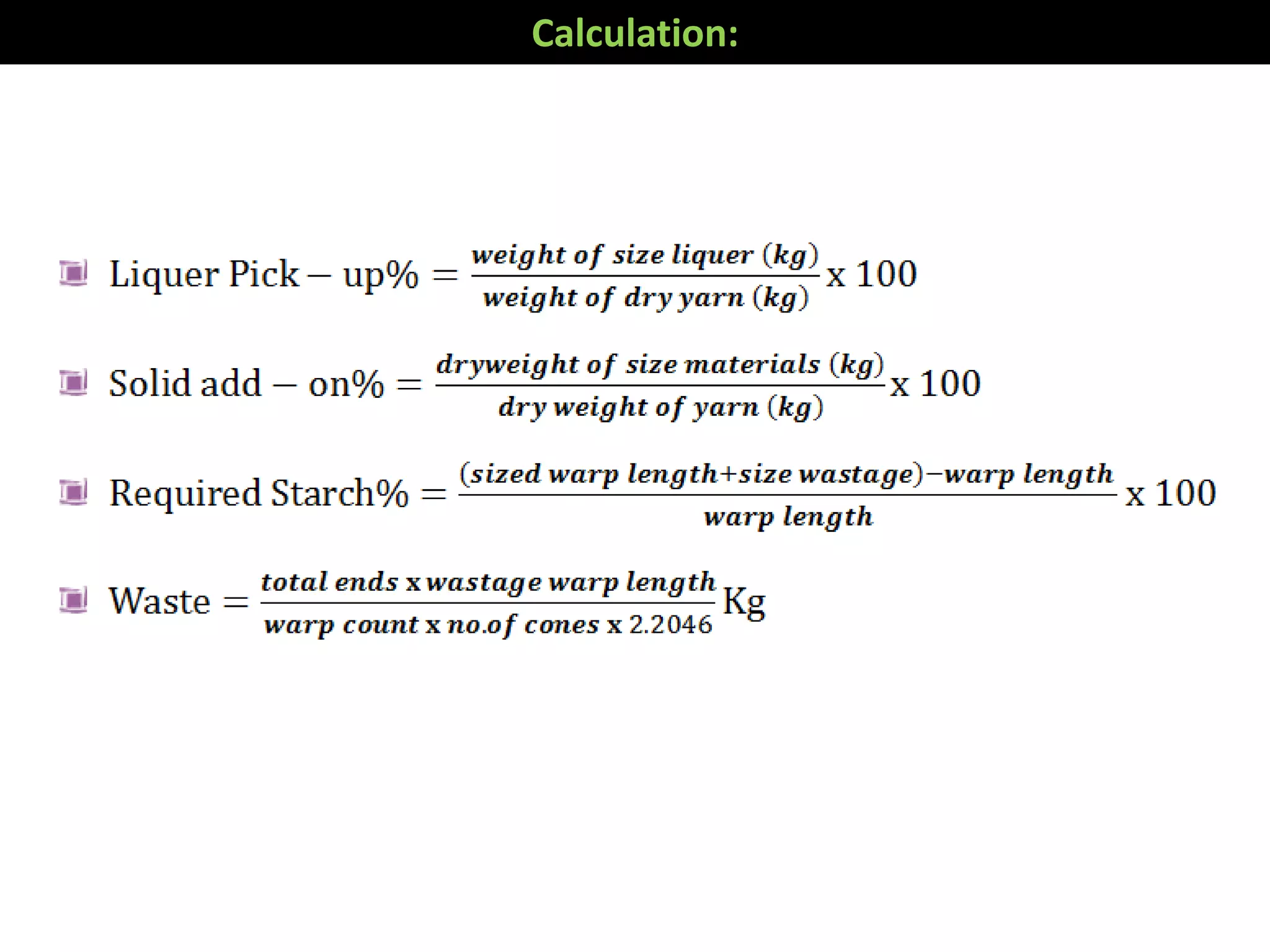
Calculation:
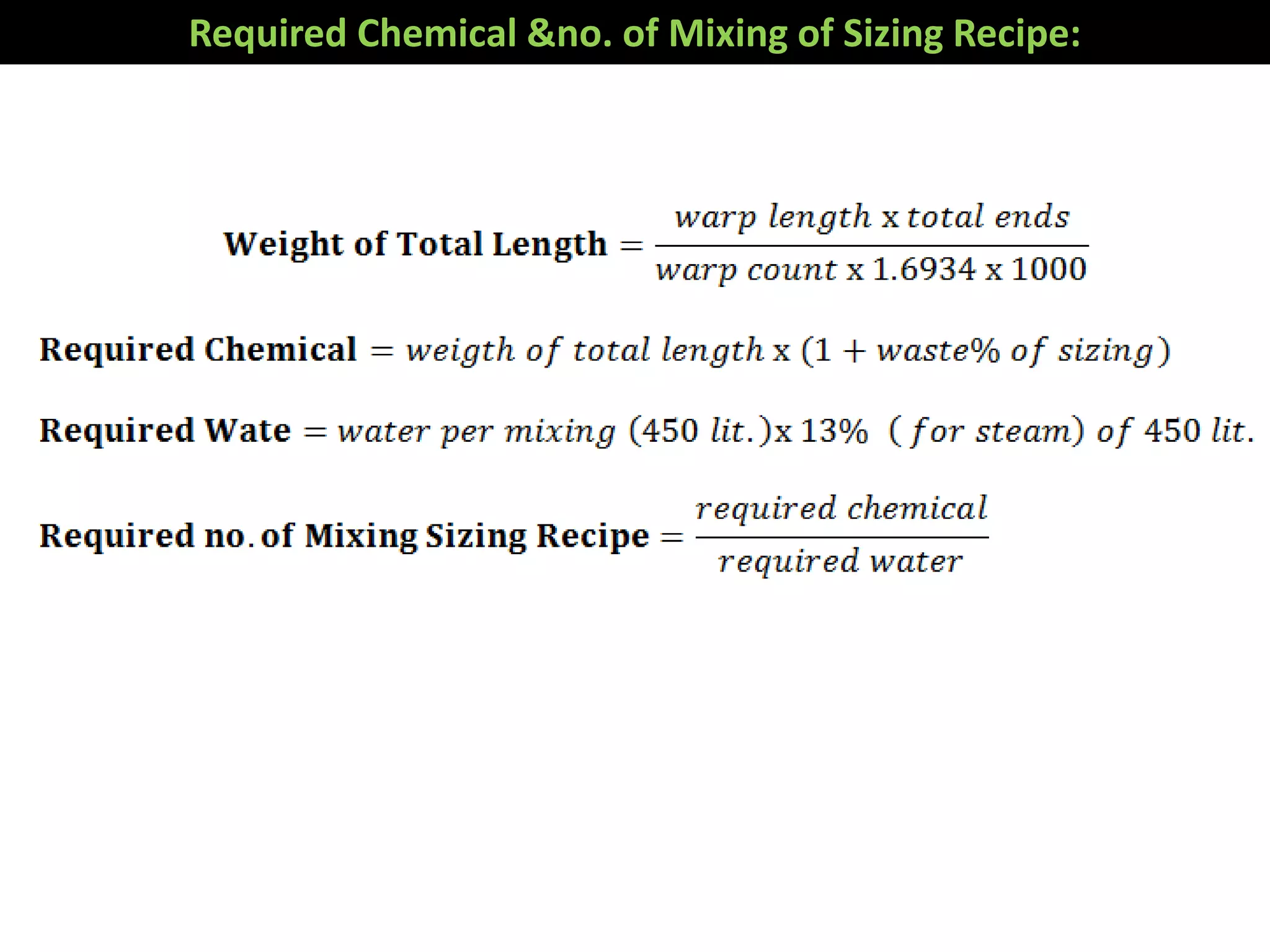
Required Chemical &no. of Mixing of Sizing Recipe:
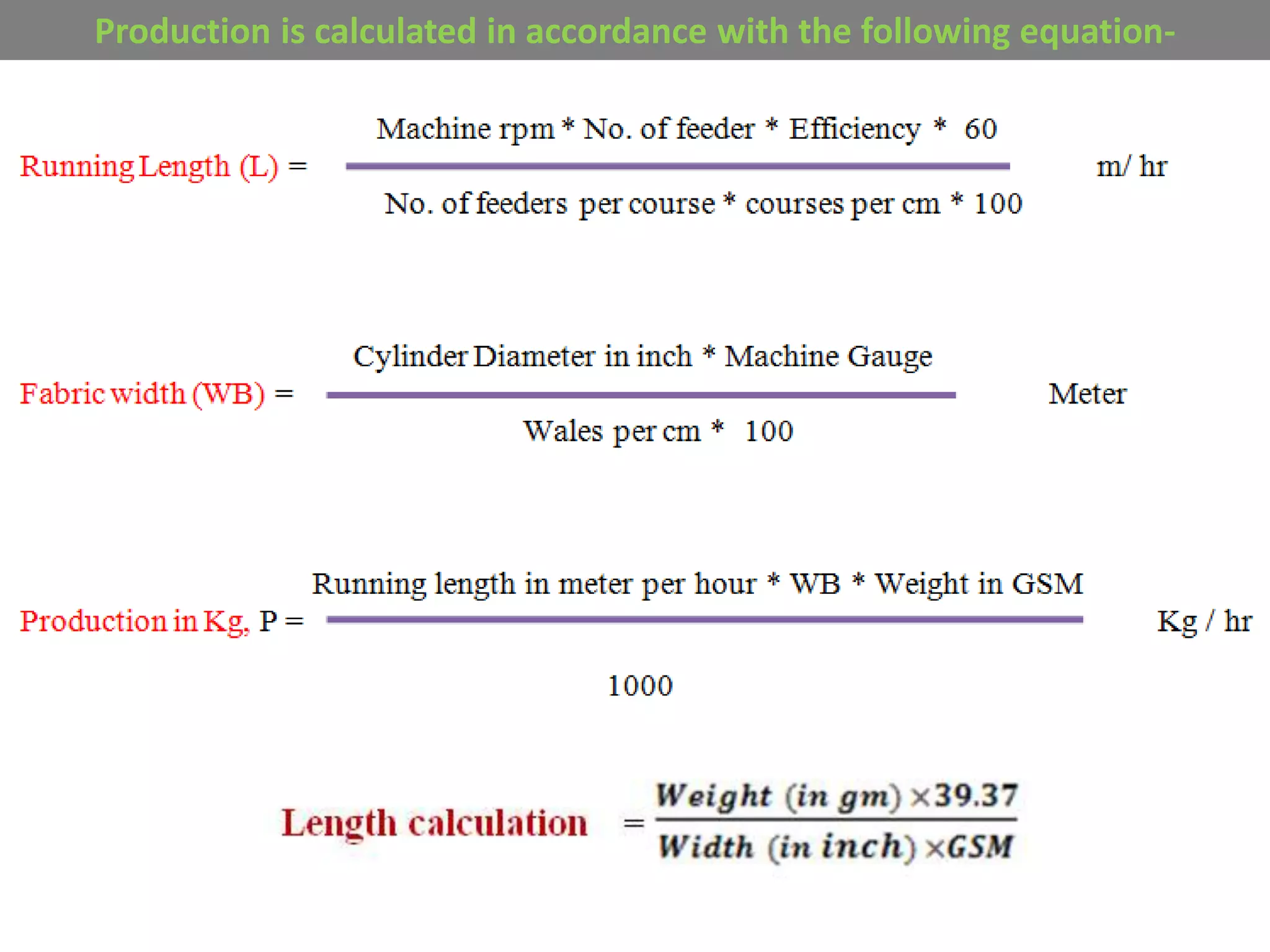
Production is calculated in accordance with the following equation-
Production calculation:
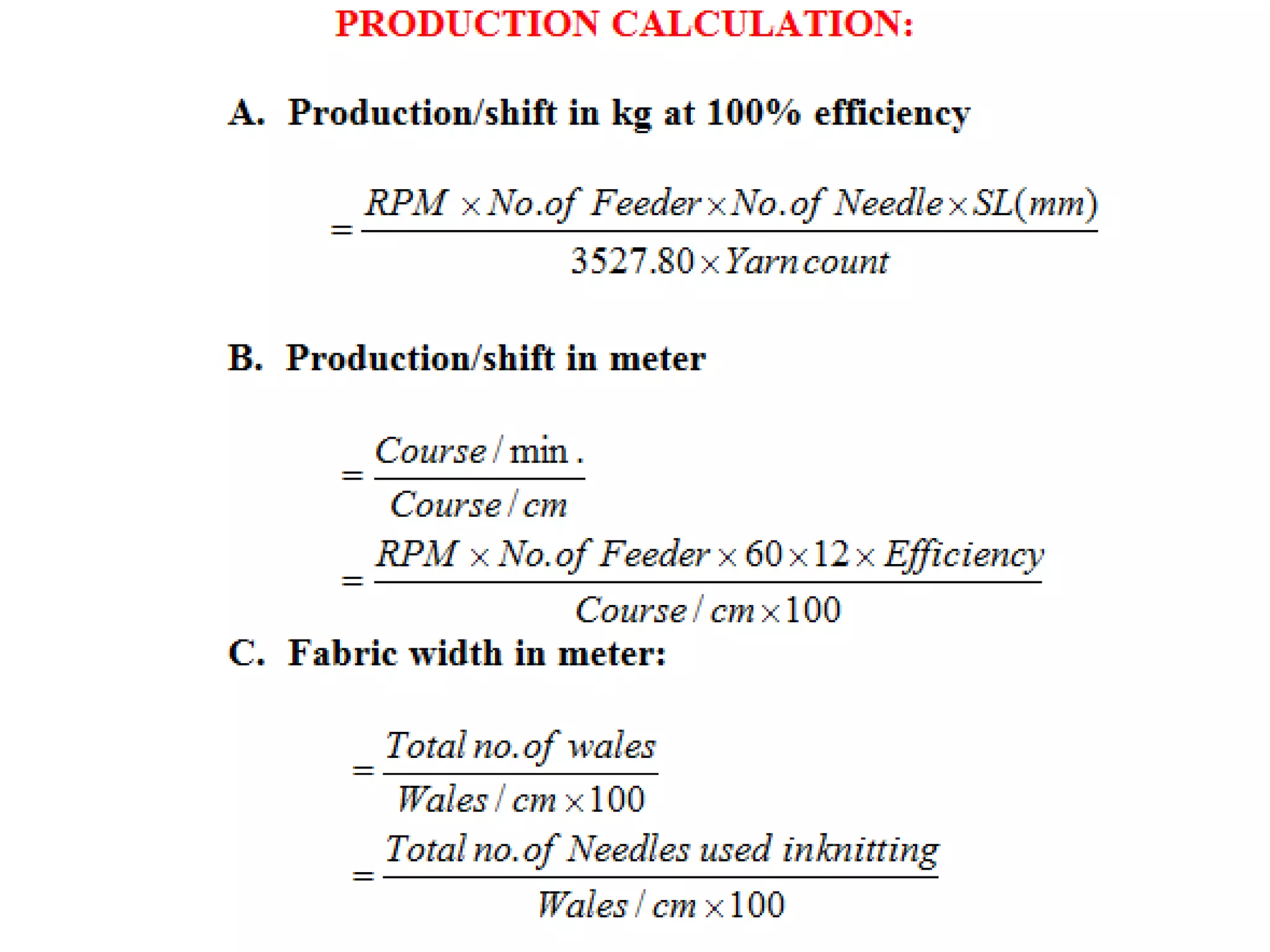
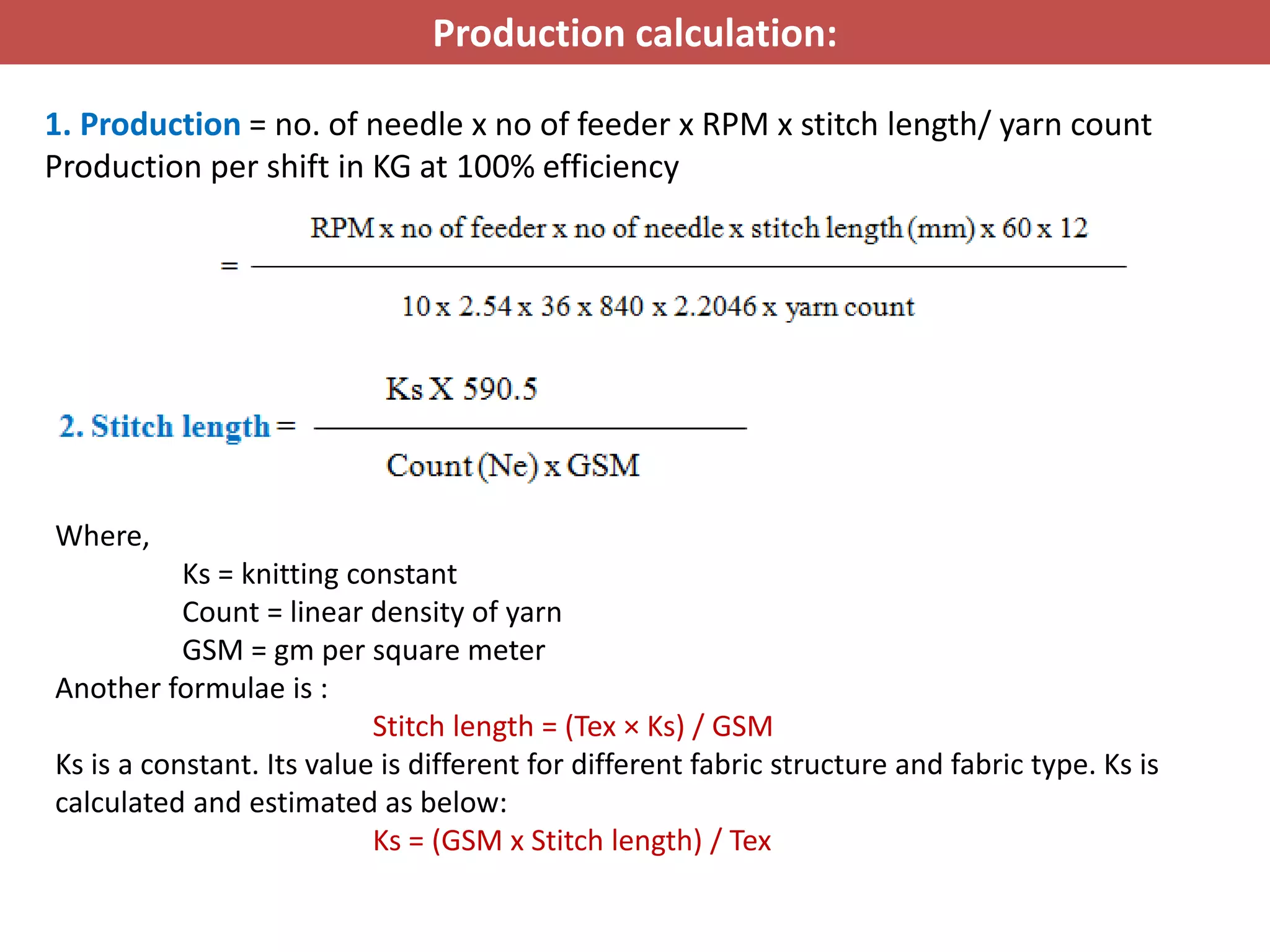
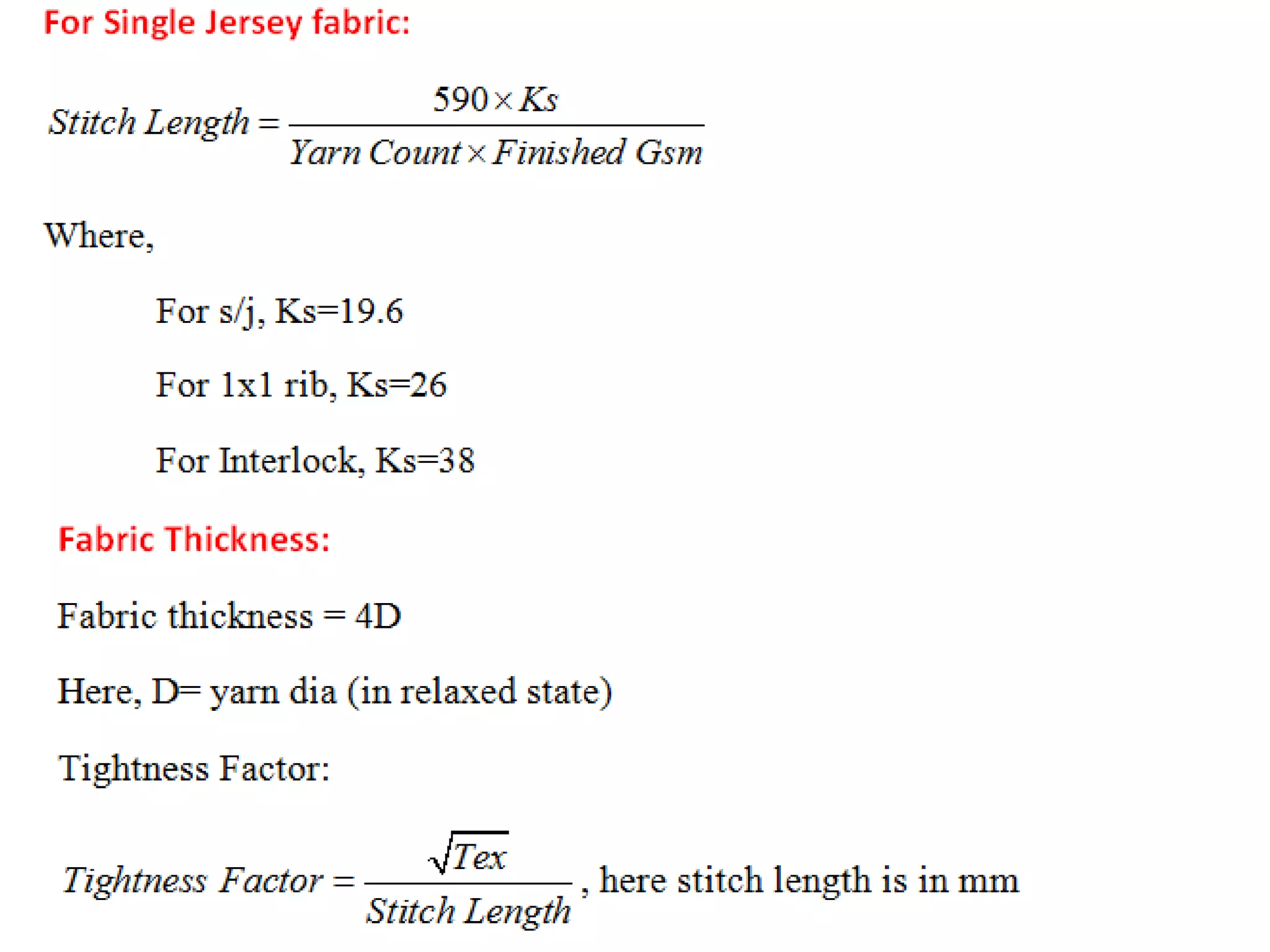
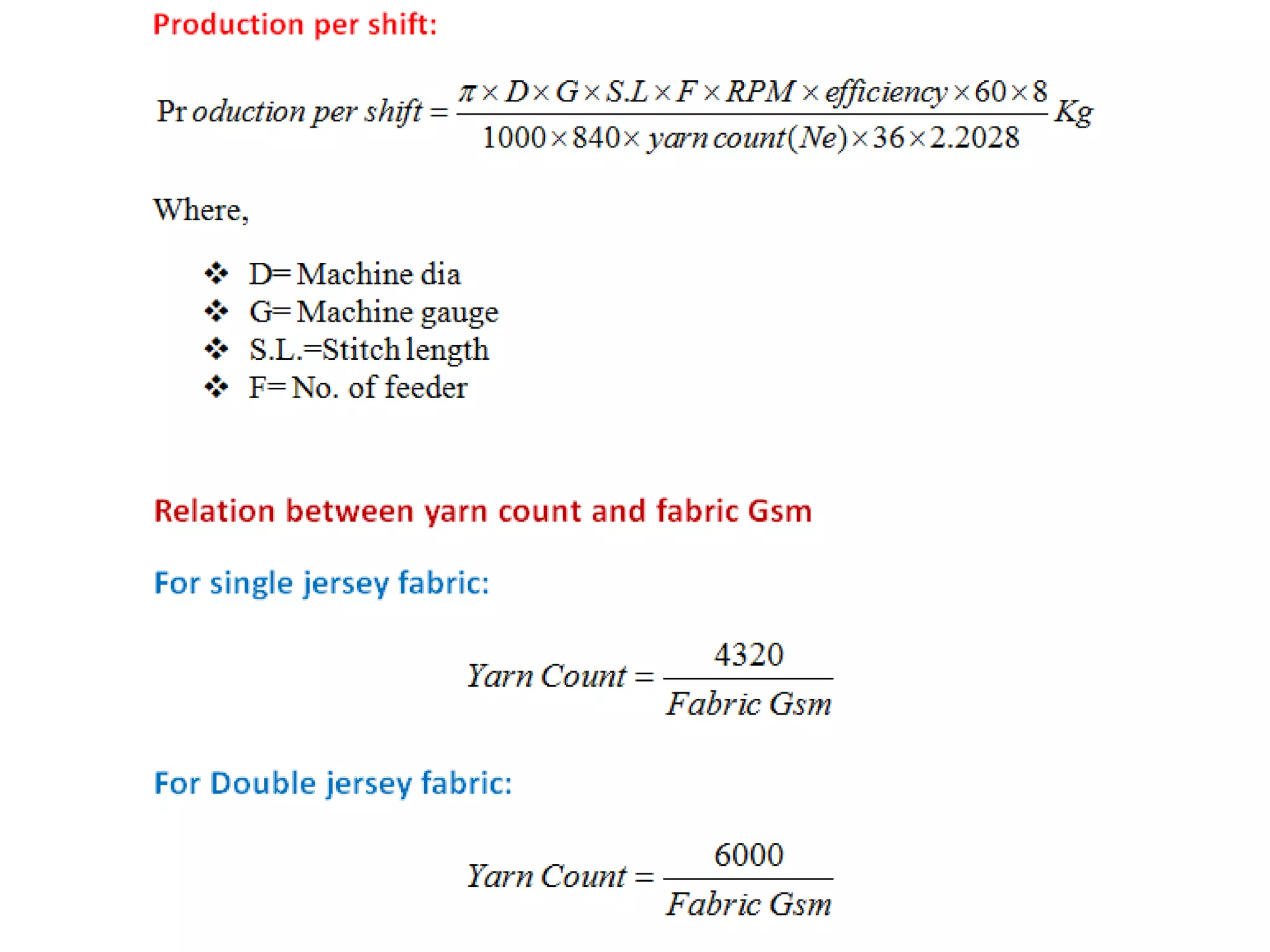
1. Production = no. of needle x no of feeder x RPM x stitch length/ yarn count
Production per shift in KG at 100% efficiency
Where,
Ks = knitting constant
Count = linear density of yarn
GSM = gm per square meter
Another formulae is :
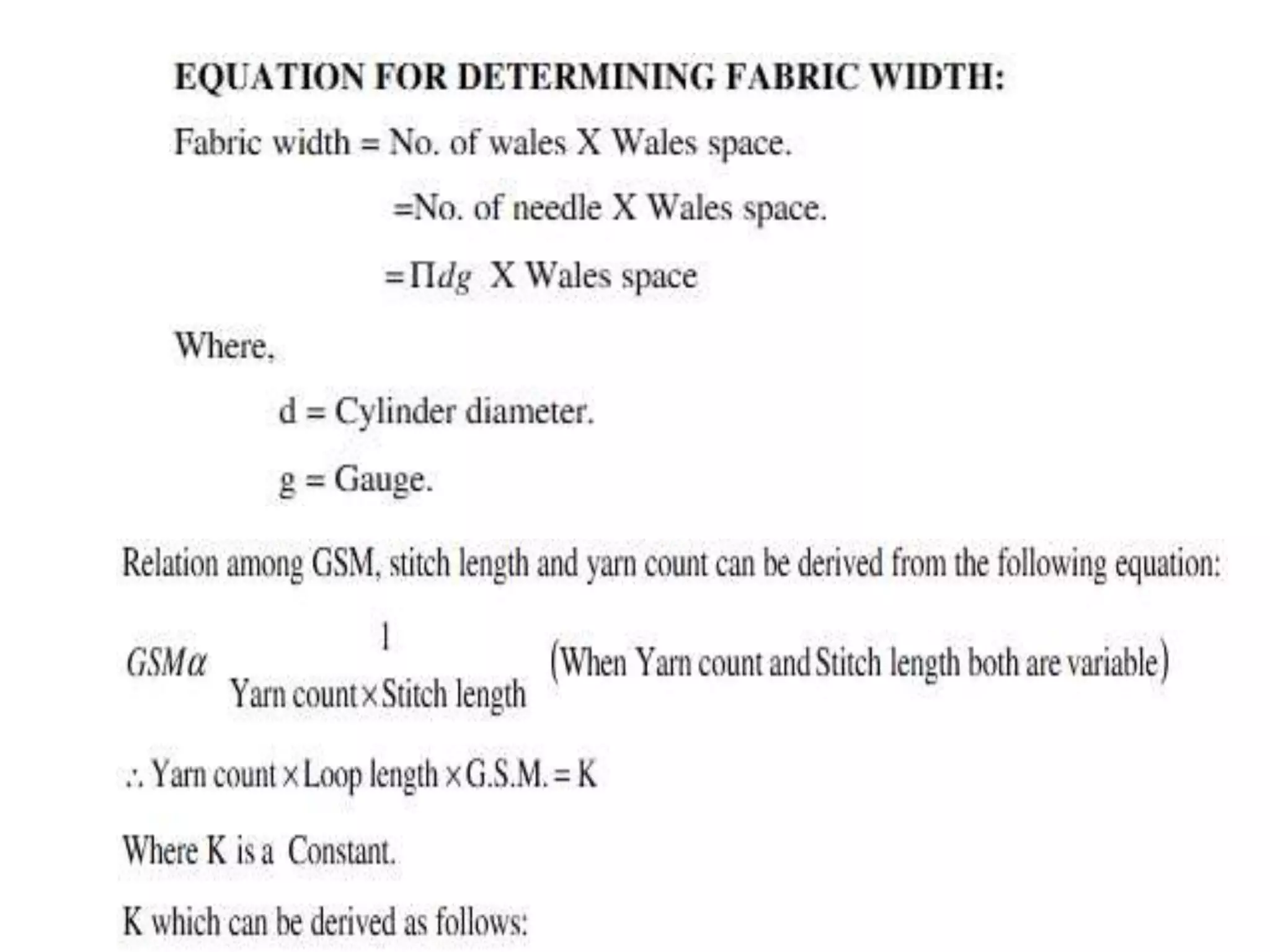
Stitch length = (Tex × Ks) / GSM
Ks is a constant. Its value is different for different fabric structure and fabric type. Ks is
calculated and estimated as below:
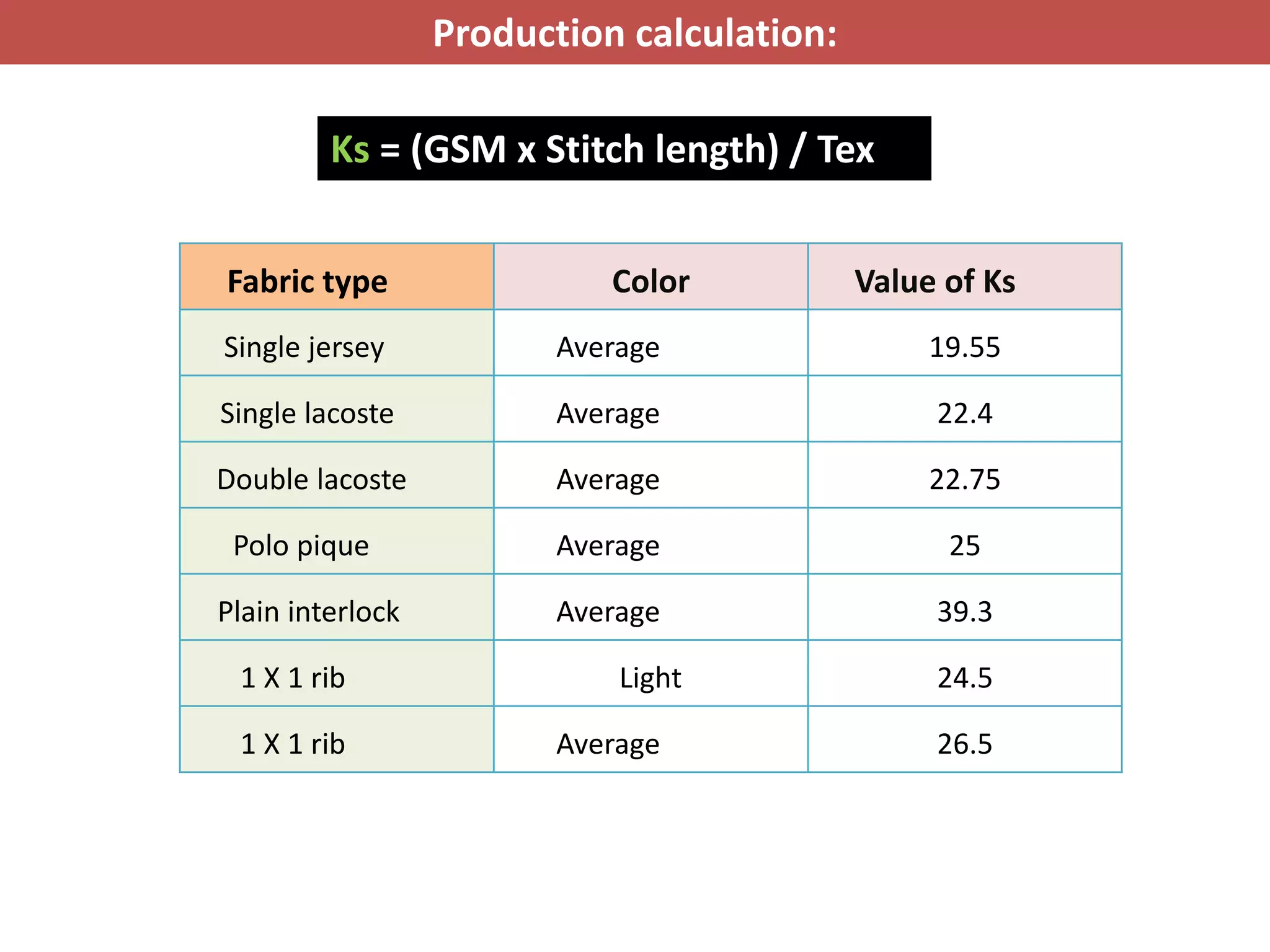
Ks = (GSM x Stitch length) / Tex
Production calculation:
Fabric type Color Value of Ks
Single jersey Average 19.55
Single lacoste Average 22.4
Double lacoste Average 22.75
Polo pique Average 25
Plain interlock Average 39.3
1 X 1 rib Light 24.5
1 X 1 rib Average 26.5
Ks = (GSM x Stitch length) / Tex
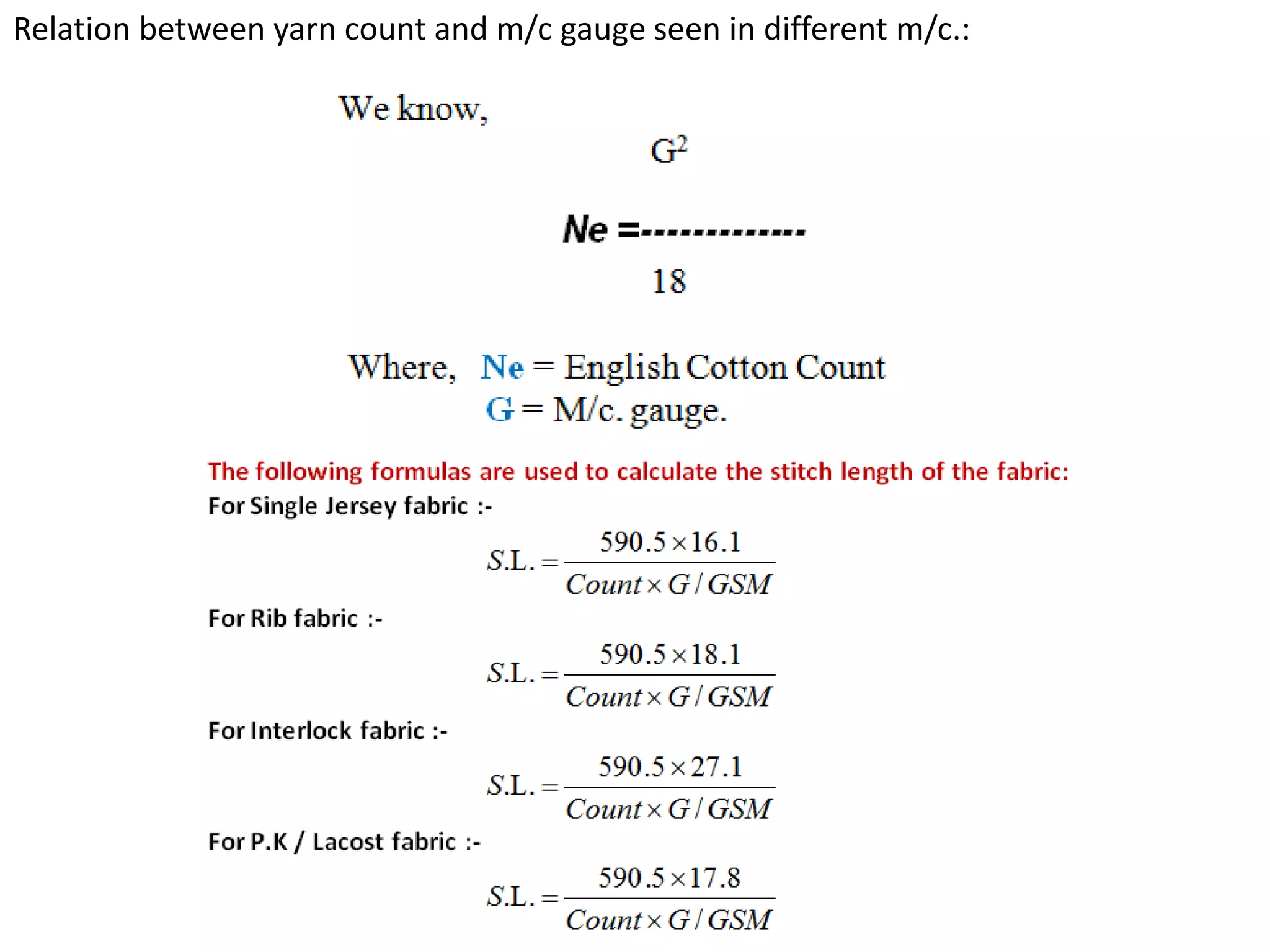
Relation between yarn count and m/c gauge seen in different m/c.:
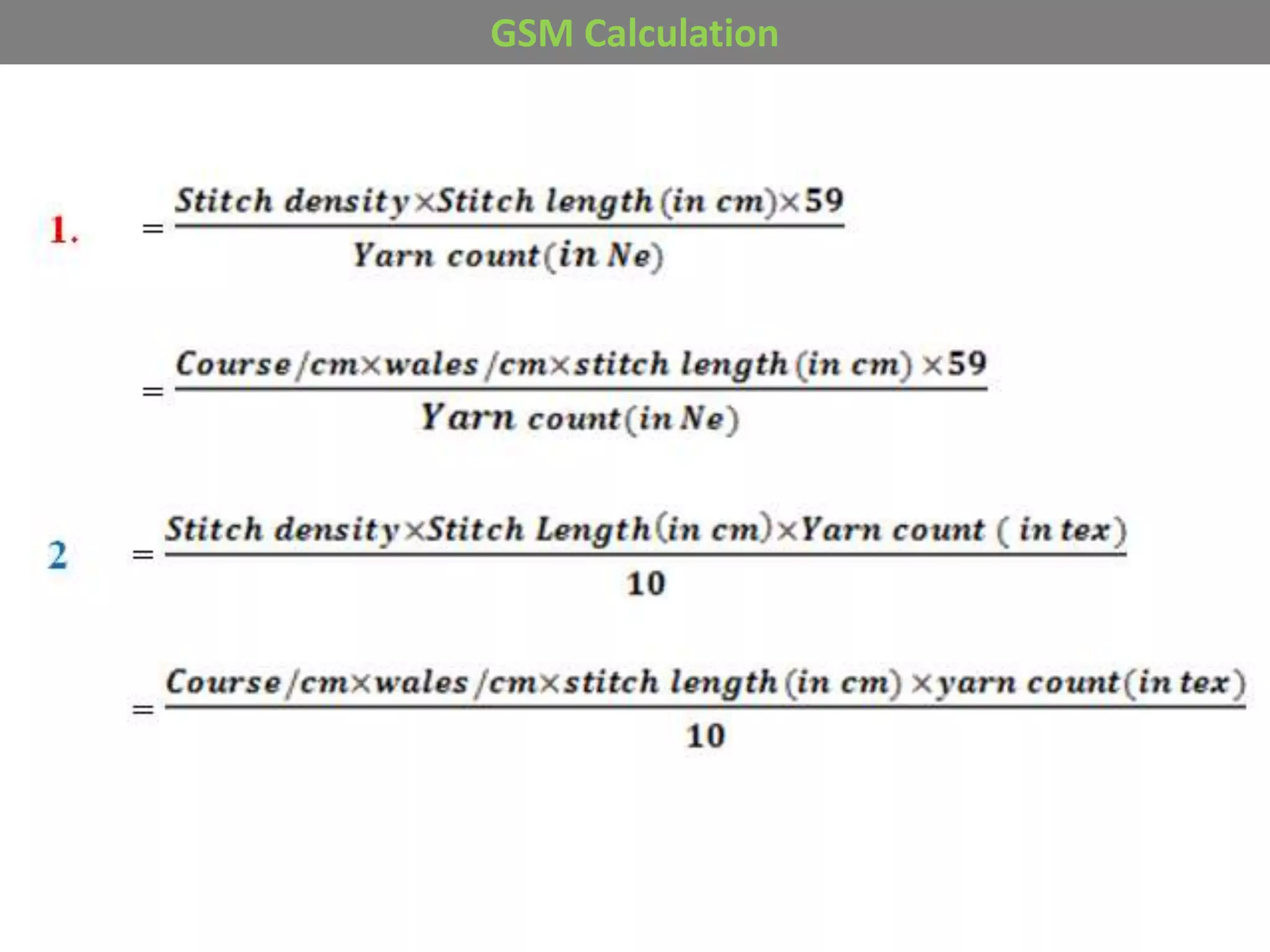
GSM Calculation
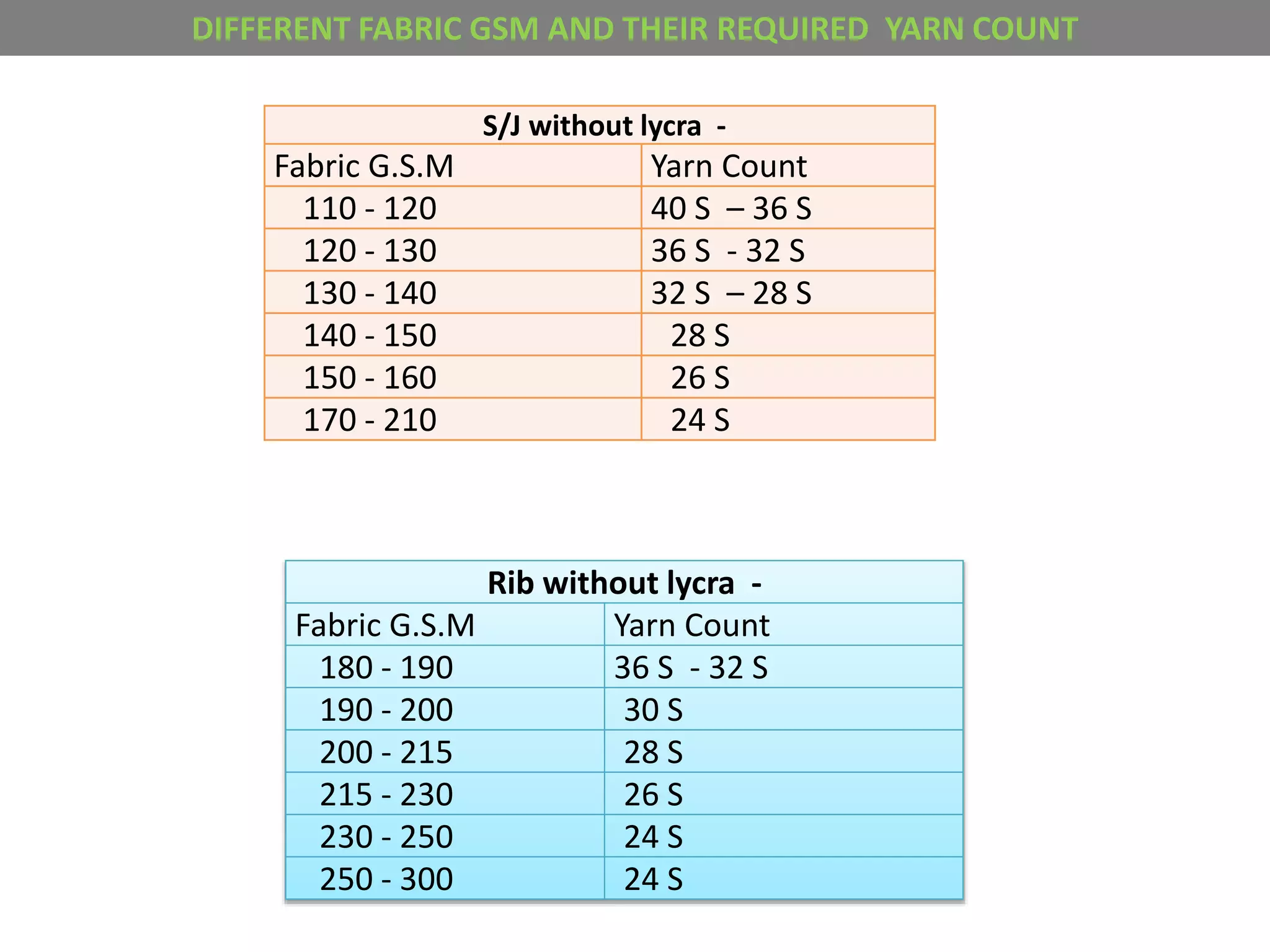
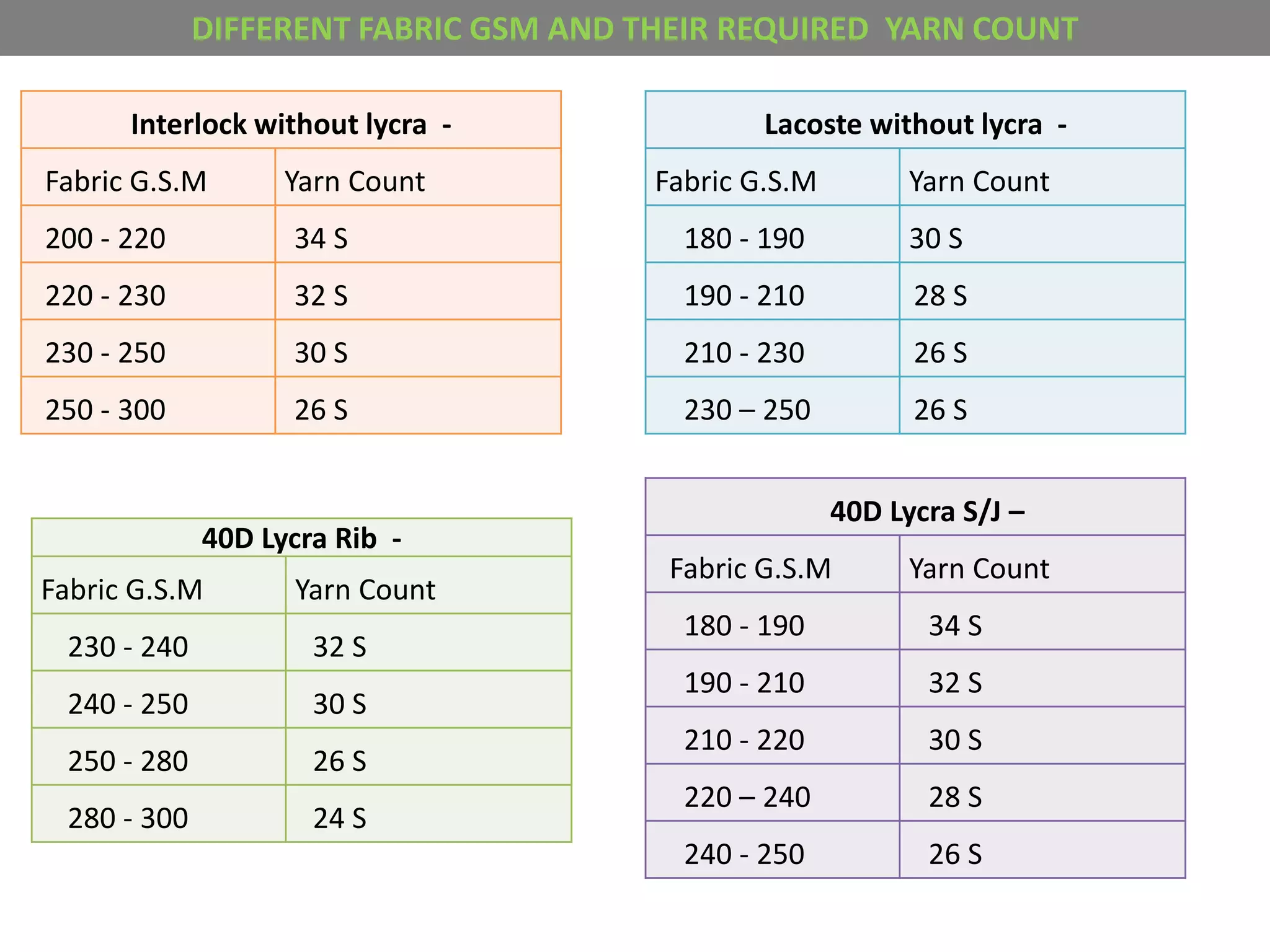
DIFFERENT FABRIC GSM AND THEIR REQUIRED YARN COUNT
S/J without lycra -
Fabric G.S.M Yarn Count
110 - 120 40 S – 36 S
120 - 130 36 S - 32 S
130 - 140 32 S – 28 S
140 - 150 28 S
150 - 160 26 S
170 - 210 24 S
Rib without lycra -
Fabric G.S.M Yarn Count
180 - 190 36 S - 32 S
190 - 200 30 S
200 - 215 28 S
215 - 230 26 S
230 - 250 24 S
250 - 300 24 S
Interlock without lycra -
Fabric G.S.M Yarn Count
200 - 220 34 S
220 - 230 32 S
230 - 250 30 S
250 - 300 26 S
Lacoste without lycra -
Fabric G.S.M Yarn Count
180 - 190 30 S
190 - 210 28 S
210 - 230 26 S
230 – 250 26 S
40D Lycra Rib -
Fabric G.S.M Yarn Count
230 - 240 32 S
240 - 250 30 S
250 - 280 26 S
280 - 300 24 S
40D Lycra S/J –
Fabric G.S.M Yarn Count
180 - 190 34 S
190 - 210 32 S
210 - 220 30 S
220 – 240 28 S
240 - 250 26 S
DIFFERENT FABRIC GSM AND THEIR REQUIRED YARN COUNT
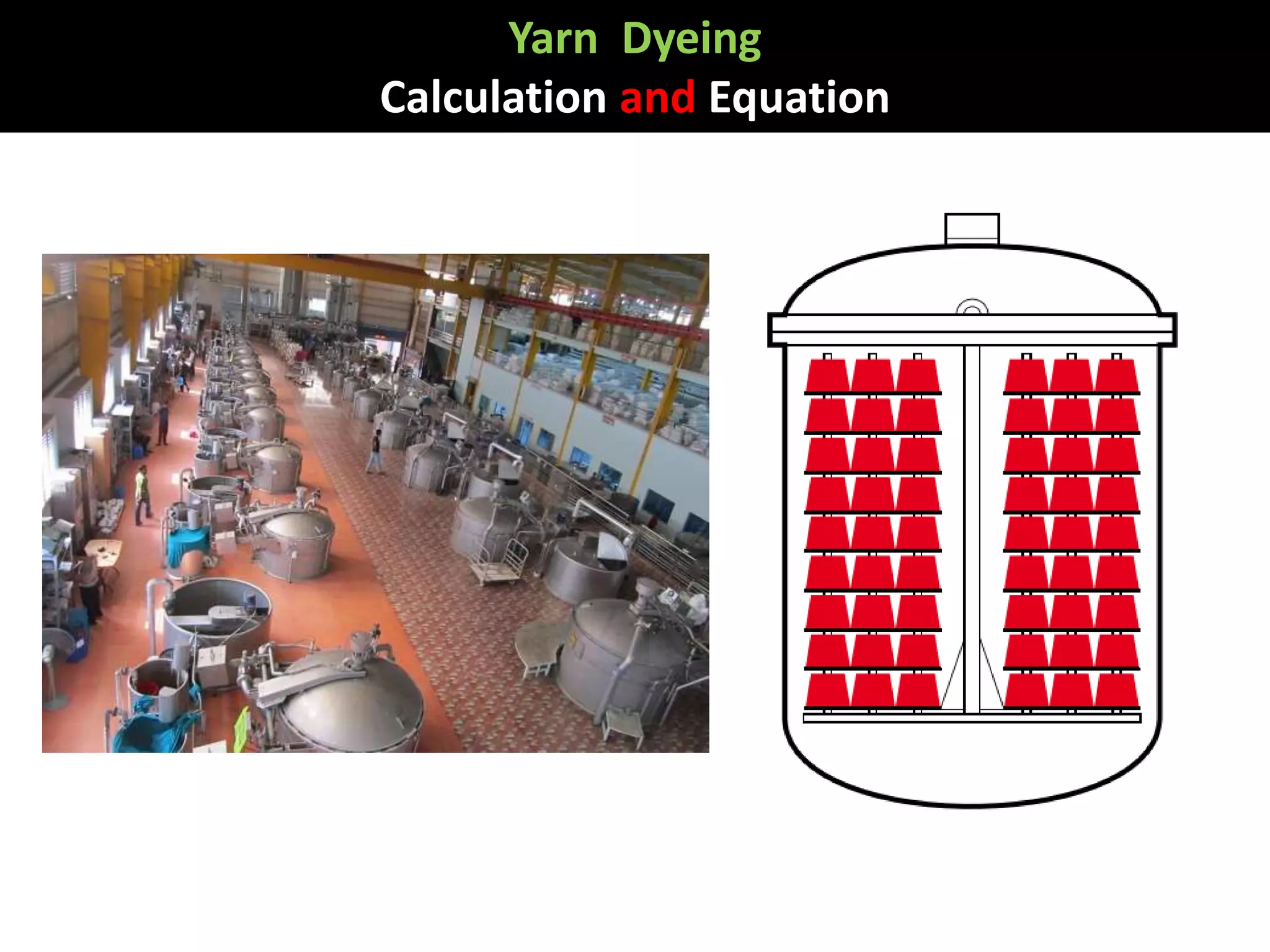
Yarn Dyeing
Calculation and Equation
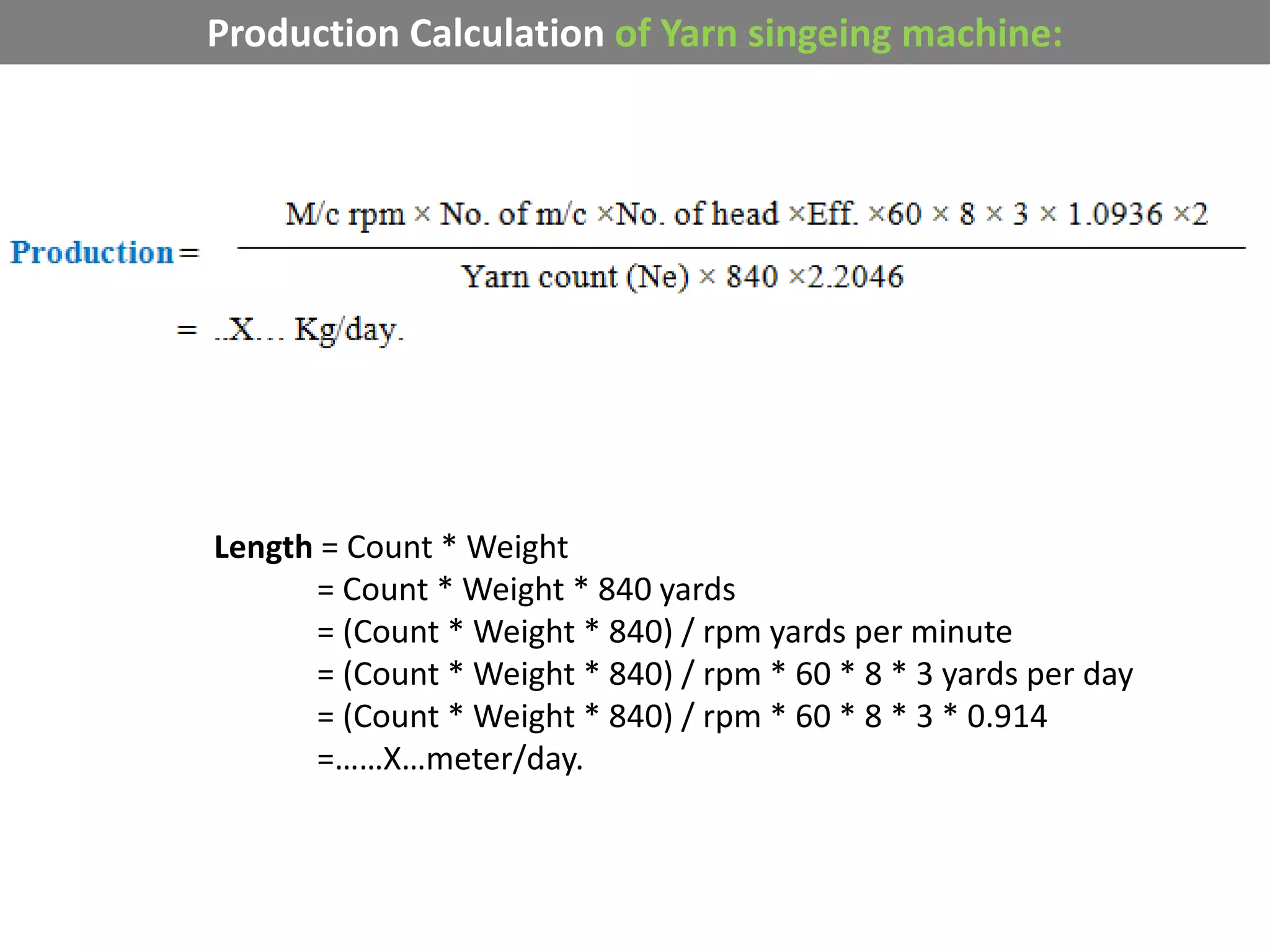
Production Calculation of Yarn singeing machine:
Length = Count * Weight
= Count * Weight * 840 yards
= (Count * Weight * 840) / rpm yards per minute
= (Count * Weight * 840) / rpm * 60 * 8 * 3 yards per day
= (Count * Weight * 840) / rpm * 60 * 8 * 3 * 0.914
=……X…meter/day.
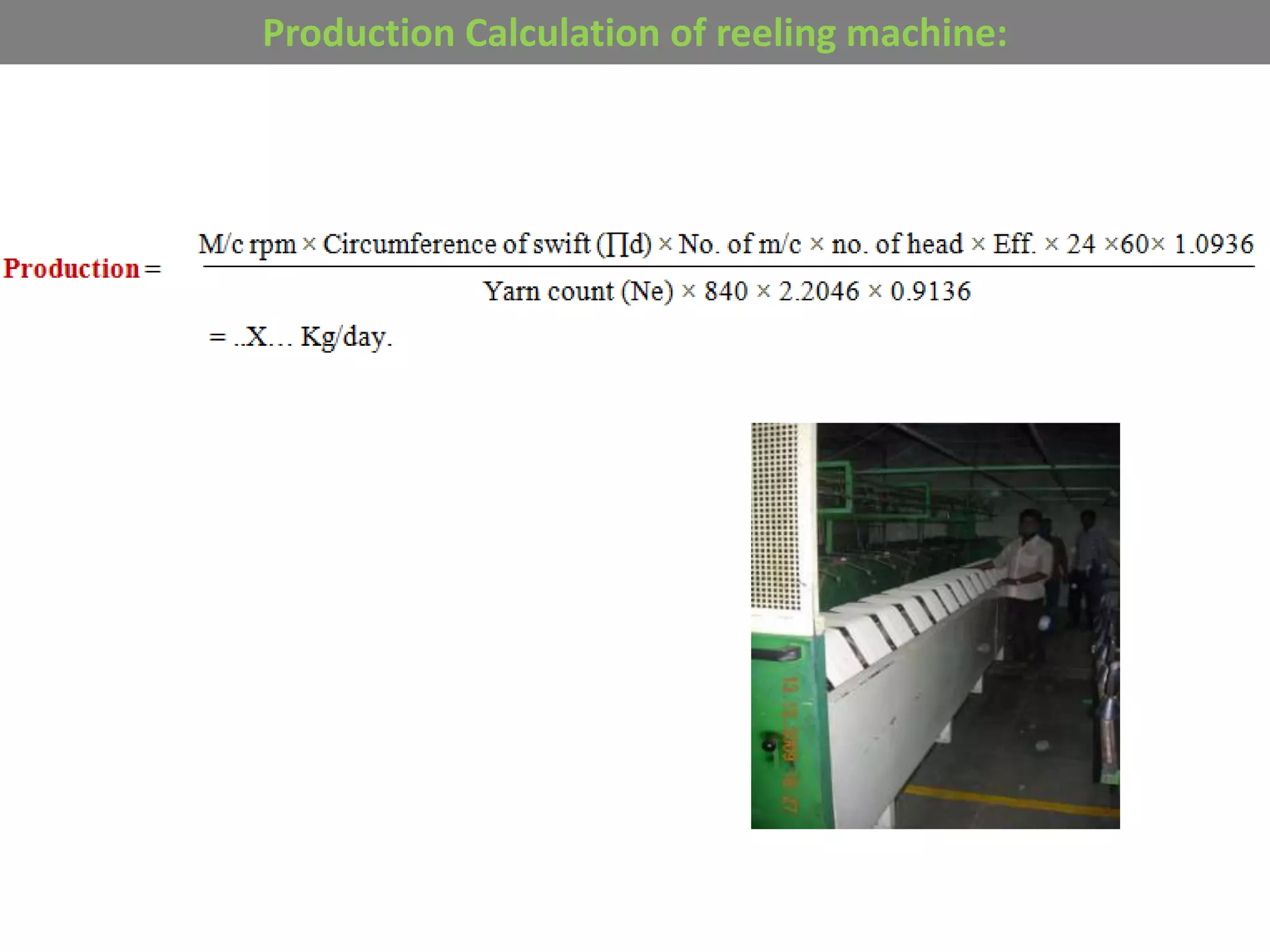
Production Calculation of reeling machine:
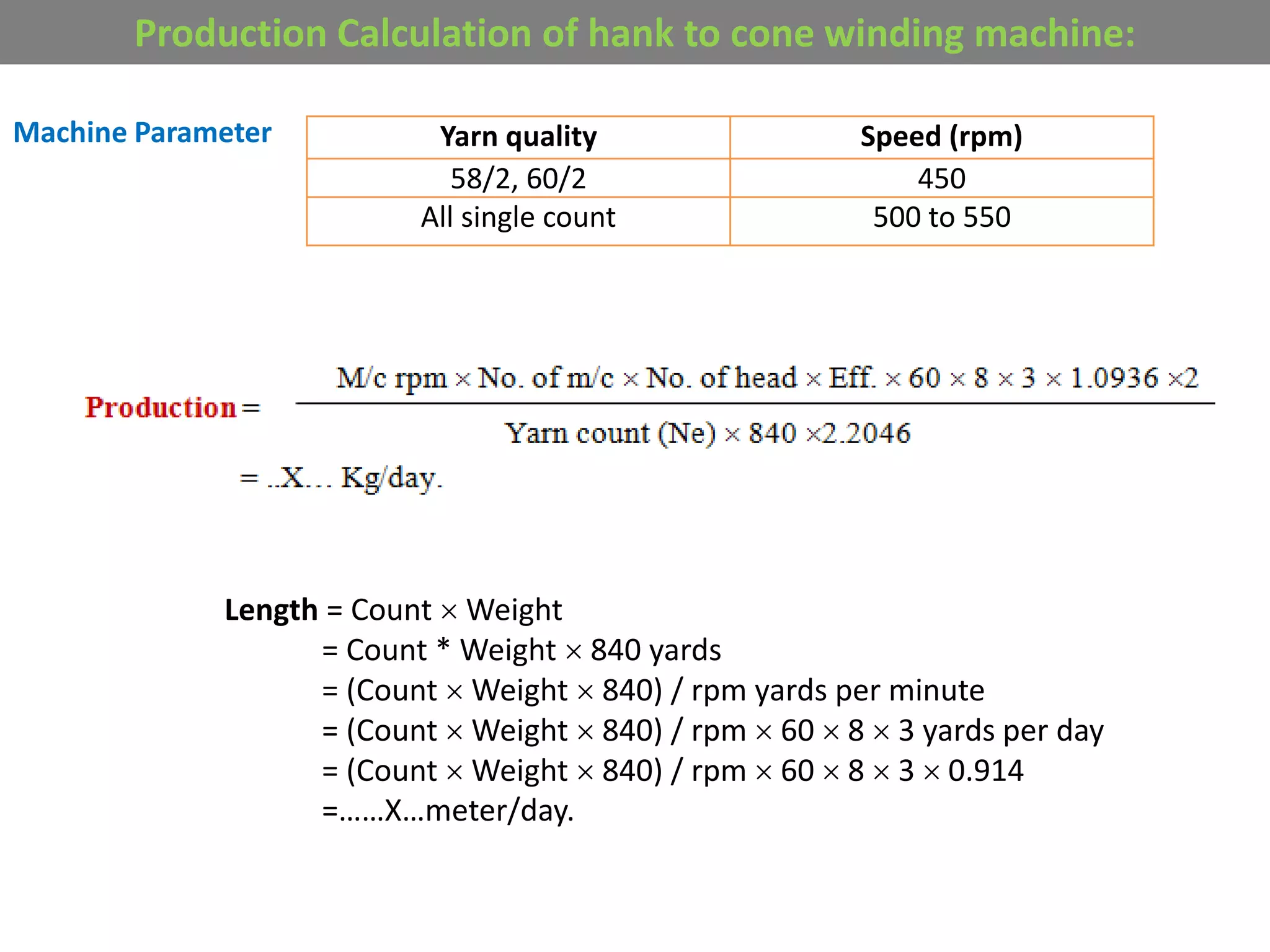
Production Calculation of hank to cone winding machine:
Machine Parameter Yarn quality Speed (rpm)
58/2, 60/2 450
All single count 500 to 550
Length = Count  Weight
= Count * Weight  840 yards
= (Count  Weight  840) / rpm yards per minute
= (Count  Weight  840) / rpm  60  8  3 yards per day
= (Count  Weight  840) / rpm  60  8  3  0.914
=……X…meter/day.
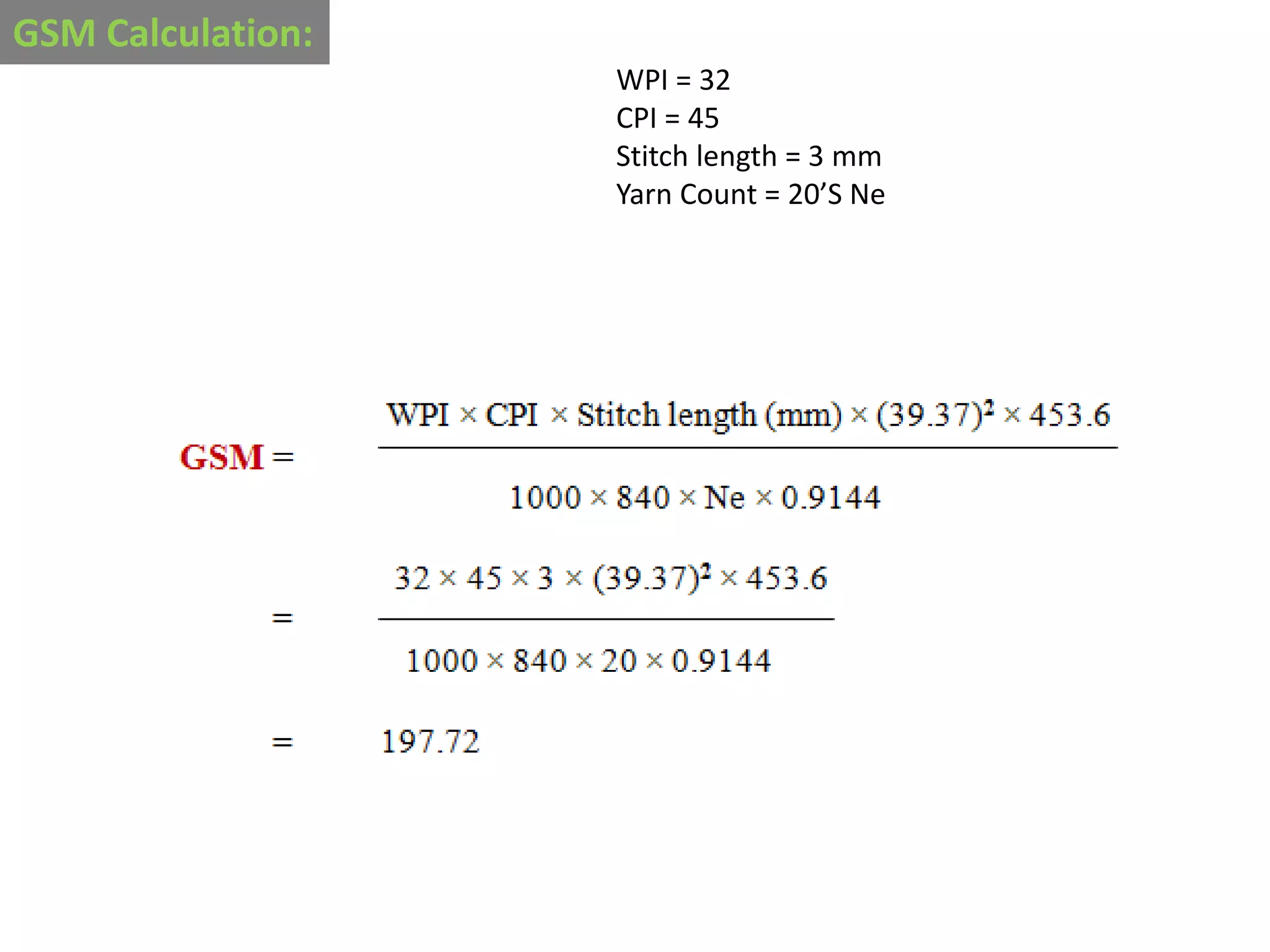
GSM Calculation:
WPI = 32
CPI = 45
Stitch length = 3 mm
Yarn Count = 20’S Ne
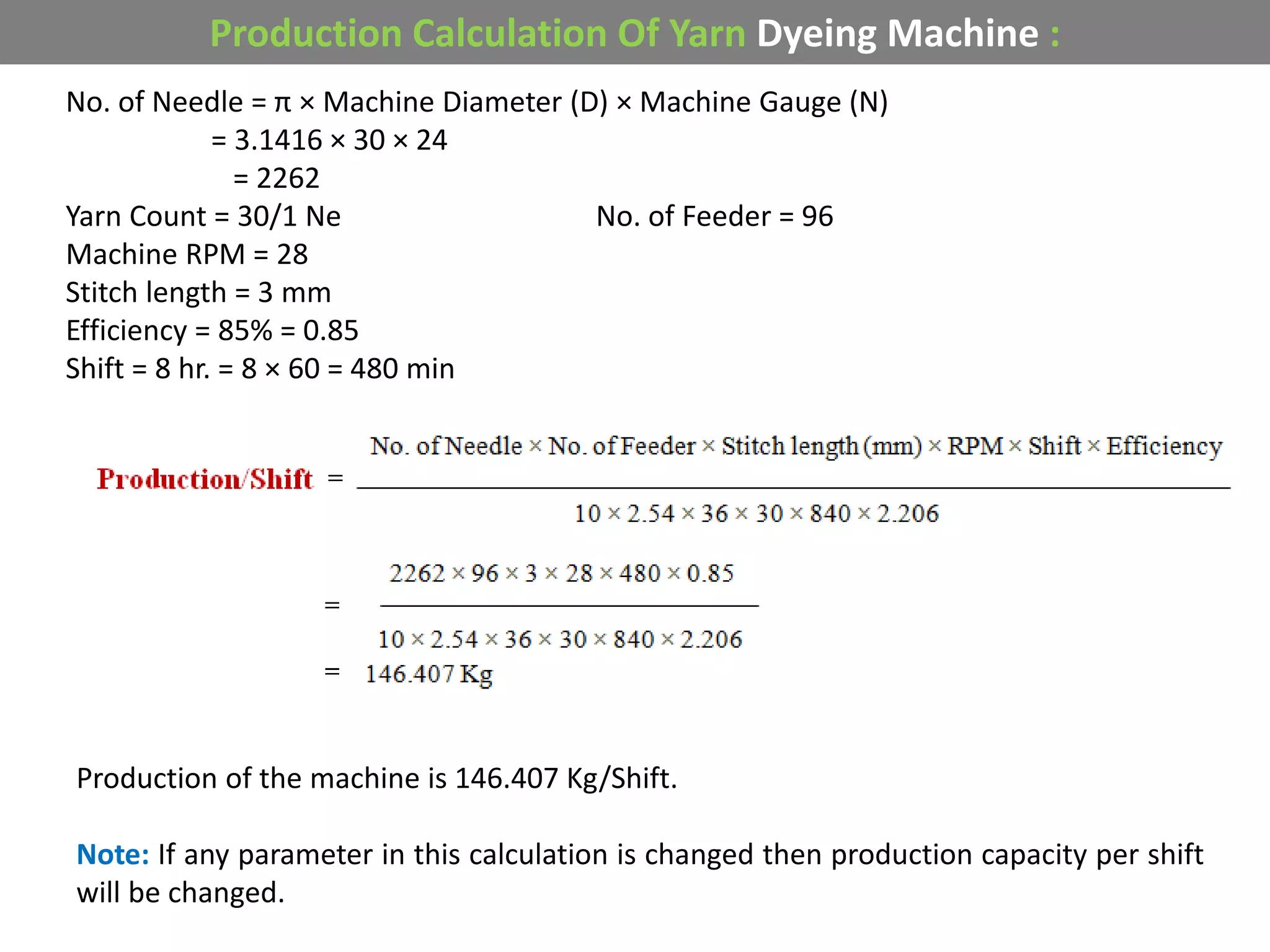
No. of Needle = π × Machine Diameter (D) × Machine Gauge (N)
= 3.1416 × 30 × 24
= 2262
Yarn Count = 30/1 Ne No. of Feeder = 96
Machine RPM = 28
Stitch length = 3 mm
Efficiency = 85% = 0.85
Shift = 8 hr. = 8 × 60 = 480 min
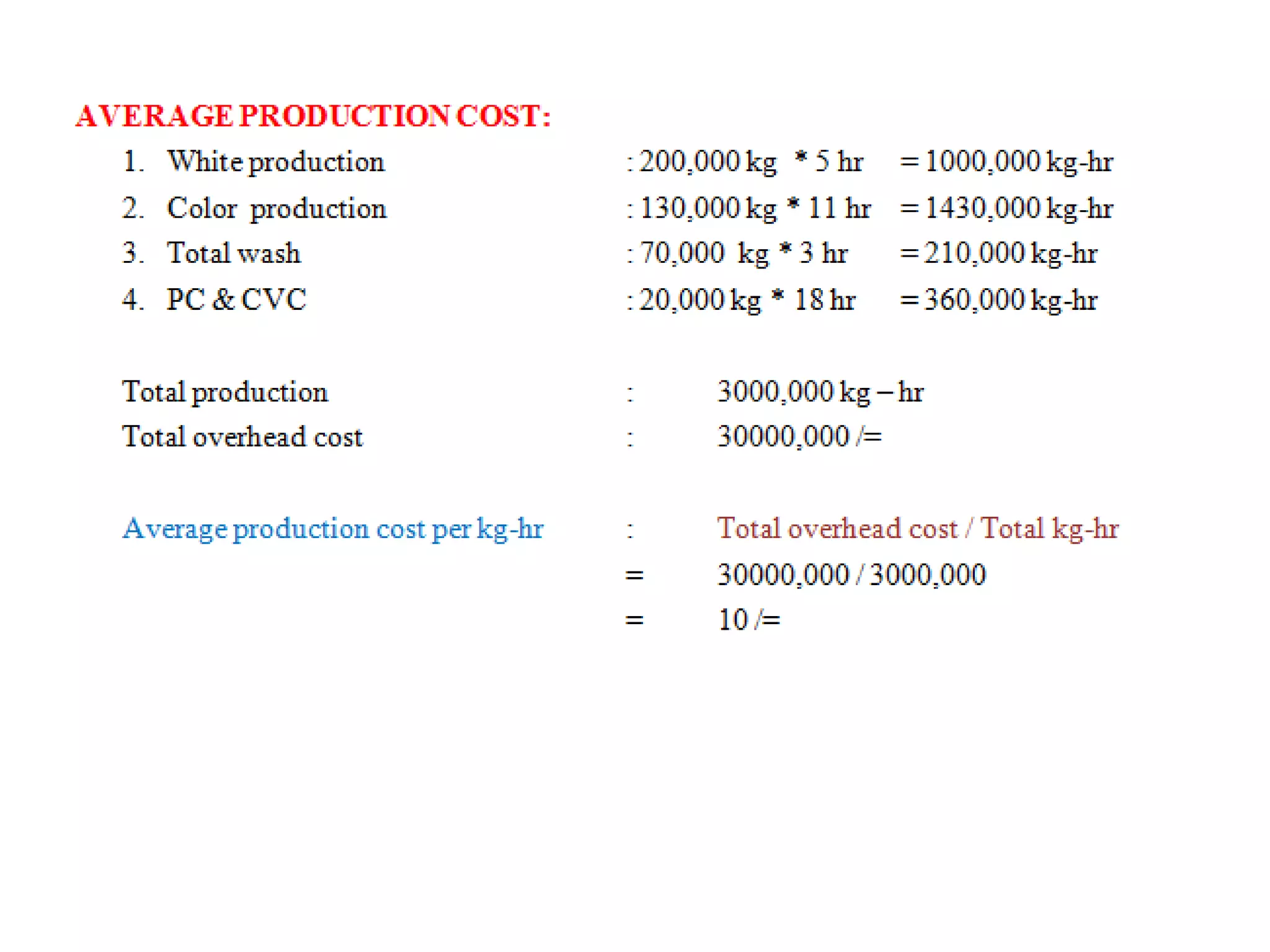
Production Calculation Of Yarn Dyeing Machine :
Production of the machine is 146.407 Kg/Shift.
Note: If any parameter in this calculation is changed then production capacity per shift
will be changed.
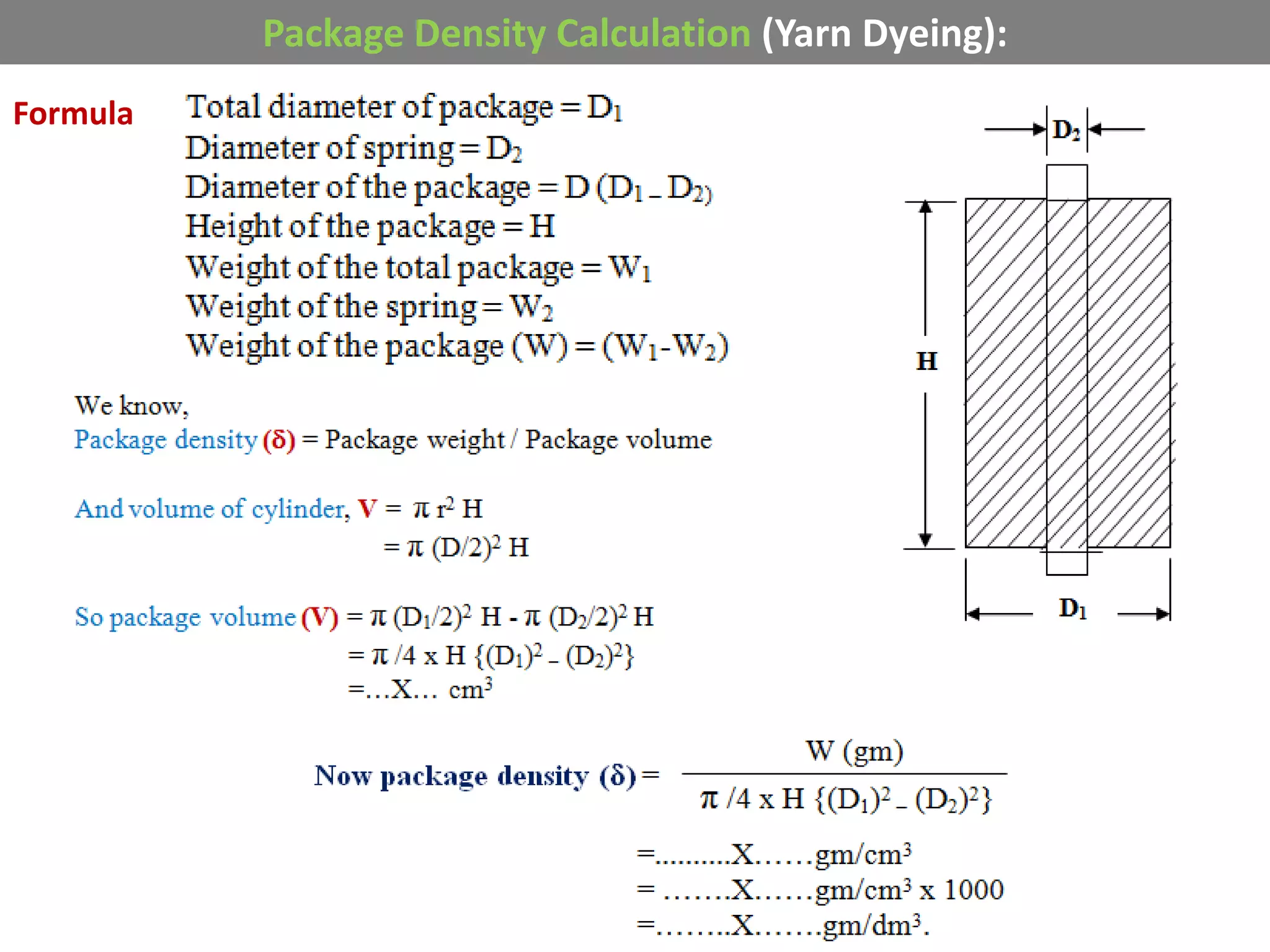
Package Density Calculation (Yarn Dyeing):
Formula
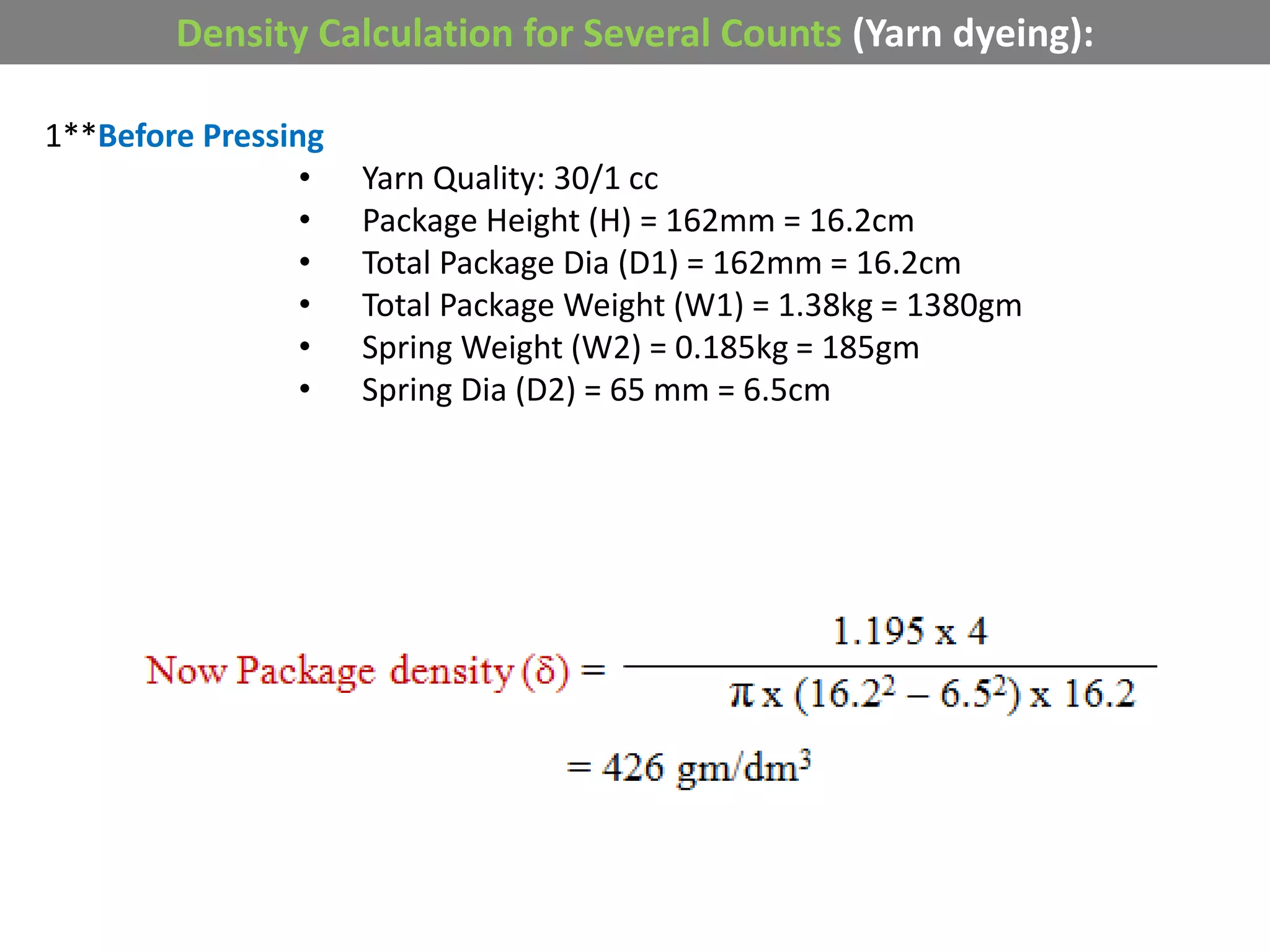
Density Calculation for Several Counts (Yarn dyeing):
1**Before Pressing
• Yarn Quality: 30/1 cc
• Package Height (H) = 162mm = 16.2cm
• Total Package Dia (D1) = 162mm = 16.2cm
• Total Package Weight (W1) = 1.38kg = 1380gm
• Spring Weight (W2) = 0.185kg = 185gm
• Spring Dia (D2) = 65 mm = 6.5cm
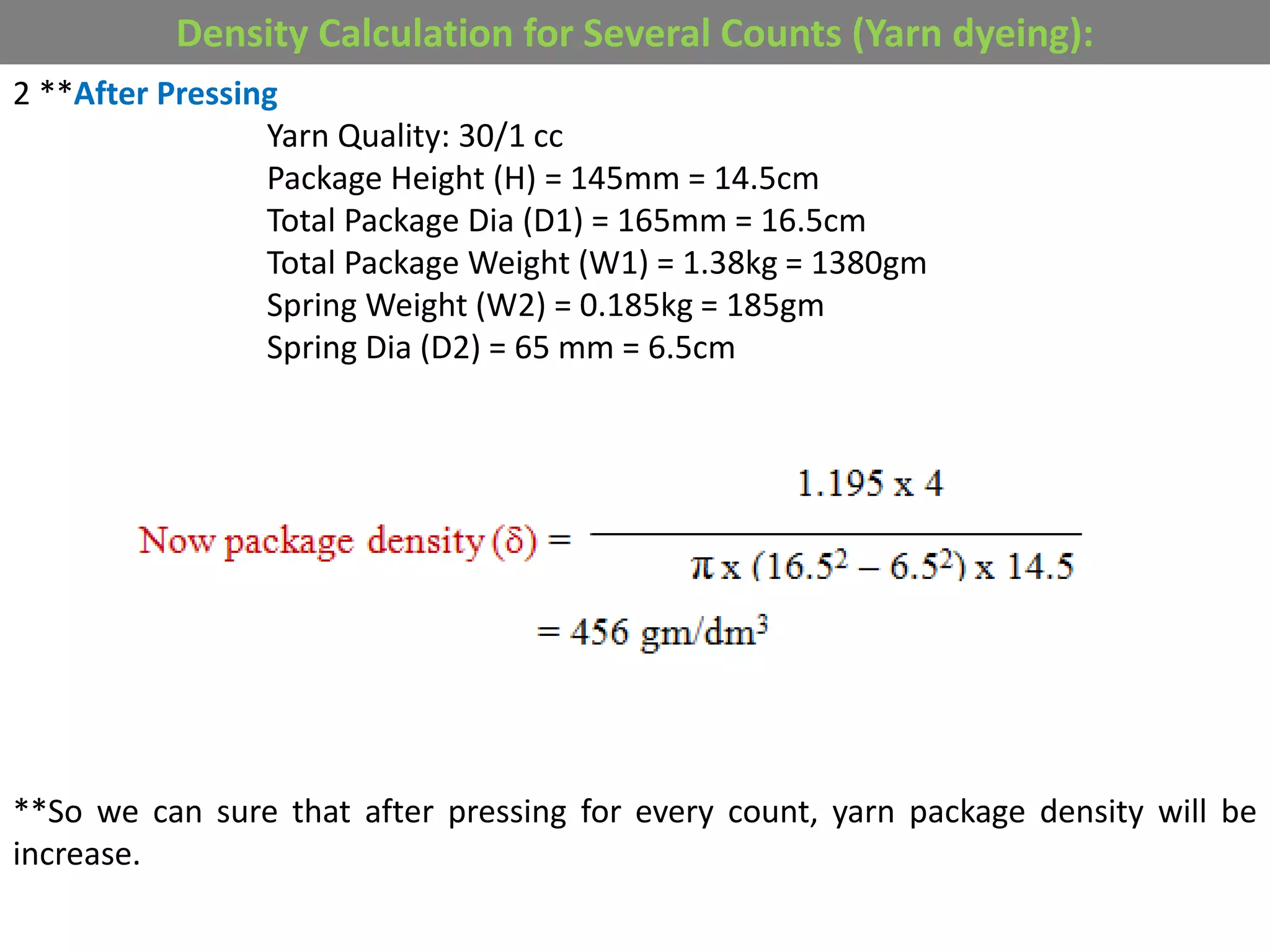
2 **After Pressing
Yarn Quality: 30/1 cc
Package Height (H) = 145mm = 14.5cm
Total Package Dia (D1) = 165mm = 16.5cm
Total Package Weight (W1) = 1.38kg = 1380gm
Spring Weight (W2) = 0.185kg = 185gm
Spring Dia (D2) = 65 mm = 6.5cm
**So we can sure that after pressing for every count, yarn package density will be
increase.
Density Calculation for Several Counts (Yarn dyeing):
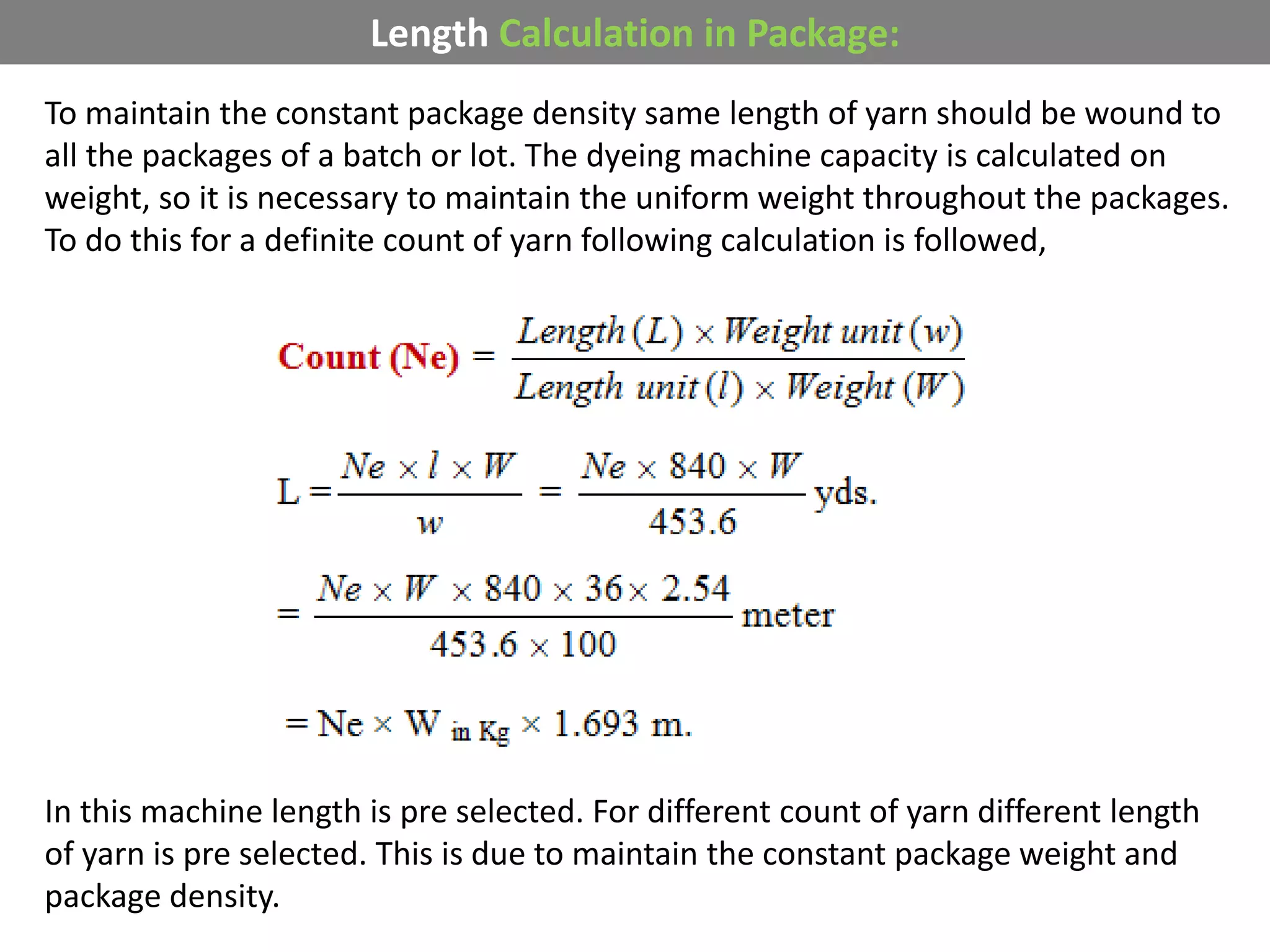
Length Calculation in Package:
To maintain the constant package density same length of yarn should be wound to
all the packages of a batch or lot. The dyeing machine capacity is calculated on
weight, so it is necessary to maintain the uniform weight throughout the packages.
To do this for a definite count of yarn following calculation is followed,
In this machine length is pre selected. For different count of yarn different length
of yarn is pre selected. This is due to maintain the constant package weight and
package density.
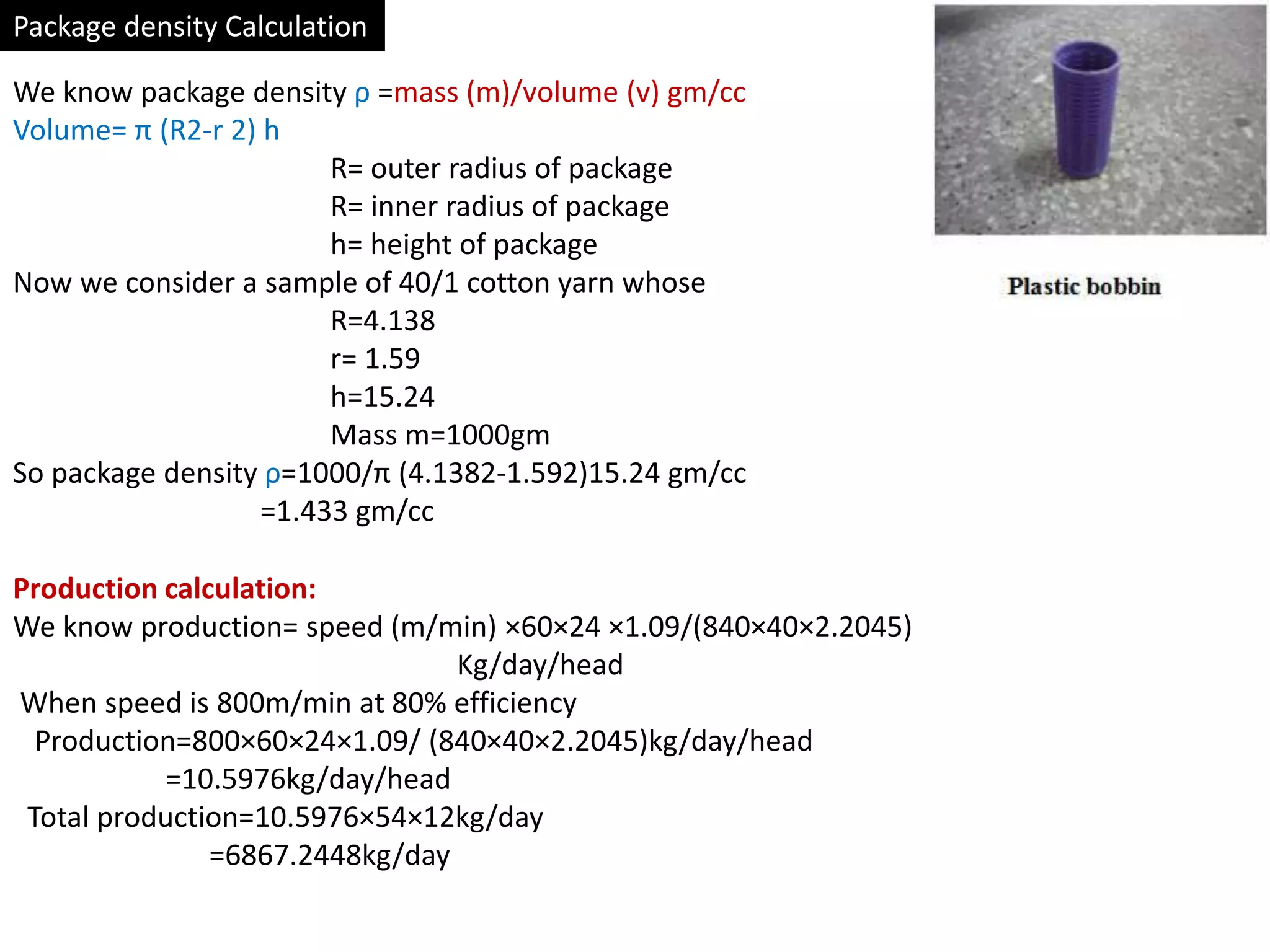
Package density Calculation
We know package density ρ =mass (m)/volume (v) gm/cc
Volume= π (R2-r 2) h
R= outer radius of package
R= inner radius of package
h= height of package
Now we consider a sample of 40/1 cotton yarn whose
R=4.138
r= 1.59
h=15.24
Mass m=1000gm
So package density ρ=1000/π (4.1382-1.592)15.24 gm/cc
=1.433 gm/cc
Production calculation:
We know production= speed (m/min) ×60×24 ×1.09/(840×40×2.2045)
Kg/day/head
When speed is 800m/min at 80% efficiency
Production=800×60×24×1.09/ (840×40×2.2045)kg/day/head
=10.5976kg/day/head
Total production=10.5976×54×12kg/day
=6867.2448kg/day
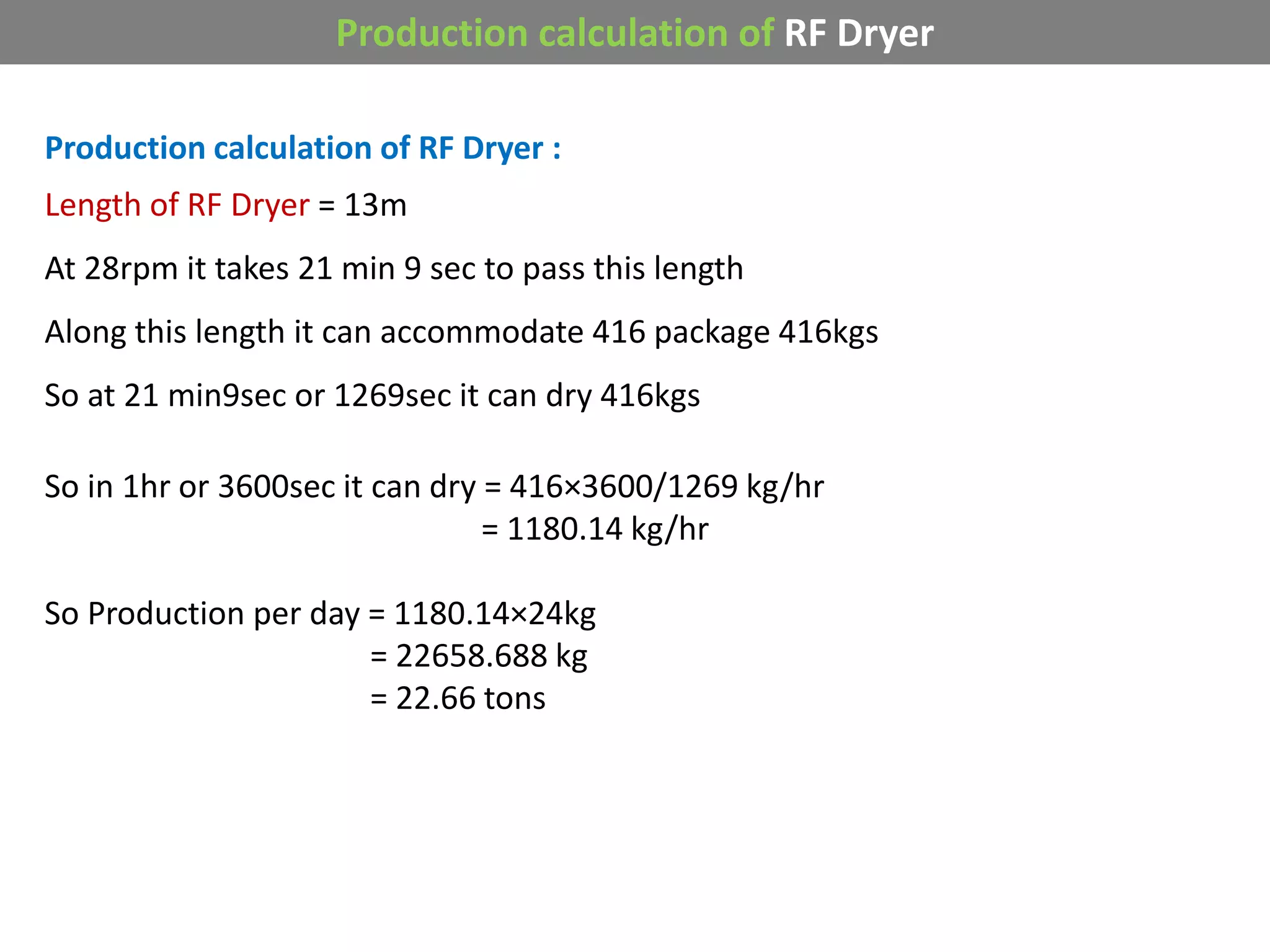
Production calculation of RF Dryer :
Length of RF Dryer = 13m
At 28rpm it takes 21 min 9 sec to pass this length
Along this length it can accommodate 416 package 416kgs
So at 21 min9sec or 1269sec it can dry 416kgs
So in 1hr or 3600sec it can dry = 416×3600/1269 kg/hr
= 1180.14 kg/hr
So Production per day = 1180.14×24kg
= 22658.688 kg
= 22.66 tons
Production calculation of RF Dryer
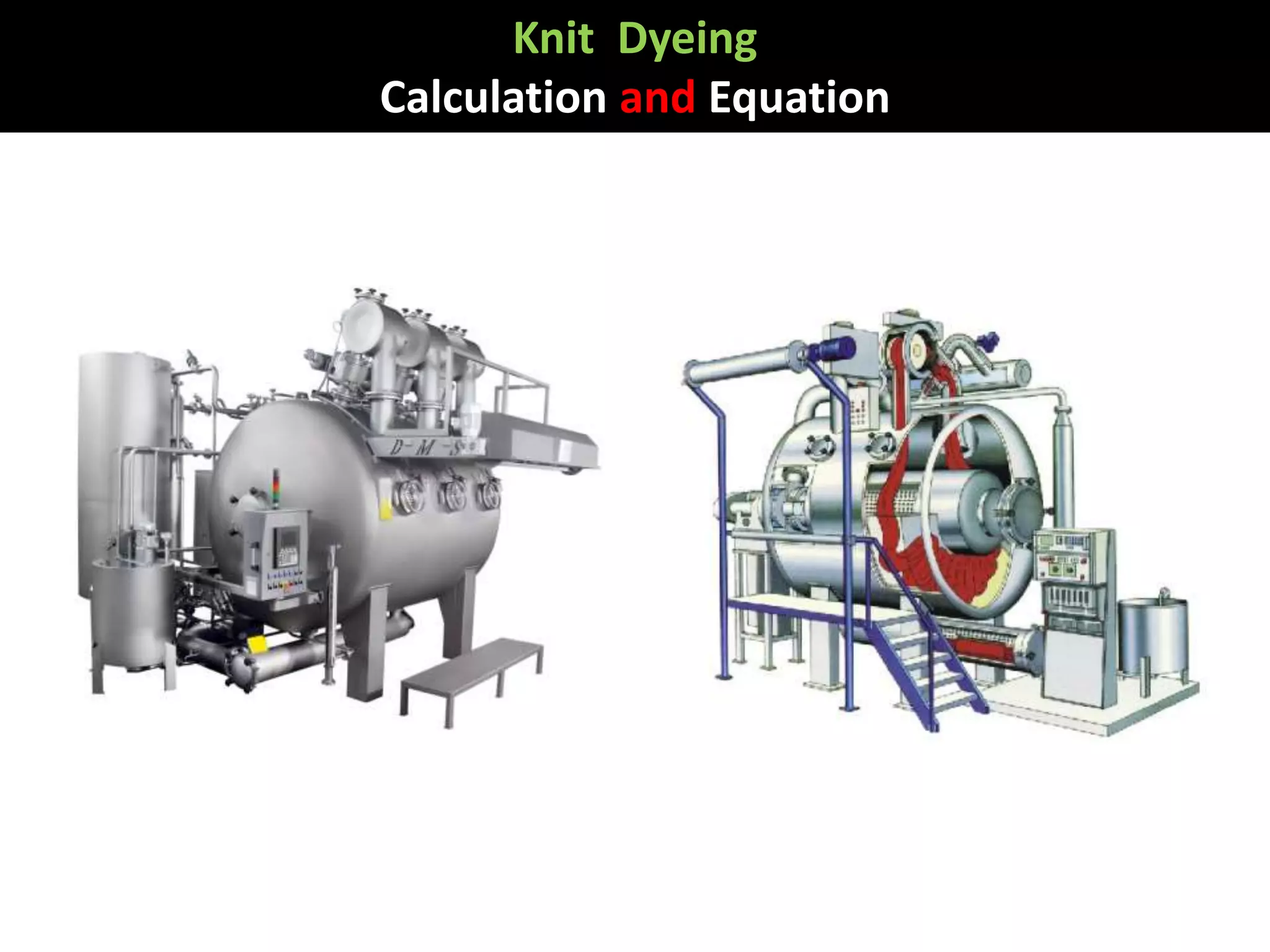
Knit Dyeing
Calculation and Equation
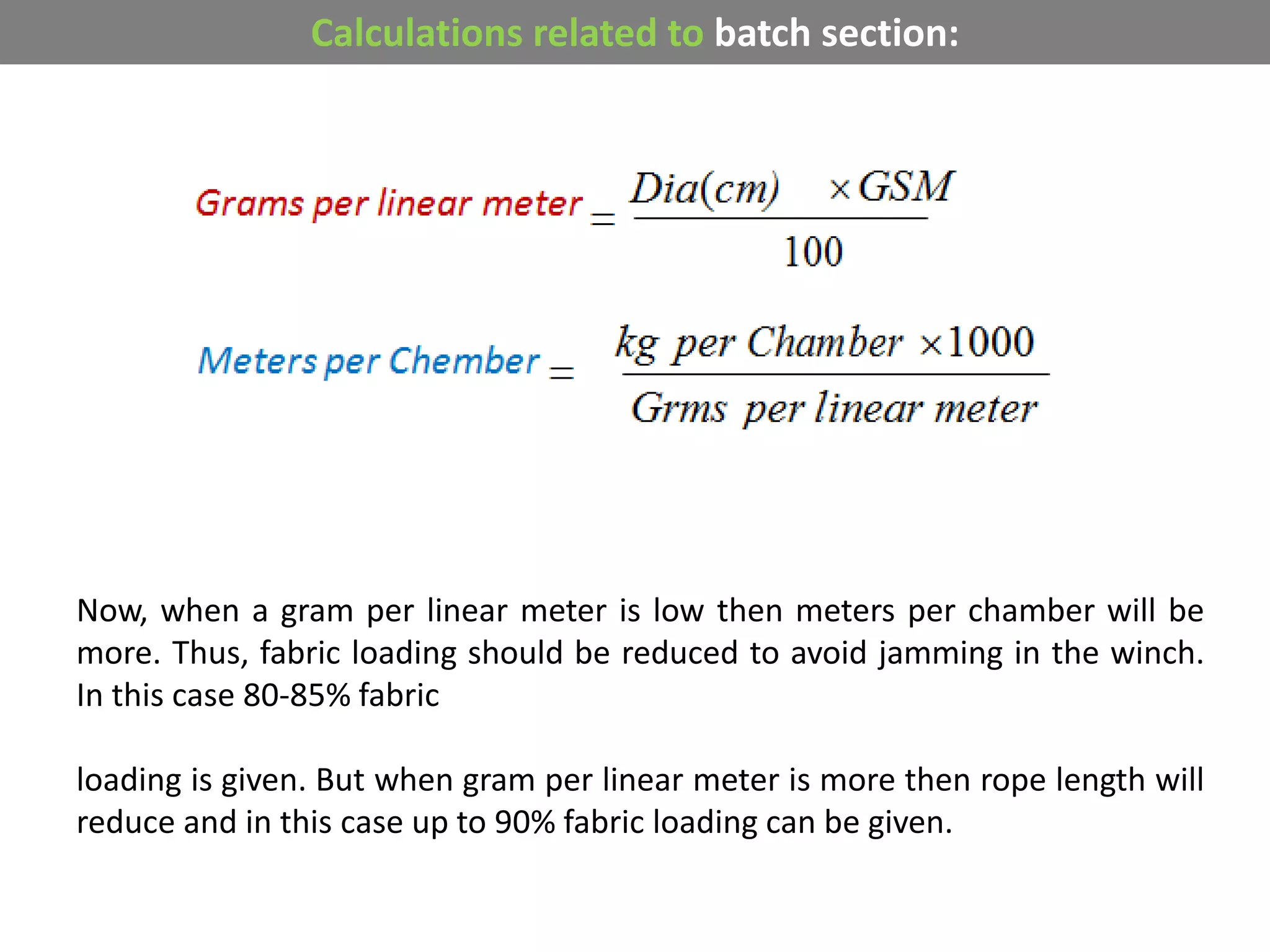
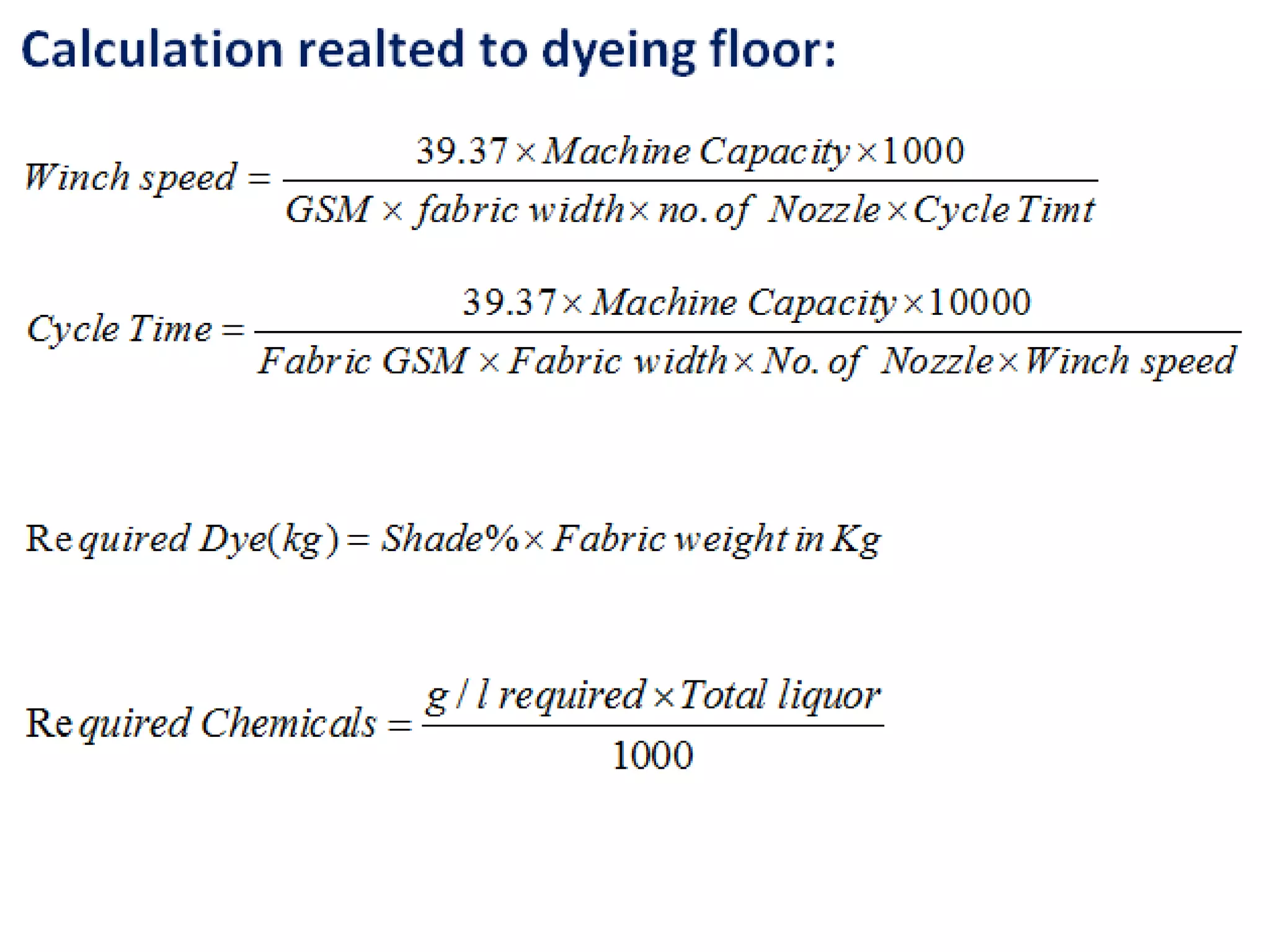
Calculations related to batch section:
Now, when a gram per linear meter is low then meters per chamber will be
more. Thus, fabric loading should be reduced to avoid jamming in the winch.
In this case 80-85% fabric
loading is given. But when gram per linear meter is more then rope length will
reduce and in this case up to 90% fabric loading can be given.
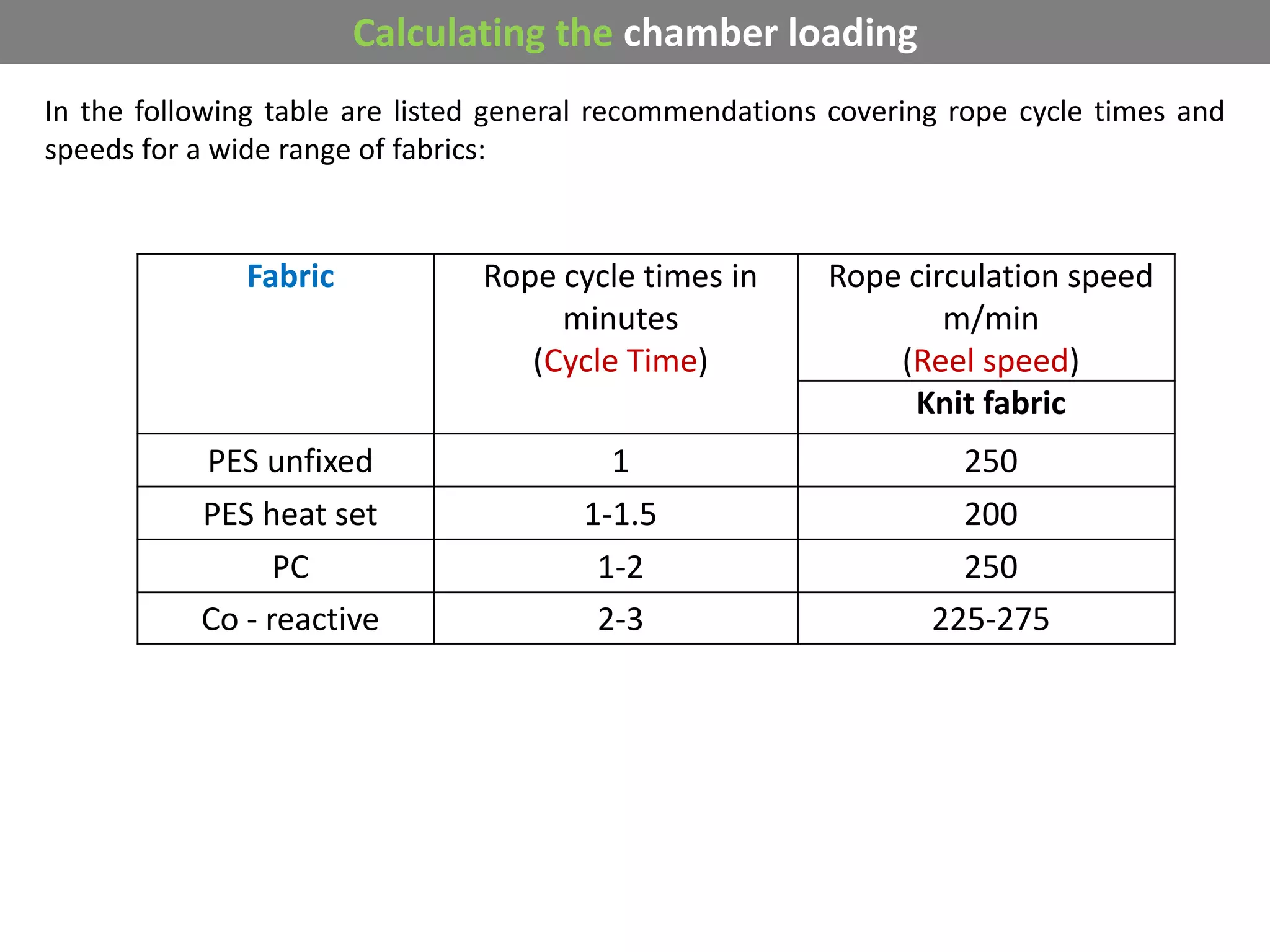
Calculating the chamber loading
In the following table are listed general recommendations covering rope cycle times and
speeds for a wide range of fabrics:
Fabric Rope cycle times in
minutes
(Cycle Time)
Rope circulation speed
m/min
(Reel speed)
Knit fabric
PES unfixed 1 250
PES heat set 1-1.5 200
PC 1-2 250
Co - reactive 2-3 225-275
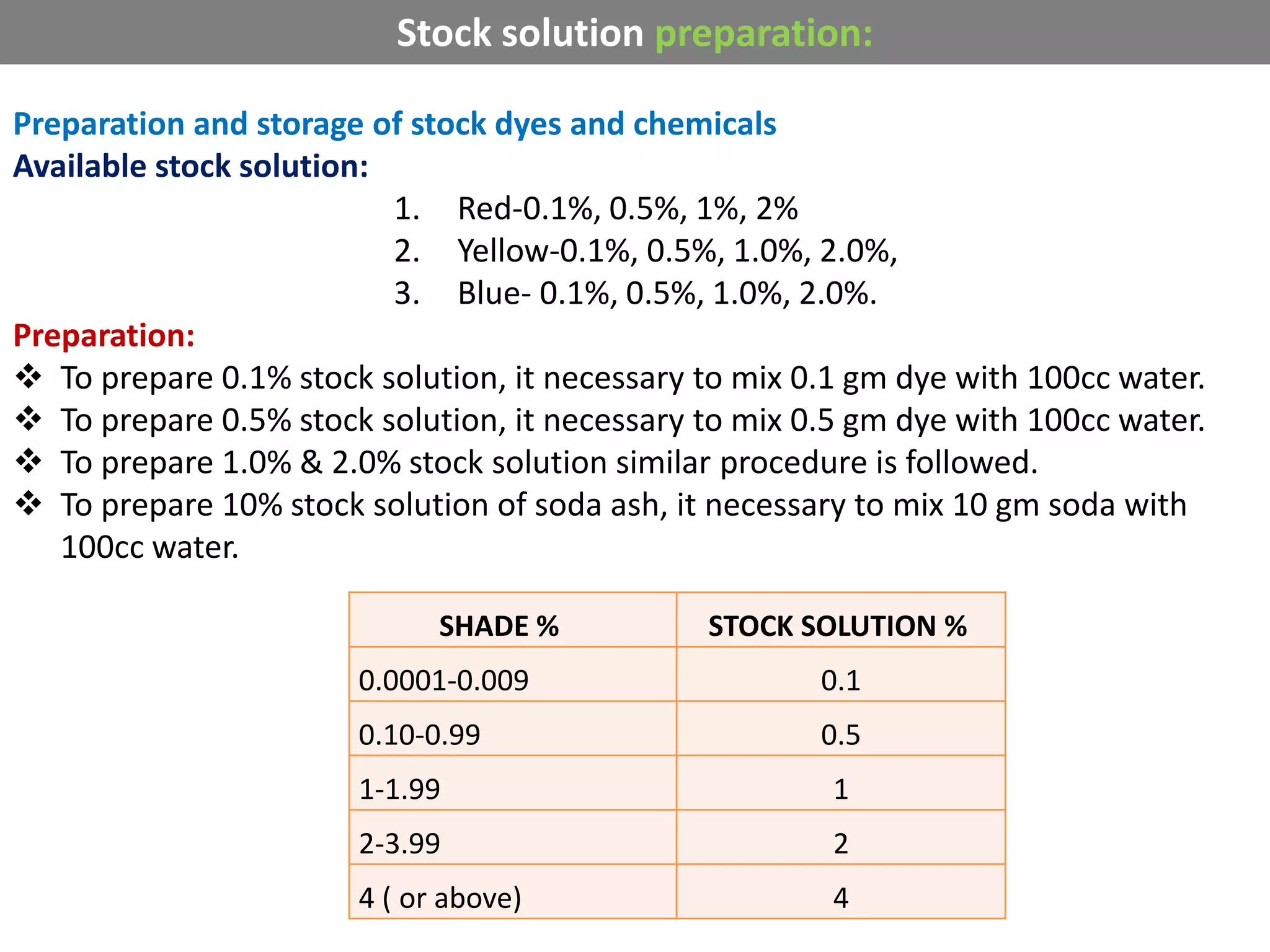
Preparation and storage of stock dyes and chemicals
Available stock solution:
1. Red-0.1%, 0.5%, 1%, 2%
2. Yellow-0.1%, 0.5%, 1.0%, 2.0%,
3. Blue- 0.1%, 0.5%, 1.0%, 2.0%.
Preparation:
 To prepare 0.1% stock solution, it necessary to mix 0.1 gm dye with 100cc water.
 To prepare 0.5% stock solution, it necessary to mix 0.5 gm dye with 100cc water.
 To prepare 1.0% & 2.0% stock solution similar procedure is followed.
 To prepare 10% stock solution of soda ash, it necessary to mix 10 gm soda with
100cc water.
SHADE % STOCK SOLUTION %
0.0001-0.009 0.1
0.10-0.99 0.5
1-1.99 1
2-3.99 2
4 ( or above) 4
Stock solution preparation:
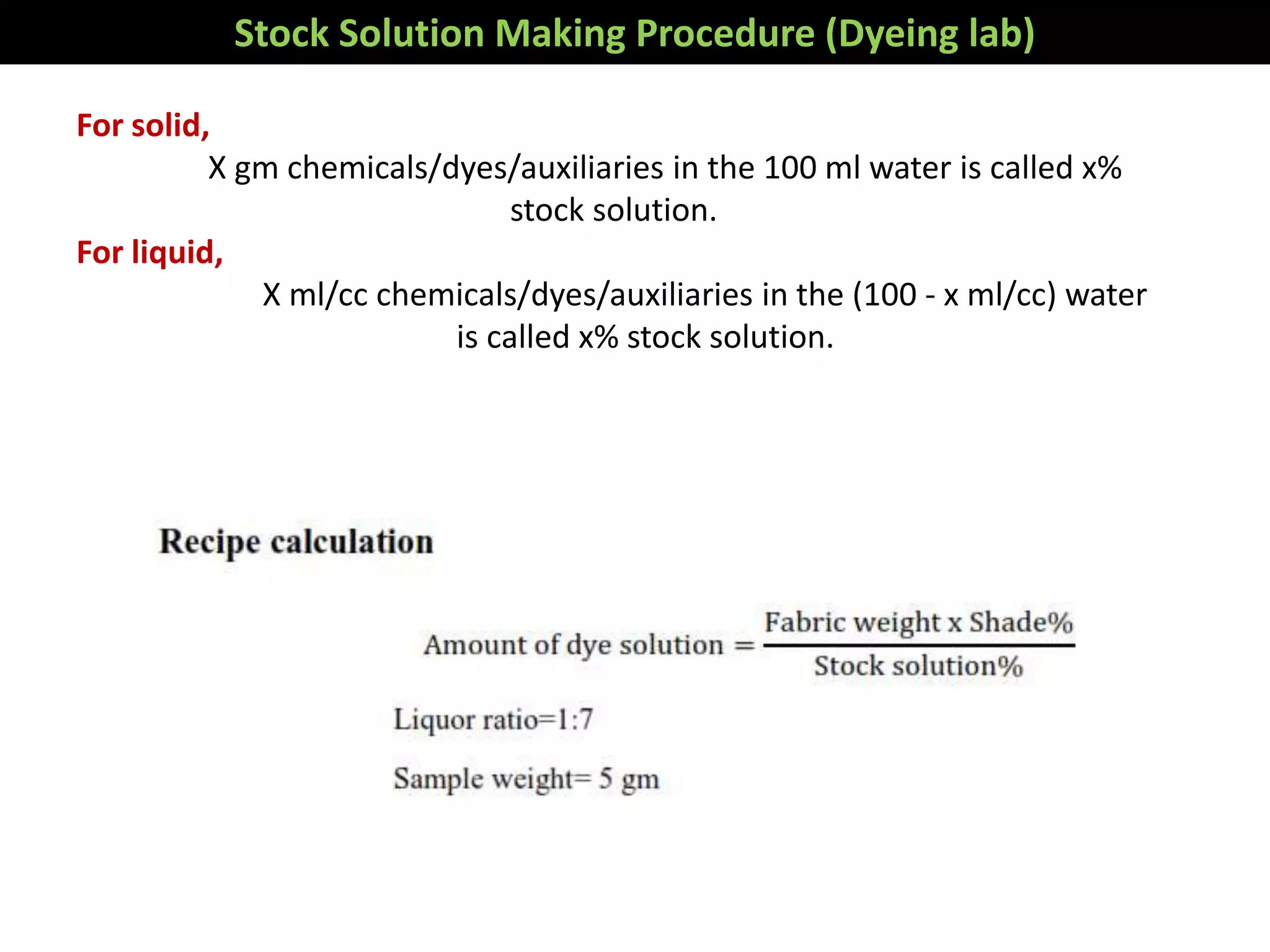
Stock Solution Making Procedure (Dyeing lab)
For solid,
X gm chemicals/dyes/auxiliaries in the 100 ml water is called x%
stock solution.
For liquid,
X ml/cc chemicals/dyes/auxiliaries in the (100 - x ml/cc) water
is called x% stock solution.
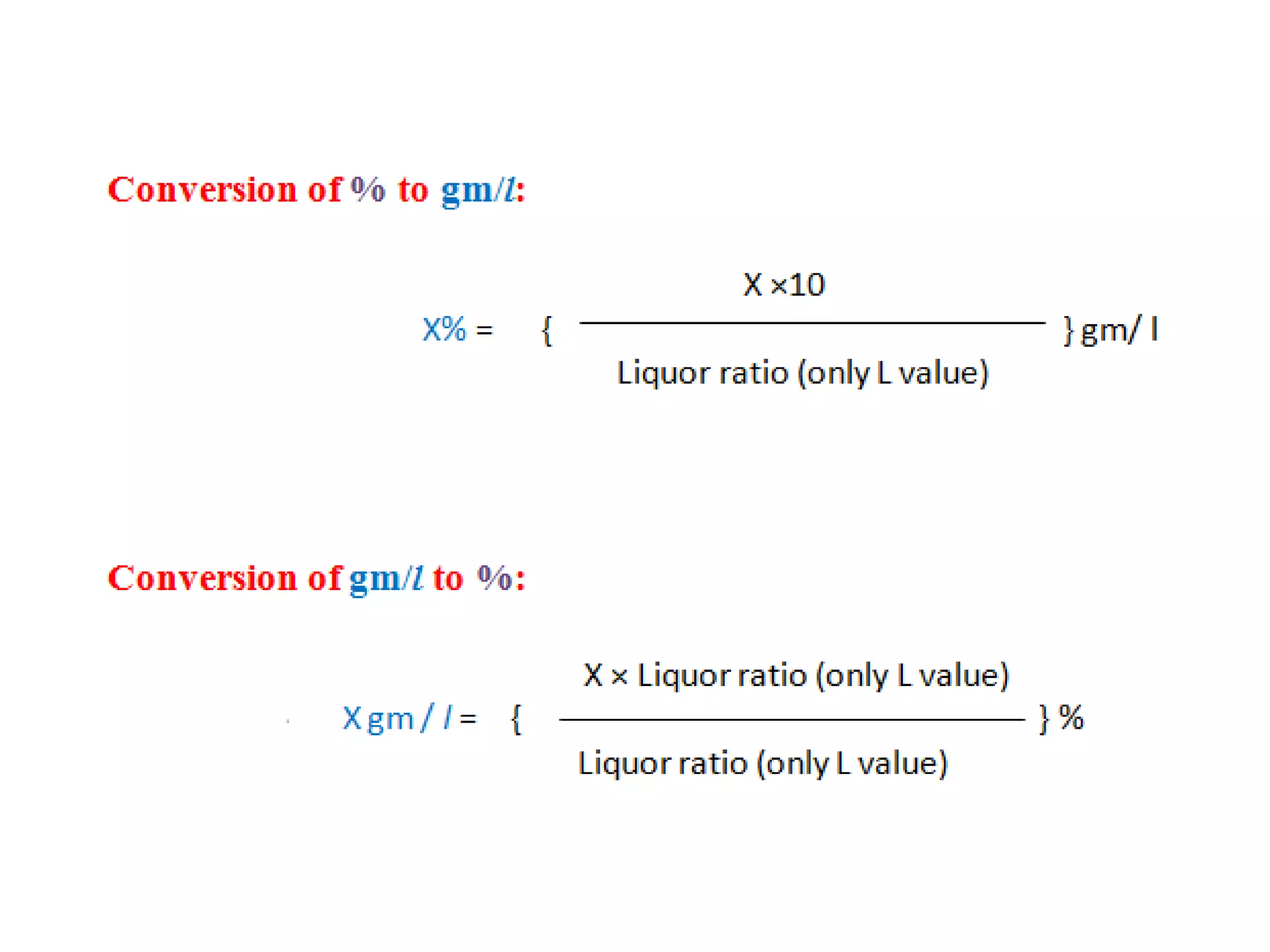
Conversion formula from percentage to g/l is as
g/l = Required amount (%)× 10
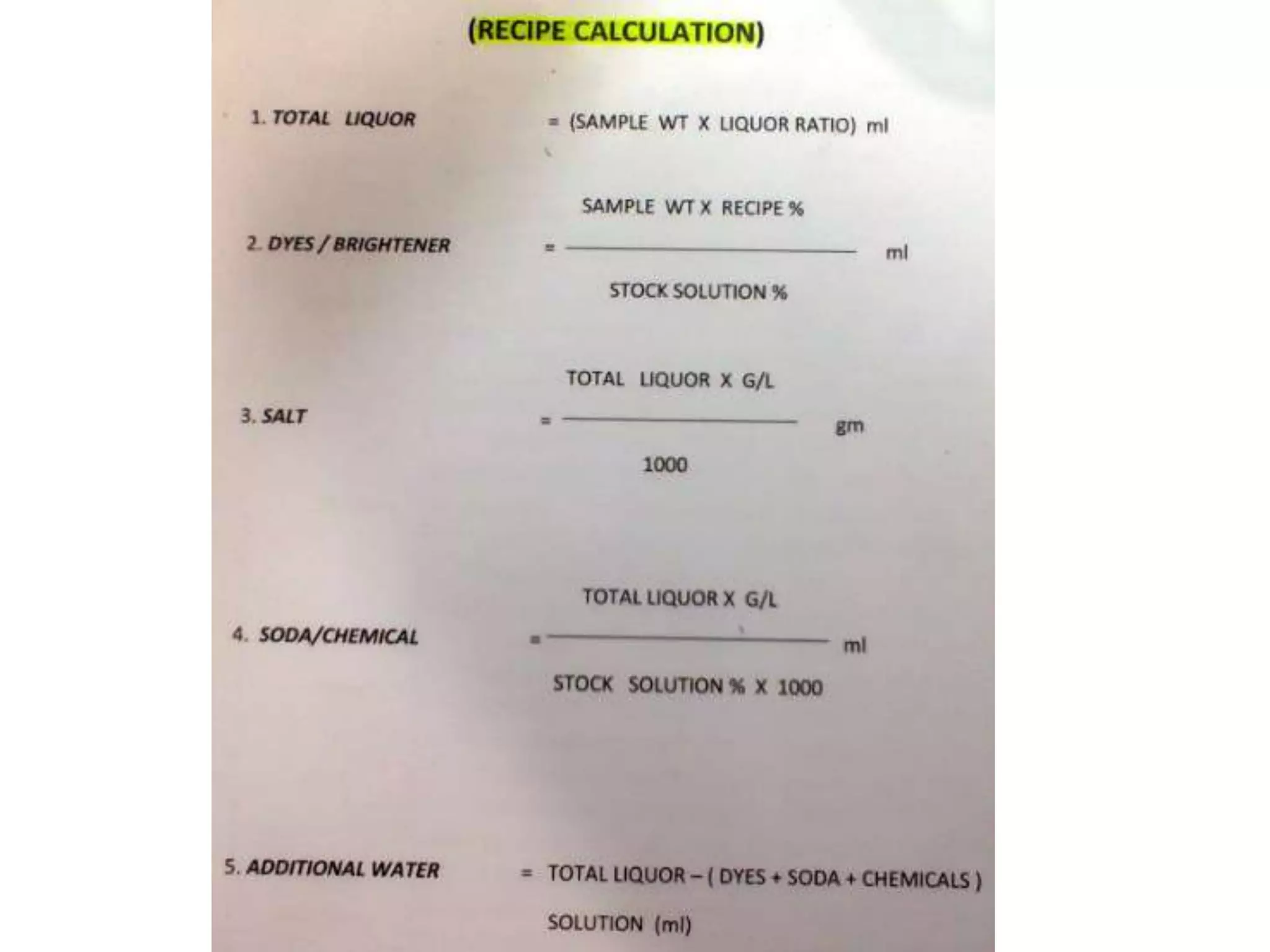
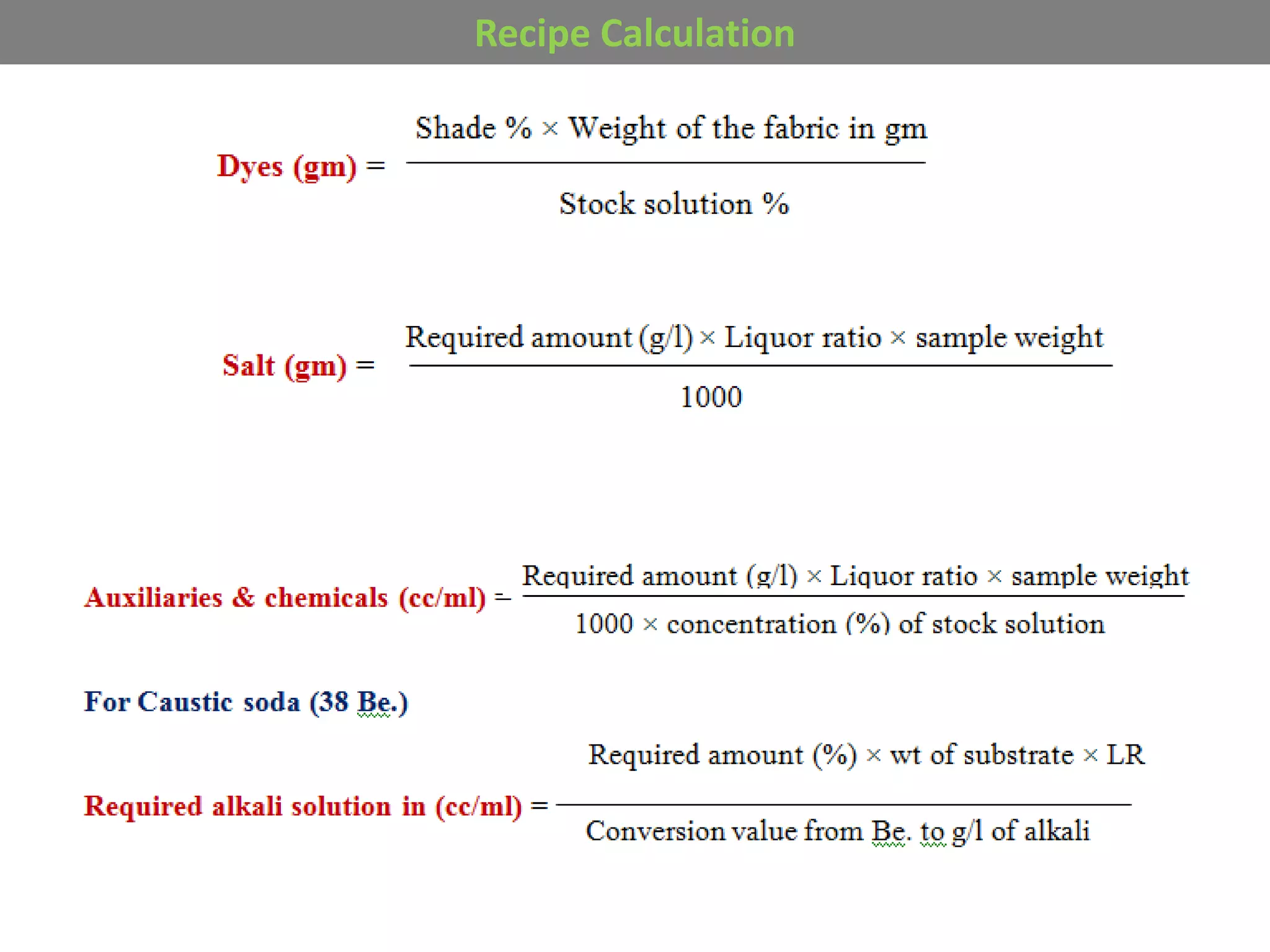
Recipe Calculation
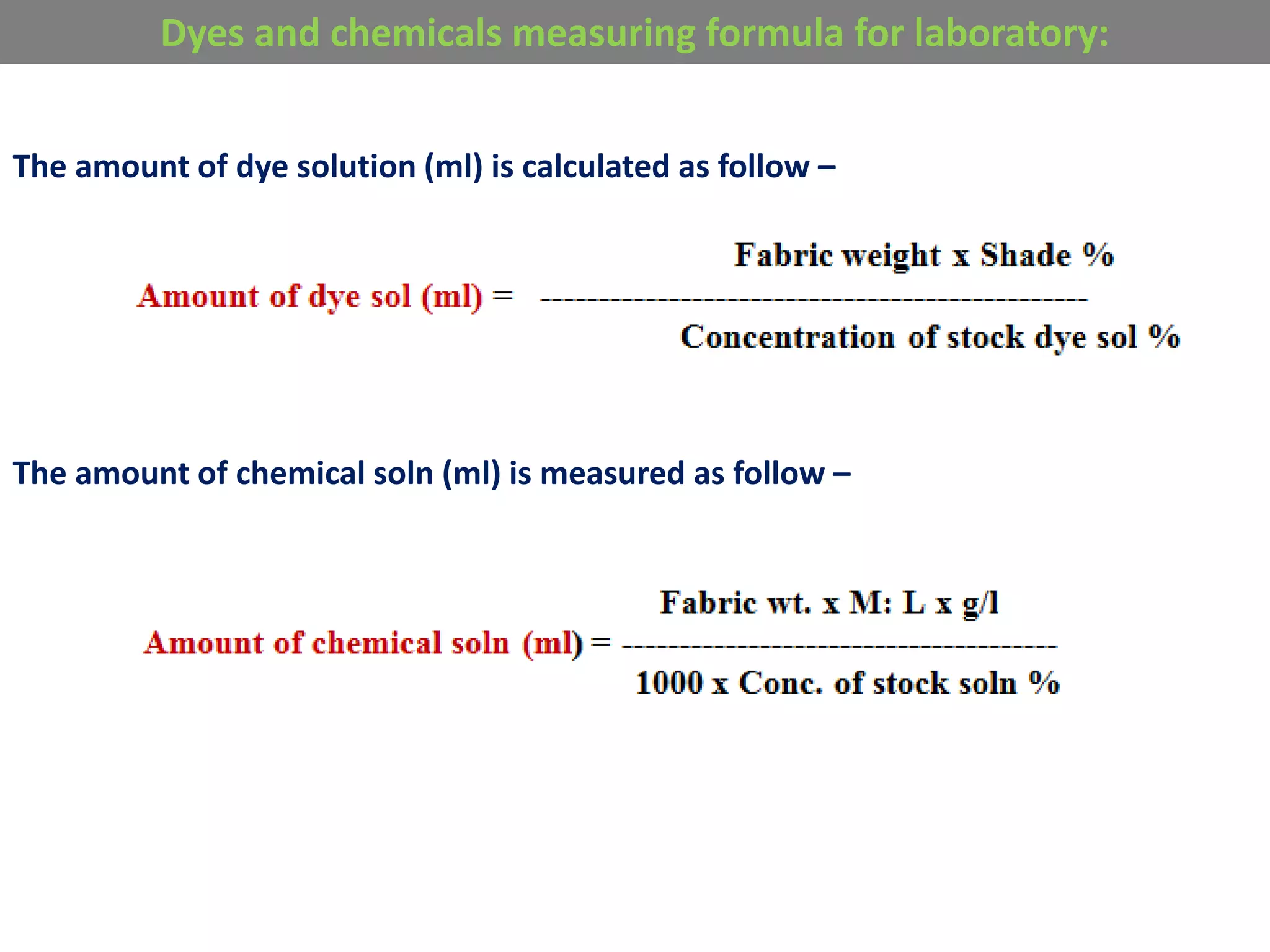
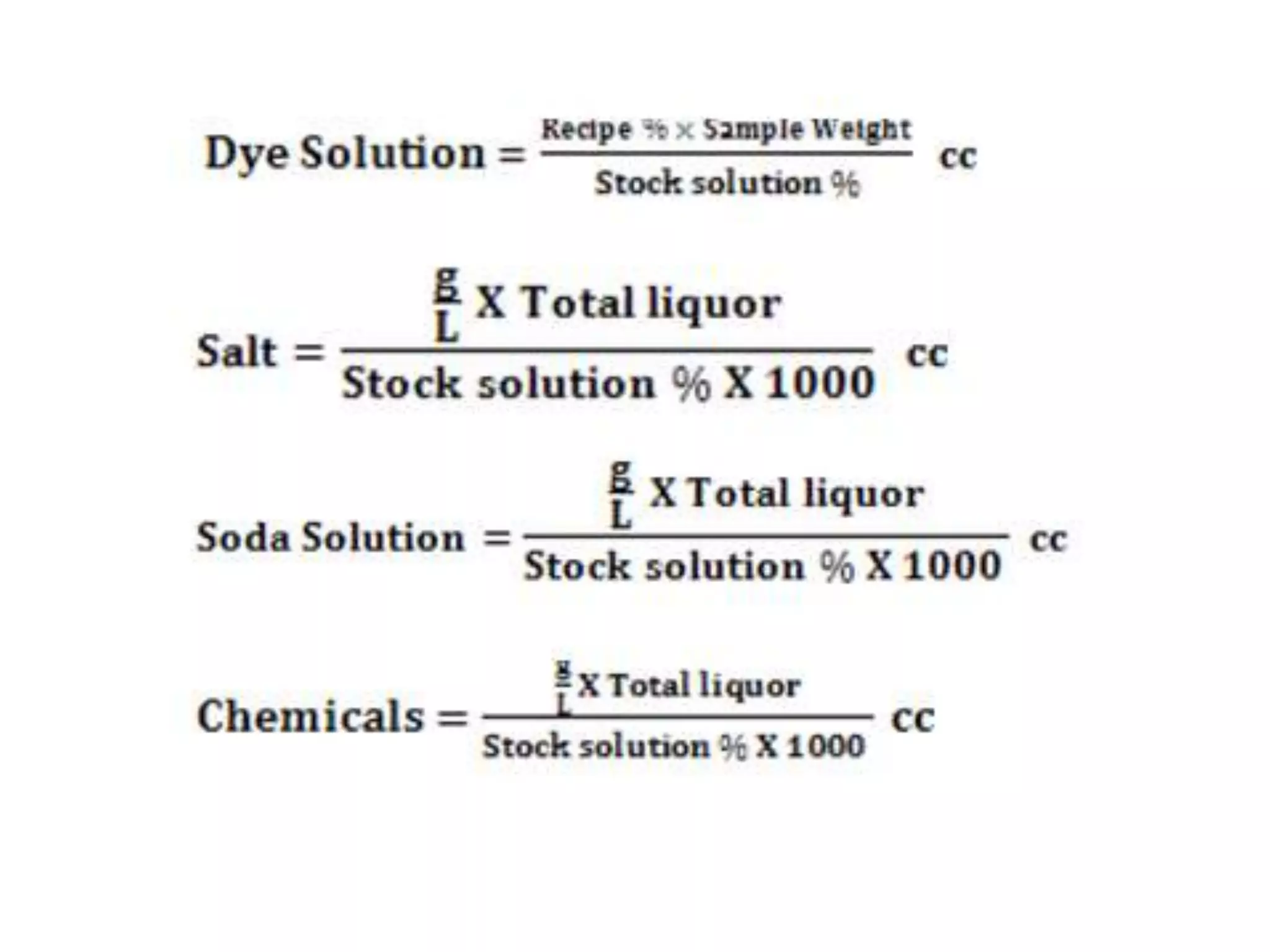
Dyes and chemicals measuring formula for laboratory:
The amount of dye solution (ml) is calculated as follow –
The amount of chemical soln (ml) is measured as follow –
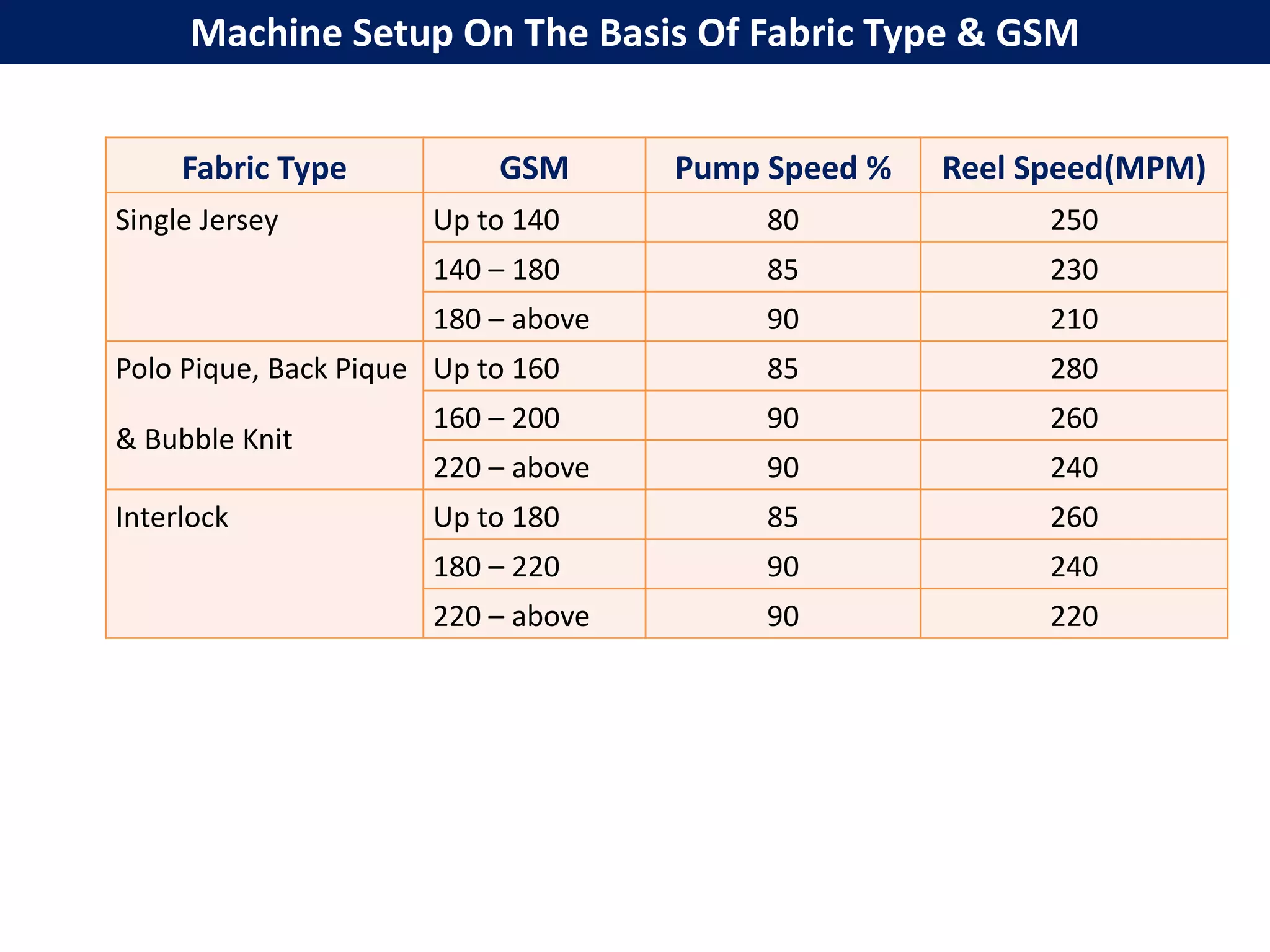
Fabric Type GSM Pump Speed % Reel Speed(MPM)
Single Jersey Up to 140 80 250
140 – 180 85 230
180 – above 90 210
Polo Pique, Back Pique
& Bubble Knit
Up to 160 85 280
160 – 200 90 260
220 – above 90 240
Interlock Up to 180 85 260
180 – 220 90 240
220 – above 90 220
Machine Setup On The Basis Of Fabric Type & GSM
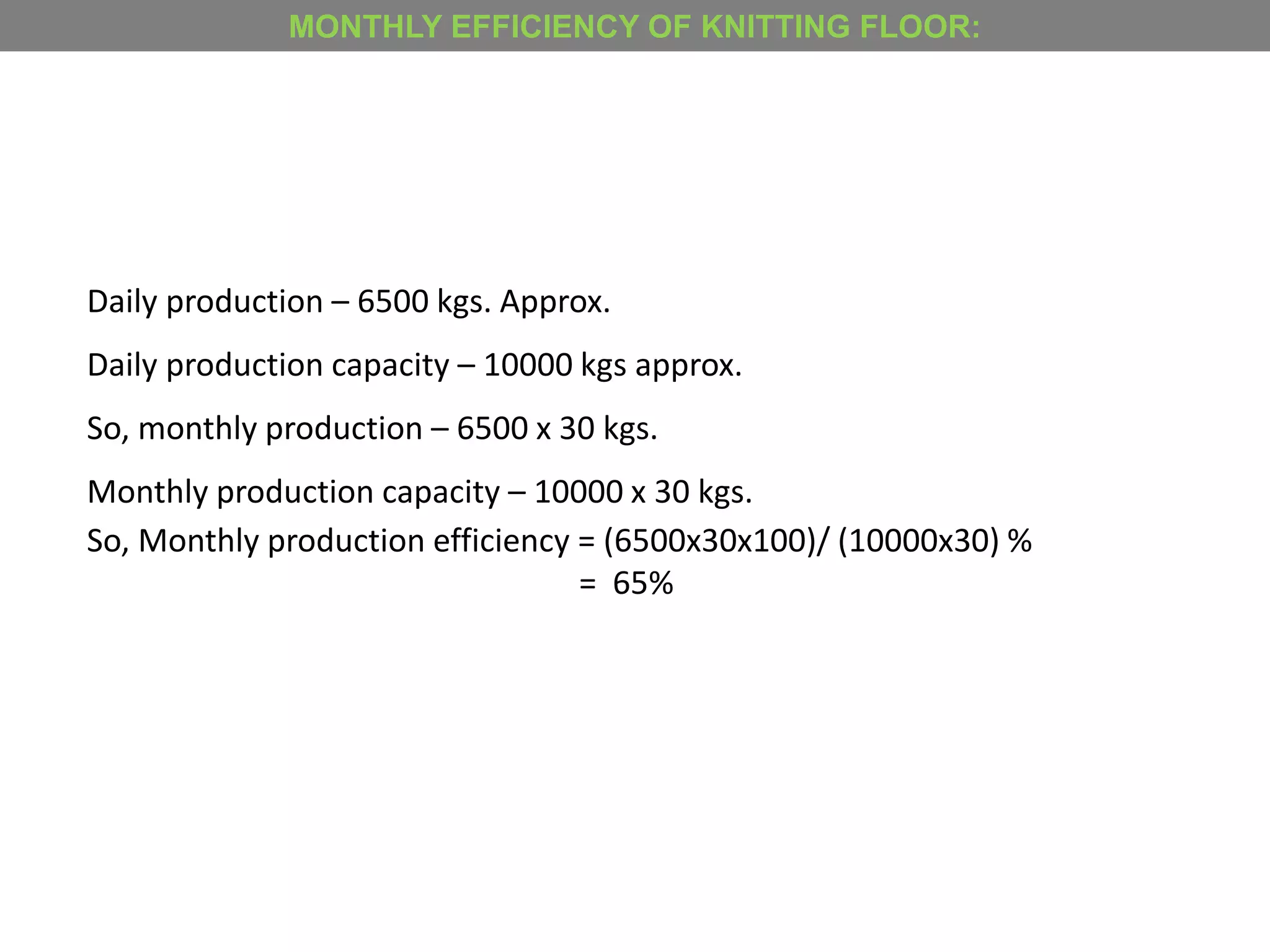
MONTHLY EFFICIENCY OF KNITTING FLOOR:
Daily production – 6500 kgs. Approx.
Daily production capacity – 10000 kgs approx.
So, monthly production – 6500 x 30 kgs.
Monthly production capacity – 10000 x 30 kgs.
So, Monthly production efficiency = (6500x30x100)/ (10000x30) %
= 65%
Garments
Calculation and Equation
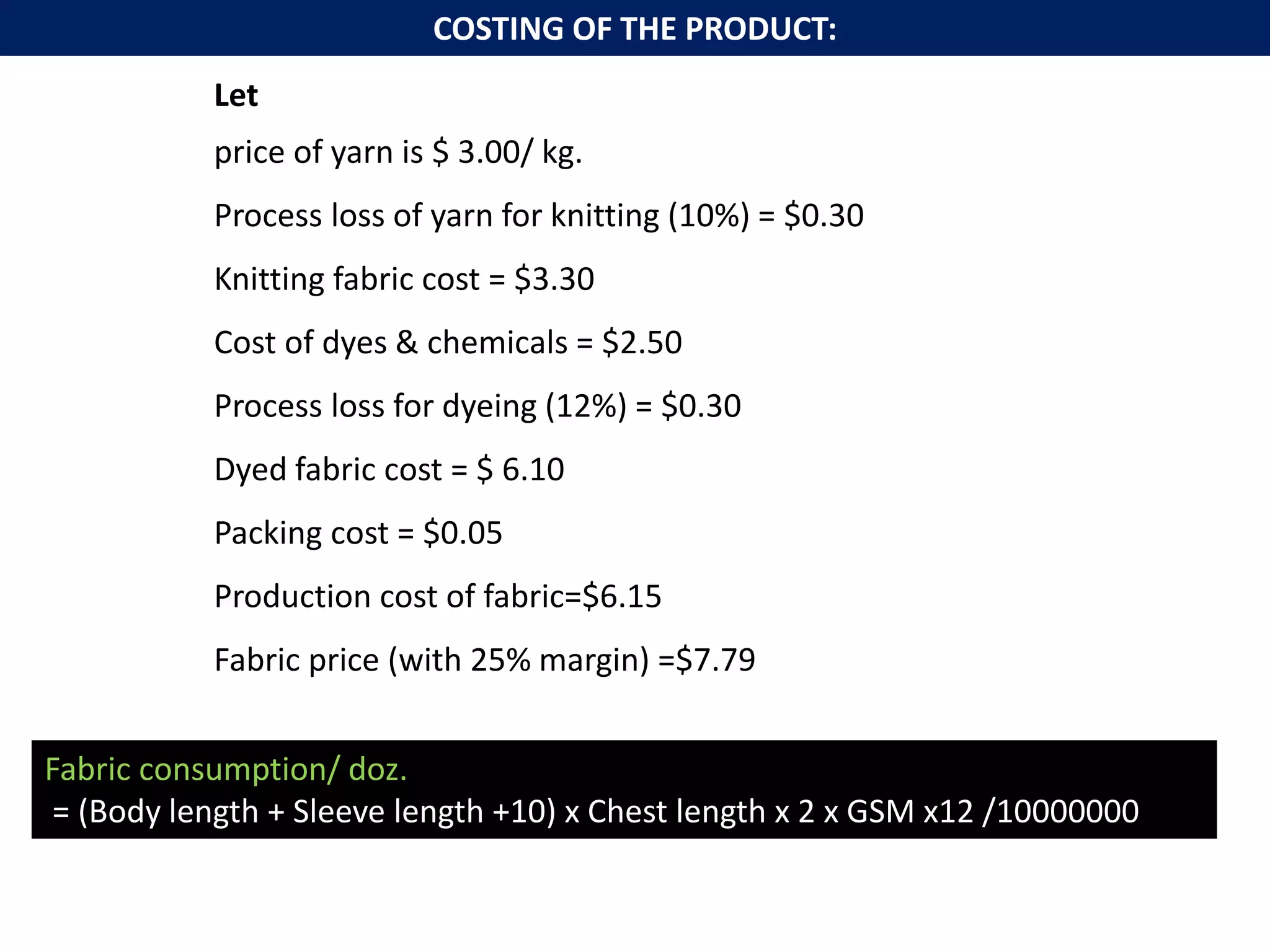
COSTING OF THE PRODUCT:
Let
price of yarn is $ 3.00/ kg.
Process loss of yarn for knitting (10%) = $0.30
Knitting fabric cost = $3.30
Cost of dyes & chemicals = $2.50
Process loss for dyeing (12%) = $0.30
Dyed fabric cost = $ 6.10
Packing cost = $0.05
Production cost of fabric=$6.15
Fabric price (with 25% margin) =$7.79
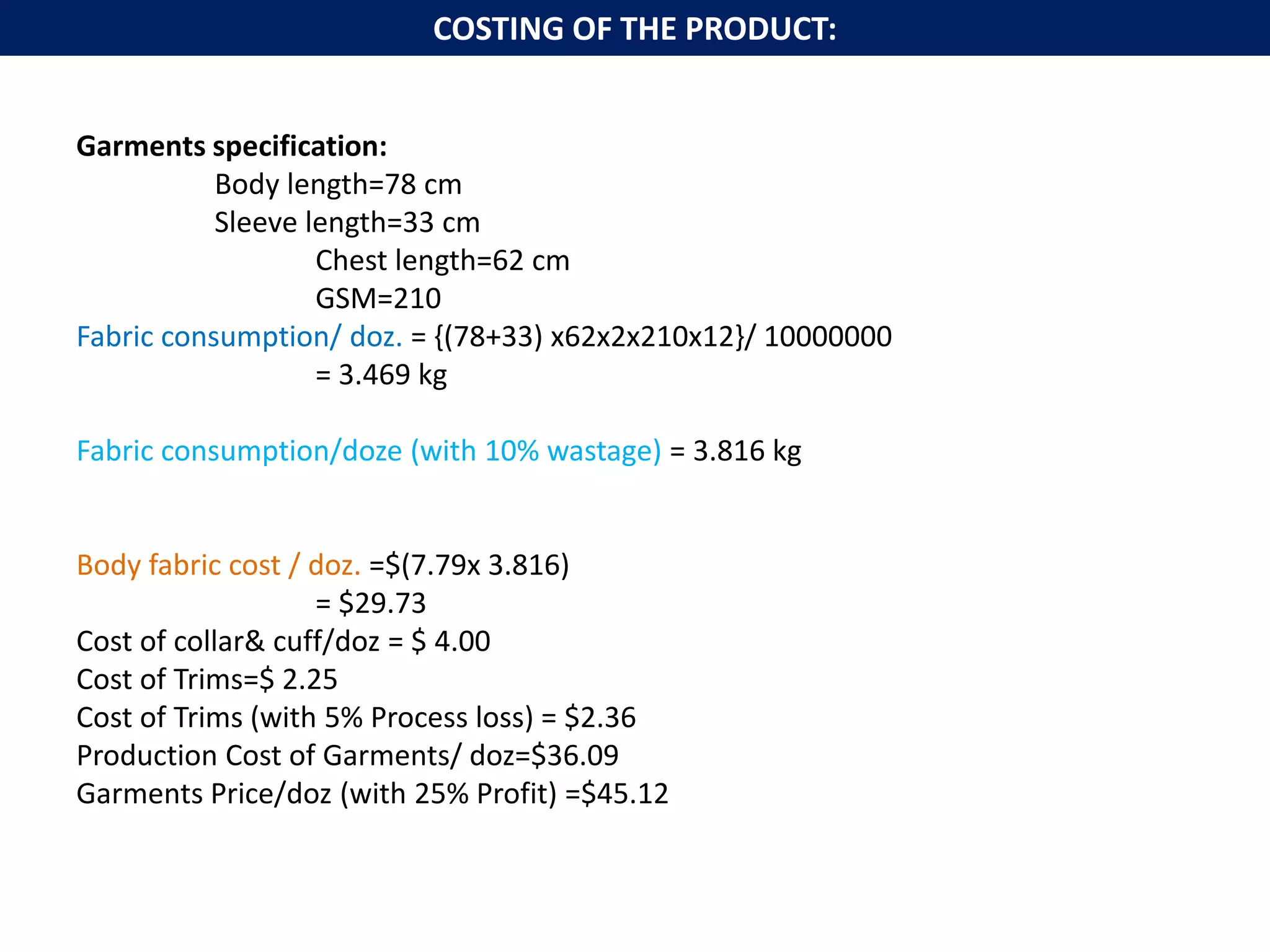
Fabric consumption/ doz.
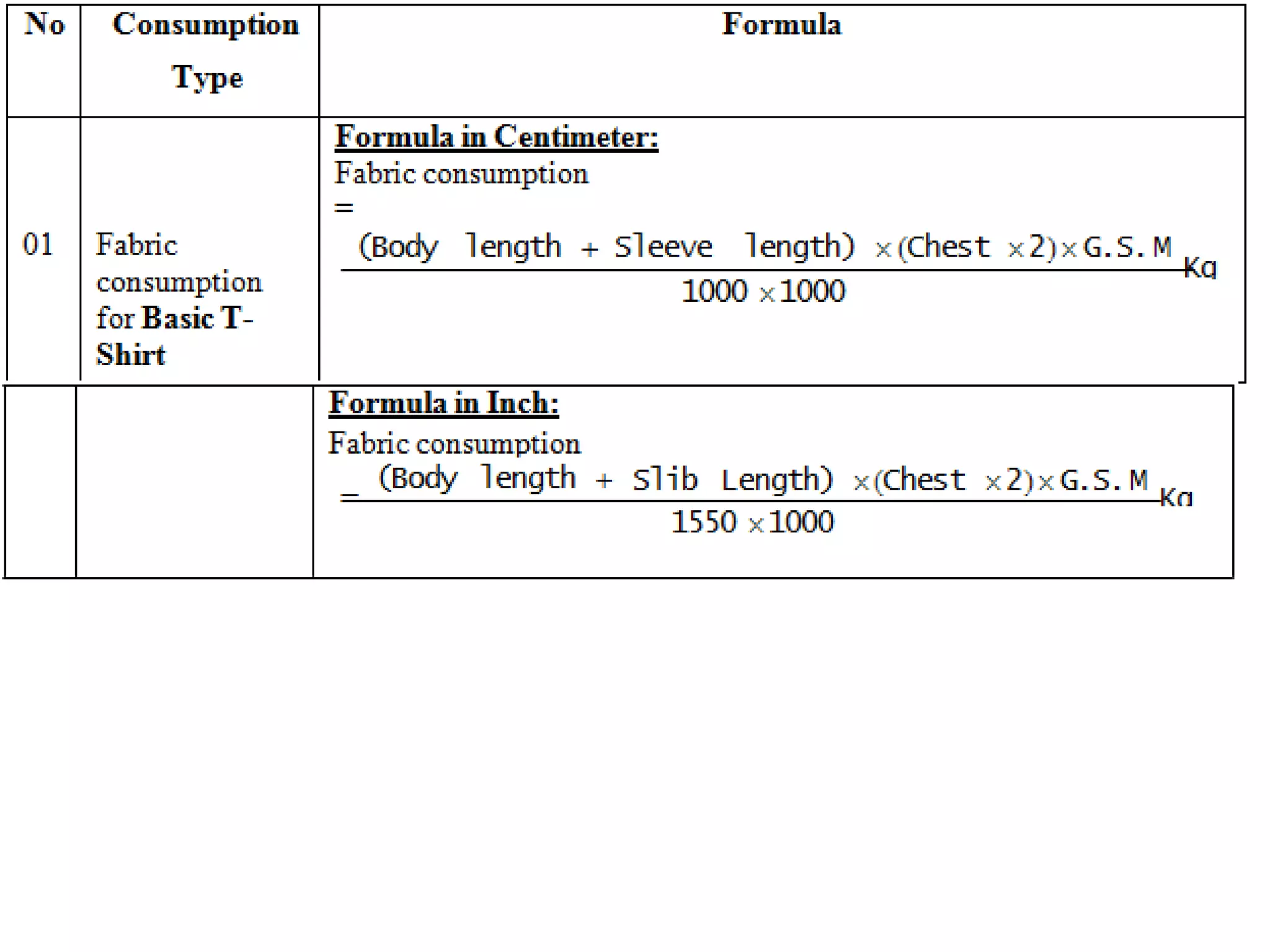
= (Body length + Sleeve length +10) x Chest length x 2 x GSM x12 /10000000
Garments specification:
Body length=78 cm
Sleeve length=33 cm
Chest length=62 cm
GSM=210
Fabric consumption/ doz. = {(78+33) x62x2x210x12}/ 10000000
= 3.469 kg
Fabric consumption/doze (with 10% wastage) = 3.816 kg
Body fabric cost / doz. =$(7.79x 3.816)
= $29.73
Cost of collar& cuff/doz = $ 4.00
Cost of Trims=$ 2.25
Cost of Trims (with 5% Process loss) = $2.36
Production Cost of Garments/ doz=$36.09
Garments Price/doz (with 25% Profit) =$45.12
COSTING OF THE PRODUCT:
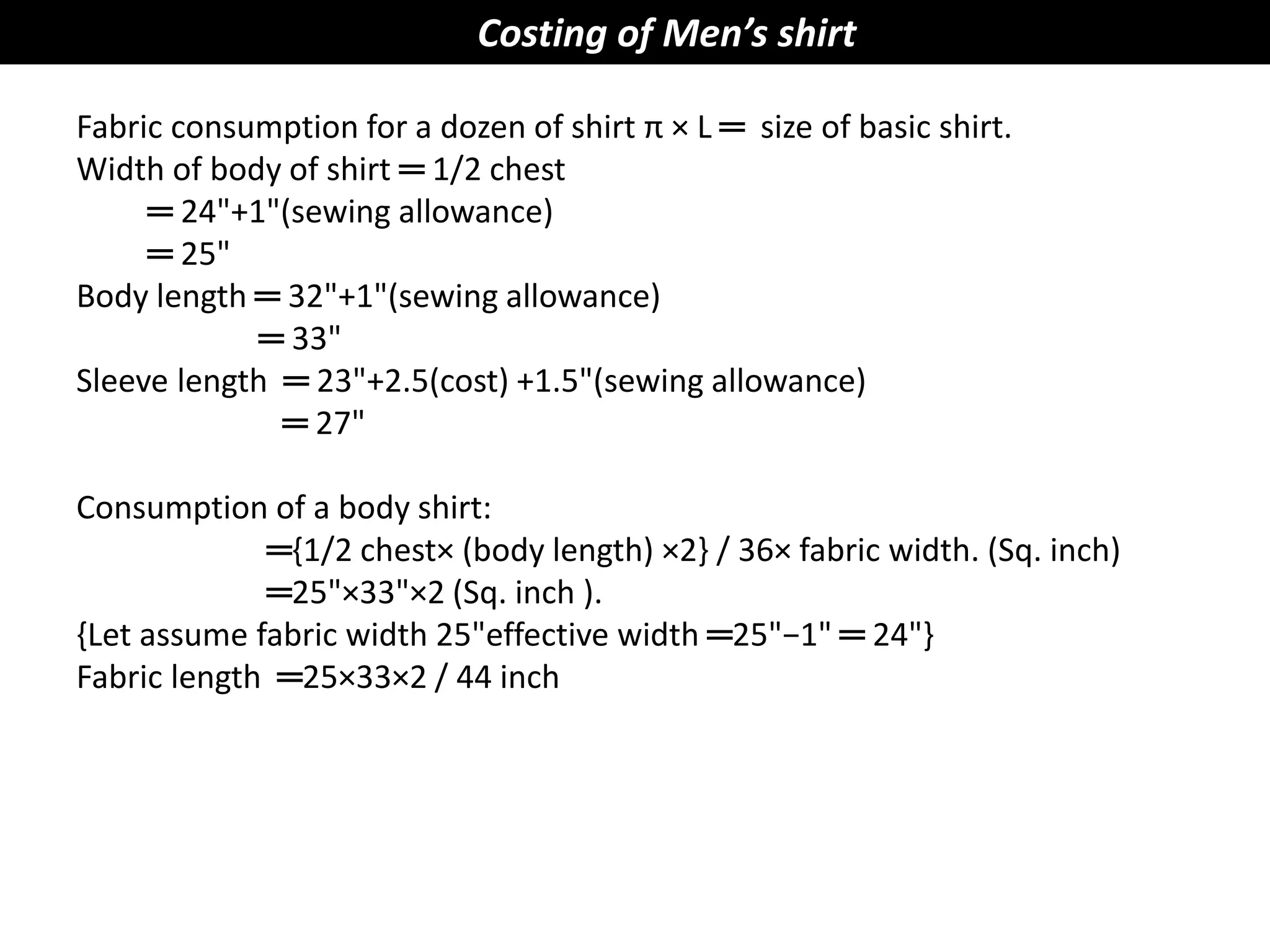
Costing of Men’s shirt
Fabric consumption for a dozen of shirt π × L ═ size of basic shirt.
Width of body of shirt ═ 1/2 chest
═ 24"+1"(sewing allowance)
═ 25"
Body length ═ 32"+1"(sewing allowance)
═ 33"
Sleeve length ═ 23"+2.5(cost) +1.5"(sewing allowance)
═ 27"
Consumption of a body shirt:
═{1/2 chest× (body length) ×2} / 36× fabric width. (Sq. inch)
═25"×33"×2 (Sq. inch ).
{Let assume fabric width 25"effective width ═25"−1" ═ 24"}
Fabric length ═25×33×2 / 44 inch
Fabric consumption ═25×33×2 / 44×36 yds
Consumption of sleeve ═ (length of sleeve × width sleeve) ×2 sq. inch
═27"×24"×2" (Sq. inch)
Fabric consumption in length width
═ 27×24×2 / 44×36 sq. inch
Total fabric consumption of one dozen shirt
═ [(25×33×2 / 44×36 + / 27×24×2 / 44×36) ×2+ wastage of 8%]
═ 22.75 yds + 8% wastage
═24.6 yds
Sewing threads consumption:
It is calculated by measuring the total of different kind of seam. Normally sewing
threads consumption per shirt , 120m.
So, sewing threads consumption per dozen,
═ 120 × 12
═ 1440m
Costing of Men’s shirt
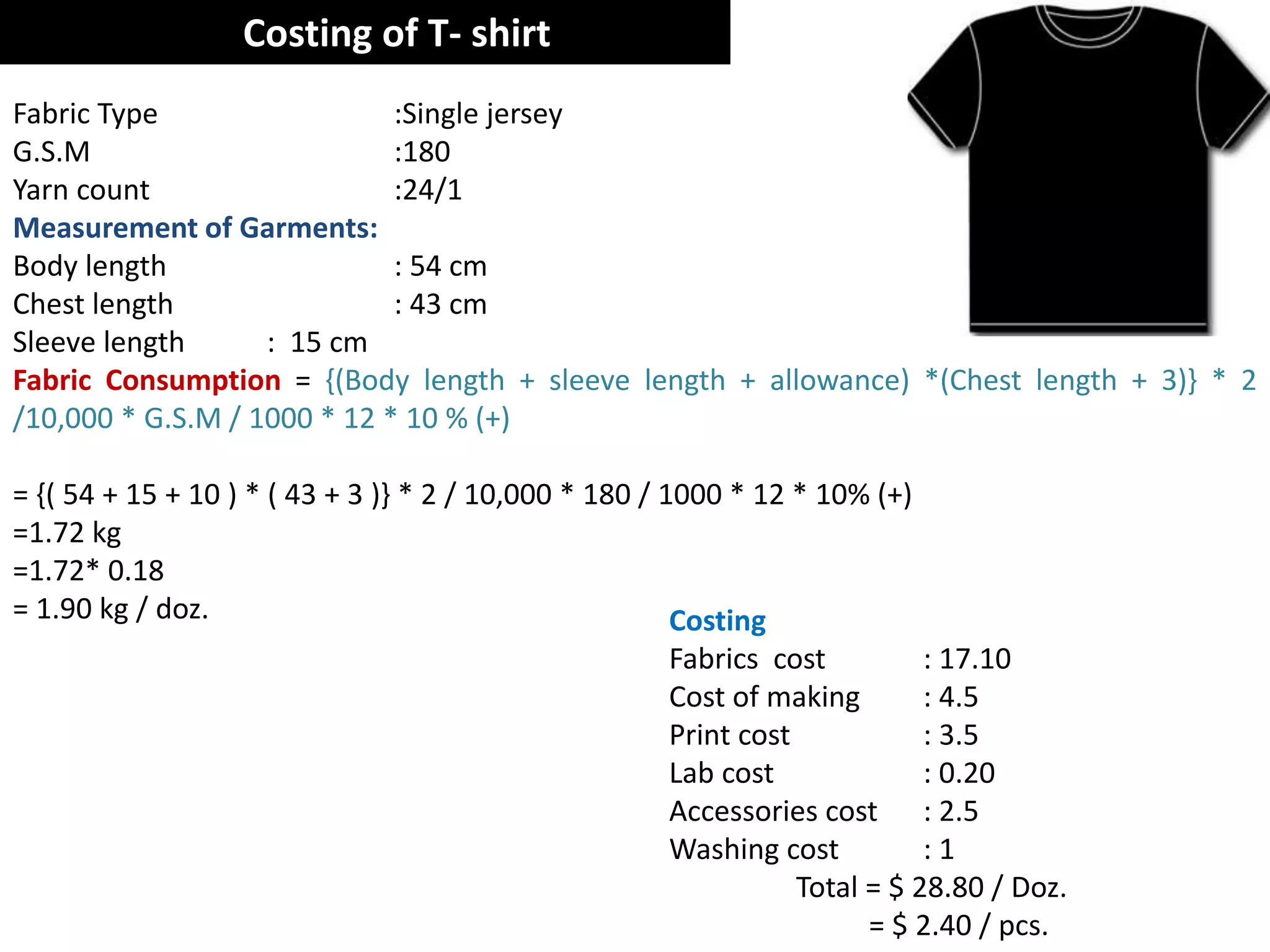
Costing of T- shirt
Fabric Type :Single jersey
G.S.M :180
Yarn count :24/1
Measurement of Garments:
Body length : 54 cm
Chest length : 43 cm
Sleeve length : 15 cm
Fabric Consumption = {(Body length + sleeve length + allowance) *(Chest length + 3)} * 2
/10,000 * G.S.M / 1000 * 12 * 10 % (+)
= {( 54 + 15 + 10 ) * ( 43 + 3 )} * 2 / 10,000 * 180 / 1000 * 12 * 10% (+)
=1.72 kg
=1.72* 0.18
= 1.90 kg / doz. Costing
Fabrics cost : 17.10
Cost of making : 4.5
Print cost : 3.5
Lab cost : 0.20
Accessories cost : 2.5
Washing cost : 1
Total = $ 28.80 / Doz.
= $ 2.40 / pcs.
How can we get Fabric Consumption & Fabrics Price?
Say:
** Body Length = 85,
Chest Width = 52,
Sleeve Length = 44 &
G.S.M = 240
Fabric Description: 100 % Cotton S/J
Fabric Need = [(85+5+44+5)  52+5]  2  12  240/10000000+10%
= [(90+49)  57]  2  12  240/10000000+10%
= (13957)  2  12  240/10000000+10%
= 7923 12  240/10000000+10%
= 45636480/10000000 + 10%
= 4.563648 +10%
= 4.563648 + .4563
= 5.02 Kgs Fabrics
Say Per Kgs Price: US$ 6.00/Kgs
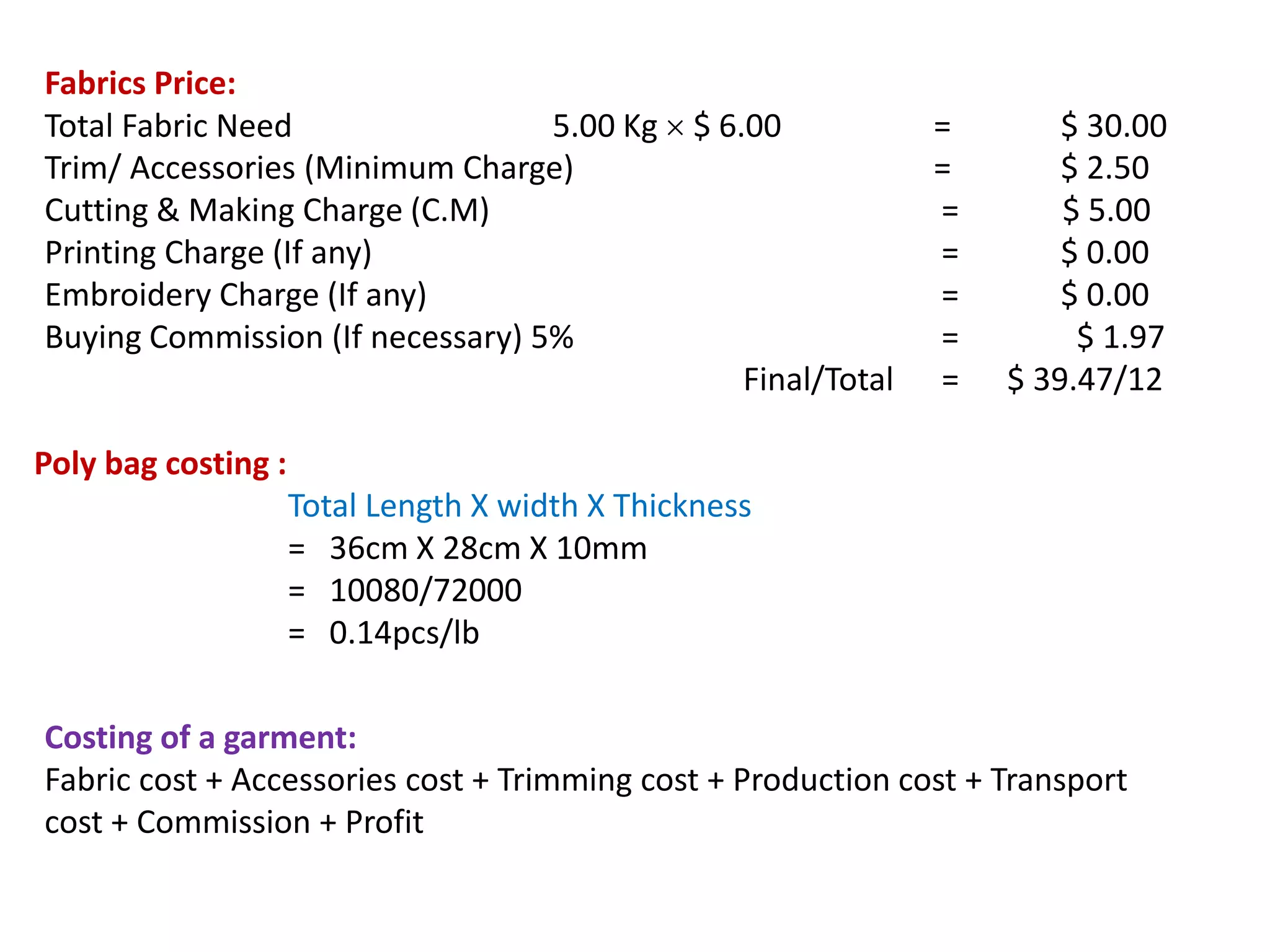
Poly bag costing :
Total Length X width X Thickness
= 36cm X 28cm X 10mm
= 10080/72000
= 0.14pcs/lb
Fabrics Price:
Total Fabric Need 5.00 Kg  $ 6.00 = $ 30.00
Trim/ Accessories (Minimum Charge) = $ 2.50
Cutting & Making Charge (C.M) = $ 5.00
Printing Charge (If any) = $ 0.00
Embroidery Charge (If any) = $ 0.00
Buying Commission (If necessary) 5% = $ 1.97
Final/Total = $ 39.47/12
Costing of a garment:
Fabric cost + Accessories cost + Trimming cost + Production cost + Transport
cost + Commission + Profit
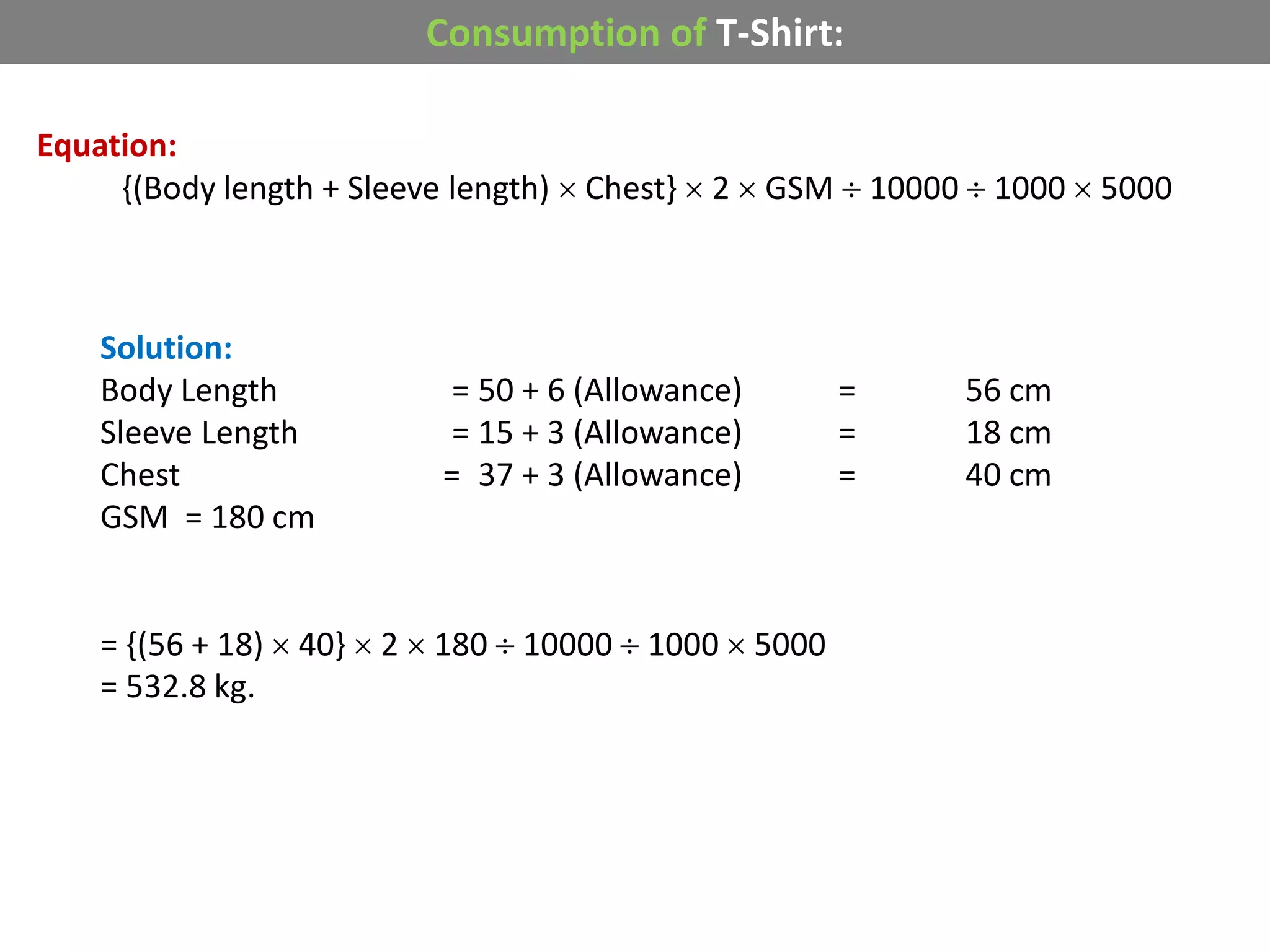
Consumption of T-Shirt:
Equation:
{(Body length + Sleeve length)  Chest}  2  GSM  10000  1000  5000
Solution:
Body Length = 50 + 6 (Allowance) = 56 cm
Sleeve Length = 15 + 3 (Allowance) = 18 cm
Chest = 37 + 3 (Allowance) = 40 cm
GSM = 180 cm
= {(56 + 18)  40}  2  180  10000  1000  5000
= 532.8 kg.
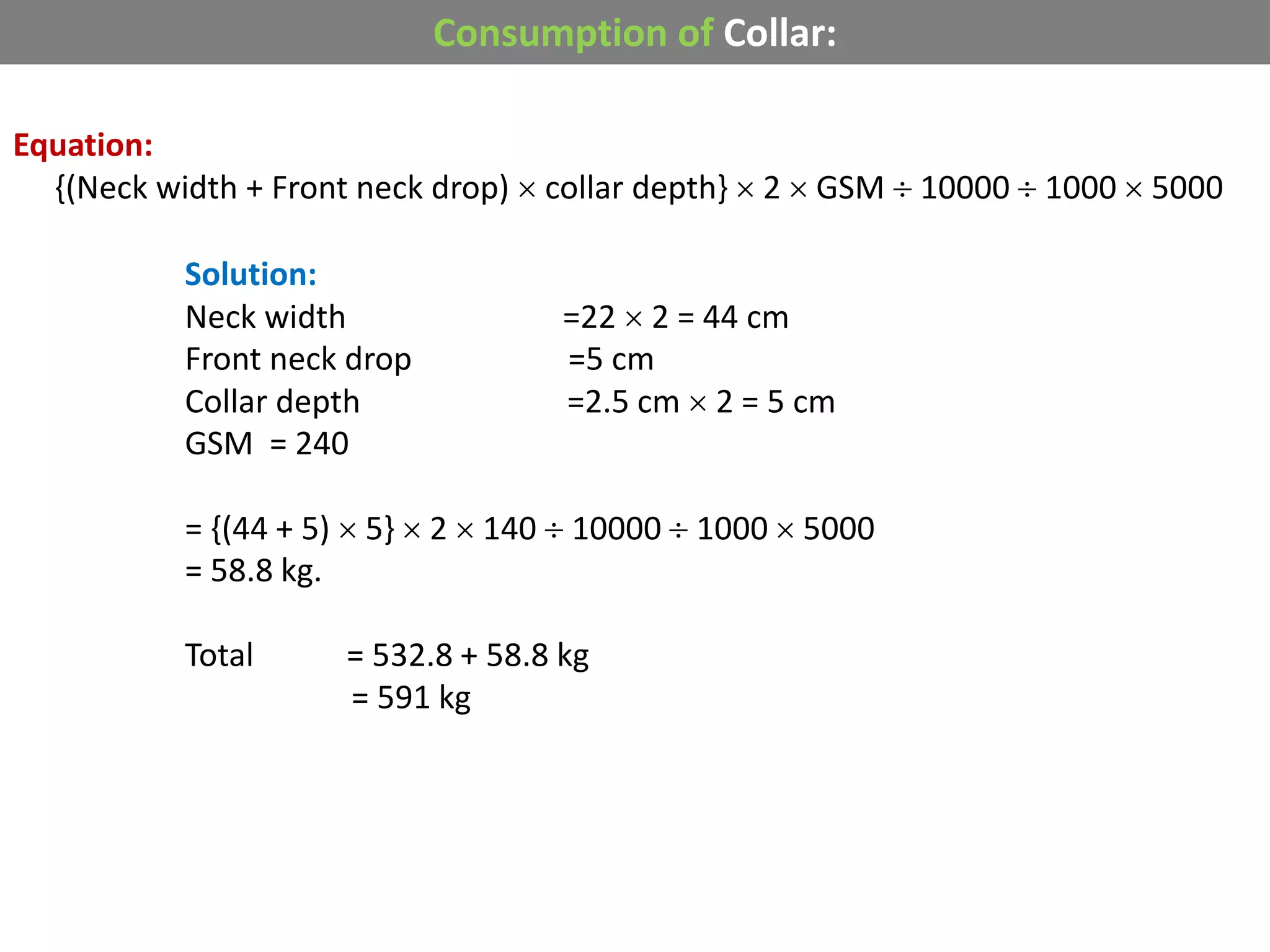
Consumption of Collar:
Equation:
{(Neck width + Front neck drop)  collar depth}  2  GSM  10000  1000  5000
Solution:
Neck width =22  2 = 44 cm
Front neck drop =5 cm
Collar depth =2.5 cm  2 = 5 cm
GSM = 240
= {(44 + 5)  5}  2  140  10000  1000  5000
= 58.8 kg.
Total = 532.8 + 58.8 kg
= 591 kg
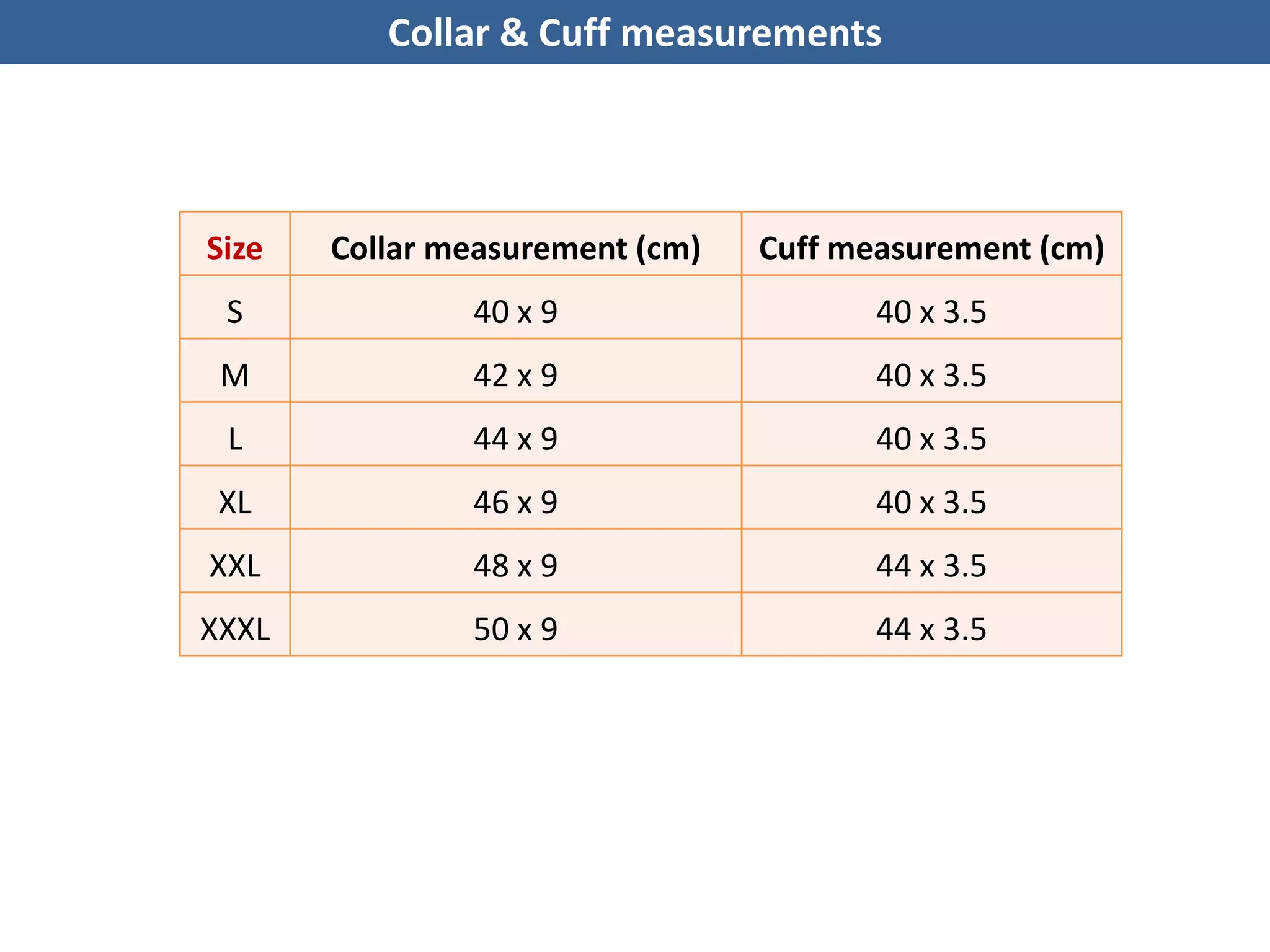
Collar & Cuff measurements
Size Collar measurement (cm) Cuff measurement (cm)
S 40 x 9 40 x 3.5
M 42 x 9 40 x 3.5
L 44 x 9 40 x 3.5
XL 46 x 9 40 x 3.5
XXL 48 x 9 44 x 3.5
XXXL 50 x 9 44 x 3.5
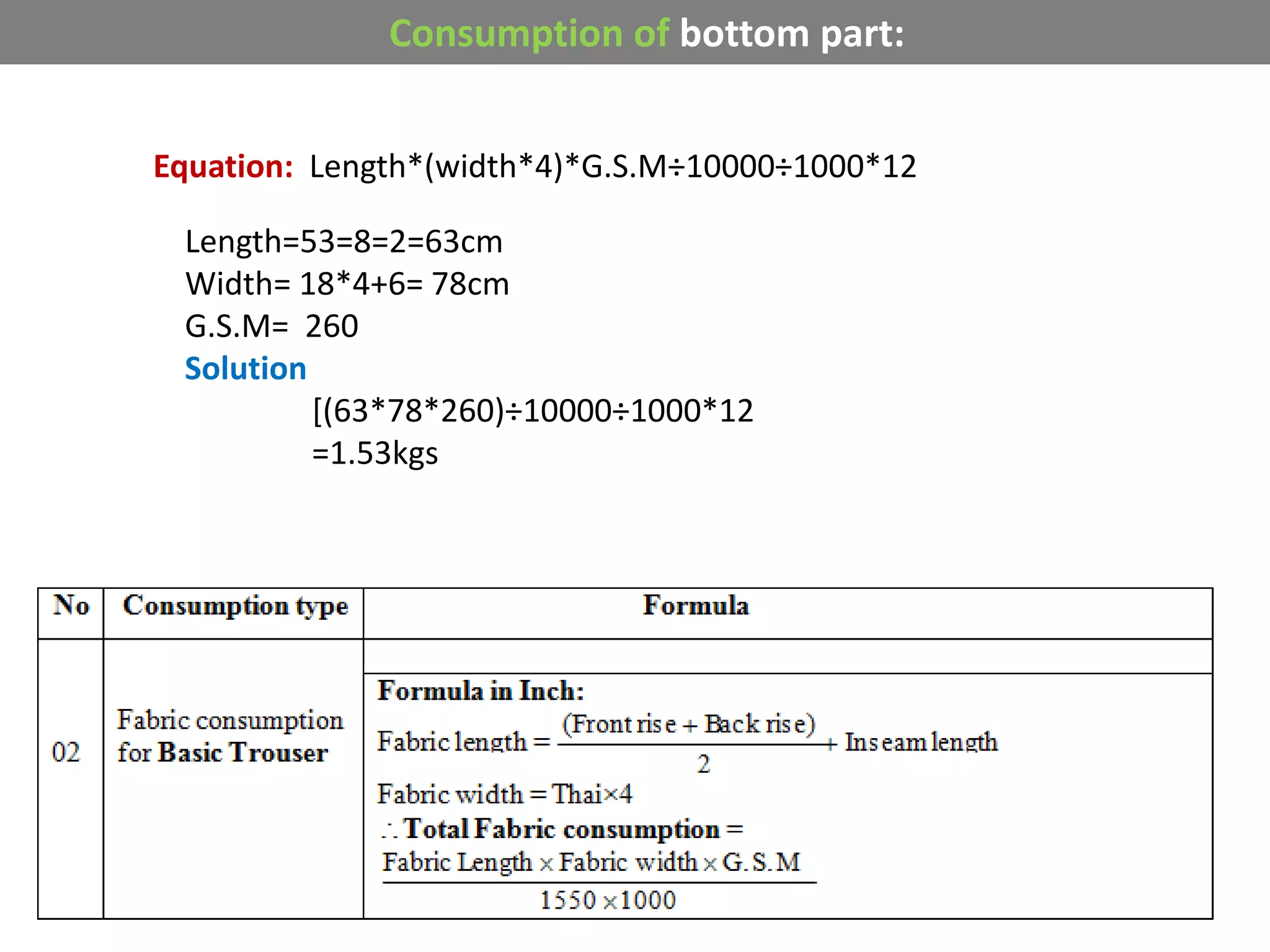
Consumption of bottom part:
Equation: Length*(width*4)*G.S.M÷10000÷1000*12
Length=53=8=2=63cm
Width= 18*4+6= 78cm
G.S.M= 260
Solution
[(63*78*260)÷10000÷1000*12
=1.53kgs
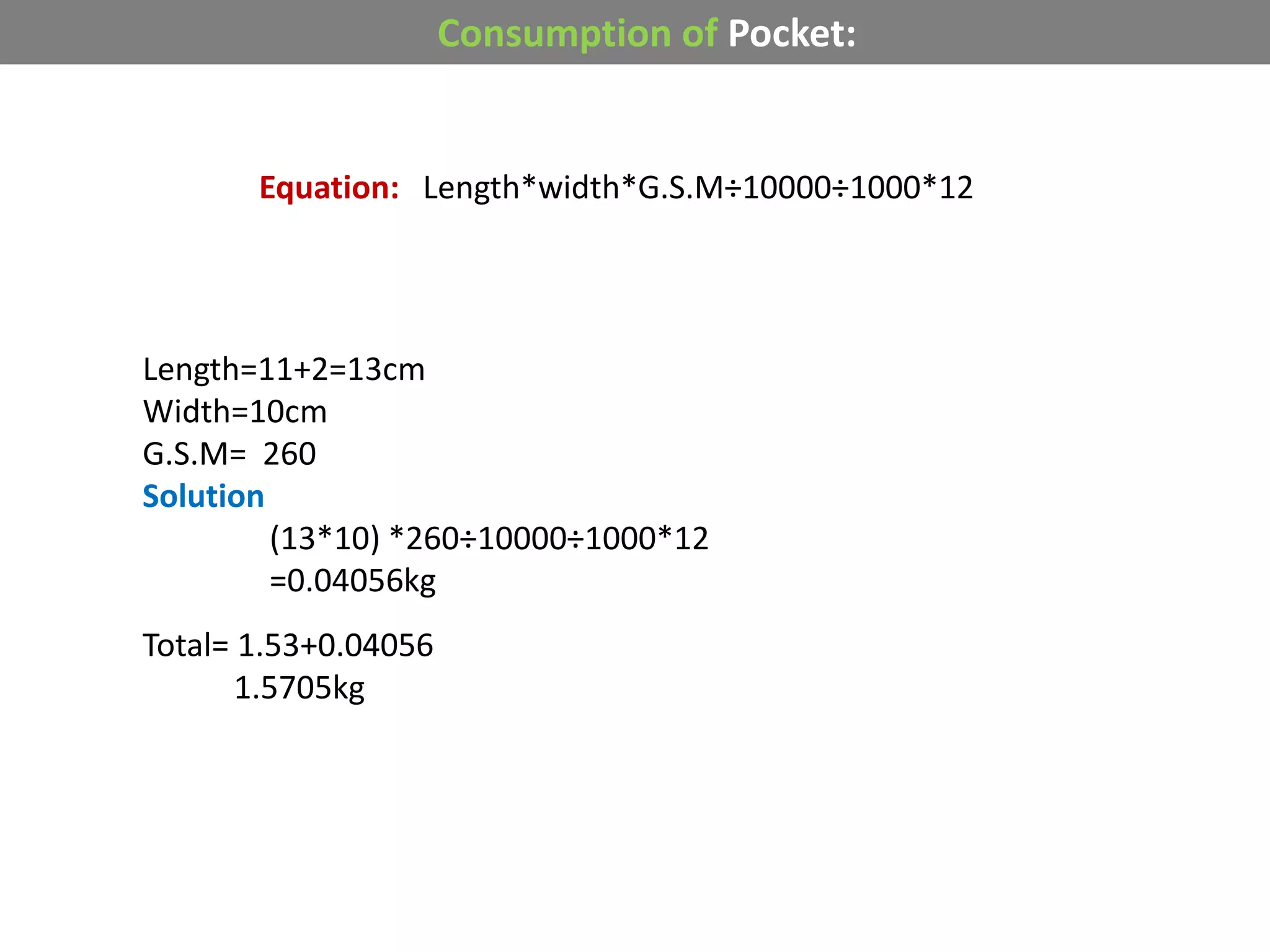
Consumption of Pocket:
Equation: Length*width*G.S.M÷10000÷1000*12
Length=11+2=13cm
Width=10cm
G.S.M= 260
Solution
(13*10) *260÷10000÷1000*12
=0.04056kg
Total= 1.53+0.04056
1.5705kg
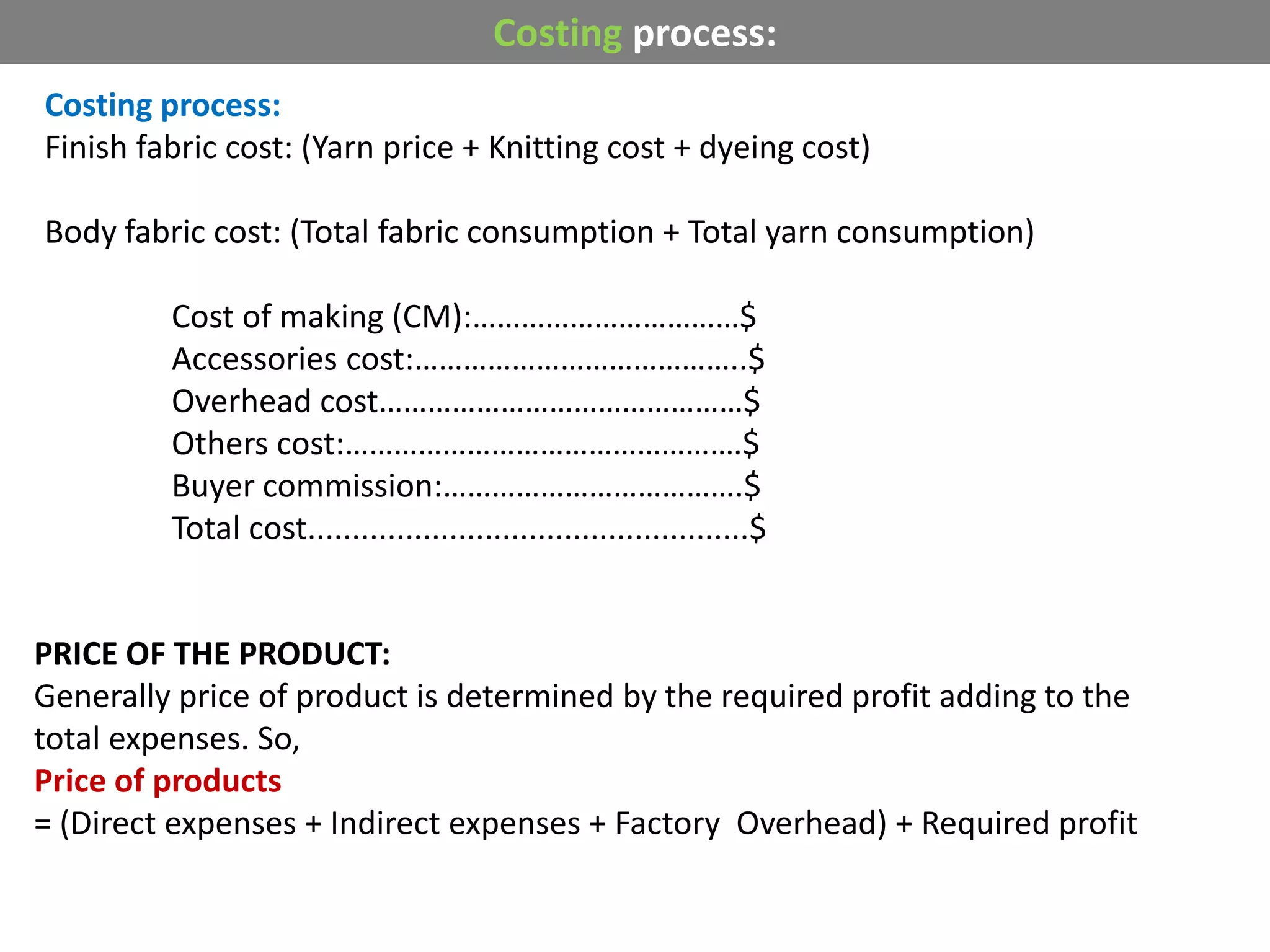
Costing process:
Finish fabric cost: (Yarn price + Knitting cost + dyeing cost)
Body fabric cost: (Total fabric consumption + Total yarn consumption)
Cost of making (CM):……………………………$
Accessories cost:…………………………………..$
Overhead cost………………………………………$
Others cost:………………………………………….$
Buyer commission:……………………………….$
Total cost..................................................$
Costing process:
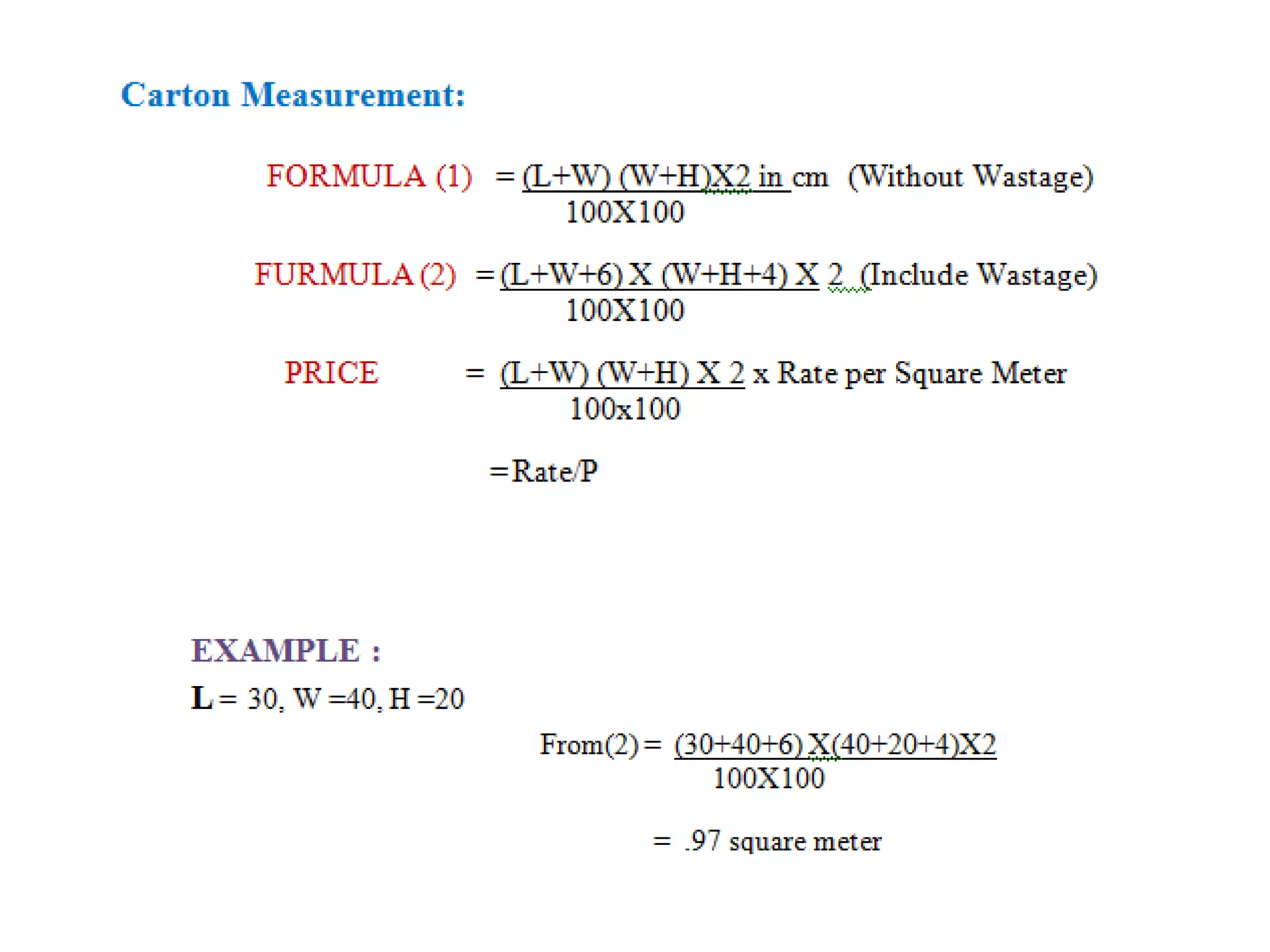
PRICE OF THE PRODUCT:
Generally price of product is determined by the required profit adding to the
total expenses. So,
Price of products
= (Direct expenses + Indirect expenses + Factory Overhead) + Required profit
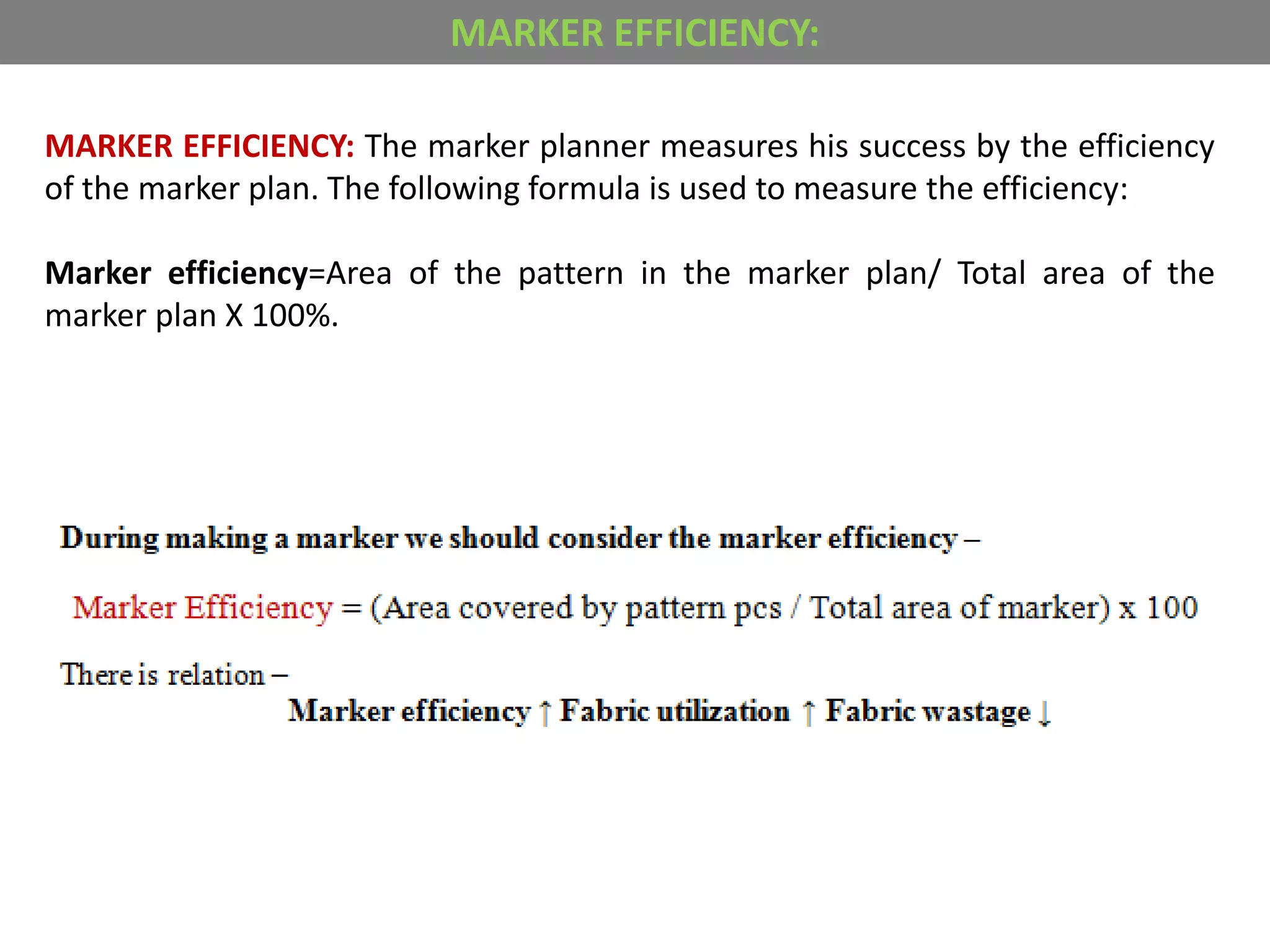
MARKER EFFICIENCY: The marker planner measures his success by the efficiency
of the marker plan. The following formula is used to measure the efficiency:
Marker efficiency=Area of the pattern in the marker plan/ Total area of the
marker plan X 100%.
MARKER EFFICIENCY:
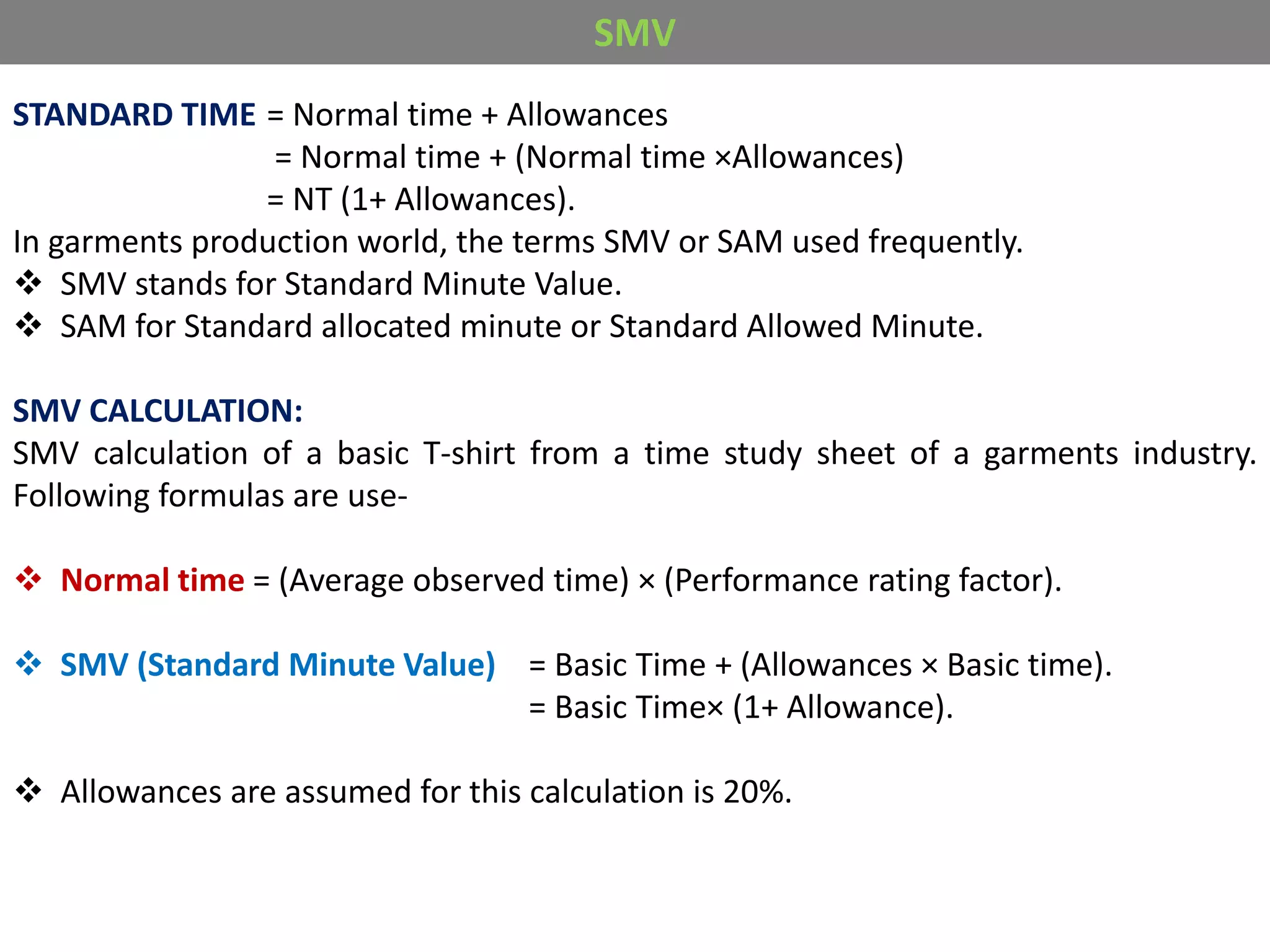
STANDARD TIME = Normal time + Allowances
= Normal time + (Normal time ×Allowances)
= NT (1+ Allowances).
In garments production world, the terms SMV or SAM used frequently.
 SMV stands for Standard Minute Value.
 SAM for Standard allocated minute or Standard Allowed Minute.
SMV CALCULATION:
SMV calculation of a basic T-shirt from a time study sheet of a garments industry.
Following formulas are use-
 Normal time = (Average observed time) × (Performance rating factor).
 SMV (Standard Minute Value) = Basic Time + (Allowances × Basic time).
= Basic Time× (1+ Allowance).
 Allowances are assumed for this calculation is 20%.
SMV
SMV
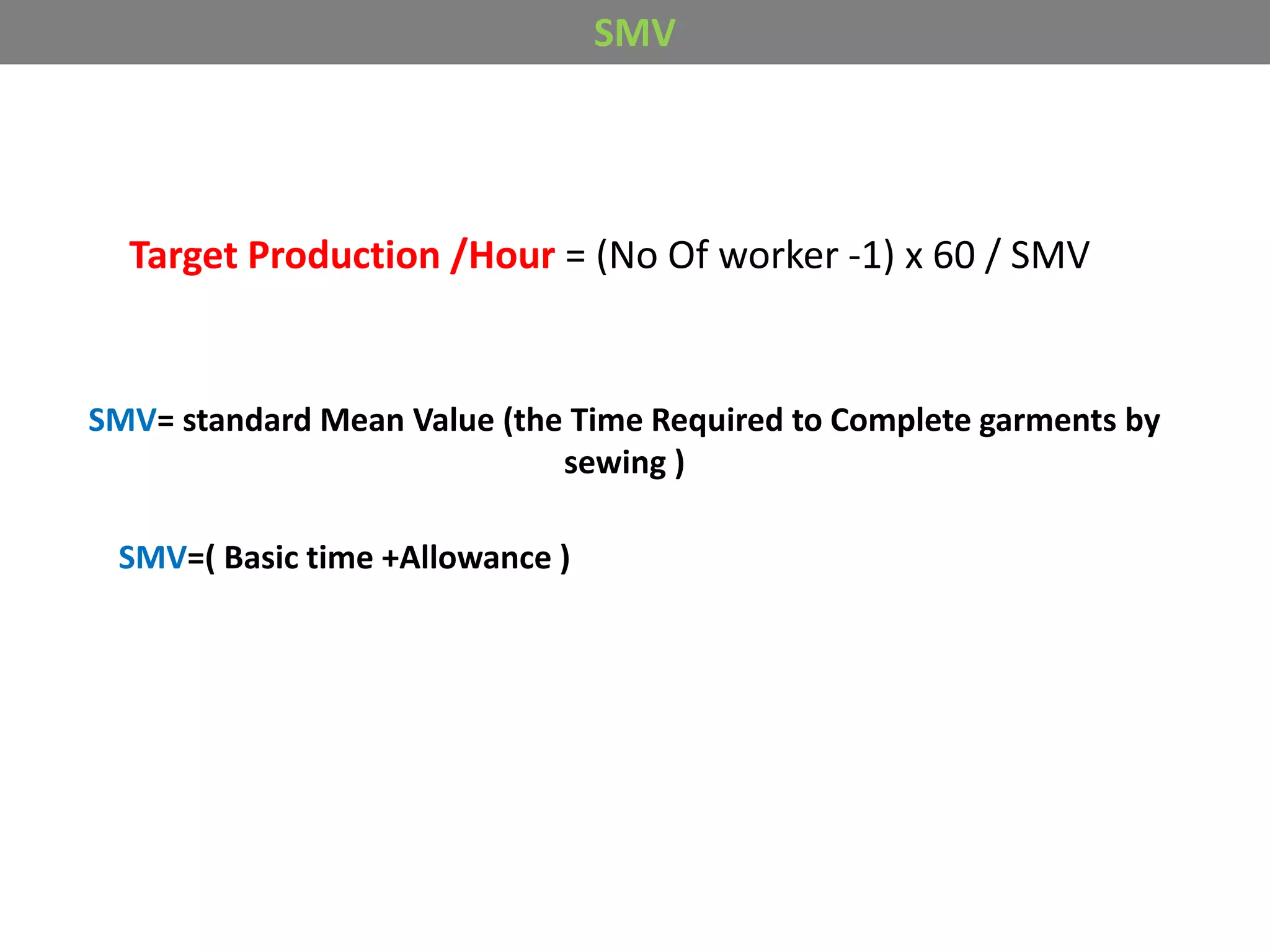
Target Production /Hour = (No Of worker -1) x 60 / SMV
SMV= standard Mean Value (the Time Required to Complete garments by
sewing )
SMV=( Basic time +Allowance )
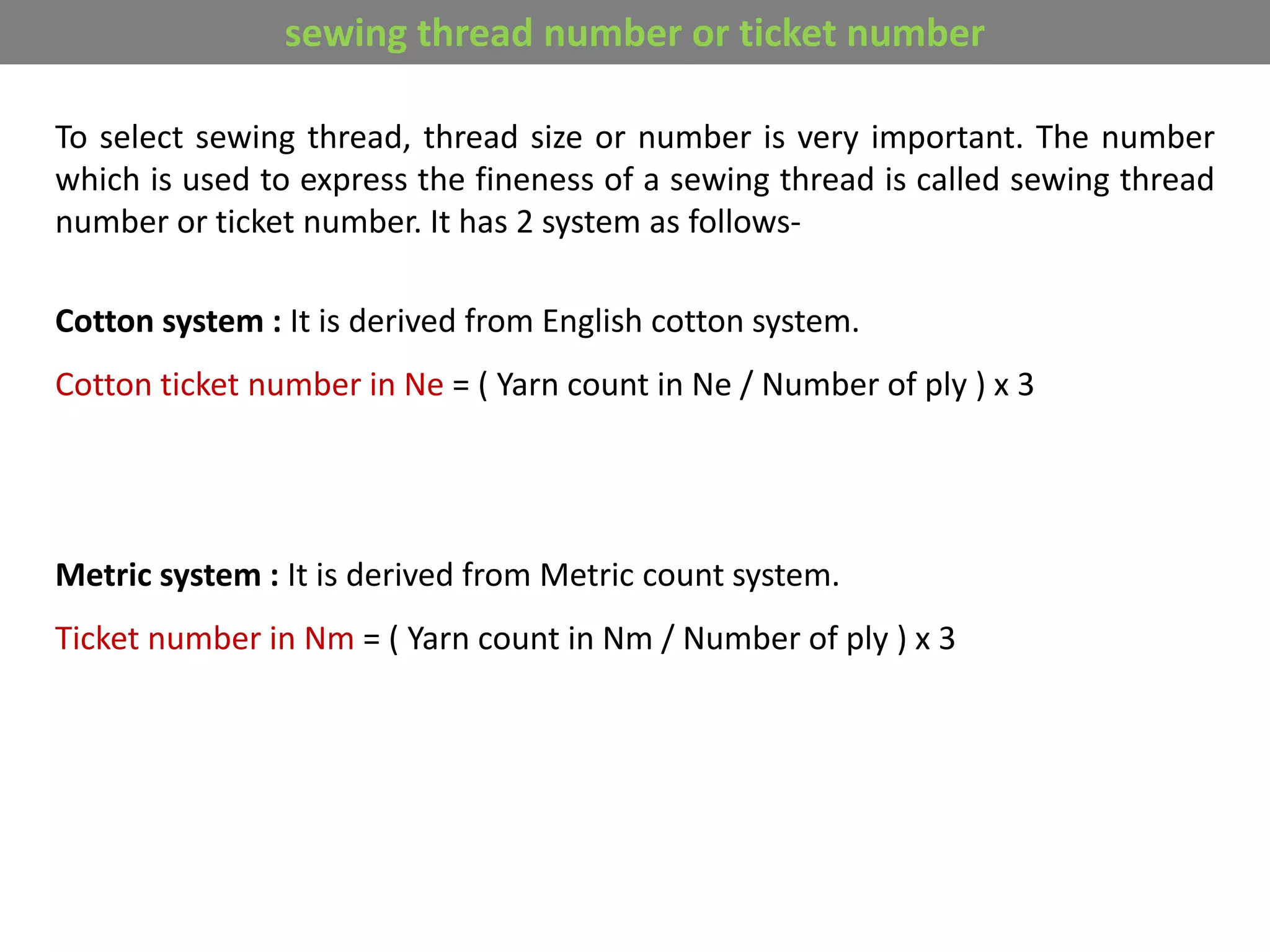
To select sewing thread, thread size or number is very important. The number
which is used to express the fineness of a sewing thread is called sewing thread
number or ticket number. It has 2 system as follows-
Cotton system : It is derived from English cotton system.
Cotton ticket number in Ne = ( Yarn count in Ne / Number of ply ) x 3
Metric system : It is derived from Metric count system.
Ticket number in Nm = ( Yarn count in Nm / Number of ply ) x 3
sewing thread number or ticket number
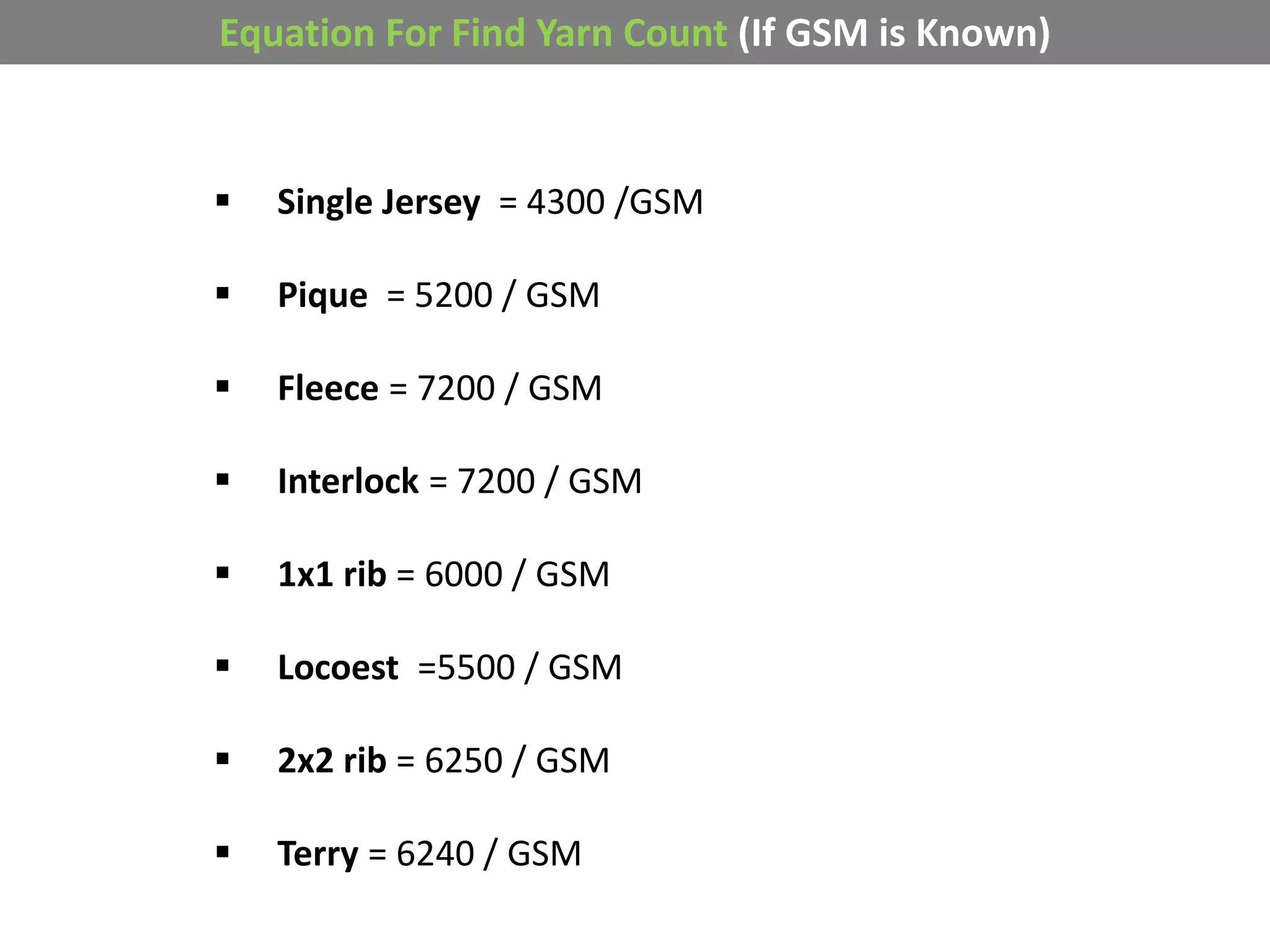
Equation For Find Yarn Count (If GSM is Known)
 Single Jersey = 4300 /GSM
 Pique = 5200 / GSM
 Fleece = 7200 / GSM
 Interlock = 7200 / GSM
 1x1 rib = 6000 / GSM
 Locoest =5500 / GSM
 2x2 rib = 6250 / GSM
 Terry = 6240 / GSM
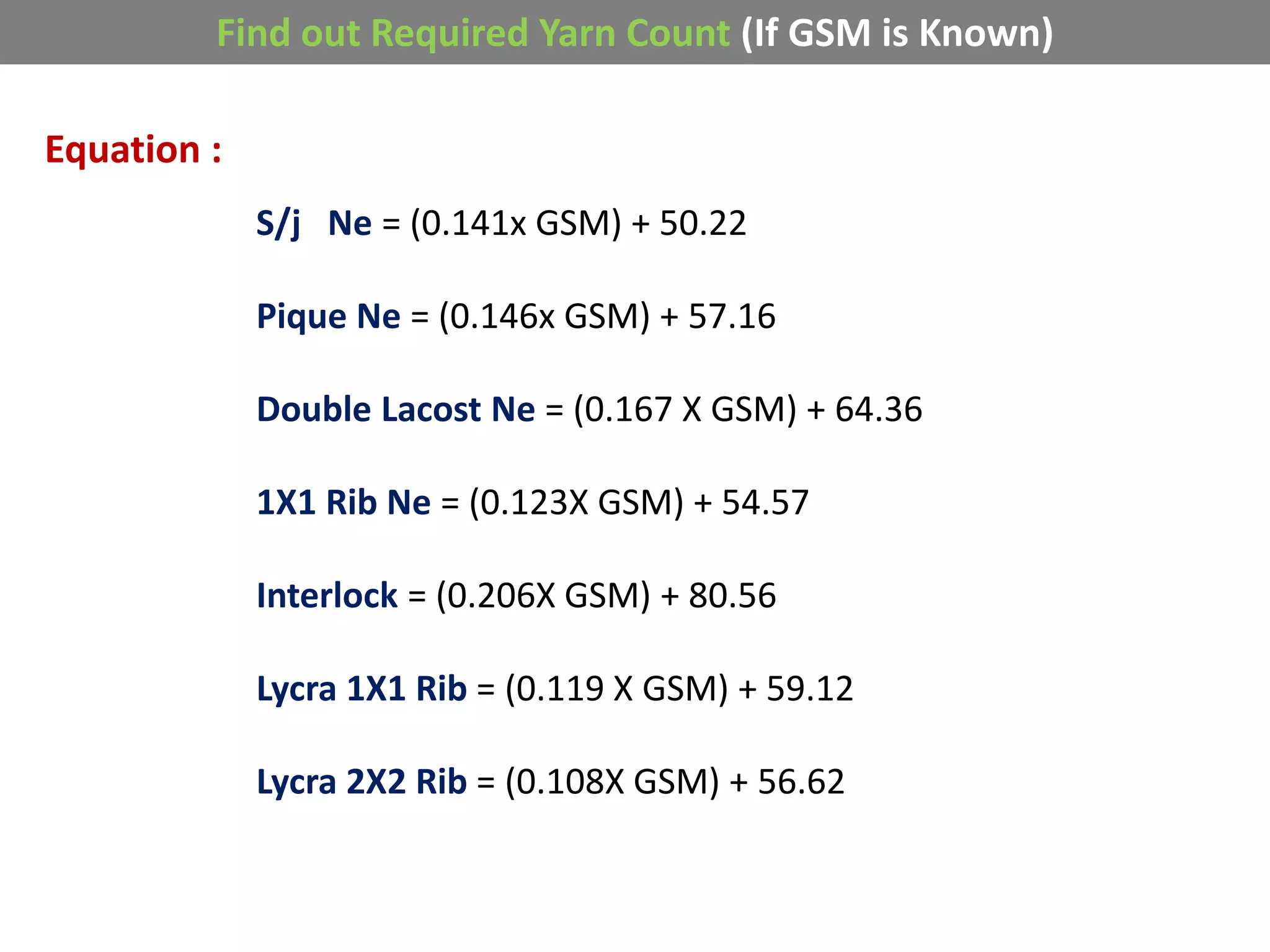
Find out Required Yarn Count (If GSM is Known)
Equation :
S/j Ne = (0.141x GSM) + 50.22
Pique Ne = (0.146x GSM) + 57.16
Double Lacost Ne = (0.167 X GSM) + 64.36
1X1 Rib Ne = (0.123X GSM) + 54.57
Interlock = (0.206X GSM) + 80.56
Lycra 1X1 Rib = (0.119 X GSM) + 59.12
Lycra 2X2 Rib = (0.108X GSM) + 56.62
Conversion of (GSM Equation )
Kg To Yards
Equation :
= GSM / 39.37 X 36 X fabric Width
=Result .Kg
=1000/ Result .yds
[It is converted Kg To yards ]
Per Yards Fabric price
Equation :
= GSM / 43” X Width / 1000 X Per kg Prize
=Result .
[This the Equation define per yards Fabric price ]
Conversion of (GSM Equation )
Yards To meter
Equation :
= Length X 36 X 2.54 /1000
=Result
[It is converted yards to Meter ]
Meter To Yards
Equation :
= Length /36 / 2.54 X 1000
=Result
[ It is converted Meter To yards ]
Conversion of (GSM Equation )
Find Out How many Yds / Kg
Equation :
= 714//GSM
=Result (yds in Kg)
[Only For 58’’/60’’ Width]
Price/Yards
Equation :
= GSM /43 / 2.54 X Width
=Result / 1000 X Price
= price/yds
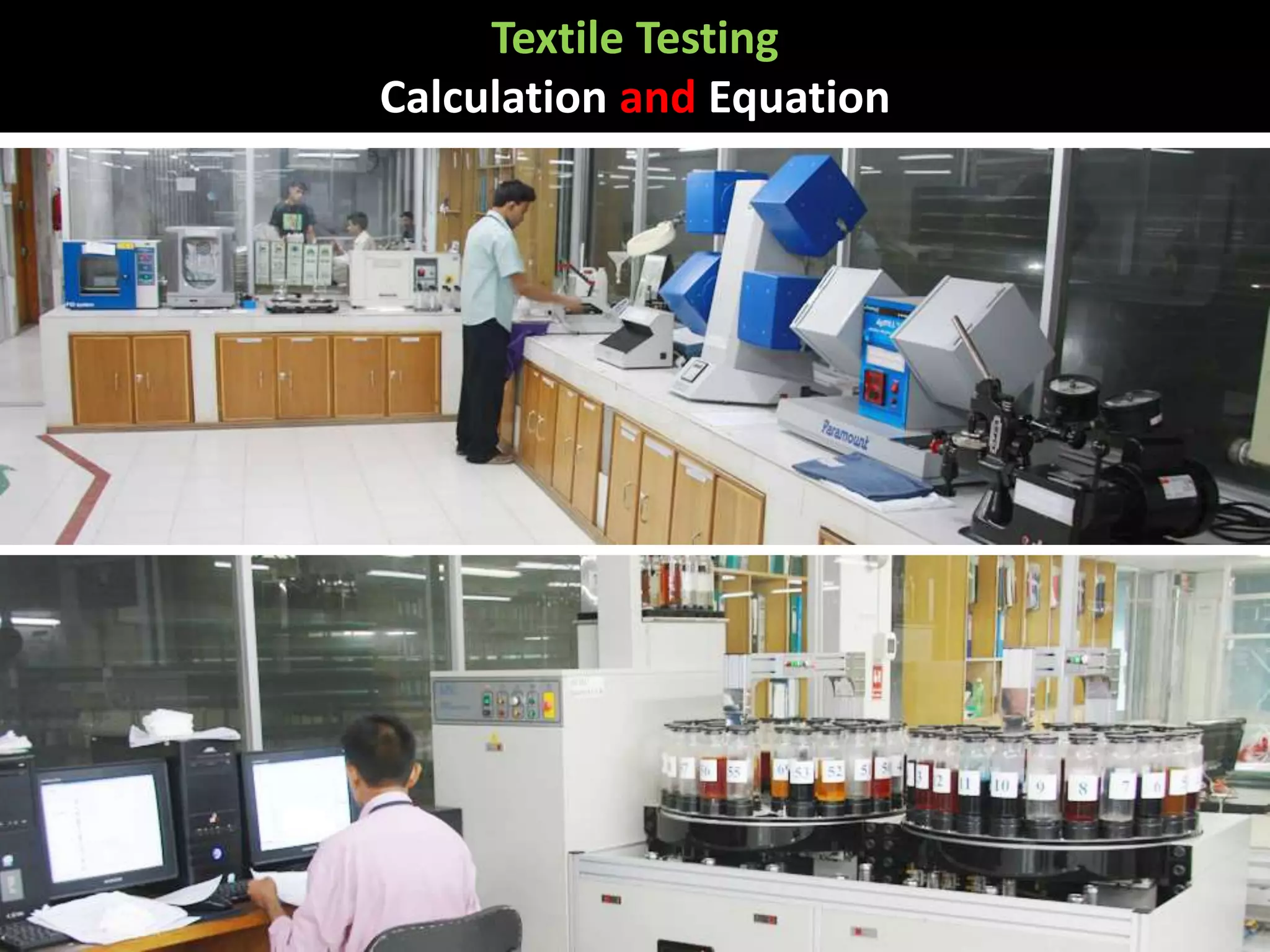
Textile Testing
Calculation and Equation
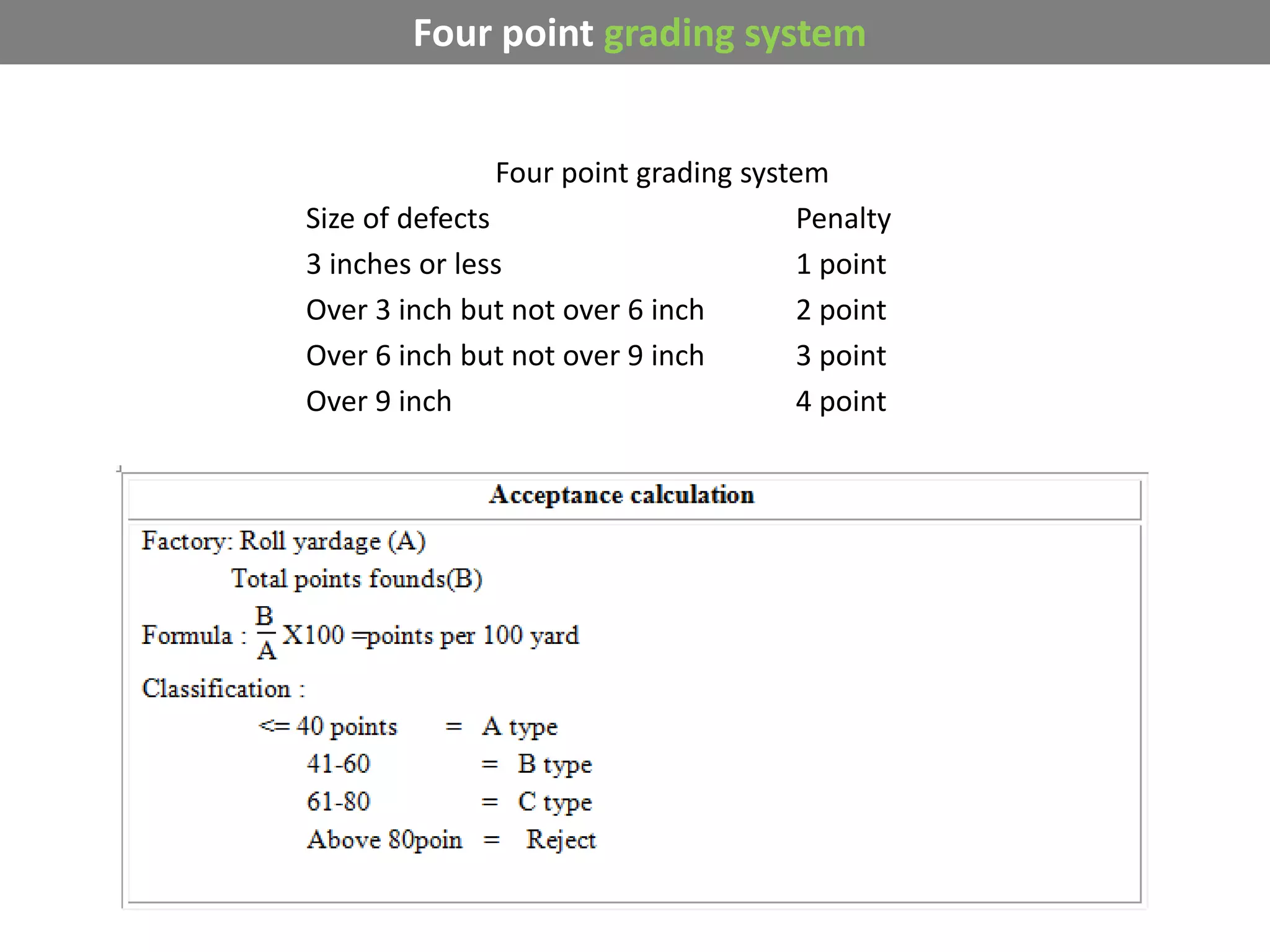
Four point grading system
Size of defects Penalty
3 inches or less 1 point
Over 3 inch but not over 6 inch 2 point
Over 6 inch but not over 9 inch 3 point
Over 9 inch 4 point
Four point grading system
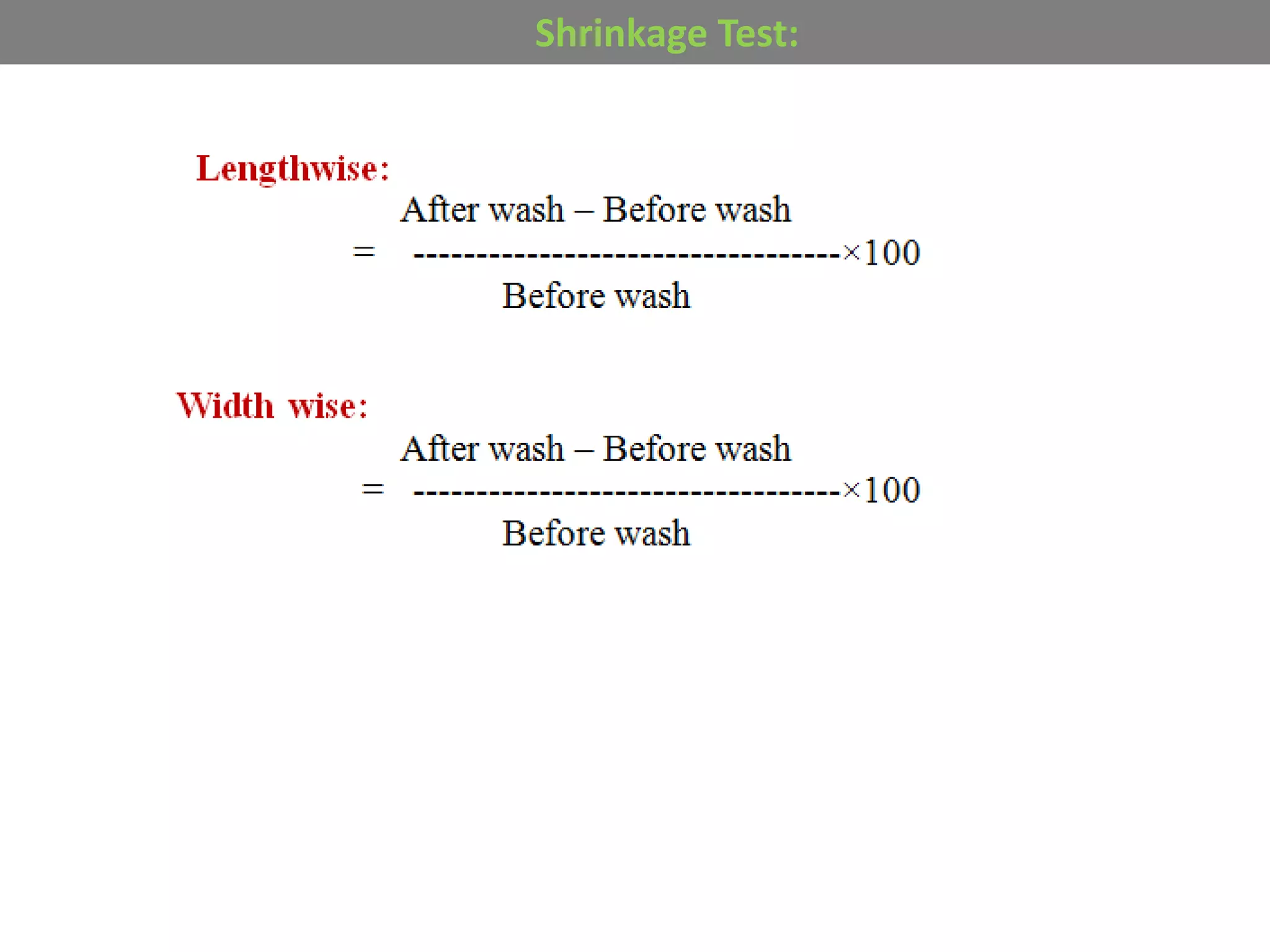
Shrinkage Test:
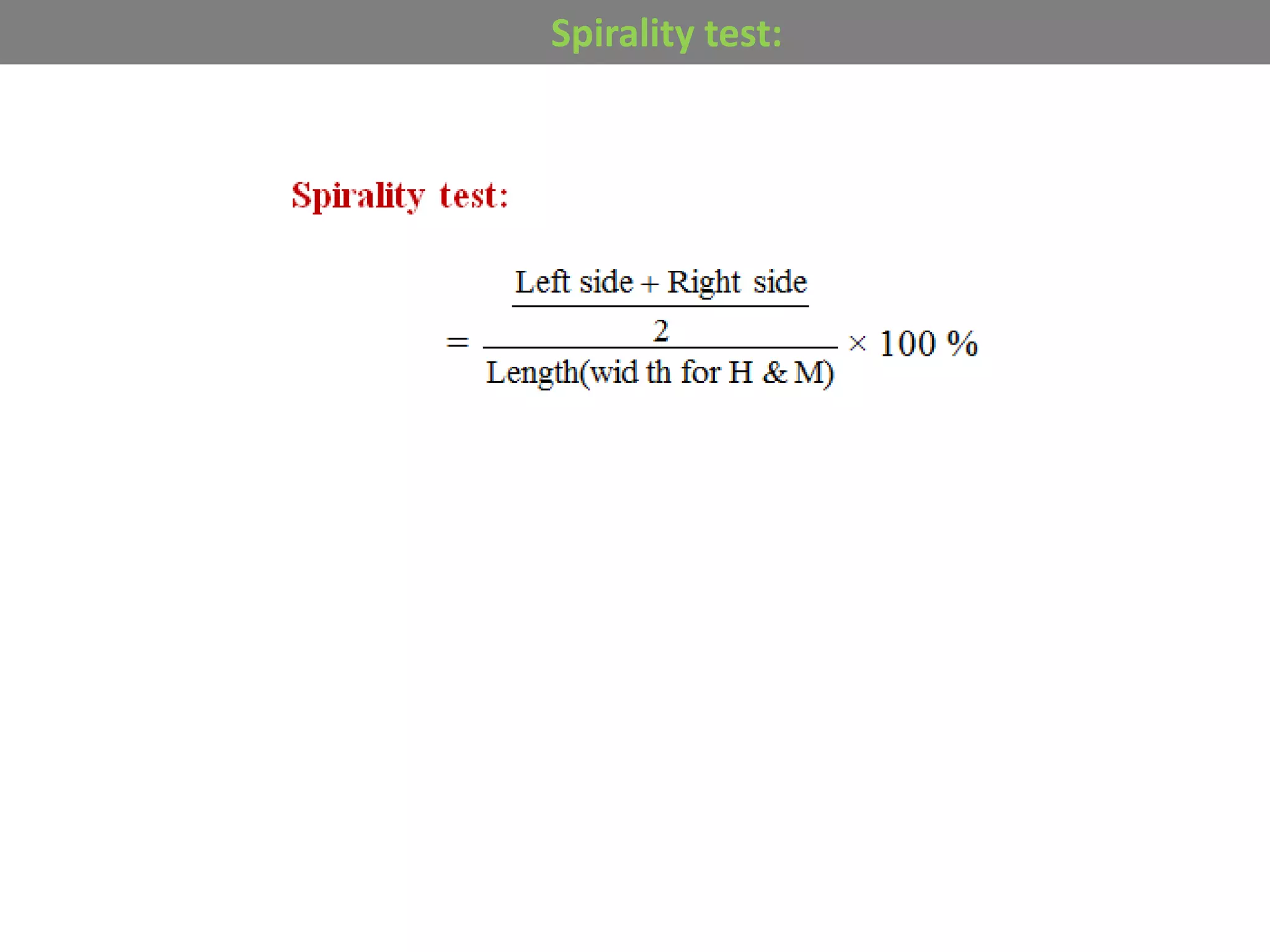
Spirality test:
Textile  Calculations and Equations

Textile Calculations and Equations

  • 1.
  • 2.
    Name : MAZADULHASAN SHESHIR ID: 2010000400008 Batch: 13th Batch (Session 2009-2013) Department: Wet Processing Technology Email: mazadulhasan@yahoo.com Blog: www. Textilelab.blogspot.com Southeast University Department of Textile Engineering PREPARED BY ©right
  • 3.
  • 4.
    Basic Conversions (Spinning) NoLength Weight Time 1. 1 in = 2.54 cm 1 lb = 7000 gr 1 min = 60 sec 2. 1 yd = 36 in 1 lb = 16 oz 1 hr = 60 min 3. 1 m = 1.0936 yd 1 oz = 437.5 gr 1 shift = 8 hr 4. 1 Hk = 840 yd 1 kg = 2.2046 lb 1 day = 24 hr 5. 1 Hk = 7 leas 1 bag = 100 lb 1 day = 3 shifts
  • 5.
    Count Conversion Table(Spinning) Ne Nm Tex Grex Denier Ne= 1 xNe 0.5905 xNm 590.5 /Tex 5905 /Grex 5315 /Den Nm= 1.693xNe 1 xNm 1000 /Tex 10,000/Grex 9000 /Den Tex= 590.5 /Ne 1000 /Nm 1 xTex 0.1 xGrex 0.111 xDen Grex= 5905 /Ne 10,000 /Nm 10 xTex 1 xGrex 1.111 xDen Denier= 5315 /Ne 9000 /Nm 9 xTex 0.9 xGrex 1 xDen
  • 6.
    Draft & TPIFormulas
  • 7.
    Efficiency Percentage (Spinning) CleaningEfficiency (%) Efficiency (%) Twists per inch
  • 8.
  • 9.
  • 11.
    Yarn Count inDirect system System Unit weight Unit length Uses Tex Grams 1,000m Polyester Denier Grams 9,000m Lycra D-Tex Grams 10,000m Lycra Pounds/Spyndle Pounds 14400yds Jute Yarn Count in Indirect system System Unit weight Unit length Uses English (Ne) 1 lb 840 yds Cotton yarn Metric (Nm) 1 kg 1 km Cotton yarn Worsted 1 lb 560 yds Worsted yarn Woolen 1 lb 256 yds Woolen yarn
  • 12.
    Excellence of fiberquality by combing:
  • 14.
    Fabric (Knitting &Weaving) Calculation and Equation
  • 15.
  • 16.
  • 17.
    Required Chemical &no.of Mixing of Sizing Recipe:
  • 20.
    Production is calculatedin accordance with the following equation-
  • 21.
    Production calculation: 1. Production= no. of needle x no of feeder x RPM x stitch length/ yarn count Production per shift in KG at 100% efficiency Where, Ks = knitting constant Count = linear density of yarn GSM = gm per square meter Another formulae is : Stitch length = (Tex × Ks) / GSM Ks is a constant. Its value is different for different fabric structure and fabric type. Ks is calculated and estimated as below: Ks = (GSM x Stitch length) / Tex
  • 22.
    Production calculation: Fabric typeColor Value of Ks Single jersey Average 19.55 Single lacoste Average 22.4 Double lacoste Average 22.75 Polo pique Average 25 Plain interlock Average 39.3 1 X 1 rib Light 24.5 1 X 1 rib Average 26.5 Ks = (GSM x Stitch length) / Tex
  • 25.
    Relation between yarncount and m/c gauge seen in different m/c.:
  • 26.
  • 27.
    DIFFERENT FABRIC GSMAND THEIR REQUIRED YARN COUNT S/J without lycra - Fabric G.S.M Yarn Count 110 - 120 40 S – 36 S 120 - 130 36 S - 32 S 130 - 140 32 S – 28 S 140 - 150 28 S 150 - 160 26 S 170 - 210 24 S Rib without lycra - Fabric G.S.M Yarn Count 180 - 190 36 S - 32 S 190 - 200 30 S 200 - 215 28 S 215 - 230 26 S 230 - 250 24 S 250 - 300 24 S
  • 28.
    Interlock without lycra- Fabric G.S.M Yarn Count 200 - 220 34 S 220 - 230 32 S 230 - 250 30 S 250 - 300 26 S Lacoste without lycra - Fabric G.S.M Yarn Count 180 - 190 30 S 190 - 210 28 S 210 - 230 26 S 230 – 250 26 S 40D Lycra Rib - Fabric G.S.M Yarn Count 230 - 240 32 S 240 - 250 30 S 250 - 280 26 S 280 - 300 24 S 40D Lycra S/J – Fabric G.S.M Yarn Count 180 - 190 34 S 190 - 210 32 S 210 - 220 30 S 220 – 240 28 S 240 - 250 26 S DIFFERENT FABRIC GSM AND THEIR REQUIRED YARN COUNT
  • 30.
  • 31.
    Production Calculation ofYarn singeing machine: Length = Count * Weight = Count * Weight * 840 yards = (Count * Weight * 840) / rpm yards per minute = (Count * Weight * 840) / rpm * 60 * 8 * 3 yards per day = (Count * Weight * 840) / rpm * 60 * 8 * 3 * 0.914 =……X…meter/day.
  • 32.
    Production Calculation ofreeling machine:
  • 33.
    Production Calculation ofhank to cone winding machine: Machine Parameter Yarn quality Speed (rpm) 58/2, 60/2 450 All single count 500 to 550 Length = Count  Weight = Count * Weight  840 yards = (Count  Weight  840) / rpm yards per minute = (Count  Weight  840) / rpm  60  8  3 yards per day = (Count  Weight  840) / rpm  60  8  3  0.914 =……X…meter/day.
  • 34.
    GSM Calculation: WPI =32 CPI = 45 Stitch length = 3 mm Yarn Count = 20’S Ne
  • 35.
    No. of Needle= π × Machine Diameter (D) × Machine Gauge (N) = 3.1416 × 30 × 24 = 2262 Yarn Count = 30/1 Ne No. of Feeder = 96 Machine RPM = 28 Stitch length = 3 mm Efficiency = 85% = 0.85 Shift = 8 hr. = 8 × 60 = 480 min Production Calculation Of Yarn Dyeing Machine : Production of the machine is 146.407 Kg/Shift. Note: If any parameter in this calculation is changed then production capacity per shift will be changed.
  • 36.
    Package Density Calculation(Yarn Dyeing): Formula
  • 37.
    Density Calculation forSeveral Counts (Yarn dyeing): 1**Before Pressing • Yarn Quality: 30/1 cc • Package Height (H) = 162mm = 16.2cm • Total Package Dia (D1) = 162mm = 16.2cm • Total Package Weight (W1) = 1.38kg = 1380gm • Spring Weight (W2) = 0.185kg = 185gm • Spring Dia (D2) = 65 mm = 6.5cm
  • 38.
    2 **After Pressing YarnQuality: 30/1 cc Package Height (H) = 145mm = 14.5cm Total Package Dia (D1) = 165mm = 16.5cm Total Package Weight (W1) = 1.38kg = 1380gm Spring Weight (W2) = 0.185kg = 185gm Spring Dia (D2) = 65 mm = 6.5cm **So we can sure that after pressing for every count, yarn package density will be increase. Density Calculation for Several Counts (Yarn dyeing):
  • 39.
    Length Calculation inPackage: To maintain the constant package density same length of yarn should be wound to all the packages of a batch or lot. The dyeing machine capacity is calculated on weight, so it is necessary to maintain the uniform weight throughout the packages. To do this for a definite count of yarn following calculation is followed, In this machine length is pre selected. For different count of yarn different length of yarn is pre selected. This is due to maintain the constant package weight and package density.
  • 40.
    Package density Calculation Weknow package density ρ =mass (m)/volume (v) gm/cc Volume= π (R2-r 2) h R= outer radius of package R= inner radius of package h= height of package Now we consider a sample of 40/1 cotton yarn whose R=4.138 r= 1.59 h=15.24 Mass m=1000gm So package density ρ=1000/π (4.1382-1.592)15.24 gm/cc =1.433 gm/cc Production calculation: We know production= speed (m/min) ×60×24 ×1.09/(840×40×2.2045) Kg/day/head When speed is 800m/min at 80% efficiency Production=800×60×24×1.09/ (840×40×2.2045)kg/day/head =10.5976kg/day/head Total production=10.5976×54×12kg/day =6867.2448kg/day
  • 41.
    Production calculation ofRF Dryer : Length of RF Dryer = 13m At 28rpm it takes 21 min 9 sec to pass this length Along this length it can accommodate 416 package 416kgs So at 21 min9sec or 1269sec it can dry 416kgs So in 1hr or 3600sec it can dry = 416×3600/1269 kg/hr = 1180.14 kg/hr So Production per day = 1180.14×24kg = 22658.688 kg = 22.66 tons Production calculation of RF Dryer
  • 42.
  • 43.
    Calculations related tobatch section: Now, when a gram per linear meter is low then meters per chamber will be more. Thus, fabric loading should be reduced to avoid jamming in the winch. In this case 80-85% fabric loading is given. But when gram per linear meter is more then rope length will reduce and in this case up to 90% fabric loading can be given.
  • 44.
    Calculating the chamberloading In the following table are listed general recommendations covering rope cycle times and speeds for a wide range of fabrics: Fabric Rope cycle times in minutes (Cycle Time) Rope circulation speed m/min (Reel speed) Knit fabric PES unfixed 1 250 PES heat set 1-1.5 200 PC 1-2 250 Co - reactive 2-3 225-275
  • 47.
    Preparation and storageof stock dyes and chemicals Available stock solution: 1. Red-0.1%, 0.5%, 1%, 2% 2. Yellow-0.1%, 0.5%, 1.0%, 2.0%, 3. Blue- 0.1%, 0.5%, 1.0%, 2.0%. Preparation:  To prepare 0.1% stock solution, it necessary to mix 0.1 gm dye with 100cc water.  To prepare 0.5% stock solution, it necessary to mix 0.5 gm dye with 100cc water.  To prepare 1.0% & 2.0% stock solution similar procedure is followed.  To prepare 10% stock solution of soda ash, it necessary to mix 10 gm soda with 100cc water. SHADE % STOCK SOLUTION % 0.0001-0.009 0.1 0.10-0.99 0.5 1-1.99 1 2-3.99 2 4 ( or above) 4 Stock solution preparation:
  • 48.
    Stock Solution MakingProcedure (Dyeing lab) For solid, X gm chemicals/dyes/auxiliaries in the 100 ml water is called x% stock solution. For liquid, X ml/cc chemicals/dyes/auxiliaries in the (100 - x ml/cc) water is called x% stock solution. Conversion formula from percentage to g/l is as g/l = Required amount (%)× 10
  • 49.
  • 51.
    Dyes and chemicalsmeasuring formula for laboratory: The amount of dye solution (ml) is calculated as follow – The amount of chemical soln (ml) is measured as follow –
  • 53.
    Fabric Type GSMPump Speed % Reel Speed(MPM) Single Jersey Up to 140 80 250 140 – 180 85 230 180 – above 90 210 Polo Pique, Back Pique & Bubble Knit Up to 160 85 280 160 – 200 90 260 220 – above 90 240 Interlock Up to 180 85 260 180 – 220 90 240 220 – above 90 220 Machine Setup On The Basis Of Fabric Type & GSM
  • 54.
    MONTHLY EFFICIENCY OFKNITTING FLOOR: Daily production – 6500 kgs. Approx. Daily production capacity – 10000 kgs approx. So, monthly production – 6500 x 30 kgs. Monthly production capacity – 10000 x 30 kgs. So, Monthly production efficiency = (6500x30x100)/ (10000x30) % = 65%
  • 55.
  • 56.
    COSTING OF THEPRODUCT: Let price of yarn is $ 3.00/ kg. Process loss of yarn for knitting (10%) = $0.30 Knitting fabric cost = $3.30 Cost of dyes & chemicals = $2.50 Process loss for dyeing (12%) = $0.30 Dyed fabric cost = $ 6.10 Packing cost = $0.05 Production cost of fabric=$6.15 Fabric price (with 25% margin) =$7.79 Fabric consumption/ doz. = (Body length + Sleeve length +10) x Chest length x 2 x GSM x12 /10000000
  • 57.
    Garments specification: Body length=78cm Sleeve length=33 cm Chest length=62 cm GSM=210 Fabric consumption/ doz. = {(78+33) x62x2x210x12}/ 10000000 = 3.469 kg Fabric consumption/doze (with 10% wastage) = 3.816 kg Body fabric cost / doz. =$(7.79x 3.816) = $29.73 Cost of collar& cuff/doz = $ 4.00 Cost of Trims=$ 2.25 Cost of Trims (with 5% Process loss) = $2.36 Production Cost of Garments/ doz=$36.09 Garments Price/doz (with 25% Profit) =$45.12 COSTING OF THE PRODUCT:
  • 58.
    Costing of Men’sshirt Fabric consumption for a dozen of shirt π × L ═ size of basic shirt. Width of body of shirt ═ 1/2 chest ═ 24"+1"(sewing allowance) ═ 25" Body length ═ 32"+1"(sewing allowance) ═ 33" Sleeve length ═ 23"+2.5(cost) +1.5"(sewing allowance) ═ 27" Consumption of a body shirt: ═{1/2 chest× (body length) ×2} / 36× fabric width. (Sq. inch) ═25"×33"×2 (Sq. inch ). {Let assume fabric width 25"effective width ═25"−1" ═ 24"} Fabric length ═25×33×2 / 44 inch
  • 59.
    Fabric consumption ═25×33×2/ 44×36 yds Consumption of sleeve ═ (length of sleeve × width sleeve) ×2 sq. inch ═27"×24"×2" (Sq. inch) Fabric consumption in length width ═ 27×24×2 / 44×36 sq. inch Total fabric consumption of one dozen shirt ═ [(25×33×2 / 44×36 + / 27×24×2 / 44×36) ×2+ wastage of 8%] ═ 22.75 yds + 8% wastage ═24.6 yds Sewing threads consumption: It is calculated by measuring the total of different kind of seam. Normally sewing threads consumption per shirt , 120m. So, sewing threads consumption per dozen, ═ 120 × 12 ═ 1440m Costing of Men’s shirt
  • 60.
    Costing of T-shirt Fabric Type :Single jersey G.S.M :180 Yarn count :24/1 Measurement of Garments: Body length : 54 cm Chest length : 43 cm Sleeve length : 15 cm Fabric Consumption = {(Body length + sleeve length + allowance) *(Chest length + 3)} * 2 /10,000 * G.S.M / 1000 * 12 * 10 % (+) = {( 54 + 15 + 10 ) * ( 43 + 3 )} * 2 / 10,000 * 180 / 1000 * 12 * 10% (+) =1.72 kg =1.72* 0.18 = 1.90 kg / doz. Costing Fabrics cost : 17.10 Cost of making : 4.5 Print cost : 3.5 Lab cost : 0.20 Accessories cost : 2.5 Washing cost : 1 Total = $ 28.80 / Doz. = $ 2.40 / pcs.
  • 62.
    How can weget Fabric Consumption & Fabrics Price? Say: ** Body Length = 85, Chest Width = 52, Sleeve Length = 44 & G.S.M = 240 Fabric Description: 100 % Cotton S/J Fabric Need = [(85+5+44+5)  52+5]  2  12  240/10000000+10% = [(90+49)  57]  2  12  240/10000000+10% = (13957)  2  12  240/10000000+10% = 7923 12  240/10000000+10% = 45636480/10000000 + 10% = 4.563648 +10% = 4.563648 + .4563 = 5.02 Kgs Fabrics Say Per Kgs Price: US$ 6.00/Kgs
  • 63.
    Poly bag costing: Total Length X width X Thickness = 36cm X 28cm X 10mm = 10080/72000 = 0.14pcs/lb Fabrics Price: Total Fabric Need 5.00 Kg  $ 6.00 = $ 30.00 Trim/ Accessories (Minimum Charge) = $ 2.50 Cutting & Making Charge (C.M) = $ 5.00 Printing Charge (If any) = $ 0.00 Embroidery Charge (If any) = $ 0.00 Buying Commission (If necessary) 5% = $ 1.97 Final/Total = $ 39.47/12 Costing of a garment: Fabric cost + Accessories cost + Trimming cost + Production cost + Transport cost + Commission + Profit
  • 65.
    Consumption of T-Shirt: Equation: {(Bodylength + Sleeve length)  Chest}  2  GSM  10000  1000  5000 Solution: Body Length = 50 + 6 (Allowance) = 56 cm Sleeve Length = 15 + 3 (Allowance) = 18 cm Chest = 37 + 3 (Allowance) = 40 cm GSM = 180 cm = {(56 + 18)  40}  2  180  10000  1000  5000 = 532.8 kg.
  • 66.
    Consumption of Collar: Equation: {(Neckwidth + Front neck drop)  collar depth}  2  GSM  10000  1000  5000 Solution: Neck width =22  2 = 44 cm Front neck drop =5 cm Collar depth =2.5 cm  2 = 5 cm GSM = 240 = {(44 + 5)  5}  2  140  10000  1000  5000 = 58.8 kg. Total = 532.8 + 58.8 kg = 591 kg
  • 67.
    Collar & Cuffmeasurements Size Collar measurement (cm) Cuff measurement (cm) S 40 x 9 40 x 3.5 M 42 x 9 40 x 3.5 L 44 x 9 40 x 3.5 XL 46 x 9 40 x 3.5 XXL 48 x 9 44 x 3.5 XXXL 50 x 9 44 x 3.5
  • 68.
    Consumption of bottompart: Equation: Length*(width*4)*G.S.M÷10000÷1000*12 Length=53=8=2=63cm Width= 18*4+6= 78cm G.S.M= 260 Solution [(63*78*260)÷10000÷1000*12 =1.53kgs
  • 69.
    Consumption of Pocket: Equation:Length*width*G.S.M÷10000÷1000*12 Length=11+2=13cm Width=10cm G.S.M= 260 Solution (13*10) *260÷10000÷1000*12 =0.04056kg Total= 1.53+0.04056 1.5705kg
  • 70.
    Costing process: Finish fabriccost: (Yarn price + Knitting cost + dyeing cost) Body fabric cost: (Total fabric consumption + Total yarn consumption) Cost of making (CM):……………………………$ Accessories cost:…………………………………..$ Overhead cost………………………………………$ Others cost:………………………………………….$ Buyer commission:……………………………….$ Total cost..................................................$ Costing process: PRICE OF THE PRODUCT: Generally price of product is determined by the required profit adding to the total expenses. So, Price of products = (Direct expenses + Indirect expenses + Factory Overhead) + Required profit
  • 72.
    MARKER EFFICIENCY: Themarker planner measures his success by the efficiency of the marker plan. The following formula is used to measure the efficiency: Marker efficiency=Area of the pattern in the marker plan/ Total area of the marker plan X 100%. MARKER EFFICIENCY:
  • 73.
    STANDARD TIME =Normal time + Allowances = Normal time + (Normal time ×Allowances) = NT (1+ Allowances). In garments production world, the terms SMV or SAM used frequently.  SMV stands for Standard Minute Value.  SAM for Standard allocated minute or Standard Allowed Minute. SMV CALCULATION: SMV calculation of a basic T-shirt from a time study sheet of a garments industry. Following formulas are use-  Normal time = (Average observed time) × (Performance rating factor).  SMV (Standard Minute Value) = Basic Time + (Allowances × Basic time). = Basic Time× (1+ Allowance).  Allowances are assumed for this calculation is 20%. SMV
  • 74.
    SMV Target Production /Hour= (No Of worker -1) x 60 / SMV SMV= standard Mean Value (the Time Required to Complete garments by sewing ) SMV=( Basic time +Allowance )
  • 75.
    To select sewingthread, thread size or number is very important. The number which is used to express the fineness of a sewing thread is called sewing thread number or ticket number. It has 2 system as follows- Cotton system : It is derived from English cotton system. Cotton ticket number in Ne = ( Yarn count in Ne / Number of ply ) x 3 Metric system : It is derived from Metric count system. Ticket number in Nm = ( Yarn count in Nm / Number of ply ) x 3 sewing thread number or ticket number
  • 76.
    Equation For FindYarn Count (If GSM is Known)  Single Jersey = 4300 /GSM  Pique = 5200 / GSM  Fleece = 7200 / GSM  Interlock = 7200 / GSM  1x1 rib = 6000 / GSM  Locoest =5500 / GSM  2x2 rib = 6250 / GSM  Terry = 6240 / GSM
  • 77.
    Find out RequiredYarn Count (If GSM is Known) Equation : S/j Ne = (0.141x GSM) + 50.22 Pique Ne = (0.146x GSM) + 57.16 Double Lacost Ne = (0.167 X GSM) + 64.36 1X1 Rib Ne = (0.123X GSM) + 54.57 Interlock = (0.206X GSM) + 80.56 Lycra 1X1 Rib = (0.119 X GSM) + 59.12 Lycra 2X2 Rib = (0.108X GSM) + 56.62
  • 78.
    Conversion of (GSMEquation ) Kg To Yards Equation : = GSM / 39.37 X 36 X fabric Width =Result .Kg =1000/ Result .yds [It is converted Kg To yards ] Per Yards Fabric price Equation : = GSM / 43” X Width / 1000 X Per kg Prize =Result . [This the Equation define per yards Fabric price ]
  • 79.
    Conversion of (GSMEquation ) Yards To meter Equation : = Length X 36 X 2.54 /1000 =Result [It is converted yards to Meter ] Meter To Yards Equation : = Length /36 / 2.54 X 1000 =Result [ It is converted Meter To yards ]
  • 80.
    Conversion of (GSMEquation ) Find Out How many Yds / Kg Equation : = 714//GSM =Result (yds in Kg) [Only For 58’’/60’’ Width] Price/Yards Equation : = GSM /43 / 2.54 X Width =Result / 1000 X Price = price/yds
  • 81.
  • 82.
    Four point gradingsystem Size of defects Penalty 3 inches or less 1 point Over 3 inch but not over 6 inch 2 point Over 6 inch but not over 9 inch 3 point Over 9 inch 4 point Four point grading system
  • 83.
  • 84.