B.PHARM. 7 SEMESTER
WINTER 2021
Contributor personality
development program (CPDP)
FINDING SOLUTIONS
PROBLEM
• a thing that is difficult to deal with or to understand
• समस ्या, मसला जिससे निपटिा या जिसे समझिा कठिि
हो
• a question that you have to solve by thinking about it
• प्रश ्ि जिसका हल काफ़ी सोचिे से निकले
EXAMPLE
• The company will face problems from strike
• I can’t play because I’ve got a problem with my knee.
SOLUTION (PROBLEM SOLVING)
• a way of solving a problem, dealing with a
difficult situation, etc.
• ककसी समस्या, कठििाई आठि से निपटिे का ढंग; हल,
समाधाि
• the answer
• उत्तर
EXAMPLE
• The solution to the quiz will be published next
week.
• a solution to the problem of unemployment
STEPS OF PROBLEM SOLVING
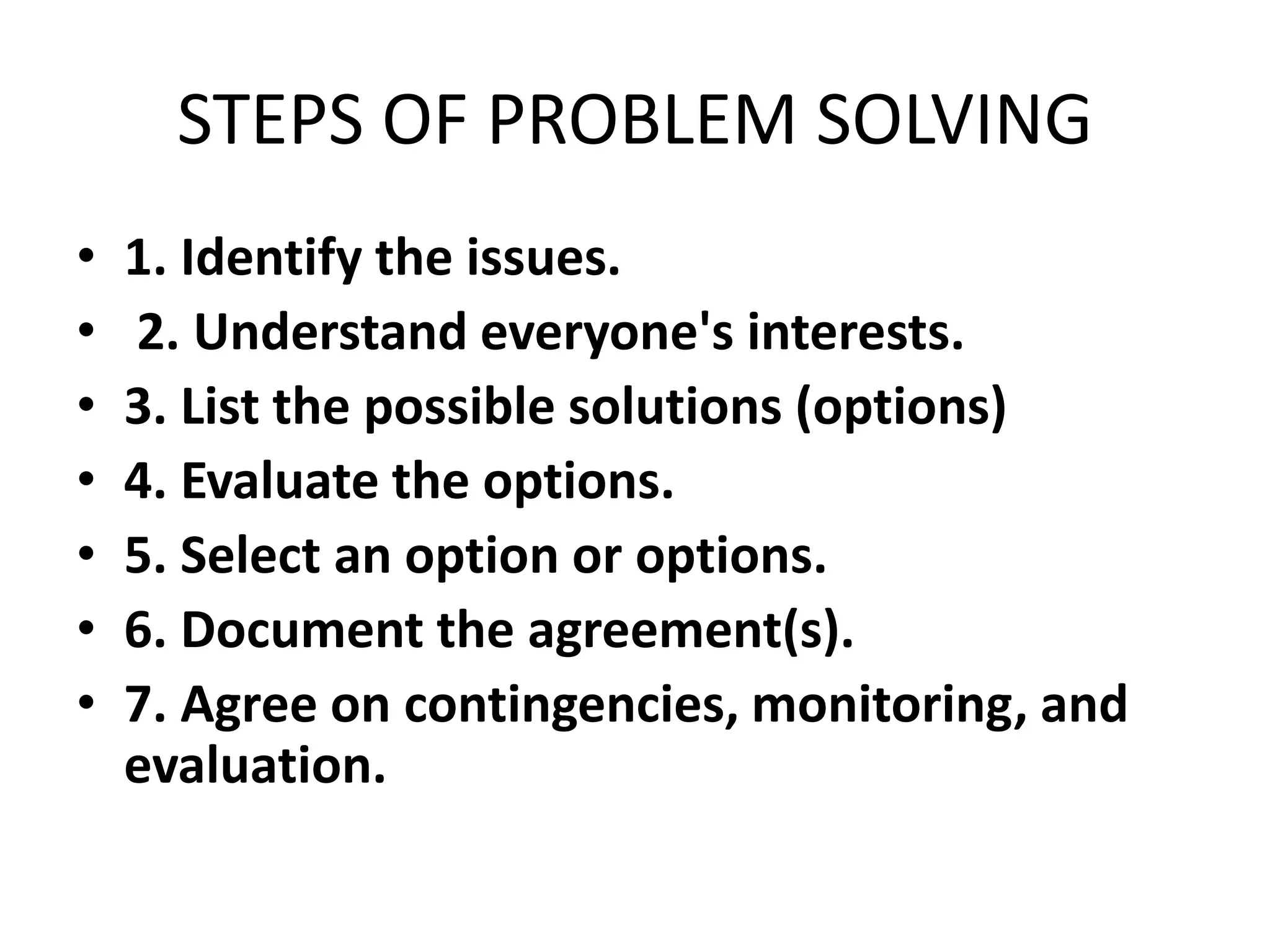
• 1. Identify the issues.
• 2. Understand everyone's interests.
• 3. List the possible solutions (options)
• 4. Evaluate the options.
• 5. Select an option or options.
• 6. Document the agreement(s).
• 7. Agree on contingencies, monitoring, and
evaluation.
1. Identify the issues.
• Be clear about what the problem is.
• Remember that different people might have
different views of what the issues are.
2. Understand everyone's interests.
• This is a critical step that is usually missing.
• Interests are the needs that you want satisfied by
any given solution. We often ignore our true
interests as we become attached to one
particular solution.
• The best solution is the one that satisfies
everyone's interests.
• This is the time for active listening. Put down
your differences for awhile and listen to each
other with the intention to understand.
3. List the possible solutions (options)
• This is the time to do some brainstorming.
There may be lots of room for creativity.
4. Evaluate the options.
• What are the pluses and minuses? Honestly!
5. Select an option or options.
• What's the best option, in the balance?
• Is there a way to "bundle" a number of
options together for a more satisfactory
solution?
6. Document the agreement(s).
• Don't rely on memory.
• Writing it down will help you think through all
the details and implications.
7. Agree on contingencies,
monitoring, and evaluation.
• Conditions may change. Make contingency
agreements about foreseeable future
circumstances (If-then!).
• How will you monitor compliance and follow-
through?
• Create opportunities to evaluate the
agreements and their implementation.
CONCLUSION
• To make ourselves strong and confident
• To prepare ourselves to face the future
challenges
• To improve ourselves to engage better in the
workplace
• To improve our skills to get the solutions of
problems arises from what, why, who, when,
where and how
REFERENCE
• https://www.mediate.com/articles/thicks.cfm
• https://www.google.com/dictionary
TAPAN KUMAR MAHATO
tapan.mahato@gmail.com
finding solutions

finding solutions

  • 1.
    B.PHARM. 7 SEMESTER WINTER2021 Contributor personality development program (CPDP) FINDING SOLUTIONS
  • 4.
    PROBLEM • a thingthat is difficult to deal with or to understand • समस ्या, मसला जिससे निपटिा या जिसे समझिा कठिि हो • a question that you have to solve by thinking about it • प्रश ्ि जिसका हल काफ़ी सोचिे से निकले EXAMPLE • The company will face problems from strike • I can’t play because I’ve got a problem with my knee.
  • 7.
    SOLUTION (PROBLEM SOLVING) •a way of solving a problem, dealing with a difficult situation, etc. • ककसी समस्या, कठििाई आठि से निपटिे का ढंग; हल, समाधाि • the answer • उत्तर EXAMPLE • The solution to the quiz will be published next week. • a solution to the problem of unemployment
  • 9.
    STEPS OF PROBLEMSOLVING • 1. Identify the issues. • 2. Understand everyone's interests. • 3. List the possible solutions (options) • 4. Evaluate the options. • 5. Select an option or options. • 6. Document the agreement(s). • 7. Agree on contingencies, monitoring, and evaluation.
  • 10.
    1. Identify theissues. • Be clear about what the problem is. • Remember that different people might have different views of what the issues are.
  • 11.
    2. Understand everyone'sinterests. • This is a critical step that is usually missing. • Interests are the needs that you want satisfied by any given solution. We often ignore our true interests as we become attached to one particular solution. • The best solution is the one that satisfies everyone's interests. • This is the time for active listening. Put down your differences for awhile and listen to each other with the intention to understand.
  • 12.
    3. List thepossible solutions (options) • This is the time to do some brainstorming. There may be lots of room for creativity.
  • 13.
    4. Evaluate theoptions. • What are the pluses and minuses? Honestly!
  • 14.
    5. Select anoption or options. • What's the best option, in the balance? • Is there a way to "bundle" a number of options together for a more satisfactory solution?
  • 15.
    6. Document theagreement(s). • Don't rely on memory. • Writing it down will help you think through all the details and implications.
  • 16.
    7. Agree oncontingencies, monitoring, and evaluation. • Conditions may change. Make contingency agreements about foreseeable future circumstances (If-then!). • How will you monitor compliance and follow- through? • Create opportunities to evaluate the agreements and their implementation.
  • 17.
    CONCLUSION • To makeourselves strong and confident • To prepare ourselves to face the future challenges • To improve ourselves to engage better in the workplace • To improve our skills to get the solutions of problems arises from what, why, who, when, where and how
  • 18.
  • 19.