Contributor Personality Development
Chapter 9
ENGAGE DEEPLY
leads institute of technology
& engineering, Matar
Guided By :-
Mr. Snehal
Patanwadia
Arvindsai Nair
Atul Hirpara
Ankit Panchal
Rajan Patel
Romanch Patel
Unnati Patel
Rishikesh Solanki
Presented
By:
CONTENT
 Contributor and Non-contributor’s
Attitude
Personal Commitment
 Interest, Initiative, Intellect
 Emotional Engagement
and Disengagement
 Case Stories
Contributor’s Attitude
Non-Contributor’s Attitude
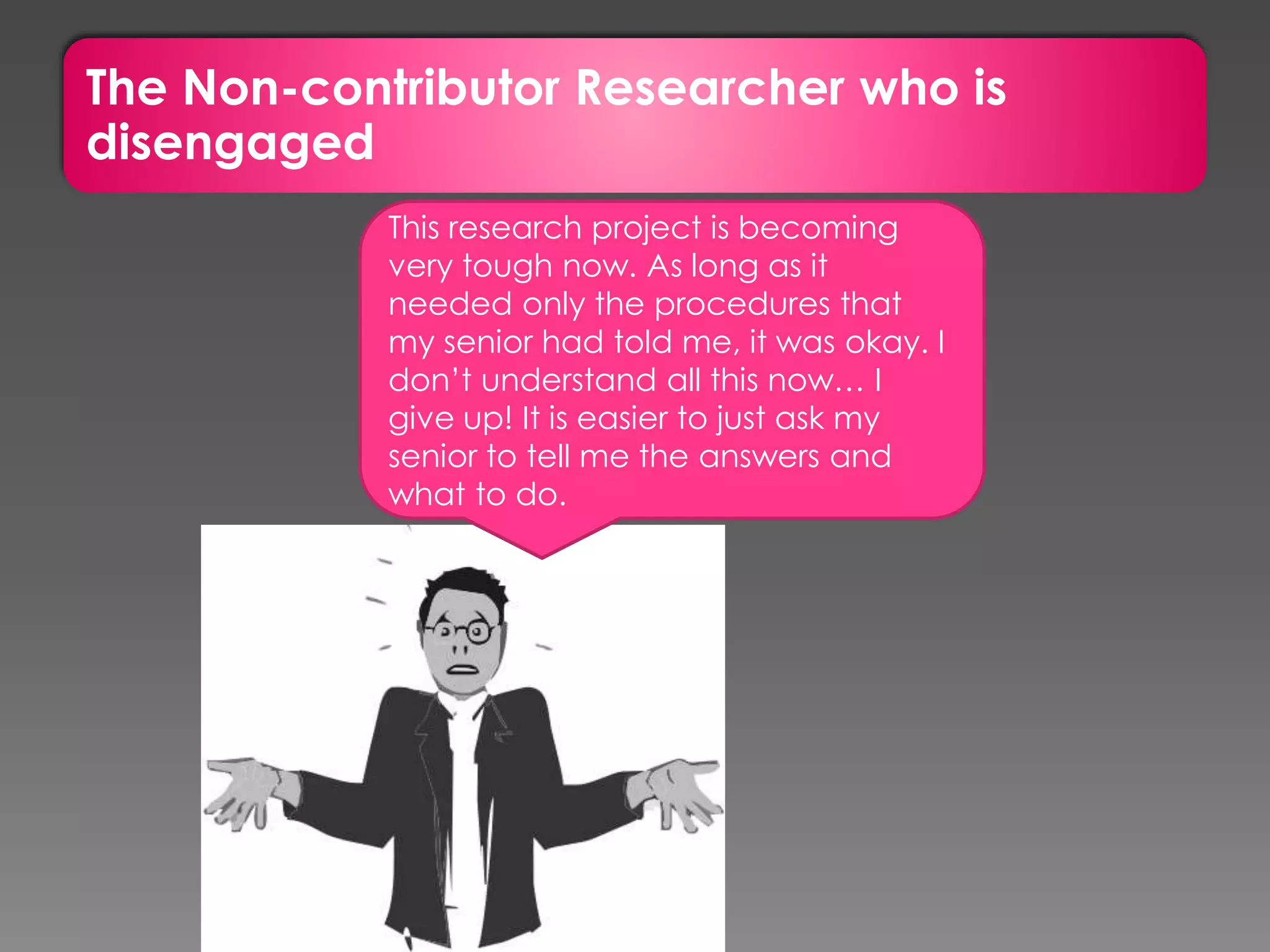
The Non-contributor Researcher who is
disengaged
This research project is becoming
very tough now. As long as it
needed only the procedures that
my senior had told me, it was okay. I
don’t understand all this now… I
give up! It is easier to just ask my
senior to tell me the answers and
what to do.
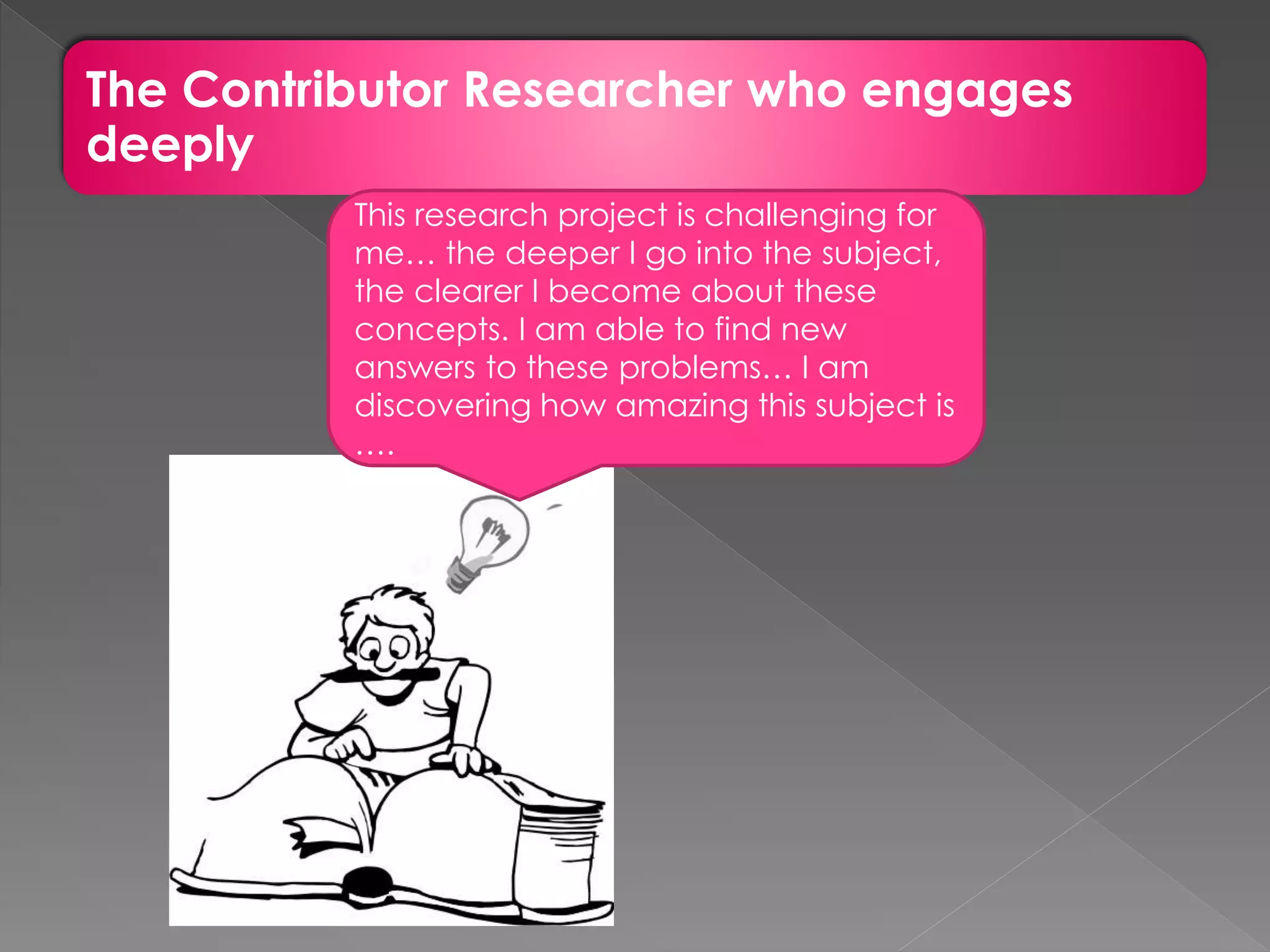
The Contributor Researcher who engages
deeply
This research project is challenging for
me… the deeper I go into the subject,
the clearer I become about these
concepts. I am able to find new
answers to these problems… I am
discovering how amazing this subject is
….
Personal Commitment
Personal commitment is the act of quality of
voluntary tasking on or fulfilling Obligation
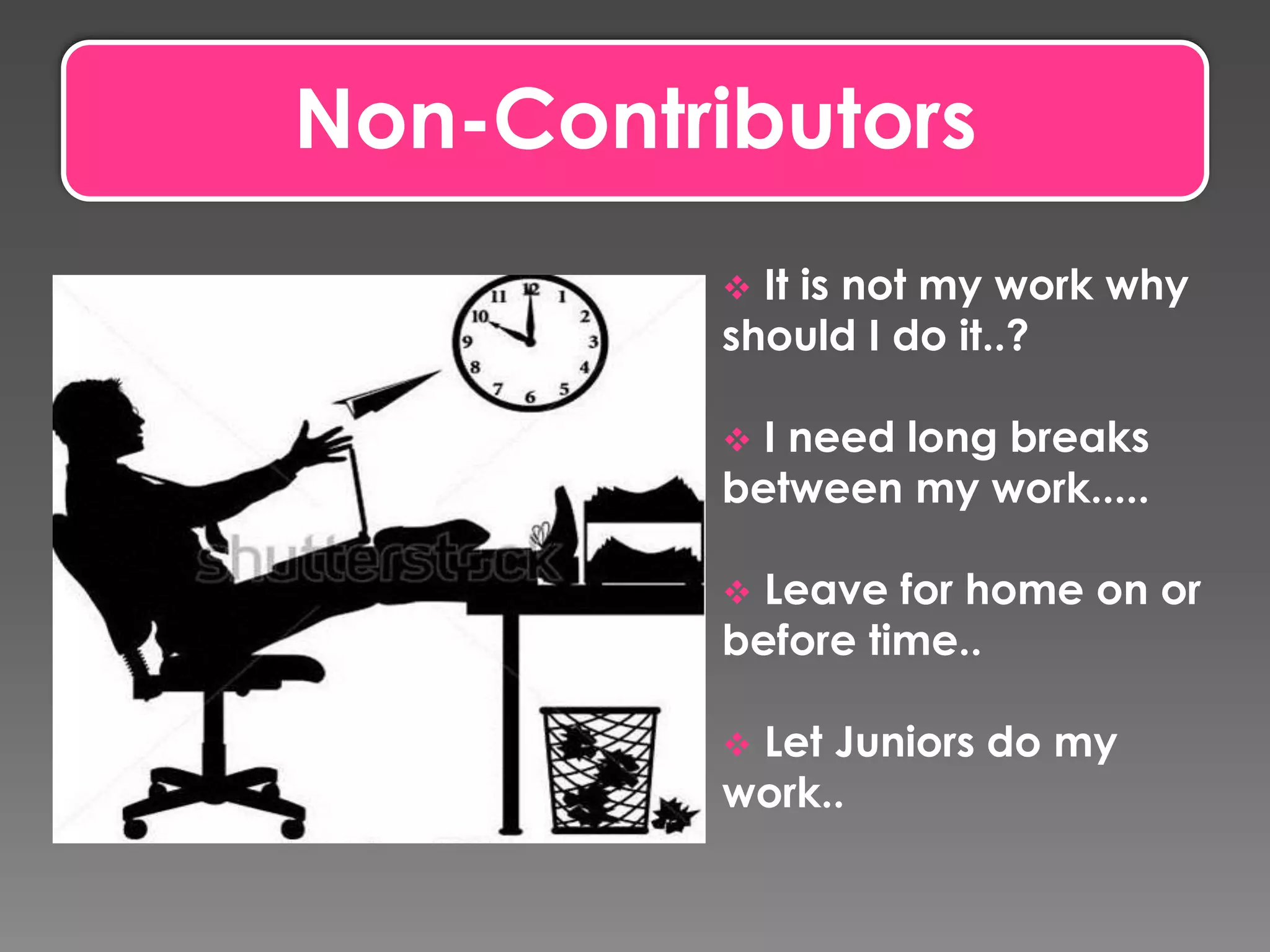
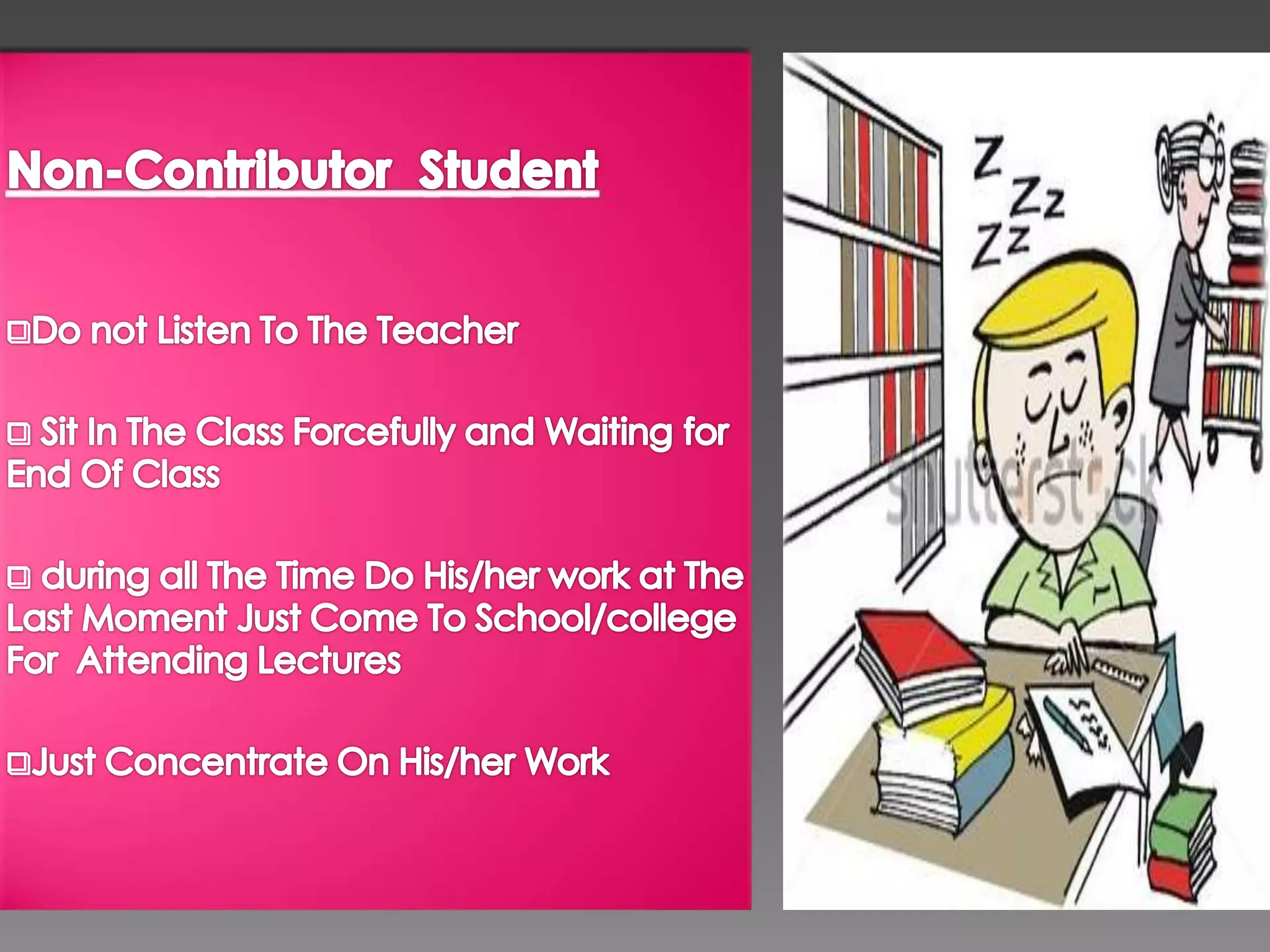
Non-Contributors
 It is not my work why
should I do it..?
 I need long breaks
between my work.....
 Leave for home on or
before time..
 Let Juniors do my
work..
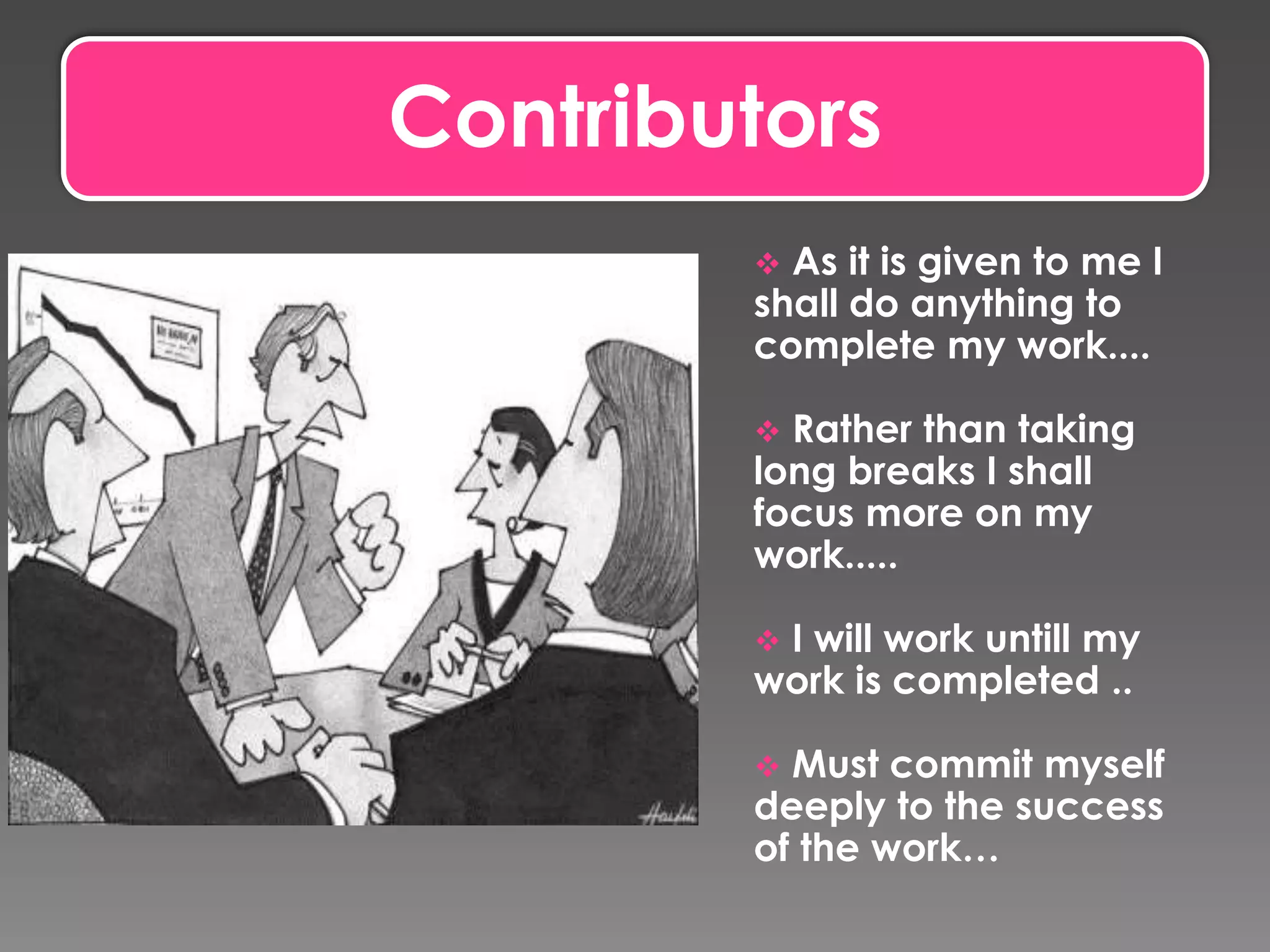
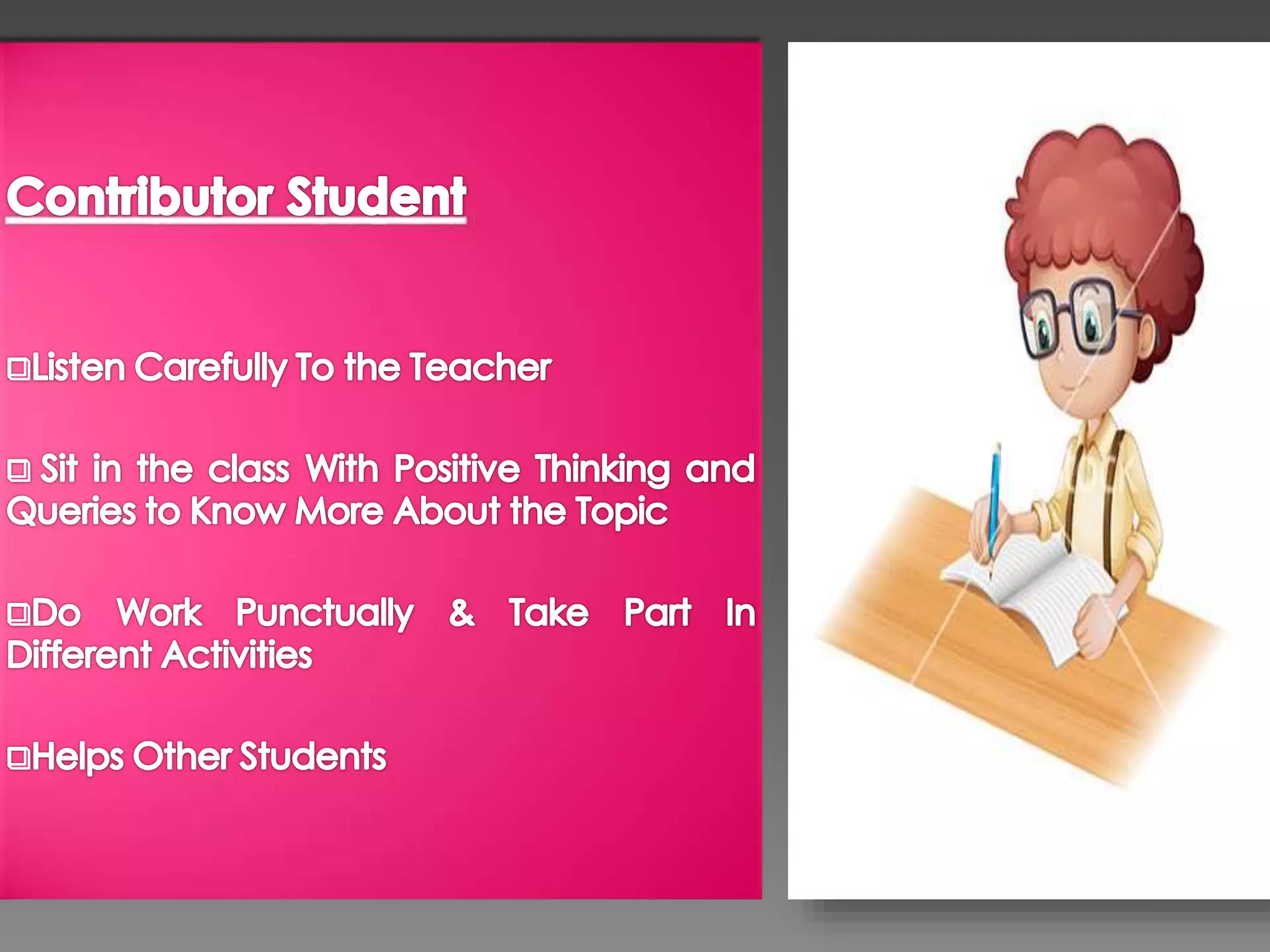
Contributors
 As it is given to me I
shall do anything to
complete my work....
 Rather than taking
long breaks I shall
focus more on my
work.....
 I will work untill my
work is completed ..
 Must commit myself
deeply to the success
of the work…
I. I. I.
•Interest
•Initiative
•Intellect
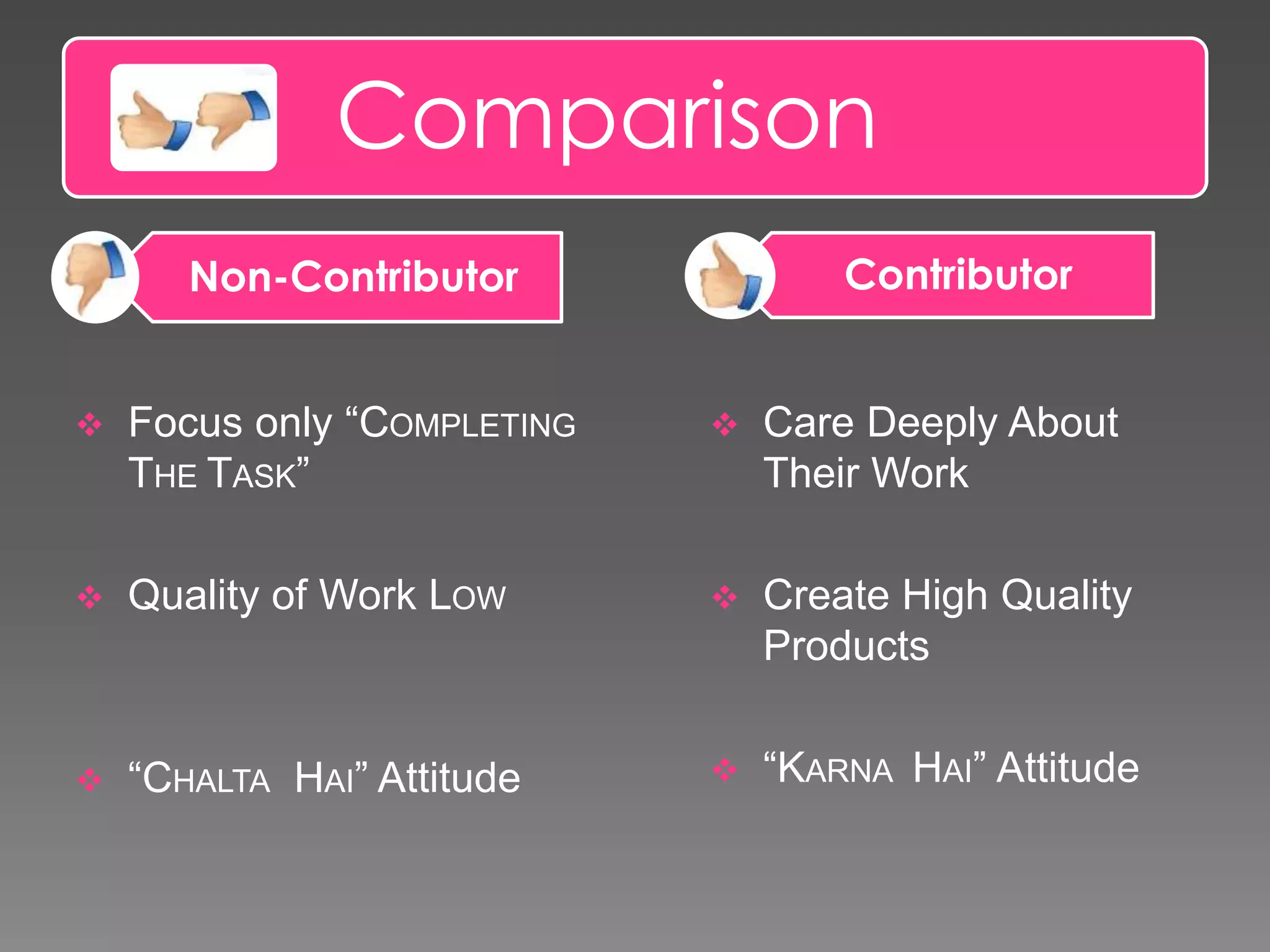
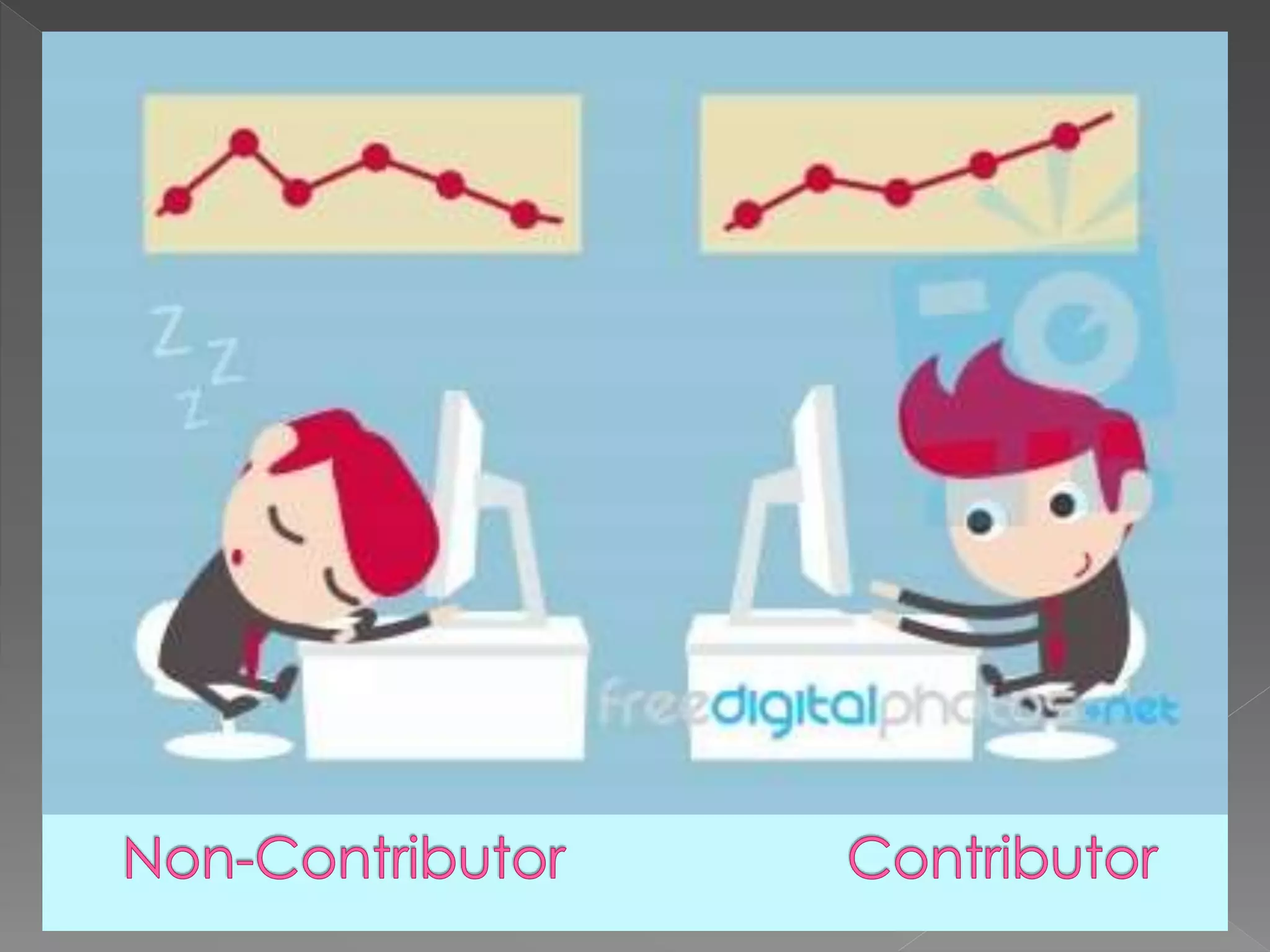
Comparison
Contributor
 Focus only “COMPLETING
THE TASK”
 Quality of Work LOW
 “CHALTA HAI” Attitude
 Care Deeply About
Their Work
 Create High Quality
Products
 “KARNA HAI” Attitude
Non-Contributor
Emotional Engagement
And
Emotional Disengagement
 Ability of an individual to engage emotionally to
any work assigned or situation faced
EMOTIONAL ENGAGEMENT
•A person who is not concerned about the work
assigned or the situation faced can be called as
emotionally disengaged person.
EMOTIONAL
DISENGAGEMENT
Case stories
I would like to tell you some stories about “How a Contributor
engage deeply with their Work?”
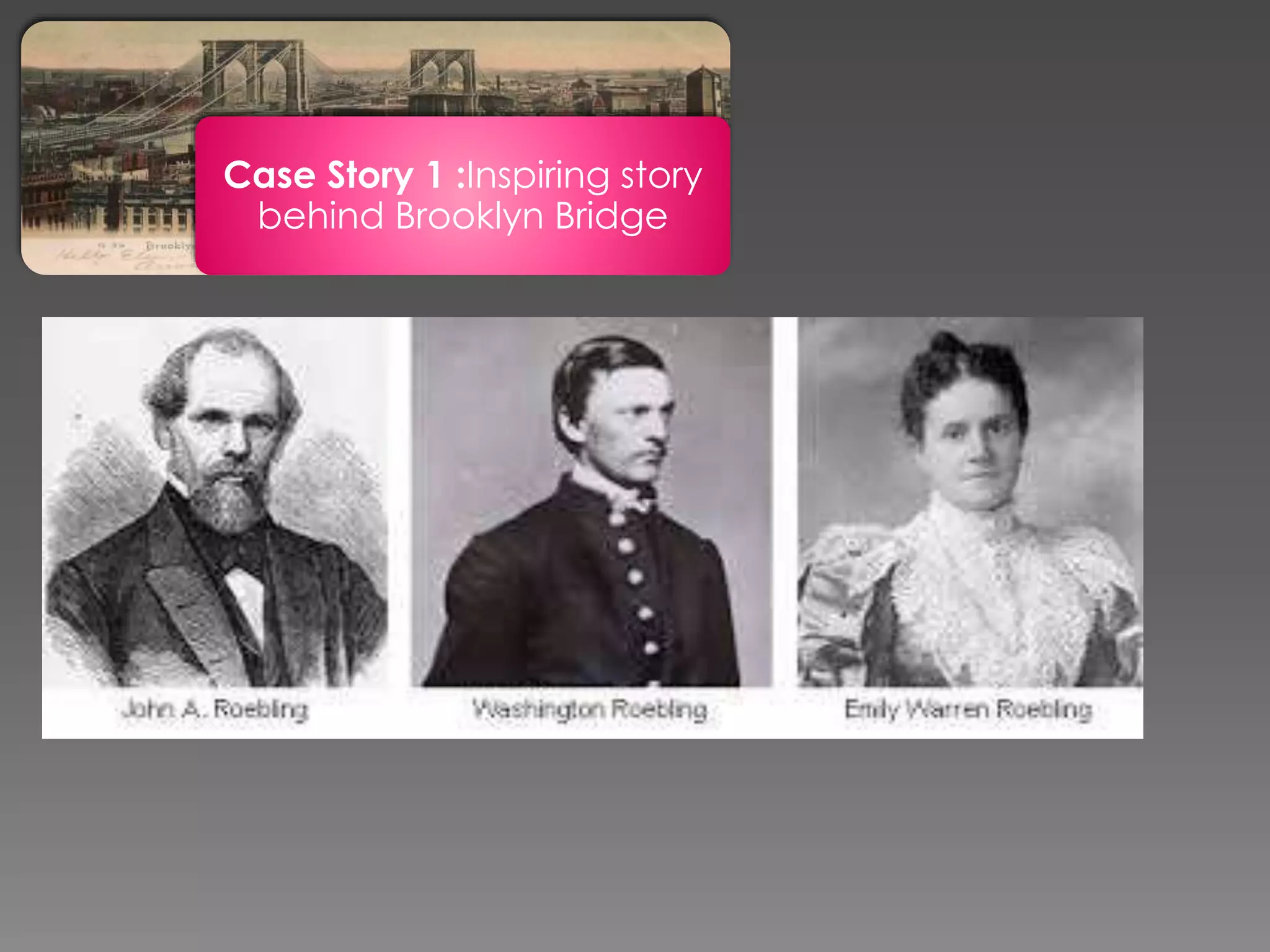
Case Story 1 :Inspiring story
behind Brooklyn Bridge
civil engineer.
Case Story 1 : Inspiring story
behind Brooklyn Bridge
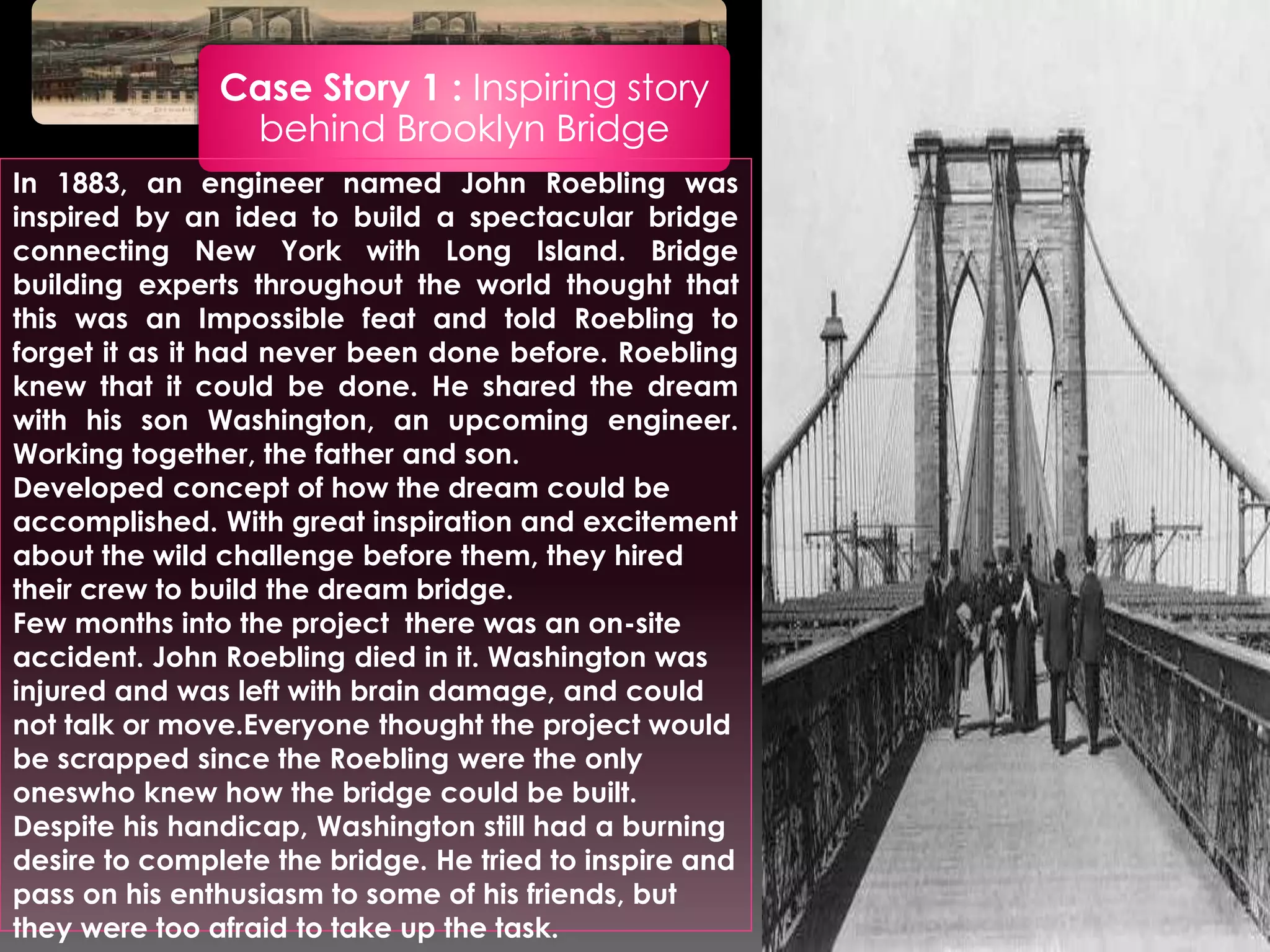
In 1883, an engineer named John Roebling was
inspired by an idea to build a spectacular bridge
connecting New York with Long Island. Bridge
building experts throughout the world thought that
this was an Impossible feat and told Roebling to
forget it as it had never been done before. Roebling
knew that it could be done. He shared the dream
with his son Washington, an upcoming engineer.
Working together, the father and son.
Developed concept of how the dream could be
accomplished. With great inspiration and excitement
about the wild challenge before them, they hired
their crew to build the dream bridge.
Few months into the project there was an on-site
accident. John Roebling died in it. Washington was
injured and was left with brain damage, and could
not talk or move.Everyone thought the project would
be scrapped since the Roebling were the only
oneswho knew how the bridge could be built.
Despite his handicap, Washington still had a burning
desire to complete the bridge. He tried to inspire and
pass on his enthusiasm to some of his friends, but
they were too afraid to take up the task.
Case Story 1 : Inspiring story
behind Brooklyn Bridge
As he lay on his bed in his hospital room, with the
sunlight streaming through, an idea hit him. All he
could do was move one finger and he decided to
make the best use of it. By moving this finger, he
slowly developed a code of communication by
tapping his finger, with his wife through which he
communicated to his engineers. He also
encouraged his wife to study higher mathematics,
strengths of different materials, etc. It seemed
foolish,
but the project was under way again.
For 13 years Washington tapped out his instructions
using his finger until the bridge was
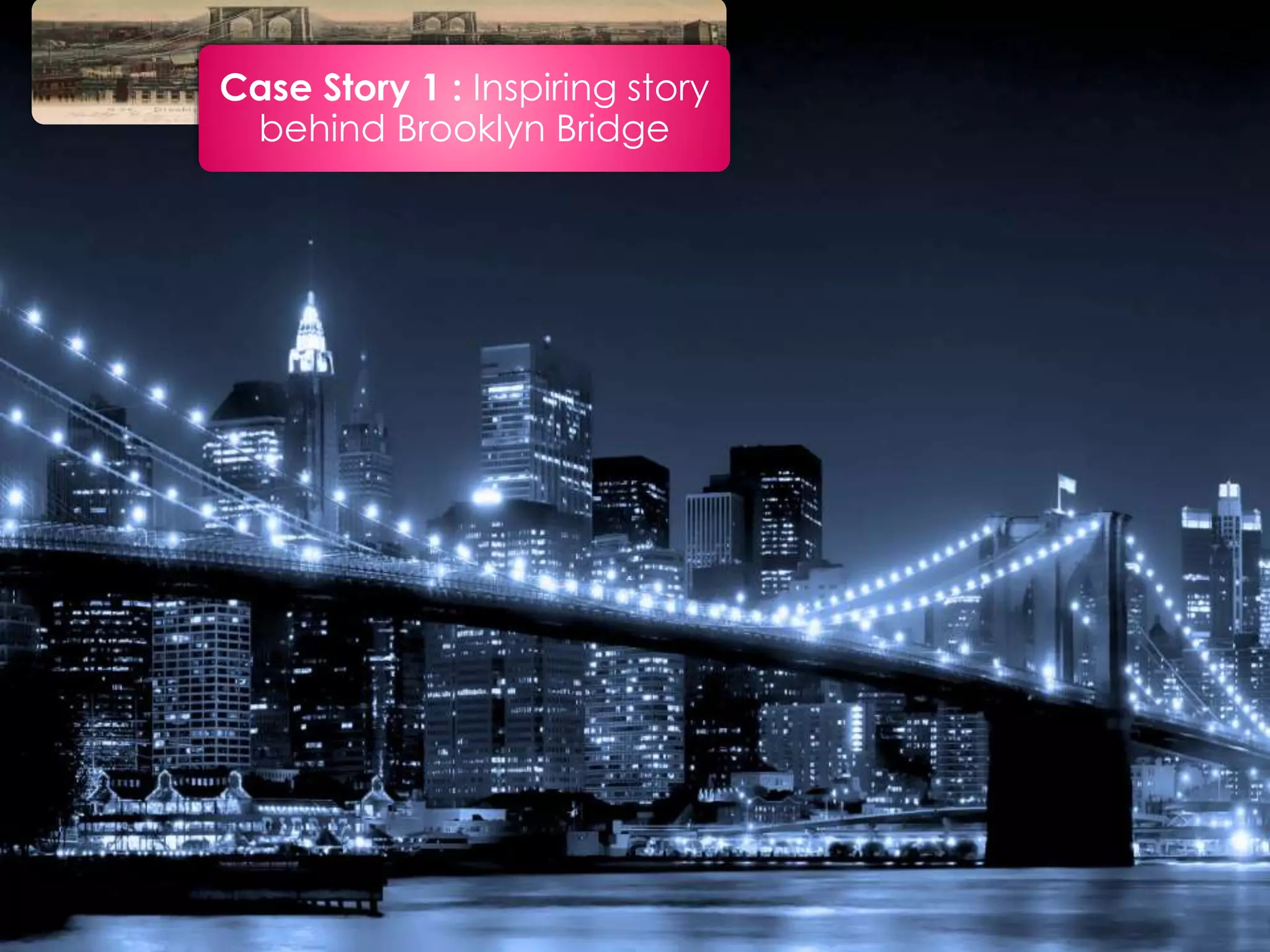
finally completed. Today the spectacular Brooklyn
Bridge stands in all its glory…..
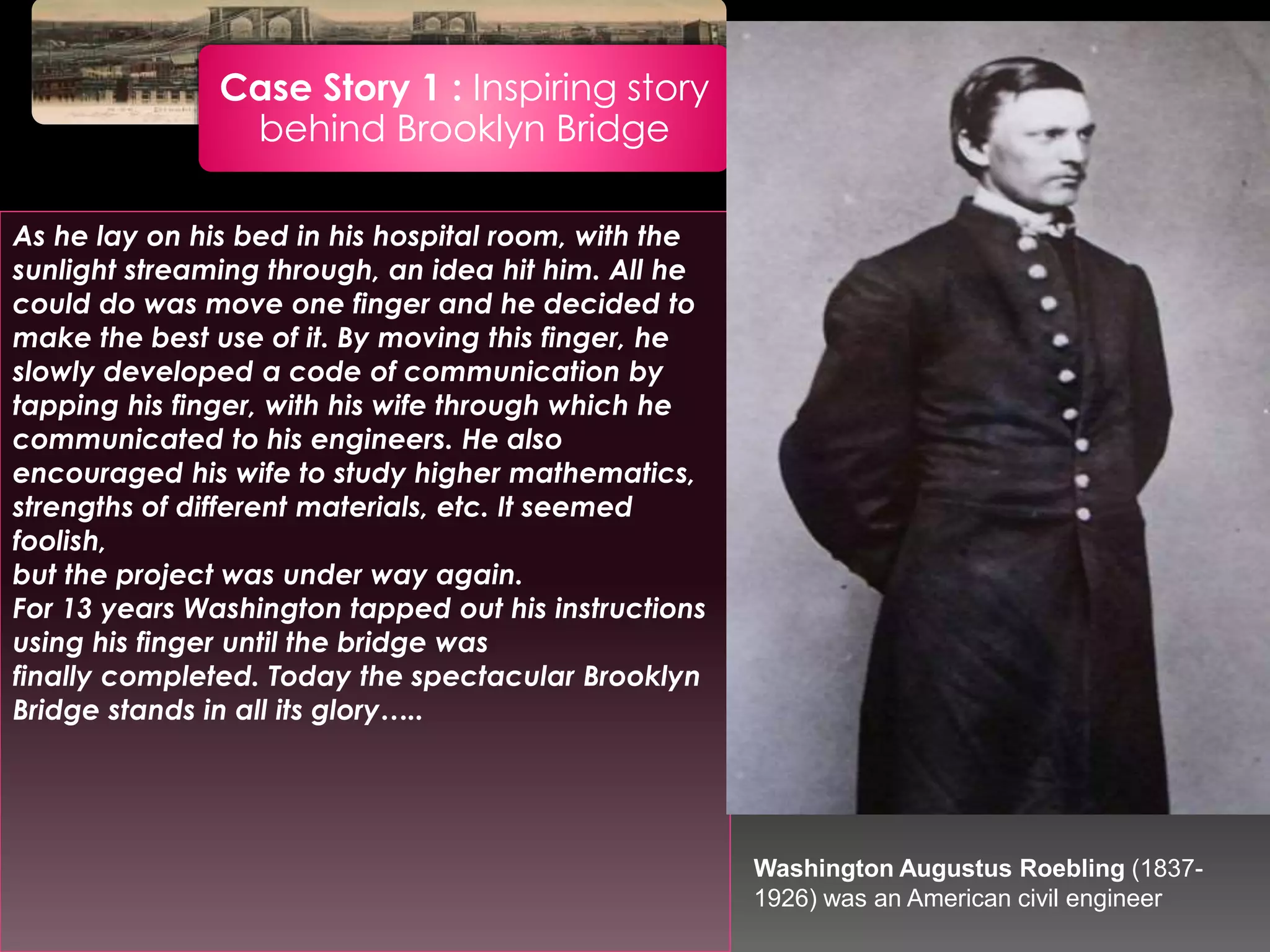
Washington Augustus Roebling (1837-
1926) was an American civil engineer
Case Story 1 : Inspiring story
behind Brooklyn Bridge
Case Story 2 : Ratan Tata’s
promise of safe road travel for
middle-class Indian families
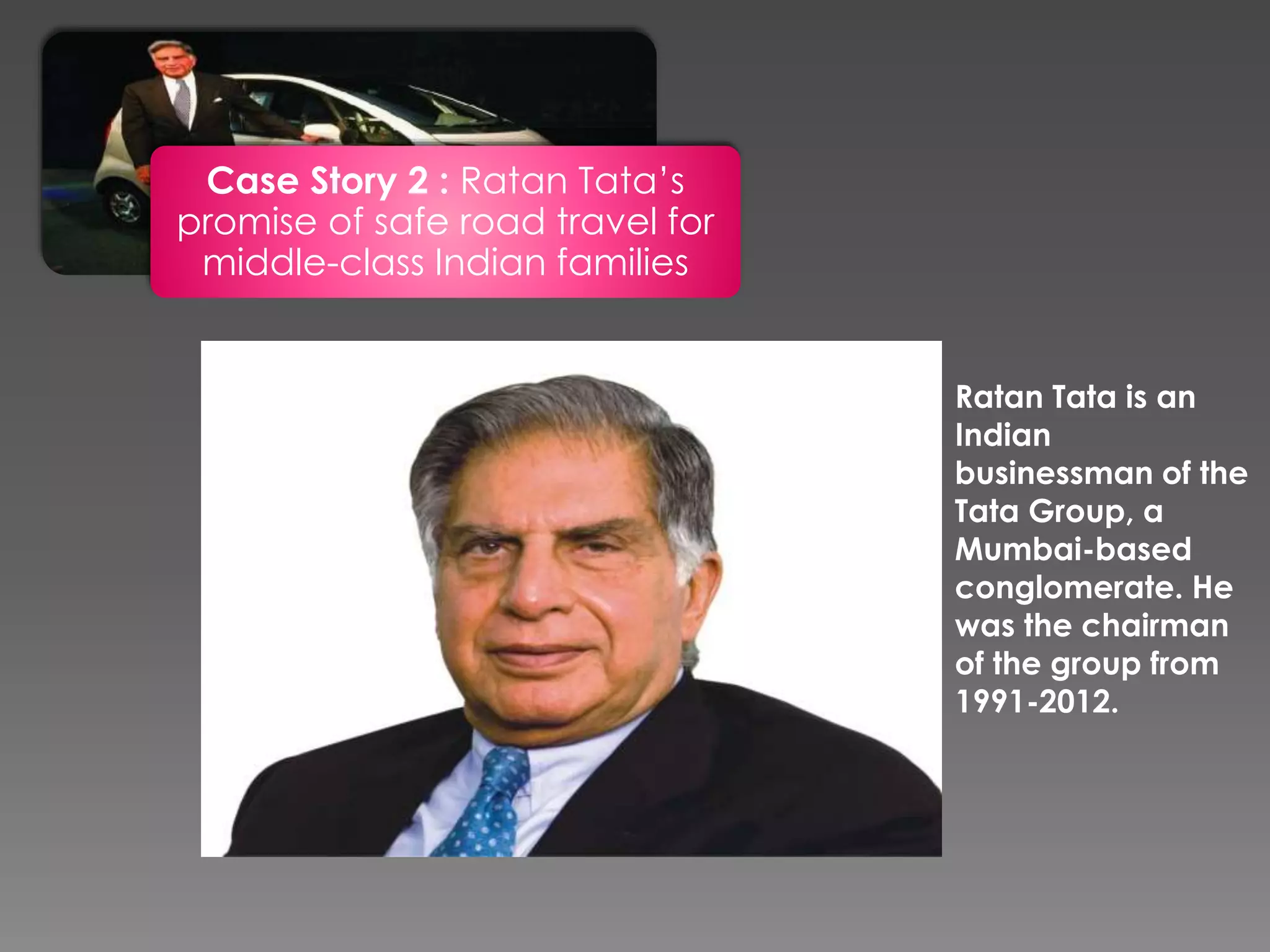
Ratan Tata is an
Indian
businessman of the
Tata Group, a
Mumbai-based
conglomerate. He
was the chairman
of the group from
1991-2012.
Case Story 2 : Ratan Tata’s
promise of safe road travel for
middle-class Indian families
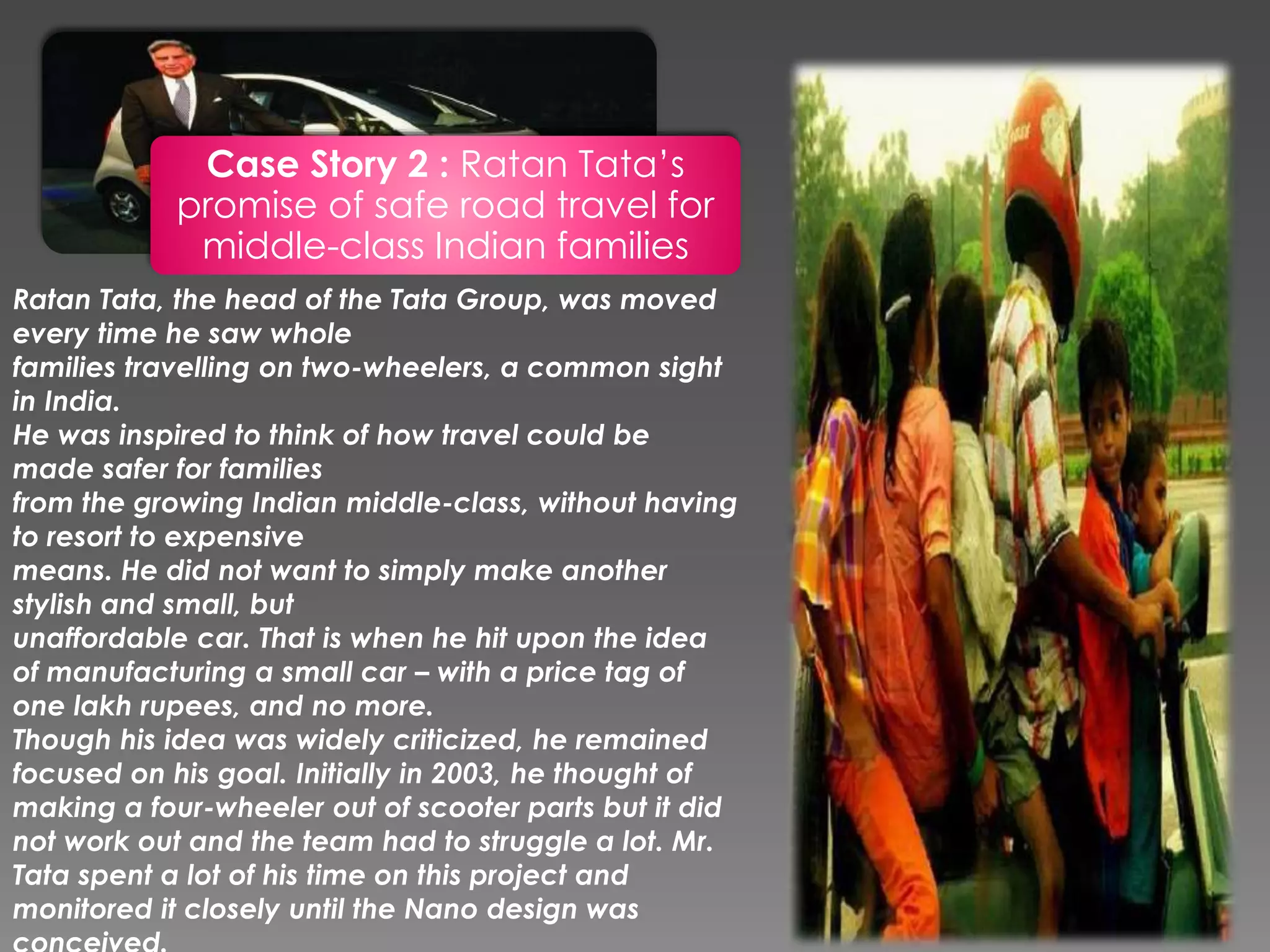
Ratan Tata, the head of the Tata Group, was moved
every time he saw whole
families travelling on two-wheelers, a common sight
in India.
He was inspired to think of how travel could be
made safer for families
from the growing Indian middle-class, without having
to resort to expensive
means. He did not want to simply make another
stylish and small, but
unaffordable car. That is when he hit upon the idea
of manufacturing a small car – with a price tag of
one lakh rupees, and no more.
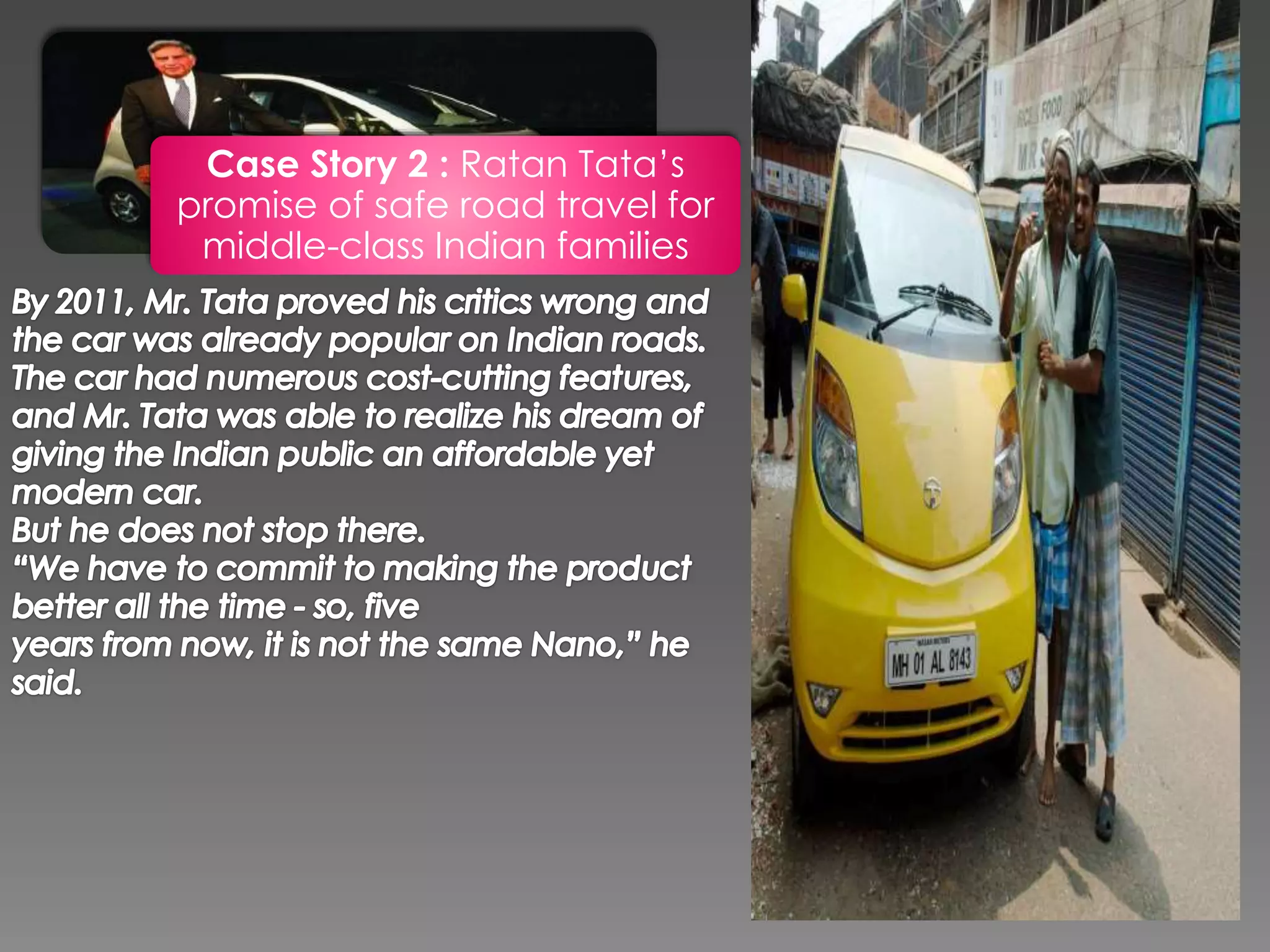
Though his idea was widely criticized, he remained
focused on his goal. Initially in 2003, he thought of
making a four-wheeler out of scooter parts but it did
not work out and the team had to struggle a lot. Mr.
Tata spent a lot of his time on this project and
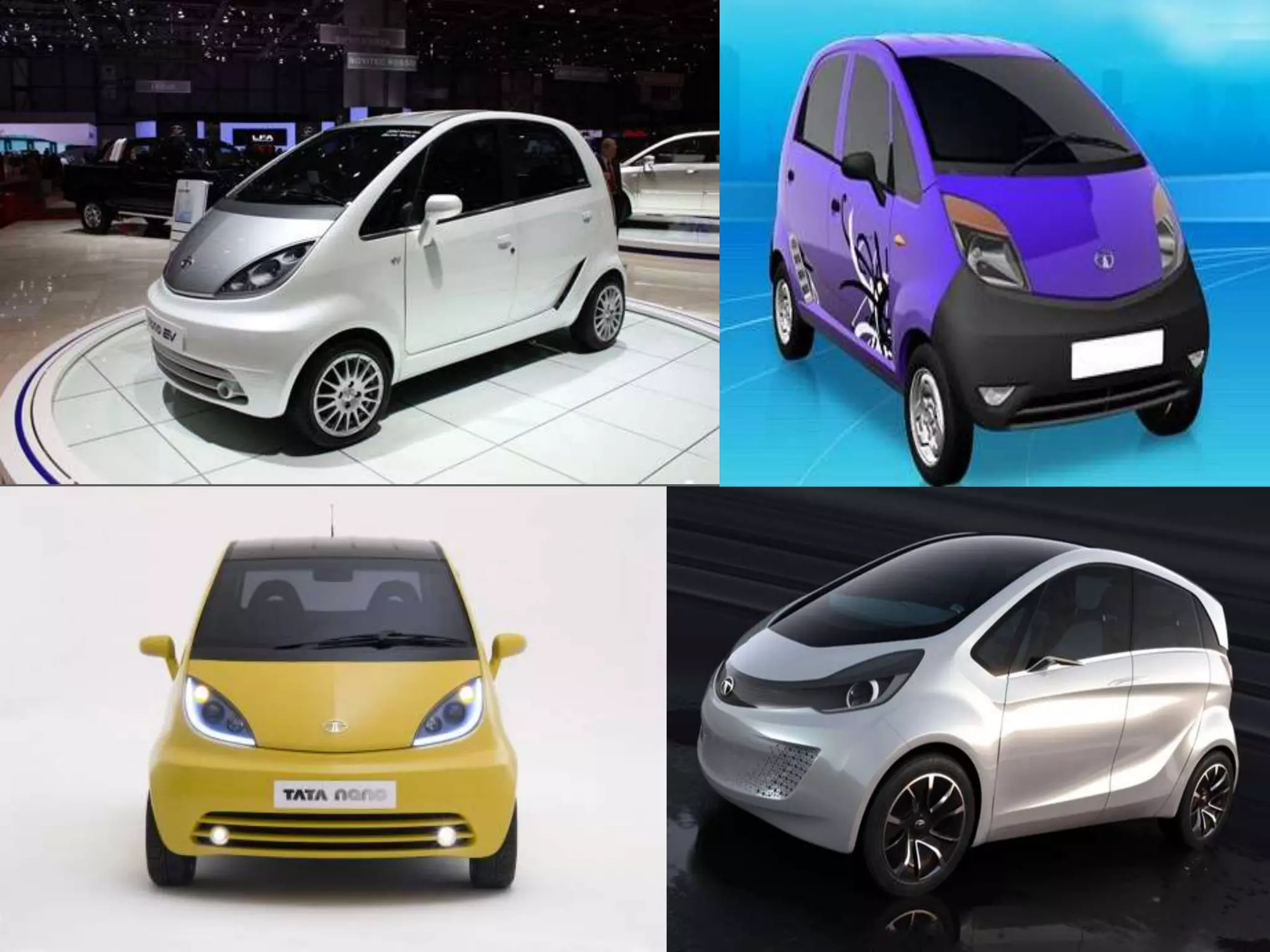
monitored it closely until the Nano design was
Case Story 2 : Ratan Tata’s
promise of safe road travel for
middle-class Indian families
Engage deeply chapter 9 cpdp

Engage deeply chapter 9 cpdp

  • 1.
    Contributor Personality Development Chapter9 ENGAGE DEEPLY leads institute of technology & engineering, Matar
  • 2.
    Guided By :- Mr.Snehal Patanwadia Arvindsai Nair Atul Hirpara Ankit Panchal Rajan Patel Romanch Patel Unnati Patel Rishikesh Solanki Presented By:
  • 3.
    CONTENT  Contributor andNon-contributor’s Attitude Personal Commitment  Interest, Initiative, Intellect  Emotional Engagement and Disengagement  Case Stories
  • 4.
  • 5.
  • 6.
    The Non-contributor Researcherwho is disengaged This research project is becoming very tough now. As long as it needed only the procedures that my senior had told me, it was okay. I don’t understand all this now… I give up! It is easier to just ask my senior to tell me the answers and what to do.
  • 7.
    The Contributor Researcherwho engages deeply This research project is challenging for me… the deeper I go into the subject, the clearer I become about these concepts. I am able to find new answers to these problems… I am discovering how amazing this subject is ….
  • 8.
    Personal Commitment Personal commitmentis the act of quality of voluntary tasking on or fulfilling Obligation
  • 9.
    Non-Contributors  It isnot my work why should I do it..?  I need long breaks between my work.....  Leave for home on or before time..  Let Juniors do my work..
  • 10.
    Contributors  As itis given to me I shall do anything to complete my work....  Rather than taking long breaks I shall focus more on my work.....  I will work untill my work is completed ..  Must commit myself deeply to the success of the work…
  • 11.
  • 12.
    Comparison Contributor  Focus only“COMPLETING THE TASK”  Quality of Work LOW  “CHALTA HAI” Attitude  Care Deeply About Their Work  Create High Quality Products  “KARNA HAI” Attitude Non-Contributor
  • 16.
  • 17.
     Ability ofan individual to engage emotionally to any work assigned or situation faced EMOTIONAL ENGAGEMENT
  • 18.
    •A person whois not concerned about the work assigned or the situation faced can be called as emotionally disengaged person. EMOTIONAL DISENGAGEMENT
  • 19.
    Case stories I wouldlike to tell you some stories about “How a Contributor engage deeply with their Work?”
  • 20.
    Case Story 1:Inspiring story behind Brooklyn Bridge civil engineer.
  • 21.
    Case Story 1: Inspiring story behind Brooklyn Bridge In 1883, an engineer named John Roebling was inspired by an idea to build a spectacular bridge connecting New York with Long Island. Bridge building experts throughout the world thought that this was an Impossible feat and told Roebling to forget it as it had never been done before. Roebling knew that it could be done. He shared the dream with his son Washington, an upcoming engineer. Working together, the father and son. Developed concept of how the dream could be accomplished. With great inspiration and excitement about the wild challenge before them, they hired their crew to build the dream bridge. Few months into the project there was an on-site accident. John Roebling died in it. Washington was injured and was left with brain damage, and could not talk or move.Everyone thought the project would be scrapped since the Roebling were the only oneswho knew how the bridge could be built. Despite his handicap, Washington still had a burning desire to complete the bridge. He tried to inspire and pass on his enthusiasm to some of his friends, but they were too afraid to take up the task.
  • 22.
    Case Story 1: Inspiring story behind Brooklyn Bridge As he lay on his bed in his hospital room, with the sunlight streaming through, an idea hit him. All he could do was move one finger and he decided to make the best use of it. By moving this finger, he slowly developed a code of communication by tapping his finger, with his wife through which he communicated to his engineers. He also encouraged his wife to study higher mathematics, strengths of different materials, etc. It seemed foolish, but the project was under way again. For 13 years Washington tapped out his instructions using his finger until the bridge was finally completed. Today the spectacular Brooklyn Bridge stands in all its glory….. Washington Augustus Roebling (1837- 1926) was an American civil engineer
  • 23.
    Case Story 1: Inspiring story behind Brooklyn Bridge
  • 24.
    Case Story 2: Ratan Tata’s promise of safe road travel for middle-class Indian families Ratan Tata is an Indian businessman of the Tata Group, a Mumbai-based conglomerate. He was the chairman of the group from 1991-2012.
  • 25.
    Case Story 2: Ratan Tata’s promise of safe road travel for middle-class Indian families Ratan Tata, the head of the Tata Group, was moved every time he saw whole families travelling on two-wheelers, a common sight in India. He was inspired to think of how travel could be made safer for families from the growing Indian middle-class, without having to resort to expensive means. He did not want to simply make another stylish and small, but unaffordable car. That is when he hit upon the idea of manufacturing a small car – with a price tag of one lakh rupees, and no more. Though his idea was widely criticized, he remained focused on his goal. Initially in 2003, he thought of making a four-wheeler out of scooter parts but it did not work out and the team had to struggle a lot. Mr. Tata spent a lot of his time on this project and monitored it closely until the Nano design was
  • 26.
    Case Story 2: Ratan Tata’s promise of safe road travel for middle-class Indian families