COMMS
KNOW YOUR AUDIENCE
Not one size fits all in comms
(content, people)
ADAPT FOR DELIVERY
Adapt different learning
styles (visual, written)
CLEAR GOALS
Ensure comms goals &
follow- up is clear
FOLLOW-UP COMMS
Follow up understanding &
any issues or questions
KEEP IT SIMPLE
Avoid jargon, KISS, watch
grammar and words
KEEP IT TWO WAY
Comms is a 2 way
process -1 mouth, 2 ears
BE DETAIL AWARE
Base detail & amount
on context , audience
LISTENING
BUILD TRUST AND RAPPORT
Do this by showing interest and asking
questions on how to help audience
DEMONSTRATE EMPATHY
Align with their thoughts and feelings on
the subject
PARAPHRASE
Repeat what is stated in your own words
to clarify understanding
VERBAL AFFIRMATIONS
Make brief statements of what
was said and actions agreed
ASK QUESTIONS
Ask open ended and specific
questions (opinions, history)
CONFLICT
RESOLUTION
CLARIFICATION
What is the disagreement about
between both sides?
DESIRED OUTCOME
What is the desired outcome
of the conflict for both sides?
IDENTIFY WAYS FORWARD
Discuss ways to meet the desired
outcome
DETERMINE BARRIERS
Both sides acknowledge issue
& what needs to be done
AGREE BEST WAY
Agree best way for conflict
resolution for both sides
ACKNOWLEDGE SOLUTION
Acknowledge agree solution
and roles / responsibilities
NEGOTIATION
PREPARATION AND COLLECTION
Consider approach, organise and collect data to
plan an effective negotiation
AGREE LOGISTICS
The place, time, duration. ground rules
& process for negotiation
CLARIFICATION & JUSTIFICATION
Each party clarifies and justifies demand,
issues & supplies support info
PROBLEM SOLVING
Discuss 7 bargain for resolution
with concessions both sides
CLOSURE
Ends with agreement for
execution & monitoring
PROBLEM
SOLVING
IDENTIFY PROBLEM
Clarify problem from
different viewpoints
UNDERSTAND STAKES
Make sure all stake- holders
are addressed
LIST OPTIONS
Identify and list solution
options
EVALUATE OPTIONS
Perform realistic pros
and cons for options
SELECT OPTION
Select best or best of a
number of solution options
DOCUMENT SOLUTION
The golden rule of putting it
all in writing is a good one
AGREE FOLLOW-UP
Agree on monitoring,
evaluation & fallback option
ANALYTICAL
THINKING
CREATIVITY
Think outside of the box to
determine solutions
CRITICAL THINKING
Evaluate data &
decide on findings
DATA ANALYSIS
Examine a large volume
of data & identify trends
RESEARCH
Able to collect data and
research a topic
SOLUTION DEVELOPMENT
Develop solution based on
research and findings
TESTING SOLUTION
Test solution and ideas based
on research and findings
POST ANALYSIS
Review what worked and
lessons & knowledge learned
FACILITATION
1. Plan the workshop logistics & send invites 2: Introductions, agenda, outcomes 3. Identify the problem you want to solve 4. Find issues, tasks, challenges 5. Sort input with sticky notes
6. Prioritise topics for important ones 7. Highlight and separate top priorities 8. Discuss requirements for top priorities 9. Decide roles & timeline 10. Agree on further steps
PRESENTATION
ANALYSE AUDIENCE
Audience’s interests,
values, background
SELECT TOPIC
Select a topic based on
audience research
DEFINE OBJECTIVES
Define presentation
goals and outcomes
PREPARE CONTENT
Include data, facts,
quotes, experiences
PREP OPEN & CLOSE
Create impactful open
/close to presentation
PRACTICE DELIVERY
Present to colleagues
for feedback & inputs
DELIVER SUCCESSFUL PRESENTATION
Tell them what you are going tell them, tell
them & tell them at the end what you told them
QUESTIONING Tell me about your pain points and challenges What is the no.1 thing to change? What things not to change? If this happens, what benefits? If this doesn’t happen, the impact?
DECISION
MAKING
IDENTIFY PURPOSE OF DECISION
What is the issue to be solved?
GATHER INFORMATION
Gather data to better understand what
needs to be done in solving the issue
CONSIDER THE POTENTIAL IMPACTS
Determine the impacts to all of the
impacted stakeholders
MAKE THE DECISION
After this process, considered the
impacts, make a final decision
EVALUATE THE DECISION
Once decision is executed, monitor
impacts for any changes required
ONE-PAGE MAGIC: Created by Ken MartinONE-PAGE MAGIC | No. 83 by Ken Martin Ken Martin
3 MAGIC
CONSULTING
Founder, Partner
TRANSFORMATION
PMO
CONSULTANT
London,
United Kingdom
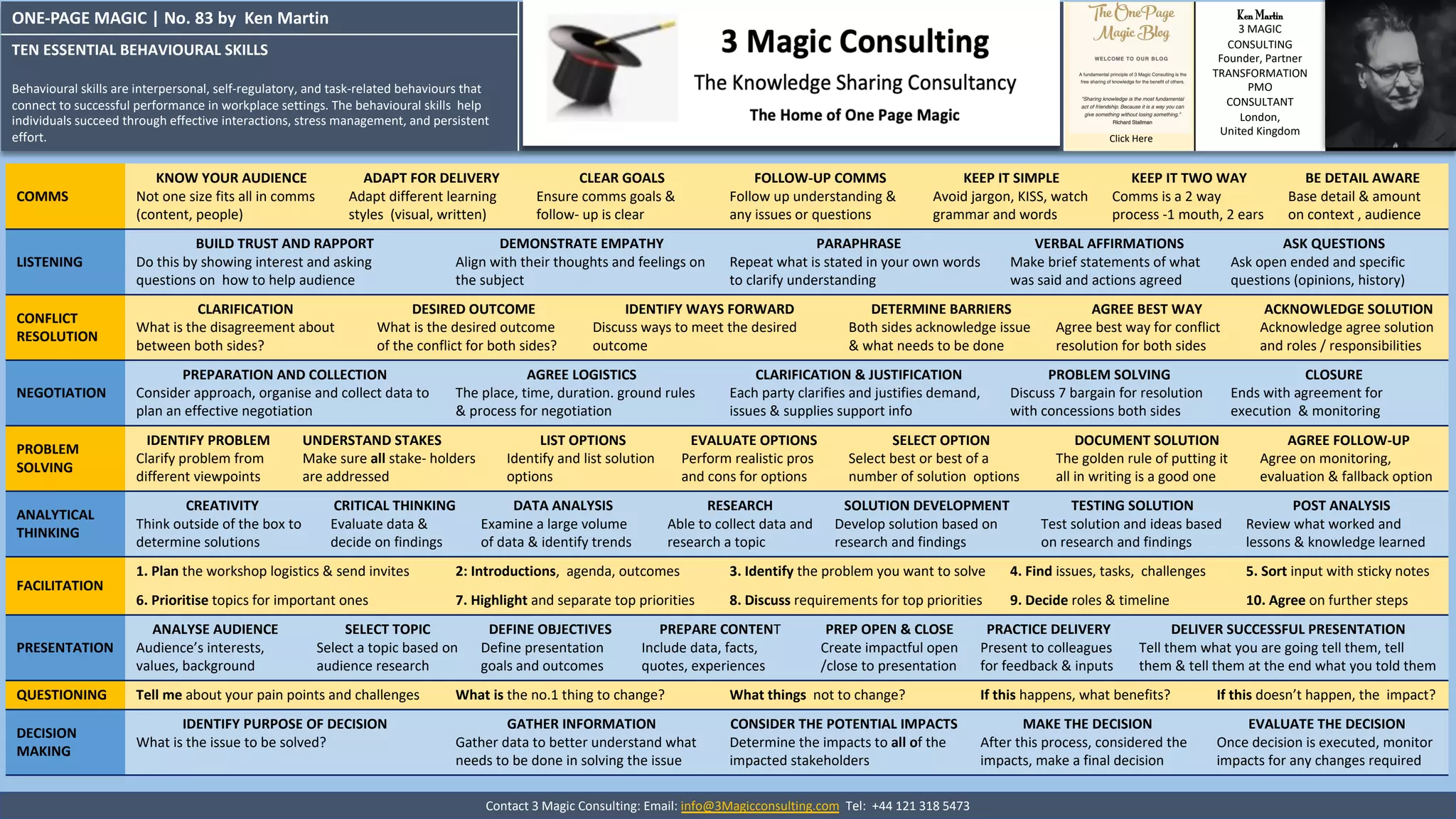
TEN ESSENTIAL BEHAVIOURAL SKILLS
Behavioural skills are interpersonal, self-regulatory, and task-related behaviours that
connect to successful performance in workplace settings. The behavioural skills help
individuals succeed through effective interactions, stress management, and persistent
effort. Click Here
Contact 3 Magic Consulting: Email: info@3Magicconsulting.com Tel: +44 121 318 5473

TEN ESSENTIAL BEHAVIOURAL SKILLS

  • 1.
    COMMS KNOW YOUR AUDIENCE Notone size fits all in comms (content, people) ADAPT FOR DELIVERY Adapt different learning styles (visual, written) CLEAR GOALS Ensure comms goals & follow- up is clear FOLLOW-UP COMMS Follow up understanding & any issues or questions KEEP IT SIMPLE Avoid jargon, KISS, watch grammar and words KEEP IT TWO WAY Comms is a 2 way process -1 mouth, 2 ears BE DETAIL AWARE Base detail & amount on context , audience LISTENING BUILD TRUST AND RAPPORT Do this by showing interest and asking questions on how to help audience DEMONSTRATE EMPATHY Align with their thoughts and feelings on the subject PARAPHRASE Repeat what is stated in your own words to clarify understanding VERBAL AFFIRMATIONS Make brief statements of what was said and actions agreed ASK QUESTIONS Ask open ended and specific questions (opinions, history) CONFLICT RESOLUTION CLARIFICATION What is the disagreement about between both sides? DESIRED OUTCOME What is the desired outcome of the conflict for both sides? IDENTIFY WAYS FORWARD Discuss ways to meet the desired outcome DETERMINE BARRIERS Both sides acknowledge issue & what needs to be done AGREE BEST WAY Agree best way for conflict resolution for both sides ACKNOWLEDGE SOLUTION Acknowledge agree solution and roles / responsibilities NEGOTIATION PREPARATION AND COLLECTION Consider approach, organise and collect data to plan an effective negotiation AGREE LOGISTICS The place, time, duration. ground rules & process for negotiation CLARIFICATION & JUSTIFICATION Each party clarifies and justifies demand, issues & supplies support info PROBLEM SOLVING Discuss 7 bargain for resolution with concessions both sides CLOSURE Ends with agreement for execution & monitoring PROBLEM SOLVING IDENTIFY PROBLEM Clarify problem from different viewpoints UNDERSTAND STAKES Make sure all stake- holders are addressed LIST OPTIONS Identify and list solution options EVALUATE OPTIONS Perform realistic pros and cons for options SELECT OPTION Select best or best of a number of solution options DOCUMENT SOLUTION The golden rule of putting it all in writing is a good one AGREE FOLLOW-UP Agree on monitoring, evaluation & fallback option ANALYTICAL THINKING CREATIVITY Think outside of the box to determine solutions CRITICAL THINKING Evaluate data & decide on findings DATA ANALYSIS Examine a large volume of data & identify trends RESEARCH Able to collect data and research a topic SOLUTION DEVELOPMENT Develop solution based on research and findings TESTING SOLUTION Test solution and ideas based on research and findings POST ANALYSIS Review what worked and lessons & knowledge learned FACILITATION 1. Plan the workshop logistics & send invites 2: Introductions, agenda, outcomes 3. Identify the problem you want to solve 4. Find issues, tasks, challenges 5. Sort input with sticky notes 6. Prioritise topics for important ones 7. Highlight and separate top priorities 8. Discuss requirements for top priorities 9. Decide roles & timeline 10. Agree on further steps PRESENTATION ANALYSE AUDIENCE Audience’s interests, values, background SELECT TOPIC Select a topic based on audience research DEFINE OBJECTIVES Define presentation goals and outcomes PREPARE CONTENT Include data, facts, quotes, experiences PREP OPEN & CLOSE Create impactful open /close to presentation PRACTICE DELIVERY Present to colleagues for feedback & inputs DELIVER SUCCESSFUL PRESENTATION Tell them what you are going tell them, tell them & tell them at the end what you told them QUESTIONING Tell me about your pain points and challenges What is the no.1 thing to change? What things not to change? If this happens, what benefits? If this doesn’t happen, the impact? DECISION MAKING IDENTIFY PURPOSE OF DECISION What is the issue to be solved? GATHER INFORMATION Gather data to better understand what needs to be done in solving the issue CONSIDER THE POTENTIAL IMPACTS Determine the impacts to all of the impacted stakeholders MAKE THE DECISION After this process, considered the impacts, make a final decision EVALUATE THE DECISION Once decision is executed, monitor impacts for any changes required ONE-PAGE MAGIC: Created by Ken MartinONE-PAGE MAGIC | No. 83 by Ken Martin Ken Martin 3 MAGIC CONSULTING Founder, Partner TRANSFORMATION PMO CONSULTANT London, United Kingdom TEN ESSENTIAL BEHAVIOURAL SKILLS Behavioural skills are interpersonal, self-regulatory, and task-related behaviours that connect to successful performance in workplace settings. The behavioural skills help individuals succeed through effective interactions, stress management, and persistent effort. Click Here Contact 3 Magic Consulting: Email: info@3Magicconsulting.com Tel: +44 121 318 5473