PROBLEM SOLVING
Career Management
Coach Wainwright
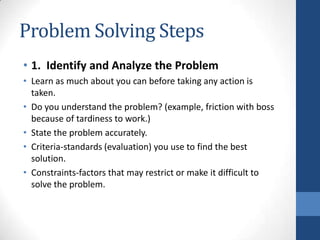
Problem Solving Steps
• 1. Identify and Analyze the Problem
• Learn as much about you can before taking any action is
taken.
• Do you understand the problem? (example, friction with boss
because of tardiness to work.)
• State the problem accurately.
• Criteria-standards (evaluation) you use to find the best
solution.
• Constraints-factors that may restrict or make it difficult to
solve the problem.
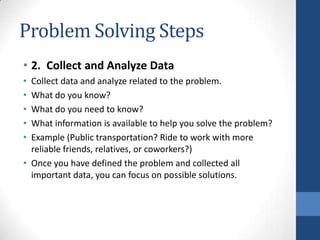
Problem Solving Steps
• 2. Collect and Analyze Data
• Collect data and analyze related to the problem.
• What do you know?
• What do you need to know?
• What information is available to help you solve the problem?
• Example (Public transportation? Ride to work with more
reliable friends, relatives, or coworkers?)
• Once you have defined the problem and collected all
important data, you can focus on possible solutions.
Problem Solving Steps
• 3. Consider Possible Solutions
• First step in actually solving the problem.
• Think creatively.
• Even wild ideas may have some later value.
• Keep ideas simple and brief at first.
• Don’t worry about details.
• Combining several ideas.
• Example- Cab ride, buy a car? Money?
Problem Solving Steps
• 4. Choose the Best Plan
• When you have 2 or 3 good ideas, select the best one.
• Criteria vs. Constraints?
• Example, decide to take the bus.
• 5. Implement the Problem
• Should now have confidence in solution.
• Example, what bus to catch, where to catch it.
Problem Solving Steps
• 6. Observe, Evaluate, and Adjust
• Most important step in problem-solving process.
• Even best plan may not go smoothly at first.
• Adjustments may be needed.
• Success or failure depends on how plan meets evaluation
criteria.
• Example-Do you arrive at work 5 minutes early by taking the
bus? Do you have enough time to change into uniform before
catching the bus?
• My need a better solution if criteria is not satisfied.
Aids To Problem Solving
• Brainstorming-a group technique used to develop many ideas
in a relatively short time. Good way to identify answers to a
problem.
• Compromise- when each side gives up something of value to
help solve the problem. Usually give up something that is
important to help reach compromise.
• Consensus- when all members of a group fully accept and
support the decision. Much more difficult to to reach than a
compromise.

Problem solving

  • 1.
  • 2.
    Problem Solving Steps •1. Identify and Analyze the Problem • Learn as much about you can before taking any action is taken. • Do you understand the problem? (example, friction with boss because of tardiness to work.) • State the problem accurately. • Criteria-standards (evaluation) you use to find the best solution. • Constraints-factors that may restrict or make it difficult to solve the problem.
  • 3.
    Problem Solving Steps •2. Collect and Analyze Data • Collect data and analyze related to the problem. • What do you know? • What do you need to know? • What information is available to help you solve the problem? • Example (Public transportation? Ride to work with more reliable friends, relatives, or coworkers?) • Once you have defined the problem and collected all important data, you can focus on possible solutions.
  • 4.
    Problem Solving Steps •3. Consider Possible Solutions • First step in actually solving the problem. • Think creatively. • Even wild ideas may have some later value. • Keep ideas simple and brief at first. • Don’t worry about details. • Combining several ideas. • Example- Cab ride, buy a car? Money?
  • 5.
    Problem Solving Steps •4. Choose the Best Plan • When you have 2 or 3 good ideas, select the best one. • Criteria vs. Constraints? • Example, decide to take the bus. • 5. Implement the Problem • Should now have confidence in solution. • Example, what bus to catch, where to catch it.
  • 6.
    Problem Solving Steps •6. Observe, Evaluate, and Adjust • Most important step in problem-solving process. • Even best plan may not go smoothly at first. • Adjustments may be needed. • Success or failure depends on how plan meets evaluation criteria. • Example-Do you arrive at work 5 minutes early by taking the bus? Do you have enough time to change into uniform before catching the bus? • My need a better solution if criteria is not satisfied.
  • 7.
    Aids To ProblemSolving • Brainstorming-a group technique used to develop many ideas in a relatively short time. Good way to identify answers to a problem. • Compromise- when each side gives up something of value to help solve the problem. Usually give up something that is important to help reach compromise. • Consensus- when all members of a group fully accept and support the decision. Much more difficult to to reach than a compromise.