Problem Solving Steps & Process By: Mohamed Anwr
According to Boll (2017) about how we can handle role conflicts, we have 4
steps to solving problem:
1. Identify important problems that can be solved.
 Whether a problem can be solved within a reasonable time period
with available resources.
 Whether it is worthwhile to invest the time, effort, and resources on
this problem rather than on others
2. Look for connections among problems.
 By relating problems to each other, a manager is more likely to recognize
opportunities to take actions that contribute to the solution of several
related problems at the same time.
3. Experiment with innovative solutions.
 Effective managers are more willing to experiment actively with
innovative Approaches for solving problems, rather than spending an
excessive amount of time studying them.
4. Take decisive action to deal with crises.
 The leader is expected to take decisive action to deal with an emergency
or crisis situation quickly before it becomes worse.
 Effective leaders quickly identify the cause of the problem, they take
decisive action to direct the work unit’s response to it, and they keep
people informed about progress in efforts to deal with the crisis
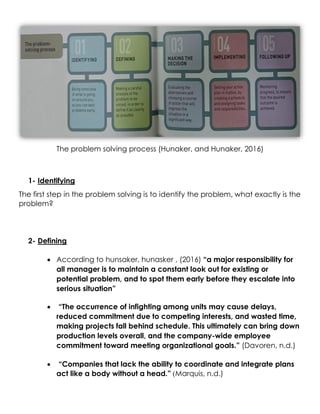
The problem solving process (Hunaker, and Hunaker, 2016)
1- Identifying
The first step in the problem solving is to identify the problem, what exactly is the
problem?
2- Defining
 According to hunsaker, hunasker , (2016) “a major responsibility for
all manager is to maintain a constant look out for existing or
potential problem, and to spot them early before they escalate into
serious situation”
 “The occurrence of infighting among units may cause delays,
reduced commitment due to competing interests, and wasted time,
making projects fall behind schedule. This ultimately can bring down
production levels overall, and the company-wide employee
commitment toward meeting organizational goals.” (Davoren, n.d.)
 “Companies that lack the ability to coordinate and integrate plans
act like a body without a head.” (Marquis, n.d.)
3- Making the decision
"Three roles deal with the interpersonal behavior of managers (leader, Liaison,
figurehead)
Three roles deal with information-processing behavior (monitor, Disseminator,
spokesperson)
Four roles deal with decision-making behavior (Entrepreneur, disturbance
handler, resource allocator, negotiator). “(Boll, 2017).
Arrange a meeting with all supervisors for each department as a first step
“90 % of successful leaders point to the value of presence face to face
interactions help build power” (hunsaker, and hunasker, 2016)
According to Boll, (2017)
“1- To increase the quality of decisions by drawing on the knowledge and
problem-solving expertise of subordinates.
2-to increase subordinate acceptance of decisions by providing a sense of
ownership.
3-to develop the decision-making skills of subordinates by giving them
experience in helping to analyse decision problems and evaluate Solutions.
4-to facilitate conflict resolution and team building.”
A. Prepare for the meeting
 I think the success of this meeting requires a good preparation of the
points that will be put forward
 Identify the points to be clearly discussed and identify a key
objective to reach a clear and agreed plan of action among all
department managers
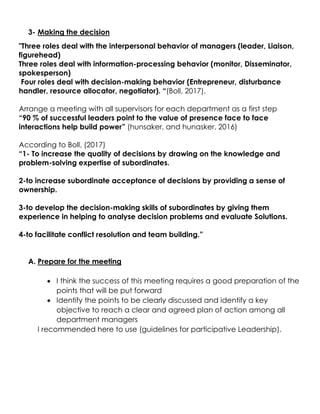
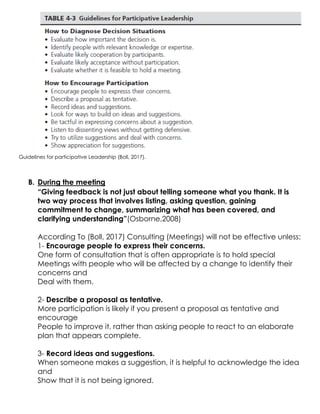
I recommended here to use (guidelines for participative Leadership).
Guidelines for participative Leadership (Boll, 2017).
B. During the meeting
“Giving feedback is not just about telling someone what you thank. It is
two way process that involves listing, asking question, gaining
commitment to change, summarizing what has been covered, and
clarifying understanding”(Osborne,2008)
According To (Boll, 2017) Consulting (Meetings) will not be effective unless:
1- Encourage people to express their concerns.
One form of consultation that is often appropriate is to hold special
Meetings with people who will be affected by a change to identify their
concerns and
Deal with them.
2- Describe a proposal as tentative.
More participation is likely if you present a proposal as tentative and
encourage
People to improve it, rather than asking people to react to an elaborate
plan that appears complete.
3- Record ideas and suggestions.
When someone makes a suggestion, it is helpful to acknowledge the idea
and
Show that it is not being ignored.
4- Look for ways to build on ideas and suggestions.
It is helpful to make a conscious effort to find positive aspects of a
suggestion and mention them before mentioning negative aspects. Many
times an initial idea is incomplete, but it can be turned into a much better
idea with a little conscious effort.
5- Be tactful in expressing concerns about a suggestion.
If you have concerns about a suggestion, express them tactfully to avoid
threatening
The self-esteem of the person who made the suggestion.
6- Listen to dissenting views without getting defensive.
In order to encourage people to express concerns and criticisms of your
plans
And proposals.
7- Try to utilize suggestions and deal with concerns.
People will stop making suggestions if you dismiss them without serious
consideration
Or simply ignore them in making a final decision.
8-Show appreciation for suggestions.
Compliment someone for good ideas and insights. It is important to thank
people
And show appreciation for helpful suggestions
 The main objective should always be clear: access to the action
plan, even if required to information gathering and scheduling
another meeting
“A broader view of problems provides better insights for understanding
them. By relating problems to each other and to informal strategic
objectives" (Boll, 2017).
Discuss existing procedures to find the gap and arrange fixes solutions
Discussion on how to optimize (models, tools used by the team) in order to
reduce time and effort, and improve the coordination of all sections
What is the processes should be changed, added or canceled?
How to Use Available resources to Increase Performance?
"Lateral consultation with people in different subunits may be used to
increase decision quality when peers have relevant knowledge about the
cause of a problem” (Boll, 2017).
 Develop a way to evaluate and follow the action plan
"There are two reasons to establish early on the criteria by which you will
evaluate your decision. First, these criteria will determine what information
you need to collect to make the decision. Second, they help make the
decision process transparent everyone involved knows what the list of
alternatives will be judged against" (hunsaker, and hunasker, 2016)
4- Implementation
 After preparing the work plan by the team and the division of roles
between them starts implementation
 The role of the manager is here to provide support, advice and
overcoming obstacles
 Make sure that the plan works as scheduled
“Coordinating: Communicating with others in the company over whom
one has no direct control in order to share information, meet previously
established schedules, solve problems, and achieve objectives;
maintaining a smooth working relationship with peers; mediating
disagreements and conflicts between key individuals.” (Boll, 2017).
5- Following up
“Establish criteria for measuring success than track progress and take
corrective action when necessary, tray to develop and maintain
positives attitudes in everyone involved” (hunsaker, and hunasker,
2016)
Checking the progress of the plan through a weekly follow-up meeting
I. Recommendations
Quick fixes
We started by meeting to get to his action plan and this is the first step to
getting into:
 Established clear policies and procedures and a way to evaluate
results
 Weekly meetings to discuss its Action plan and work on its
development
 Workshops to share experiences between the team, make
people closer together, create a spirit of cooperation
Develop a long-term plan
 Train the team on effective communication skills when budget allows
 Search for technological solutions to coordinate departments
Reference
Boll, J., (2017), MBA 609: Leadership for management & Business, Geneva
business school
Davoren, j., (n.d.), Functional Structure Organization Strength & Weakness,
[Online] Available at: http://smallbusiness.chron.com/functional-structure-
organization-strength-weakness-60111.html [Accessed 28 April. 2017].
Davoren, j., (n.d.), Functional Structure Organization Strength & Weakness,
[Online] Available at: http://smallbusiness.chron.com/functional-structure-
organization-strength-weakness-60111.html [Accessed 28 April. 2017].
Hunaker, P, and Hunaker, J, (2016) the problem solving process, the essential
manager’s handbook, Dorling Kindersley limited, Pg. 62-63
Hunaker, P, and Hunaker, J, (2016), the essential manager’s handbook, Dorling
Kindersley limited, Pg. 62
Marquis, A., (n.d.), Importance of Integration & Coordination in an
Organization, [Online] Available at:
http://smallbusiness.chron.com/importance-integration-coordination-
organization-17921.html [Accessed 28 April. 2017].
Osborne, C, (2008), Essential managers leadership, Dorling Kindersley limited,
pg.20

Problem solving steps & process

  • 1.
    Problem Solving Steps& Process By: Mohamed Anwr According to Boll (2017) about how we can handle role conflicts, we have 4 steps to solving problem: 1. Identify important problems that can be solved.  Whether a problem can be solved within a reasonable time period with available resources.  Whether it is worthwhile to invest the time, effort, and resources on this problem rather than on others 2. Look for connections among problems.  By relating problems to each other, a manager is more likely to recognize opportunities to take actions that contribute to the solution of several related problems at the same time. 3. Experiment with innovative solutions.  Effective managers are more willing to experiment actively with innovative Approaches for solving problems, rather than spending an excessive amount of time studying them. 4. Take decisive action to deal with crises.  The leader is expected to take decisive action to deal with an emergency or crisis situation quickly before it becomes worse.  Effective leaders quickly identify the cause of the problem, they take decisive action to direct the work unit’s response to it, and they keep people informed about progress in efforts to deal with the crisis
  • 2.
    The problem solvingprocess (Hunaker, and Hunaker, 2016) 1- Identifying The first step in the problem solving is to identify the problem, what exactly is the problem? 2- Defining  According to hunsaker, hunasker , (2016) “a major responsibility for all manager is to maintain a constant look out for existing or potential problem, and to spot them early before they escalate into serious situation”  “The occurrence of infighting among units may cause delays, reduced commitment due to competing interests, and wasted time, making projects fall behind schedule. This ultimately can bring down production levels overall, and the company-wide employee commitment toward meeting organizational goals.” (Davoren, n.d.)  “Companies that lack the ability to coordinate and integrate plans act like a body without a head.” (Marquis, n.d.)
  • 3.
    3- Making thedecision "Three roles deal with the interpersonal behavior of managers (leader, Liaison, figurehead) Three roles deal with information-processing behavior (monitor, Disseminator, spokesperson) Four roles deal with decision-making behavior (Entrepreneur, disturbance handler, resource allocator, negotiator). “(Boll, 2017). Arrange a meeting with all supervisors for each department as a first step “90 % of successful leaders point to the value of presence face to face interactions help build power” (hunsaker, and hunasker, 2016) According to Boll, (2017) “1- To increase the quality of decisions by drawing on the knowledge and problem-solving expertise of subordinates. 2-to increase subordinate acceptance of decisions by providing a sense of ownership. 3-to develop the decision-making skills of subordinates by giving them experience in helping to analyse decision problems and evaluate Solutions. 4-to facilitate conflict resolution and team building.” A. Prepare for the meeting  I think the success of this meeting requires a good preparation of the points that will be put forward  Identify the points to be clearly discussed and identify a key objective to reach a clear and agreed plan of action among all department managers I recommended here to use (guidelines for participative Leadership).
  • 4.
    Guidelines for participativeLeadership (Boll, 2017). B. During the meeting “Giving feedback is not just about telling someone what you thank. It is two way process that involves listing, asking question, gaining commitment to change, summarizing what has been covered, and clarifying understanding”(Osborne,2008) According To (Boll, 2017) Consulting (Meetings) will not be effective unless: 1- Encourage people to express their concerns. One form of consultation that is often appropriate is to hold special Meetings with people who will be affected by a change to identify their concerns and Deal with them. 2- Describe a proposal as tentative. More participation is likely if you present a proposal as tentative and encourage People to improve it, rather than asking people to react to an elaborate plan that appears complete. 3- Record ideas and suggestions. When someone makes a suggestion, it is helpful to acknowledge the idea and Show that it is not being ignored.
  • 5.
    4- Look forways to build on ideas and suggestions. It is helpful to make a conscious effort to find positive aspects of a suggestion and mention them before mentioning negative aspects. Many times an initial idea is incomplete, but it can be turned into a much better idea with a little conscious effort. 5- Be tactful in expressing concerns about a suggestion. If you have concerns about a suggestion, express them tactfully to avoid threatening The self-esteem of the person who made the suggestion. 6- Listen to dissenting views without getting defensive. In order to encourage people to express concerns and criticisms of your plans And proposals. 7- Try to utilize suggestions and deal with concerns. People will stop making suggestions if you dismiss them without serious consideration Or simply ignore them in making a final decision. 8-Show appreciation for suggestions. Compliment someone for good ideas and insights. It is important to thank people And show appreciation for helpful suggestions  The main objective should always be clear: access to the action plan, even if required to information gathering and scheduling another meeting “A broader view of problems provides better insights for understanding them. By relating problems to each other and to informal strategic objectives" (Boll, 2017). Discuss existing procedures to find the gap and arrange fixes solutions Discussion on how to optimize (models, tools used by the team) in order to reduce time and effort, and improve the coordination of all sections What is the processes should be changed, added or canceled? How to Use Available resources to Increase Performance?
  • 6.
    "Lateral consultation withpeople in different subunits may be used to increase decision quality when peers have relevant knowledge about the cause of a problem” (Boll, 2017).  Develop a way to evaluate and follow the action plan "There are two reasons to establish early on the criteria by which you will evaluate your decision. First, these criteria will determine what information you need to collect to make the decision. Second, they help make the decision process transparent everyone involved knows what the list of alternatives will be judged against" (hunsaker, and hunasker, 2016) 4- Implementation  After preparing the work plan by the team and the division of roles between them starts implementation  The role of the manager is here to provide support, advice and overcoming obstacles  Make sure that the plan works as scheduled “Coordinating: Communicating with others in the company over whom one has no direct control in order to share information, meet previously established schedules, solve problems, and achieve objectives; maintaining a smooth working relationship with peers; mediating disagreements and conflicts between key individuals.” (Boll, 2017). 5- Following up “Establish criteria for measuring success than track progress and take corrective action when necessary, tray to develop and maintain positives attitudes in everyone involved” (hunsaker, and hunasker, 2016) Checking the progress of the plan through a weekly follow-up meeting
  • 7.
    I. Recommendations Quick fixes Westarted by meeting to get to his action plan and this is the first step to getting into:  Established clear policies and procedures and a way to evaluate results  Weekly meetings to discuss its Action plan and work on its development  Workshops to share experiences between the team, make people closer together, create a spirit of cooperation Develop a long-term plan  Train the team on effective communication skills when budget allows  Search for technological solutions to coordinate departments Reference Boll, J., (2017), MBA 609: Leadership for management & Business, Geneva business school Davoren, j., (n.d.), Functional Structure Organization Strength & Weakness, [Online] Available at: http://smallbusiness.chron.com/functional-structure- organization-strength-weakness-60111.html [Accessed 28 April. 2017]. Davoren, j., (n.d.), Functional Structure Organization Strength & Weakness, [Online] Available at: http://smallbusiness.chron.com/functional-structure- organization-strength-weakness-60111.html [Accessed 28 April. 2017]. Hunaker, P, and Hunaker, J, (2016) the problem solving process, the essential manager’s handbook, Dorling Kindersley limited, Pg. 62-63 Hunaker, P, and Hunaker, J, (2016), the essential manager’s handbook, Dorling Kindersley limited, Pg. 62 Marquis, A., (n.d.), Importance of Integration & Coordination in an Organization, [Online] Available at: http://smallbusiness.chron.com/importance-integration-coordination- organization-17921.html [Accessed 28 April. 2017]. Osborne, C, (2008), Essential managers leadership, Dorling Kindersley limited, pg.20