Most people in the workplace
don’t have a consistent method
for solving problems.
Procrastination
Efficiency / Effectiveness
Biases (Recency, Ego Depletion, and many,
many more)
Trail of Evidence
Find, learn, and then use a consistent
problem solving method.
Could it be that easy?
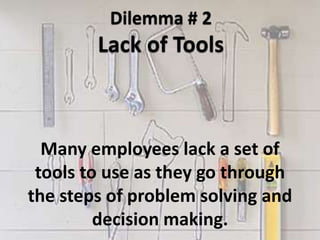
Many employees lack a set of
tools to use as they go through
the steps of problem solving and
decision making.
Find some effective tools, learn
how to use them, and go to work.
Having access to more information
doesn’t necessarily lead to better
decisions; in fact it often results in
worse decisions.
Use critical thinking skills to minimize the
information you wish to analyze then
critically evaluate what you have.
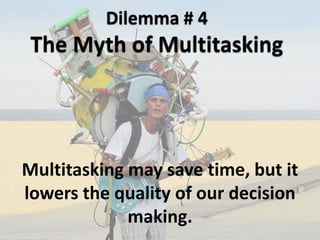
Multitasking may save time, but it
lowers the quality of our decision
making.
When engaged with problem solving or
decision making, focus on a single task.
Explore what other firms, agencies, and
organizations are using…
 Positive Psychology,
 Emotional Intelligence, and
 Mindfulness
**SOME EXAMPLES?**
training presetation.pptx

training presetation.pptx

Editor's Notes

  • #2  Introduce myself and Linda The three hands symbolize the three partners for CALHR UCD, CSUS, and Los Rios Promotes collaboration and collegiality and I think I speak for the three of us by saying we are thrilled to be involved in this effort. Or PGB My focus today is not going to be on ALL courses we collaborate with CALHR on (sup skills, etc) but only on Analytical Skills and related…
  • #3 So remember – four dilemmas to PS and DM and how to overcome them…. A question for you: What is happening in your workplace if employees don’t have or employ a standard problem solving method(s)? Is it a “Big Deal” or a “So What”
  • #4 So What? Procrastination… If you don’t have a method, you put off PS or DM… Efficiency/ Effectiveness – If you spen as much time deciding HOW to approach a problem as you spend in PS, then THAT is NOT Efficient. Biases There are so many PROVEN biases working against good PS (explain recency and ego depletion) Trail of Evidence – Student in a CSW class and how many analysts are good intuitive PSs, but how this may not be enough…
  • #5 Well yes it is Problem Solving Methods / mention the 99 Problem solving is not new and it is not rocket science. Simple to complex -trial and error, asking an expert, going to Google, to the less-than-dependable flip of a coin. More reliable processes are logical, multi-step methods… At CALHR there are multiple courses, methods, and tools taught
  • #6 So what? Or do you even believe this? What are these Tools? Do your employees have the tools needed to: 1) LOOK Look at a problem from a fresh perspective? 2) SEE Examine a problem in detail / probe for root causes? 3) IMAGINE Generate original and viable alternatives? 4) SHOW Make a convincing case as they show or try to "sell" the solution?   This is a dilemma, because many employees have few, if any problem solving tools at their disposal.   But do these tools exist? Yes they do, and therein lies the solution to Dilemma #2.  
  • #7  So I guess we have to ask ourselves what are some of these tools Well here we go! PS tools!!!!
  • #8  The problem solver-ometer Oh don’t we wish… But it’s not that easy!
  • #9 Summarize this!!! No, this can’t be true. Now that my employees have the internet, Google, social networking, and crowd-sourcing, don't they have all the information they need to make fast and dependable decisions all the time? Twitterization of Culture - good evidence from recent research, in the social and psychological sciences, that more information leads to poorer decision making. Example: A Columbia University study of a few years ago, found that as people received more and more information about 401K plan options, participation in any plan fell. Participation went from 75% of the workforce opting into a plan when they were given information about two alternate plans, to only 61% opting in when there were 59 plan options presented. In addition, those who did choose a plan (when more options were offered) made poorer choices; they made worse decisions. Chocolate Cake study? Study after study shows that when our working memory is overloaded, we make poorer decisions. The brain can hold roughly seven items in working memory (this is why seven digit phone numbers have survived). 2 numbers / 7 numbers walk the hall / choc cake or healthy fruit WILLPOWER / Decision Making  
  • #10 NOT so what? / Let me try to convince you…. But if an employee can gather loads of information about a topic, shouldn't all that information be analyzed? The answer is not necessarily. A much sounder approach involves organizing and reducing the information before analysis. How can this organization and reduction be accomplished? CARD? The answer lies in critical thinking. What is critical thinking? Critical thinking is disciplined, rational and stepwise analysis. In this paper, critical thinking will refer to a few reliable methods to reduce the amount of information to be analyzed. Critical thinking will be the means to sort quality information from suspect or less valuable information. But how is this done?
  • #11 Pressure to multitask – BUT -Research from the world of cognitive neuroscience provides absolute evidence that we are incapable of simultaneously conducting two mental activities at once, without sacrificing the quality of the resulting decision(s).   Consider the evidence on multitasking What most consider multitasking is not multitasking, but instead rapidly switching from one task to another. When we switch from one task to another, no matter how rapidly, the flow of our problem solving is interrupted and we lose information, recollection, and focus Texting while driving Many people find the lure of the cellphone impossible to resist, even though they know the danger of multitasking. Dopamine charge,,, Given the reluctance of many to give up this potentially lethal habit of texting while driving, it is no surprise that employees are attracted to multitasking at their desks. In Winifred   Given the significant evidence that multitasking has a negative effect, what is the solution to the dilemma of multitasking?  
  • #13 Business and organizations are embracing the lessons, tools, and techniques from Positive Psychology Emotional Intellignece And Mindfulness To combat – information overload, multitasking leading to lack of attention, stress, … Work life imbalance And more….  
  • #14  Thanks for the opportunity to share with you…. Any Questions?