A TECHNICAL SEMINAR ON

BUCK CONVERTER FED BY PV ARRAY

PRESENTED BY
Monika Rout

1
2

CONTENTS
 INTRODUCTION

 PV SYSTEM
 APPLICATIONS OF PV SYSTEM
 CHARGE CONTROLLER

 BUCK CONVERTER
 MAXIMUM POWER POINT TRACKING
 ADVANTAGES

 CONCLUSION
INSTITUTE OF TECHNICAL EDUCATION & RESEARCH,SOA University
DEPT. of EICE
INTRODUCTION
 For environmental concern and increase in peak power

demand, PV solar cells has become

an alternative energy

source for green and clean power generation.
 With the growing demand for renewable sources of energy, the
manufacturing of solar cells and pv array has advanced in
recent years.

INSTITUTE OF TECHNICAL EDUCATION & RESEARCH,SOA University
DEPT. of EICE

3
4

PV SYSTEM
PV MODULE

Imodule

ILOAD
+

+
Vmodule

-

CONVERTER

V load

LOAD

-

Fig.1. Block diagram of the PV system [1]
INSTITUTE OF TECHNICAL EDUCATION & RESEARCH,SOA University
DEPT. of EICE
5

Fig.2.Simplified equivalent circuit diagram of pv cell[3]

INSTITUTE OF TECHNICAL EDUCATION & RESEARCH,SOA University
DEPT. of EICE
6

PV SYSTEM(contd..)
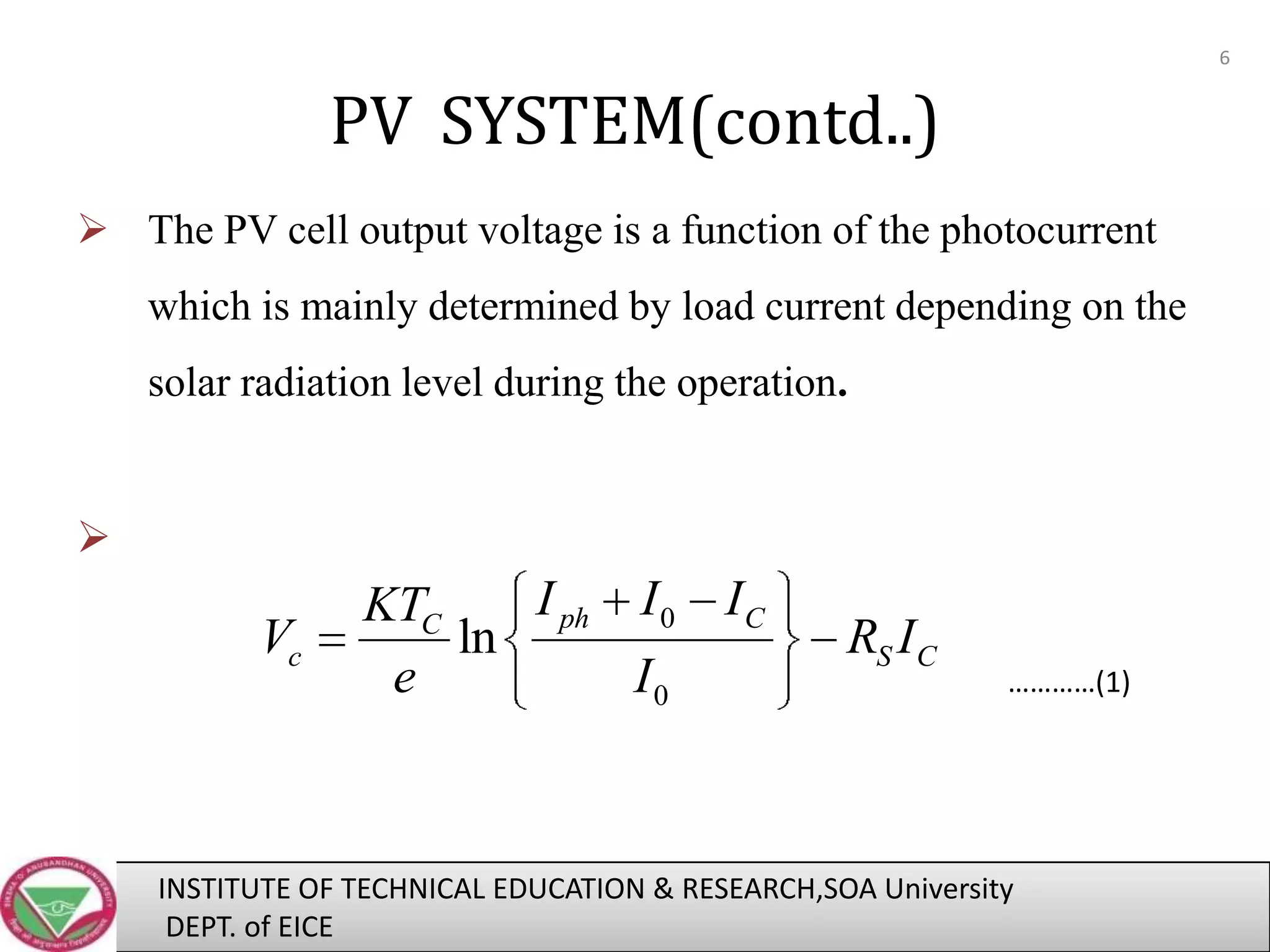
 The PV cell output voltage is a function of the photocurrent
which is mainly determined by load current depending on the
solar radiation level during the operation.



Vc

I ph I 0
KTC
ln
e
I0

IC

RS I C

…………(1)

INSTITUTE OF TECHNICAL EDUCATION & RESEARCH,SOA University
DEPT. of EICE
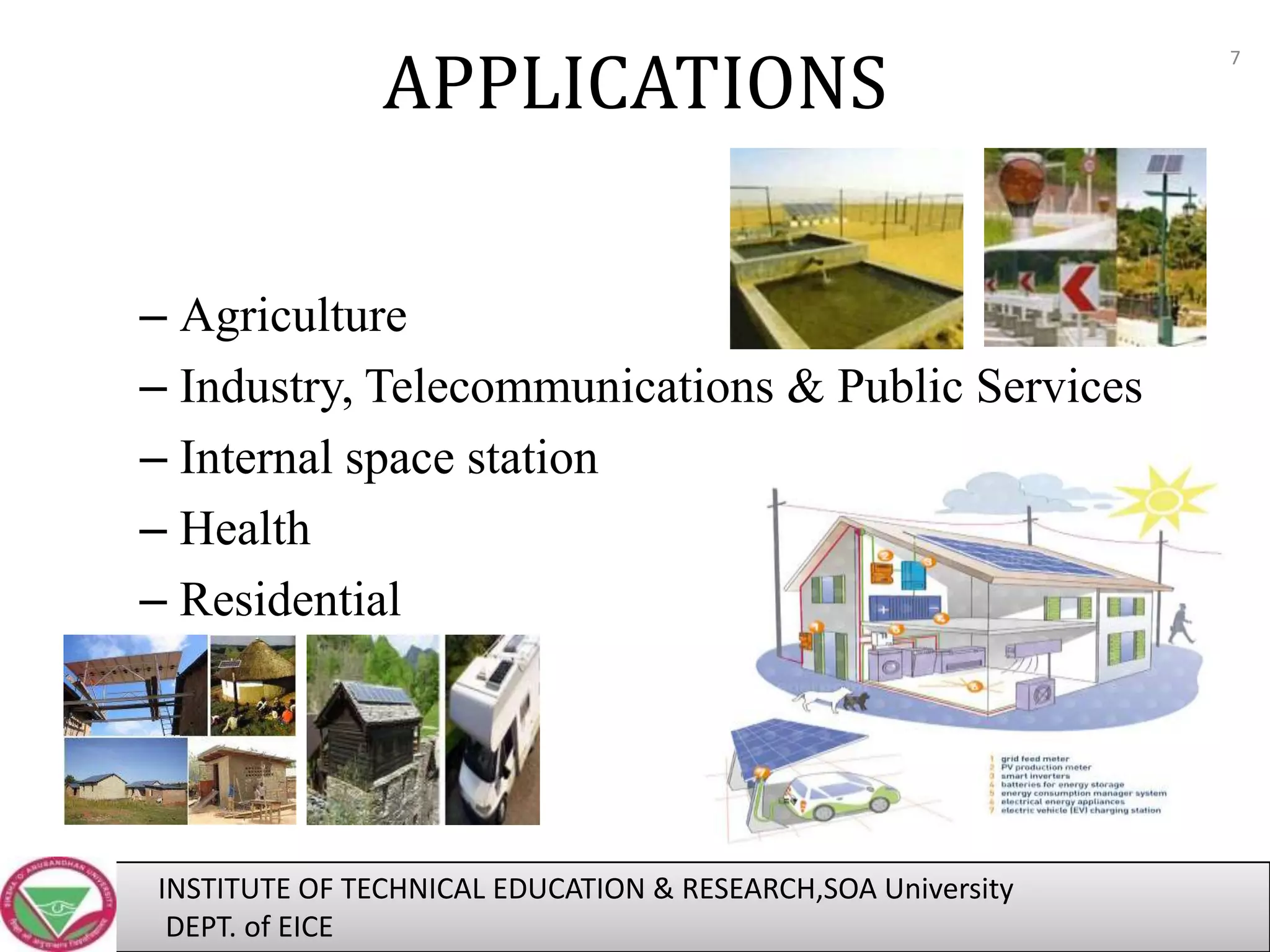
APPLICATIONS
– Agriculture
– Industry, Telecommunications & Public Services
– Internal space station
– Health
– Residential

INSTITUTE OF TECHNICAL EDUCATION & RESEARCH,SOA University
DEPT. of EICE

7
8

EUROPE

3%
7%

ASIA,JAPAN

15%

30%

NORTH AMERICA
INDIA,CHINA

20%

25%

SOUTH AMERICA
REST

Fig.3.Status of the PV technology worldwide.[6]

INSTITUTE OF TECHNICAL EDUCATION & RESEARCH,SOA University
DEPT. of EICE
9

CHARGE CONTROLLER
 Charge controller regulates the charging and discharging of a

battery.
 Such

controllers

are

mainly

used

where

loads

are

unpredictable.
 The batteries are optimized or undersized to minimize the

initial cost.

INSTITUTE OF TECHNICAL EDUCATION & RESEARCH,SOA University
DEPT. of EICE
10

SHUNT TYPE CHARGE CONTROLLER
S2

Blocking diode
battery
+

_

Pv array
Charge
controller
S1

Fig.4 circuit diagram for shunt charge controller[2]

load
11

SERIES TYPE CHARGE CONTROLLER
S1

S2

battery
+

_

Pv array
Charge
controller

Fig.5 circuit diagram for series charge controller[2]

load
DC TO DC CONVERTER TYPE
CHARGE CONTROLLER

Pv array

Dc to dc converter

battery

Fig.6 circuit diagram for dc to dc charge controller[2]

12

load
13

MPPT CHARGE CONTROLLER
 MPPT stands for maximum power point tracking

 All types of solar installations will be benefited by using
MPPT technology.
 To charge battery in more efficient manner, the pv array is

operated at a point where the pv output power is maximum.
 To extract maximum power from pv array, a dc to dc converter

is used between the pv array and the battery
INSTITUTE OF TECHNICAL EDUCATION & RESEARCH,SOA University
DEPT. of EICE
14

THE BUCK CONVERTER
o The buck is a non-isolated power stage topology, sometimes
called a step down power stage.
o These converters produce a lower average output voltage than
the DC input voltage.

o It consists of a DC input voltage source
, inductor
L, controlled switch (BJT), diode D, filter capacitor C, and
load resistance R.

INSTITUTE OF TECHNICAL EDUCATION & RESEARCH,SOA University
DEPT. of EICE
15

Fig.7 circuit diagram for buck converter[5]
INSTITUTE OF TECHNICAL EDUCATION & RESEARCH,SOA University
DEPT. of EICE
16

Fig.8 waveform diagram for buck converter[5]
INSTITUTE OF TECHNICAL EDUCATION & RESEARCH,SOA University
DEPT. of EICE
MAXIMUM POWER POINT
TRACKING
 Photovoltaic system displays an inherently nonlinear current

voltage (I-V) relationship .
 When a solar pv module is used in a system, its operating
point is decided by the load to which it is connected.
 To ensure the operation of pv modules for maximum power
transfer, method is called MPPT.

INSTITUTE OF TECHNICAL EDUCATION & RESEARCH,SOA University
DEPT. of EICE

17
18

Fig.7. Current/power Vs Voltage plot with MPPT [2]
INSTITUTE OF TECHNICAL EDUCATION & RESEARCH,SOA University
DEPT. of EICE
19

ADVANTAGES
• No fuel requirement

• National economic benefits
• Easy to maintain
• Long life
• Environment friendly

INSTITUTE OF TECHNICAL EDUCATION & RESEARCH,SOA University
DEPT. of EICE
20

CONCLUSION

• A dc-dc buck converter is introduced between PV
system and load to meet the dynamic energy
requirement of the load in an efficient way. It is
observed that, the buck converter largely
increases the system efficiency by using MPPT
technique.

INSTITUTE OF TECHNICAL EDUCATION & RESEARCH,SOA University
DEPT. of EICE
REFERENCE
[1] S. Rahmam, M. A. Khallat, and B. H. Chowdhury, “A discussion on
thediversity in the applications of photovoltaic system,” IEEE Trans.,Energy
Conversion, vol. 3, pp. 738–746, Dec. 1988.
[2]Chetan Singh Solanki,”Solar Photovoltaics,fundamentals,technologies and
applications”, second edition, PHI LEARNING Private Limited,2012.
[3]B.Chitti Babu, R.Vigneshwaran, Sudarshan Karthik, Nayan Ku. Dalei,Rabi
Narayan Das, “A Novel Technique for Maximum Power Point Tracking of PV
Energy Conversion System”, Proc. of International Conf. on Computer
Applications in Electrical Engineering, IIT Roorkee. pp.276-279,CERA 2010.
[4] S.Sukhatme,J.nayak “SOLAR ENERGY : PRINCIPLES OF THERMAL
COLLECTION AND STORAGE”, Third edition,Tata McGraw-Hill, 2008.
[5]Dr. P.S Bimbhra: “Power electronics”, KHANNA PUBLISHERS, New
Delhi,2010.
[6] G. Foley: “Photovoltaic Applications in Rural Areas of the Developing
World”. World Bank, 2012.
INSTITUTE OF TECHNICAL EDUCATION & RESEARCH,SOA University
DEPT. of EICE

21

BUCK converter fed by PV array

  • 1.
    A TECHNICAL SEMINARON BUCK CONVERTER FED BY PV ARRAY PRESENTED BY Monika Rout 1
  • 2.
    2 CONTENTS  INTRODUCTION  PVSYSTEM  APPLICATIONS OF PV SYSTEM  CHARGE CONTROLLER  BUCK CONVERTER  MAXIMUM POWER POINT TRACKING  ADVANTAGES  CONCLUSION INSTITUTE OF TECHNICAL EDUCATION & RESEARCH,SOA University DEPT. of EICE
  • 3.
    INTRODUCTION  For environmentalconcern and increase in peak power demand, PV solar cells has become an alternative energy source for green and clean power generation.  With the growing demand for renewable sources of energy, the manufacturing of solar cells and pv array has advanced in recent years. INSTITUTE OF TECHNICAL EDUCATION & RESEARCH,SOA University DEPT. of EICE 3
  • 4.
    4 PV SYSTEM PV MODULE Imodule ILOAD + + Vmodule - CONVERTER Vload LOAD - Fig.1. Block diagram of the PV system [1] INSTITUTE OF TECHNICAL EDUCATION & RESEARCH,SOA University DEPT. of EICE
  • 5.
    5 Fig.2.Simplified equivalent circuitdiagram of pv cell[3] INSTITUTE OF TECHNICAL EDUCATION & RESEARCH,SOA University DEPT. of EICE
  • 6.
    6 PV SYSTEM(contd..)  ThePV cell output voltage is a function of the photocurrent which is mainly determined by load current depending on the solar radiation level during the operation.  Vc I ph I 0 KTC ln e I0 IC RS I C …………(1) INSTITUTE OF TECHNICAL EDUCATION & RESEARCH,SOA University DEPT. of EICE
  • 7.
    APPLICATIONS – Agriculture – Industry,Telecommunications & Public Services – Internal space station – Health – Residential INSTITUTE OF TECHNICAL EDUCATION & RESEARCH,SOA University DEPT. of EICE 7
  • 8.
    8 EUROPE 3% 7% ASIA,JAPAN 15% 30% NORTH AMERICA INDIA,CHINA 20% 25% SOUTH AMERICA REST Fig.3.Statusof the PV technology worldwide.[6] INSTITUTE OF TECHNICAL EDUCATION & RESEARCH,SOA University DEPT. of EICE
  • 9.
    9 CHARGE CONTROLLER  Chargecontroller regulates the charging and discharging of a battery.  Such controllers are mainly used where loads are unpredictable.  The batteries are optimized or undersized to minimize the initial cost. INSTITUTE OF TECHNICAL EDUCATION & RESEARCH,SOA University DEPT. of EICE
  • 10.
    10 SHUNT TYPE CHARGECONTROLLER S2 Blocking diode battery + _ Pv array Charge controller S1 Fig.4 circuit diagram for shunt charge controller[2] load
  • 11.
    11 SERIES TYPE CHARGECONTROLLER S1 S2 battery + _ Pv array Charge controller Fig.5 circuit diagram for series charge controller[2] load
  • 12.
    DC TO DCCONVERTER TYPE CHARGE CONTROLLER Pv array Dc to dc converter battery Fig.6 circuit diagram for dc to dc charge controller[2] 12 load
  • 13.
    13 MPPT CHARGE CONTROLLER MPPT stands for maximum power point tracking  All types of solar installations will be benefited by using MPPT technology.  To charge battery in more efficient manner, the pv array is operated at a point where the pv output power is maximum.  To extract maximum power from pv array, a dc to dc converter is used between the pv array and the battery INSTITUTE OF TECHNICAL EDUCATION & RESEARCH,SOA University DEPT. of EICE
  • 14.
    14 THE BUCK CONVERTER oThe buck is a non-isolated power stage topology, sometimes called a step down power stage. o These converters produce a lower average output voltage than the DC input voltage. o It consists of a DC input voltage source , inductor L, controlled switch (BJT), diode D, filter capacitor C, and load resistance R. INSTITUTE OF TECHNICAL EDUCATION & RESEARCH,SOA University DEPT. of EICE
  • 15.
    15 Fig.7 circuit diagramfor buck converter[5] INSTITUTE OF TECHNICAL EDUCATION & RESEARCH,SOA University DEPT. of EICE
  • 16.
    16 Fig.8 waveform diagramfor buck converter[5] INSTITUTE OF TECHNICAL EDUCATION & RESEARCH,SOA University DEPT. of EICE
  • 17.
    MAXIMUM POWER POINT TRACKING Photovoltaic system displays an inherently nonlinear current voltage (I-V) relationship .  When a solar pv module is used in a system, its operating point is decided by the load to which it is connected.  To ensure the operation of pv modules for maximum power transfer, method is called MPPT. INSTITUTE OF TECHNICAL EDUCATION & RESEARCH,SOA University DEPT. of EICE 17
  • 18.
    18 Fig.7. Current/power VsVoltage plot with MPPT [2] INSTITUTE OF TECHNICAL EDUCATION & RESEARCH,SOA University DEPT. of EICE
  • 19.
    19 ADVANTAGES • No fuelrequirement • National economic benefits • Easy to maintain • Long life • Environment friendly INSTITUTE OF TECHNICAL EDUCATION & RESEARCH,SOA University DEPT. of EICE
  • 20.
    20 CONCLUSION • A dc-dcbuck converter is introduced between PV system and load to meet the dynamic energy requirement of the load in an efficient way. It is observed that, the buck converter largely increases the system efficiency by using MPPT technique. INSTITUTE OF TECHNICAL EDUCATION & RESEARCH,SOA University DEPT. of EICE
  • 21.
    REFERENCE [1] S. Rahmam,M. A. Khallat, and B. H. Chowdhury, “A discussion on thediversity in the applications of photovoltaic system,” IEEE Trans.,Energy Conversion, vol. 3, pp. 738–746, Dec. 1988. [2]Chetan Singh Solanki,”Solar Photovoltaics,fundamentals,technologies and applications”, second edition, PHI LEARNING Private Limited,2012. [3]B.Chitti Babu, R.Vigneshwaran, Sudarshan Karthik, Nayan Ku. Dalei,Rabi Narayan Das, “A Novel Technique for Maximum Power Point Tracking of PV Energy Conversion System”, Proc. of International Conf. on Computer Applications in Electrical Engineering, IIT Roorkee. pp.276-279,CERA 2010. [4] S.Sukhatme,J.nayak “SOLAR ENERGY : PRINCIPLES OF THERMAL COLLECTION AND STORAGE”, Third edition,Tata McGraw-Hill, 2008. [5]Dr. P.S Bimbhra: “Power electronics”, KHANNA PUBLISHERS, New Delhi,2010. [6] G. Foley: “Photovoltaic Applications in Rural Areas of the Developing World”. World Bank, 2012. INSTITUTE OF TECHNICAL EDUCATION & RESEARCH,SOA University DEPT. of EICE 21