Neeraj Kumar Int. Journal of Engineering Research and Applications www.ijera.com
ISSN: 2248-9622, Vol. 5, Issue 11, (Part - 2) November 2015, pp.52-58
www.ijera.com 52|P a g e
Design and Analysis of Three Phase Inverter with Two
Buck/Boost MPPTs for DC Distribution System
Neeraj Kumar1
, G. Indirarani2
M. Tech ScholarDepartment of EEEVignanaBharathi Institute of Technology, Hyderabad
M. TechAssistant ProfessorDepartment of EEEVignanaBharathi Institute of Technology, Hyderabad
ABSTRACT
Anintegration and operation of a three-phase inverter with twobuck/boost maximum power point trackers
(MPPTs) for dc-distribution applications. In a dc-distribution system, a three phase inverter isrequired to control
the power flow between dc busand three phase ac grid, and to regulate the dc bus to a certainrange of voltages.
A droop regulation mechanism according to the inverter inductor current levels to reduce capacitor size, balance
power flow, and accommodate load variation is proposed. Since thephotovoltaic (PV) array voltage can vary
from 0 to 5000 V, especially with thin-film PV panels, the MPPT topology is formed with buck and boost
converters to operate at the dc-bus voltage around 4000 V, reducing the voltage stress of its followed inverter.
Additionally, the controller can online check the input configuration of the two MPPTs, equally distribute the
PV-array output current to the two MPPTs in parallel operation, and switch control laws to smooth out mode
transition. A comparison between the conventional boost MPPT and the proposed buck/boost MPPT integrated
with a PV inverter is also presented. Asingle-phase bidirectional inverter with two buck/boost maximum power
point trackers (MPPTs) by using the closed loop circuit. This project is workout bySimulink using mat lab.
Index Terms: Three Phase inverter, buck/boost maximum power point trackers (MPPTs), dc-distribution
applications
I. INTRODUCTION
Many types of renewable energy, such as
photovoltaic (PV), wind, tidal, and geothermal energy,
have attracted a lot of attention over the past decade
[1]–[3]. Among these natural resources, the PV energy
is a main and appropriate renewable energy for low-
voltage dc-distribution systems, owing to the merits of
clean, quiet, pollution free, asnd abundant. In the dc-
distribution applications, a power system, including re-
newable distributed generators (DGs), dc loads
(lighting, air conditioner, and electric vehicle), and a
bidirectional inverter, is shown in Fig. 1, in which two
PV arrays with two maximum power point trackers
(MPPTs) are implemented. However, the i–v
characteristics of the PV arrays are nonlinear, and they
require MPPTs to draw the maximum power from each
PV array. Moreover, the bidirectional inverter has to
fulfill grid connection (sell power) and rectification
(buy power) with power-factor correction (PFC) to
control the power flow between dc bus and ac grid, and
to regulate the dc bus to a certain range of voltages,
suchas380± 10 V.
Fig. 1.Configuration of a dc-distribution system.
Nowadays, a conventional two-stage configuration
is usually adopted in the PV inverter systems [4]–[8].
Each MPPT is realized with a boost converter to step up
the PV-array voltage close to the specified dc-link
voltage, as shown in Fig. 2. The boost converter is
operated in by-pass mode when the PV-array voltage is
higher than the dc-link voltage, and the inverter will
function as an MPPT. However, since the characteristics
of PV arrays are different from each other, the inverter
operated in by-pass mode cannot track each individual
maximum power point accurately, and the inverter
suffers from as high-voltage stress as the open voltage of
the arrays. To release this limitation, an MPPT topology,
RESEARCH ARTICLE OPEN ACCESS
Neeraj Kumar Int. Journal of Engineering Research and Applications www.ijera.com
ISSN: 2248-9622, Vol. 5, Issue 11, (Part - 2) November 2015, pp.52-58
www.ijera.com 53|P a g e
which combines buck and boost converters is proposed
in
Fig.2. Block Diagram
this study, in which the control algorithm for tracking
maximum power points is based on a perturbation and
observation method. The MPPT will switch operation
modes between buck and boost when the output
voltage of a PV array is close to the dc-bus voltage. The
designed controller can switch control laws to achieve
smooth mode transition and fulfill online configuration
check for the MPPTs, which can be either separate or in
parallel connection, to draw the maximum power from
the PV arrays more effectively. Additionally, a uniform
current control scheme is introduced to the controller to
equally distribute the PV-array output current to the
two MPPTs in parallel operation.
The goals of this research are:
 To simulate and analyze the typical power in PV
array.
 Basic overview of MPPTs to include tracking
algorithms.
 Perturbation and observation tracking method.
 To simulate and analyze the methodology chosen
for MPPTs.
 Building the case for the usage of multiple
MPPTs.
 To determine the best control mode for proposed
buck/boost.
 To implement a single-phase bidirectional
inverter using AC and DC power supply unit.
Fig.3. Conventional two-stage PV inverter system
with boost-type MPPTs
II. THREE PHASE INVERTER FOR
PHOTOVOLTAIC APPLICATION
To eliminate leakage ground current circulating
through PV arrays and ground, several
transformerlessinverter topologies were proposed [9]–
[11]. Even though they can achieve high efficiency, they
require more components than the conventional full-
bridge topology. Thus, in this study, the bidirectional
full-bridge inverter is operated with bipolar modulation
to avoid leakage ground current and to save power
components while still sustaining comparatively high
efficiency to those in [9]–[11]. Note that a full-bridge
inverter operated with bipolar modulation can achieve
only low frequency common-mode voltage (vCM =
(vdc− vs)/2), resulting in low leakage ground current [9].
To regulate the dc-bus voltage for the grid-
connected inverter, the controls, such as robust,
adaptive, and fuzzy [12]–[14], were adopted. When
adopting these controls for the studied dc-distribution
system, a heavy step-load change at the dc-bus side
will cause high dc-bus voltage variation and
fluctuation, and the system might run abnormally or
drop into under or over voltage protection. Bulky dc-
bus capacitors can be adopted to increase the hold-up
time and suppress the fluctuation of the dc-bus voltage
[15], but it will increase the size and cost of the system
significantly. Additionally, even though there are
approaches to achieving fast dc-bus voltage dynamics,
the systems with load connected to the dc bus have not
been studied yet [16], [17]. Therefore, to operate the
dc-distribution system efficiently while reducing the
size of dc-bus capacitors, a droop regulation
mechanism according to the inverter current levels is
proposed in this study.
In this paper, operational principle and control
laws of the system are first described, and the MPPT
control algorithm, online configuration check, uniform
current control, buck/boost mode transition, and dc-
bus-voltage regulation mechanism are then addressed.
Simulation results from a 5-kW, three-phase inverter
with two buck/boost MPPTs are presented to verify the
analysis and discussion.
Fig. 3. Configuration of the studied PV inverter
system with the buck/boost MPPTs
III. OPERATION AND ANALYSIS OF
THE PROPOSED BUCK/BOOST
MPPTs
The MPPT topology is formed from a buck
converter and a boost converter but with a shared
Neeraj Kumar Int. Journal of Engineering Research and Applications www.ijera.com
ISSN: 2248-9622, Vol. 5, Issue 11, (Part - 2) November 2015, pp.52-58
www.ijera.com 54|P a g e
inductor to accommodate wide PV-array voltages
from 0 to 600 V. For various PV-array applications,
the two MPPTs will be connected separately or in
parallel. The MPPT senses PV voltage vPV, dc-bus
voltage vdc, and inductor current iLminto the single-
chip microcontroller (TMS320LF2406 A) to
determine operational mode and duty ratio for
tracking the maximum power point accurately. When
voltage vPV is higher than vdc, the MPPT is operated
in buck mode, and switch M1 is turned ON to
magnetize inductor Lmand thus increase inductor
current iLm. While switch M1 is turned OFF, inductor
Lm releases its stored energy through diodes D1 and
D2. On the other hand, the MPPT is operated in boost
mode when voltage vPV is lower than vdc, and
switches M1 and M2 are turned ON to magnetize
inductor Lm. While switch M2 is turned OFF, inductor
Lm releases its stored energy through diode D2. Thus,
the control laws can be expressed as follows
𝑑
𝑏𝑢𝑐𝑘 =
𝑉 𝑑𝑐
𝑉 𝑝𝑣
And
𝑑
𝑏𝑜𝑜𝑠𝑡 =
𝑉 𝑑𝑐 −𝑉𝑝𝑣
𝑉 𝑝𝑣
To draw maximum power from PV arrays, a
perturbation and observation control algorithm for
tracking maximum power points is adopted. If the
maximum power level of a PV array is higher than the
power rating of an MPPT, the two MPPTs will be in
parallel operation to function as a single MPPT. Thus, it
requires an online configuration check to determine the
connection types of the two MPPTs, separately or in
parallel. Moreover, if the two MPPTs are in parallel
operation, a uniform current control scheme is
introduced to equally distribute the PV-array output
current to the two MPPTs. The operational-mode transi-
tion control between buck and boost is also presented.
A. Perturbation and Observation Tracking Method
In this study, the MPPT controller tracks the
maximum output power of a PV array based on the
perturbation and observation tracking method. At the
beginning, the controller will determine the operation
mode of the proposed MPPT. When the MPPT is
operated in boost mode, inductor current iLmis equal to
output current iPV of the PV array; thus, the output
power of the PV array can be expressed as follows:
PPV boost(n) = vPV(n) × iLm(n). (9)
On the other hand, when the proposed MPPT is
operated in buck mode, inductor current iLmis equal
to output current io; thus, the output power of the PV
array can be expressed as follows:
PPV buck(n) = vdc(n) × iLm(n). 10)
With this control algorithm, the controller tracks
the peak power by increasing or decreasing the duty
ratio periodically.
In this studied PV inverter system, there is a shared
auxiliary power supply for the MPPTs and the inverter.
Because the switching frequencies of the MPPT (25
kHz) and the inverter (20 kHz) are different, their
switching noises might affect the accuracy of voltage
and current sampling, especially under high-power
condition. To avoid noise interference, the MPPTs are
synchronized with the inverter, and the controller will
update the duty ratio of the MPPT power stage every ten
line cycles at the zero crossing of the line voltage.
Additionally, since the single-phase PV inverter system
has a twice line-frequency ripple voltage on the dc bus,
this synchronization approach can also eliminate the
ripple voltage effect and determine accurate output
power of the PV arrays. When the output power of the
PV arrays can be determined accurately, the proposed
controller can track the maximum power point
precisely.
B. Online MPPT Configuration Check
In order to track the maximum power point
correctly and effectively, a scheme of online MPPT
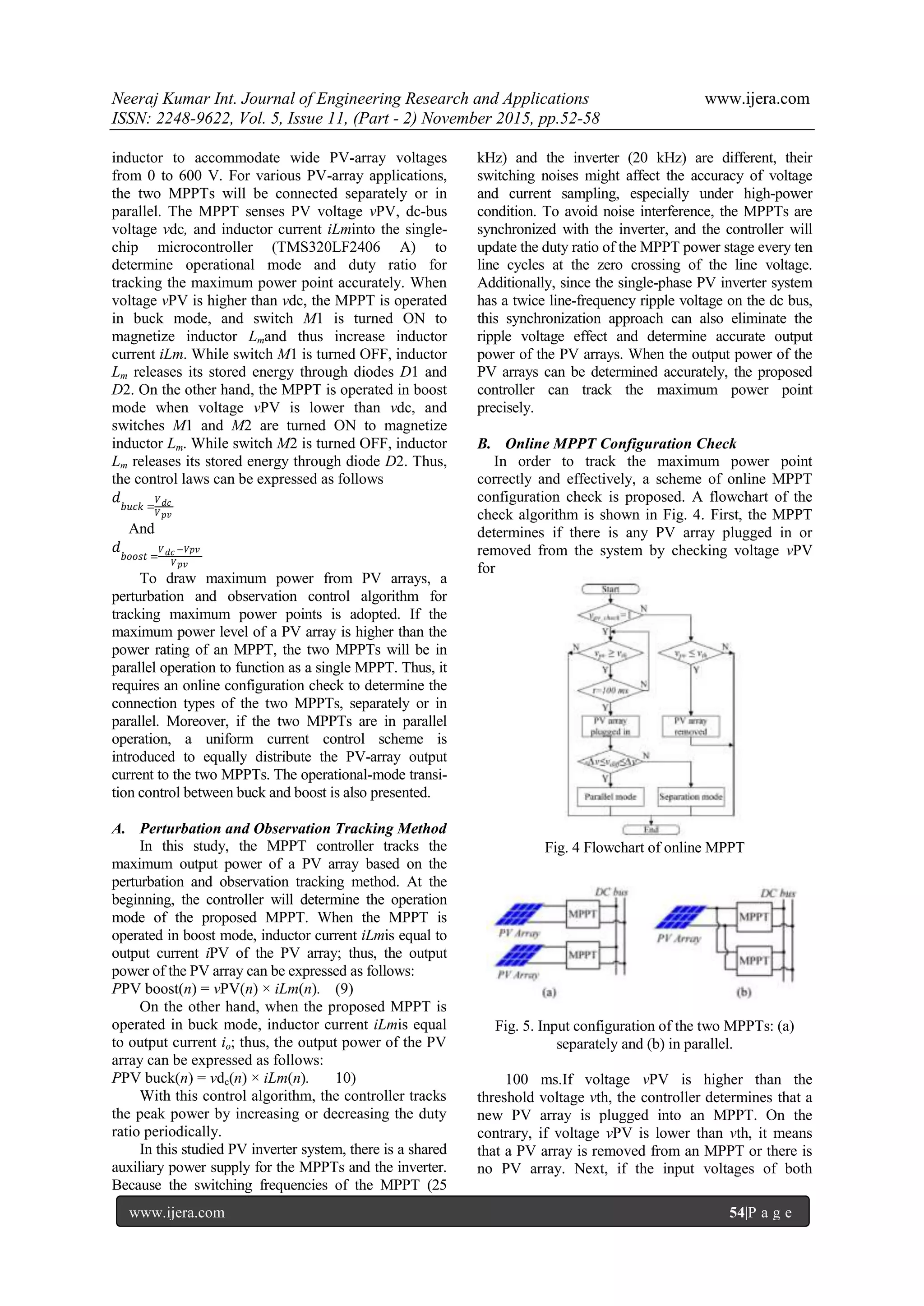
configuration check is proposed. A flowchart of the
check algorithm is shown in Fig. 4. First, the MPPT
determines if there is any PV array plugged in or
removed from the system by checking voltage vPV
for
Fig. 4 Flowchart of online MPPT
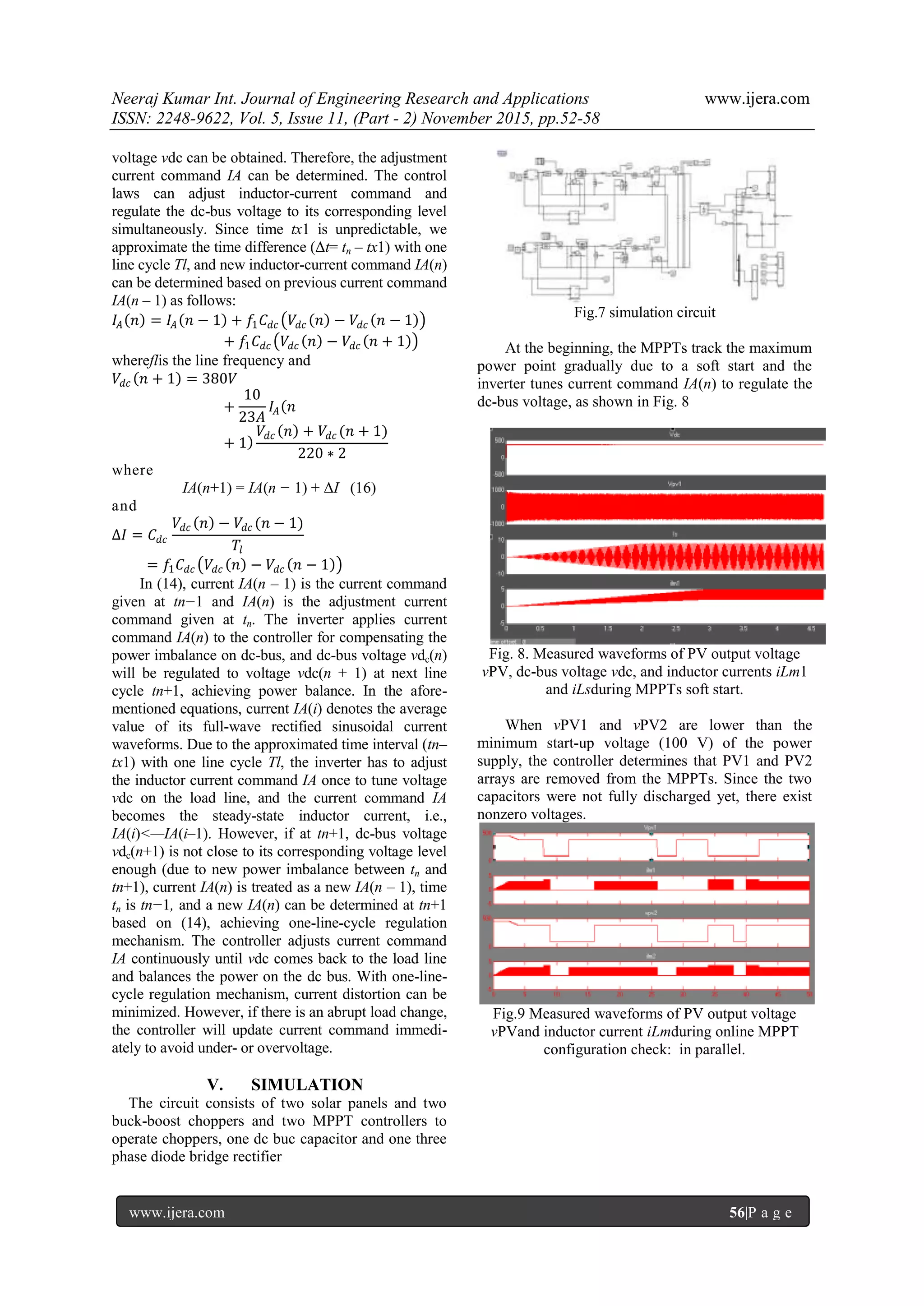
Fig. 5. Input configuration of the two MPPTs: (a)
separately and (b) in parallel.
100 ms.If voltage vPV is higher than the
threshold voltage vth, the controller determines that a
new PV array is plugged into an MPPT. On the
contrary, if voltage vPV is lower than vth, it means
that a PV array is removed from an MPPT or there is
no PV array. Next, if the input voltages of both
Neeraj Kumar Int. Journal of Engineering Research and Applications www.ijera.com
ISSN: 2248-9622, Vol. 5, Issue 11, (Part - 2) November 2015, pp.52-58
www.ijera.com 55|P a g e
MPPTs are very close (within Δv), the MPPT
configuration will be determined as a parallel mode.
On the contrary, the two MPPTs will be operated in
separate mode. Moreover, a parallel verification
algorithm is utilized to confirm the MPPT
configuration check. The controller will perturb the
duty ratio of one MPPT to examine if both MPPT
input voltages are still identical to indentify the
connection modes.
The system controller checks the configuration of
the MPPTs every switching cycle. If the PV arrays are
connected to the MPPTs separately, as shown in Fig.
5(a), the MPPTs will calculate their PV output power
and tune their duty ratios individually. If the maximum
power level of a PV array is higher than that of an
MPPT, the two MPPTs will be connected to this PV
array and operated synchronously, as shown in Fig. 5(b).
When tracking the maximum PV output power, the
MPPTs will sum up their input currents and equally
distribute the total current to the two MPPTs based on a
uniform current control scheme.
C. Uniform Current Control Scheme
There might exist differences between the two
MPPTs, such as components, feedback signals, and
noise levels, which will
Fig. 6.Flowchart of the buck/boost mode transition
algorithm.
result in current imbalance while they are connected in
parallel. When a current imbalance occurs, the
components with higher current level will suffer from
higher temperature and shorter lifetime. Considering
the component reliability and thermal problem, a
uniform current control scheme is proposed and
described as follows. First, we calculate the current
difference (Δidiff) between the two MPPTs to determine
if a uniform current control is necessary. If the current
difference Δidiff is higher than a threshold value, the
controller will vary the duty ratios (Δd) of the MPPTs
to achieve equal current distribution. The duty ratios of
the two MPPTs are determined as follows:
DPV1← DPV1± Δd
and
DPV2← DPV2± Δd
in which when DPV1 is increased by ΔdandDPV2 will
be decreased by Δdand vice versa.
D. Buck–Boost Mode Transition
Since the operation range of the dc-bus voltage is
limited within 380 ± 20 V (including ripple voltage)
in the dc-distribution system, operational-mode
transition between the buck and boost modes will be a
critical control issue to accommodate a wide PV input
voltage variation (0–600 V). When the proposed
MPPT is operated in boost mode and voltage vPV is
close to vdc, switch M2 is turned OFF and the duty
ratio of switch M1 starts to decrease (–Δd) from
100%. With this control scheme, current iPV of the
PV array will charge input capacitor Crv, and voltage
vPV can be raised up to a higher level to prevent
mode fluctuation problems. On the contrary, switch
M1 is continuously turned ON and the duty ratio of
switch M2 starts to increase (+Δd) from 0%, when
vPV drops toward vdc during buck mode. Therefore,
the MPPT can achieve smooth mode transition by
tuning the duty ratios of the active switches. A
flowchart of the buck/boost mode transition scheme is
shown in Fig. 6.
IV. DC-BUS-VOLTAGE REGULATION
MECHANISM
The proposed regulation mechanism is similar to
the concept of the adaptive voltage position (AVP)
method [20], but it is more like a droop one. In the
discussed dc-distribution system, for reducing dc-bus
capacitance and mode-change frequency, a droop dc-
bus-voltage regulation mechanism is proposed, , in
which the dc-bus voltage is regulated according to the
inductor current linearly. When the bidirectional
inverter sells higher power, which means less load-
power requirement, the dc-bus voltage will be regulated
to a higher level. If there is a heavy step-load change
suddenly, this mechanism can avoid a voltage drop
below 380 V abruptly and it will not change the
operation mode from grid connection to rectification, or
can avoid under voltage protection. On the other hand,
when the bidirectional inverter buys higher power, the
dc-bus voltage is regulated to a lower level, reducing
the frequency of mode change, and thus, reducing the
dc-bus capacitance around 15%.
When there exists a power imbalance between
sourcing and loading at time tx1, for instance, the dc-
bus voltage increases from vdc(n – 1) to vdc(n). We
can determine the current difference Δidc between the
source and the load from the voltage variation, and it
can be expressed as follows:
∆𝑖
𝑑𝑐=𝐶 𝑑𝑐
𝑉 𝑑𝑐 𝑛 −𝑉 𝑑𝑐 (𝑛−1)
𝑡 𝑛 −𝑡 𝑥1
From the linear dc-bus voltage regulation
relationship, as shown in Fig. 8, the new steady-state
Neeraj Kumar Int. Journal of Engineering Research and Applications www.ijera.com
ISSN: 2248-9622, Vol. 5, Issue 11, (Part - 2) November 2015, pp.52-58
www.ijera.com 56|P a g e
voltage vdc can be obtained. Therefore, the adjustment
current command IA can be determined. The control
laws can adjust inductor-current command and
regulate the dc-bus voltage to its corresponding level
simultaneously. Since time tx1 is unpredictable, we
approximate the time difference (Δt= tn – tx1) with one
line cycle Tl, and new inductor-current command IA(n)
can be determined based on previous current command
IA(n – 1) as follows:
𝐼𝐴 𝑛 = 𝐼𝐴 𝑛 − 1 + 𝑓1 𝐶 𝑑𝑐 𝑉𝑑𝑐 𝑛 − 𝑉𝑑𝑐 𝑛 − 1
+ 𝑓1 𝐶 𝑑𝑐 𝑉𝑑𝑐 𝑛 − 𝑉𝑑𝑐 𝑛 + 1
whereflis the line frequency and
𝑉𝑑𝑐 𝑛 + 1 = 380𝑉
+
10
23𝐴
𝐼𝐴 𝑛
+ 1
𝑉𝑑𝑐 𝑛 + 𝑉𝑑𝑐 (𝑛 + 1)
220 ∗ 2
where
IA(n+1) = IA(n − 1) + ΔI (16)
and
∆𝐼 = 𝐶𝑑𝑐
𝑉𝑑𝑐 𝑛 − 𝑉𝑑𝑐 (𝑛 − 1)
𝑇𝑙
= 𝑓1 𝐶𝑑𝑐 𝑉𝑑𝑐 𝑛 − 𝑉𝑑𝑐 𝑛 − 1
In (14), current IA(n – 1) is the current command
given at tn−1 and IA(n) is the adjustment current
command given at tn. The inverter applies current
command IA(n) to the controller for compensating the
power imbalance on dc-bus, and dc-bus voltage vdc(n)
will be regulated to voltage vdc(n + 1) at next line
cycle tn+1, achieving power balance. In the afore-
mentioned equations, current IA(i) denotes the average
value of its full-wave rectified sinusoidal current
waveforms. Due to the approximated time interval (tn–
tx1) with one line cycle Tl, the inverter has to adjust
the inductor current command IA once to tune voltage
vdc on the load line, and the current command IA
becomes the steady-state inductor current, i.e.,
IA(i)<—IA(i–1). However, if at tn+1, dc-bus voltage
vdc(n+1) is not close to its corresponding voltage level
enough (due to new power imbalance between tn and
tn+1), current IA(n) is treated as a new IA(n – 1), time
tn is tn−1, and a new IA(n) can be determined at tn+1
based on (14), achieving one-line-cycle regulation
mechanism. The controller adjusts current command
IA continuously until vdc comes back to the load line
and balances the power on the dc bus. With one-line-
cycle regulation mechanism, current distortion can be
minimized. However, if there is an abrupt load change,
the controller will update current command immedi-
ately to avoid under- or overvoltage.
V. SIMULATION
The circuit consists of two solar panels and two
buck-boost choppers and two MPPT controllers to
operate choppers, one dc buc capacitor and one three
phase diode bridge rectifier
Fig.7 simulation circuit
At the beginning, the MPPTs track the maximum
power point gradually due to a soft start and the
inverter tunes current command IA(n) to regulate the
dc-bus voltage, as shown in Fig. 8
Fig. 8. Measured waveforms of PV output voltage
vPV, dc-bus voltage vdc, and inductor currents iLm1
and iLsduring MPPTs soft start.
When vPV1 and vPV2 are lower than the
minimum start-up voltage (100 V) of the power
supply, the controller determines that PV1 and PV2
arrays are removed from the MPPTs. Since the two
capacitors were not fully discharged yet, there exist
nonzero voltages.
Fig.9 Measured waveforms of PV output voltage
vPVand inductor current iLmduring online MPPT
configuration check: in parallel.
Neeraj Kumar Int. Journal of Engineering Research and Applications www.ijera.com
ISSN: 2248-9622, Vol. 5, Issue 11, (Part - 2) November 2015, pp.52-58
www.ijera.com 57|P a g e
Fig.Measeured waveforms of three phase grid current
VI. CONCLUSION
In this paper, a three-phase inverter with two
buck/boost MPPTs has been designed and implemented.
The inverter controls the power flow between dc bus
and ac grid, and regulates the dc bus to a certain range
of voltages. A droop regulation mechanism according to
the inductor current levels has been proposed to balance
the power flow and accommodate load variation. Since
the PV-array voltage can vary from 0 to 600 V, the
MPPT topology is formed with buck and boost
converters to operate at the dc-bus voltage around 380
V, reducing the voltage stress of its followed inverter..
REFERENCES
[1] J. M. Carrasco, L. G. Franquelo, J. T.
Bialasiewicz, E. Galvan, R. C. P. Guisado,
Ma. A. M. Prats, J. I. Leon, and N. Moreno-
Alfonso, “Power-electronic systems for the
grid integration of renewable energy
sources: a survey,” IEEE Trans. Ind.
Electron., vol. 53, no. 4, pp. 1002– 1016,
Aug. 2006.
[2] L. N. Khanh, J.-J. Seo, T.-S. Kim, and D.-J.
Won, “Power-management strategies for a
grid-connected PV-FC hybrid system,”
IEEE Trans. Power Deliv., vol. 25, no. 3,
pp. 1874–1882, Jul. 2010.
[3] Y. K. Tan and S. K. Panda, “Optimized wind
energy harvesting system using resistance
emulator and active rectifier for wireless
sensor nodes,” IEEE Trans. Power Electron.,
vol. 26, no. 1, pp. 38–50, Jan. 2011.
[4] J.-M. Kwon, K.-H. Nam, and B.-H.
Kwon, “Photovoltaic power conditioning
system with line connection,” IEEE
Trans. Ind. Electron., vol. 53, no. 4, pp.
1048–1054, Aug. 2006.
[5] J. Selvaraj and N. A. Rahim, “Multilevel
inverter for grid-connected PV system
employing digital PI controller,” IEEE
Trans. Ind. Electron., vol. 56, no. 1, pp.
149–158, Jan. 2009.
[6] F. Gao, D. Li, P. C. Loh, Y. Tang, and P.
Wang, “Indirect dc-link voltage control of
two-stage single-phase PV inverter,” in
Proc. 2009 IEEE ECCE, 2009, pp. 1166–
1172.
[7] A. Nami, F. Zare, A. Ghosh, and F.
Blaabjerg, “A hybrid cascade converter
topology with series-connected symmetrical
and asymmetrical diodeclamped H-Bridge
cells,” IEEE Trans. Power Electron., vol.
26, no. 1, pp. 51–65, Jan. 2011.
[8] S. Dwari and L. Parsa, “An efficient high-
step-up interleaved dc–dc converter with a
common active clamp,” IEEE Trans. Power
Electron., vol. 26, no. 1, pp. 66–78, Jan.
2011.
[9] J.-M. Shen, H.-L. Jou, and J.-C.Wu, “Novel
transformerlessgridconnected power
converter with negative grounding for
photovoltaic generation system,” IEEE
Trans. Power Electron., vol. 27, no. 4, pp.
1818–1829, Apr. 2012.
[10] T. Kerekes, R. Teodorescu, P. Rodriguez, G.
Vazquez, and E. Aldabas, “A new high-
efficiency single-phase transformerless PV
inverter topology,” IEEE Trans. Ind.
Electron., vol. 58, no. 1, pp. 184–191, Jan.
2011.
[11] S. V. Araujo, P. Zacharias, and R. Mallwitz,
“Highly efficient single-phase
transformerless inverters for grid-connected
photovoltaic systems,” IEEE Trans. Ind.
Electron., vol. 57, no. 9, pp. 3118–3128,
Sep. 2010.
[12] J. S. Park, J. H. Choi, B. G. Gu, I. S. Jung,
E. C. Lee, and K. S. Ahn, “Robust dc-link
voltage control scheme for photovoltaic
power generation system PCS,” in Proc.
31st Int. Telecommun. Energy Conf., 2009,
pp. 1–4.
[13] D. Salomonsson, L. Soder, and A. Sannino,
“An adaptive control system for a dc
microgrid for data centers,” IEEE Trans.
Ind. Appl., vol. 44, no. 6, pp. 1910–1917,
Nov. 2008.
[14] M. A. Azzouz and A. L. Elshafei, “An
adaptive fuzzy regulation of the dc-bus
voltage in wind energy conversion systems,”
in Proc. 2010 IEEE Int. Conf. CCA, pp.
1193–1198.
[15] H. Kakigano, A. Nishino, Y. Miura, and T.
Ise, “Distribution voltage control for dc
microgrid by converters of energy storages
considering the stored energy,” in Proc.
2010 IEEE ECCE, pp. 2851–2856.
[16] N. Hur, J. Jung, and K. Nam, “A fast
dynamic dc-link power-balancing scheme
for aPWMconverter-inverter system,” IEEE
Trans. Ind. Electron., vol. 48, no. 4, pp.
794–1803, Aug. 2001.
[17] J. Yao, H. Li, Y. Liao, and Z. Chen, “An
improved control strategy of limiting the dc-
link voltage fluctuation for a doubly fed
Neeraj Kumar Int. Journal of Engineering Research and Applications www.ijera.com
ISSN: 2248-9622, Vol. 5, Issue 11, (Part - 2) November 2015, pp.52-58
www.ijera.com 58|P a g e
induction wind generator,” IEEE Trans.
Power Electron., vol. 23, no. 3, pp. 1205–
1213, May 2008.
[18] T.-F. Wu, K.-H. Sun, C.-L. Kuo, and C.-H.
Chang, “Predictive current controlled 5
kWsingle-phase bi-directional inverter with
wide inductance variation for DC-microgrid
applications,” IEEE Trans. Power Electron.,
vol. 25, no. 12, pp. 3076–3084, Dec. 2010.
[19] R. D. Middlebrook, “Small-signal modeling
of pulse-width modulated switched-mode
power converters,” in Proc. IEEE, Apr.
1988, vol. 76, no. 4, pp. 343–354.
[20] M. T. Zhang, “Powering Intel Pentium 4
Generation Processors,” in Proc. Intel
Technol. Symp., 2001, pp. 215–218.
Author’s Profile
Mr.Neeraj Kumar received B.Tech
degree in Electrical and Electronics Engineering from
ACE Engineering College, And currently pursuing
M.Tech in Electrical and Electronics Engineering
with PE&EDspecialization
fromVignanaBharathiInstitute
ofTechnology,aushapur, ghatkesar, rangareddydist,
Telangana.His research interests include
PowerQuality, Power Electronics and Electrical
Drives,FACTS and Control Systems.
Mrs.G.Indira Rani presently
working as Assistant professor in VBIT Engineering
College, Aushapur, Ghatkesar, Rangareddy,
Telangana, India.She received the B. Techdegree in
Electrical & Electronics Engineering from BVCEC,
JNTU Hyderabad.And then completed her M.Tech in
Electrical & Electronics Engineering with PE&ED
specialization at GNITS, JNTU Hyderabad. She has a
teaching experience of 10 years.Her areas of interest
are Power System, Power Electronics and Electrical
Drives, FACTS, Switchgear and Protection.

Design and Analysis of Three Phase Inverter with Two Buck/Boost MPPTs for DC Distribution System

  • 1.
    Neeraj Kumar Int.Journal of Engineering Research and Applications www.ijera.com ISSN: 2248-9622, Vol. 5, Issue 11, (Part - 2) November 2015, pp.52-58 www.ijera.com 52|P a g e Design and Analysis of Three Phase Inverter with Two Buck/Boost MPPTs for DC Distribution System Neeraj Kumar1 , G. Indirarani2 M. Tech ScholarDepartment of EEEVignanaBharathi Institute of Technology, Hyderabad M. TechAssistant ProfessorDepartment of EEEVignanaBharathi Institute of Technology, Hyderabad ABSTRACT Anintegration and operation of a three-phase inverter with twobuck/boost maximum power point trackers (MPPTs) for dc-distribution applications. In a dc-distribution system, a three phase inverter isrequired to control the power flow between dc busand three phase ac grid, and to regulate the dc bus to a certainrange of voltages. A droop regulation mechanism according to the inverter inductor current levels to reduce capacitor size, balance power flow, and accommodate load variation is proposed. Since thephotovoltaic (PV) array voltage can vary from 0 to 5000 V, especially with thin-film PV panels, the MPPT topology is formed with buck and boost converters to operate at the dc-bus voltage around 4000 V, reducing the voltage stress of its followed inverter. Additionally, the controller can online check the input configuration of the two MPPTs, equally distribute the PV-array output current to the two MPPTs in parallel operation, and switch control laws to smooth out mode transition. A comparison between the conventional boost MPPT and the proposed buck/boost MPPT integrated with a PV inverter is also presented. Asingle-phase bidirectional inverter with two buck/boost maximum power point trackers (MPPTs) by using the closed loop circuit. This project is workout bySimulink using mat lab. Index Terms: Three Phase inverter, buck/boost maximum power point trackers (MPPTs), dc-distribution applications I. INTRODUCTION Many types of renewable energy, such as photovoltaic (PV), wind, tidal, and geothermal energy, have attracted a lot of attention over the past decade [1]–[3]. Among these natural resources, the PV energy is a main and appropriate renewable energy for low- voltage dc-distribution systems, owing to the merits of clean, quiet, pollution free, asnd abundant. In the dc- distribution applications, a power system, including re- newable distributed generators (DGs), dc loads (lighting, air conditioner, and electric vehicle), and a bidirectional inverter, is shown in Fig. 1, in which two PV arrays with two maximum power point trackers (MPPTs) are implemented. However, the i–v characteristics of the PV arrays are nonlinear, and they require MPPTs to draw the maximum power from each PV array. Moreover, the bidirectional inverter has to fulfill grid connection (sell power) and rectification (buy power) with power-factor correction (PFC) to control the power flow between dc bus and ac grid, and to regulate the dc bus to a certain range of voltages, suchas380± 10 V. Fig. 1.Configuration of a dc-distribution system. Nowadays, a conventional two-stage configuration is usually adopted in the PV inverter systems [4]–[8]. Each MPPT is realized with a boost converter to step up the PV-array voltage close to the specified dc-link voltage, as shown in Fig. 2. The boost converter is operated in by-pass mode when the PV-array voltage is higher than the dc-link voltage, and the inverter will function as an MPPT. However, since the characteristics of PV arrays are different from each other, the inverter operated in by-pass mode cannot track each individual maximum power point accurately, and the inverter suffers from as high-voltage stress as the open voltage of the arrays. To release this limitation, an MPPT topology, RESEARCH ARTICLE OPEN ACCESS
  • 2.
    Neeraj Kumar Int.Journal of Engineering Research and Applications www.ijera.com ISSN: 2248-9622, Vol. 5, Issue 11, (Part - 2) November 2015, pp.52-58 www.ijera.com 53|P a g e which combines buck and boost converters is proposed in Fig.2. Block Diagram this study, in which the control algorithm for tracking maximum power points is based on a perturbation and observation method. The MPPT will switch operation modes between buck and boost when the output voltage of a PV array is close to the dc-bus voltage. The designed controller can switch control laws to achieve smooth mode transition and fulfill online configuration check for the MPPTs, which can be either separate or in parallel connection, to draw the maximum power from the PV arrays more effectively. Additionally, a uniform current control scheme is introduced to the controller to equally distribute the PV-array output current to the two MPPTs in parallel operation. The goals of this research are:  To simulate and analyze the typical power in PV array.  Basic overview of MPPTs to include tracking algorithms.  Perturbation and observation tracking method.  To simulate and analyze the methodology chosen for MPPTs.  Building the case for the usage of multiple MPPTs.  To determine the best control mode for proposed buck/boost.  To implement a single-phase bidirectional inverter using AC and DC power supply unit. Fig.3. Conventional two-stage PV inverter system with boost-type MPPTs II. THREE PHASE INVERTER FOR PHOTOVOLTAIC APPLICATION To eliminate leakage ground current circulating through PV arrays and ground, several transformerlessinverter topologies were proposed [9]– [11]. Even though they can achieve high efficiency, they require more components than the conventional full- bridge topology. Thus, in this study, the bidirectional full-bridge inverter is operated with bipolar modulation to avoid leakage ground current and to save power components while still sustaining comparatively high efficiency to those in [9]–[11]. Note that a full-bridge inverter operated with bipolar modulation can achieve only low frequency common-mode voltage (vCM = (vdc− vs)/2), resulting in low leakage ground current [9]. To regulate the dc-bus voltage for the grid- connected inverter, the controls, such as robust, adaptive, and fuzzy [12]–[14], were adopted. When adopting these controls for the studied dc-distribution system, a heavy step-load change at the dc-bus side will cause high dc-bus voltage variation and fluctuation, and the system might run abnormally or drop into under or over voltage protection. Bulky dc- bus capacitors can be adopted to increase the hold-up time and suppress the fluctuation of the dc-bus voltage [15], but it will increase the size and cost of the system significantly. Additionally, even though there are approaches to achieving fast dc-bus voltage dynamics, the systems with load connected to the dc bus have not been studied yet [16], [17]. Therefore, to operate the dc-distribution system efficiently while reducing the size of dc-bus capacitors, a droop regulation mechanism according to the inverter current levels is proposed in this study. In this paper, operational principle and control laws of the system are first described, and the MPPT control algorithm, online configuration check, uniform current control, buck/boost mode transition, and dc- bus-voltage regulation mechanism are then addressed. Simulation results from a 5-kW, three-phase inverter with two buck/boost MPPTs are presented to verify the analysis and discussion. Fig. 3. Configuration of the studied PV inverter system with the buck/boost MPPTs III. OPERATION AND ANALYSIS OF THE PROPOSED BUCK/BOOST MPPTs The MPPT topology is formed from a buck converter and a boost converter but with a shared
  • 3.
    Neeraj Kumar Int.Journal of Engineering Research and Applications www.ijera.com ISSN: 2248-9622, Vol. 5, Issue 11, (Part - 2) November 2015, pp.52-58 www.ijera.com 54|P a g e inductor to accommodate wide PV-array voltages from 0 to 600 V. For various PV-array applications, the two MPPTs will be connected separately or in parallel. The MPPT senses PV voltage vPV, dc-bus voltage vdc, and inductor current iLminto the single- chip microcontroller (TMS320LF2406 A) to determine operational mode and duty ratio for tracking the maximum power point accurately. When voltage vPV is higher than vdc, the MPPT is operated in buck mode, and switch M1 is turned ON to magnetize inductor Lmand thus increase inductor current iLm. While switch M1 is turned OFF, inductor Lm releases its stored energy through diodes D1 and D2. On the other hand, the MPPT is operated in boost mode when voltage vPV is lower than vdc, and switches M1 and M2 are turned ON to magnetize inductor Lm. While switch M2 is turned OFF, inductor Lm releases its stored energy through diode D2. Thus, the control laws can be expressed as follows 𝑑 𝑏𝑢𝑐𝑘 = 𝑉 𝑑𝑐 𝑉 𝑝𝑣 And 𝑑 𝑏𝑜𝑜𝑠𝑡 = 𝑉 𝑑𝑐 −𝑉𝑝𝑣 𝑉 𝑝𝑣 To draw maximum power from PV arrays, a perturbation and observation control algorithm for tracking maximum power points is adopted. If the maximum power level of a PV array is higher than the power rating of an MPPT, the two MPPTs will be in parallel operation to function as a single MPPT. Thus, it requires an online configuration check to determine the connection types of the two MPPTs, separately or in parallel. Moreover, if the two MPPTs are in parallel operation, a uniform current control scheme is introduced to equally distribute the PV-array output current to the two MPPTs. The operational-mode transi- tion control between buck and boost is also presented. A. Perturbation and Observation Tracking Method In this study, the MPPT controller tracks the maximum output power of a PV array based on the perturbation and observation tracking method. At the beginning, the controller will determine the operation mode of the proposed MPPT. When the MPPT is operated in boost mode, inductor current iLmis equal to output current iPV of the PV array; thus, the output power of the PV array can be expressed as follows: PPV boost(n) = vPV(n) × iLm(n). (9) On the other hand, when the proposed MPPT is operated in buck mode, inductor current iLmis equal to output current io; thus, the output power of the PV array can be expressed as follows: PPV buck(n) = vdc(n) × iLm(n). 10) With this control algorithm, the controller tracks the peak power by increasing or decreasing the duty ratio periodically. In this studied PV inverter system, there is a shared auxiliary power supply for the MPPTs and the inverter. Because the switching frequencies of the MPPT (25 kHz) and the inverter (20 kHz) are different, their switching noises might affect the accuracy of voltage and current sampling, especially under high-power condition. To avoid noise interference, the MPPTs are synchronized with the inverter, and the controller will update the duty ratio of the MPPT power stage every ten line cycles at the zero crossing of the line voltage. Additionally, since the single-phase PV inverter system has a twice line-frequency ripple voltage on the dc bus, this synchronization approach can also eliminate the ripple voltage effect and determine accurate output power of the PV arrays. When the output power of the PV arrays can be determined accurately, the proposed controller can track the maximum power point precisely. B. Online MPPT Configuration Check In order to track the maximum power point correctly and effectively, a scheme of online MPPT configuration check is proposed. A flowchart of the check algorithm is shown in Fig. 4. First, the MPPT determines if there is any PV array plugged in or removed from the system by checking voltage vPV for Fig. 4 Flowchart of online MPPT Fig. 5. Input configuration of the two MPPTs: (a) separately and (b) in parallel. 100 ms.If voltage vPV is higher than the threshold voltage vth, the controller determines that a new PV array is plugged into an MPPT. On the contrary, if voltage vPV is lower than vth, it means that a PV array is removed from an MPPT or there is no PV array. Next, if the input voltages of both
  • 4.
    Neeraj Kumar Int.Journal of Engineering Research and Applications www.ijera.com ISSN: 2248-9622, Vol. 5, Issue 11, (Part - 2) November 2015, pp.52-58 www.ijera.com 55|P a g e MPPTs are very close (within Δv), the MPPT configuration will be determined as a parallel mode. On the contrary, the two MPPTs will be operated in separate mode. Moreover, a parallel verification algorithm is utilized to confirm the MPPT configuration check. The controller will perturb the duty ratio of one MPPT to examine if both MPPT input voltages are still identical to indentify the connection modes. The system controller checks the configuration of the MPPTs every switching cycle. If the PV arrays are connected to the MPPTs separately, as shown in Fig. 5(a), the MPPTs will calculate their PV output power and tune their duty ratios individually. If the maximum power level of a PV array is higher than that of an MPPT, the two MPPTs will be connected to this PV array and operated synchronously, as shown in Fig. 5(b). When tracking the maximum PV output power, the MPPTs will sum up their input currents and equally distribute the total current to the two MPPTs based on a uniform current control scheme. C. Uniform Current Control Scheme There might exist differences between the two MPPTs, such as components, feedback signals, and noise levels, which will Fig. 6.Flowchart of the buck/boost mode transition algorithm. result in current imbalance while they are connected in parallel. When a current imbalance occurs, the components with higher current level will suffer from higher temperature and shorter lifetime. Considering the component reliability and thermal problem, a uniform current control scheme is proposed and described as follows. First, we calculate the current difference (Δidiff) between the two MPPTs to determine if a uniform current control is necessary. If the current difference Δidiff is higher than a threshold value, the controller will vary the duty ratios (Δd) of the MPPTs to achieve equal current distribution. The duty ratios of the two MPPTs are determined as follows: DPV1← DPV1± Δd and DPV2← DPV2± Δd in which when DPV1 is increased by ΔdandDPV2 will be decreased by Δdand vice versa. D. Buck–Boost Mode Transition Since the operation range of the dc-bus voltage is limited within 380 ± 20 V (including ripple voltage) in the dc-distribution system, operational-mode transition between the buck and boost modes will be a critical control issue to accommodate a wide PV input voltage variation (0–600 V). When the proposed MPPT is operated in boost mode and voltage vPV is close to vdc, switch M2 is turned OFF and the duty ratio of switch M1 starts to decrease (–Δd) from 100%. With this control scheme, current iPV of the PV array will charge input capacitor Crv, and voltage vPV can be raised up to a higher level to prevent mode fluctuation problems. On the contrary, switch M1 is continuously turned ON and the duty ratio of switch M2 starts to increase (+Δd) from 0%, when vPV drops toward vdc during buck mode. Therefore, the MPPT can achieve smooth mode transition by tuning the duty ratios of the active switches. A flowchart of the buck/boost mode transition scheme is shown in Fig. 6. IV. DC-BUS-VOLTAGE REGULATION MECHANISM The proposed regulation mechanism is similar to the concept of the adaptive voltage position (AVP) method [20], but it is more like a droop one. In the discussed dc-distribution system, for reducing dc-bus capacitance and mode-change frequency, a droop dc- bus-voltage regulation mechanism is proposed, , in which the dc-bus voltage is regulated according to the inductor current linearly. When the bidirectional inverter sells higher power, which means less load- power requirement, the dc-bus voltage will be regulated to a higher level. If there is a heavy step-load change suddenly, this mechanism can avoid a voltage drop below 380 V abruptly and it will not change the operation mode from grid connection to rectification, or can avoid under voltage protection. On the other hand, when the bidirectional inverter buys higher power, the dc-bus voltage is regulated to a lower level, reducing the frequency of mode change, and thus, reducing the dc-bus capacitance around 15%. When there exists a power imbalance between sourcing and loading at time tx1, for instance, the dc- bus voltage increases from vdc(n – 1) to vdc(n). We can determine the current difference Δidc between the source and the load from the voltage variation, and it can be expressed as follows: ∆𝑖 𝑑𝑐=𝐶 𝑑𝑐 𝑉 𝑑𝑐 𝑛 −𝑉 𝑑𝑐 (𝑛−1) 𝑡 𝑛 −𝑡 𝑥1 From the linear dc-bus voltage regulation relationship, as shown in Fig. 8, the new steady-state
  • 5.
    Neeraj Kumar Int.Journal of Engineering Research and Applications www.ijera.com ISSN: 2248-9622, Vol. 5, Issue 11, (Part - 2) November 2015, pp.52-58 www.ijera.com 56|P a g e voltage vdc can be obtained. Therefore, the adjustment current command IA can be determined. The control laws can adjust inductor-current command and regulate the dc-bus voltage to its corresponding level simultaneously. Since time tx1 is unpredictable, we approximate the time difference (Δt= tn – tx1) with one line cycle Tl, and new inductor-current command IA(n) can be determined based on previous current command IA(n – 1) as follows: 𝐼𝐴 𝑛 = 𝐼𝐴 𝑛 − 1 + 𝑓1 𝐶 𝑑𝑐 𝑉𝑑𝑐 𝑛 − 𝑉𝑑𝑐 𝑛 − 1 + 𝑓1 𝐶 𝑑𝑐 𝑉𝑑𝑐 𝑛 − 𝑉𝑑𝑐 𝑛 + 1 whereflis the line frequency and 𝑉𝑑𝑐 𝑛 + 1 = 380𝑉 + 10 23𝐴 𝐼𝐴 𝑛 + 1 𝑉𝑑𝑐 𝑛 + 𝑉𝑑𝑐 (𝑛 + 1) 220 ∗ 2 where IA(n+1) = IA(n − 1) + ΔI (16) and ∆𝐼 = 𝐶𝑑𝑐 𝑉𝑑𝑐 𝑛 − 𝑉𝑑𝑐 (𝑛 − 1) 𝑇𝑙 = 𝑓1 𝐶𝑑𝑐 𝑉𝑑𝑐 𝑛 − 𝑉𝑑𝑐 𝑛 − 1 In (14), current IA(n – 1) is the current command given at tn−1 and IA(n) is the adjustment current command given at tn. The inverter applies current command IA(n) to the controller for compensating the power imbalance on dc-bus, and dc-bus voltage vdc(n) will be regulated to voltage vdc(n + 1) at next line cycle tn+1, achieving power balance. In the afore- mentioned equations, current IA(i) denotes the average value of its full-wave rectified sinusoidal current waveforms. Due to the approximated time interval (tn– tx1) with one line cycle Tl, the inverter has to adjust the inductor current command IA once to tune voltage vdc on the load line, and the current command IA becomes the steady-state inductor current, i.e., IA(i)<—IA(i–1). However, if at tn+1, dc-bus voltage vdc(n+1) is not close to its corresponding voltage level enough (due to new power imbalance between tn and tn+1), current IA(n) is treated as a new IA(n – 1), time tn is tn−1, and a new IA(n) can be determined at tn+1 based on (14), achieving one-line-cycle regulation mechanism. The controller adjusts current command IA continuously until vdc comes back to the load line and balances the power on the dc bus. With one-line- cycle regulation mechanism, current distortion can be minimized. However, if there is an abrupt load change, the controller will update current command immedi- ately to avoid under- or overvoltage. V. SIMULATION The circuit consists of two solar panels and two buck-boost choppers and two MPPT controllers to operate choppers, one dc buc capacitor and one three phase diode bridge rectifier Fig.7 simulation circuit At the beginning, the MPPTs track the maximum power point gradually due to a soft start and the inverter tunes current command IA(n) to regulate the dc-bus voltage, as shown in Fig. 8 Fig. 8. Measured waveforms of PV output voltage vPV, dc-bus voltage vdc, and inductor currents iLm1 and iLsduring MPPTs soft start. When vPV1 and vPV2 are lower than the minimum start-up voltage (100 V) of the power supply, the controller determines that PV1 and PV2 arrays are removed from the MPPTs. Since the two capacitors were not fully discharged yet, there exist nonzero voltages. Fig.9 Measured waveforms of PV output voltage vPVand inductor current iLmduring online MPPT configuration check: in parallel.
  • 6.
    Neeraj Kumar Int.Journal of Engineering Research and Applications www.ijera.com ISSN: 2248-9622, Vol. 5, Issue 11, (Part - 2) November 2015, pp.52-58 www.ijera.com 57|P a g e Fig.Measeured waveforms of three phase grid current VI. CONCLUSION In this paper, a three-phase inverter with two buck/boost MPPTs has been designed and implemented. The inverter controls the power flow between dc bus and ac grid, and regulates the dc bus to a certain range of voltages. A droop regulation mechanism according to the inductor current levels has been proposed to balance the power flow and accommodate load variation. Since the PV-array voltage can vary from 0 to 600 V, the MPPT topology is formed with buck and boost converters to operate at the dc-bus voltage around 380 V, reducing the voltage stress of its followed inverter.. REFERENCES [1] J. M. Carrasco, L. G. Franquelo, J. T. Bialasiewicz, E. Galvan, R. C. P. Guisado, Ma. A. M. Prats, J. I. Leon, and N. Moreno- Alfonso, “Power-electronic systems for the grid integration of renewable energy sources: a survey,” IEEE Trans. Ind. Electron., vol. 53, no. 4, pp. 1002– 1016, Aug. 2006. [2] L. N. Khanh, J.-J. Seo, T.-S. Kim, and D.-J. Won, “Power-management strategies for a grid-connected PV-FC hybrid system,” IEEE Trans. Power Deliv., vol. 25, no. 3, pp. 1874–1882, Jul. 2010. [3] Y. K. Tan and S. K. Panda, “Optimized wind energy harvesting system using resistance emulator and active rectifier for wireless sensor nodes,” IEEE Trans. Power Electron., vol. 26, no. 1, pp. 38–50, Jan. 2011. [4] J.-M. Kwon, K.-H. Nam, and B.-H. Kwon, “Photovoltaic power conditioning system with line connection,” IEEE Trans. Ind. Electron., vol. 53, no. 4, pp. 1048–1054, Aug. 2006. [5] J. Selvaraj and N. A. Rahim, “Multilevel inverter for grid-connected PV system employing digital PI controller,” IEEE Trans. Ind. Electron., vol. 56, no. 1, pp. 149–158, Jan. 2009. [6] F. Gao, D. Li, P. C. Loh, Y. Tang, and P. Wang, “Indirect dc-link voltage control of two-stage single-phase PV inverter,” in Proc. 2009 IEEE ECCE, 2009, pp. 1166– 1172. [7] A. Nami, F. Zare, A. Ghosh, and F. Blaabjerg, “A hybrid cascade converter topology with series-connected symmetrical and asymmetrical diodeclamped H-Bridge cells,” IEEE Trans. Power Electron., vol. 26, no. 1, pp. 51–65, Jan. 2011. [8] S. Dwari and L. Parsa, “An efficient high- step-up interleaved dc–dc converter with a common active clamp,” IEEE Trans. Power Electron., vol. 26, no. 1, pp. 66–78, Jan. 2011. [9] J.-M. Shen, H.-L. Jou, and J.-C.Wu, “Novel transformerlessgridconnected power converter with negative grounding for photovoltaic generation system,” IEEE Trans. Power Electron., vol. 27, no. 4, pp. 1818–1829, Apr. 2012. [10] T. Kerekes, R. Teodorescu, P. Rodriguez, G. Vazquez, and E. Aldabas, “A new high- efficiency single-phase transformerless PV inverter topology,” IEEE Trans. Ind. Electron., vol. 58, no. 1, pp. 184–191, Jan. 2011. [11] S. V. Araujo, P. Zacharias, and R. Mallwitz, “Highly efficient single-phase transformerless inverters for grid-connected photovoltaic systems,” IEEE Trans. Ind. Electron., vol. 57, no. 9, pp. 3118–3128, Sep. 2010. [12] J. S. Park, J. H. Choi, B. G. Gu, I. S. Jung, E. C. Lee, and K. S. Ahn, “Robust dc-link voltage control scheme for photovoltaic power generation system PCS,” in Proc. 31st Int. Telecommun. Energy Conf., 2009, pp. 1–4. [13] D. Salomonsson, L. Soder, and A. Sannino, “An adaptive control system for a dc microgrid for data centers,” IEEE Trans. Ind. Appl., vol. 44, no. 6, pp. 1910–1917, Nov. 2008. [14] M. A. Azzouz and A. L. Elshafei, “An adaptive fuzzy regulation of the dc-bus voltage in wind energy conversion systems,” in Proc. 2010 IEEE Int. Conf. CCA, pp. 1193–1198. [15] H. Kakigano, A. Nishino, Y. Miura, and T. Ise, “Distribution voltage control for dc microgrid by converters of energy storages considering the stored energy,” in Proc. 2010 IEEE ECCE, pp. 2851–2856. [16] N. Hur, J. Jung, and K. Nam, “A fast dynamic dc-link power-balancing scheme for aPWMconverter-inverter system,” IEEE Trans. Ind. Electron., vol. 48, no. 4, pp. 794–1803, Aug. 2001. [17] J. Yao, H. Li, Y. Liao, and Z. Chen, “An improved control strategy of limiting the dc- link voltage fluctuation for a doubly fed
  • 7.
    Neeraj Kumar Int.Journal of Engineering Research and Applications www.ijera.com ISSN: 2248-9622, Vol. 5, Issue 11, (Part - 2) November 2015, pp.52-58 www.ijera.com 58|P a g e induction wind generator,” IEEE Trans. Power Electron., vol. 23, no. 3, pp. 1205– 1213, May 2008. [18] T.-F. Wu, K.-H. Sun, C.-L. Kuo, and C.-H. Chang, “Predictive current controlled 5 kWsingle-phase bi-directional inverter with wide inductance variation for DC-microgrid applications,” IEEE Trans. Power Electron., vol. 25, no. 12, pp. 3076–3084, Dec. 2010. [19] R. D. Middlebrook, “Small-signal modeling of pulse-width modulated switched-mode power converters,” in Proc. IEEE, Apr. 1988, vol. 76, no. 4, pp. 343–354. [20] M. T. Zhang, “Powering Intel Pentium 4 Generation Processors,” in Proc. Intel Technol. Symp., 2001, pp. 215–218. Author’s Profile Mr.Neeraj Kumar received B.Tech degree in Electrical and Electronics Engineering from ACE Engineering College, And currently pursuing M.Tech in Electrical and Electronics Engineering with PE&EDspecialization fromVignanaBharathiInstitute ofTechnology,aushapur, ghatkesar, rangareddydist, Telangana.His research interests include PowerQuality, Power Electronics and Electrical Drives,FACTS and Control Systems. Mrs.G.Indira Rani presently working as Assistant professor in VBIT Engineering College, Aushapur, Ghatkesar, Rangareddy, Telangana, India.She received the B. Techdegree in Electrical & Electronics Engineering from BVCEC, JNTU Hyderabad.And then completed her M.Tech in Electrical & Electronics Engineering with PE&ED specialization at GNITS, JNTU Hyderabad. She has a teaching experience of 10 years.Her areas of interest are Power System, Power Electronics and Electrical Drives, FACTS, Switchgear and Protection.