MADAN MOHAN MALVIYA UNIVERSITY TECHNOLOGY
Gorakhpur
IRIS Biometric for Person
Identification
By
MANISH KUMAR
CSE 3rd
YEAR
Roll No-1204210030
Submmited To
Mr. M.K. Srivastav Sir
Mr. J.P. Sir
 What are Biometrics?
 Why are Biometrics used?
 How Biometrics is today?
Iris
 Iris is the area of the eye where the pigmented
or colored circle,usually brown, blue, rings the
dark pupil of the eye.
Normal Eye
Example of iris
Example of 10 Different People Iris
Exciting Biometrics
 Fingerprint Recognition
 Voice Recognition
 Signature Recognition
 Face Recognition
 Palm Recognition
Fingerprint Recognition
 This relies on the fact that a fingerprint’s
uniqueness can be defined by analyzing the
minutiae of a human being.
 Two individuals having the same fingerprint is
less than one in a billion.
Voice Recognition
 The person to be identified is usually
pronounce a designated password or phrase,
which facilitates the verification process.
 But has the weakness of technology
Signature Recognition
 This is done by analyzing the shape, speed,
stroke, pen pressure and timing information
during the act of signing.
 Dynamic signature verification is a
replacement.
Face Recognition
 To identify any person we generally look at
face and eyes in particular seem to tell a story
how the person feels.
 Face recognition is a kind of electronic
unmasking
Palm Recognition
 The image of the hand is collected and the
feature vectors are extracted and compared with
the database feature vectors.
Iris Recognition systems
 The iris-scan process begins with a photograph. A
specialized camera, typically very close to the
subject, not more than three feet, uses an infrared
imager to illuminate the eye and capture a very
high-resolution photograph. This process takes 1 to
2 seconds.
Creating an Iris code
 The picture of eye first is processed by software
that localizes the inner and outer boundaries of
the iris.
 And it is encoded by image-processing
technologies.
Iris recognition
 In less than few seconds, even on a database of
millions of records, the iris code template
generated from a live image is compared to
previously enrolled ones to see if it matches to
any of them.
Major characteristics of iris recognition
 Iris is thin membrane on the interior of the
eyeball.
 Iris pattern remains unchanged after the age of
two and does not degrade overtime or with the
environment.
 Iris patterns are extremely complex than other
biometric patterns
Typical iris system configuration for
taking a picture
 An iris recognition camera takes a black and
white picture from 5 to 24 inches away.
 The camera uses non-invasive, near-infrared
illumination that is barely visible and very safe.
 And this iris recognition cannot take place
without the person permission
Example of iris recognition system
Lan
reference
Gate device
Management device
Register
Typical iris system configuration
Pre
processing
Feature-
extraction
Identification
Verification
Stored
templates
Uniform
distribution
Reject
AcceptIris scan 2d image
capture
Iris
localization
Transform
representation
comparison
enrolment
Authentication
Techniques used
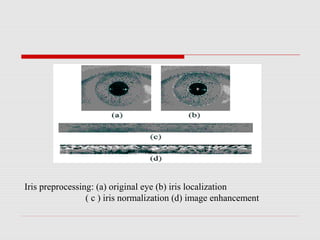
 Iris Localization
 Iris Normalization
 Image Enhancement
Iris Localization

Both the inner boundary and the outer boundary of a
typical iris can be taken as circles. But the two circles
are usually not co-centric. Compared with the other
part of the eye, the pupil is much darker. We detect the
inner boundary between the pupil and the iris. The
outer boundary of the iris is more difficult to detect
because of the low contrast between the two sides of
the boundary. We detect the outer boundary by
maximizing changes of the perimeter- normalized
along the circle. The technique is found to be efficient
and effective.
Iris Normalization
 The size of the pupil may change due to the variation of the
illumination and the associated elastic deformations in the iris
texture may interface with the results of pattern matching. For the
purpose of accurate texture analysis, it is necessary to
compensate this deformation. Since both the inner and outer
boundaries of the iris have been detected, it is easy to map the
iris ring to a rectangular block of texture of a fixed size.
Image Enhancement
 The original image has low contrast and may
have non-uniform illumination caused by the
position of the light source. These may impair
the result of the texture analysis. We enhance
the iris image reduce the effect of non-uniform
illumination.
Iris preprocessing: (a) original eye (b) iris localization
( c ) iris normalization (d) image enhancement
Comparison Of Iris Recognition With
Other Biometrics
 Accurate
 Stability
 Fast
 Scalable
Comparison
Method Coded Pattern
MisIdentific-
-ation rate
Security Applications
Iris Iris pattern 1/1,200,0
00
High high-security
Fingerprint fingerprints
1/1,000 Medium Universal
voice
Signature
Face
Palm
Voice
characteristics 1/30 Low
Low
Low
Low
Telephone service
Low-security
Low-security
Low-security
1/100
1/100
1/700
Shape of letters, writing
Order, pen pressure
Outline, shape &
distribution of eyes, nose
size, length, &
thickness hands
Analysis
 Current Uses
 Future Uses
References
 Y.Zhu,T.Tan and Y.Wang,”Biometric
Identification Based on Iris Pattern”.
 Anil K Jain,”Biometric Authentication: How
Do I Know Who You Are”.
 D Maltoni, D.Maio, Anil K Jain, and S
prabhakar”Handbook of Finger print
Recognition”.

Iris Biometric for Person Identification

  • 1.
    MADAN MOHAN MALVIYAUNIVERSITY TECHNOLOGY Gorakhpur IRIS Biometric for Person Identification By MANISH KUMAR CSE 3rd YEAR Roll No-1204210030 Submmited To Mr. M.K. Srivastav Sir Mr. J.P. Sir
  • 2.
     What areBiometrics?  Why are Biometrics used?  How Biometrics is today?
  • 3.
    Iris  Iris isthe area of the eye where the pigmented or colored circle,usually brown, blue, rings the dark pupil of the eye.
  • 4.
  • 5.
    Example of 10Different People Iris
  • 6.
    Exciting Biometrics  FingerprintRecognition  Voice Recognition  Signature Recognition  Face Recognition  Palm Recognition
  • 7.
    Fingerprint Recognition  Thisrelies on the fact that a fingerprint’s uniqueness can be defined by analyzing the minutiae of a human being.  Two individuals having the same fingerprint is less than one in a billion.
  • 8.
    Voice Recognition  Theperson to be identified is usually pronounce a designated password or phrase, which facilitates the verification process.  But has the weakness of technology
  • 9.
    Signature Recognition  Thisis done by analyzing the shape, speed, stroke, pen pressure and timing information during the act of signing.  Dynamic signature verification is a replacement.
  • 10.
    Face Recognition  Toidentify any person we generally look at face and eyes in particular seem to tell a story how the person feels.  Face recognition is a kind of electronic unmasking
  • 11.
    Palm Recognition  Theimage of the hand is collected and the feature vectors are extracted and compared with the database feature vectors.
  • 12.
    Iris Recognition systems The iris-scan process begins with a photograph. A specialized camera, typically very close to the subject, not more than three feet, uses an infrared imager to illuminate the eye and capture a very high-resolution photograph. This process takes 1 to 2 seconds.
  • 13.
    Creating an Iriscode  The picture of eye first is processed by software that localizes the inner and outer boundaries of the iris.  And it is encoded by image-processing technologies.
  • 14.
    Iris recognition  Inless than few seconds, even on a database of millions of records, the iris code template generated from a live image is compared to previously enrolled ones to see if it matches to any of them.
  • 15.
    Major characteristics ofiris recognition  Iris is thin membrane on the interior of the eyeball.  Iris pattern remains unchanged after the age of two and does not degrade overtime or with the environment.  Iris patterns are extremely complex than other biometric patterns
  • 16.
    Typical iris systemconfiguration for taking a picture  An iris recognition camera takes a black and white picture from 5 to 24 inches away.  The camera uses non-invasive, near-infrared illumination that is barely visible and very safe.  And this iris recognition cannot take place without the person permission
  • 17.
    Example of irisrecognition system Lan reference Gate device Management device Register
  • 18.
    Typical iris systemconfiguration Pre processing Feature- extraction Identification Verification Stored templates Uniform distribution Reject AcceptIris scan 2d image capture Iris localization Transform representation comparison enrolment Authentication
  • 19.
    Techniques used  IrisLocalization  Iris Normalization  Image Enhancement
  • 20.
    Iris Localization  Both theinner boundary and the outer boundary of a typical iris can be taken as circles. But the two circles are usually not co-centric. Compared with the other part of the eye, the pupil is much darker. We detect the inner boundary between the pupil and the iris. The outer boundary of the iris is more difficult to detect because of the low contrast between the two sides of the boundary. We detect the outer boundary by maximizing changes of the perimeter- normalized along the circle. The technique is found to be efficient and effective.
  • 21.
    Iris Normalization  Thesize of the pupil may change due to the variation of the illumination and the associated elastic deformations in the iris texture may interface with the results of pattern matching. For the purpose of accurate texture analysis, it is necessary to compensate this deformation. Since both the inner and outer boundaries of the iris have been detected, it is easy to map the iris ring to a rectangular block of texture of a fixed size.
  • 22.
    Image Enhancement  Theoriginal image has low contrast and may have non-uniform illumination caused by the position of the light source. These may impair the result of the texture analysis. We enhance the iris image reduce the effect of non-uniform illumination.
  • 23.
    Iris preprocessing: (a)original eye (b) iris localization ( c ) iris normalization (d) image enhancement
  • 24.
    Comparison Of IrisRecognition With Other Biometrics  Accurate  Stability  Fast  Scalable
  • 25.
    Comparison Method Coded Pattern MisIdentific- -ationrate Security Applications Iris Iris pattern 1/1,200,0 00 High high-security Fingerprint fingerprints 1/1,000 Medium Universal voice Signature Face Palm Voice characteristics 1/30 Low Low Low Low Telephone service Low-security Low-security Low-security 1/100 1/100 1/700 Shape of letters, writing Order, pen pressure Outline, shape & distribution of eyes, nose size, length, & thickness hands
  • 26.
  • 27.
    References  Y.Zhu,T.Tan andY.Wang,”Biometric Identification Based on Iris Pattern”.  Anil K Jain,”Biometric Authentication: How Do I Know Who You Are”.  D Maltoni, D.Maio, Anil K Jain, and S prabhakar”Handbook of Finger print Recognition”.