Name-Sunjay kumar sahu
Branch-CSE
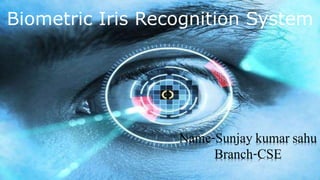
Biometric Iris Recognition System
Contents
Overview of biometrics
Introduction
Iris Recognition systems
Four simple steps to follow
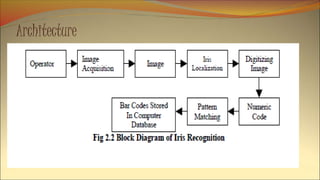
Architecture
Working of iris technology
1. Image Acquisition
2. Preprocessing
 Iris Localization
 Edge Detection
3. Image Analysis
4. Image Recognition
Recording of Identities
Pattern Matching
Advantages of iris technology
Disadvantages of iris technology
Applications of iris Recognition
system
Real Life Applications
Comparison Of Iris Recognition
With Other Biometrics
Conclusion
References
Overview of biometrics
Biometrics is the science of measuring physical or anatomical
characteristics of individuals.
It performs automatic identification of a person based on his/her
physiological characteristics.
Among the features measured are face, fingerprints, handwriting, iris,
retinal, vein, and voice. Biometric technologies are becoming the
foundation of an extensive array of highly secure identification and
personal verification solutions.
Of all the biometric devices and scanners available today, it is generally
conceded that iris recognition is the most accurate. The automated
method of iris recognition is relatively young, existing in patent since
only 1994.
Introduction
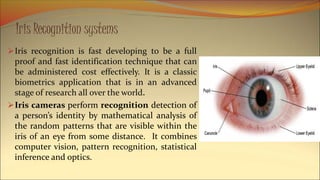
Iris is the area of the eye where the pigmented or
colored circle, usually brown, blue, rings the dark
pupil of the eye.
It is the colored portion of the eye that regulates the
size of the pupil.
Has unique complex and random patterns which can
be seen from some distance.
Iris recognition is an automated method of biometric
identification that uses mathematical pattern-
recognition techniques on the images of the irides of
an individual's eyes, whose complex random patterns
are unique and can be seen from some distance.
Iris Recognition systems
Iris recognition is fast developing to be a full
proof and fast identification technique that can
be administered cost effectively. It is a classic
biometrics application that is in an advanced
stage of research all over the world.
Iris cameras perform recognition detection of
a person’s identity by mathematical analysis of
the random patterns that are visible within the
iris of an eye from some distance. It combines
computer vision, pattern recognition, statistical
inference and optics.
FOUR SIMPLE STEPS TO FOLLOW
A person stands in front of the iris identification system, between one or
three feet away, while a wide angle camera calculates the position of
their eye.
A second camera zooms in on the eye and takes a black and white
image.
Once the iris is in focus, it overlays a circular grid on the image of the
iris and identifies the light and dark areas, like an “eye print”.
To prevent a fake eye from being used to fool system, these devices may
vary the light shine into the eye and watch for pupil dilation.
Architecture
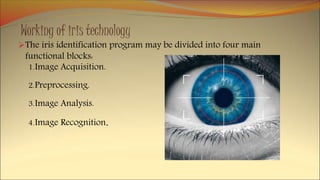
Working of iris technology
The iris identification program may be divided into four main
functional blocks:
1.Image Acquisition.
2.Preprocessing.
3.Image Analysis.
4.Image Recognition.
Image Acquisition
To acquire images with sufficient resolution and sharpness to support recognition.
Good contrast and high illumination.
Optics and Camera:
 Human heads are on the order of 15 cm wide.
 In case of a portal, we needed a capture volume width on the order of 20–30 cm.
 More than 200 pixels or more across the iris- Good quality.
 Of 150–200 pixels across the iris – Acceptable quality
 Of 100–150 pixels to be of- Marginal quality.
Camera Distance up to 3 meters.
High Quality Image, Daughman’s Algorithm expect minimum 640X480.
Preprocessing
The acquired image always not only “useful” parts (IRIS), but also some
“irrelevant” parts e.g. eyelid, pupil .
Preprocessing removes the effect of spots/holes lying on the pupillary
area.
The Preprocessing module first transforms the true colour into intensity
image
So the preprocessing is composed of two steps:
1. Iris Localization
2. Edge Detection
Iris Localization
 Both the inner boundary and the outer boundary of a typical iris can
be taken as circles.
 But the two circles are usually not co-centric.
The inner boundary between the pupil and the iris is detected.
 The outer boundary of the iris is more difficult to detect because of the
low contrast between the two sides of the boundary.
 The outer boundary is detected by maximizing changes of the
perimeter- normalized along the circle.
Edge Detection
It is used to find complex object boundaries by marking potential edge
point corresponding to places in an image where rapid change in
brightness occurs.
In other words, edge is defined by the discontinuity in gray values. An
edge separates two distinct objects.
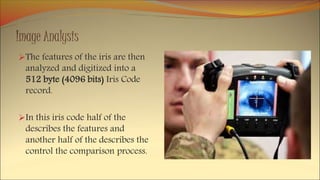
Image Analysis
The features of the iris are then
analyzed and digitized into a
512 byte (4096 bits) Iris Code
record.
In this iris code half of the
describes the features and
another half of the describes the
control the comparison process.
Image Recognition
Iris code record is stored in the database for future comparison.
During a recognition attempt, when an iris is presented at a
recognition point, the same process is repeated ; however the resulting
Iris Code record is not stored but is compared to every file in the
database.
Recording of Identities
The Process Overview:
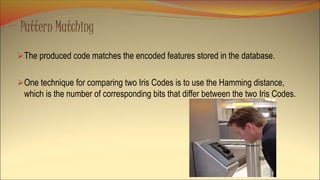
Pattern Matching
The produced code matches the encoded features stored in the database.
One technique for comparing two Iris Codes is to use the Hamming distance,
which is the number of corresponding bits that differ between the two Iris Codes.
Advantages of iris technology
Uniqueness of iris patterns hence improved accuracy.
Highly protected, internal organ of the eye.
Stability : Persistence of iris patterns.
Non-invasive : Relatively easy to be acquired.
Unique - the probability of two rises producing the same code is nearly
impossible.
Flexible - iris recognition technology easily integrates into existing
security systems or operates as a standalone
Patterns apparently stable throughout life.
Reliable - a distinctive iris pattern is not susceptible to theft, loss or
compromise
Disadvantages of iris technology
Small target (1 cm) to acquire from a distance (1m)
Alcohol consumption causes deformation in Iris pattern
Illumination should not be visible or bright
Obscured by eyelashes, lenses, reflections
It will be difficult to capture an image of handicap people sitting on
wheel chair because the cameras are usually attached on the wall and
capture an image up to a certain height.
The iris recognition systems are much costlier than other biometric
technologies.
If a person is wearing glasses or facing direct sunlight for quite a while,
than it may affect the authentication.
Applications of iris Recognition system
Computer login: the iris as a living password.
National border controls: the iris as a living passport.
Driving licenses and personal certificates.
Internet security, control of access to privileged information.
Premises access control (Home, Office, Laboratory).
Anti-terrorism (e.g. security screening at airports)
Financial Transactions (electronic commerce and banking).
Secure accesses to bank cash machine accounts.
Credit-card authentication.
Automobile ignition and unlocking; anti-theft devices
Real Life Applications:
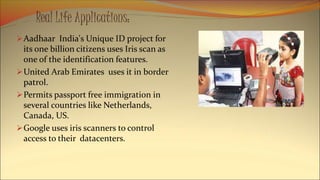
Aadhaar India's Unique ID project for
its one billion citizens uses Iris scan as
one of the identification features.
United Arab Emirates uses it in border
patrol.
Permits passport free immigration in
several countries like Netherlands,
Canada, US.
Google uses iris scanners to control
access to their datacenters.
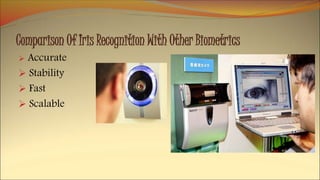
Comparison Of Iris Recognition With Other Biometrics
 Accurate
 Stability
 Fast
 Scalable
Comparison
Method
Coded Pattern
MisIdentific
--ation rate
Security Applications
Iris Iris pattern 1/1,200,00
0
High high-security
Fingerprint fingerprints
1/1,000 Medium
Universal
voice
Signature
Face
Palm
Voice
characteristics 1/30 Low
Low
Low
Low
Telephone service
Low-security
Low-security
Low-security
1/100
1/100
1/700
Shape of letters, writing
Order, pen pressure
Outline, shape &
distribution of eyes, nose
size, length, & thickness
hands
Conclusion
The applications of iris recognition are rapidly growing in the field of
security, due to it’s high rate of accuracy. This technology has the
potential to take over all other security techniques, as it provides a
hands-free, rapid and reliable identification process.
Iris recognition has proven to be a very useful and versatile security
measure.
It is a quick and accurate way of identifying an individual with no
chance for human error.
Iris recognition is widely used in the transportation industry and can
have many applications in other fields where security is necessary.
Iris recognition will prove to be a widely used security measure in the
future.
References
http://findbiometrics.com/solutions/iris-scanners-recognition/
http://www.irisid.com/irisrecognitiontechnology
http://www.slideshare.net/search/slideshow?searchfrom=header&q=iris+
recognition
http://en.wikipedia.org/wiki/Iris_recognition#History
Biometrics iris recognition

Biometrics iris recognition

  • 1.
  • 2.
    Contents Overview of biometrics Introduction IrisRecognition systems Four simple steps to follow Architecture Working of iris technology 1. Image Acquisition 2. Preprocessing  Iris Localization  Edge Detection 3. Image Analysis 4. Image Recognition Recording of Identities Pattern Matching Advantages of iris technology Disadvantages of iris technology Applications of iris Recognition system Real Life Applications Comparison Of Iris Recognition With Other Biometrics Conclusion References
  • 3.
    Overview of biometrics Biometricsis the science of measuring physical or anatomical characteristics of individuals. It performs automatic identification of a person based on his/her physiological characteristics. Among the features measured are face, fingerprints, handwriting, iris, retinal, vein, and voice. Biometric technologies are becoming the foundation of an extensive array of highly secure identification and personal verification solutions. Of all the biometric devices and scanners available today, it is generally conceded that iris recognition is the most accurate. The automated method of iris recognition is relatively young, existing in patent since only 1994.
  • 4.
    Introduction Iris is thearea of the eye where the pigmented or colored circle, usually brown, blue, rings the dark pupil of the eye. It is the colored portion of the eye that regulates the size of the pupil. Has unique complex and random patterns which can be seen from some distance. Iris recognition is an automated method of biometric identification that uses mathematical pattern- recognition techniques on the images of the irides of an individual's eyes, whose complex random patterns are unique and can be seen from some distance.
  • 5.
    Iris Recognition systems Irisrecognition is fast developing to be a full proof and fast identification technique that can be administered cost effectively. It is a classic biometrics application that is in an advanced stage of research all over the world. Iris cameras perform recognition detection of a person’s identity by mathematical analysis of the random patterns that are visible within the iris of an eye from some distance. It combines computer vision, pattern recognition, statistical inference and optics.
  • 6.
    FOUR SIMPLE STEPSTO FOLLOW A person stands in front of the iris identification system, between one or three feet away, while a wide angle camera calculates the position of their eye. A second camera zooms in on the eye and takes a black and white image. Once the iris is in focus, it overlays a circular grid on the image of the iris and identifies the light and dark areas, like an “eye print”. To prevent a fake eye from being used to fool system, these devices may vary the light shine into the eye and watch for pupil dilation.
  • 7.
  • 8.
    Working of iristechnology The iris identification program may be divided into four main functional blocks: 1.Image Acquisition. 2.Preprocessing. 3.Image Analysis. 4.Image Recognition.
  • 9.
    Image Acquisition To acquireimages with sufficient resolution and sharpness to support recognition. Good contrast and high illumination. Optics and Camera:  Human heads are on the order of 15 cm wide.  In case of a portal, we needed a capture volume width on the order of 20–30 cm.  More than 200 pixels or more across the iris- Good quality.  Of 150–200 pixels across the iris – Acceptable quality  Of 100–150 pixels to be of- Marginal quality. Camera Distance up to 3 meters. High Quality Image, Daughman’s Algorithm expect minimum 640X480.
  • 10.
    Preprocessing The acquired imagealways not only “useful” parts (IRIS), but also some “irrelevant” parts e.g. eyelid, pupil . Preprocessing removes the effect of spots/holes lying on the pupillary area. The Preprocessing module first transforms the true colour into intensity image So the preprocessing is composed of two steps: 1. Iris Localization 2. Edge Detection
  • 11.
    Iris Localization  Boththe inner boundary and the outer boundary of a typical iris can be taken as circles.  But the two circles are usually not co-centric. The inner boundary between the pupil and the iris is detected.  The outer boundary of the iris is more difficult to detect because of the low contrast between the two sides of the boundary.  The outer boundary is detected by maximizing changes of the perimeter- normalized along the circle.
  • 12.
    Edge Detection It isused to find complex object boundaries by marking potential edge point corresponding to places in an image where rapid change in brightness occurs. In other words, edge is defined by the discontinuity in gray values. An edge separates two distinct objects.
  • 13.
    Image Analysis The featuresof the iris are then analyzed and digitized into a 512 byte (4096 bits) Iris Code record. In this iris code half of the describes the features and another half of the describes the control the comparison process.
  • 14.
    Image Recognition Iris coderecord is stored in the database for future comparison. During a recognition attempt, when an iris is presented at a recognition point, the same process is repeated ; however the resulting Iris Code record is not stored but is compared to every file in the database.
  • 15.
  • 16.
  • 17.
    Pattern Matching The producedcode matches the encoded features stored in the database. One technique for comparing two Iris Codes is to use the Hamming distance, which is the number of corresponding bits that differ between the two Iris Codes.
  • 18.
    Advantages of iristechnology Uniqueness of iris patterns hence improved accuracy. Highly protected, internal organ of the eye. Stability : Persistence of iris patterns. Non-invasive : Relatively easy to be acquired. Unique - the probability of two rises producing the same code is nearly impossible. Flexible - iris recognition technology easily integrates into existing security systems or operates as a standalone Patterns apparently stable throughout life. Reliable - a distinctive iris pattern is not susceptible to theft, loss or compromise
  • 19.
    Disadvantages of iristechnology Small target (1 cm) to acquire from a distance (1m) Alcohol consumption causes deformation in Iris pattern Illumination should not be visible or bright Obscured by eyelashes, lenses, reflections It will be difficult to capture an image of handicap people sitting on wheel chair because the cameras are usually attached on the wall and capture an image up to a certain height. The iris recognition systems are much costlier than other biometric technologies. If a person is wearing glasses or facing direct sunlight for quite a while, than it may affect the authentication.
  • 20.
    Applications of irisRecognition system Computer login: the iris as a living password. National border controls: the iris as a living passport. Driving licenses and personal certificates. Internet security, control of access to privileged information. Premises access control (Home, Office, Laboratory). Anti-terrorism (e.g. security screening at airports) Financial Transactions (electronic commerce and banking). Secure accesses to bank cash machine accounts. Credit-card authentication. Automobile ignition and unlocking; anti-theft devices
  • 21.
    Real Life Applications: AadhaarIndia's Unique ID project for its one billion citizens uses Iris scan as one of the identification features. United Arab Emirates uses it in border patrol. Permits passport free immigration in several countries like Netherlands, Canada, US. Google uses iris scanners to control access to their datacenters.
  • 22.
    Comparison Of IrisRecognition With Other Biometrics  Accurate  Stability  Fast  Scalable
  • 23.
    Comparison Method Coded Pattern MisIdentific --ation rate SecurityApplications Iris Iris pattern 1/1,200,00 0 High high-security Fingerprint fingerprints 1/1,000 Medium Universal voice Signature Face Palm Voice characteristics 1/30 Low Low Low Low Telephone service Low-security Low-security Low-security 1/100 1/100 1/700 Shape of letters, writing Order, pen pressure Outline, shape & distribution of eyes, nose size, length, & thickness hands
  • 24.
    Conclusion The applications ofiris recognition are rapidly growing in the field of security, due to it’s high rate of accuracy. This technology has the potential to take over all other security techniques, as it provides a hands-free, rapid and reliable identification process. Iris recognition has proven to be a very useful and versatile security measure. It is a quick and accurate way of identifying an individual with no chance for human error. Iris recognition is widely used in the transportation industry and can have many applications in other fields where security is necessary. Iris recognition will prove to be a widely used security measure in the future.
  • 25.