FACULTY DEVELOPMENT
    PROGRAMME
        TODAYS TOPIC


OPTICAL FIBER COMMUNICATION

              BY


     Mr.Rajkumar D Bhure
  Assoc.Prof.,ECE Dept. JBIET
DEPT OF ELECTRONICS & COMMUNICATION ENGINEERING,JBIET

     Optical Fiber Communication


                             By:- Mr. Rajkumar D
   Bhure
                             Assoc.Prof. ECE Dept.
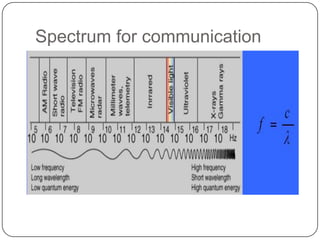
Spectrum for communication
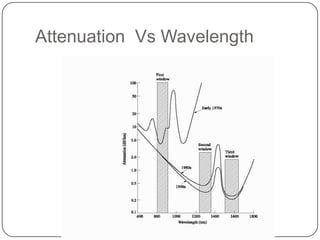
Attenuation Vs Wavelength
Fiber vs. Copper
 Optical fiber transmits light pulses
   Can be used for analog or digital transmission
   Voice, computer data, video, etc.
 Copper wires (or other metals) can carry the same
 types of signals with electrical pulses
Advantages of
        OFC over conventional Copper Wire Communication
 Small Size and light Weight
 Abundant Raw Material Availability
 Higher Band Width Low Noise
 Low transmission loss and high signal security
 Highly Reliable and easy of maintainance
 Fibers Are Electrically Isolation
 Highly transparent at particularo Wave Length
 No possiblityof ISI and echoes cross talketc.
 Immunity to natural hazardous.
Index of Refraction(n)
 When light enters a dense medium like glass
  or water, it slows down
 The index of refraction (n) is the ratio of the
  speed of light in vacuum to the speed of light
  in the medium n=c/v
 Water has n = 1.3
   Light takes 30% longer to travel through it
 Fiber optic glass has n = 1.5
   Light takes 50% longer to travel through it
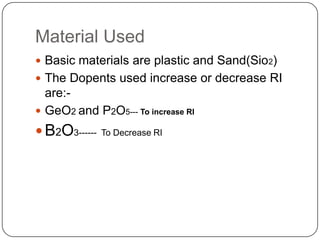
Material Used
 Basic materials are plastic and Sand(Sio2)
 The Dopents used increase or decrease RI
  are:-
 GeO2 and P2O5--- To increase RI
 B2O3------   To Decrease RI
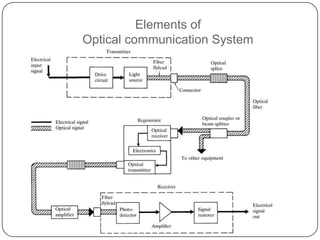
Elements of
Optical communication System
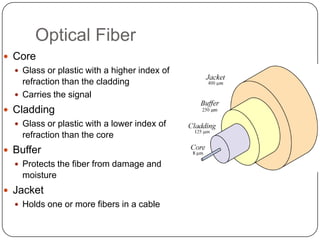
Optical Fiber
 Core
   Glass or plastic with a higher index of
    refraction than the cladding
   Carries the signal

 Cladding
   Glass or plastic with a lower index of
    refraction than the core
 Buffer
   Protects the fiber from damage and
    moisture
 Jacket
   Holds one or more fibers in a cable
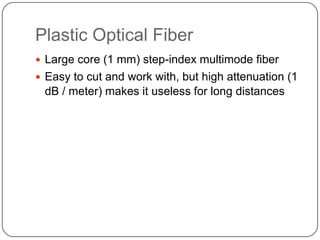
Plastic Optical Fiber
 Large core (1 mm) step-index multimode fiber
 Easy to cut and work with, but high attenuation (1
 dB / meter) makes it useless for long distances
Singlemode Fiber
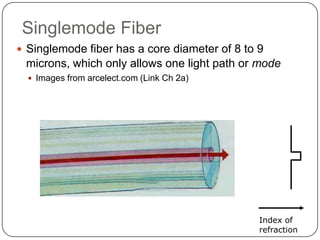
 Singlemode fiber has a core diameter of 8 to 9
 microns, which only allows one light path or mode
   Images from arcelect.com (Link Ch 2a)


                                               Index of
                                               refraction
Multimode Step-Index Fiber
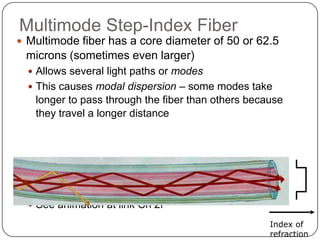
 Multimode fiber has a core diameter of 50 or 62.5
 microns (sometimes even larger)
   Allows several light paths or modes
   This causes modal dispersion – some modes take
   longer to pass through the fiber than others because
   they travel a longer distance


   See animation at link Ch 2f

                                                    Index of
                                                    refraction
Step-index Multimode
 Large core size, so source power can be
    efficiently coupled to the fiber
   High attenuation (4-6 dB / km)
   Low bandwidth (50 MHz-km)
   Used in short, low-speed datalinks
   Also useful in high-radiation
    environments, because it can be made with pure
    silica core
Singlemode FIber
 Best for high speeds and long distances
 Used by telephone companies and CATV
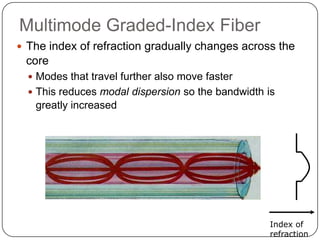
Multimode Graded-Index Fiber
 The index of refraction gradually changes across the
 core
   Modes that travel further also move faster
   This reduces modal dispersion so the bandwidth is
   greatly increased


                                                   Index of
                                                   refraction
Step-index and Graded-index
 Step index multimode was developed first, but
  rare today because it has a low bandwidth (50
  MHz-km)
 It has been replaced by graded-index multimode
  with a bandwidth up to 2 GHz-km
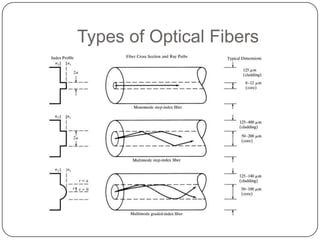
Types of Optical Fibers
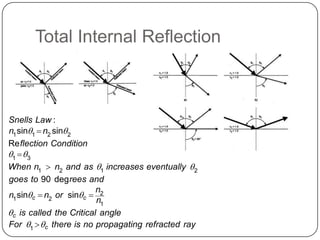
Total Internal Reflection


Snells Law :
n1 sin1  n2 sin2
Re flection Condition
1  3
When n1  n2 and as 1 increases eventually 2
goes to 90 deg rees and
                         n
n1 sinc  n2 or sinc  2
                         n1
c is called the Critical angle
For 1  c there is no propagating refracted ray
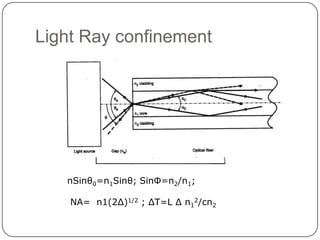
Light Ray confinement


   nSinθ0=n1Sinθ; SinΦ=n2/n1;

    NA= n1(2Δ)1/2 ; ΔT=L Δ n12/cn2
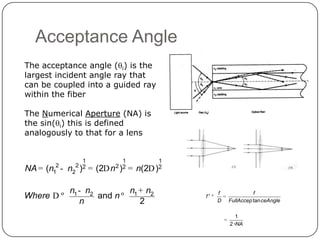
Acceptance Angle
The acceptance angle (i) is the
largest incident angle ray that
can be coupled into a guided ray
within the fiber

The Numerical Aperture (NA) is
the sin(i) this is defined
analogously to that for a lens


                        1               1              1
NA =   (n12 -   n2   2 2
                      )     =        2 2
                                (2D n )     =   n(2D ) 2


                n1 - n2         n + n2
Where D º               and n º 1                          f# º
                                                                  f
                                                                    =
                                                                              f
                   n              2                               D FullAccep tan ceAngle

                                                                           1
                                                                    =
                                                                        2 ×NA
Sources and Wavelengths
 Multimode fiber is used with
   LED sources at wavelengths of 850 and 1300 nm
    for slower local area networks
   Lasers at 850 and 1310 nm for networks running at
    gigabits per second or more
Sources and Wavelengths
 Singlemode fiber is used with
   Laser sources at 1300 and 1550 nm
   Bandwidth is extremely high, around 100 THz-km
Fiber Optic Specifications
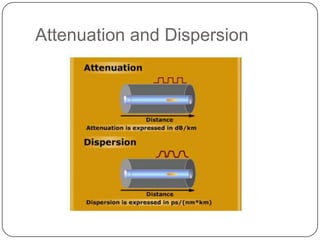
 Attenuation
   Loss of signal, measured in dB
 Dispersion
   Blurring of a signal, affects bandwidth
 Bandwidth
   The number of bits per second that can be sent
   through a data link
 Numerical Aperture
   Measures the largest angle of light that can be
   accepted into the core
Attenuation and Dispersion
Measuring Bandwidth
 The bandwidth-distance product in units of
  MHz×km shows how fast data can be sent
  through a cable
 A common multimode fiber with bandwidth-
  distance product of 500 MHz×km could
  carry
  A 500 MHz signal for 1 km, or
  A 1000 MHz signal for 0.5 km
    From Wikipedia
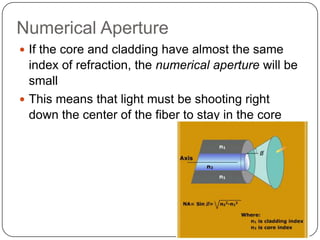
Numerical Aperture
 If the core and cladding have almost the same
  index of refraction, the numerical aperture will be
  small
 This means that light must be shooting right
  down the center of the fiber to stay in the core
Fiber Manufacture
Three Methods
 Modified Chemical Vapor Deposition (MCVD)
 Outside Vapor Deposition (OVD)
 Vapor Axial Deposition (VAD)
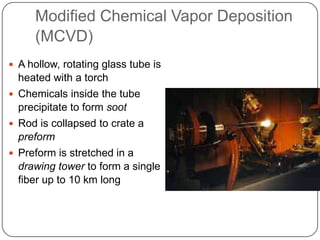
Modified Chemical Vapor Deposition
     (MCVD)
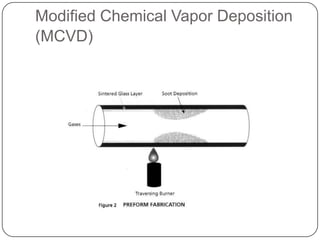
 A hollow, rotating glass tube is
  heated with a torch
 Chemicals inside the tube
  precipitate to form soot
 Rod is collapsed to crate a
  preform
 Preform is stretched in a
  drawing tower to form a single
  fiber up to 10 km long
Modified Chemical Vapor Deposition
(MCVD)
Outside Vapor Deposition (OVD)
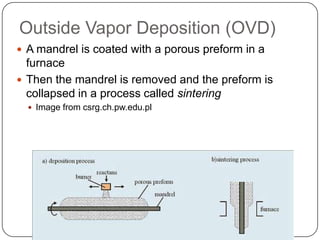
 A mandrel is coated with a porous preform in a
  furnace
 Then the mandrel is removed and the preform is
  collapsed in a process called sintering
   Image from csrg.ch.pw.edu.pl
Vapor Axial Deposition (VAD)
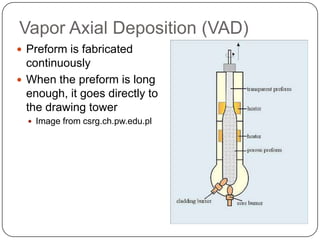
 Preform is fabricated
  continuously
 When the preform is long
  enough, it goes directly to
  the drawing tower
   Image from csrg.ch.pw.edu.pl
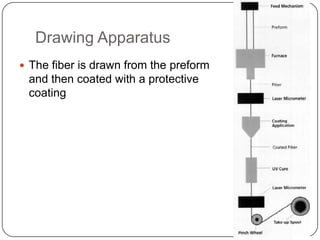
Drawing Apparatus
 The fiber is drawn from the preform
 and then coated with a protective
 coating
Fiber Performance
Attenuation
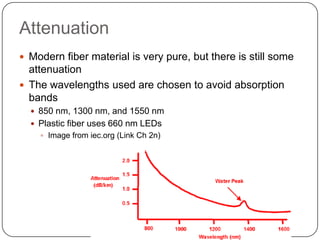
 Modern fiber material is very pure, but there is still some
  attenuation
 The wavelengths used are chosen to avoid absorption
  bands
   850 nm, 1300 nm, and 1550 nm
   Plastic fiber uses 660 nm LEDs
     Image from iec.org (Link Ch 2n)
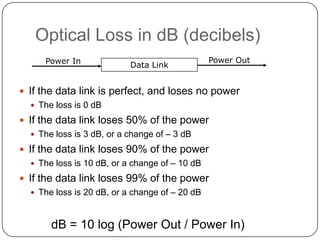
Optical Loss in dB (decibels)
      Power In                               Power Out
                          Data Link


 If the data link is perfect, and loses no power
    The loss is 0 dB

 If the data link loses 50% of the power
    The loss is 3 dB, or a change of – 3 dB

 If the data link loses 90% of the power
    The loss is 10 dB, or a change of – 10 dB

 If the data link loses 99% of the power
    The loss is 20 dB, or a change of – 20 dB


       dB = 10 log (Power Out / Power In)
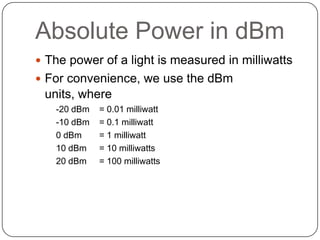
Absolute Power in dBm
 The power of a light is measured in milliwatts
 For convenience, we use the dBm
 units, where
   -20 dBm   = 0.01 milliwatt
   -10 dBm   = 0.1 milliwatt
   0 dBm     = 1 milliwatt
   10 dBm    = 10 milliwatts
   20 dBm    = 100 milliwatts
Three Types of Dispersion
 Dispersion is the spreading out of a light pulse as
  it travels through the fiber
 Three types:
   Modal Dispersion
   Chromatic Dispersion
   Polarization Mode Dispersion (PMD)
Modal Dispersion
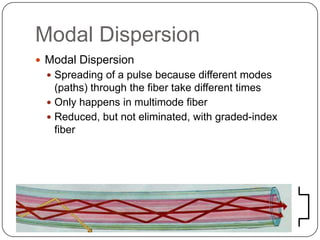
 Modal Dispersion
   Spreading of a pulse because different modes
    (paths) through the fiber take different times
   Only happens in multimode fiber
   Reduced, but not eliminated, with graded-index
    fiber
Chromatic Dispersion
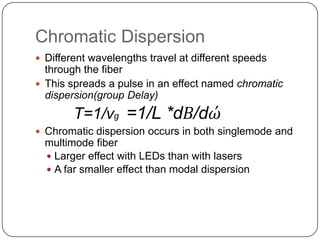
 Different wavelengths travel at different speeds
  through the fiber
 This spreads a pulse in an effect named chromatic
  dispersion(group Delay)
        T=1/vg =1/L *dВ/dώ
 Chromatic dispersion occurs in both singlemode and
  multimode fiber
   Larger effect with LEDs than with lasers
   A far smaller effect than modal dispersion
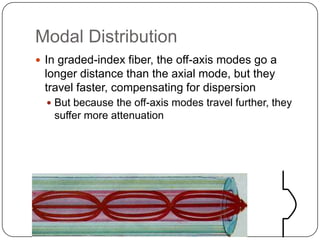
Modal Distribution
 In graded-index fiber, the off-axis modes go a
 longer distance than the axial mode, but they
 travel faster, compensating for dispersion
   But because the off-axis modes travel further, they
   suffer more attenuation
Equilibrium Modal Distribution
 A long fiber that has lost the high-order modes is
  said to have an equilibrium modal distribution
 For testing fibers, devices that can be used to
  condition the modal distribution so that
  measurements will be accurate
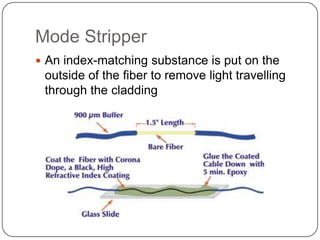
Mode Stripper
 An index-matching substance is put on the
 outside of the fiber to remove light travelling
 through the cladding
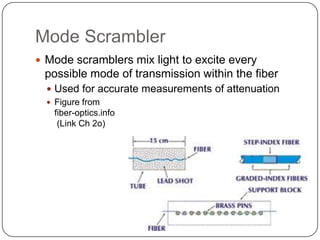
Mode Scrambler
 Mode scramblers mix light to excite every
 possible mode of transmission within the fiber
   Used for accurate measurements of attenuation
   Figure from
    fiber-optics.info
     (Link Ch 2o)
Semiconductor Optical Sources
Source Characteristics
 Important Parameters
   Electrical-optical conversion efficiency
   Optical power
   Wavelength
   Wavelength distribution (called linewidth)
   Cost
 Semiconductor lasers
   Compact
   Good electrical-optical conversion efficiency
   Low voltages
   Los cost
Semiconductor Optoelectronics
 Two energy bands
   Conduction band (CB)
   Valence band (VB)
 Fundamental processes
   Absorbed photon creates an electron-hole pair
   Recombination of an electron and hole can emit a photon
 Types of photon emission
   Spontaneous emission
     Random recombination of an electron-hole pair
     Dominant emission for light emitting diodes (LED)
   Stimulated emission
     A photon excites another electron and hole to recombine
     Emitted photon has similar wavelength, direction, and phase
     Dominant emission for laser diodes
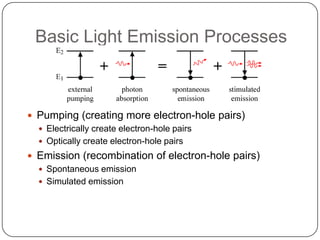
Basic Light Emission Processes


 Pumping (creating more electron-hole pairs)
   Electrically create electron-hole pairs
   Optically create electron-hole pairs
 Emission (recombination of electron-hole pairs)
   Spontaneous emission
   Simulated emission
Semiconductor Material
 Semiconductor crystal is required
 Type IV elements on Periodic Table
   Silicon
   Germanium
 Combination of III-V materials
   GaAs
   InP
   AlAs
   GaP
   InAs
    …
Direct and Indirect Materials


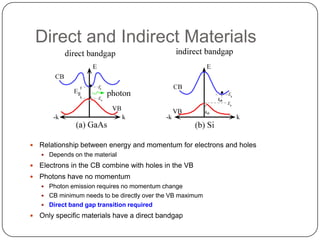
   Relationship between energy and momentum for electrons and holes
     Depends on the material

   Electrons in the CB combine with holes in the VB
   Photons have no momentum
     Photon emission requires no momentum change
     CB minimum needs to be directly over the VB maximum
     Direct band gap transition required

   Only specific materials have a direct bandgap
Light Emission
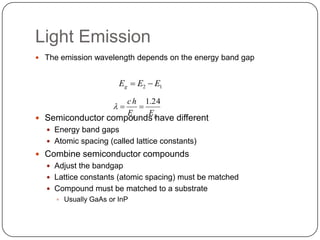
 The emission wavelength depends on the energy band gap


                       Eg  E2  E1

                         ch   1.24
                     
                    Eg   E
 Semiconductor compounds ghave different
   Energy band gaps
   Atomic spacing (called lattice constants)
 Combine semiconductor compounds
   Adjust the bandgap
   Lattice constants (atomic spacing) must be matched
   Compound must be matched to a substrate
      Usually GaAs or InP
Common Semiconductor
Compounds
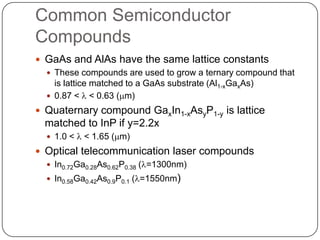
 GaAs and AlAs have the same lattice constants
   These compounds are used to grow a ternary compound that
    is lattice matched to a GaAs substrate (Al1-xGaxAs)
   0.87 <  < 0.63 (mm)
 Quaternary compound GaxIn1-xAsyP1-y is lattice
  matched to InP if y=2.2x
   1.0 <  < 1.65 (mm)
 Optical telecommunication laser compounds
   In0.72Ga0.28As0.62P0.38 (=1300nm)
   In0.58Ga0.42As0.9P0.1 (=1550nm)
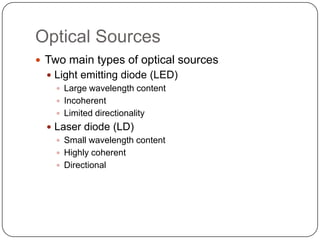
Optical Sources
 Two main types of optical sources
   Light emitting diode (LED)
     Large wavelength content
     Incoherent
     Limited directionality
   Laser diode (LD)
     Small wavelength content
     Highly coherent
     Directional
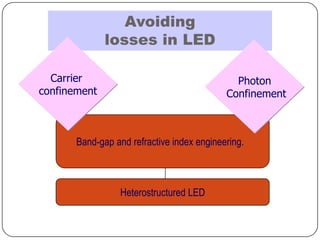
Avoiding
              losses in LED

  Carrier                                     Photon
confinement                                 Confinement


       Band-gap and refractive index engineering.


                  Heterostructured LED
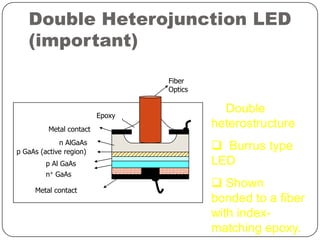
Double Heterojunction LED
   (important)

                                 Fiber
                                 Optics


                         Epoxy
                                           Double
         Metal contact
                                          heterostructure
             n AlGaAs
p GaAs (active region)
                                           Burrus type
         p Al GaAs                        LED
         n+ GaAs

     Metal contact
                                           Shown
                                          bonded to a fiber
                                          with index-
                                          matching epoxy.
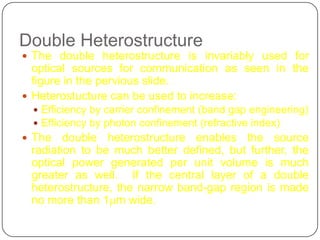
Double Heterostructure
 The double heterostructure is invariably used for
  optical sources for communication as seen in the
  figure in the pervious slide.
 Heterostucture can be used to increase:
  Efficiency by carrier confinement (band gap engineering)
  Efficiency by photon confinement (refractive index)
 The   double heterostructure enables the source
 radiation to be much better defined, but further, the
 optical power generated per unit volume is much
 greater as well. If the central layer of a double
 heterostructure, the narrow band-gap region is made
 no more than 1mm wide.
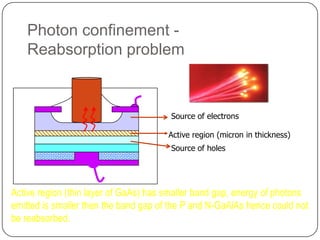
Photon confinement -
   Reabsorption problem


                                       Source of electrons

                                       Active region (micron in thickness)
                                       Source of holes


Active region (thin layer of GaAs) has smaller band gap, energy of photons
emitted is smaller then the band gap of the P and N-GaAlAs hence could not
be reabsorbed.
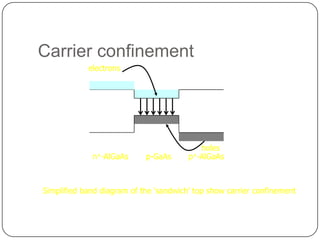
Carrier confinement
            electrons


                                           holes
             n+-AlGaAs      p-GaAs      p+-AlGaAs


Simplified band diagram of the ‘sandwich’ top show carrier confinement
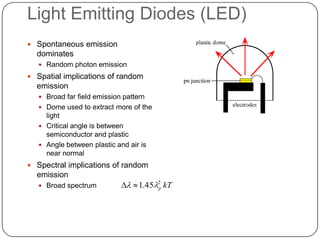
Light Emitting Diodes (LED)
 Spontaneous emission
  dominates
    Random photon emission

 Spatial implications of random
  emission
    Broad far field emission pattern
    Dome used to extract more of the
     light
    Critical angle is between
     semiconductor and plastic
    Angle between plastic and air is
     near normal
 Spectral implications of random
  emission
    Broad spectrum            1.452 kT
                                       p
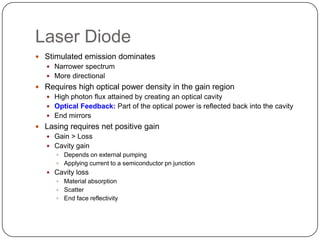
Laser Diode
 Stimulated emission dominates
   Narrower spectrum
   More directional
 Requires high optical power density in the gain region
   High photon flux attained by creating an optical cavity
   Optical Feedback: Part of the optical power is reflected back into the cavity
   End mirrors
 Lasing requires net positive gain
   Gain > Loss
   Cavity gain
       Depends on external pumping
       Applying current to a semiconductor pn junction
    Cavity loss
      Material absorption
      Scatter
      End face reflectivity
Laser Diode
 Stimulated emission dominates
   Narrower spectrum
   More directional
 Requires high optical power density in the gain region
   High photon flux attained by creating an optical cavity
   Optical Feedback: Part of the optical power is reflected back into the cavity
   End mirrors
 Lasing requires net positive gain
   Gain > Loss
   Cavity gain
       Depends on external pumping
       Applying current to a semiconductor pn junction
    Cavity loss
      Material absorption
      Scatter
      End face reflectivity
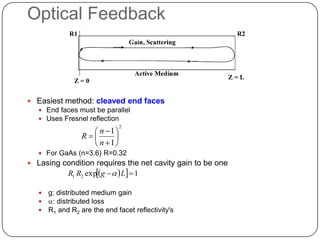
Optical Feedback


 Easiest method: cleaved end faces
   End faces must be parallel
   Uses Fresnel reflection

                     n 1 
                               2

                  R      
                     n 1
    For GaAs (n=3.6) R=0.32
 Lasing condition requires the net cavity gain to be one
             R1 R2 expg  a  L  1

      g: distributed medium gain
      a: distributed loss
      R1 and R2 are the end facet reflectivity's
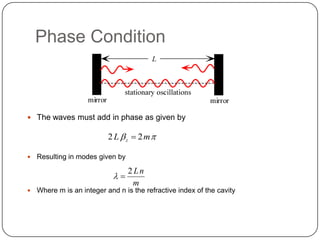
Phase Condition


 The waves must add in phase as given by

                           2 L  z  2 m

   Resulting in modes given by

                                  2Ln
                             
                                   m
   Where m is an integer and n is the refractive index of the cavity
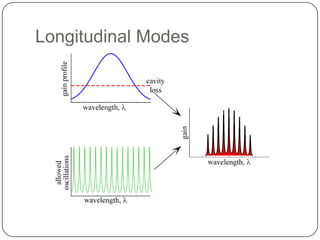
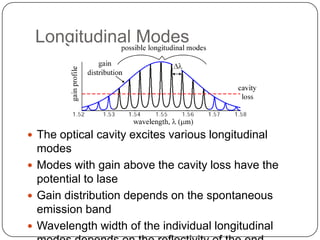
Longitudinal Modes
Longitudinal Modes


 The optical cavity excites various longitudinal
  modes
 Modes with gain above the cavity loss have the
  potential to lase
 Gain distribution depends on the spontaneous
  emission band
 Wavelength width of the individual longitudinal
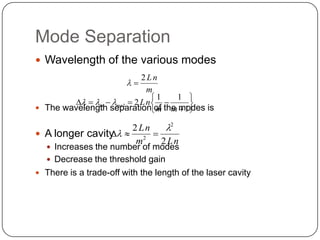
Mode Separation
 Wavelength of the various modes
                           2Ln
                        
                             m
                               1  1 
          m  m1  2 L n       
                                m m  1
 The wavelength separationof the modes is

                     2 Ln  2
 A longer cavity   2 
                
                      m   2 Ln
    Increases the number of modes
    Decrease the threshold gain
 There is a trade-off with the length of the laser cavity

Final ofc ppt

  • 1.
    FACULTY DEVELOPMENT PROGRAMME TODAYS TOPIC OPTICAL FIBER COMMUNICATION BY Mr.Rajkumar D Bhure Assoc.Prof.,ECE Dept. JBIET
  • 2.
    DEPT OF ELECTRONICS& COMMUNICATION ENGINEERING,JBIET Optical Fiber Communication By:- Mr. Rajkumar D Bhure Assoc.Prof. ECE Dept.
  • 3.
  • 4.
  • 5.
    Fiber vs. Copper Optical fiber transmits light pulses  Can be used for analog or digital transmission  Voice, computer data, video, etc.  Copper wires (or other metals) can carry the same types of signals with electrical pulses
  • 6.
    Advantages of OFC over conventional Copper Wire Communication  Small Size and light Weight  Abundant Raw Material Availability  Higher Band Width Low Noise  Low transmission loss and high signal security  Highly Reliable and easy of maintainance  Fibers Are Electrically Isolation  Highly transparent at particularo Wave Length  No possiblityof ISI and echoes cross talketc.  Immunity to natural hazardous.
  • 7.
    Index of Refraction(n) When light enters a dense medium like glass or water, it slows down  The index of refraction (n) is the ratio of the speed of light in vacuum to the speed of light in the medium n=c/v  Water has n = 1.3  Light takes 30% longer to travel through it  Fiber optic glass has n = 1.5  Light takes 50% longer to travel through it
  • 8.
    Material Used  Basicmaterials are plastic and Sand(Sio2)  The Dopents used increase or decrease RI are:-  GeO2 and P2O5--- To increase RI  B2O3------ To Decrease RI
  • 9.
  • 10.
    Optical Fiber  Core  Glass or plastic with a higher index of refraction than the cladding  Carries the signal  Cladding  Glass or plastic with a lower index of refraction than the core  Buffer  Protects the fiber from damage and moisture  Jacket  Holds one or more fibers in a cable
  • 11.
    Plastic Optical Fiber Large core (1 mm) step-index multimode fiber  Easy to cut and work with, but high attenuation (1 dB / meter) makes it useless for long distances
  • 12.
    Singlemode Fiber  Singlemodefiber has a core diameter of 8 to 9 microns, which only allows one light path or mode  Images from arcelect.com (Link Ch 2a) Index of refraction
  • 13.
    Multimode Step-Index Fiber Multimode fiber has a core diameter of 50 or 62.5 microns (sometimes even larger)  Allows several light paths or modes  This causes modal dispersion – some modes take longer to pass through the fiber than others because they travel a longer distance  See animation at link Ch 2f Index of refraction
  • 14.
    Step-index Multimode  Largecore size, so source power can be efficiently coupled to the fiber  High attenuation (4-6 dB / km)  Low bandwidth (50 MHz-km)  Used in short, low-speed datalinks  Also useful in high-radiation environments, because it can be made with pure silica core
  • 15.
    Singlemode FIber  Bestfor high speeds and long distances  Used by telephone companies and CATV
  • 16.
    Multimode Graded-Index Fiber The index of refraction gradually changes across the core  Modes that travel further also move faster  This reduces modal dispersion so the bandwidth is greatly increased Index of refraction
  • 17.
    Step-index and Graded-index Step index multimode was developed first, but rare today because it has a low bandwidth (50 MHz-km)  It has been replaced by graded-index multimode with a bandwidth up to 2 GHz-km
  • 18.
  • 19.
    Total Internal Reflection SnellsLaw : n1 sin1  n2 sin2 Re flection Condition 1  3 When n1  n2 and as 1 increases eventually 2 goes to 90 deg rees and n n1 sinc  n2 or sinc  2 n1 c is called the Critical angle For 1  c there is no propagating refracted ray
  • 20.
    Light Ray confinement nSinθ0=n1Sinθ; SinΦ=n2/n1; NA= n1(2Δ)1/2 ; ΔT=L Δ n12/cn2
  • 21.
    Acceptance Angle The acceptanceangle (i) is the largest incident angle ray that can be coupled into a guided ray within the fiber The Numerical Aperture (NA) is the sin(i) this is defined analogously to that for a lens 1 1 1 NA = (n12 - n2 2 2 ) = 2 2 (2D n ) = n(2D ) 2 n1 - n2 n + n2 Where D º and n º 1 f# º f = f n 2 D FullAccep tan ceAngle 1 = 2 ×NA
  • 22.
    Sources and Wavelengths Multimode fiber is used with  LED sources at wavelengths of 850 and 1300 nm for slower local area networks  Lasers at 850 and 1310 nm for networks running at gigabits per second or more
  • 23.
    Sources and Wavelengths Singlemode fiber is used with  Laser sources at 1300 and 1550 nm  Bandwidth is extremely high, around 100 THz-km
  • 24.
    Fiber Optic Specifications Attenuation  Loss of signal, measured in dB  Dispersion  Blurring of a signal, affects bandwidth  Bandwidth  The number of bits per second that can be sent through a data link  Numerical Aperture  Measures the largest angle of light that can be accepted into the core
  • 25.
  • 26.
    Measuring Bandwidth  Thebandwidth-distance product in units of MHz×km shows how fast data can be sent through a cable  A common multimode fiber with bandwidth- distance product of 500 MHz×km could carry  A 500 MHz signal for 1 km, or  A 1000 MHz signal for 0.5 km  From Wikipedia
  • 27.
    Numerical Aperture  Ifthe core and cladding have almost the same index of refraction, the numerical aperture will be small  This means that light must be shooting right down the center of the fiber to stay in the core
  • 28.
  • 29.
    Three Methods  ModifiedChemical Vapor Deposition (MCVD)  Outside Vapor Deposition (OVD)  Vapor Axial Deposition (VAD)
  • 30.
    Modified Chemical VaporDeposition (MCVD)  A hollow, rotating glass tube is heated with a torch  Chemicals inside the tube precipitate to form soot  Rod is collapsed to crate a preform  Preform is stretched in a drawing tower to form a single fiber up to 10 km long
  • 31.
    Modified Chemical VaporDeposition (MCVD)
  • 32.
    Outside Vapor Deposition(OVD)  A mandrel is coated with a porous preform in a furnace  Then the mandrel is removed and the preform is collapsed in a process called sintering  Image from csrg.ch.pw.edu.pl
  • 33.
    Vapor Axial Deposition(VAD)  Preform is fabricated continuously  When the preform is long enough, it goes directly to the drawing tower  Image from csrg.ch.pw.edu.pl
  • 34.
    Drawing Apparatus  Thefiber is drawn from the preform and then coated with a protective coating
  • 35.
  • 36.
    Attenuation  Modern fibermaterial is very pure, but there is still some attenuation  The wavelengths used are chosen to avoid absorption bands  850 nm, 1300 nm, and 1550 nm  Plastic fiber uses 660 nm LEDs  Image from iec.org (Link Ch 2n)
  • 37.
    Optical Loss indB (decibels) Power In Power Out Data Link  If the data link is perfect, and loses no power  The loss is 0 dB  If the data link loses 50% of the power  The loss is 3 dB, or a change of – 3 dB  If the data link loses 90% of the power  The loss is 10 dB, or a change of – 10 dB  If the data link loses 99% of the power  The loss is 20 dB, or a change of – 20 dB dB = 10 log (Power Out / Power In)
  • 38.
    Absolute Power indBm  The power of a light is measured in milliwatts  For convenience, we use the dBm units, where -20 dBm = 0.01 milliwatt -10 dBm = 0.1 milliwatt 0 dBm = 1 milliwatt 10 dBm = 10 milliwatts 20 dBm = 100 milliwatts
  • 39.
    Three Types ofDispersion  Dispersion is the spreading out of a light pulse as it travels through the fiber  Three types:  Modal Dispersion  Chromatic Dispersion  Polarization Mode Dispersion (PMD)
  • 40.
    Modal Dispersion  ModalDispersion  Spreading of a pulse because different modes (paths) through the fiber take different times  Only happens in multimode fiber  Reduced, but not eliminated, with graded-index fiber
  • 41.
    Chromatic Dispersion  Differentwavelengths travel at different speeds through the fiber  This spreads a pulse in an effect named chromatic dispersion(group Delay) T=1/vg =1/L *dВ/dώ  Chromatic dispersion occurs in both singlemode and multimode fiber  Larger effect with LEDs than with lasers  A far smaller effect than modal dispersion
  • 42.
    Modal Distribution  Ingraded-index fiber, the off-axis modes go a longer distance than the axial mode, but they travel faster, compensating for dispersion  But because the off-axis modes travel further, they suffer more attenuation
  • 43.
    Equilibrium Modal Distribution A long fiber that has lost the high-order modes is said to have an equilibrium modal distribution  For testing fibers, devices that can be used to condition the modal distribution so that measurements will be accurate
  • 44.
    Mode Stripper  Anindex-matching substance is put on the outside of the fiber to remove light travelling through the cladding
  • 45.
    Mode Scrambler  Modescramblers mix light to excite every possible mode of transmission within the fiber  Used for accurate measurements of attenuation  Figure from fiber-optics.info (Link Ch 2o)
  • 46.
  • 47.
    Source Characteristics  ImportantParameters  Electrical-optical conversion efficiency  Optical power  Wavelength  Wavelength distribution (called linewidth)  Cost  Semiconductor lasers  Compact  Good electrical-optical conversion efficiency  Low voltages  Los cost
  • 48.
    Semiconductor Optoelectronics  Twoenergy bands  Conduction band (CB)  Valence band (VB)  Fundamental processes  Absorbed photon creates an electron-hole pair  Recombination of an electron and hole can emit a photon  Types of photon emission  Spontaneous emission  Random recombination of an electron-hole pair  Dominant emission for light emitting diodes (LED)  Stimulated emission  A photon excites another electron and hole to recombine  Emitted photon has similar wavelength, direction, and phase  Dominant emission for laser diodes
  • 49.
    Basic Light EmissionProcesses  Pumping (creating more electron-hole pairs)  Electrically create electron-hole pairs  Optically create electron-hole pairs  Emission (recombination of electron-hole pairs)  Spontaneous emission  Simulated emission
  • 50.
    Semiconductor Material  Semiconductorcrystal is required  Type IV elements on Periodic Table  Silicon  Germanium  Combination of III-V materials  GaAs  InP  AlAs  GaP  InAs …
  • 51.
    Direct and IndirectMaterials  Relationship between energy and momentum for electrons and holes  Depends on the material  Electrons in the CB combine with holes in the VB  Photons have no momentum  Photon emission requires no momentum change  CB minimum needs to be directly over the VB maximum  Direct band gap transition required  Only specific materials have a direct bandgap
  • 52.
    Light Emission  Theemission wavelength depends on the energy band gap Eg  E2  E1 ch 1.24   Eg E  Semiconductor compounds ghave different  Energy band gaps  Atomic spacing (called lattice constants)  Combine semiconductor compounds  Adjust the bandgap  Lattice constants (atomic spacing) must be matched  Compound must be matched to a substrate  Usually GaAs or InP
  • 53.
    Common Semiconductor Compounds  GaAsand AlAs have the same lattice constants  These compounds are used to grow a ternary compound that is lattice matched to a GaAs substrate (Al1-xGaxAs)  0.87 <  < 0.63 (mm)  Quaternary compound GaxIn1-xAsyP1-y is lattice matched to InP if y=2.2x  1.0 <  < 1.65 (mm)  Optical telecommunication laser compounds  In0.72Ga0.28As0.62P0.38 (=1300nm)  In0.58Ga0.42As0.9P0.1 (=1550nm)
  • 54.
    Optical Sources  Twomain types of optical sources  Light emitting diode (LED)  Large wavelength content  Incoherent  Limited directionality  Laser diode (LD)  Small wavelength content  Highly coherent  Directional
  • 55.
    Avoiding losses in LED Carrier Photon confinement Confinement Band-gap and refractive index engineering. Heterostructured LED
  • 56.
    Double Heterojunction LED (important) Fiber Optics Epoxy  Double Metal contact heterostructure n AlGaAs p GaAs (active region)  Burrus type p Al GaAs LED n+ GaAs Metal contact  Shown bonded to a fiber with index- matching epoxy.
  • 57.
    Double Heterostructure  Thedouble heterostructure is invariably used for optical sources for communication as seen in the figure in the pervious slide.  Heterostucture can be used to increase:  Efficiency by carrier confinement (band gap engineering)  Efficiency by photon confinement (refractive index)  The double heterostructure enables the source radiation to be much better defined, but further, the optical power generated per unit volume is much greater as well. If the central layer of a double heterostructure, the narrow band-gap region is made no more than 1mm wide.
  • 58.
    Photon confinement - Reabsorption problem Source of electrons Active region (micron in thickness) Source of holes Active region (thin layer of GaAs) has smaller band gap, energy of photons emitted is smaller then the band gap of the P and N-GaAlAs hence could not be reabsorbed.
  • 59.
    Carrier confinement electrons holes n+-AlGaAs p-GaAs p+-AlGaAs Simplified band diagram of the ‘sandwich’ top show carrier confinement
  • 60.
    Light Emitting Diodes(LED)  Spontaneous emission dominates  Random photon emission  Spatial implications of random emission  Broad far field emission pattern  Dome used to extract more of the light  Critical angle is between semiconductor and plastic  Angle between plastic and air is near normal  Spectral implications of random emission  Broad spectrum   1.452 kT p
  • 61.
    Laser Diode  Stimulatedemission dominates  Narrower spectrum  More directional  Requires high optical power density in the gain region  High photon flux attained by creating an optical cavity  Optical Feedback: Part of the optical power is reflected back into the cavity  End mirrors  Lasing requires net positive gain  Gain > Loss  Cavity gain  Depends on external pumping  Applying current to a semiconductor pn junction  Cavity loss  Material absorption  Scatter  End face reflectivity
  • 62.
    Laser Diode  Stimulatedemission dominates  Narrower spectrum  More directional  Requires high optical power density in the gain region  High photon flux attained by creating an optical cavity  Optical Feedback: Part of the optical power is reflected back into the cavity  End mirrors  Lasing requires net positive gain  Gain > Loss  Cavity gain  Depends on external pumping  Applying current to a semiconductor pn junction  Cavity loss  Material absorption  Scatter  End face reflectivity
  • 63.
    Optical Feedback  Easiestmethod: cleaved end faces  End faces must be parallel  Uses Fresnel reflection  n 1  2 R   n 1  For GaAs (n=3.6) R=0.32  Lasing condition requires the net cavity gain to be one R1 R2 expg  a  L  1  g: distributed medium gain  a: distributed loss  R1 and R2 are the end facet reflectivity's
  • 64.
    Phase Condition  Thewaves must add in phase as given by 2 L  z  2 m  Resulting in modes given by 2Ln  m  Where m is an integer and n is the refractive index of the cavity
  • 65.
  • 66.
    Longitudinal Modes  Theoptical cavity excites various longitudinal modes  Modes with gain above the cavity loss have the potential to lase  Gain distribution depends on the spontaneous emission band  Wavelength width of the individual longitudinal
  • 67.
    Mode Separation  Wavelengthof the various modes 2Ln  m 1 1    m  m1  2 L n    m m  1  The wavelength separationof the modes is 2 Ln 2  A longer cavity   2   m 2 Ln  Increases the number of modes  Decrease the threshold gain  There is a trade-off with the length of the laser cavity