


PORTFOLIO
MANAGEMENT
Portfolio Evaluation and Revision
BY JIBUMON K G
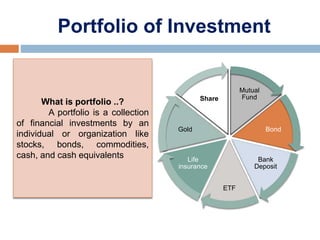
Portfolio of Investment
Mutual
Fund
Bond
Bank
Deposit
ETF
Life
insurance
Gold
Share
What is portfolio ..?
A portfolio is a collection
of financial investments by an
individual or organization like
stocks, bonds, commodities,
cash, and cash equivalents
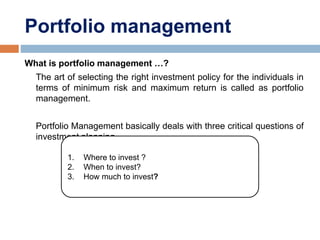
Portfolio management
What is portfolio management …?
The art of selecting the right investment policy for the individuals in
terms of minimum risk and maximum return is called as portfolio
management.
Portfolio Management basically deals with three critical questions of
investment planning.
1. Where to invest ?
2. When to invest?
3. How much to invest?
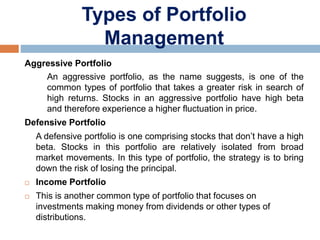
Types of Portfolio
Management
Aggressive Portfolio
An aggressive portfolio, as the name suggests, is one of the
common types of portfolio that takes a greater risk in search of
high returns. Stocks in an aggressive portfolio have high beta
and therefore experience a higher fluctuation in price.
Defensive Portfolio
A defensive portfolio is one comprising stocks that don’t have a high
beta. Stocks in this portfolio are relatively isolated from broad
market movements. In this type of portfolio, the strategy is to bring
down the risk of losing the principal.
 Income Portfolio
 This is another common type of portfolio that focuses on
investments making money from dividends or other types of
distributions.
Hybrid Portfolio
It is combined form of active and passive portfolio. Mixing stocks
and bonds in a fixed proportion, a hybrid portfolio offers
diversification across several asset classes.
Factors Considering
Portfolio
Diversity
When you invest in the stock market, a good approach is to spread
your investments across various market categories. Diversity helps
to minimize risk.
Minimize investment costs
When your are regularly buy or sell securities you may bear
transaction cost and commission to brokers and other
intermediaries. Therefore avoid unnecessary transfer of securities
Regular investment
In order to strengthen your portfolio, it is important to invest regularly.
Follow-up buying
When you are investing in a new stock, you may not know how it is
going to perform. So to be on the safe side, it is a good idea to
avoid committing your full position in one single investment.
Instead, try to invest through a follow-up strategy.
Portfolio Analysis
 Portfolio analysis is the process of studying an investment portfolio
to see if it meets a given investor's needs, preferences, and
resources.
 It also measures how likely it is of meeting the goals and objectives
of a given investment mandate.
 This is done on a risk-adjusted basis, looking at factors such as how
the asset class performed in the past, as well as inflation.
Portfolio Construction &
Selection
 Portfolio Construction refers to a process of selecting the optimum
mix of securities such as stocks, bonds, mutual funds, and money
market instruments, for the purpose of achieving maximum returns
by making minimum risk or loss.
 Approaches of Portfolio Constructions
 Traditional Approach
 Modern Approach or Markowitz efficient frontier approach
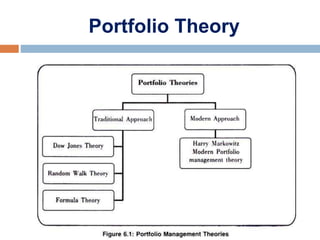
Portfolio Theory
Traditional Approach
In the traditional approach, investor’s needs in terms of
income and capital appreciation are evaluated and
appropriate securities are selected to meet the needs of
the investor.
The common practice in the traditional approach is to
evaluate the entire financial plan of the individual.
The traditional approach basically deals with two major decisions.
 Determining the objectives of the portfolio.
 Selection of securities to be included in the portfolio.
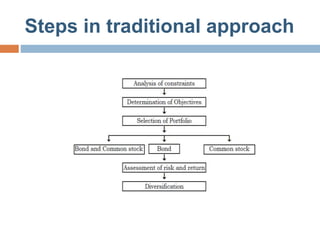
Steps in traditional approach
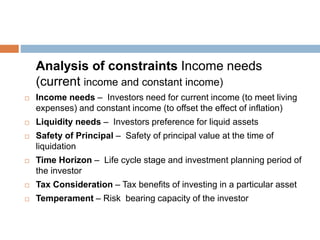
Analysis of constraints Income needs
(current income and constant income)
 Income needs – Investors need for current income (to meet living
expenses) and constant income (to offset the effect of inflation)
 Liquidity needs – Investors preference for liquid assets
 Safety of Principal – Safety of principal value at the time of
liquidation
 Time Horizon – Life cycle stage and investment planning period of
the investor
 Tax Consideration – Tax benefits of investing in a particular asset
 Temperament – Risk bearing capacity of the investor
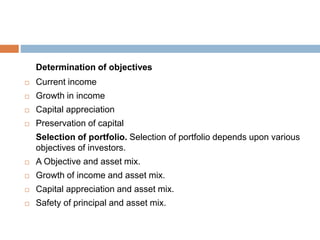
Determination of objectives
 Current income
 Growth in income
 Capital appreciation
 Preservation of capital
Selection of portfolio. Selection of portfolio depends upon various
objectives of investors.
 A Objective and asset mix.
 Growth of income and asset mix.
 Capital appreciation and asset mix.
 Safety of principal and asset mix.
Risk & Return Analysis:
It involves analysis of risk and returns involved in following a
particular course of action. Major risk categories that an investor
can tolerate are determined and efforts are made to minimize these
risks to get expected returns.
Diversification: It involves assigning relative portfolio weights to
different securities on the basis of which the portfolio is
diversified. Diversification is done on the basis of investors need of
income and his risk bearing capacity
Formula Plans
 It is a portfolio revision techniques or procedures have
been developed to enable investors to benefit from price
fluctuations in the market.
 It is a plan for buying stocks when prices are low and
selling them when prices are high.
 Formula plans are primarily oriented to achieve loss
minimization rather than return maximization.
Features of Formula plans
 The amount available for investment is predetermined
 The investor would construct two portfolios, one
aggressive (equities) and the other defensive (bonds,
debentures) with his investment funds.
 The ratio between the investments in the aggressive
portfolio and the defensive portfolio would be
predetermined such as 1:1 or 2:1.
 The portfolios are periodically monitored and adjusted
accordingly
Modern Portfolio Theory or Markowitz
Theory
The model was developed by Harry Markowitz in 1952
and he was later awarded a Nobel Prize for his work on
modern portfolio theory
It is a theoretical framework for analysis of risk and
return and their inter relationship
According to Markowitz identifying the portfolio which
give the highest return for a particular level of risk.
The model is also called mean-variance model because
it is based on expected returns (mean) and the
standard deviation (variance) of the various portfolios.
Markowitz Theory……..
He studied the effect of asset risk, return, correlation
and diversification on probable investment portfolio
returns.
Total risk of the portfolio can be reduced by
diversification this can be achieved by investing in
assets that have no correlation, or negative correlation.
Which means that assets or securities whose return are
not correlated and whose risk are mutually offsetting will
reduce the overall risk.
The covariance have negative interactive effect among
the securities with in the portfolio and coefficient of
correlation to have -1 so that the over all risk of the
portfolio is nill or negligible.
Assumptions
Investors are rational and behave in a manner as to
maximise their utility with a given level of income or
money.
Investors have free access to fair and correct
information on the returns and risk.
The markets are efficient and absorb the information
quickly and perfectly.
Investors are risk averse and try to minimise the risk and
maximise return.
Investors base decisions on expected returns and
variance or standard deviation of these returns from the
mean.
Investors choose higher returns to lower returns for a
given level of risk.
Limitations of Markowitz Theory
The portfolio returns are not normally distributed but are
heavily skewed on the tails.
The investors are irrational. They believe in risk taking,
expecting that higher the risk, higher the returns.
In reality, the investors in the market have limited access
to borrowing or lending of money at risk free rate.
Markowitch - Efficient frontier
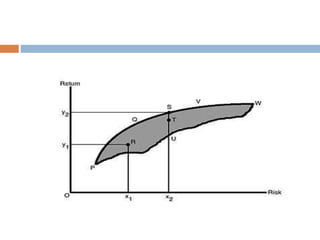
An efficient frontier is a set of investment portfolios that
are expected to provide the highest returns at a given
level of risk.
A portfolio is said to be efficient if there is no other
portfolio that offers higher returns for a lower or equal
amount of risk.
Where portfolios are located on the efficient frontier
depends on the investor’s degree of risk tolerance.
Efficient Frontier…………
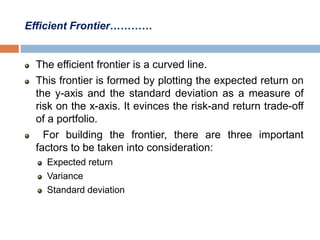
The efficient frontier is a curved line.
This frontier is formed by plotting the expected return on
the y-axis and the standard deviation as a measure of
risk on the x-axis. It evinces the risk-and return trade-off
of a portfolio.
For building the frontier, there are three important
factors to be taken into consideration:
Expected return
Variance
Standard deviation
Efficient Frontier……..
Efficient Frontier………..
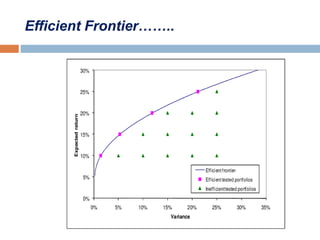
All portfolios that lie below the Efficient Frontier are not
good enough because the return would be lower for the
given risk.
Portfolios that lie to the right of the Efficient Frontier
would not be good enough, as there is higher risk for a
given rate of return.
All portfolios lying on the boundary of efficient frontier
are called Efficient Portfolios.
The Efficient Frontier is the same for all investors, as all
investors want maximum return with the lowest possible
risk and they are risk averse.
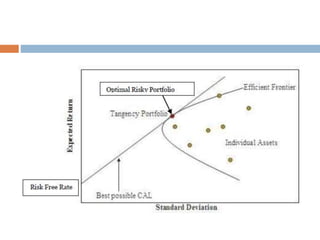
 The capital allocation line (CAL), also known as the
capital market link (CML), is a line created on a graph of
all possible combinations of risk-free and risky assets.
Single Index Model
The single-index model (SIM) is a simple asset pricing
model to measure both the risk and the return of a stock.
William Sharpe simplify the mathematical calculations of
Markowitch theory and develop a new model that is
single index model.
According to Sharp model the theory estimate , the
expected return and variance indices which may be one
or more are related to economic activity.
Sharp assumed that the return of a security is linearly
related to a single Index ( NIFTY, SENSEX) eg market
index.
The market index represent all securities traded in the
market
Single Index Model……..
In simple terms
The Sharpe ratio is an investment measurement that is
used to calculate the average return beyond the risk free
rate of return. Risk free return means returns from
government securities.
Assumptions of Single Index Model;
The security return are related to each other
The expected return and variance of the index are same
The return on individual security is determined by
unpredictable sources
Single Index Model……..
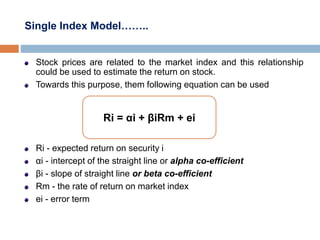
Stock prices are related to the market index and this relationship
could be used to estimate the return on stock.
Towards this purpose, them following equation can be used
Ri - expected return on security i
αi - intercept of the straight line or alpha co-efficient
βi - slope of straight line or beta co-efficient
Rm - the rate of return on market index
ei - error term
Ri = αi + βiRm + ei
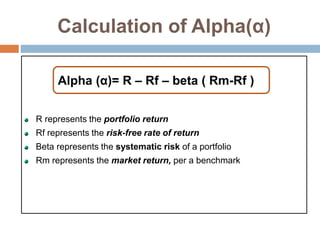
Calculation of Alpha(α)
R represents the portfolio return
Rf represents the risk-free rate of return
Beta represents the systematic risk of a portfolio
Rm represents the market return, per a benchmark
Alpha (α)= R – Rf – beta ( Rm-Rf )
Multi Index Model
 Multi-index models attempt to identify and incorporate these
nonmarket or extra-market factors that cause securities to
move together also into the model.
 These extra-market factors are a set of economic factors that
account for common movement in stock prices beyond that
accounted for by the market index itself.
 Fundamental economic variables such as inflation, real
economic growth, interest rates, exchange rates, etc. would
have a significant impact in determining security returns and
hence, their co-movement.
 A multi-index model augments the single index model by
incorporating these extra market factors as additional
independent variables.
 The model says that the return of an individual security is a
function of four factors – the general market factor Rm and
three extra-market factors R1, R2, R3.
 Multi-factor models also help explain the weight of the
different factors used in the models, indicating which factor
has more of an impact on the price of an asset.
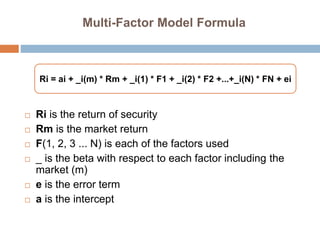
Multi-Factor Model Formula
 Ri is the return of security
 Rm is the market return
 F(1, 2, 3 ... N) is each of the factors used
 _ is the beta with respect to each factor including the
market (m)
 e is the error term
 a is the intercept
Ri = ai + _i(m) * Rm + _i(1) * F1 + _i(2) * F2 +...+_i(N) * FN + ei
Portfolio Performance Evaluation
 Portfolio performance measures are a key factor in the
investment decision.
 The portfolio performance evaluation can be made
based on the following methods.
1. Sharpe Ratio
2. Treynor Ratio
3. Jensen’s Alpha
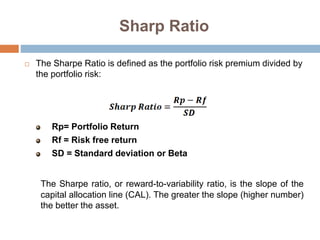
Sharp Ratio
 The Sharpe Ratio is defined as the portfolio risk premium divided by
the portfolio risk:
Rp= Portfolio Return
Rf = Risk free return
SD = Standard deviation or Beta
The Sharpe ratio, or reward-to-variability ratio, is the slope of the
capital allocation line (CAL). The greater the slope (higher number)
the better the asset.
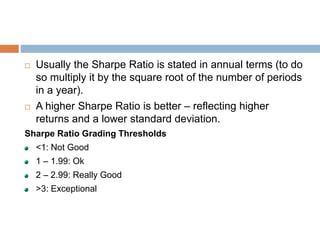
 Usually the Sharpe Ratio is stated in annual terms (to do
so multiply it by the square root of the number of periods
in a year).
 A higher Sharpe Ratio is better – reflecting higher
returns and a lower standard deviation.
Sharpe Ratio Grading Thresholds
<1: Not Good
1 – 1.99: Ok
2 – 2.99: Really Good
>3: Exceptional
Treynor Ratio
The Treynor's measure related a portfolio's excess
return to non-diversifiable or Systematic risk.
The Treynor ratio is an extension of the Sharpe ratio
that, instead of using total risk, uses beta or systematic
risk in the denominator.
As such, this is better suited to investors who hold
diversified portfolios.
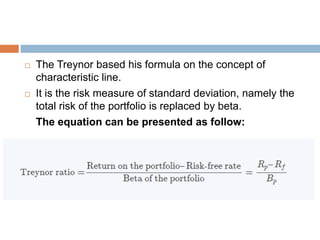
 The Treynor based his formula on the concept of
characteristic line.
 It is the risk measure of standard deviation, namely the
total risk of the portfolio is replaced by beta.
The equation can be presented as follow:
 Treynor ratio does not work for negative beta assets.
Also.
 Do not provide information on whether the portfolios are
better than the market portfolio.
 Do not information about the degree of superiority of a
higher ratio portfolio over a lower ratio portfolio.
 A higher Treynor Ratio is better.
 The Treynor Ratio does account for leverage.
Jensen’s Alpha Measure
 Jensen’s Alpha is based on systematic risk.
 The daily returns of the portfolio are regressed against
the daily returns of the market in order to compute a
measure of this systematic risk in the same manner as
the CAPM.
 The difference between the actual return of the portfolio
and the calculated or modeled risk-adjusted return is a
measure of performance relative to the market.
 Jensen’s Alpha is the expected return on the portfolio
adjusted for the return earned for taking market risk.
 In other words, it is the return on a portfolio is excess of
what the CAPM expects it to be:
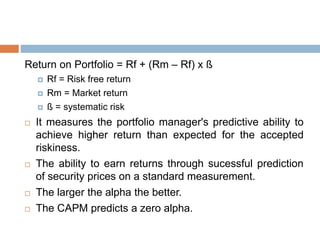
Return on Portfolio = Rf + (Rm – Rf) x ß
 Rf = Risk free return
 Rm = Market return
 ß = systematic risk
 It measures the portfolio manager's predictive ability to
achieve higher return than expected for the accepted
riskiness.
 The ability to earn returns through sucessful prediction
of security prices on a standard measurement.
 The larger the alpha the better.
 The CAPM predicts a zero alpha.
Which Measure Should I Use?
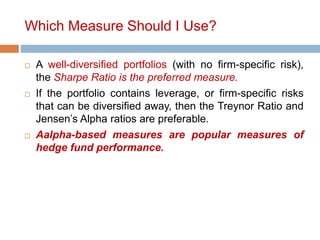
 A well-diversified portfolios (with no firm-specific risk),
the Sharpe Ratio is the preferred measure.
 If the portfolio contains leverage, or firm-specific risks
that can be diversified away, then the Treynor Ratio and
Jensen’s Alpha ratios are preferable.
 Aalpha-based measures are popular measures of
hedge fund performance.
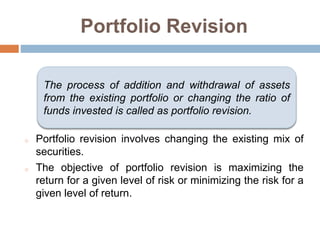
Portfolio Revision
o Portfolio revision involves changing the existing mix of
securities.
o The objective of portfolio revision is maximizing the
return for a given level of risk or minimizing the risk for a
given level of return.
The process of addition and withdrawal of assets
from the existing portfolio or changing the ratio of
funds invested is called as portfolio revision.
Portfolio Revision Strategies
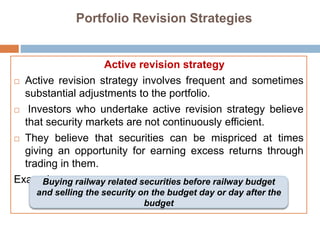
Active revision strategy
 Active revision strategy involves frequent and sometimes
substantial adjustments to the portfolio.
 Investors who undertake active revision strategy believe
that security markets are not continuously efficient.
 They believe that securities can be mispriced at times
giving an opportunity for earning excess returns through
trading in them.
Example
Buying railway related securities before railway budget
and selling the security on the budget day or day after the
budget
Passive revision strategy
 In passive portfolio revision, the primary aim is to keep
earning market returns by executing a buy-and-hold
strategy for the most part.
 The believers in passive portfolio revision subscribe to
Efficient Market Hypothesis which holds that financial
markets are efficient as all available information about a
security is available throughout the market and is priced
into the security.
 Portfolio changes in this strategy usually take place at a
pre-determined duration and a smaller number of
changes, the costs associated with this strategy are low.
There are rules associated with the portfolio revision
strategy, specifically that which is passive in approach,
which decides the changes that will need to be made to
a portfolio. These rules are known as formula plans.
Formula Plans
Formula Plans are certain predefined rules and
regulations deciding when and how much assets an
individual can purchase or sell for portfolio revision.
Securities can be purchased and sold only when there
are changes or fluctuations in the financial market.
Why formula plan?
1. Formula plans help an investor to make the best
possible use of fluctuations in the financial market.
2. Formula plans help an investor to make the best
possible use of fluctuations in the financial market.
There are three types of formula plans
1. Dollar or Rupee cost average Plan
2. Constant Ratio Plan
3. Variable Ratio Plan
Dollar or Rupee Cost Averaging
 The plan stipulates that the investor invest a constant sum, in
a specified share or portfolio of shares regularly at periodical
intervals.
 This periodic investment is to be continued over a fairly long
period to cover a complete cycle of share price movements.
 The investor will obtain his shares at a lower average cost
per share than the average price prevailing in the market over
the period.
 When a large portfolio has been built up over a complete
cycle of share price movements, the investor may switch over
to one of the other formula plans for its subsequent revision.
 The dollar cost averaging is specially suited to investors who
have periodic sums to invest.
Constant Ratio Plan
 The investor would construct two portfolios, one aggressive and the
other defensive with his investment funds.
 The ratio between the investments in aggressive portfolio and the
defensive portfolio would be predetermined such as 1:1 or 1.5:1 etc.
 The purpose of this plan is to keep this ratio constant by readjusting
the two portfolios when share prices fluctuate from time to time. For
this purpose, a revision point will also have to be predetermined.
Suppose the revision points may be fixed as +/- 0.10. This means
that when the ratio between the values of the aggressive portfolio
and the defensive portfolio moves up by 0.10 points or moves down
by 0.10 points, the portfolios would be adjusted by transfer of funds
from one to the other.
Variable Ratio Plan
 The variable ratio plan allows the ratio between the aggressive and
defensive portions of a portfolio to change either based on market
movement or on some pre-set factors.
 For instance, a variable ratio plan can allow for a higher ratio of the
aggressive portion vis-à-vis the conservative portion when equities
are doing well in order to benefit from the bull-run.
 The plan can also allow for a higher ratio in favor of the defensive
portion as an investor grows old and his life cycle demands a more
conservative approach to investments
Thank you

Portfolio Evaluation and Revision

  • 1.
  • 2.
    Portfolio of Investment Mutual Fund Bond Bank Deposit ETF Life insurance Gold Share Whatis portfolio ..? A portfolio is a collection of financial investments by an individual or organization like stocks, bonds, commodities, cash, and cash equivalents
  • 3.
    Portfolio management What isportfolio management …? The art of selecting the right investment policy for the individuals in terms of minimum risk and maximum return is called as portfolio management. Portfolio Management basically deals with three critical questions of investment planning. 1. Where to invest ? 2. When to invest? 3. How much to invest?
  • 4.
    Types of Portfolio Management AggressivePortfolio An aggressive portfolio, as the name suggests, is one of the common types of portfolio that takes a greater risk in search of high returns. Stocks in an aggressive portfolio have high beta and therefore experience a higher fluctuation in price. Defensive Portfolio A defensive portfolio is one comprising stocks that don’t have a high beta. Stocks in this portfolio are relatively isolated from broad market movements. In this type of portfolio, the strategy is to bring down the risk of losing the principal.  Income Portfolio  This is another common type of portfolio that focuses on investments making money from dividends or other types of distributions.
  • 5.
    Hybrid Portfolio It iscombined form of active and passive portfolio. Mixing stocks and bonds in a fixed proportion, a hybrid portfolio offers diversification across several asset classes.
  • 6.
  • 7.
    Diversity When you investin the stock market, a good approach is to spread your investments across various market categories. Diversity helps to minimize risk. Minimize investment costs When your are regularly buy or sell securities you may bear transaction cost and commission to brokers and other intermediaries. Therefore avoid unnecessary transfer of securities Regular investment In order to strengthen your portfolio, it is important to invest regularly. Follow-up buying When you are investing in a new stock, you may not know how it is going to perform. So to be on the safe side, it is a good idea to avoid committing your full position in one single investment. Instead, try to invest through a follow-up strategy.
  • 8.
    Portfolio Analysis  Portfolioanalysis is the process of studying an investment portfolio to see if it meets a given investor's needs, preferences, and resources.  It also measures how likely it is of meeting the goals and objectives of a given investment mandate.  This is done on a risk-adjusted basis, looking at factors such as how the asset class performed in the past, as well as inflation.
  • 9.
    Portfolio Construction & Selection Portfolio Construction refers to a process of selecting the optimum mix of securities such as stocks, bonds, mutual funds, and money market instruments, for the purpose of achieving maximum returns by making minimum risk or loss.  Approaches of Portfolio Constructions  Traditional Approach  Modern Approach or Markowitz efficient frontier approach
  • 10.
  • 11.
    Traditional Approach In thetraditional approach, investor’s needs in terms of income and capital appreciation are evaluated and appropriate securities are selected to meet the needs of the investor. The common practice in the traditional approach is to evaluate the entire financial plan of the individual. The traditional approach basically deals with two major decisions.  Determining the objectives of the portfolio.  Selection of securities to be included in the portfolio.
  • 12.
  • 13.
    Analysis of constraintsIncome needs (current income and constant income)  Income needs – Investors need for current income (to meet living expenses) and constant income (to offset the effect of inflation)  Liquidity needs – Investors preference for liquid assets  Safety of Principal – Safety of principal value at the time of liquidation  Time Horizon – Life cycle stage and investment planning period of the investor  Tax Consideration – Tax benefits of investing in a particular asset  Temperament – Risk bearing capacity of the investor
  • 14.
    Determination of objectives Current income  Growth in income  Capital appreciation  Preservation of capital Selection of portfolio. Selection of portfolio depends upon various objectives of investors.  A Objective and asset mix.  Growth of income and asset mix.  Capital appreciation and asset mix.  Safety of principal and asset mix.
  • 15.
    Risk & ReturnAnalysis: It involves analysis of risk and returns involved in following a particular course of action. Major risk categories that an investor can tolerate are determined and efforts are made to minimize these risks to get expected returns. Diversification: It involves assigning relative portfolio weights to different securities on the basis of which the portfolio is diversified. Diversification is done on the basis of investors need of income and his risk bearing capacity
  • 16.
    Formula Plans  Itis a portfolio revision techniques or procedures have been developed to enable investors to benefit from price fluctuations in the market.  It is a plan for buying stocks when prices are low and selling them when prices are high.  Formula plans are primarily oriented to achieve loss minimization rather than return maximization.
  • 17.
    Features of Formulaplans  The amount available for investment is predetermined  The investor would construct two portfolios, one aggressive (equities) and the other defensive (bonds, debentures) with his investment funds.  The ratio between the investments in the aggressive portfolio and the defensive portfolio would be predetermined such as 1:1 or 2:1.  The portfolios are periodically monitored and adjusted accordingly
  • 18.
    Modern Portfolio Theoryor Markowitz Theory The model was developed by Harry Markowitz in 1952 and he was later awarded a Nobel Prize for his work on modern portfolio theory It is a theoretical framework for analysis of risk and return and their inter relationship According to Markowitz identifying the portfolio which give the highest return for a particular level of risk. The model is also called mean-variance model because it is based on expected returns (mean) and the standard deviation (variance) of the various portfolios.
  • 19.
    Markowitz Theory…….. He studiedthe effect of asset risk, return, correlation and diversification on probable investment portfolio returns. Total risk of the portfolio can be reduced by diversification this can be achieved by investing in assets that have no correlation, or negative correlation. Which means that assets or securities whose return are not correlated and whose risk are mutually offsetting will reduce the overall risk. The covariance have negative interactive effect among the securities with in the portfolio and coefficient of correlation to have -1 so that the over all risk of the portfolio is nill or negligible.
  • 20.
    Assumptions Investors are rationaland behave in a manner as to maximise their utility with a given level of income or money. Investors have free access to fair and correct information on the returns and risk. The markets are efficient and absorb the information quickly and perfectly. Investors are risk averse and try to minimise the risk and maximise return. Investors base decisions on expected returns and variance or standard deviation of these returns from the mean. Investors choose higher returns to lower returns for a given level of risk.
  • 21.
    Limitations of MarkowitzTheory The portfolio returns are not normally distributed but are heavily skewed on the tails. The investors are irrational. They believe in risk taking, expecting that higher the risk, higher the returns. In reality, the investors in the market have limited access to borrowing or lending of money at risk free rate.
  • 22.
    Markowitch - Efficientfrontier An efficient frontier is a set of investment portfolios that are expected to provide the highest returns at a given level of risk. A portfolio is said to be efficient if there is no other portfolio that offers higher returns for a lower or equal amount of risk. Where portfolios are located on the efficient frontier depends on the investor’s degree of risk tolerance.
  • 23.
    Efficient Frontier………… The efficientfrontier is a curved line. This frontier is formed by plotting the expected return on the y-axis and the standard deviation as a measure of risk on the x-axis. It evinces the risk-and return trade-off of a portfolio. For building the frontier, there are three important factors to be taken into consideration: Expected return Variance Standard deviation
  • 24.
  • 27.
    Efficient Frontier……….. All portfoliosthat lie below the Efficient Frontier are not good enough because the return would be lower for the given risk. Portfolios that lie to the right of the Efficient Frontier would not be good enough, as there is higher risk for a given rate of return. All portfolios lying on the boundary of efficient frontier are called Efficient Portfolios. The Efficient Frontier is the same for all investors, as all investors want maximum return with the lowest possible risk and they are risk averse.
  • 28.
     The capitalallocation line (CAL), also known as the capital market link (CML), is a line created on a graph of all possible combinations of risk-free and risky assets.
  • 29.
    Single Index Model Thesingle-index model (SIM) is a simple asset pricing model to measure both the risk and the return of a stock. William Sharpe simplify the mathematical calculations of Markowitch theory and develop a new model that is single index model. According to Sharp model the theory estimate , the expected return and variance indices which may be one or more are related to economic activity. Sharp assumed that the return of a security is linearly related to a single Index ( NIFTY, SENSEX) eg market index. The market index represent all securities traded in the market
  • 30.
    Single Index Model…….. Insimple terms The Sharpe ratio is an investment measurement that is used to calculate the average return beyond the risk free rate of return. Risk free return means returns from government securities. Assumptions of Single Index Model; The security return are related to each other The expected return and variance of the index are same The return on individual security is determined by unpredictable sources
  • 31.
    Single Index Model…….. Stockprices are related to the market index and this relationship could be used to estimate the return on stock. Towards this purpose, them following equation can be used Ri - expected return on security i αi - intercept of the straight line or alpha co-efficient βi - slope of straight line or beta co-efficient Rm - the rate of return on market index ei - error term Ri = αi + βiRm + ei
  • 32.
    Calculation of Alpha(α) Rrepresents the portfolio return Rf represents the risk-free rate of return Beta represents the systematic risk of a portfolio Rm represents the market return, per a benchmark Alpha (α)= R – Rf – beta ( Rm-Rf )
  • 33.
    Multi Index Model Multi-index models attempt to identify and incorporate these nonmarket or extra-market factors that cause securities to move together also into the model.  These extra-market factors are a set of economic factors that account for common movement in stock prices beyond that accounted for by the market index itself.  Fundamental economic variables such as inflation, real economic growth, interest rates, exchange rates, etc. would have a significant impact in determining security returns and hence, their co-movement.
  • 34.
     A multi-indexmodel augments the single index model by incorporating these extra market factors as additional independent variables.  The model says that the return of an individual security is a function of four factors – the general market factor Rm and three extra-market factors R1, R2, R3.  Multi-factor models also help explain the weight of the different factors used in the models, indicating which factor has more of an impact on the price of an asset.
  • 35.
    Multi-Factor Model Formula Ri is the return of security  Rm is the market return  F(1, 2, 3 ... N) is each of the factors used  _ is the beta with respect to each factor including the market (m)  e is the error term  a is the intercept Ri = ai + _i(m) * Rm + _i(1) * F1 + _i(2) * F2 +...+_i(N) * FN + ei
  • 36.
    Portfolio Performance Evaluation Portfolio performance measures are a key factor in the investment decision.  The portfolio performance evaluation can be made based on the following methods. 1. Sharpe Ratio 2. Treynor Ratio 3. Jensen’s Alpha
  • 37.
    Sharp Ratio  TheSharpe Ratio is defined as the portfolio risk premium divided by the portfolio risk: Rp= Portfolio Return Rf = Risk free return SD = Standard deviation or Beta The Sharpe ratio, or reward-to-variability ratio, is the slope of the capital allocation line (CAL). The greater the slope (higher number) the better the asset.
  • 38.
     Usually theSharpe Ratio is stated in annual terms (to do so multiply it by the square root of the number of periods in a year).  A higher Sharpe Ratio is better – reflecting higher returns and a lower standard deviation. Sharpe Ratio Grading Thresholds <1: Not Good 1 – 1.99: Ok 2 – 2.99: Really Good >3: Exceptional
  • 39.
    Treynor Ratio The Treynor'smeasure related a portfolio's excess return to non-diversifiable or Systematic risk. The Treynor ratio is an extension of the Sharpe ratio that, instead of using total risk, uses beta or systematic risk in the denominator. As such, this is better suited to investors who hold diversified portfolios.
  • 40.
     The Treynorbased his formula on the concept of characteristic line.  It is the risk measure of standard deviation, namely the total risk of the portfolio is replaced by beta. The equation can be presented as follow:
  • 41.
     Treynor ratiodoes not work for negative beta assets. Also.  Do not provide information on whether the portfolios are better than the market portfolio.  Do not information about the degree of superiority of a higher ratio portfolio over a lower ratio portfolio.  A higher Treynor Ratio is better.  The Treynor Ratio does account for leverage.
  • 42.
    Jensen’s Alpha Measure Jensen’s Alpha is based on systematic risk.  The daily returns of the portfolio are regressed against the daily returns of the market in order to compute a measure of this systematic risk in the same manner as the CAPM.  The difference between the actual return of the portfolio and the calculated or modeled risk-adjusted return is a measure of performance relative to the market.  Jensen’s Alpha is the expected return on the portfolio adjusted for the return earned for taking market risk.  In other words, it is the return on a portfolio is excess of what the CAPM expects it to be:
  • 43.
    Return on Portfolio= Rf + (Rm – Rf) x ß  Rf = Risk free return  Rm = Market return  ß = systematic risk  It measures the portfolio manager's predictive ability to achieve higher return than expected for the accepted riskiness.  The ability to earn returns through sucessful prediction of security prices on a standard measurement.  The larger the alpha the better.  The CAPM predicts a zero alpha.
  • 44.
    Which Measure ShouldI Use?  A well-diversified portfolios (with no firm-specific risk), the Sharpe Ratio is the preferred measure.  If the portfolio contains leverage, or firm-specific risks that can be diversified away, then the Treynor Ratio and Jensen’s Alpha ratios are preferable.  Aalpha-based measures are popular measures of hedge fund performance.
  • 45.
    Portfolio Revision o Portfoliorevision involves changing the existing mix of securities. o The objective of portfolio revision is maximizing the return for a given level of risk or minimizing the risk for a given level of return. The process of addition and withdrawal of assets from the existing portfolio or changing the ratio of funds invested is called as portfolio revision.
  • 46.
    Portfolio Revision Strategies Activerevision strategy  Active revision strategy involves frequent and sometimes substantial adjustments to the portfolio.  Investors who undertake active revision strategy believe that security markets are not continuously efficient.  They believe that securities can be mispriced at times giving an opportunity for earning excess returns through trading in them. Example Buying railway related securities before railway budget and selling the security on the budget day or day after the budget
  • 47.
    Passive revision strategy In passive portfolio revision, the primary aim is to keep earning market returns by executing a buy-and-hold strategy for the most part.  The believers in passive portfolio revision subscribe to Efficient Market Hypothesis which holds that financial markets are efficient as all available information about a security is available throughout the market and is priced into the security.  Portfolio changes in this strategy usually take place at a pre-determined duration and a smaller number of changes, the costs associated with this strategy are low.
  • 48.
    There are rulesassociated with the portfolio revision strategy, specifically that which is passive in approach, which decides the changes that will need to be made to a portfolio. These rules are known as formula plans. Formula Plans Formula Plans are certain predefined rules and regulations deciding when and how much assets an individual can purchase or sell for portfolio revision. Securities can be purchased and sold only when there are changes or fluctuations in the financial market.
  • 49.
    Why formula plan? 1.Formula plans help an investor to make the best possible use of fluctuations in the financial market. 2. Formula plans help an investor to make the best possible use of fluctuations in the financial market. There are three types of formula plans 1. Dollar or Rupee cost average Plan 2. Constant Ratio Plan 3. Variable Ratio Plan
  • 50.
    Dollar or RupeeCost Averaging  The plan stipulates that the investor invest a constant sum, in a specified share or portfolio of shares regularly at periodical intervals.  This periodic investment is to be continued over a fairly long period to cover a complete cycle of share price movements.  The investor will obtain his shares at a lower average cost per share than the average price prevailing in the market over the period.  When a large portfolio has been built up over a complete cycle of share price movements, the investor may switch over to one of the other formula plans for its subsequent revision.  The dollar cost averaging is specially suited to investors who have periodic sums to invest.
  • 51.
    Constant Ratio Plan The investor would construct two portfolios, one aggressive and the other defensive with his investment funds.  The ratio between the investments in aggressive portfolio and the defensive portfolio would be predetermined such as 1:1 or 1.5:1 etc.  The purpose of this plan is to keep this ratio constant by readjusting the two portfolios when share prices fluctuate from time to time. For this purpose, a revision point will also have to be predetermined. Suppose the revision points may be fixed as +/- 0.10. This means that when the ratio between the values of the aggressive portfolio and the defensive portfolio moves up by 0.10 points or moves down by 0.10 points, the portfolios would be adjusted by transfer of funds from one to the other.
  • 52.
    Variable Ratio Plan The variable ratio plan allows the ratio between the aggressive and defensive portions of a portfolio to change either based on market movement or on some pre-set factors.  For instance, a variable ratio plan can allow for a higher ratio of the aggressive portion vis-à-vis the conservative portion when equities are doing well in order to benefit from the bull-run.  The plan can also allow for a higher ratio in favor of the defensive portion as an investor grows old and his life cycle demands a more conservative approach to investments
  • 53.