
Yen Carry TradeAmandeep Singh KalraCharuMishra					Harsh AdvaniManpreet SinghMayankAgrawal
JAPANESE ECONOMY Pre World War II period:  A rural agrarian society
Need for Industrialization
New Western-based education system for all young people.
The government also built railroads, improved roads, and inaugurated a land reform program.
A banking system was started with the establishment of the Bank of Japan and yen was introduced.World War :The war left the Japanese economy destroyed
World War II wiped out many of the gains Japan had made since 1868
About 40 percent of the nation's industrial plants and infrastructure were destroyed, and production reverted to levels of about fifteen years earlierPost War Period:Korean War boosted Japan's economy as Japan became the supplier of goods needed for war.
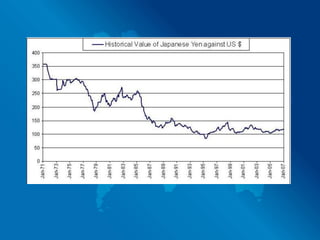
The yen was pegged at 1 USD = ¥360 in April 1949. It remained at this value for a period of 22 years until 1971
Payments from the U.S. government bolstered the Japanese economy, amounting to 27 percent of Japan’s total export trade1960’s BoomBetween 1953 and 1965:
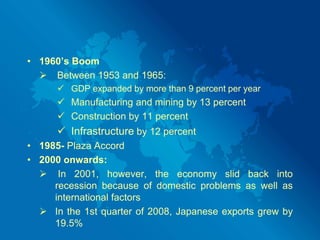
GDP expanded by more than 9 percent per year
Manufacturing and mining by 13 percent
Construction by 11 percent
Infrastructure by 12 percent1985- Plaza Accord2000 onwards: In 2001, however, the economy slid back into recession because of domestic problems as well as international factors
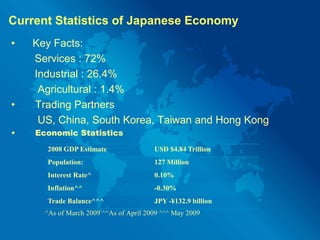
In the 1st quarter of 2008, Japanese exports grew by 19.5% Current Statistics of Japanese Economy      Key Facts:        Services : 72%       Industrial : 26.4%        Agricultural : 1.4%Trading Partners        US, China, South Korea, Taiwan and Hong KongEconomic Statistics                   ^As of March 2009 ^^As of April 2009 ^^^ May 2009
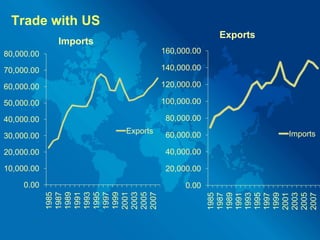
Trade with US
Introduction to Carry Trade	In general terms the carry of an asset is the positive return received from holding it. For example, the interest received from a term-deposit account.The term 'carry trade' refers specifically to interest rates and currencies , between countries.Carry trade is the name of the strategy of going short in a low-interest rate currency and simultaneously long in a high-interest rate currency Each country sets its own interest rate, theoretically based upon the money supply and inflation. 
Basics of Carry Trade	Funding CurrencyCurrency with low interest ratesTarget CurrencyCurrency with high rate interest (high yield asset)Carry to risk RatioIt adjusts the interest rate differential by the risk of future exchange rate movements, where this risk is proxied by the expected volatility (implied by foreign exchange options) of the relevant currency pair.
Implementation of Carry Tradeexchanging borrowed funds into the target currency in the spot marketderivative contracts, including foreign exchange futures, forwards and interest rate swaps. BondsProfit = I(f) – I (j) + E (1) – E (0)Participants:		Hedge Funds, pension funds, charitable endowments, investment banks, and wealthy individuals
CARRY TRADE“Low Volatility” required. 	Exchange rate stability, reduces Risk appetite of investors“Interest Rate Arbitrage” 	differential Interest rate“Bad news is actually good news for Yen”	More depreciation of Yen
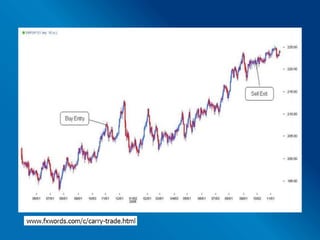
ExampleSuppose a carry trader is looking for differential profit between GBP/JPY.One lot size (=100000) is bought of GBP/JPYInterest rates :GBP-5%, JPY-.25%Interest profit :$4750 approx ( USD/JPY =90)( Buy/Sell 204.73/221.25)
Brief HistoryIn 1990-91 recession in US led to drop in interest rates.Search for yield led to Latin American and Asian investments.(Dollar carry trade)By mid 1990’s reversal happened in the US and also marked start of Yen carry trade.
What led to Yen Carry Trade?Excess Domestic reserves.    (Mrs. Watanabe aka $15 trillion)External Asset /Liability structure of Japanese banks.Japan “Premium”Due to structural weakness of Japanese Banks  BOJ easy monetary policy(ZIRP).
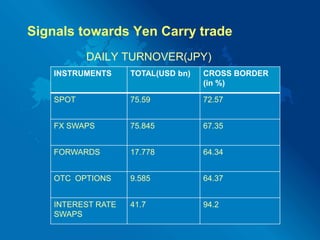
Signals towards Yen Carry trade                   DAILY TURNOVER(JPY)
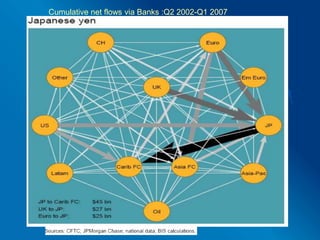
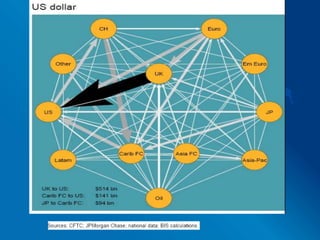
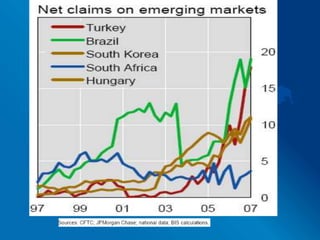
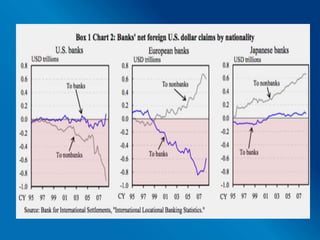
Where does the money go?North America, OECD Countries, Offshore centers(OFC’s), and Emerging Asia total 90% of this money.“Round Tripping Operation”		Moving money in different currencies and bringing it back to home Role of Caribbean OFC’s?		Hedge Fund established in Cayman Island
Cumulative net flows via Banks :Q2 2002-Q1 2007
           Hedge Fund StrategiesTrade on a basket on currencies.Build a portfolio on currencies such that loss in one can be made up by others.Complex Neural network based Algorithmic programming to time the entry/exit of trades.
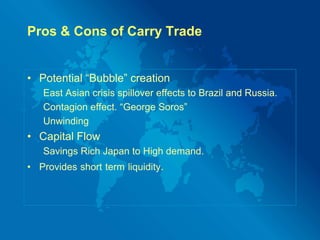
Pros & Cons of Carry TradePotential “Bubble” creation East Asian crisis spillover effects to Brazil and Russia.Contagion effect. “George Soros”UnwindingCapital Flow Savings Rich Japan to High demand.	Providesshorttermliquidity.
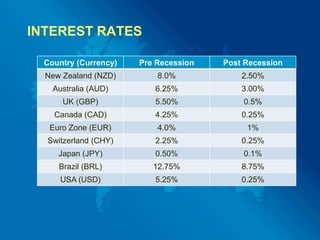
INTEREST RATES
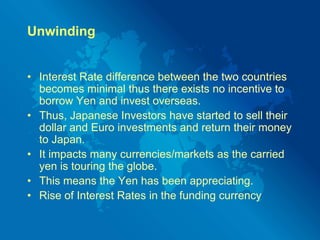
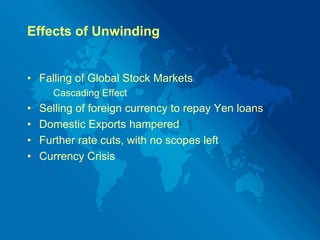
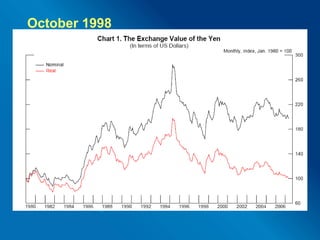
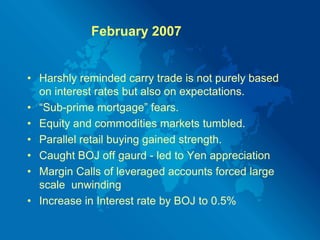
Unwinding Interest Rate difference between the two countries becomes minimal thus there exists no incentive to borrow Yen and invest overseas.Thus, Japanese Investors have started to sell their dollar and Euro investments and return their money to Japan.It impacts many currencies/markets as the carried yen is touring the globe. This means the Yen has been appreciating.Rise of Interest Rates in the funding currency
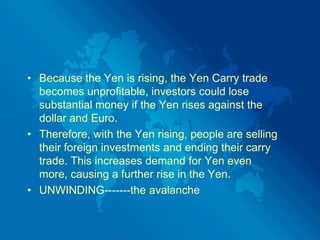
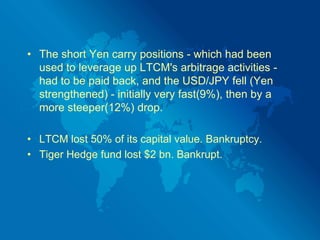
Because the Yen is rising, the Yen Carry trade becomes unprofitable, investors could lose substantial money if the Yen rises against the dollar and Euro. Therefore, with the Yen rising, people are selling their foreign investments and ending their carry trade. This increases demand for Yen even more, causing a further rise in the Yen.UNWINDING-------the avalanche

Yen Carry Trade

  • 1.
    Yen Carry TradeAmandeepSingh KalraCharuMishra Harsh AdvaniManpreet SinghMayankAgrawal
  • 2.
    JAPANESE ECONOMY PreWorld War II period: A rural agrarian society
  • 3.
  • 4.
    New Western-based educationsystem for all young people.
  • 5.
    The government alsobuilt railroads, improved roads, and inaugurated a land reform program.
  • 6.
    A banking systemwas started with the establishment of the Bank of Japan and yen was introduced.World War :The war left the Japanese economy destroyed
  • 7.
    World War IIwiped out many of the gains Japan had made since 1868
  • 8.
    About 40 percentof the nation's industrial plants and infrastructure were destroyed, and production reverted to levels of about fifteen years earlierPost War Period:Korean War boosted Japan's economy as Japan became the supplier of goods needed for war.
  • 9.
    The yen waspegged at 1 USD = ¥360 in April 1949. It remained at this value for a period of 22 years until 1971
  • 10.
    Payments from theU.S. government bolstered the Japanese economy, amounting to 27 percent of Japan’s total export trade1960’s BoomBetween 1953 and 1965:
  • 11.
    GDP expanded bymore than 9 percent per year
  • 12.
  • 13.
  • 14.
    Infrastructure by 12percent1985- Plaza Accord2000 onwards: In 2001, however, the economy slid back into recession because of domestic problems as well as international factors
  • 15.
    In the 1stquarter of 2008, Japanese exports grew by 19.5% Current Statistics of Japanese Economy Key Facts: Services : 72% Industrial : 26.4% Agricultural : 1.4%Trading Partners US, China, South Korea, Taiwan and Hong KongEconomic Statistics ^As of March 2009 ^^As of April 2009 ^^^ May 2009
  • 17.
  • 18.
    Introduction to CarryTrade In general terms the carry of an asset is the positive return received from holding it. For example, the interest received from a term-deposit account.The term 'carry trade' refers specifically to interest rates and currencies , between countries.Carry trade is the name of the strategy of going short in a low-interest rate currency and simultaneously long in a high-interest rate currency Each country sets its own interest rate, theoretically based upon the money supply and inflation. 
  • 19.
    Basics of CarryTrade Funding CurrencyCurrency with low interest ratesTarget CurrencyCurrency with high rate interest (high yield asset)Carry to risk RatioIt adjusts the interest rate differential by the risk of future exchange rate movements, where this risk is proxied by the expected volatility (implied by foreign exchange options) of the relevant currency pair.
  • 20.
    Implementation of CarryTradeexchanging borrowed funds into the target currency in the spot marketderivative contracts, including foreign exchange futures, forwards and interest rate swaps. BondsProfit = I(f) – I (j) + E (1) – E (0)Participants: Hedge Funds, pension funds, charitable endowments, investment banks, and wealthy individuals
  • 21.
    CARRY TRADE“Low Volatility”required. Exchange rate stability, reduces Risk appetite of investors“Interest Rate Arbitrage” differential Interest rate“Bad news is actually good news for Yen” More depreciation of Yen
  • 22.
    ExampleSuppose a carrytrader is looking for differential profit between GBP/JPY.One lot size (=100000) is bought of GBP/JPYInterest rates :GBP-5%, JPY-.25%Interest profit :$4750 approx ( USD/JPY =90)( Buy/Sell 204.73/221.25)
  • 24.
    Brief HistoryIn 1990-91recession in US led to drop in interest rates.Search for yield led to Latin American and Asian investments.(Dollar carry trade)By mid 1990’s reversal happened in the US and also marked start of Yen carry trade.
  • 25.
    What led toYen Carry Trade?Excess Domestic reserves. (Mrs. Watanabe aka $15 trillion)External Asset /Liability structure of Japanese banks.Japan “Premium”Due to structural weakness of Japanese Banks BOJ easy monetary policy(ZIRP).
  • 26.
    Signals towards YenCarry trade DAILY TURNOVER(JPY)
  • 27.
    Where does themoney go?North America, OECD Countries, Offshore centers(OFC’s), and Emerging Asia total 90% of this money.“Round Tripping Operation” Moving money in different currencies and bringing it back to home Role of Caribbean OFC’s? Hedge Fund established in Cayman Island
  • 28.
    Cumulative net flowsvia Banks :Q2 2002-Q1 2007
  • 32.
    Hedge Fund StrategiesTrade on a basket on currencies.Build a portfolio on currencies such that loss in one can be made up by others.Complex Neural network based Algorithmic programming to time the entry/exit of trades.
  • 33.
    Pros & Consof Carry TradePotential “Bubble” creation East Asian crisis spillover effects to Brazil and Russia.Contagion effect. “George Soros”UnwindingCapital Flow Savings Rich Japan to High demand. Providesshorttermliquidity.
  • 34.
  • 35.
    Unwinding Interest Ratedifference between the two countries becomes minimal thus there exists no incentive to borrow Yen and invest overseas.Thus, Japanese Investors have started to sell their dollar and Euro investments and return their money to Japan.It impacts many currencies/markets as the carried yen is touring the globe. This means the Yen has been appreciating.Rise of Interest Rates in the funding currency
  • 36.
    Because the Yenis rising, the Yen Carry trade becomes unprofitable, investors could lose substantial money if the Yen rises against the dollar and Euro. Therefore, with the Yen rising, people are selling their foreign investments and ending their carry trade. This increases demand for Yen even more, causing a further rise in the Yen.UNWINDING-------the avalanche